 Скачать презентацию Policy Workshop SANOG V Dhaka Bangladesh 12
26a94f390d986125bba66208ff836e8d.ppt
- Количество слайдов: 83



Policy Workshop SANOG V Dhaka , Bangladesh 12 February, 2005
Overview • Introduction – Intro to APNIC • Policy development – Overview of the policy development process • Address management – Background – IPv 4 Lifetime – IPv 6 Tea break • Policy discussion – FAQ – Update on new policies – Discussion • Next steps – How to voice your opinion and participate in Internet policy making
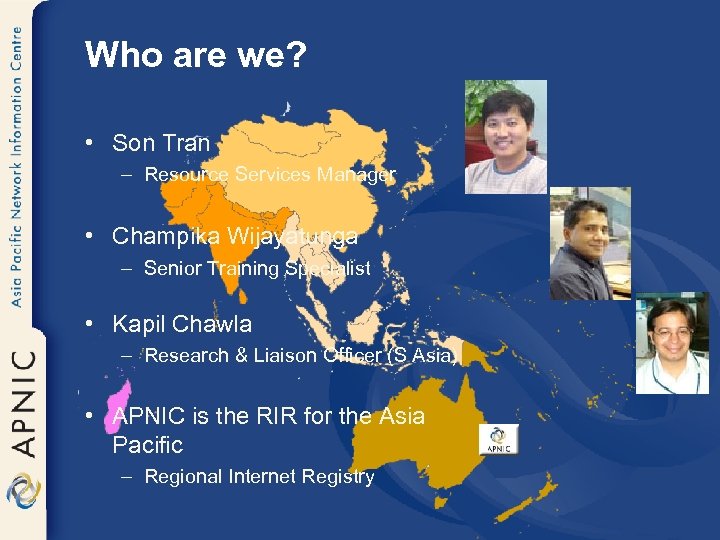
Who are we? • Son Tran – Resource Services Manager • Champika Wijayatunga – Senior Training Specialist • Kapil Chawla – Research & Liaison Officer (S Asia) • APNIC is the RIR for the Asia Pacific – Regional Internet Registry
Who are You? • Who are you? • Why are you here at SANOG? – Have you ever attended an APNIC training?
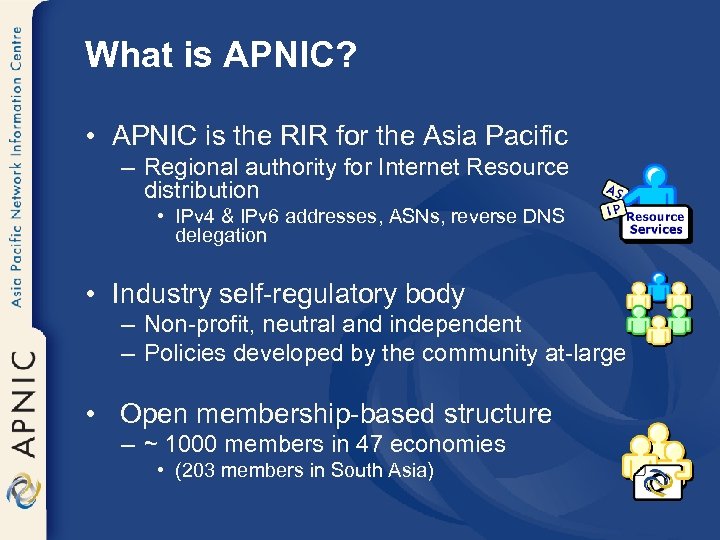
What is APNIC? • APNIC is the RIR for the Asia Pacific – Regional authority for Internet Resource distribution • IPv 4 & IPv 6 addresses, ASNs, reverse DNS delegation • Industry self-regulatory body – Non-profit, neutral and independent – Policies developed by the community at-large • Open membership-based structure – ~ 1000 members in 47 economies • (203 members in South Asia)
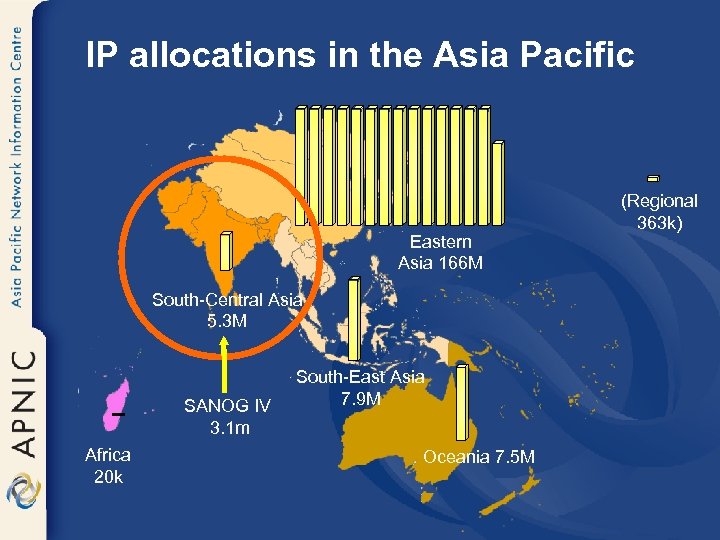
IP allocations in the Asia Pacific Eastern Asia 166 M South-Central Asia 5. 3 M SANOG IV 3. 1 m Africa 20 k South-East Asia 7. 9 M Oceania 7. 5 M (Regional 363 k)
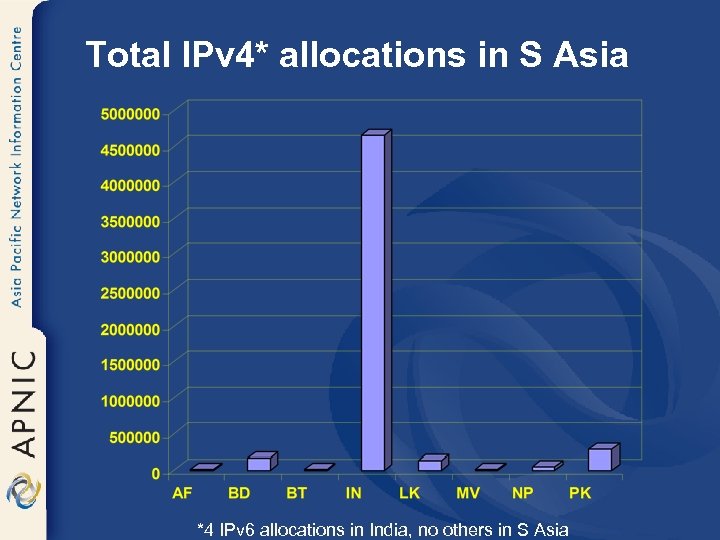
Total IPv 4* allocations in S Asia *4 IPv 6 allocations in India, no others in S Asia
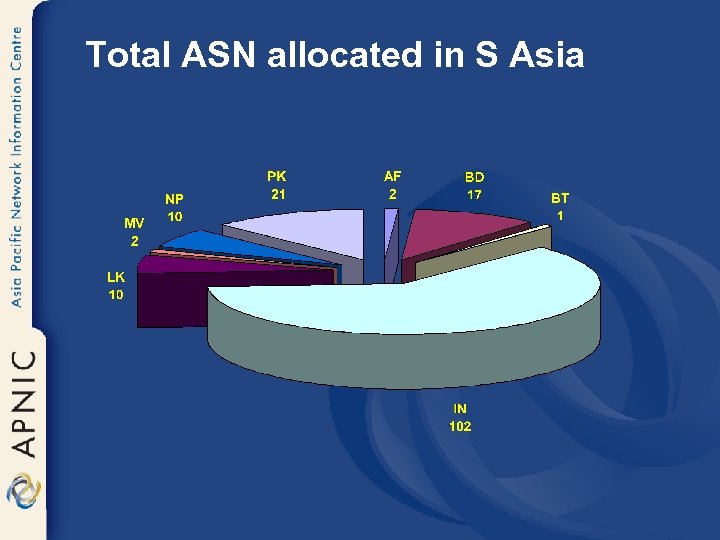
Total ASN allocated in S Asia
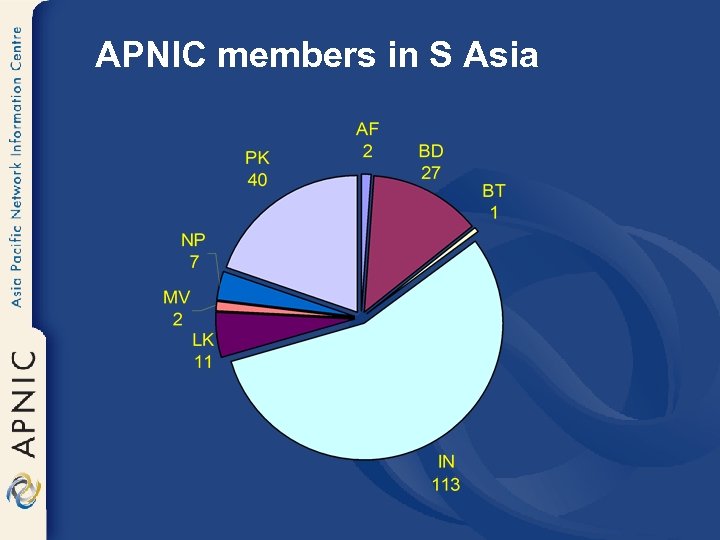
APNIC members in S Asia
Now some more questions to you… • What is your experience with Internet resources? – Are you a member of APNIC? • Have you participated in IP policy development before? • What do YOU see as the Internet resource issues for the SANOG community?
Questions ?
Policy Development in the Asia Pacific The APNIC Community & the Policy Development Process
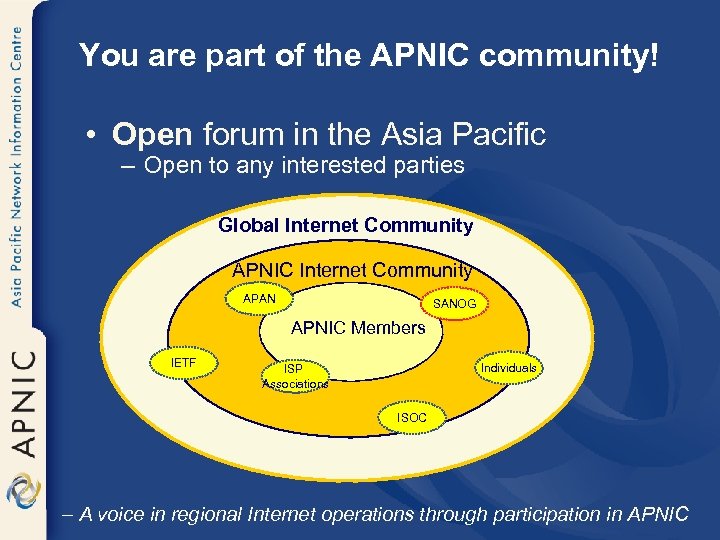
You are part of the APNIC community! • Open forum in the Asia Pacific – Open to any interested parties Global Internet Community APNIC Internet Community APAN SANOG APNIC Members IETF Individuals ISP Associations ISOC – A voice in regional Internet operations through participation in APNIC
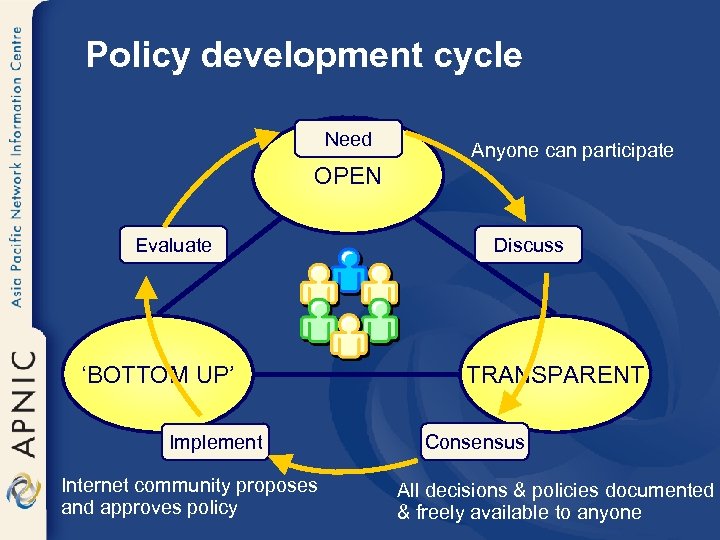
Policy development cycle Need Anyone can participate OPEN Evaluate ‘BOTTOM UP’ Implement Internet community proposes and approves policy Discuss TRANSPARENT Consensus All decisions & policies documented & freely available to anyone
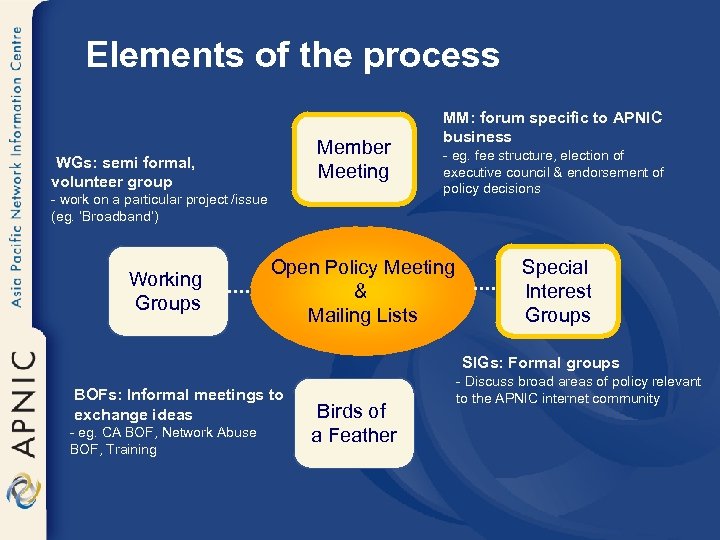
Elements of the process Member Meeting WGs: semi formal, volunteer group - work on a particular project /issue (eg. ‘Broadband’) Working Groups MM: forum specific to APNIC business - eg. fee structure, election of executive council & endorsement of policy decisions Open Policy Meeting & Mailing Lists Special Interest Groups SIGs: Formal groups BOFs: Informal meetings to exchange ideas - eg. CA BOF, Network Abuse BOF, Training Birds of a Feather - Discuss broad areas of policy relevant to the APNIC internet community
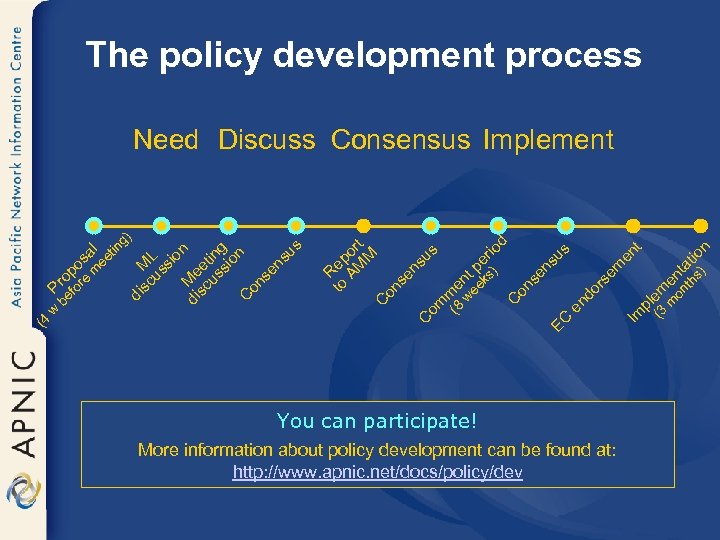
The policy development process R to ep A M or Mt C on se ns C us om (8 me w nt ee p ks er ) iod C on se ns EC us en do rs em en Im t pl (3 em m en on t th ati s) on (4 w P be ro fo po re s m al ee tin g di M ) sc L us si o M n di e sc et us in si g on C on se ns us Need Discuss Consensus Implement You can participate! More information about policy development can be found at: http: //www. apnic. net/docs/policy/dev
Why should I bother to participate? • Responsibility as an APNIC member – To be aware of the current policies for managing address space allocated to you • Business reasons – Policies affect your business operating environment and are constantly changing – Ensure your ‘needs’ are met – Money matters $$ $$$ • Educational – Learn and share experiences – Stay abreast with ‘best practices’ in the Internet
Questions ?
IP Address Management The development of the RIR System
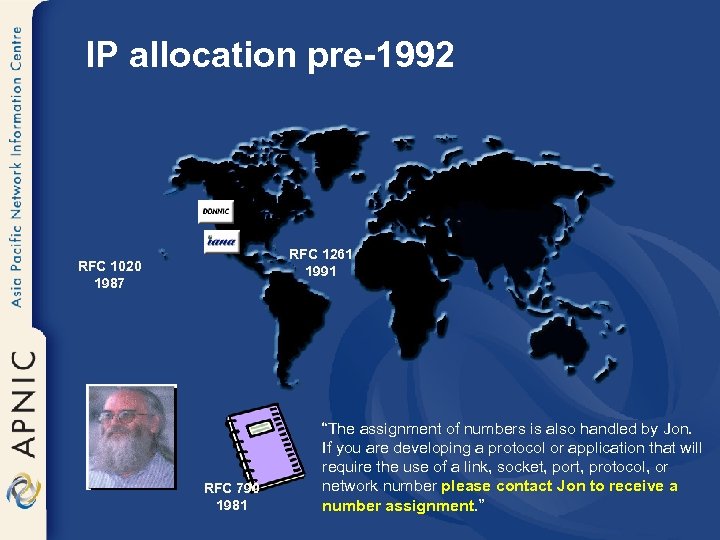
IP allocation pre-1992 RFC 1261 1991 RFC 1020 1987 RFC 790 1981 “The assignment of numbers is also handled by Jon. If you are developing a protocol or application that will require the use of a link, socket, port, protocol, or network number please contact Jon to receive a number assignment. ”
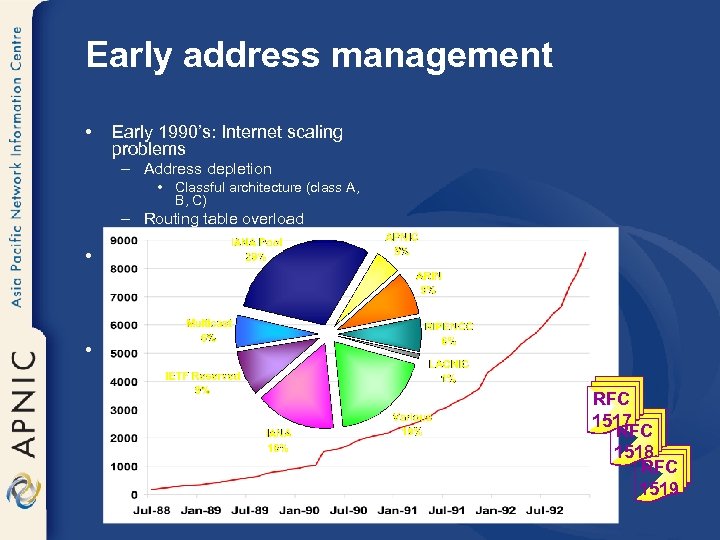
Early address management • Early 1990’s: Internet scaling problems – Address depletion • Classful architecture (class A, B, C) – Routing table overload • Internet widely projected to fail – Growth would stop by mid’ 90 s – Urgent measures required • 1993: “CIDR” – Addressed both technical problems: – Address depletion • More accurate assignment – Routing table overload • Address space aggregation RFC 1517 RFC 1518 RFC 1519
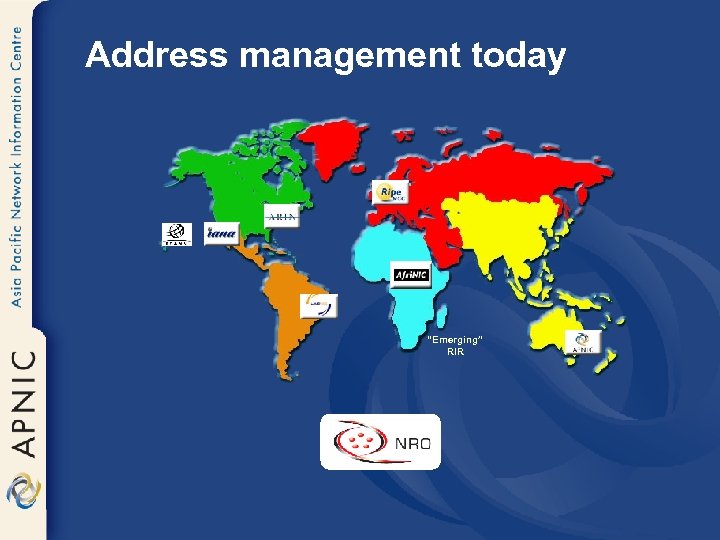
Address management today “Emerging” RIR
What are the main (IPv 4) address management objectives? • What did we learn from history?
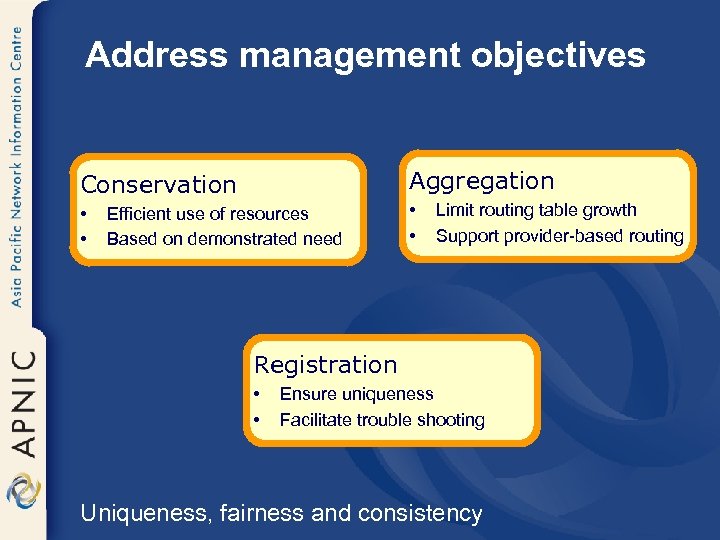
Address management objectives Conservation Aggregation • • Efficient use of resources Based on demonstrated need Limit routing table growth Support provider-based routing Registration • • Ensure uniqueness Facilitate trouble shooting Uniqueness, fairness and consistency
Questions ?
IPv 4 Lifetime Expectancy - Are we running out of IP addresses?
IPv 4 lifetime • How many of you have heard that we are running out of IPv 4? • How many think it’s true? – If not now, then when…?
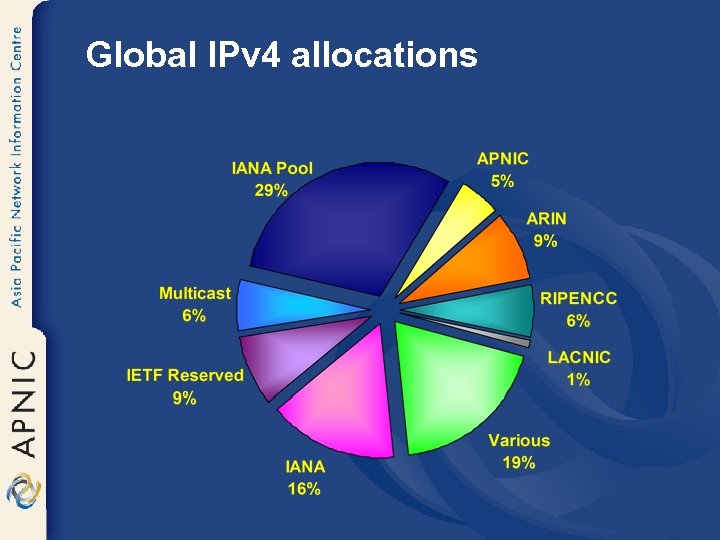
Global IPv 4 allocations
Are we running out of IP addresses? • Recent media reports claiming we are running out of IP addresses – Some claim we’ve already run out in some parts of the world • But what are the facts? – Is the IPv 4 sky falling? • Geoff Huston, chief scientist at APNIC, has studied the IPv 4 consumption rates
Conclusions of Huston’s study • Analysis of IPv 4 allocation rates and the BGP routing table – Address space predicted to last ~20 -40 years • Depending on the model adopted – Conclusions based on a model – reality will be different! • IPv 4 address space not yet exhausted – But impossible to predict future • Policies & market change, new technologies emerge • IPv 6 – Necessary to start now – transition will take time!

Full presentation of Geoff Huston’s study is available at the following URL http: //www. potaroo. net/ispcolumn/2003 -07 -v 4 -address-lifetime/ale. pdf Recommended Reading!
Questions ?
IPv 6
What’s IPv 6? • How many of you have heard about IPv 6? • What do you know about IPv 6? • How many of you have an IPv 6 allocation?
IPv 6 - Internet for everything!
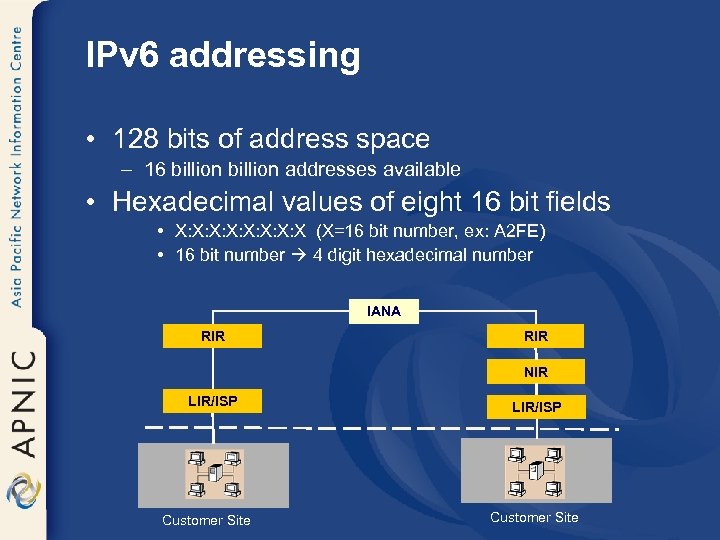
IPv 6 addressing • 128 bits of address space – 16 billion addresses available • Hexadecimal values of eight 16 bit fields • X: X: X (X=16 bit number, ex: A 2 FE) • 16 bit number 4 digit hexadecimal number IANA RIR NIR LIR/ISP Customer Site
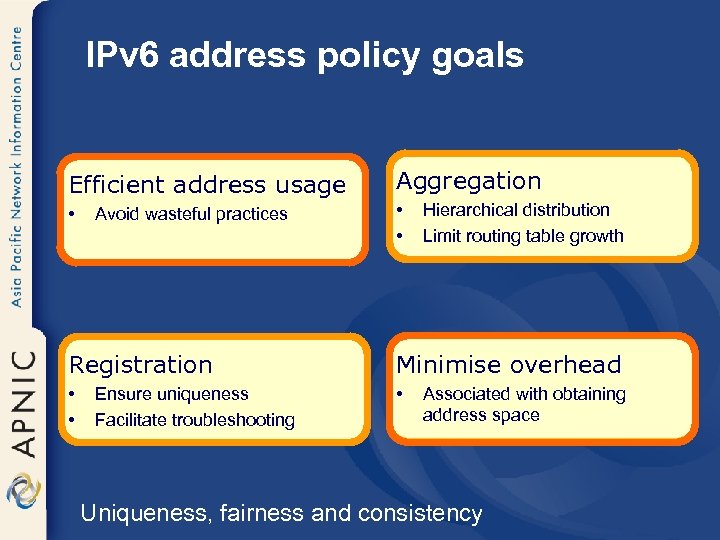
IPv 6 address policy goals Efficient address usage Aggregation • • • Avoid wasteful practices Hierarchical distribution Limit routing table growth Registration Minimise overhead • • • Ensure uniqueness Facilitate troubleshooting Associated with obtaining address space Uniqueness, fairness and consistency
What’s different and why? • What’s different in the IPv 6 goals? • Why are the IPv 6 goals different from those in IPv 4?
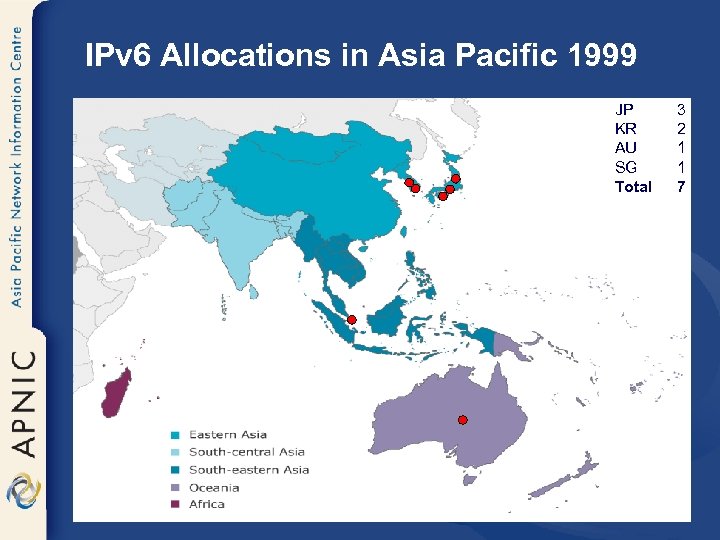
IPv 6 Allocations in Asia Pacific 1999 JP KR AU SG Total 3 2 1 1 7
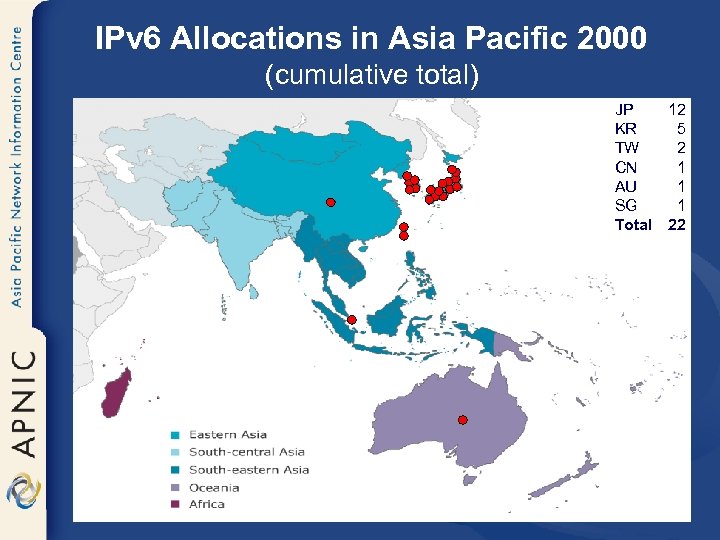
IPv 6 Allocations in Asia Pacific 2000 (cumulative total) JP 12 KR 5 TW 2 CN 1 AU 1 SG 1 Total 22
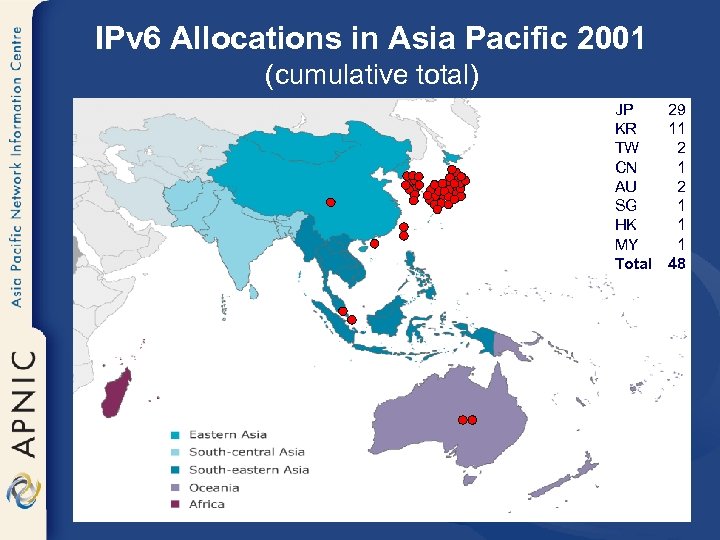
IPv 6 Allocations in Asia Pacific 2001 (cumulative total) JP 29 KR 11 TW 2 CN 1 AU 2 SG 1 HK 1 MY 1 Total 48
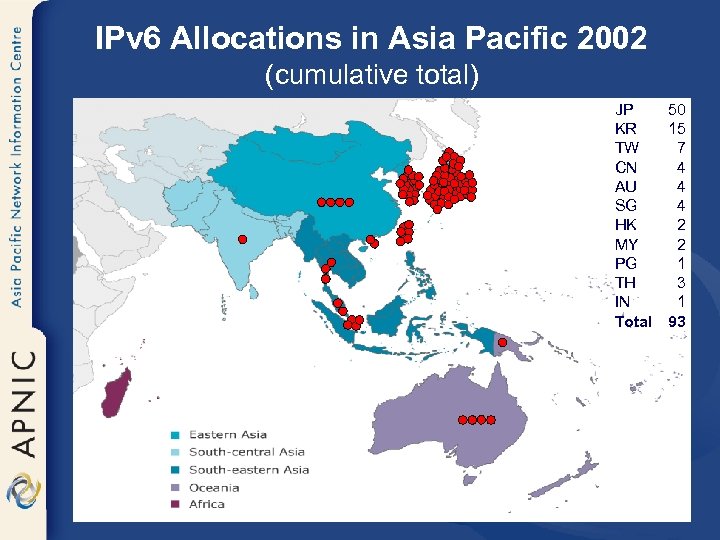
IPv 6 Allocations in Asia Pacific 2002 (cumulative total) JP 50 KR 15 TW 7 CN 4 AU 4 SG 4 HK 2 MY 2 PG 1 TH 3 IN 1 Total 93
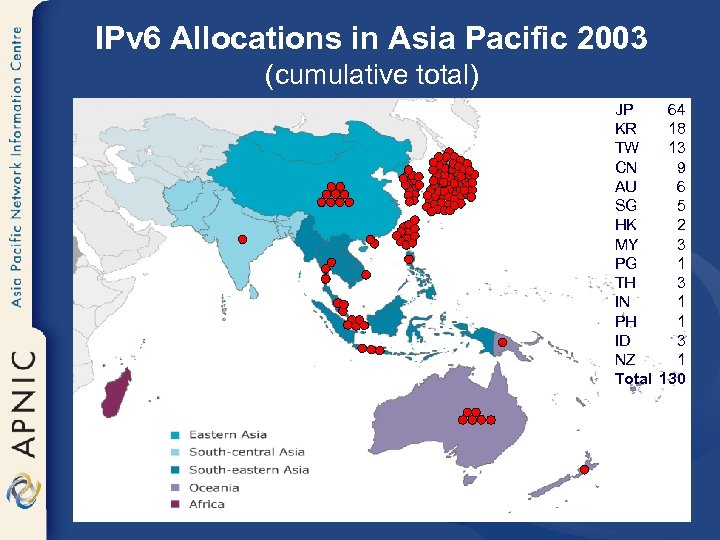
IPv 6 Allocations in Asia Pacific 2003 (cumulative total) JP KR TW CN AU SG HK MY PG TH IN PH ID NZ Total 64 18 13 9 6 5 2 3 1 130
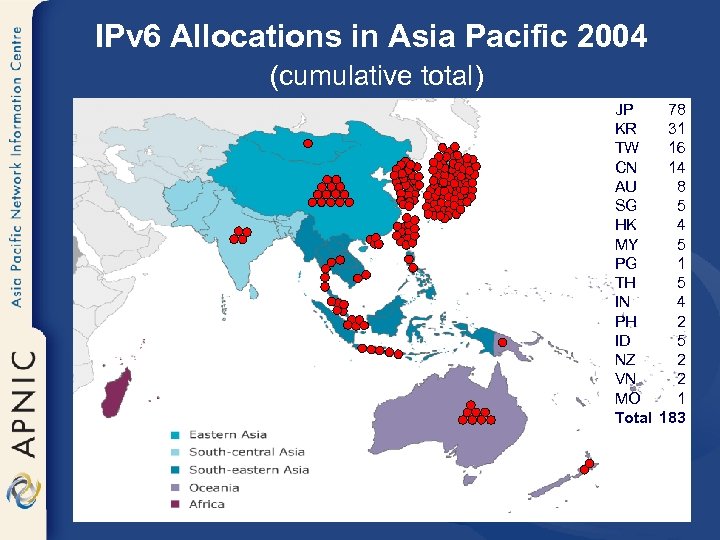
IPv 6 Allocations in Asia Pacific 2004 (cumulative total) JP KR TW CN AU SG HK MY PG TH IN PH ID NZ VN MO Total 78 31 16 14 8 5 4 5 1 5 4 2 5 2 2 1 183
Questions ?
Current address policy FAQ, Case studies & discussion
FAQ – Internet resources • Are IP addresses (like domains) allocated on a per country basis? – No, there’s nothing intrinsic in IP that binds it to a country-based distribution model • Can I buy IP addresses or AS numbers? – No, Internet resources cannot be bought or sold. It goes against the goals of responsible $$$ management
Your thoughts: Internet Resources • What would happen if Internet resources were sold and bought like any other commodity? • Is it a good thing for APNIC to recover unused (historical) address space?
FAQ – Providing IP addresses • Why should I give out IP addresses to my downstream ISPs and customers? – By assigning your customers IP addresses… • • You are building long-term relationships You are providing a more complete solution You are reducing the risk of losing your customers You are being a good Internet citizen – IP address distribution is part of your responsibility as an LIR – This is considered best current practice across the world
FAQ – Getting addresses • My upstream provider doesn’t want to give me IP addresses. What should I do? – Get another provider! – Approach APNIC • Contact <helpdesk@apnic. net> - we can talk to your provider • We can try to find another solution for you – If you meet the allocation criteria, you could become an APNIC member and receive an independent allocation
Some definitions. . a recap • What is the difference between an ‘assignment’ and an ‘allocation’? • What do we mean by ‘portable’ and ‘nonportable’ address space?
FAQ – IPv 4 • Do I have to become an APNIC member to get address space? – No, you can get a non-portable assignment or a sub-allocation from an upstream provider – Or you can get a portable assignment for multihoming • Are there criteria for getting an allocation? And what size do you get? – The minimum allocation size is a /21 (2048 addresses) – Yes, there are criteria, see next slide…
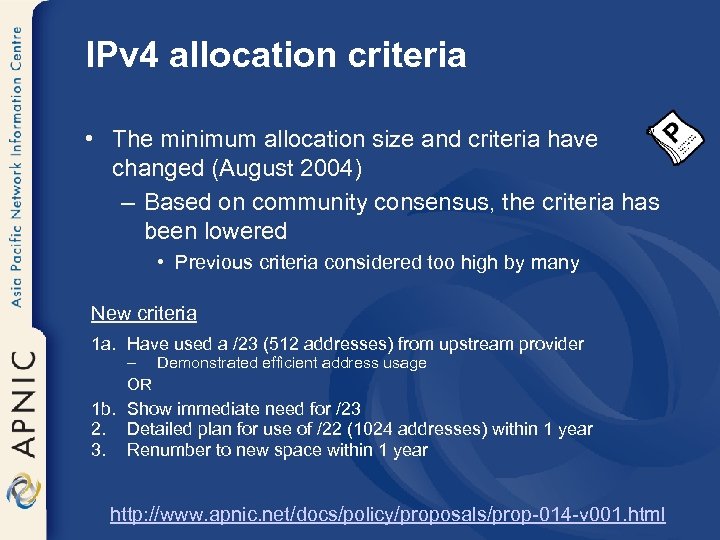
IPv 4 allocation criteria • The minimum allocation size and criteria have changed (August 2004) – Based on community consensus, the criteria has been lowered • Previous criteria considered too high by many New criteria 1 a. Have used a /23 (512 addresses) from upstream provider – Demonstrated efficient address usage OR 1 b. Show immediate need for /23 2. Detailed plan for use of /22 (1024 addresses) within 1 year 3. Renumber to new space within 1 year http: //www. apnic. net/docs/policy/proposals/prop-014 -v 001. html
Your thoughts: Minimum Allocation • Why is a minimum allocation necessary? Can’t people just get whatever they need? • What are the criteria for a minimum allocation?
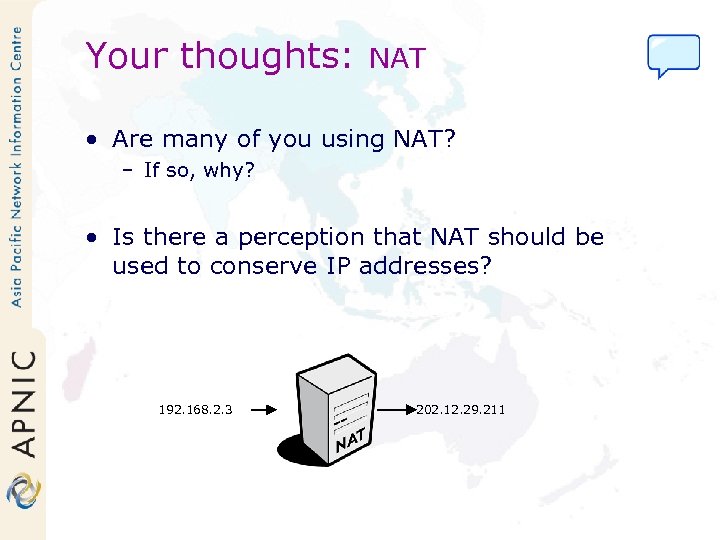
Your thoughts: NAT • Are many of you using NAT? – If so, why? • Is there a perception that NAT should be used to conserve IP addresses? 192. 168. 2. 3 202. 12. 29. 211
FAQ - NAT • Should we use NAT where possible in our networks to conserve IP addresses? – The use of NAT is entirely up to you. APNIC does NOT require you to use NAT to conserve IP addresses – NAT… • • Removes transparency Makes troubleshooting more difficult It creates a single point of failure It increases the complexity • If we are using NAT, can we get public addresses from APNIC if we wish to convert the network from private to public? – Yes! (Provided you meet the criteria for the minimum allocation)
Case study - NAT • We have only 16 public IP addresses, but we have 520 private addresses for our customers behind NAT. Can we include the private addresses in our request for an allocation from APNIC? – Yes, the private addresses should be included In this case, it represents a total of 536 addresses which meets the criterion of a /23 immediate/past need • (So if you can also show a need of a /22 within a year, you qualify for the minimum /21 allocation)
FAQ – IPv 6 • What are the criteria for getting an IPv 6 allocation? – You will need to show that you have a detailed & realistic technical plan to make at least 200 /48 customer assignments within two years – (You also need to be an LIR)
FAQ – IPv 6 • We just learned that criteria for getting an IPv 6 allocation. What if I can’t show a detailed plan to connect 200 customers? – The policy was made very flexible to encourage the deployment of IPv 6. You need to show a plan, just an intention (Don’t get restricted by 200 customers)
FAQ – IPv 6 • How many IPv 6 allocations have been made in South Asia? – Out of a total of 183 allocations in the region, 4 have been made in South Asia (all in India)
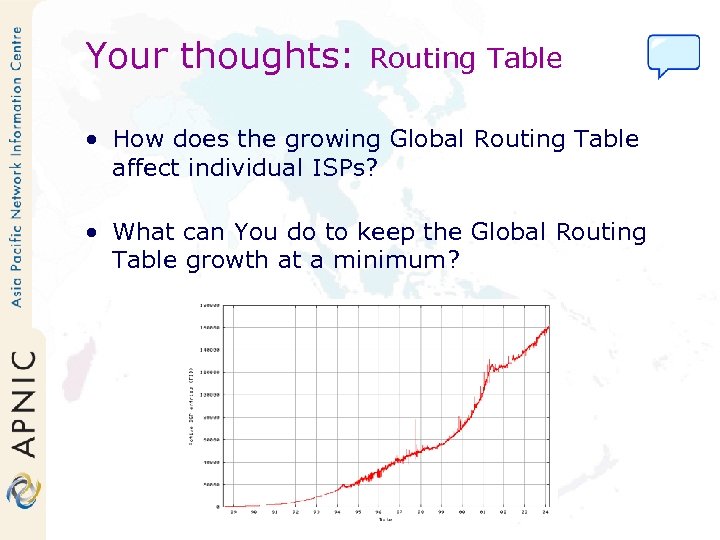
Your thoughts: Routing Table • How does the growing Global Routing Table affect individual ISPs? • What can You do to keep the Global Routing Table growth at a minimum?
FAQ – Policy development • So who decides on all these policies? – Policies are made by the Internet community through a open and transparent, bottom-up process. Anyone interested can participate! • So it’s not Son then? – Nope!
Your thoughts: Policy Development • As a member of the Internet community, do you believe that policies affect you? • What policies do you think should change? • What steps will you take to change policy? – What do YOU see as the barriers to participating?
Some more questions for you ? • How many of you configure your reverse DNS? • Do you know what ‘lame delegation’ is?
Lame delegations policy – new! • Objective of this new policy – To repair or remove persistently lame DNS delegations • DNS delegations are lame if – Some or all of the registered DNS nameservers are unreachable or badly configured
FAQ – Lame delegation policy • Why should I care about lame DNS? – Delays in service binding for clients using affected address ranges – Refusal of service due to failures during DNS processing – Increased DNS traffic – Lame DNS reverse delegations affect network users and third parties
FAQ – Lame delegation policy • I have just received an email from APNIC stating that my name-servers are lame Why did I receive this email? – You received this because you are listed as one of the contacts in the object • You may be an ‘admin-c’, ‘tech-c’ or ‘zone-c’ contact person
FAQ - Lame delegation policy • I have received an email from APNIC saying my reverse DNS is ‘lame’. What should I do? - Fix the Lameness - Correct the name server http: //www. apnic. net/info/faq/lame-del-faq. html#5
Privacy of WHOIS database assignments • How many of you know that database assignments are by default no longer visible in the APNIC whois database? • How many of you know why?
Motivation for customer privacy policy • Privacy issues – Concerns about publication of customer information – Increasing government concern • APNIC legal risk – Legal responsibility for accuracy and advice – Damages incurred by maintaining inaccurate personal data • Customer data is hard to maintain – APNIC has no direct control over accuracy of data
FAQ- Privacy of WHOIS database assignments • Where are my customer assignments? – When the privacy of customer assignment policy was implemented, all customer assignments were moved to a private WHOIS database – However you can still see your customer assignments through ‘My. APNIC’
FAQ- Privacy of WHOIS database assignments • How do I move the customer assignment from private database to public customer & vice-versa ? – Use My. APNIC!
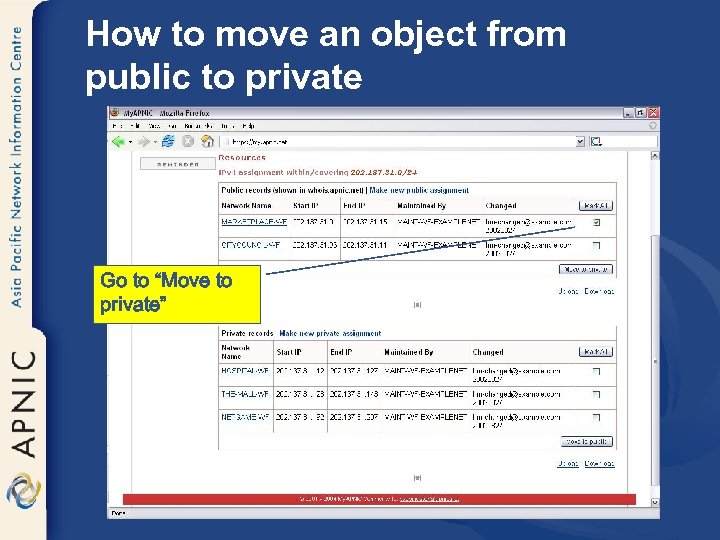
How to move an object from public to private Go to “Move to private”
Questions ?
Next steps
Internet resource issues in the SANOG community • Let’s review…
- Ok, so I have an opinion. How do I express it? 1 Contact APNIC staff / SIG chair 2 Participate on the mailing list 3 Participate in the meetings
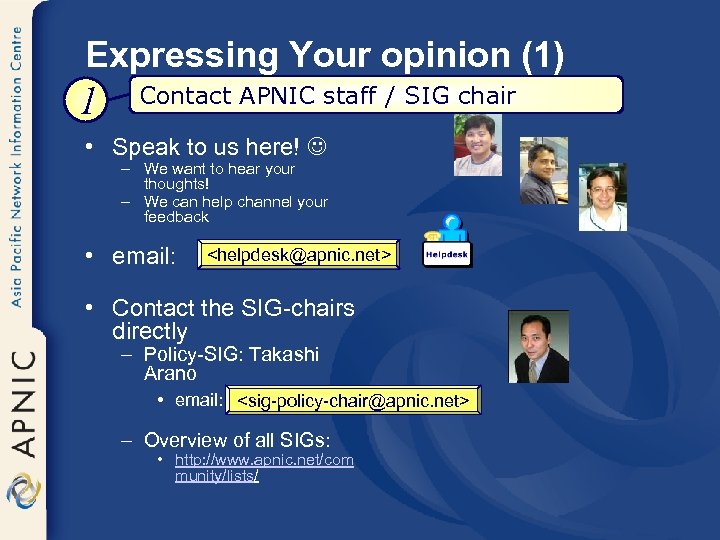
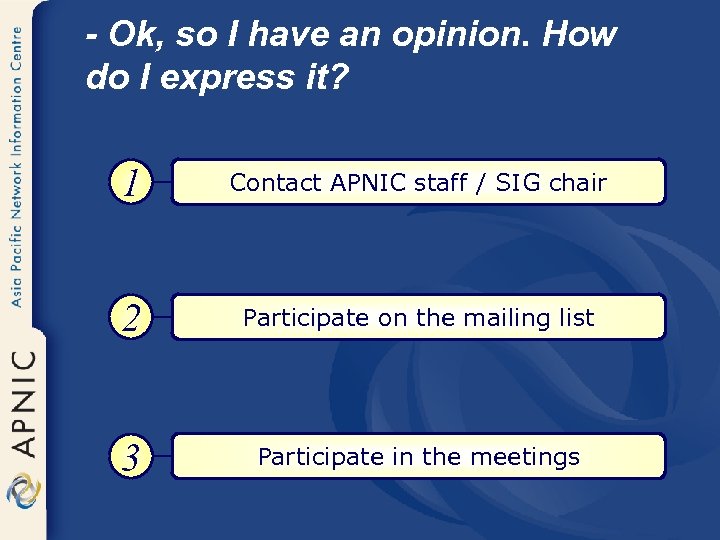
Expressing Your opinion (1) 1 Contact APNIC staff / SIG chair • Speak to us here! – We want to hear your thoughts! – We can help channel your feedback • email: <helpdesk@apnic. net> • Contact the SIG-chairs directly – Policy-SIG: Takashi Arano • email: <sig-policy-chair@apnic. net> – Overview of all SIGs: • http: //www. apnic. net/com munity/lists/
Expressing Your opinion (2) 2 Participate on the mailing list • Mailing Lists: – APNIC: http: //www. apnic. net/community/lists/ – Discuss on the SANOG mailing list! – Policy-sig: <sig-policy@apnic. net> • Read archives at: http: //www. apnic. net/mailing-lists/sig-policy/ • Send in a formal proposal • Put forward a suggestion, ask a question – Start a discussion! ! ! ?
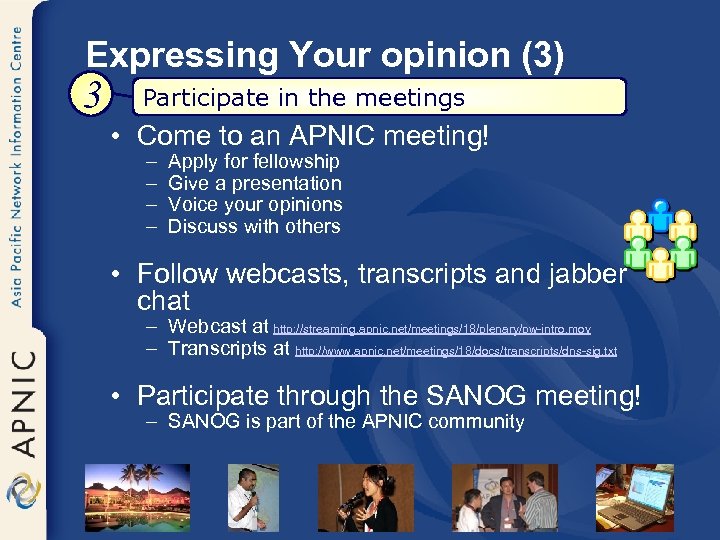
Expressing Your opinion (3) 3 Participate in the meetings • Come to an APNIC meeting! – – Apply for fellowship Give a presentation Voice your opinions Discuss with others • Follow webcasts, transcripts and jabber chat – Webcast at http: //streaming. apnic. net/meetings/18/plenary/pw-intro. mov – Transcripts at http: //www. apnic. net/meetings/18/docs/transcripts/dns-sig. txt • Participate through the SANOG meeting! – SANOG is part of the APNIC community
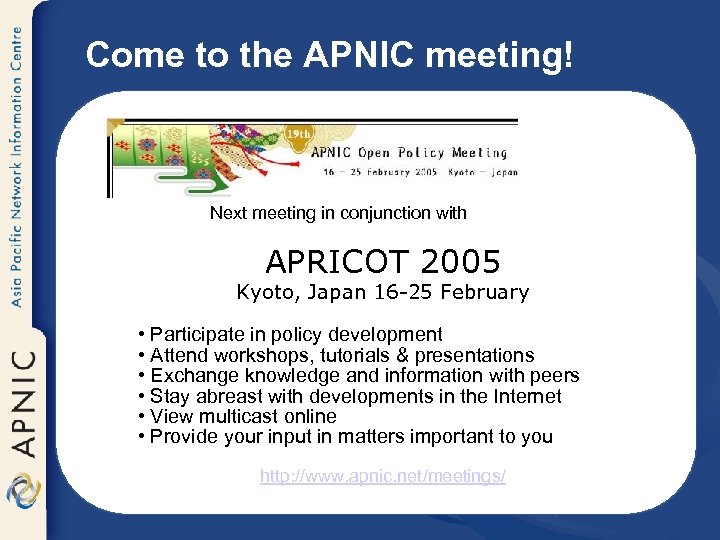
Come to the APNIC meeting! Next meeting in conjunction with APRICOT 2005 Kyoto, Japan 16 -25 February • Participate in policy development • Attend workshops, tutorials & presentations • Exchange knowledge and information with peers • Stay abreast with developments in the Internet • View multicast online • Provide your input in matters important to you http: //www. apnic. net/meetings/
Your steps • What steps will You be taking to participate in the APNIC community?
Thank You Don’t be a stranger… Material available at: www. apnic. net/training/recent/
Скачать презентацию Policy Workshop SANOG V Dhaka Bangladesh 12
26a94f390d986125bba66208ff836e8d.ppt