


 Скачать презентацию Policy Types and Tools Solutions Josh Farley
5550b8d73b0841bc73a3e2ad71ff783e.ppt
- Количество слайдов: 46
 Policy Types and Tools: Solutions Josh Farley
 What is a Policy? § Birkland: “a statement by government of what it intends to do or not to do, such as a law, regulation, ruling, decision, or order, or a combination of these. ” § Not one document, but collection of documents, statements, decisions, etc. § Output of government that shapes and is shaped by political conflict § Legislation implementation
 Policy Typologies § Many ways to classify. How we do so depends on what we want to understand. § We want to understand political process
 Lowi’s typologies in the news § § § Distributive Regulatory Redistributive
 Distributive § § § Highway bill (e. g. ‘bridge to nowhere’) Agriculture subsidies Pork, logrolling
 Regulatory § Competitive – FCC – FDA and cooperation § Protective – Clean air – “Healthy Forests”
 Redistributive § § § Food stamps Medicaid Tax cuts The banking system? Enclosure of the commons: – Mining law of 1872 – Grazing rights? – Oil rights? – ANWR?
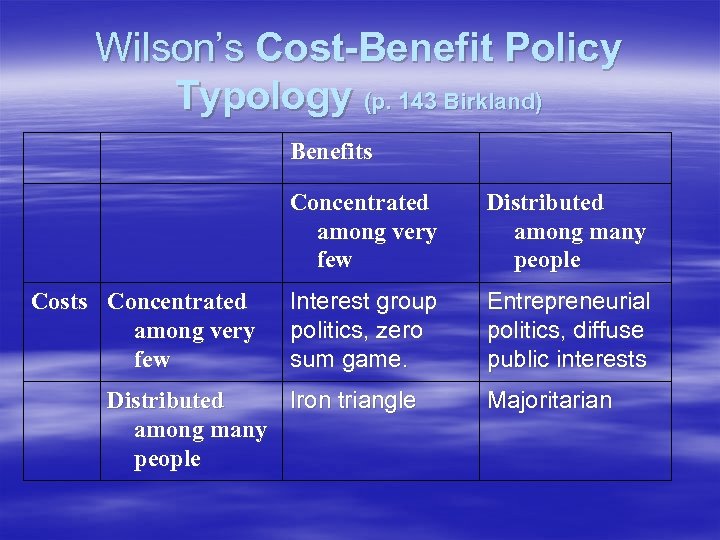 Wilson’s Cost-Benefit Policy Typology (p. 143 Birkland) Benefits Concentrated among very few Costs Concentrated among very few Distributed among many people Interest group politics, zero sum game. Entrepreneurial politics, diffuse public interests Distributed Iron triangle among many people Majoritarian
 Substantive vs. Procedural § Substantive: what government does § Procedural: how it does it – Energy policy – Freedom of information act
 Material vs. Symbolic
 Public vs. Private Goods
 Excludability § Excludable resource regime – One person can prevent another from using the resource – Necessary for markets to exist § Non-excludable – No enforceable property rights due to technology or social institutions – Can’t charge for use § Some resources non-excludable by nature. None are inherently excludable. § Excludability is a product of institutions.
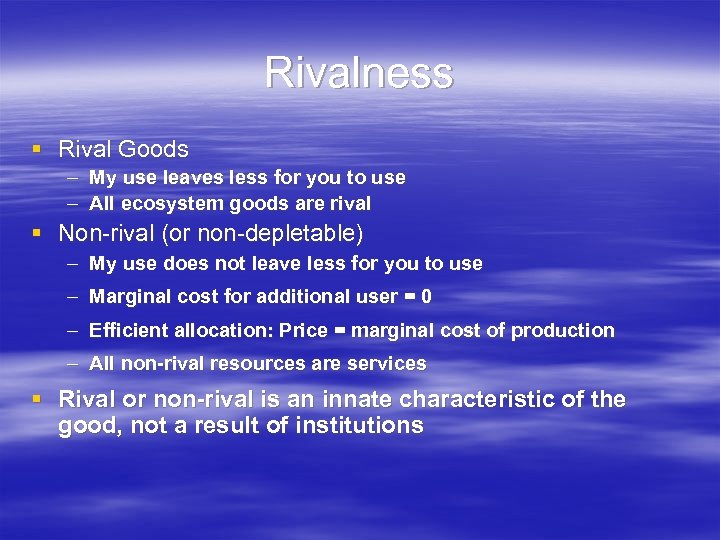 Rivalness § Rival Goods – My use leaves less for you to use – All ecosystem goods are rival § Non-rival (or non-depletable) – My use does not leave less for you to use – Marginal cost for additional user = 0 – Efficient allocation: Price = marginal cost of production – All non-rival resources are services § Rival or non-rival is an innate characteristic of the good, not a result of institutions
 Rivalness (cont. ) § Non-rival but congestible – Non-rival as long as few people use it, becomes rival with excessive use (e. g. golf course) – Empty planet vs. full planet
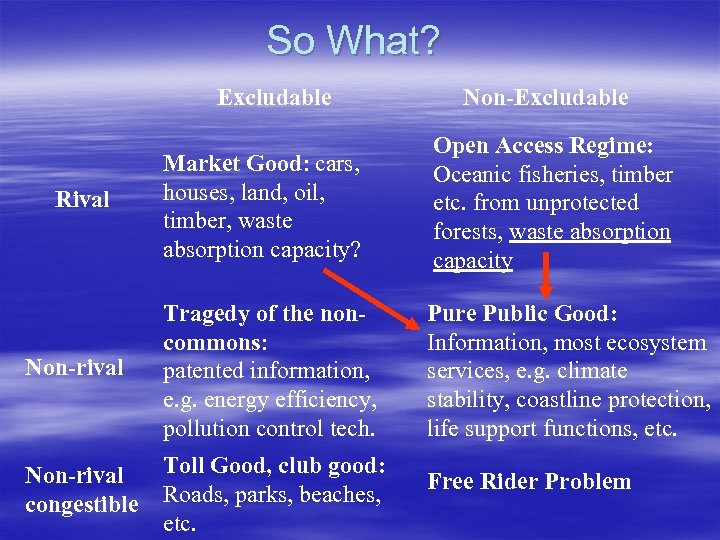 So What? Excludable Non-Excludable Market Good: cars, houses, land, oil, timber, waste absorption capacity? Open Access Regime: Oceanic fisheries, timber etc. from unprotected forests, waste absorption capacity Non-rival Tragedy of the noncommons: patented information, e. g. energy efficiency, pollution control tech. Pure Public Good: Information, most ecosystem services, e. g. climate stability, coastline protection, life support functions, etc. Non-rival congestible Toll Good, club good: Roads, parks, beaches, etc. Rival Free Rider Problem
 § “techniques and not ‘isms’ are the kernel of rational social action in the Western World”
 Conservative vs. Liberal Policies § § § What is a conservative? What is a liberal? What is a Red-Sox fan?
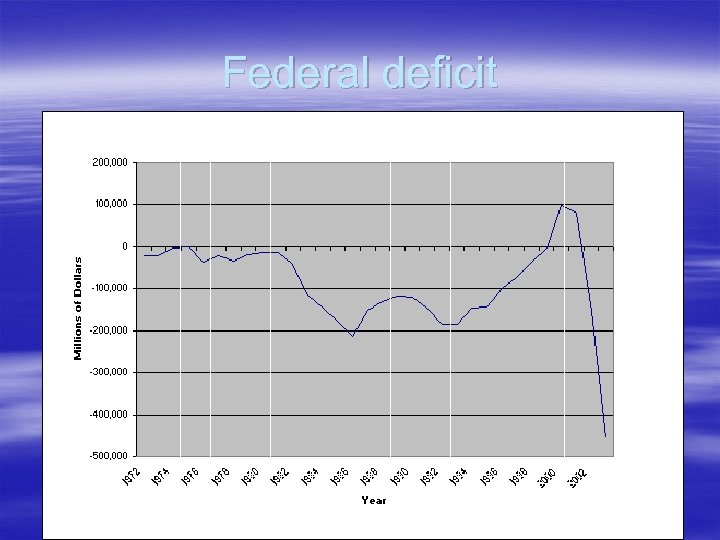 Federal deficit
 Exercise § Apply typologies to the current budget debate
 Policy Design and Tools § What are tools? – “a tool, or instrument, of public action can be defined as an identifiable method through which collective action is structured to address a public problem. ”
 4 Dimensions of Policy Tools § “Nature of the activity in which government is engaged” – Outright money payments – Provision of goods and services, including information – Legal protections, such as monopolies or guarantees – Restrictions/penalties
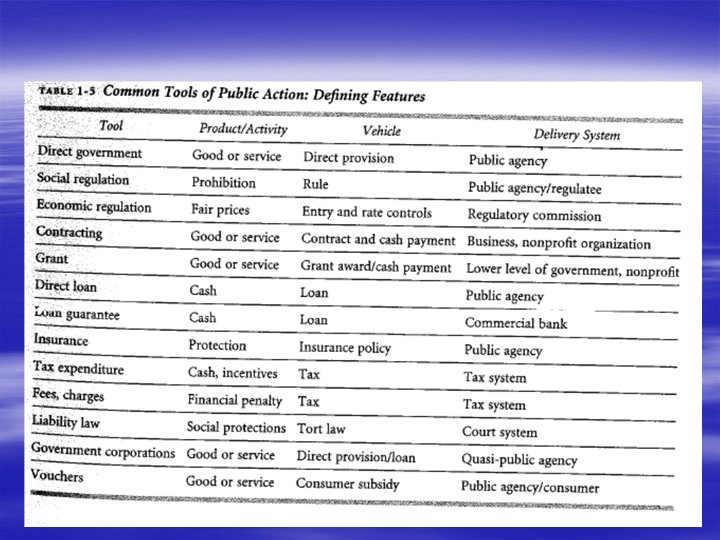
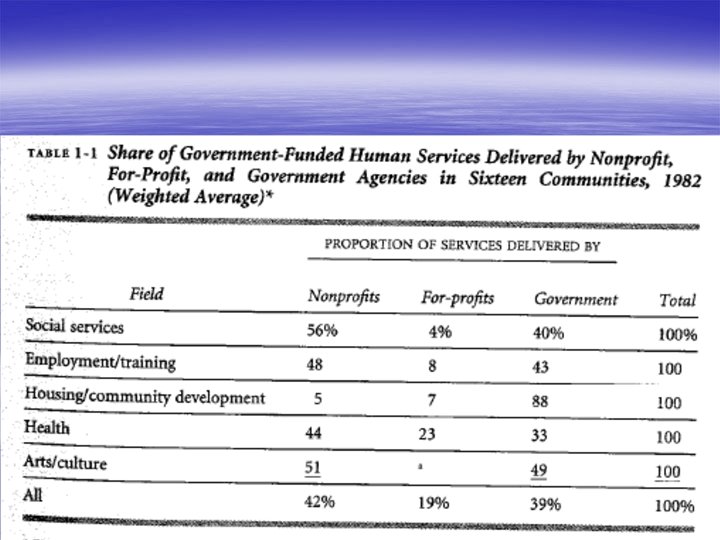
 § “Structure of the delivery system” – Direct – Indirect § To private sector, other levels of government, individuals, etc. § Loan guarantees, research grants, ‘privatization’ § Water, prisons, etc.
 § “Degree of centralization” – Subsidiarity – CO 2, SO 2, Mercury, etc. – Welfare, Medicaid, etc. § “Degree of automaticity” – E. g. tax incentives – What about earned income tax credit?
 Economic vs. Political Models § Economic: freedom, initiative and rational choice – Taxes – Tradable quotas – Assurance bonds – Property rights § Political: any tool can achieve any end. Less coercion is preferred to more, but will be used when necessary
 Economic Tools in Depth
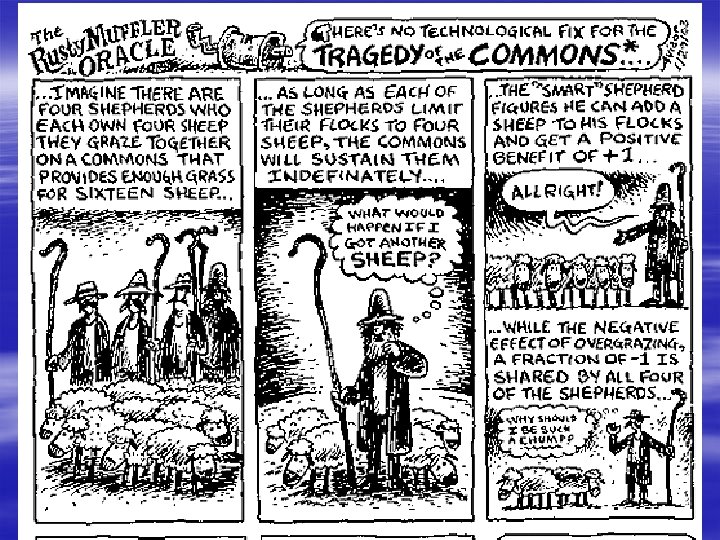
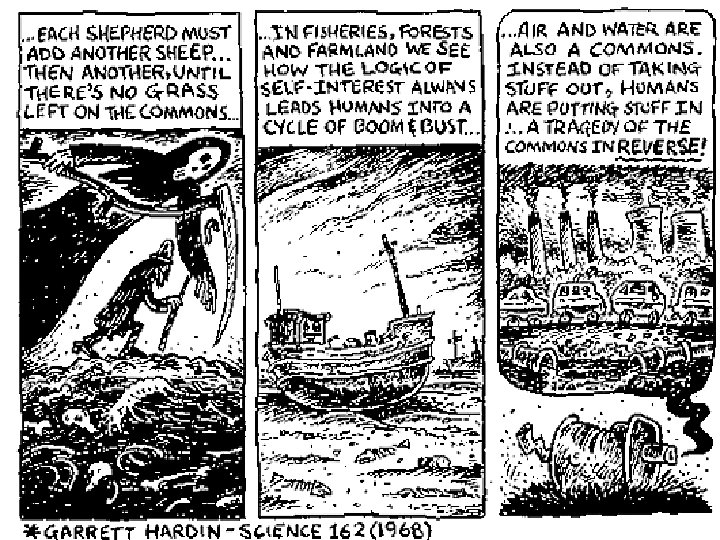
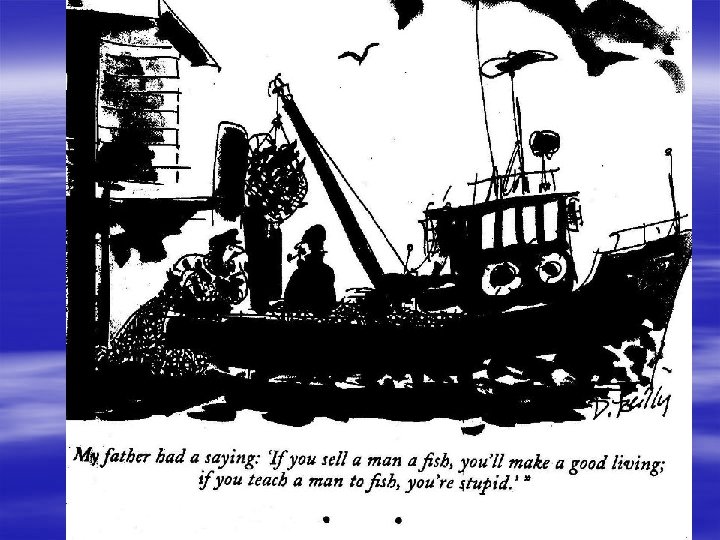
 Policies for the Tragedy of the Commons?
 Public Goods § Free-riding § No price signal as feed-back mechanism – Scarcity price increase innovation • Lack of Incentives to produce them • Examples • Vaccines and bird flu • Ecosystem services: e. g. wetlands • Defense
 Policies for Public Goods?
 Non-rival & Excludable: tragedy of the non-commons § Why do we have patents? § When did patents come about? – 1790 s in US – 1947 international, rarely used before 1980 s § How long do they last?
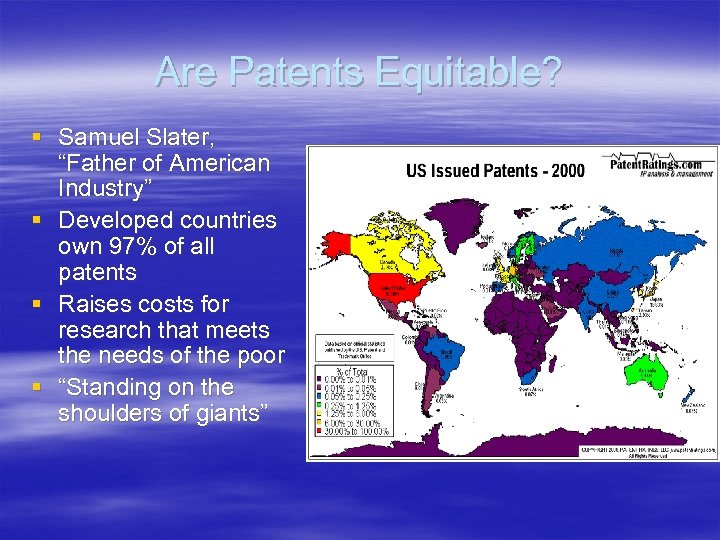 Are Patents Equitable? § Samuel Slater, “Father of American Industry” § Developed countries own 97% of all patents § Raises costs for research that meets the needs of the poor § “Standing on the shoulders of giants”
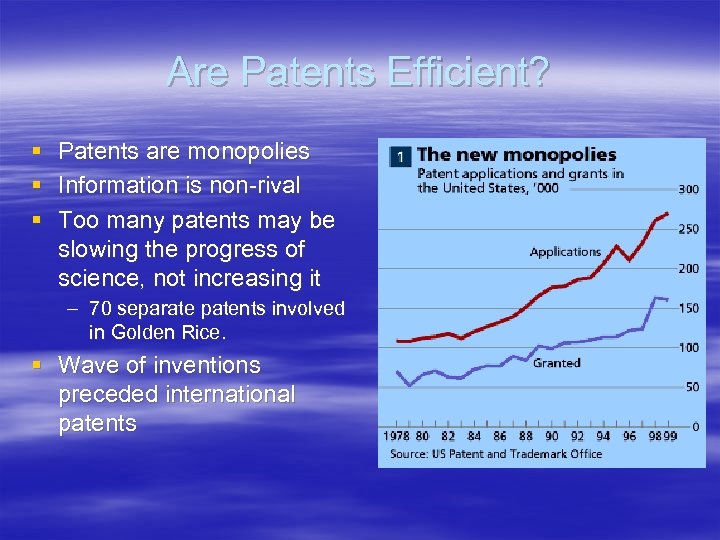 Are Patents Efficient? § Patents are monopolies § Information is non-rival § Too many patents may be slowing the progress of science, not increasing it – 70 separate patents involved in Golden Rice. § Wave of inventions preceded international patents
 Policies for Information?
 Market goods: The theory of Externalities
 Externalities § Definition – “an activity by one agent causes a loss (gain) of welfare to another agent” – “The loss (gain) of welfare is uncompensated” § Completely Internal to the Economic Process. Why? § How are these related to public goods?
 Examples § § § Louisiana wetlands Factory farming Waste emissions
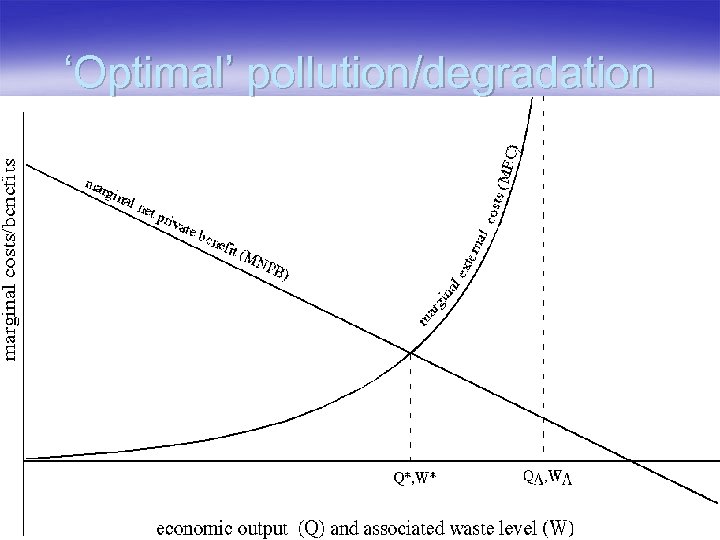 ‘Optimal’ pollution/degradation
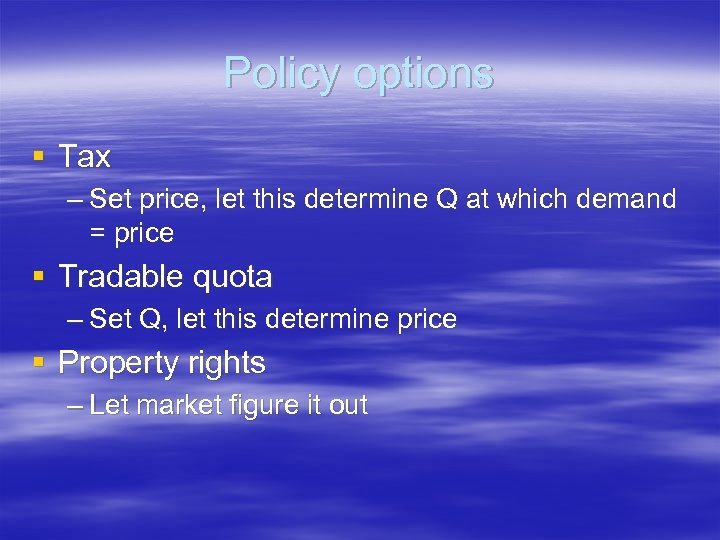 Policy options § Tax – Set price, let this determine Q at which demand = price § Tradable quota – Set Q, let this determine price § Property rights – Let market figure it out
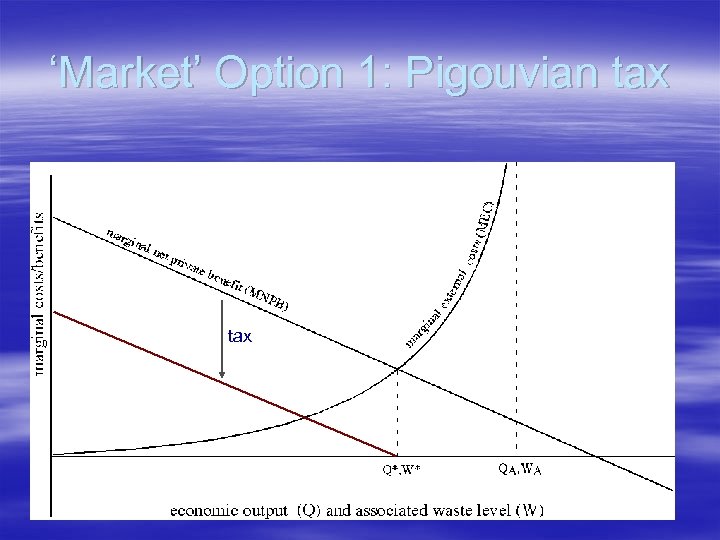 ‘Market’ Option 1: Pigouvian tax
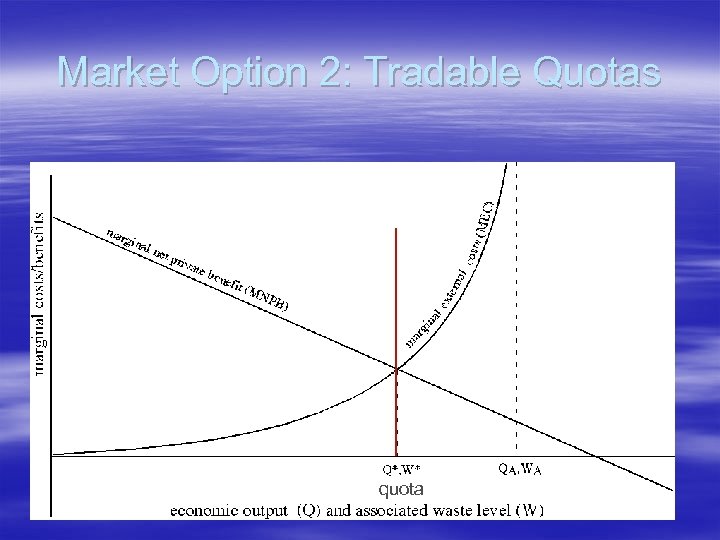 Market Option 2: Tradable Quotas quota
 Natural Monopolies § § High fixed costs, low marginal costs Economies of scale How do we deal with natural monopolies? Ideology vs. economics – Water, monopoly and externalities – Energy
 Does the Government have the final say on Policies? § § § Long-horn beetles Turtle Excluder Devices Cotton subsidies