


 Скачать презентацию POLICY RESEARCH 101 A guide to getting started
f8248a6b1c5e2672f78693ed6c57fb38.ppt
- Количество слайдов: 22
 POLICY RESEARCH 101 A guide to getting started researching interests, issues, laws, and policies November 2013
 THINGS YOU MAY WANT TO KNOW ABOUT YOUR ISSUE… What are some of the root causes of the issue? What current policies are in place concerning my issue? What has been tried before in efforts to address this issue? What is being tried elsewhere / in other cities? Who is already working on this issue? What does their research say? Who is most effected by this issue? Who has the decision-making power to make the desired change
 TYPES OF INFORMATION YOU MAY WANT TO FIND. . . Quantitative: Concerned with quantity and data Survey Results Census Information Statistics Ratios and probabilties Budgets and cost figures Qualitative: Concerned with quality and meaning Interviews and Focus Groups Observations (Seeing and listening) Document Analysis Case studies
 TYPES OF INFORMATION YOU MAY WANT TO FIND. . . Primary Sources: First hand testimony or direct evidence concerning a topic. Personal testimonies Audio and Video recordings Laws and legislative hearings Census or demographic records Secondary Sources: Analysis or interpretation of primary sources. Review articles Book Reviews Editorial Biographies Try to include some primary sources!
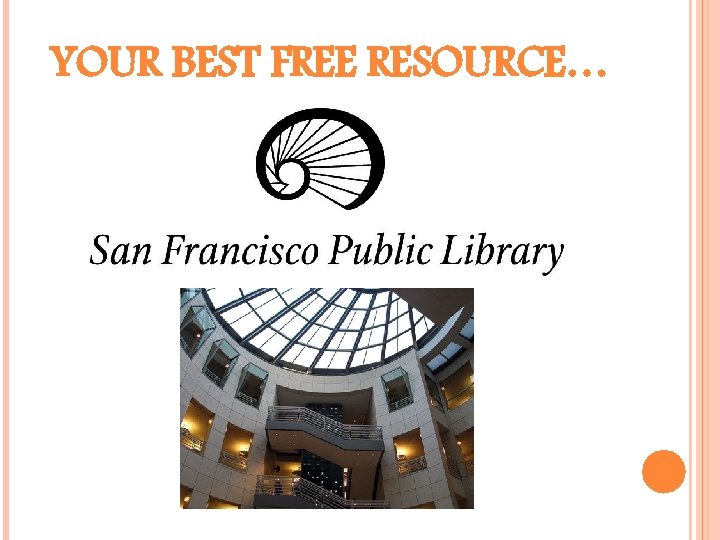 YOUR BEST FREE RESOURCE…
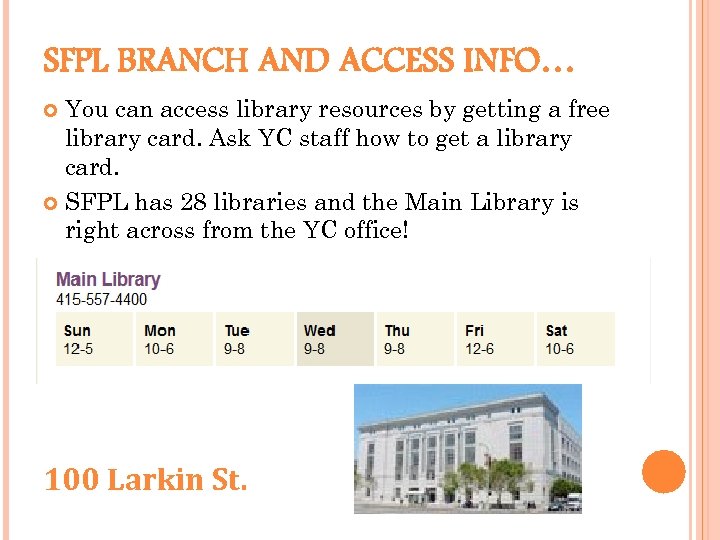 SFPL BRANCH AND ACCESS INFO… You can access library resources by getting a free library card. Ask YC staff how to get a library card. SFPL has 28 libraries and the Main Library is right across from the YC office! 100 Larkin St.
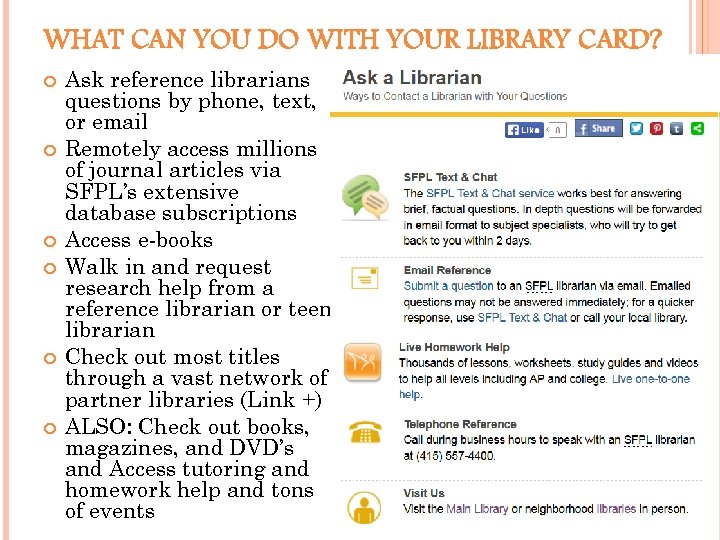 WHAT CAN YOU DO WITH YOUR LIBRARY CARD? Ask reference librarians questions by phone, text, or email Remotely access millions of journal articles via SFPL’s extensive database subscriptions Access e-books Walk in and request research help from a reference librarian or teen librarian Check out most titles through a vast network of partner libraries (Link +) ALSO: Check out books, magazines, and DVD’s and Access tutoring and homework help and tons of events
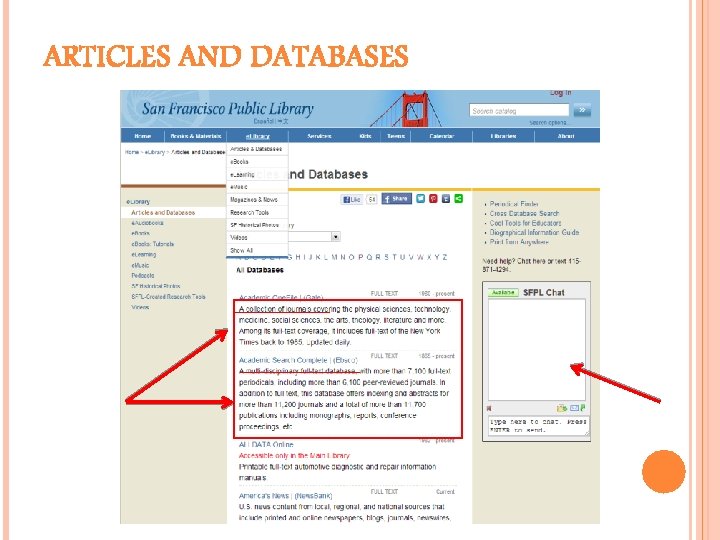 ARTICLES AND DATABASES
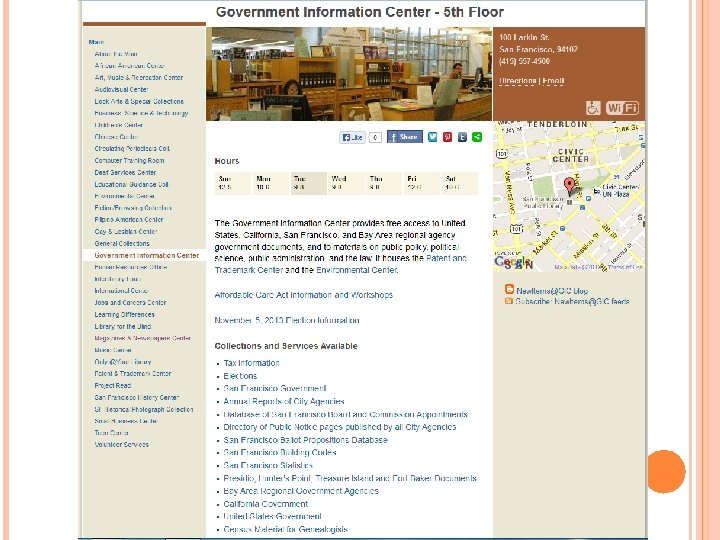
 DATABASES Government Information Center Peer-reviewed academic journals: Research done on your topic by university researchers. These articles will usually be longer and denser. News Databases: Comprehensive searches of national or international news on your topic. This is a good way to see what is being done in other places, or what kind of press your issue has gotten. America’s News (News. Bank) Ethnic News. Watch (Pro. Quest) Newspapers (Proquest) SF Chronicle (Newsbank) Lexis Nexus (not at SFPL, if you have access to university library login) Searching contents of other libraries: World. Cat (First. Search) Statistics and Government Info: Pro. Quest Statistical Insight RAND California Pro. Quest Congressional Databases on particular topics: Look on the site to see what is available Health and Wellness Resource Center and Teen Health & Wellness Environmental Databases
 Google Scholar is a freely accessible web search engine that indexes the full text of scholarly literature across an array of publishing formats and disciplines You can use it to look up the closest matches to your search inputs using the broadest possible search Use Google Scholar settings to add “Library link” to SFPL. Search results will then include links to full text versions that SFPL holds a subscription to.
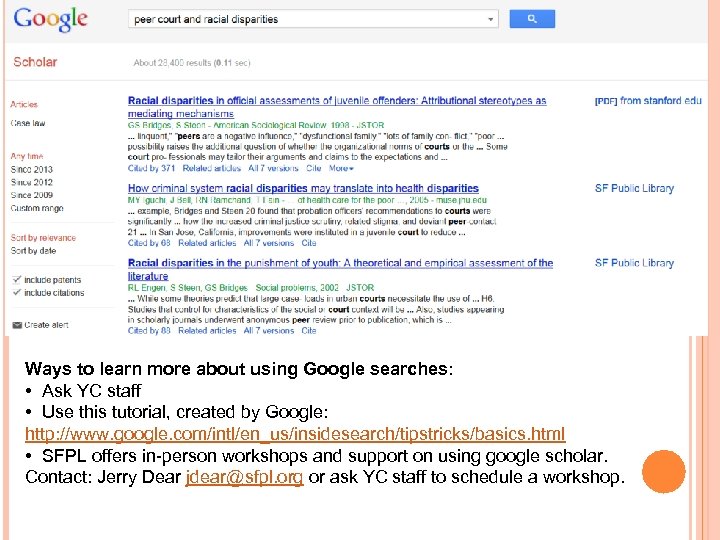 Ways to learn more about using Google searches: • Ask YC staff • Use this tutorial, created by Google: http: //www. google. com/intl/en_us/insidesearch/tipstricks/basics. html • SFPL offers in-person workshops and support on using google scholar. Contact: Jerry Dear jdear@sfpl. org or ask YC staff to schedule a workshop.
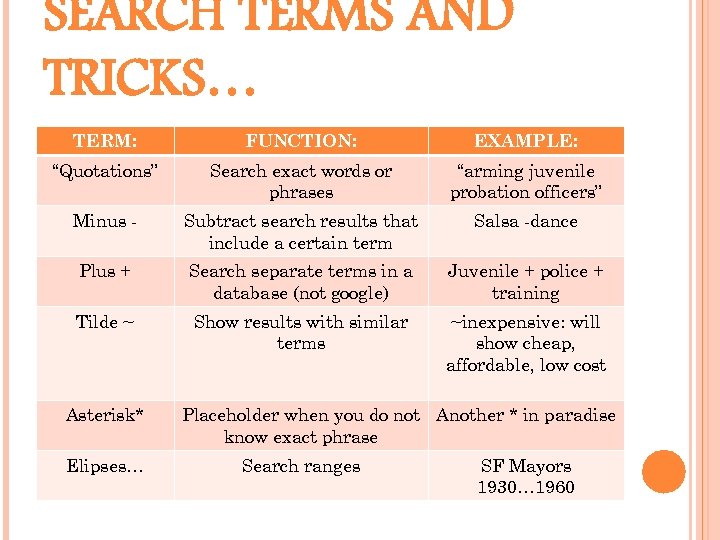 SEARCH TERMS AND TRICKS… TERM: FUNCTION: EXAMPLE: “Quotations” Search exact words or phrases “arming juvenile probation officers” Minus - Subtract search results that include a certain term Salsa -dance Plus + Search separate terms in a database (not google) Juvenile + police + training Tilde ~ Show results with similar terms ~inexpensive: will show cheap, affordable, low cost Asterisk* Elipses… Placeholder when you do not Another * in paradise know exact phrase Search ranges SF Mayors 1930… 1960
 SEARCHING TIPS… Use likely Words Avoid using a question Avoid phases like, “article about” Be Specific; Example) “High School Graduation Requirements” vs. “Graduation requirements” Be Brief Google ignores common words; Example) ‘summertime jobs in SF’ vs. ‘summertime jobs SF’
 OTHER NON-LIBRARY WEBSITES AND RESOURCES Youth Vote Student Survey SFUSD. edu American factfinder: Census info by area factfinder 2. census. gov Purdue Online Writing Lab: has dozens of online guides and tutorials for primary research, writing, formatting citations – a GREAT resource! https: //owl. english. purdue. edu/
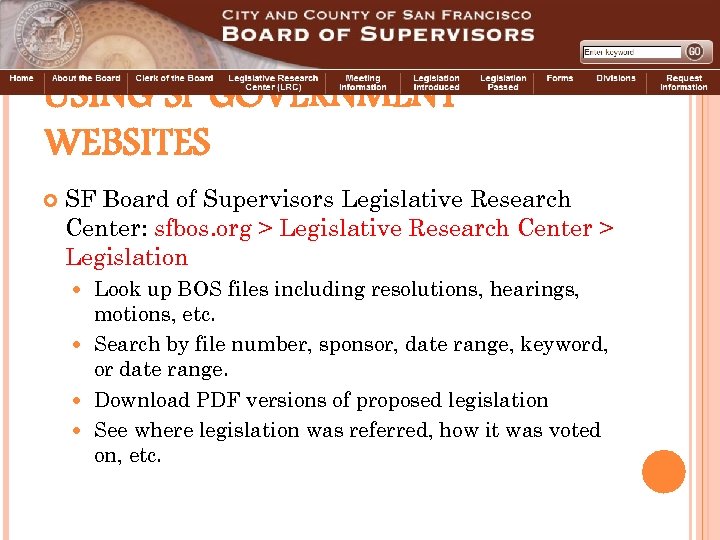 USING SF GOVERNMENT WEBSITES SF Board of Supervisors Legislative Research Center: sfbos. org > Legislative Research Center > Legislation Look up BOS files including resolutions, hearings, motions, etc. Search by file number, sponsor, date range, keyword, or date range. Download PDF versions of proposed legislation See where legislation was referred, how it was voted on, etc.
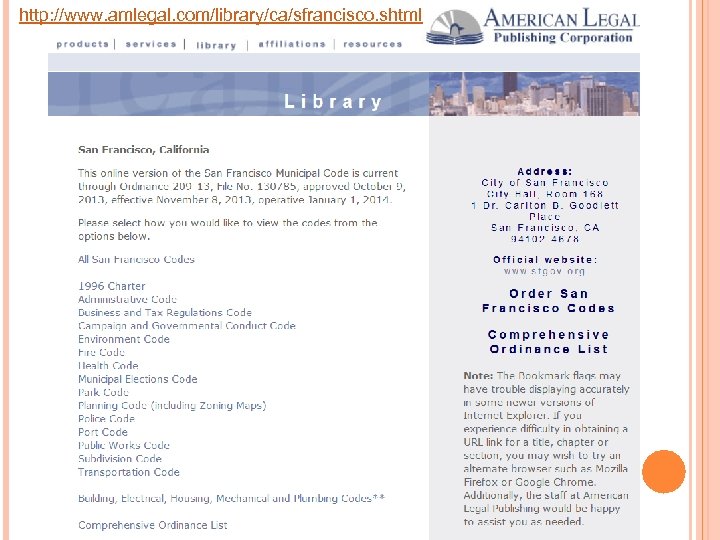 http: //www. amlegal. com/library/ca/sfrancisco. shtml
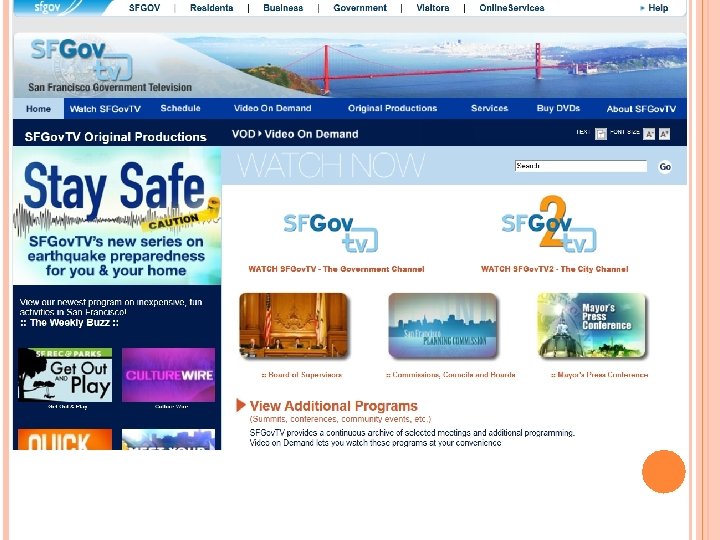
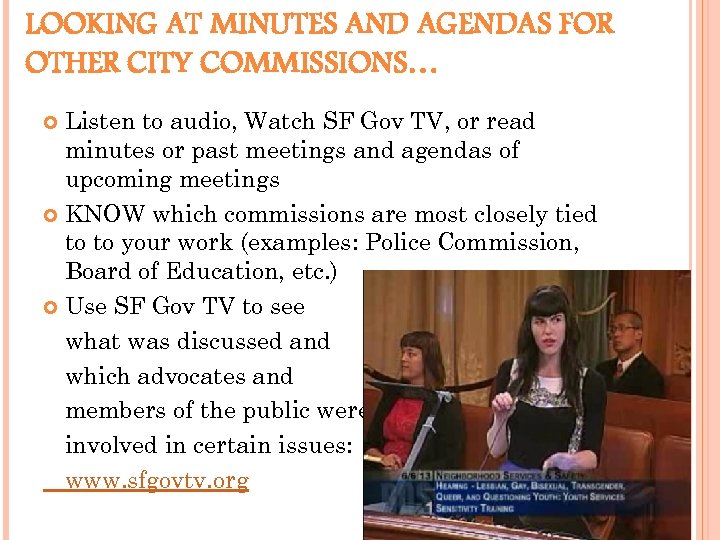 LOOKING AT MINUTES AND AGENDAS FOR OTHER CITY COMMISSIONS… Listen to audio, Watch SF Gov TV, or read minutes or past meetings and agendas of upcoming meetings KNOW which commissions are most closely tied to to your work (examples: Police Commission, Board of Education, etc. ) Use SF Gov TV to see what was discussed and which advocates and members of the public were involved in certain issues: www. sfgovtv. org
 FINALLY…. REFINE AND ASK! You can always ask staff from city departments! Government information and records are PUBLIC! Just be sure to REFINE your questions and DIRECT them to the correct people.
 LOOKING AT REPORTS FROM ADVOCACY ORGANIZATIONS Who is already doing work on the issue locally or nationally? GO ONLINE AND FIND OUT! Search organizational websites, especially by looking at the “Resources” and “Links” pages to find publications or other organizations doing similar work Look at citations in reports and factsheets to see what primary sources were used—then look them up! Look at staff bios to see who you can contact to ask for further documentation on their work Example: While writing a resolution against the arming of SFPD with tasers, commissioners found that Amnesty International had released a report on deaths from tasers: http: //ddq 74 coujkv 1 i. cloudfront. net/Taser. Amnesty_Intl_Report-Dec_2008. pdf
 GOOD LUCK AND HAPPY RESEARCHING!! Let YC staff know if you have questions!