


 Скачать презентацию Policy Proposals Health Care Coverage Costs and Financing
56c14555b99b72d9c6a01d9398ef3e2d.ppt
- Количество слайдов: 18
 Policy Proposals Health Care Coverage, Costs, and Financing
 Outline Benefit Design/Coverage • Paying for Care • Incremental vs. Comprehensive Health Care Reform •
 Benefit Design/Coverage • What does health insurance coverage look like today? • Historically, most policies have covered: Hospital • Physician • Some preventive care • Some cost-sharing, possibly with catastrophic cap • • If the goal is to expand coverage to more individuals: Who receives coverage (all, low income, kids, disabled, workers)? • Bare-bones policies or comprehensive health insurance? • One standard benefit package, standardized packages, or tailored plans? • How much cost-sharing (deductibles, coinsurance, maximum per •
 Paying for Care • How is health insurance financed today? Employer-sponsored: Employee/employer contributions/foregone wages, tax exclusion • Medicare: Payroll taxes, federal income taxes, enrollee premiums (Part B income-related in 2007), and beneficiary cost-sharing • Medicaid: Federal income taxes and state tax revenues, nominal cost-sharing • • If the goal is to expand coverage to more individuals: How should it be financed? Should premiums be related to a person’s income? Should the current tax exclusion for employer coverage be limited? • Stretch limited resources by offering less generous benefits? •
 Incremental vs. Comprehensive Reforms • If the goal is to reform the health care system, how do we get there? • Comprehensive Focus: Achieve coverage for all • Examples: Individual mandates; Single payer systems; Voucher system • • Incremental Focus: Expand coverage to certain populations, improving insurance markets, promoting quality reforms, etc. , but not achieve coverage for all • Examples: Subsidies for individually-purchased insurance; •
 Combining Incremental Reforms • Comprehensive reforms can be built on frameworks that combine multiple incremental strategies (addressing quality, efficiency, cost, as well as access) • However, comprehensive reforms have stated principal goal of guaranteeing coverage for all • Features must include: Formal structure that ties parts together • Public commitment • Accountability •
 Incremental Reforms
 Subsidies • Goal: Reduce number of uninsured by subsidizing purchase of health insurance, often through tax credits • Examples of subsidy proposals: Provide tax credits to low and middle-income to buy insurance on individual market • Create a tax deduction for purchase of individual insurance • Provide tax credits for businesses who offer health insurance to employees •
 Medicare or Medicaid Expansions • Goal: Reduce number of uninsured by expanding eligibility for existing government programs (e. g. , Medicaid, Medicare) • Examples of expansion proposals: Raise income ceiling for Medicaid and SCHIP eligibility • Extend public coverage to all uninsured children • Offer Medicare to more adults (e. g. , age 55 -64) without insurance •
 Employer Mandates • Goal: Increase access to health insurance for workers and their families, by requiring employers to offer health insurance • Examples of employer mandate proposals: Require employers to cover percentage of premium; small employers in purchasing pools • Impose “free rider surcharges” on employers and employees •
 Health Savings Accounts • Goal: HSAs and other forms of consumer-directed care have a goal of making health coverage more affordable by encouraging consumers to be more cost-conscious and focus on healthier behaviors • Features of HSAs: People set aside their own money, before taxes, to pay for health care • Usually combined with high-deductible health insurance • • Examples of HSA and other consumer-directed care proposals: • Tax credits for employer contributions to HSAs
 Comprehensive Reforms
 Individual Mandates • Goal: Achieve universal coverage using current system as base • Examples of individual mandate proposals: Require individuals to buy insurance, and provide tax credits to do this; those with the lowest income would pay zero premium • Mandate that everyone have health insurance or pay modest penalties • Create incentives for uninsured to buy into proposed “Medicare Plus” program, but later impose individual mandate if high number of uninsured persons remains •
 Single Payer • Goal: Achieve universal coverage and reduce administrative costs • Examples of single payer model proposals: • Physicians for a National Health Insurance Program: • • Comprehensive benefits (medical, dental, LTC, Rx, mental health) Medicare, Medicaid, private health insurance restricted or eliminated For-profit hospitals phased out; hospitals given set budget for year Doctors salaried or paid on fee-for-service basis by federal government Global budget that grows each year with GDP Copayments, deductibles low or zero; financed through variety of taxes State-designed comprehensive insurance—CA, NY, MA. . .
 Voucher System • Goal: Achieve universal coverage for basic services • Example of voucher system (Emanuel & Fuchs proposal): • • • Guaranteed enrollment and renewal of risk-adjusted voucher Choice of plans offering basic services Additional services available for higher premium with after-tax dollars Financing through value added tax (VAT) Employer-sponsored health insurance, Medicaid, Medicare eliminated
 Combining Incremental Reforms
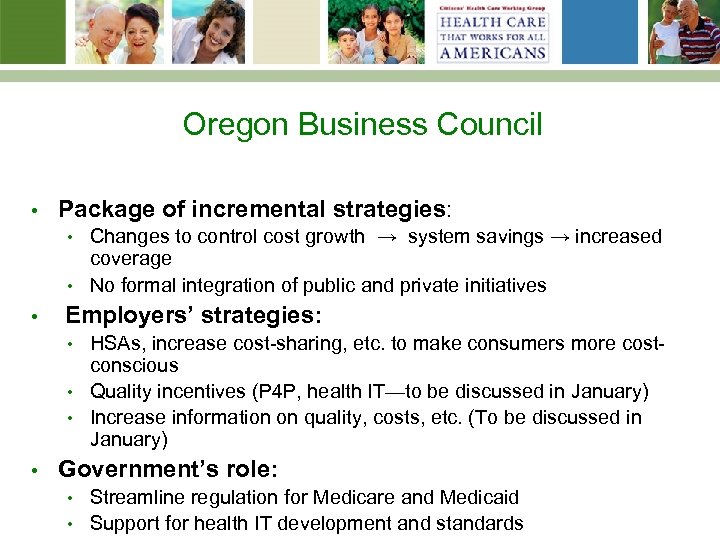 Oregon Business Council • Package of incremental strategies: Changes to control cost growth → system savings → increased coverage • No formal integration of public and private initiatives • • Employers’ strategies: HSAs, increase cost-sharing, etc. to make consumers more costconscious • Quality incentives (P 4 P, health IT—to be discussed in January) • Increase information on quality, costs, etc. (To be discussed in January) • • Government’s role: Streamline regulation for Medicare and Medicaid • Support for health IT development and standards •
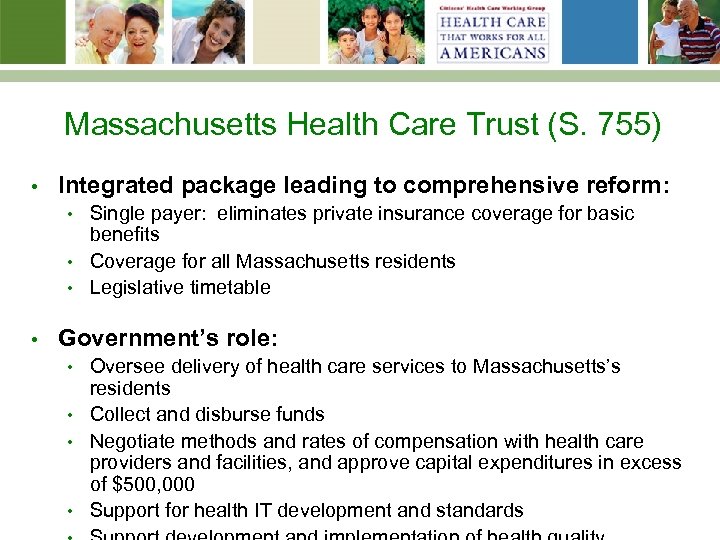 Massachusetts Health Care Trust (S. 755) • Integrated package leading to comprehensive reform: Single payer: eliminates private insurance coverage for basic benefits • Coverage for all Massachusetts residents • Legislative timetable • • Government’s role: Oversee delivery of health care services to Massachusetts’s residents • Collect and disburse funds • Negotiate methods and rates of compensation with health care providers and facilities, and approve capital expenditures in excess of $500, 000 • Support for health IT development and standards •