


 Скачать презентацию Policy instruments addressing new farms The Netherlands experience
b98438318bde62e1880a78f665790ef2.ppt
- Количество слайдов: 16
 Policy instruments addressing new farms The Netherlands experience Gé Backus © Wageningen UR Policy development workshop Bangkok, 17 June 2008
 Contents n n n n Setting the stage The problem Regulatory instruments Assessment at province and local level Permit policies EU directives: EIA and IPPC Law on ammonia Law on smell
 Setting the stage n High population density n High landscape (toerism) and nature values n Many pigs and poultry per km 2 n Regulation at (inter)national, regional and local level
 Problem: farming, urban life and nature conflict! PIGS and POULTRY • Nearby population • noise, smell • Nearby nature • ammonia • Zoning inevitable!
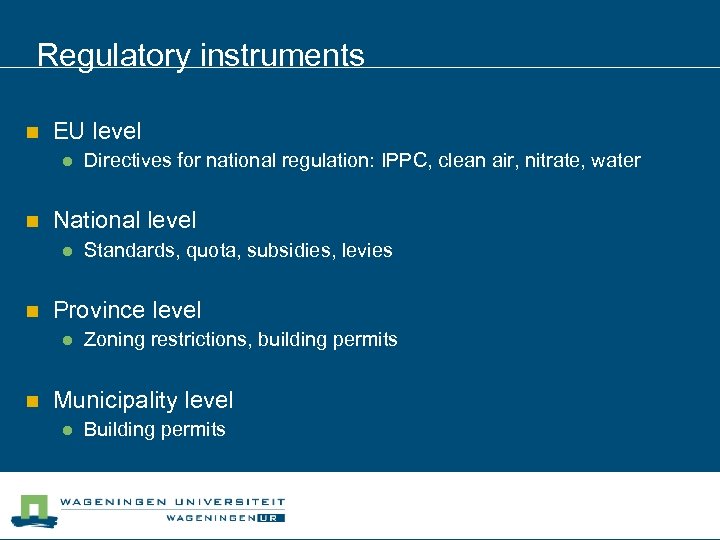 Regulatory instruments n EU level l n National level l n Standards, quota, subsidies, levies Province level l n Directives for national regulation: IPPC, clean air, nitrate, water Zoning restrictions, building permits Municipality level l Building permits
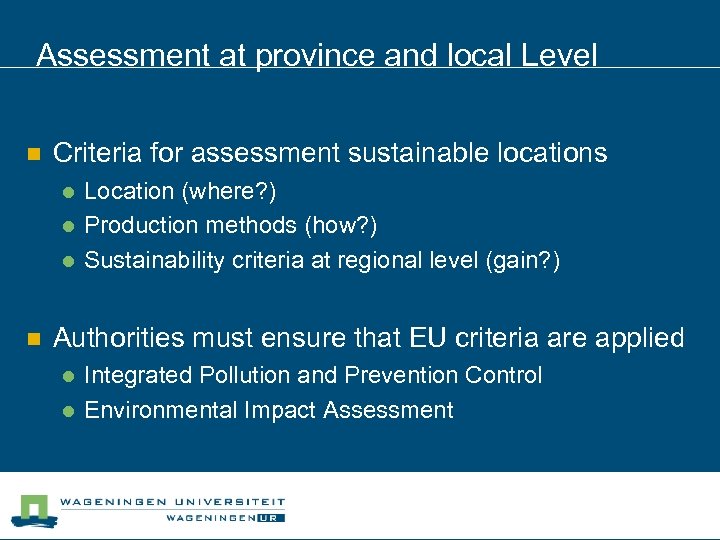 Assessment at province and local Level n Criteria for assessment sustainable locations l l l n Location (where? ) Production methods (how? ) Sustainability criteria at regional level (gain? ) Authorities must ensure that EU criteria are applied l l Integrated Pollution and Prevention Control Environmental Impact Assessment
 Permit policies n Phased approach n Flow schemes n Requests in many cases not granted smell and ammonia
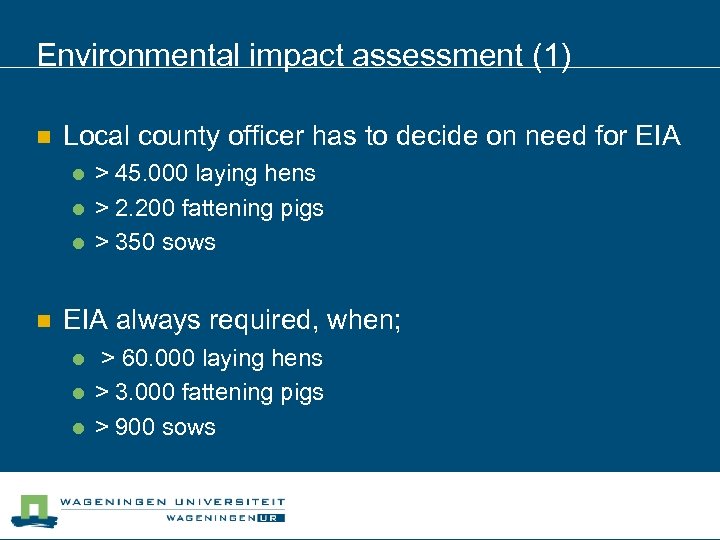 Environmental impact assessment (1) n Local county officer has to decide on need for EIA l l l n > 45. 000 laying hens > 2. 200 fattening pigs > 350 sows EIA always required, when; l l l > 60. 000 laying hens > 3. 000 fattening pigs > 900 sows
 Environmental Impact Assessment (2) n Provides information to fully weigh environmental impact before decisions are taken on major plans n Ten steps l l l l l Pre-starting note Public participation (4 weeks) Guidelines set by competent authority (13 weeks) Environmental Impact Report (EIR) Acceptability assessment (6 weeks) Publication EIR and draft decision (8 weeks) Participation and hearings (comments within 4 weeks) Environmental Impact Assessment Commission (5 weeks) Decision (objection or appeal must be submitted within 6 weeks) Assessment
 Integrated Pollution Prevention and Control n Introduced in 1996 n For farms l l l > 40. 000 poultry > 2. 000 fattening pigs > 750 sows n Assessment at individual farm level n Based on principle ‘best available technology’ l Additional thresholds in areas with many pigs and poultry
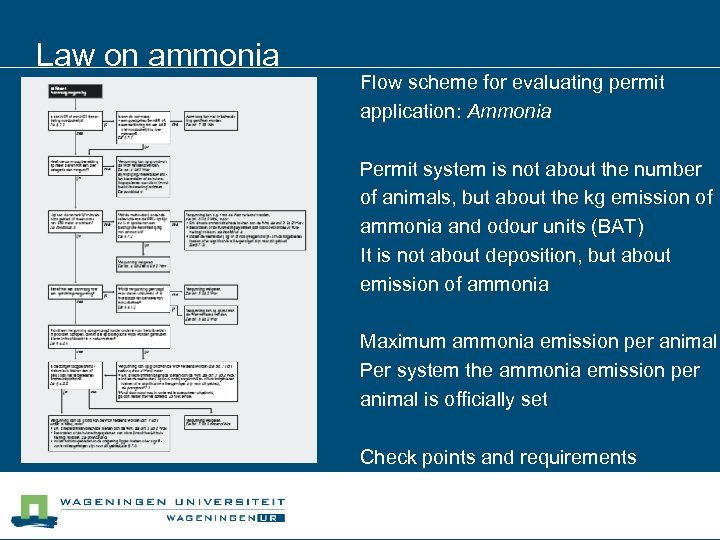 Law on ammonia Flow scheme for evaluating permit application: Ammonia Permit system is not about the number of animals, but about the kg emission of ammonia and odour units (BAT) It is not about deposition, but about emission of ammonia Maximum ammonia emission per animal Per system the ammonia emission per animal is officially set Check points and requirements
 Requirements for using ammonia system n Sampling and testing by independent expert n If threshold not met, farmers has to take action n At least 1 x per year cleaning the installation n Maintenance contract with supplier, including control
 Law on smell n FOUR STEPS l Calculate smell emission of farm l Determine required minimal distance to building objects l Determine actual distances l Decide yes or no on application
 Smell burden n Permits require limited ‘smell burden’ l Computer based calculation of Odour units per m 3 • Number of animals x smell factor per animal • Distance to nearest smell sensitive object (smell spread model) n Smell sensitive object l l Buildings and houses (four categories) But, ……. no recreation area
 Categories of smell sensitive objects n I: Urban area, hospital n II: Concentrated houses in rural areas n III: Spreaded houses in rural areas n IV: House nearby farm
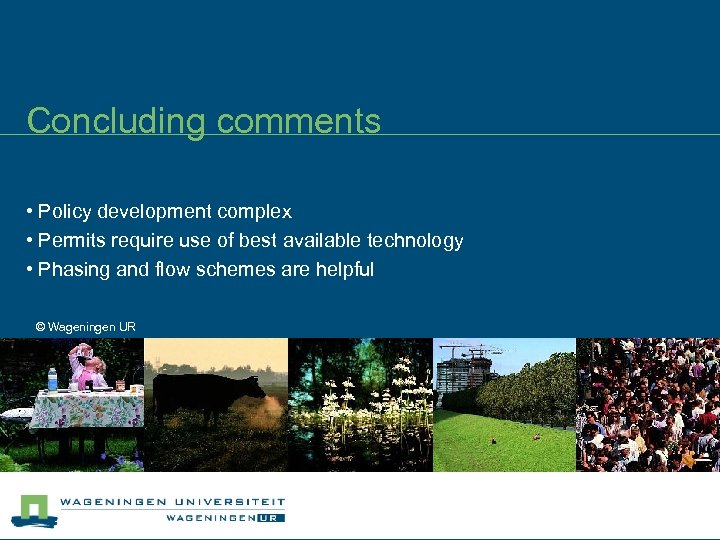 Concluding comments • Policy development complex • Permits require use of best available technology • Phasing and flow schemes are helpful © Wageningen UR