 Скачать презентацию Polar Wind Geotail Science Data Analysis Status November
8b75b746f49a60bc9959f2dae2b6931a.ppt
- Количество слайдов: 20



Polar, Wind, Geotail Science Data Analysis Status November, 2002 Robert Hoffman/Polar Project Scientist Keith Ogilvie/ Wind Project Scientist Michael Desch / Wind Deputy Project Scientist Barbara Giles/Polar Deputy Project Scientist
Background: Directive from HQ for FY 02 -FY 05 As a result of the Senior Review 2001, HQ evaluated separately the five elements of ISTP/GGS and recommended a substantial restructuring. • The end of ISTP as a program. • Continuation of Polar science activities as the apogee progresses through the equatorial regions. • Reduction of NASA support in science participation in Geotail. • Placement of Wind at L 1 as a "hot spare" for monitoring the solar wind and limited support to science teams for special campaigns. • Termination of the ISTP Theory and Ground Based Investigations program. • Termination of the ISTP/CDHF as an independently funded facility. In addition, HQ reorganized the funding authority such that each spacecraft project scientist has budget responsibility for implementing the complete science, operations, data processing and data distribution program elements. Polar, Wind and Geotail Science Data Processing Status / 15 November 2002 Pg 2
Background: Directive from HQ for FY 02 -FY 05 HQ recommended that the continuing missions, • accept higher risk levels than during the prime mission phase – minimize operations and data processing costs in order to maximize the use of funds for instrument calibration, data analysis and science interpretation. • accept a lower data capture rate from 99+% – a 95% data capture that lessens demands on the operations and data processing staff is acceptable. The project scientists found that, • the ISTP flight operations and data system costs considerably exceeded funding to be provided for FY 02 and beyond. • the project would need to immediately investigate new approaches to "find the best deal". The prime goal became to maintain Polar science funding as close to FY 01 levels as possible and to maintain the same level of data service to Polar, Wind and Geotail Science Data Processing Status / 15 November 2002 Pg 3
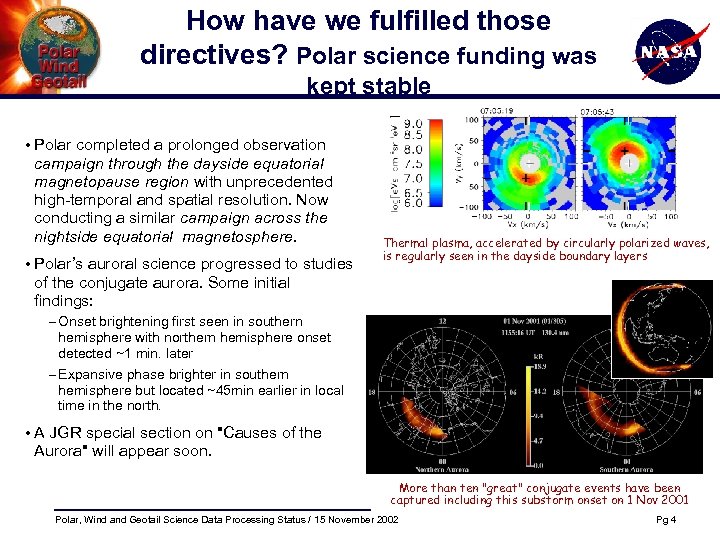
How have we fulfilled those directives? Polar science funding was kept stable • Polar completed a prolonged observation campaign through the dayside equatorial magnetopause region with unprecedented high-temporal and spatial resolution. Now conducting a similar campaign across the nightside equatorial magnetosphere. • Polar’s auroral science progressed to studies of the conjugate aurora. Some initial findings: Thermal plasma, accelerated by circularly polarized waves, is regularly seen in the dayside boundary layers – Onset brightening first seen in southern hemisphere with northern hemisphere onset detected ~1 min. later – Expansive phase brighter in southern hemisphere but located ~45 min earlier in local time in the north. • A JGR special section on "Causes of the Aurora" will appear soon. More than ten "great" conjugate events have been captured including this substorm onset on 1 Nov 2001 Polar, Wind and Geotail Science Data Processing Status / 15 November 2002 Pg 4
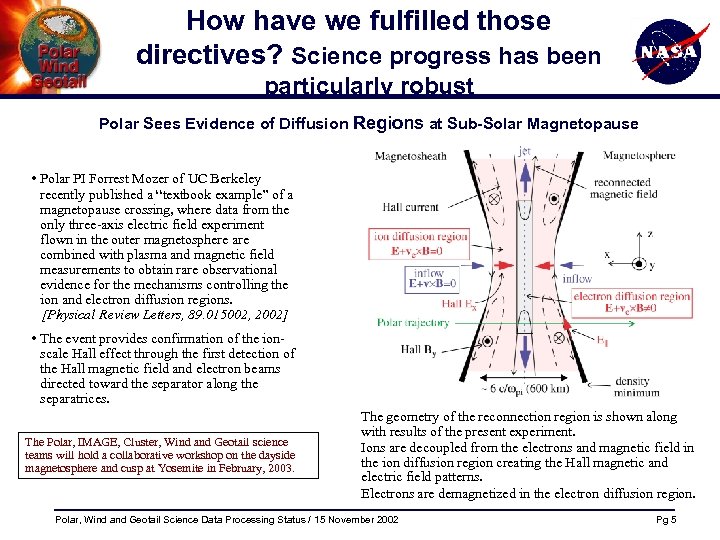
How have we fulfilled those directives? Science progress has been particularly robust Polar Sees Evidence of Diffusion Regions at Sub-Solar Magnetopause • Polar PI Forrest Mozer of UC Berkeley recently published a “textbook example” of a magnetopause crossing, where data from the only three-axis electric field experiment flown in the outer magnetosphere are combined with plasma and magnetic field measurements to obtain rare observational evidence for the mechanisms controlling the ion and electron diffusion regions. [Physical Review Letters, 89. 015002, 2002] • The event provides confirmation of the ionscale Hall effect through the first detection of the Hall magnetic field and electron beams directed toward the separator along the separatrices. The Polar, IMAGE, Cluster, Wind and Geotail science teams will hold a collaborative workshop on the dayside magnetosphere and cusp at Yosemite in February, 2003. The geometry of the reconnection region is shown along with results of the present experiment. Ions are decoupled from the electrons and magnetic field in the ion diffusion region creating the Hall magnetic and electric field patterns. Electrons are demagnetized in the electron diffusion region. Polar, Wind and Geotail Science Data Processing Status / 15 November 2002 Pg 5
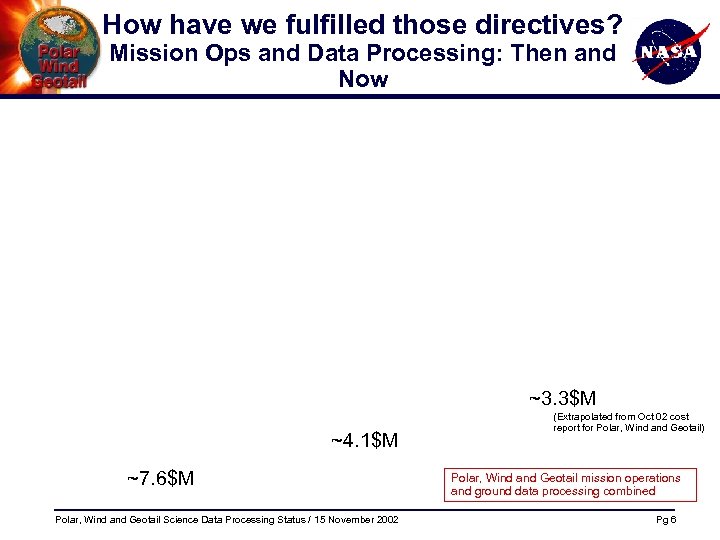
How have we fulfilled those directives? Mission Ops and Data Processing: Then and Now ~3. 3$M ~4. 1$M ~7. 6$M Polar, Wind and Geotail Science Data Processing Status / 15 November 2002 (Extrapolated from Oct 02 cost report for Polar, Wind and Geotail) Polar, Wind and Geotail mission operations and ground data processing combined Pg 6
Review of the ISTP Data System (an independent entity to serve the worldwide SEC community) In addition to • data processing and distribution services for GGS (Polar, Wind, Geotail) & IMP-8, • data distribution services for SOHO and Cluster, • operations and science coordination, ISTP served as a one-stop data source by • consolidating and distributing data for 15 additional spacecraft, observatories and T&M programs • providing extensive data and media integrity and quality services. Polar, Wind and Geotail Science Data Processing Status / 15 November 2002 Pg 7
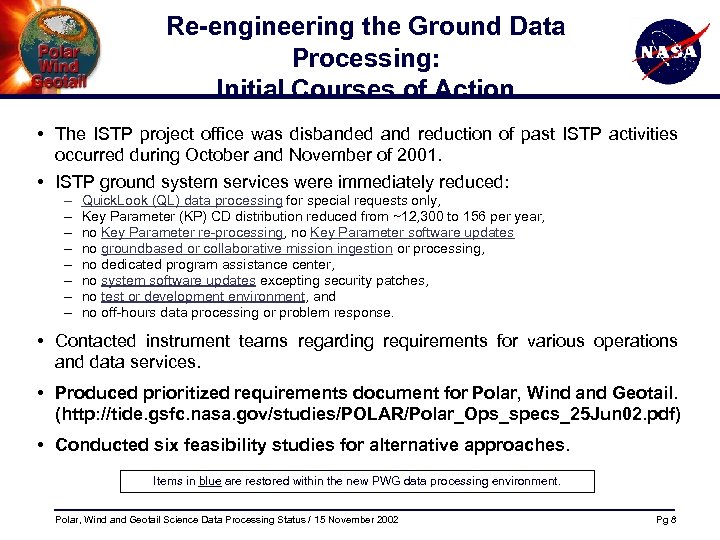
Re-engineering the Ground Data Processing: Initial Courses of Action • The ISTP project office was disbanded and reduction of past ISTP activities occurred during October and November of 2001. • ISTP ground system services were immediately reduced: – – – – Quick. Look (QL) data processing for special requests only, Key Parameter (KP) CD distribution reduced from ~12, 300 to 156 per year, no Key Parameter re-processing, no Key Parameter software updates no groundbased or collaborative mission ingestion or processing, no dedicated program assistance center, no system software updates excepting security patches, no test or development environment, and no off-hours data processing or problem response. • Contacted instrument teams regarding requirements for various operations and data services. • Produced prioritized requirements document for Polar, Wind and Geotail. (http: //tide. gsfc. nasa. gov/studies/POLAR/Polar_Ops_specs_25 Jun 02. pdf) • Conducted six feasibility studies for alternative approaches. Items in blue are restored within the new PWG data processing environment. Polar, Wind and Geotail Science Data Processing Status / 15 November 2002 Pg 8
Re-engineering the Ground Data Processing: Results of the Feasibility Studies The following conclusions and actions resulted from the review of the studies: • More software and system re-engineering needed to be pursued than provided for by the CSOC studies. • Nine re-engineering projects were identified with the potential to reduce the number of FTEs by three-quarters. • The re-engineering work should be performed under local control. • The UC Berkeley capabilities for hosting mission operations remain of interest. It was determined that a consolidation of all systems under the PWG Mission Operations Center (MOC) under an ID/IQ contract, as suggested by the SPDF study, offered the most cost effective solution with the least disruption to flight operations and the least risk to spacecraft health and safety. SPDF: Code 630/Space Physics Data Facility Polar, Wind and Geotail Science Data Processing Status / 15 November 2002 Pg 9
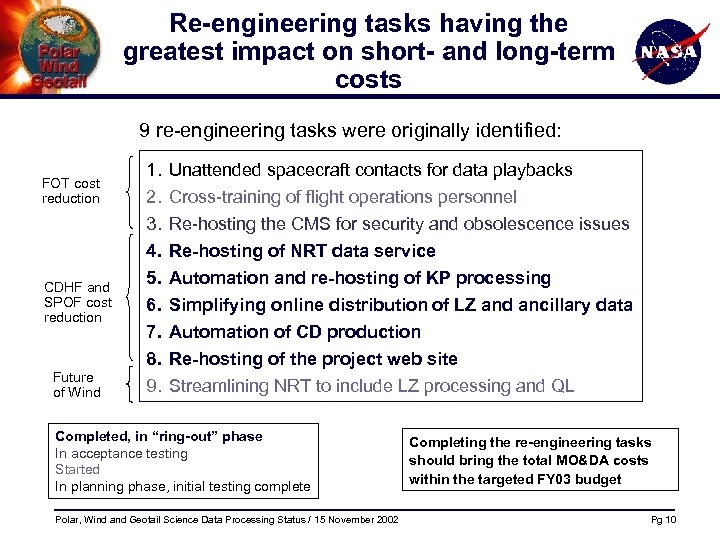
Re-engineering tasks having the greatest impact on short- and long-term costs 9 re-engineering tasks were originally identified: FOT cost reduction CDHF and SPOF cost reduction Future of Wind 1. 2. 3. 4. 5. 6. 7. 8. 9. Unattended spacecraft contacts for data playbacks Cross-training of flight operations personnel Re-hosting the CMS for security and obsolescence issues Re-hosting of NRT data service Automation and re-hosting of KP processing Simplifying online distribution of LZ and ancillary data Automation of CD production Re-hosting of the project web site Streamlining NRT to include LZ processing and QL Completed, in “ring-out” phase In acceptance testing Started In planning phase, initial testing complete Polar, Wind and Geotail Science Data Processing Status / 15 November 2002 Completing the re-engineering tasks should bring the total MO&DA costs within the targeted FY 03 budget Pg 10
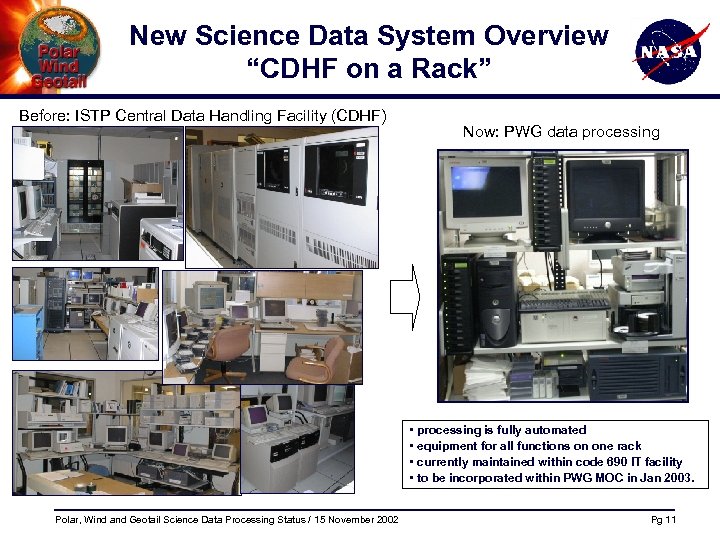
New Science Data System Overview “CDHF on a Rack” Before: ISTP Central Data Handling Facility (CDHF) Now: PWG data processing • processing is fully automated • equipment for all functions on one rack • currently maintained within code 690 IT facility • to be incorporated within PWG MOC in Jan 2003. Polar, Wind and Geotail Science Data Processing Status / 15 November 2002 Pg 11
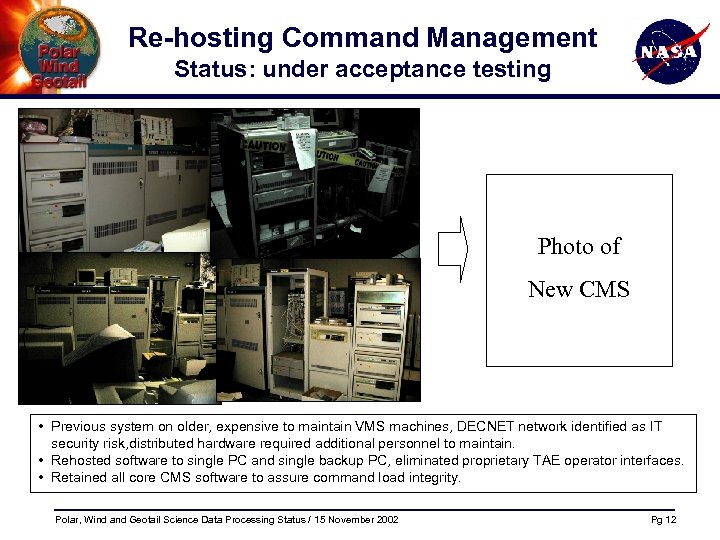
Re-hosting Command Management Status: under acceptance testing Photo of New CMS • Previous system on older, expensive to maintain VMS machines, DECNET network identified as IT security risk, distributed hardware required additional personnel to maintain. • Rehosted software to single PC and single backup PC, eliminated proprietary TAE operator interfaces. • Retained all core CMS software to assure command load integrity. Polar, Wind and Geotail Science Data Processing Status / 15 November 2002 Pg 12
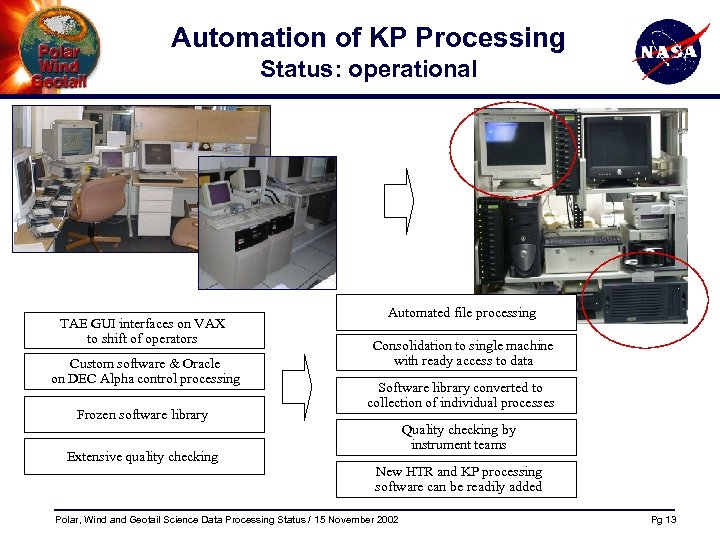
Automation of KP Processing Status: operational TAE GUI interfaces on VAX to shift of operators Custom software & Oracle on DEC Alpha control processing Frozen software library Automated file processing Consolidation to single machine with ready access to data Software library converted to collection of individual processes Quality checking by instrument teams Extensive quality checking New HTR and KP processing software can be readily added Polar, Wind and Geotail Science Data Processing Status / 15 November 2002 Pg 13
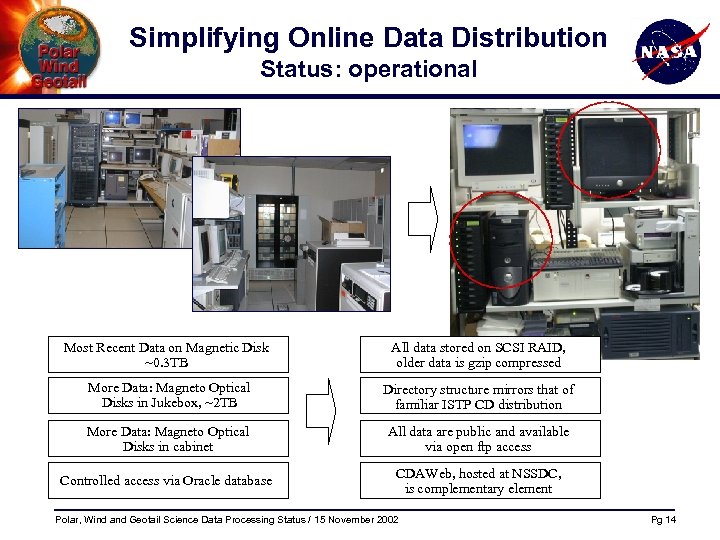
Simplifying Online Data Distribution Status: operational Most Recent Data on Magnetic Disk ~0. 3 TB All data stored on SCSI RAID, older data is gzip compressed More Data: Magneto Optical Disks in Jukebox, ~2 TB Directory structure mirrors that of familiar ISTP CD distribution More Data: Magneto Optical Disks in cabinet All data are public and available via open ftp access Controlled access via Oracle database CDAWeb, hosted at NSSDC, is complementary element Polar, Wind and Geotail Science Data Processing Status / 15 November 2002 Pg 14
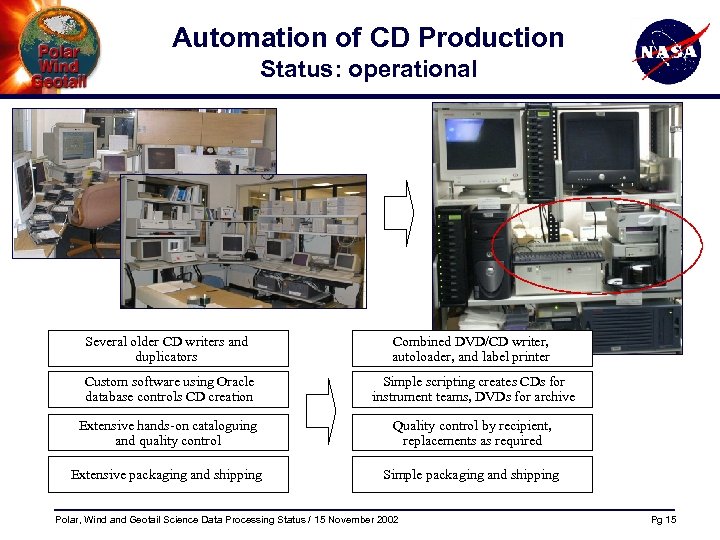
Automation of CD Production Status: operational Several older CD writers and duplicators Combined DVD/CD writer, autoloader, and label printer Custom software using Oracle database controls CD creation Simple scripting creates CDs for instrument teams, DVDs for archive Extensive hands-on cataloguing and quality control Quality control by recipient, replacements as required Extensive packaging and shipping Simple packaging and shipping Polar, Wind and Geotail Science Data Processing Status / 15 November 2002 Pg 15
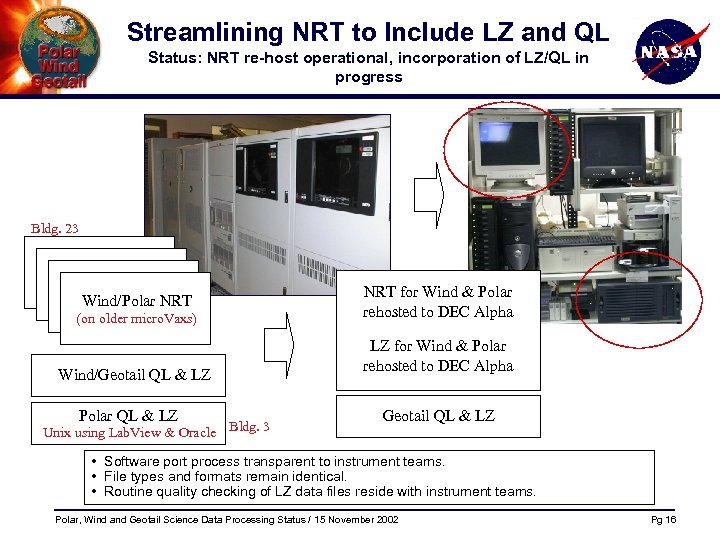
Streamlining NRT to Include LZ and QL Status: NRT re-host operational, incorporation of LZ/QL in progress Bldg. 23 Wind/Polar NRTWind/Polar on older NRT on older micro. Vaxs older NRT on Wind/Polar micro. Vaxs NRT micro. Vaxs (on older. Bldg. 3 micro. Vaxs) Wind/Geotail QL & LZ Polar QL & LZ Unix using Lab. View & Oracle Bldg. 3 NRT for Wind & Polar rehosted to DEC Alpha LZ for Wind & Polar rehosted to DEC Alpha Geotail QL & LZ • Software port process transparent to instrument teams. • File types and formats remain identical. • Routine quality checking of LZ data files reside with instrument teams. Polar, Wind and Geotail Science Data Processing Status / 15 November 2002 Pg 16
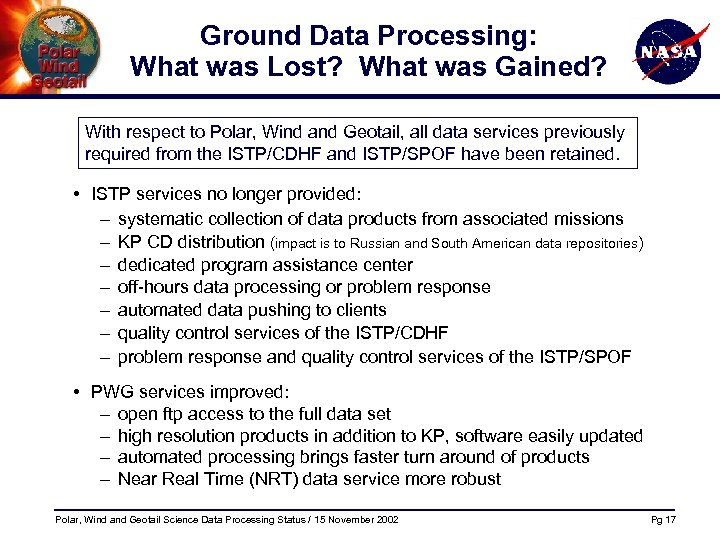
Ground Data Processing: What was Lost? What was Gained? With respect to Polar, Wind and Geotail, all data services previously required from the ISTP/CDHF and ISTP/SPOF have been retained. • ISTP services no longer provided: – systematic collection of data products from associated missions – KP CD distribution (impact is to Russian and South American data repositories) – dedicated program assistance center – off-hours data processing or problem response – automated data pushing to clients – quality control services of the ISTP/CDHF – problem response and quality control services of the ISTP/SPOF • PWG services improved: – open ftp access to the full data set – high resolution products in addition to KP, software easily updated – automated processing brings faster turn around of products – Near Real Time (NRT) data service more robust Polar, Wind and Geotail Science Data Processing Status / 15 November 2002 Pg 17
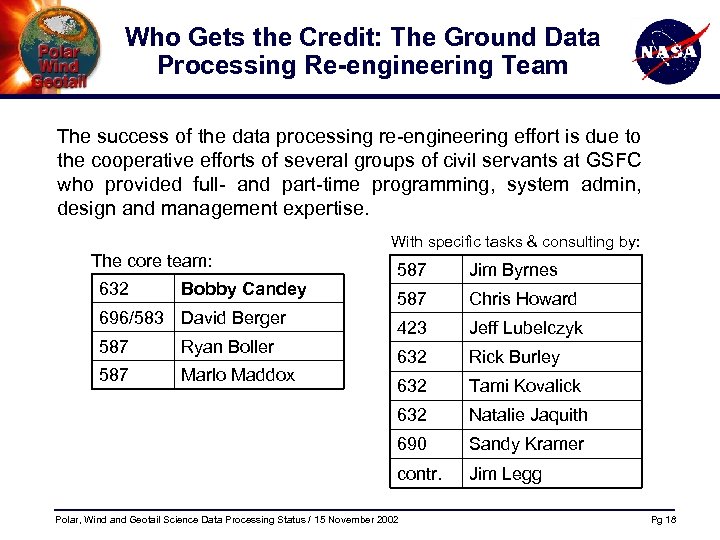
Who Gets the Credit: The Ground Data Processing Re-engineering Team The success of the data processing re-engineering effort is due to the cooperative efforts of several groups of civil servants at GSFC who provided full- and part-time programming, system admin, design and management expertise. With specific tasks & consulting by: The core team: 587 Ryan Boller 587 Marlo Maddox Chris Howard 423 Jeff Lubelczyk 632 Rick Burley 632 Tami Kovalick Natalie Jaquith Sandy Kramer contr. 696/583 David Berger 587 690 Bobby Candey Jim Byrnes 632 587 Jim Legg Polar, Wind and Geotail Science Data Processing Status / 15 November 2002 Pg 18
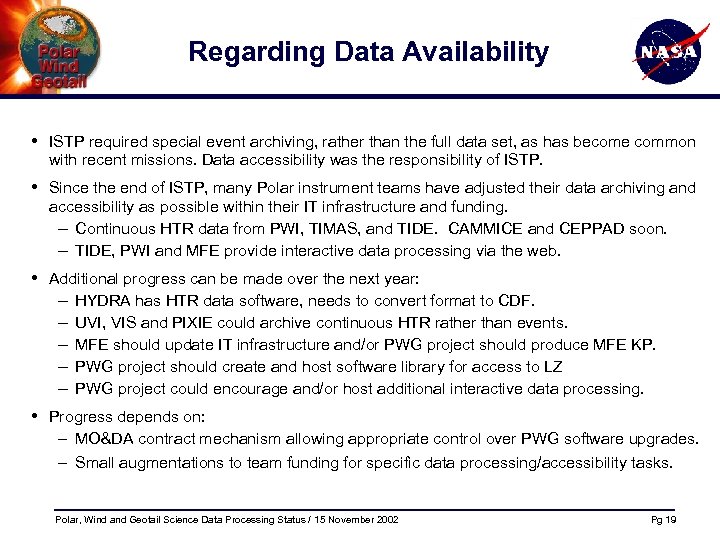
Regarding Data Availability • ISTP required special event archiving, rather than the full data set, as has become common with recent missions. Data accessibility was the responsibility of ISTP. • Since the end of ISTP, many Polar instrument teams have adjusted their data archiving and accessibility as possible within their IT infrastructure and funding. – Continuous HTR data from PWI, TIMAS, and TIDE. CAMMICE and CEPPAD soon. – TIDE, PWI and MFE provide interactive data processing via the web. • Additional progress can be made over the next year: – HYDRA has HTR data software, needs to convert format to CDF. – UVI, VIS and PIXIE could archive continuous HTR rather than events. – MFE should update IT infrastructure and/or PWG project should produce MFE KP. – PWG project should create and host software library for access to LZ – PWG project could encourage and/or host additional interactive data processing. • Progress depends on: – MO&DA contract mechanism allowing appropriate control over PWG software upgrades. – Small augmentations to team funding for specific data processing/accessibility tasks. Polar, Wind and Geotail Science Data Processing Status / 15 November 2002 Pg 19
Summary • The Polar spacecraft and instruments are healthy. • Science progress over the past two years has been particularly robust. Prospects for further breakthroughs with respect to substorm and reconnection physics appears very strong. • Science funding has been relatively stable. FY 02 funding was, on average, 90% of FY 01 levels. Funding profiles for FY 03 are budgeted at FY 02 levels. • The new mission operations and ground data processing systems are operating and serving the science community well. Several important reengineering tasks remain to be completed by the end of December 02. • A plan to implement additional data accessibility improvements is under development. Polar, Wind and Geotail Science Data Processing Status / 15 November 2002 Pg 20
Скачать презентацию Polar Wind Geotail Science Data Analysis Status November
8b75b746f49a60bc9959f2dae2b6931a.ppt