


 Скачать презентацию Pnoy SONA Nang nagsisimula pa lang
9145233df4f4380e08088aea6c4b2a13.ppt
- Количество слайдов: 44
 Pnoy SONA
 Nang nagsisimula pa lang tayo, hindi ko inasahang manunumbalik agad ang tiwala ng mundo sa Pilipinas. Ang inisip ko lang po noon: Itigil ang kalokohang umiiral sa sistema, para mahinto ang paglubog ng sitwasyon ng ating kababayang naghihikahos sa kahirapan. Sumagi man lang ba sa isip ninyo na magtutuloy-tuloy ang pag-angat natin sa global competitiveness rankings, at magiging tanyag tayo dahil sa bilis ng paglago ng ating ekonomiya? Ngayon, ang Pilipinas, nabansagan nang “Asia’s Rising Tiger, ” “Asia’s Rising Star, ” at “Asia’s Bright Spot” Ngayon nga po, sa kauna-unahang pagkakataon, investment grade na tayo ayon sa mga pinakatanyag na credit rating agencies. Malinaw ang sinasabi nito sa mga negosyante: Sulit mamuhunan sa Pilipinas; nabawasan na ang peligro sa pagnenegosyo dito. Ngayon, mas mababa ang interes at mas mahaba ang panahon ng pagbabayad ng utang, na nakakaengganyo sa mga negosyanteng tumaya sa Pilipinas. Sa pagtatayo at pagpapalawak ng negosyo, sisigla ang kalan, lalakas ang kompetisyon, at dadami ang oportunidad. Lahat ito, direktang resulta ng pagsulong ng reporma sa Daang Matuwid.
 Tignan po natin: Noong 2010, nasa P 1. 07 billion lang net foreign direct investments na pumasok sa ating bansa. Noong 2014, pumalo na ng $6. 2 billion ang net foreign direct investments. [Palakpakan] Ito ang pinakamataas na naitala sa ating buong kasaysayan. Pati sa domestic investments, napakasigla ng mga numero; ngayon, ang Pilipino, tumataya sa kapwa Pilipino. Ikumpara natin: Mula nang una itong itala noong 2003 hanggang sa pag-upo natin noong 2010, P 1. 24 trillion lang approved na domestic investments. Mula naman third quarter ng 2010 hanggang 2014, ang ipinasok na puhunan ng ating mga kababayan sa merkado: P 2. 09 trillion na po.
 Sa manufacturing naman po: Aaminin ko, noong unang nanungkulan tayo, isa sa mga pinakamalaking palaisipan ang pagbabalik ng sigla sa sektor na ito. Humarap sa maraming hamon ang mga industriya: Kuryente pa lang, napakamahal na nga, di pa tiyak. Di rin po biro ang pagtatayo ng pasilidad, dahil malaking puhunan ang kailangan para sa mga makina at pagsasanay ng mga tao. Kaya po ultimo low-tech na electric fan noon, kinailangan na nating angkatin. Dahil sa repormang nagpanumbalik ng kumpiyansa sa ating bansa, lumago ang manufacturing sector. Ang three-percent annual average growth ng sektor mula 2001 hanggang 2009, naiangat natin sa 8 percent mula 2010 hanggang 2014.
 Malinaw po: Kaya nang makipagsabayan ng Pilipino. Dati, ang tanging bentahe natin ay ang mababang pasahod sa ating mga manggagawa. Ngayon, dinadala na rin dito ang mga pabrika ng hi-tech na kagamitan: mula sa mga bahagi ng eroplano, mga electricycle, mga printer, at iba pang digital media products, hanggang sa high-quality medical devices gaya ng aortic catheter, at gamit para sa in vitro diagnostics at hemodialysis treatment.
 Alam po natin: Ang pangunahing sukatan kung tunay na tumatalab sa karaniwang Pilipino ang pag-unlad ay ang nalilikhang trabaho. Suriin natin ang pagbabago sa aspektong ito. Taon-taon, mahigit 800, 000 ang mga bagong pasok sa ating labor force. Idagdag na rin po natin diyan ang naiulat na pagkaunti ng Overseas Filipinos. Noong taong 2011, nasa 9. 51 million ang naitalang Overseas Filipinos ng Department of Foreign Affairs. Sa huling datos naman ng Disyembre ng taong 2014, nasa 9. 07 million na lang ito. Hindi kalabisang isiping marami sa tinatayang 440, 000 nabawas sa kanila ay bumalik sa Pilipinas, at nakahanap ng trabaho.
 Bagama’t may bagong salta sa merkado, mga balikbayan, at dati nang walang trabaho, ang unemployment rate, bumaba sa 6. 8 percent noong nakaraang taon. Ito ang pinakamababa sa loob ng isang dekada. Linawin ko rin po: Permanenteng trabaho ang nalikha natin; hindi tayo naghire ng magwawalis ng kalsada tuwing survey period lang , para kargahan ang resulta. Kaakibat ng paglikha natin ng trabaho ang maaliwalas na ugnayan ng manggagawa at negosyante. Ikumpara po natin. Noong siyam at kalahating taon ng nakaraang administrasyon, ang natuloy na labor strike: 199, o halos 21 kada taon. Sa limang taon po natin, ang suma-total ng natuloy na strike: 15 na nga lamang po. Noon nga pong 2013, ang nag-strike sa buong bansa: isa. Ito ang pinakamababa sa kasaysayan ng DOLE.
 Kaya naman po talagang bilib tayo kay Secretary Linda Baldoz, at sa sektor ng manggagawa at mga nangangasiwa. Si Sec. Linda po, hindi lang magaling; napakadali mo pang katrabaho dahil lagi kang positibo. Ikaw na nga ang tinagurian kong Pastora ng Gabinete. Maraming salamat sa iyo, Linda. Talagang napakalaki na nga po ng pagbabago. Noon, ang mga signage na lagi nating nakikita, di ho ba, “No Vacancy”. Ngayon, nagkalat ang mga anunsiyong “For Immediate Hiring”; magbukas ka lang ng diyaryo, makikita sa classified ads ang maraming kumpanyang naghahanap ng maeempleo. Ang iba nga, pagandahan pa ng insentibo. Merong magpa-interview ka lang, ililibre ka na ng almusal. Kapag na-hire naman, sagot na rin nila ang blow-out para ipagdiwang bago mong trabaho.
 Nagawa po ito dahil sa pagtugon sa tinatawag na job-skills mismatch. Dati, maraming nagsasabing wala silang trabaho, kahit napakarami namang bakanteng posisyong nakatala sa Phil. Job-Net na hindi napupunuan. Ang simpleng dahilan: Hindi tugma ang kakayahan ng ating mga kababayan sa hinahanap ng merkado. Simple lang din po ang solusyon dito: Kausapin ang mga prospective employer, para malaman kung anong klaseng kaalaman ang hinihingi ng mga posisyong binubuksan nila. Dito naman tayo nagsasanay ng trainees, upang masagad nila ang oportunidad.
 Ang prinsipyo ng ating pamumuno: Sa halip na bigyan ang kapwa ng isda, turuan siyang mangisda. Ang pag-unlad at pagkakataon, sinisiguro nating masasagad ng ating mga kababayan. Hindi puwedeng daanin sa trickle down, “bahala na” o “sana” ang pag-abot nito sa mga pinakamahirap. Ang paninindigan po natin: inclusive growth. Ang agenda: • ayuda, kaalaman, kasanayan, at kalusugan, para walang maiiwan. Ang isa sa mga mekanismo: Pantawid Pamilyang Pilipino Program.
 Sa Phil. Health po: Dumating tayong 47 milyong Pilipino lang benepisyaryo. Halos dinoble na po natin ito. Nitong Hunyo, pumalo na ang saklaw ng ating Phil. Health sa 89. 4 million na Pilipino. [Palakpakan] Ang pagbabago pa nga po: Tuwing eleksiyon, parang kabuteng nagsusulputan ang mga bagong benepisyaryo ng Phil. Health. Imbis kasi na pangangailangan ng taumbayan, interes ng kandidato ang naging basehan. Tinama na natin ang ganyang kalakaran. Heto pa po. Noong 2012, inanunsiyo natin: Kung kabilang pamilya mo sa lowest quintile o ang pinakamahirap na 20 porsiyento ng ating populasyon, at nagpagamot ka sa pampublikong ospital, sigurado, wala kang kailangang bayaran. Simula po noong 2014: Lumawak na iyan para saklawin ang susunod na quintile sa ating lipunan. Ibig sabihin, para sa pinakamahirap na 40 porsiyento, libre na ring magpagamot sa mga pampublikong ospital. Ito po ‘yung pagkalingang tinatawag ng iba na palpak at manhid. Ang tugon ko po, sabi nga ni Aiza Seguerra noong araw, “I thank you, bow. ”
 Muli po nating balangkasin ang kuwento ng nakaraang limang taon. Hinabol natin ang mga corrupt at nilinis ang sistema, na nanganak ng kumpiyansa po sa ating mga merkado. Pumasok ang negosyo, lumawak ang oportunidad, habang binibigyang-lakas nating magkatrabaho ang Pilipino. Sila ang tumatangkilik ng mga negosyo; ito naman pong mga negosyo, nakikitang meron nang level playing field; naaasahan ang pag-asenso nang hindi kailangang mandaya. Nagpapalawak sila ng operasyon, at umeempleo ng mas maraming tao. Siklo po ito: Katarungan, tiwala, paglago ng ekonomiya, pagkakataon, pag-asenso. Boss, ito mismo ang diwa ng “Kung walang corrupt, walang mahirap. ”
 Bihira ang nagbabanggit na may katuwang tayong pribadong korporasyon, na naalala ang kanilang mga karapatan, pero tila ba nalimot ang kanilang mga obligasyon. Ang katuwang na ito, sagot ang maintenance. Dapat, noong 2008, nagkaroon ng general overhaul ang MRT, pero nang suriin ng ating Department of Transportation and Communication, halos pagpipintura lang pinagawang overhaul. Sa pagwawalang-bahalang ito, parang ginarantiyang masisira ang tren. Di po ba maski sinong kumpanya, dapat sinisigurong masusulit ang kanilang investment? Pero hinayaan lang nilang lumala nang lumala ang sitwasyon hanggang umabot sa puntong ipinasa na sa atin nang ora-orada ang pagsasaayos ng MRT.
 Nang aayusin na natin, bigla naman silang humirit, sila na lang daw ulit. Pero ang mungkahi nilang pagsasaayos, di-hamak na mas mahal kaysa ating plano. Siyempre, katumbas nito, dagdag na gastos at perwisyo sa taumbayan. Hindi tayo pumayag, at kumilos na nga para makakuha ng ayuda tulad ng mga bagong bagon. Ang problema, mapilit ang korporasyon, kaya’t pina-TRO nila ang pagbili nito. Kaya umabot sa ganitong situwasyon ang MRT. Habang sumasailalim sa prosesong ito, nagsasagawa na tayo ng agarang maintenance. Paparating na rin ang mga mas malalaki at pangmatagalang solusyon. Sa susunod na buwan, darating na ang prototype ng bagon; ‘pag pumasa ito sa pagsusuri, mula Enero ay 3 bagon ang sisimulang i-deliver kada buwan hanggang makumpleto ang in-order nating 48. Ongoing na rin ang proseso para sa mga bagong riles, at pag-a-upgrade ng signalling system at automatic fare collection system; inaasahan ang lahat ng ito bago tayo bumaba sa puwesto. Ang power supply para sa mga tren, maa-upgrade bago matapos ang 2016. May 12 escalator na ring maaayos bago matapos ang taong ito, habang ongoing na ang procurement para sa rehabilitasyon ng 34 pang escalator at 32 elevator. Ipapaalala ko lang po: Hindi puwedeng laktawan ang proseso sa mga bagay na ito; ayaw na nating maantala ng kaliwa’t kanang demandahan ang atin pong mga hakbang.
 Tumungo naman po tayo sa Public Private Partnerships. Kapag pinagsama natin ang solicited PPP projects ng nakaraang tatlong administrasyon, ang suma-total: anim na proyekto. Sa atin, may 50 proyekto na: Ang sampu dito, awarded na; ang 13, nasa bidding; habang 27 naman ang nakapila pa. Kayo na po ang magkumpara sa pagkakaiba. Dati, walang nakikisali sa proyekto, ngayon, nag-uunahan na ang mga pribadong kumpanya, at nagbibigay ng premium. Suma-total, ang primang natanggap natin mula sa mga kumpanyang katuwang sa PPP, umabot na sa P 64. 1 billion, na napupunta naman sa kaban ng ating bayan. Kada matagumpay na proyekto, magbubunsod din ng higit na kumpiyansa, na siyang magpapabilis sa pagpapatayo natin ng iba pang kinakailangang imprastruktura. Ang pagtitiis ng ating mga Boss, maiibsan, kundi man matatapos na.
 Kumpiyansa nga po ang ating mga kababayan sa estabilidad ng kanilang kinabukasan. Ngayon, maski bagong pasok pa lang sa trabaho ay nakakapaghulog na para sa sariling sasakyan o condo unit. Di na nakakagulat na nitong nakaraang taon, tumaas ng 27 percent ang car sales sa Pilipinas. Ang paniniwala ngayon: Kayang-kaya nang bayaran, di lang down payment, kundi maging ang monthly amortization. Sa dami ng nakakapagpundar ng bagong sasakyan, dalawa po sa pinakamalaking kompanyang nagbebenta sa Pilipinas ay inaabot ng dalawa’t kalahati hanggang tatlong buwan bago makapag-deliver ng kotse. Sa sarili ko pong karanasan, noong una akong nagkatrabaho, kinalkula ko kung gaano katagal bago ako makaipon para sa sariling kotse. Dalawampung taon lang naman po ang aabutin, segunda mano pa.
 Nakausap din po natin ang mga pinuno ng dalawang malaking kumpanya; ang isa, mayroon nang mga pabrika dito habang isa pa ay gusto ring pumasok. Pareho po silang nagpahayag ng interes na magtayo ng research and development facilities dito po sa ating bansa. Nakita nila ang potensiyal at talento ng Pilipinong makatulong upang mapanatili ang kanilang magandang posisyon sa merkado. Ang tanong nila: Kaya ba nating mag-supply ng daan-daang empleadong may masteral at doctoral degrees sa engineering? Ang tugon ng mga kaibigan natin sa DOST: Kayang-kaya. Sabi ko pa po, kung may magbubukas na trabaho sa high-tech na industriya, baka makapagpauwi pa tayo ng mga OFW, na papayag naman sigurong tumanggap ng mas mababang sahod kung mapapalapit sila sa kanilang pamilya. Ang sabi ng mga kausap natin: Hindi kailangang babaan, dahil handa silang tapatan ang suweldo nitong mga kababayan nating ito.
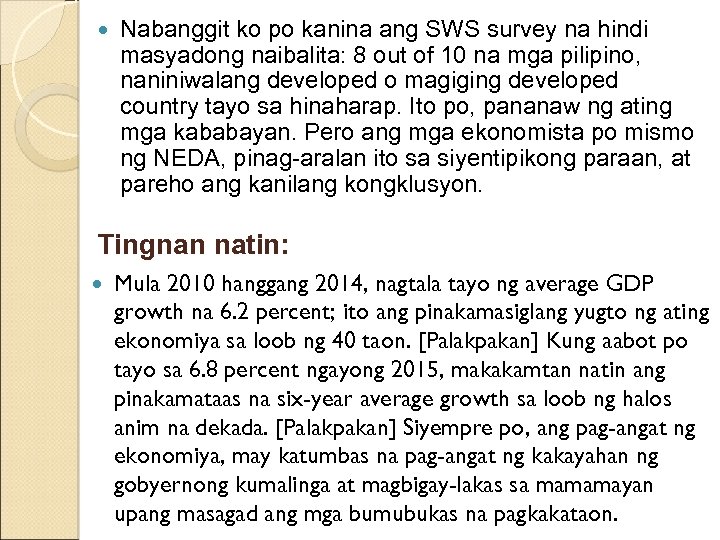 Nabanggit ko po kanina ang SWS survey na hindi masyadong naibalita: 8 out of 10 na mga pilipino, naniniwalang developed o magiging developed country tayo sa hinaharap. Ito po, pananaw ng ating mga kababayan. Pero ang mga ekonomista po mismo ng NEDA, pinag-aralan ito sa siyentipikong paraan, at pareho ang kanilang kongklusyon. Tingnan natin: Mula 2010 hanggang 2014, nagtala tayo ng average GDP growth na 6. 2 percent; ito ang pinakamasiglang yugto ng ating ekonomiya sa loob ng 40 taon. [Palakpakan] Kung aabot po tayo sa 6. 8 percent ngayong 2015, makakamtan natin ang pinakamataas na six-year average growth sa loob ng halos anim na dekada. [Palakpakan] Siyempre po, ang pag-angat ng ekonomiya, may katumbas na pag-angat ng kakayahan ng gobyernong kumalinga at magbigay-lakas sa mamamayan upang masagad ang mga bumubukas na pagkakataon.
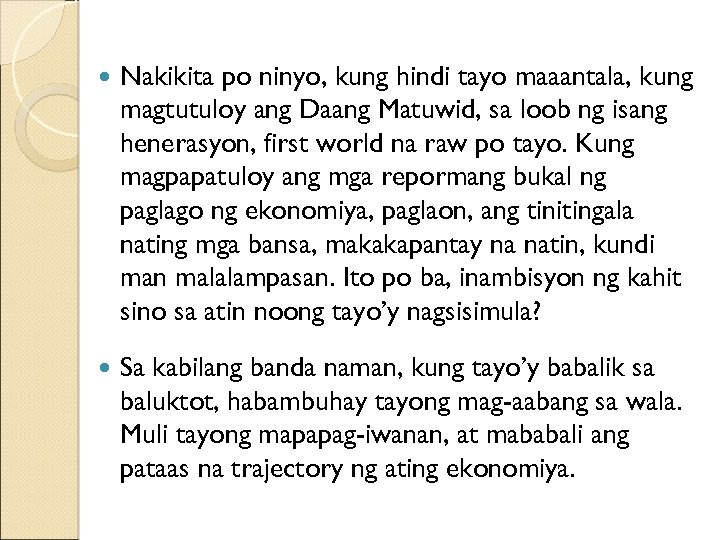 Nakikita po ninyo, kung hindi tayo maaantala, kung magtutuloy ang Daang Matuwid, sa loob ng isang henerasyon, first world na raw po tayo. Kung magpapatuloy ang mga repormang bukal ng paglago ng ekonomiya, paglaon, ang tinitingala nating mga bansa, makakapantay na natin, kundi man malalampasan. Ito po ba, inambisyon ng kahit sino sa atin noong tayo’y nagsisimula? Sa kabilang banda naman, kung tayo’y babalik sa baluktot, habambuhay tayong mag-aabang sa wala. Muli tayong mapapag-iwanan, at mababali ang pataas na trajectory ng ating ekonomiya.
 SONA 2015: a Legacy of A Disconnected Economy
 Achievements?
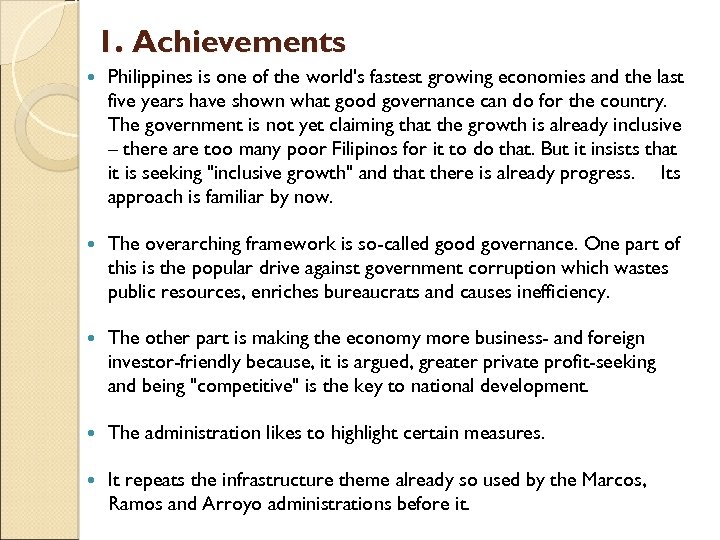 1. Achievements Philippines is one of the world's fastest growing economies and the last five years have shown what good governance can do for the country. The government is not yet claiming that the growth is already inclusive – there are too many poor Filipinos for it to do that. But it insists that it is seeking "inclusive growth" and that there is already progress.
Its approach is familiar by now. The overarching framework is so-called good governance. One part of this is the popular drive against government corruption which wastes public resources, enriches bureaucrats and causes inefficiency. The other part is making the economy more business- and foreign investor-friendly because, it is argued, greater private profit-seeking and being "competitive" is the key to national development. The administration likes to highlight certain measures. It repeats the infrastructure theme already so used by the Marcos, Ramos and Arroyo administrations before it.
1. Achievements Philippines is one of the world's fastest growing economies and the last five years have shown what good governance can do for the country. The government is not yet claiming that the growth is already inclusive – there are too many poor Filipinos for it to do that. But it insists that it is seeking "inclusive growth" and that there is already progress.
Its approach is familiar by now. The overarching framework is so-called good governance. One part of this is the popular drive against government corruption which wastes public resources, enriches bureaucrats and causes inefficiency. The other part is making the economy more business- and foreign investor-friendly because, it is argued, greater private profit-seeking and being "competitive" is the key to national development. The administration likes to highlight certain measures. It repeats the infrastructure theme already so used by the Marcos, Ramos and Arroyo administrations before it.
 1. Achievements This involves mostly transport infrastructure of roads and railways (especially in and around the National Capital Region or NCR), airports, and sea ports but also some water and other projects. National road projects account for a large part of infrastructure spending and are funded the traditional way with public funds. The highest-profile big-ticket infrastructure projects however will be implemented with profit-oriented Public. Private Partnership (PPP) schemes; only ten out of 54 declared priority projects have been awarded so far. Unable to resolve the crisis of joblessness, the government's flagship anti-poverty effort is the conditional cash transfer (CCT) dole-out under the Pantawid Pamilyang Pilipino Program (4 Ps).
 1. Achievements The reported 4. 5 million beneficiaries as of end 2014 already includes 218, 000 beneficiary families living in the street, displaced by disasters, and in other special circumstances who were added after the regular CCT program was criticized for being too household-based. The government also boasts about large public investments in social spending. In education it claims to have addressed backlogs in schools, classrooms, desks, textbooks and teachers inherited from the previous Arroyo administration. It does not report new backlogs since 2010 though and uses the controversial shift to K-to-12 to divert from this.
 1. Achievements The administration claims to seek Universal Health Care but it does this not through improving the public hospital system but by increased funding for the health insurance scheme Philhealth. The scheme's coverage is greatly exaggerated and Filipinos still pay for some 68% of their personal health care needs out-of-pocket. Worryingly, even these vital social services have been subjected to profit-seeking with breakthrough PPP projects in building schools and in privatizing hospitals. The administration is enthusiastic about its supposed achievements.
 1. Achievements Over all other indicators it is proudest about economic growth which became second only to China in the region and among the 30 fastest worldwide. Gross domestic product (GDP) grew at an annual average of 6. 3% over the 2010 -2014 period. The administration trumpets investment grade credit ratings from the major international ratings agencies Standard & Poor's, Fitch and Moody's. It is also excited about favorable assessments of the country's "competitiveness" by the business-oriented World Bank, World Economic Forum (WEF) and Heritage Foundation. Net foreign direct investment (FDI) increased almost six-fold from 2010 to US$6. 2 billion in 2014.
 1. Achievements The economy under Pres. Aquino has supposedly broken from its past of just 5% long-term trend growth. Continuity between this government and the next is said to be more important than ever because the rapid growth has to be sustained over the next decade or so for the benefits to really start to be felt widely.
 Development?
 2. Development But rather than being encouraging, this actually draws attention to the exclusionary nature of growth in the last few years. It is apparently acceptable that years of economic growth still mainly benefits just a few rich families, corporations, and foreign transnational firms while the number of poor and unemployed continues to increase. This is acceptable because, experts say, that is how an economy works. Inequality is normal. It takes time for economic gains to “trickle down”. Business activity and rising profits are important because these will eventually benefit the majority of poor Filipinos. The wealth of the 10 richest Filipinos has already more than tripled under the Aquino administration from Php 630 billion in 2010 to Php 2. 2 trillion in 2015, or a 250% increase.
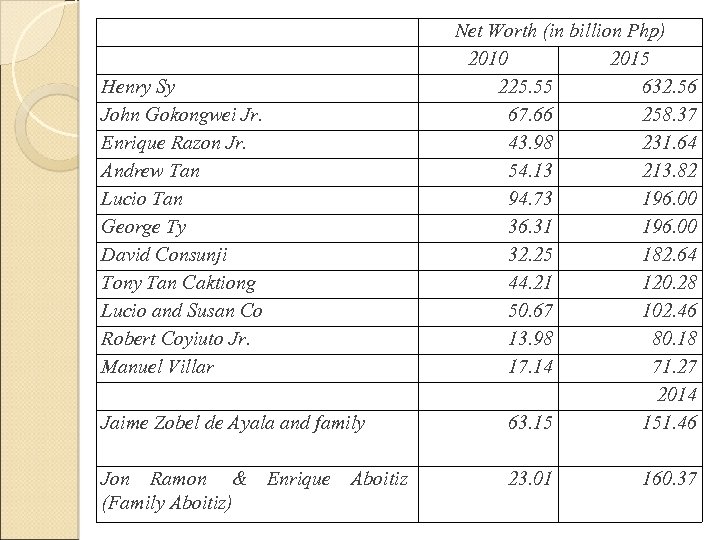 Henry Sy John Gokongwei Jr. Enrique Razon Jr. Andrew Tan Lucio Tan George Ty David Consunji Tony Tan Caktiong Lucio and Susan Co Robert Coyiuto Jr. Manuel Villar Jaime Zobel de Ayala and family Jon Ramon & Enrique Aboitiz (Family Aboitiz) Net Worth (in billion Php) 2010 2015 225. 55 632. 56 67. 66 258. 37 43. 98 231. 64 54. 13 213. 82 94. 73 196. 00 36. 31 196. 00 32. 25 182. 64 44. 21 120. 28 50. 67 102. 46 13. 98 80. 18 17. 14 71. 27 2014 63. 15 151. 46 23. 01 160. 37
 2. Development The net income of the country's some 260 listed firms on the Philippine Stock Exchange (PSE) rose from Php 438 billion in 2010 to Php 583 billion in 2014, or a 33% increase. The net income of the country's Top 1000 corporations grew from Php 804 billion in 2010 to Php 1. 0 trillion in 2013, or a 26% increase. In contrast, the real value of the average daily basic pay of millions of workers nationwide increased by less than Php 9 or just 3. 5% between 2010 and 2014. The mandated minimum wage is highest in NCR but even here its real value only rose by Php 17 or by less than 5% since June 2010.
 2. Development The number of poor and unemployed Filipinos has continued to swell. Since the start of the Aquino administration the number of poor Filipinos has likely increased by some 2. 5 million to 25. 8 million poor in 2014, using the very low official poverty thresholds. This is despite Php 178 billion being spent on the 4 Ps CCT program over the period 2010 -2014. IBON's latest national survey in May 2015 had seven out of 10 respondents (67%) seeing themselves as poor – which would be equivalent to 67 million poor Filipinos. This larger figure is more consistent with the 66 million poor Filipinos earlier calculated by IBON using Family Income and Expenditure Survey (FIES) data for 2012. This massive poverty is despite the government's reportedly augmented Php 78 billion CCT budget for 2015.
 2. Development The number of unemployed Filipinos has likely risen by at least 100, 000, the number of underemployed Filipinos by at least a million, and the number of merely part-time workers by at least 1. 5 million. IBON estimates 12. 2 million unemployed and underemployed Philippines as of 2014 consisting of 4. 3 million unemployed and 7. 9 million underemployed. These estimates are not as precise as they should be because of various problems of comparability or incompleteness of available government data. But they are not unreasonable estimates. For instance the rise in poverty is calculated by using annual 2009 FIES data, approximated poverty magnitudes using first semester 2014 Annual Poverty Indicator Survey (APIS) results, and considering how poverty incidence rose from 24. 6% in 2013 to 25. 8% in 2014.
 2. Development The employment estimates compensate for how recent official figures underestimate unemployment and underemployment by excluding or having incomplete Region VIII data. There were already 563, 000 unemployed and underemployed in Region VIII before Typhoon Yolanda hit and this can only have grown given still unresolved livelihood and infrastructure problems in the aftermath.
As it is, even the latest comparable official figures for April 2015 (that exclude Leyte) clearly show the quality of work deteriorating. The economy is actually shedding full-time work and officially reported unemployment could be ignoring increasing numbers of discouraged job-seekers. This deterioration is also due to how the share of nonregular and agency-hired workers rose from 37% in 2008 to 44% in 2012, according to the government's latest estimates.
2. Development The employment estimates compensate for how recent official figures underestimate unemployment and underemployment by excluding or having incomplete Region VIII data. There were already 563, 000 unemployed and underemployed in Region VIII before Typhoon Yolanda hit and this can only have grown given still unresolved livelihood and infrastructure problems in the aftermath.
As it is, even the latest comparable official figures for April 2015 (that exclude Leyte) clearly show the quality of work deteriorating. The economy is actually shedding full-time work and officially reported unemployment could be ignoring increasing numbers of discouraged job-seekers. This deterioration is also due to how the share of nonregular and agency-hired workers rose from 37% in 2008 to 44% in 2012, according to the government's latest estimates.
 2. Development The number of contractual and other workers in insecure and poorly-paid work has been increasing in the last two years. As of April 2015, 15. 5 million or 40% of employed Filipinos were in just part-time work with likely very low pay and scant benefits. Economic elitism has been the norm for the economy for decades but the growth in wealth and profits for a few has been striking under the Aquino administration. There can be quibbling about the exact figures but the essential conclusion is ironclad: the years of rapid economic growth under the Aquino administration have made a few much richer while leaving the majority as poor as ever. Worse, the economy has become even more distorted and less able to provide secure jobs with decent pay to millions of Filipinos.
 Progress?
 3. Progress All this raises some important questions. Why is there a disconnect between growth and development? And if the current conditions of most Filipinos are bad, are their prospects any better? There is a disconnect because the economy is being managed by the Aquino administration according to what is immediately profitable for big domestic and foreign corporations rather than what the majority needs in terms of stable jobs and higher incomes over the longterm. The most profitable opportunities in recent years have been in real estate, construction, finance, business process outsourcing (BPO, especially call centers) and overseas Filipino remittance-driven consumer spending.
 3. Progress This is because of low global interest rates and the continued demand for cheap Filipino labor. The Aquino administration has relied on these sectors for economic growth rather than take the more strategic view of supporting domestic agriculture and building genuinely Filipino industry. Yet these latter production sectors are the more solid foundations of a strong domestic economy. In the Top 1000 corporations the sectors which saw the biggest growth in profits between 2010 and 2013 are finance, insurance, real estate and business services (69% increase), wholesale and retail trade (47%) and construction (43%). Agriculture saw less than 14% growth and there was an 11% contraction in manufacturing
 3. Progress Among PSE-listed firms the biggest increase in net income between 2010 and 2014 were in property (26%), financials (26%), and holding firms that are heavily invested in property and construction (41%). There was a 2. 1% contraction in the industrial sector. The problem with real estate, construction, finance, BPOs, and remittance-driven consumer spending is that they are narrow and shallow sources of growth. They account for a relatively small share of total employment. Overall they have weak forward and backward linkages with the domestic economy either as suppliers of purchasers of inputs. They are also heavily concentrated in a few firms and in the NCR, Central Luzon and Calabarzon regions. So while specific businesses here may be very profitable there is actually a weak effect on overall Philippine economic development.
 3. Progress The drivers of growth should be domestic agriculture and Filipino industry, which is not the same as foreign investor-dominated industry. These production sectors have great potential to generate jobs and to support rising incomes. They can be the backbone of an economy in spanning agricultural and mineral raw materials, manufacturing, and high value services. They will drive Filipino science and technology. However production has continued its decades-long fall under the Aquino administration. Agriculture, manufacturing, construction and mining have cumulatively fallen from 39. 5% of GDP in 2010 to 39. 0% in 2014.
 3. Progress Despite its rich natural resources the Philippine economy is a service-oriented economy more than a producing one. This is most of all what compromises domestic job generation. Restoring the share of production in the economy to their levels in the 1960 s and 1970 s for instance could create an additional 2 -2. 5 million jobs. The weak production is also what keeps the economy backward, incomes low, and growth slow. This is why the marked slowdown in growth since late 2013 is not surprising and why the administration's blaming supposed government underspending is incorrect and only diverts from the real problem. Sustainable growth that really benefits the majority is impossible without real and significant Filipino production.
 3. Progress Lacking sound fundamentals, the country has just become more vulnerable to the inevitable global economic downturn. The recent financial difficulties in Greece and the rest of Europe as well as the China stock exchange turmoil are reminders of the chronic volatility of global capitalism. The population will breach the 100 million-mark under the Aquino administration. Without any radical shift in economic policy, the prospects of the overwhelming number of these Filipinos will remain poor. The government has to protect and support Filipino agriculture and industry. The rights of farmers to land its products, and of workers to an equitable share of their labor need to be upheld.
 3. Progress The public education and health care system has to be strengthened and decent housing for all has to be ensured. Foreign trade and investment should serve the Philippine economy and not the other way around. The continued deterioration of the economy in the last five years of the Aquino administration has made nationalist and pro-people economic development more urgent than ever. The president will report many things in the SONA to distract from how, in the most important things that matter, the economy and Filipinos have become worse off.
 END
END