


 Скачать презентацию PMI PMP Exam Prep PMI Mile High Chapter
9ace7d0bfd9811ebdb98409c9c5d0051.ppt
- Количество слайдов: 47
 PMI PMP Exam Prep PMI Mile High Chapter North Area Study Group Cost Presentation Prepared by Denise Robertson 8 March 2003 Denise Robertson Information quoted or derived from PMI, Mulcahy, and Looking Glass Development's PMP exam prep materials Page 1
 Cost Estimating n Concepts for working with cost estimates: n n n Estimates are resource driven and based on the WBS Estimates should be made by person responsible for the work Estimate accuracy is improved by historical information Denise Robertson Information quoted or derived from PMI, Mulcahy, and Looking Glass Development's PMP exam prep materials 2
 Cost Estimating n Concepts for working with cost estimates (continued): n n n Costs should be managed to cost estimates (“toe the line”) A cost baseline should be kept and not changed except for project changes Plans should be revised as necessary during work Denise Robertson Information quoted or derived from PMI, Mulcahy, and Looking Glass Development's PMP exam prep materials 3
 Cost Estimating n Concepts for working with cost estimates (continued): n n Corrective action should be taken when (cost) problems occur Management estimates should not be taken at face value; the PM is responsible for performing his own estimates and reconciling any differences Denise Robertson Information quoted or derived from PMI, Mulcahy, and Looking Glass Development's PMP exam prep materials 4
 Earned Value Analysis n n Measures scope, time project performance Integrates cost, time, scope Can be used to forecast future performance and project completion date EV charts are in texts. You may want to substitute them for old terminology “placemat” features or use the following to match the placement format. Denise Robertson Information quoted or derived from PMI, Mulcahy, and Looking Glass Development's PMP exam prep materials 5
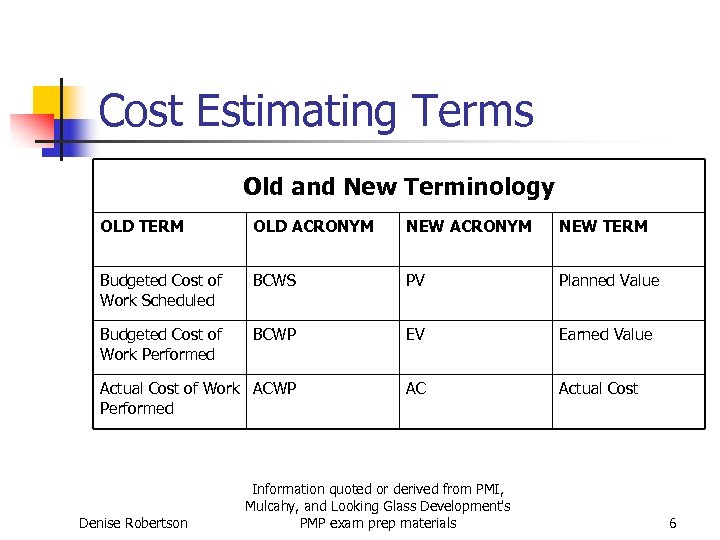 Cost Estimating Terms Old and New Terminology OLD TERM OLD ACRONYM NEW TERM Budgeted Cost of Work Scheduled BCWS PV Planned Value Budgeted Cost of Work Performed BCWP EV Earned Value Actual Cost of Work ACWP Performed AC Actual Cost Denise Robertson Information quoted or derived from PMI, Mulcahy, and Looking Glass Development's PMP exam prep materials 6
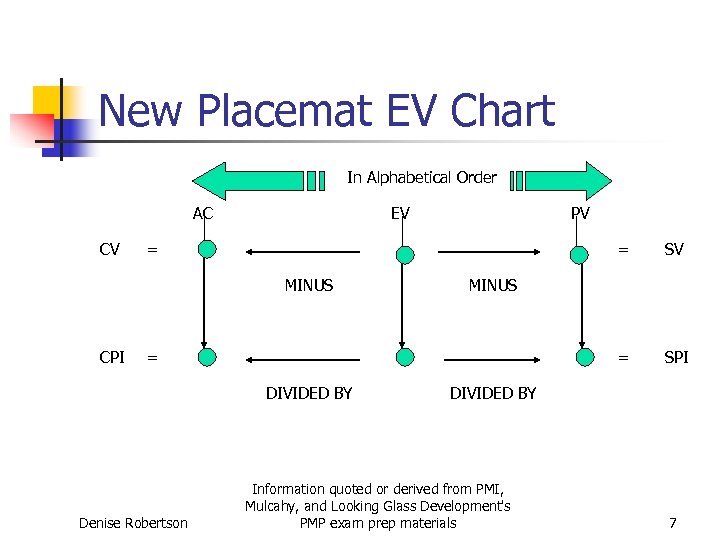 New Placemat EV Chart In Alphabetical Order AC CV EV = = Denise Robertson SPI MINUS = DIVIDED BY SV = MINUS CPI PV DIVIDED BY Information quoted or derived from PMI, Mulcahy, and Looking Glass Development's PMP exam prep materials 7
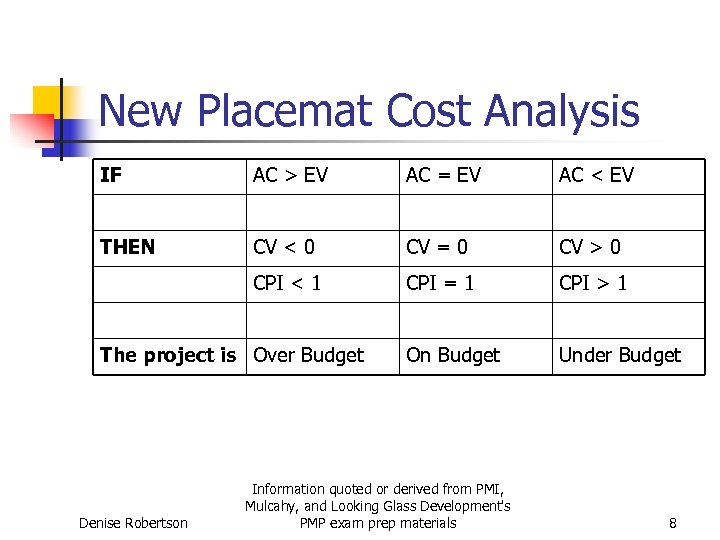 New Placemat Cost Analysis IF AC > EV AC = EV AC < EV THEN CV < 0 CV = 0 CV > 0 CPI < 1 CPI = 1 CPI > 1 On Budget Under Budget The project is Over Budget Denise Robertson Information quoted or derived from PMI, Mulcahy, and Looking Glass Development's PMP exam prep materials 8
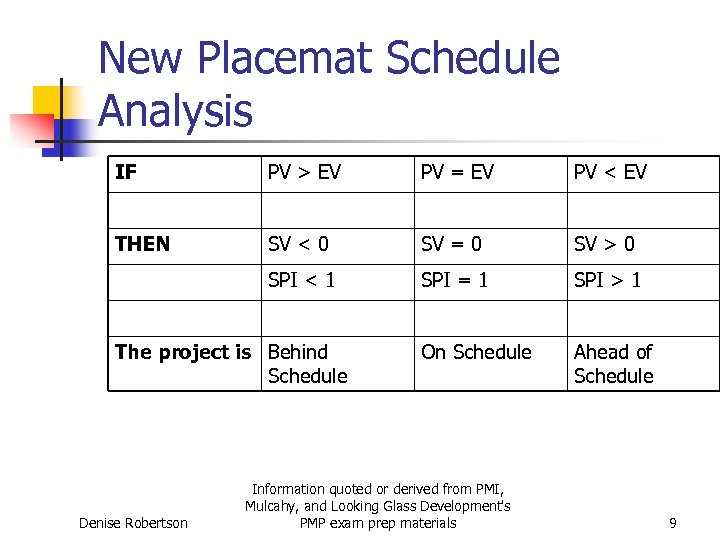 New Placemat Schedule Analysis IF PV > EV PV = EV PV < EV THEN SV < 0 SV = 0 SV > 0 SPI < 1 SPI = 1 SPI > 1 On Schedule Ahead of Schedule The project is Behind Schedule Denise Robertson Information quoted or derived from PMI, Mulcahy, and Looking Glass Development's PMP exam prep materials 9
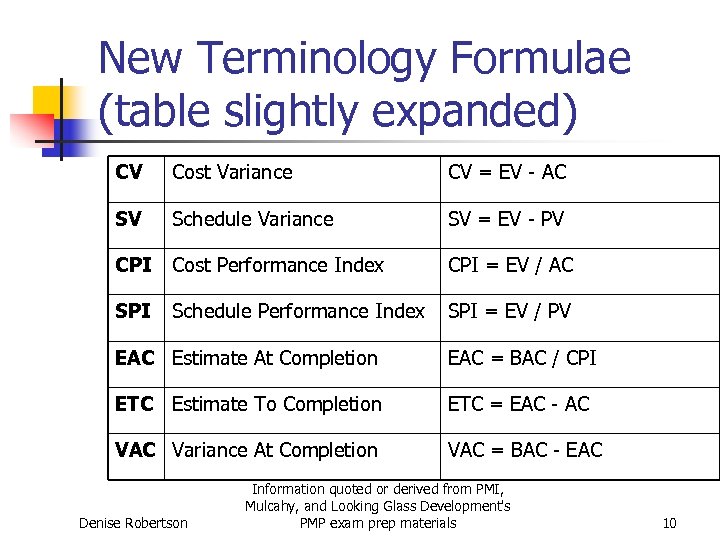 New Terminology Formulae (table slightly expanded) CV Cost Variance CV = EV - AC SV Schedule Variance SV = EV - PV CPI Cost Performance Index CPI = EV / AC SPI Schedule Performance Index SPI = EV / PV EAC Estimate At Completion EAC = BAC / CPI ETC Estimate To Completion ETC = EAC - AC Variance At Completion VAC = BAC - EAC Denise Robertson Information quoted or derived from PMI, Mulcahy, and Looking Glass Development's PMP exam prep materials 10
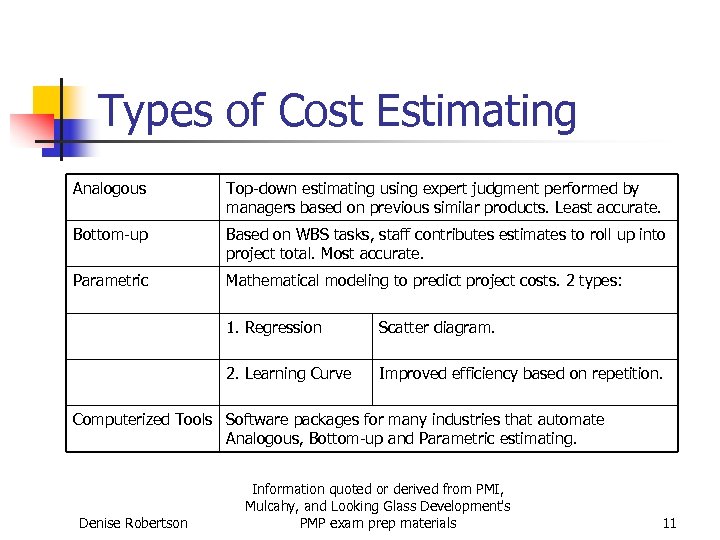 Types of Cost Estimating Analogous Top-down estimating using expert judgment performed by managers based on previous similar products. Least accurate. Bottom-up Based on WBS tasks, staff contributes estimates to roll up into project total. Most accurate. Parametric Mathematical modeling to predict project costs. 2 types: 1. Regression Scatter diagram. 2. Learning Curve Improved efficiency based on repetition. Computerized Tools Software packages for many industries that automate Analogous, Bottom-up and Parametric estimating. Denise Robertson Information quoted or derived from PMI, Mulcahy, and Looking Glass Development's PMP exam prep materials 11
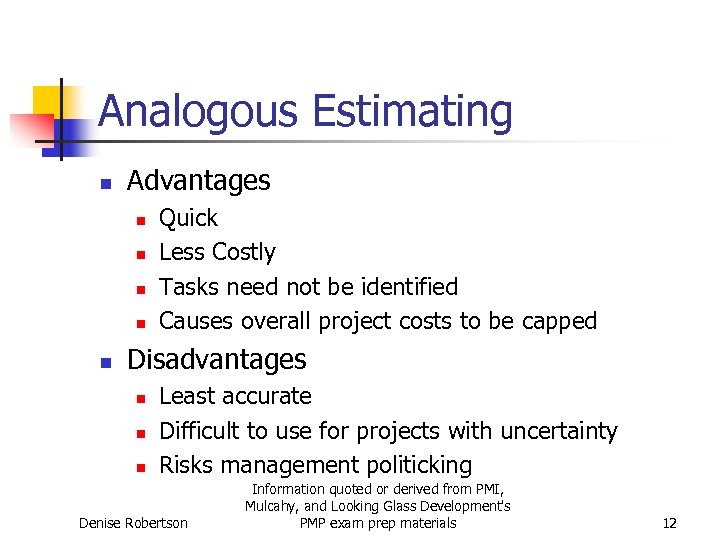 Analogous Estimating n Advantages n n n Quick Less Costly Tasks need not be identified Causes overall project costs to be capped Disadvantages n n n Least accurate Difficult to use for projects with uncertainty Risks management politicking Denise Robertson Information quoted or derived from PMI, Mulcahy, and Looking Glass Development's PMP exam prep materials 12
 Bottom-up Cost Estimating n Advantages n n Most accurate Gains buy-in from team Provides basis for monitoring and control Disadvantages n n n Time intensive Encourages padding Risks team politicking Denise Robertson Information quoted or derived from PMI, Mulcahy, and Looking Glass Development's PMP exam prep materials 13
 Earned Value Associations n Per Mulcahy, the PMP exam associates n n n “Measure project performance continually. ” “Refine control limits. ” “Evaluate the effectiveness of corrective action. ” with the controlling process group so consider thinking of them with EV. Denise Robertson Information quoted or derived from PMI, Mulcahy, and Looking Glass Development's PMP exam prep materials 14
 Resource Planning Activities Pertaining to Cost Estimation n Construct responsibility assignment matrix n n Intersection of WBS and OBS (Organization Breakdown Structure) Identification of management leads and WBS resources Calculate staff availability Calculate amount of work that can be completed within a given period of time n Work = (total hrs. * availability) * efficiency where efficiency is. 70 Denise Robertson Information quoted or derived from PMI, Mulcahy, and Looking Glass Development's PMP exam prep materials 15
 Resources and Cost Estimating n n n Cost estimating involves developing an approximation of the cost of resources needed to complete project activities Cost estimating is resource driven Resource requirements are based on quantities of each element at the lowest level of the WBS. Denise Robertson Information quoted or derived from PMI, Mulcahy, and Looking Glass Development's PMP exam prep materials 16
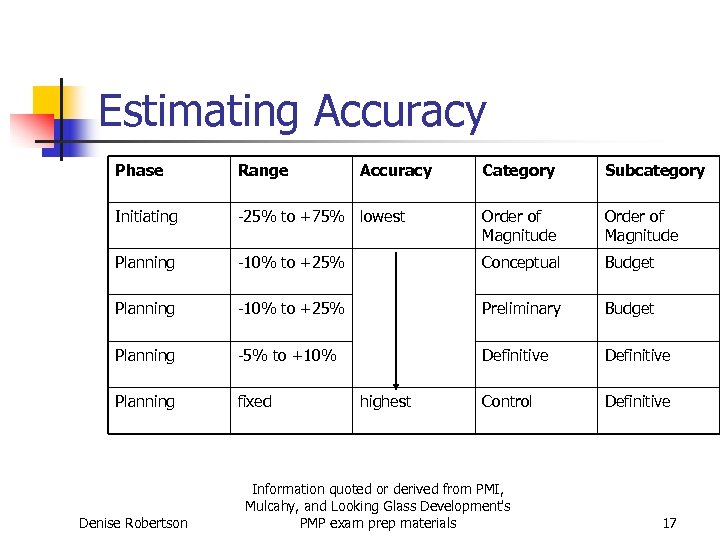 Estimating Accuracy Phase Range Initiating Category Subcategory -25% to +75% lowest Order of Magnitude Planning -10% to +25% Conceptual Budget Planning -10% to +25% Preliminary Budget Planning -5% to +10% Definitive Planning fixed Control Definitive Denise Robertson Accuracy highest Information quoted or derived from PMI, Mulcahy, and Looking Glass Development's PMP exam prep materials 17
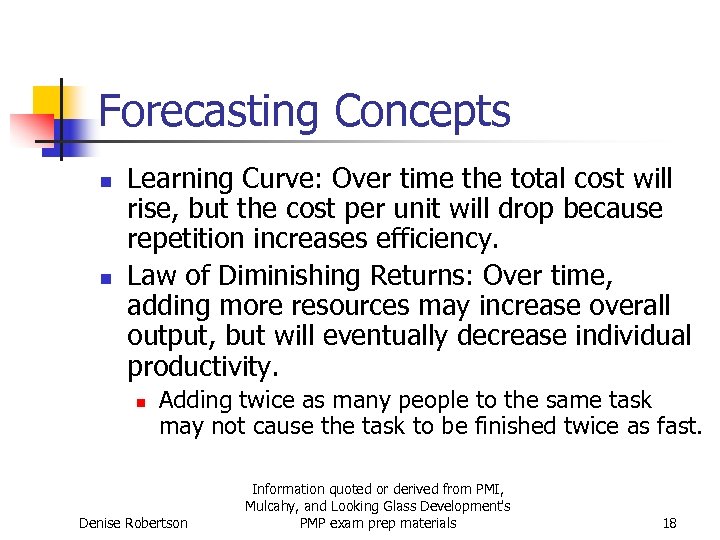 Forecasting Concepts n n Learning Curve: Over time the total cost will rise, but the cost per unit will drop because repetition increases efficiency. Law of Diminishing Returns: Over time, adding more resources may increase overall output, but will eventually decrease individual productivity. n Adding twice as many people to the same task may not cause the task to be finished twice as fast. Denise Robertson Information quoted or derived from PMI, Mulcahy, and Looking Glass Development's PMP exam prep materials 18
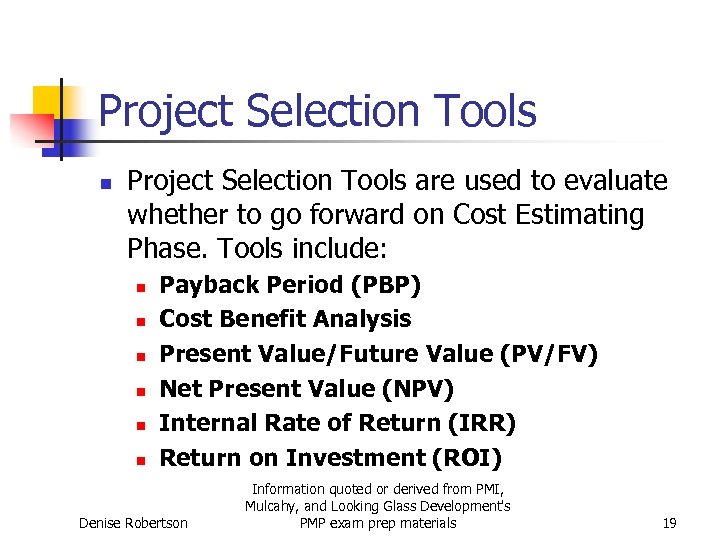 Project Selection Tools n Project Selection Tools are used to evaluate whether to go forward on Cost Estimating Phase. Tools include: n n n Payback Period (PBP) Cost Benefit Analysis Present Value/Future Value (PV/FV) Net Present Value (NPV) Internal Rate of Return (IRR) Return on Investment (ROI) Denise Robertson Information quoted or derived from PMI, Mulcahy, and Looking Glass Development's PMP exam prep materials 19
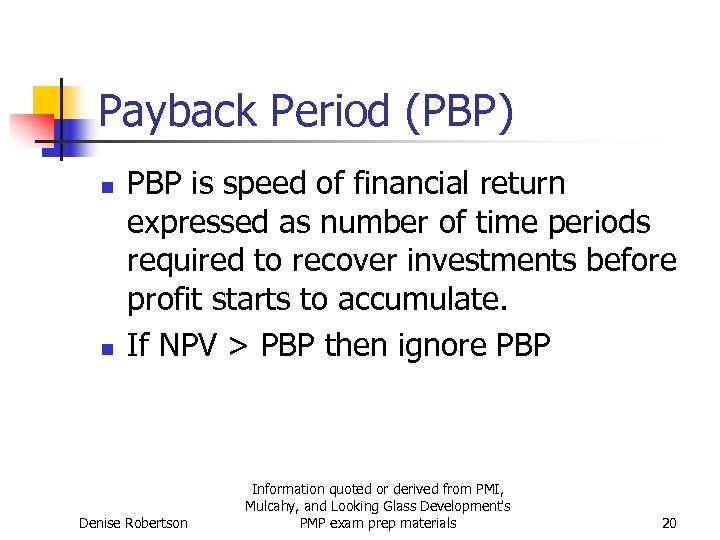 Payback Period (PBP) n n PBP is speed of financial return expressed as number of time periods required to recover investments before profit starts to accumulate. If NPV > PBP then ignore PBP Denise Robertson Information quoted or derived from PMI, Mulcahy, and Looking Glass Development's PMP exam prep materials 20
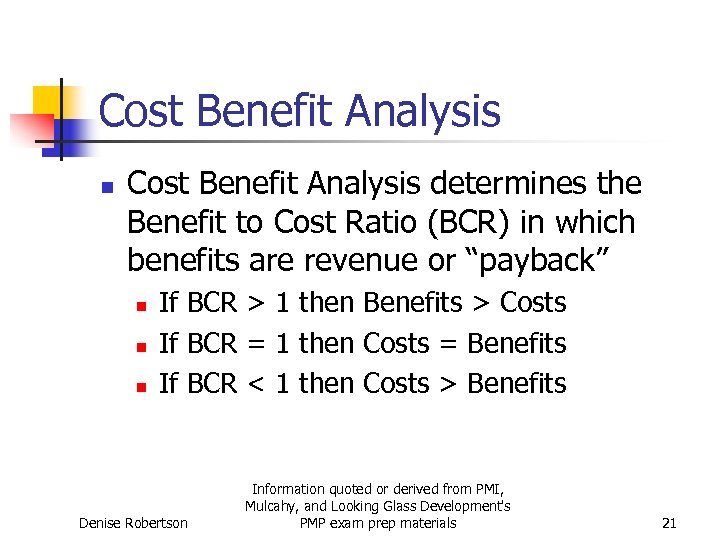 Cost Benefit Analysis n Cost Benefit Analysis determines the Benefit to Cost Ratio (BCR) in which benefits are revenue or “payback” n n n If BCR > 1 then Benefits > Costs If BCR = 1 then Costs = Benefits If BCR < 1 then Costs > Benefits Denise Robertson Information quoted or derived from PMI, Mulcahy, and Looking Glass Development's PMP exam prep materials 21
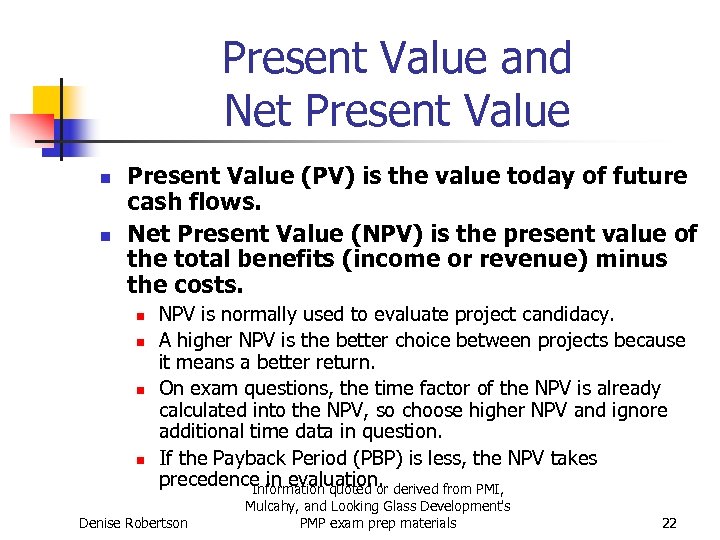 Present Value and Net Present Value n n Present Value (PV) is the value today of future cash flows. Net Present Value (NPV) is the present value of the total benefits (income or revenue) minus the costs. n n NPV is normally used to evaluate project candidacy. A higher NPV is the better choice between projects because it means a better return. On exam questions, the time factor of the NPV is already calculated into the NPV, so choose higher NPV and ignore additional time data in question. If the Payback Period (PBP) is less, the NPV takes precedence in evaluation. derived from PMI, Information quoted or Denise Robertson Mulcahy, and Looking Glass Development's PMP exam prep materials 22
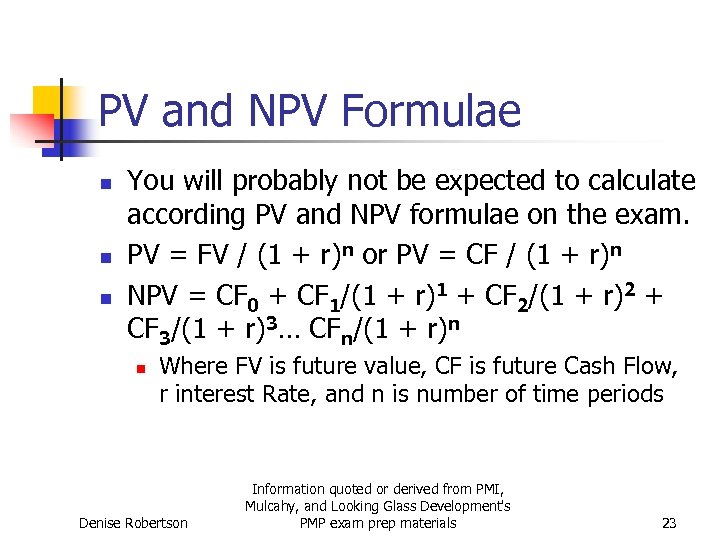 PV and NPV Formulae n n n You will probably not be expected to calculate according PV and NPV formulae on the exam. PV = FV / (1 + r)n or PV = CF / (1 + r)n NPV = CF 0 + CF 1/(1 + r)1 + CF 2/(1 + r)2 + CF 3/(1 + r)3… CFn/(1 + r)n n Where FV is future value, CF is future Cash Flow, r interest Rate, and n is number of time periods Denise Robertson Information quoted or derived from PMI, Mulcahy, and Looking Glass Development's PMP exam prep materials 23
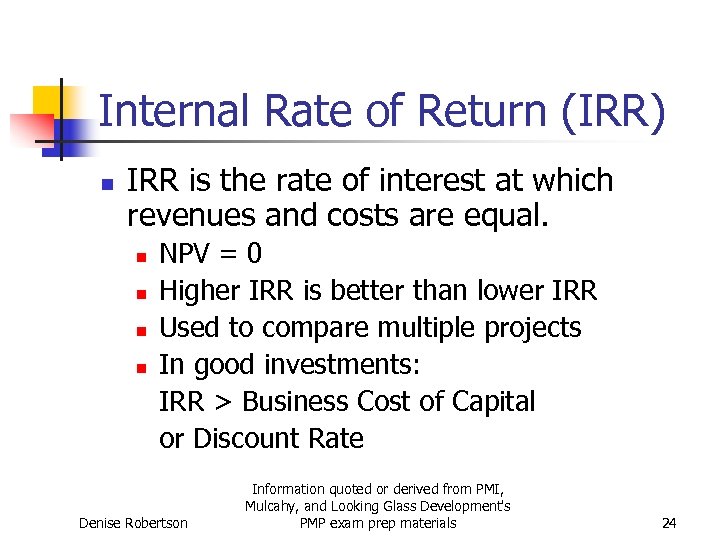 Internal Rate of Return (IRR) n IRR is the rate of interest at which revenues and costs are equal. n n NPV = 0 Higher IRR is better than lower IRR Used to compare multiple projects In good investments: IRR > Business Cost of Capital or Discount Rate Denise Robertson Information quoted or derived from PMI, Mulcahy, and Looking Glass Development's PMP exam prep materials 24
 Return on Investment (ROI) n n n ROI = Income / Invested Capital Measures overall effectiveness of generating profits with available assets. Higher ROI is better than lower ROI Denise Robertson Information quoted or derived from PMI, Mulcahy, and Looking Glass Development's PMP exam prep materials 25
 Cost Considerations n 3 types of project costs to consider: 1. Life Cycle Costing (cradle-to-grave) 2. Opportunity Cost (cost of next best project) 3. Sunk Costs (monies already spent) Denise Robertson Information quoted or derived from PMI, Mulcahy, and Looking Glass Development's PMP exam prep materials 26
 Life Cycle Costing (cradle-to-grave) n n Concept that PMs should not manage project costs to the exclusion of overall costs for Operations and Maintenance Phases. Project costs may be low at the expense of costs for the rest of the life of the project. Denise Robertson Information quoted or derived from PMI, Mulcahy, and Looking Glass Development's PMP exam prep materials 27
 Opportunity Cost (cost of next best project) n n Impacts cost estimating by reducing options to perform other projects. Value of the project that was not selected or the “cost of the lost opportunity. ” Denise Robertson Information quoted or derived from PMI, Mulcahy, and Looking Glass Development's PMP exam prep materials 28
 Sunk Costs (monies already spent) n n Sunk costs should not be considered in the estimating process. Never use them. Bad Project Manager, bad! Denise Robertson Information quoted or derived from PMI, Mulcahy, and Looking Glass Development's PMP exam prep materials 29
 Cost Budgeting Definition n Cost Budgeting is allocating the overall project cost estimates to the individual work packages and activities to establish a Cost Baseline for measuring project performance. Denise Robertson Information quoted or derived from PMI, Mulcahy, and Looking Glass Development's PMP exam prep materials 30
 Cost Budgeting Concepts n n n An estimate is an approximation A budget is what you’re allowed to spend WBS must be deliverable based Assign costs to deliverables Cost budget may be described by a cumulative S curve mapping cost of deliverables against time period Denise Robertson Information quoted or derived from PMI, Mulcahy, and Looking Glass Development's PMP exam prep materials 31
 Cost Budgeting Activities n n n Establish control accounts Delineate accounting categories Establish management reserves Forecast cash flows Create cost baseline Denise Robertson Information quoted or derived from PMI, Mulcahy, and Looking Glass Development's PMP exam prep materials 32
 Control Accounts n Used in Cost Budgeting to divide WBS into cost packages to facilitate one or more cost baselines through: n n cost assignment schedule tracking cost control reporting Denise Robertson Information quoted or derived from PMI, Mulcahy, and Looking Glass Development's PMP exam prep materials 33
 Accounting Categories n The following Accounting Categories are delineated during Cost Budgeting for consideration by PMs: n n variable vs. fixed direct vs. indirect recurring vs. non-recurring capital vs. expense, (I. e. , durable vs. consumable) Denise Robertson Information quoted or derived from PMI, Mulcahy, and Looking Glass Development's PMP exam prep materials 34
 Managerial Reserves n n n Provided for risks outside defined project scope (Unknown-Unknowns) Not controlled by PM Granted through Change Control Denise Robertson Information quoted or derived from PMI, Mulcahy, and Looking Glass Development's PMP exam prep materials 35
 Cash Flow Forecasting n Forecasting cash flows that can be demonstrated as a cumulative S curve of cost vs. time for deliverables on a time based budget is a Cost Budgeting activity. Denise Robertson Information quoted or derived from PMI, Mulcahy, and Looking Glass Development's PMP exam prep materials 36
 Cost Baseline n The Cost Baseline is an output of the Cost Budgeting process that can be represented as a performance measurement baseline cumulative S curve showing budgeted cost of work scheduled and cumulative planned value. Denise Robertson Information quoted or derived from PMI, Mulcahy, and Looking Glass Development's PMP exam prep materials 37
 Depreciation Definition n n Depreciation is the indirect cost of an asset’s (piece of capital equipment’s) value over time. The most common form of depreciation is Straight Line Depreciation (SL) in which the same amount is taken each year. Denise Robertson Information quoted or derived from PMI, Mulcahy, and Looking Glass Development's PMP exam prep materials 38
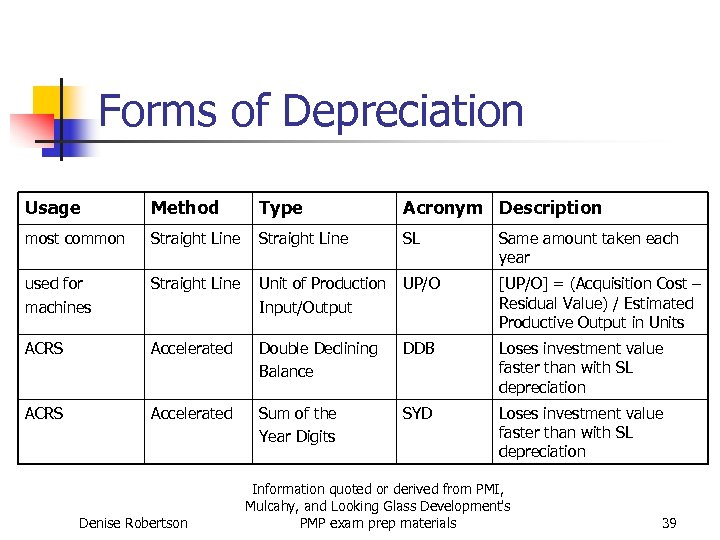 Forms of Depreciation Usage Method Type Acronym Description most common Straight Line SL Same amount taken each year used for machines Straight Line Unit of Production Input/Output UP/O [UP/O] = (Acquisition Cost – Residual Value) / Estimated Productive Output in Units ACRS Accelerated Double Declining Balance DDB Loses investment value faster than with SL depreciation ACRS Accelerated Sum of the Year Digits SYD Loses investment value faster than with SL depreciation Denise Robertson Information quoted or derived from PMI, Mulcahy, and Looking Glass Development's PMP exam prep materials 39
 Cost Control and Firefighting 1. Fire prevention by influencing the factors which create changes to the cost baseline to ensure that the changes are beneficial. 2. Fire detection by determining that a cost baseline has changed and… 3. Fire fighting by managing actual changes when and if they occur § Cost Budget : = Cost Plan Denise Robertson Information quoted or derived from PMI, Mulcahy, and Looking Glass Development's PMP exam prep materials 40
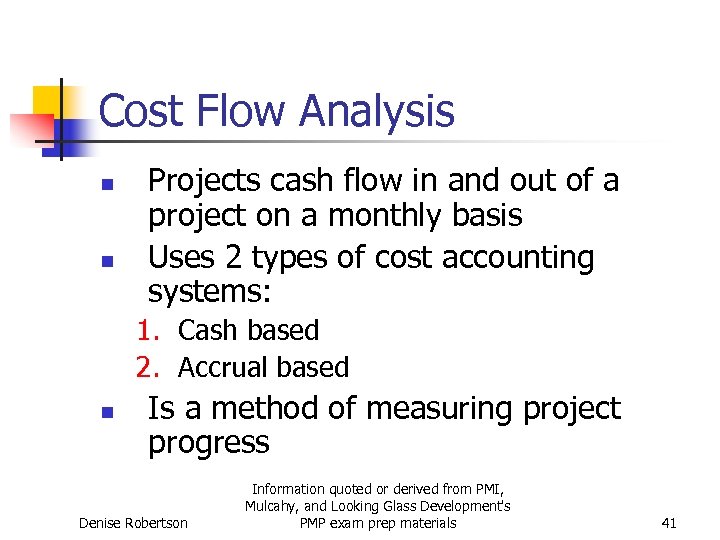 Cost Flow Analysis n n Projects cash flow in and out of a project on a monthly basis Uses 2 types of cost accounting systems: 1. Cash based 2. Accrual based n Is a method of measuring project progress Denise Robertson Information quoted or derived from PMI, Mulcahy, and Looking Glass Development's PMP exam prep materials 41
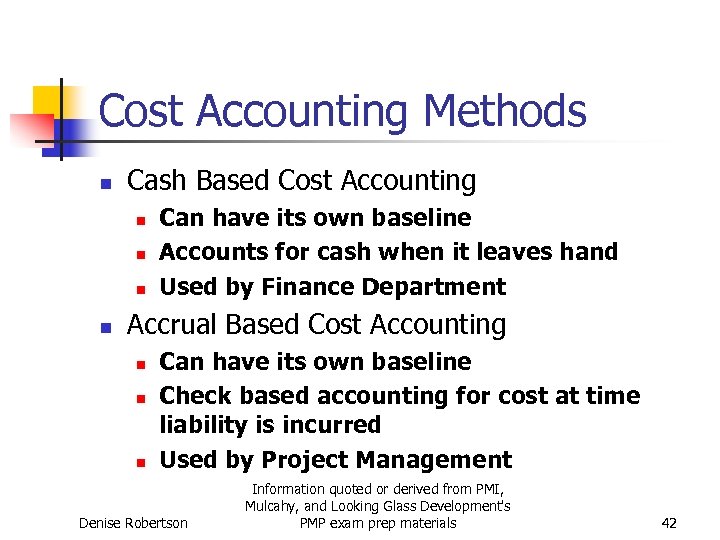 Cost Accounting Methods n Cash Based Cost Accounting n n Can have its own baseline Accounts for cash when it leaves hand Used by Finance Department Accrual Based Cost Accounting n n n Can have its own baseline Check based accounting for cost at time liability is incurred Used by Project Management Denise Robertson Information quoted or derived from PMI, Mulcahy, and Looking Glass Development's PMP exam prep materials 42
 Pareto’s Principle n 20% of the work packages account for 80% of the cost variances. Denise Robertson Information quoted or derived from PMI, Mulcahy, and Looking Glass Development's PMP exam prep materials 43
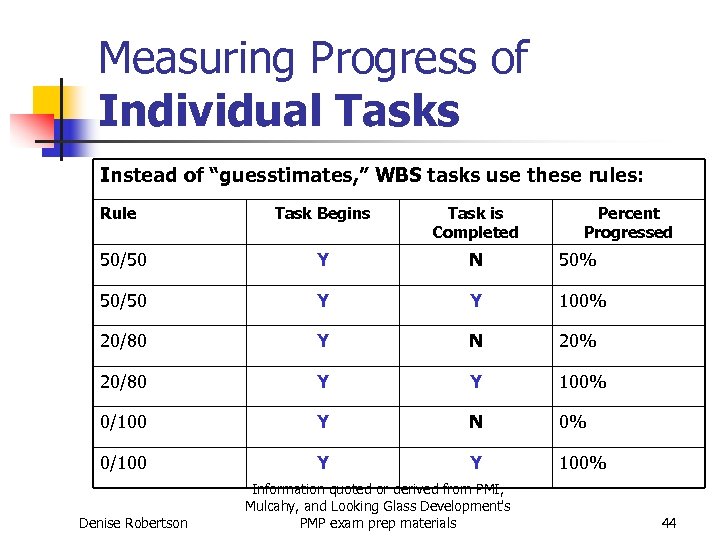 Measuring Progress of Individual Tasks Instead of “guesstimates, ” WBS tasks use these rules: Rule Task Begins Task is Completed 50/50 Y N 50% 50/50 Y Y 100% 20/80 Y N 20% 20/80 Y Y 100% 0/100 Y N 0% 0/100 Y Y 100% Denise Robertson Information quoted or derived from PMI, Mulcahy, and Looking Glass Development's PMP exam prep materials Percent Progressed 44
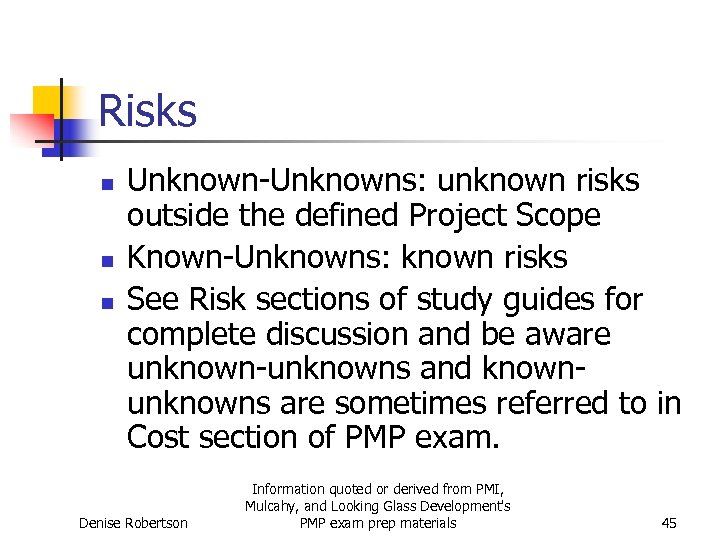 Risks n n n Unknown-Unknowns: unknown risks outside the defined Project Scope Known-Unknowns: known risks See Risk sections of study guides for complete discussion and be aware unknown-unknowns and knownunknowns are sometimes referred to in Cost section of PMP exam. Denise Robertson Information quoted or derived from PMI, Mulcahy, and Looking Glass Development's PMP exam prep materials 45
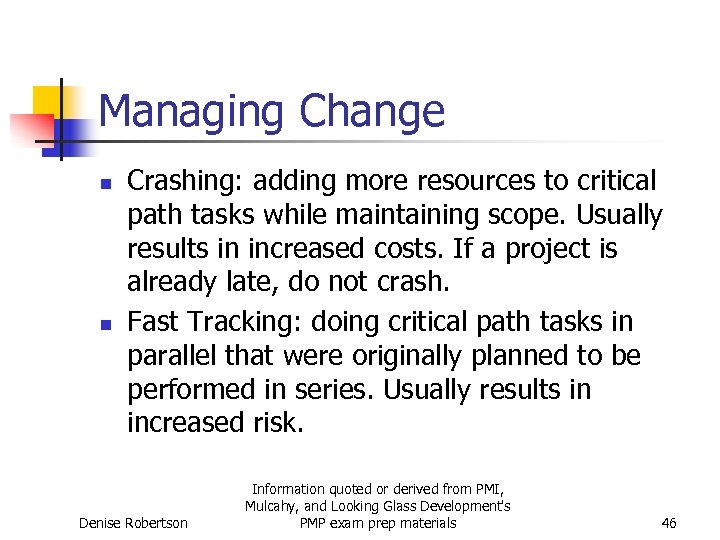 Managing Change n n Crashing: adding more resources to critical path tasks while maintaining scope. Usually results in increased costs. If a project is already late, do not crash. Fast Tracking: doing critical path tasks in parallel that were originally planned to be performed in series. Usually results in increased risk. Denise Robertson Information quoted or derived from PMI, Mulcahy, and Looking Glass Development's PMP exam prep materials 46
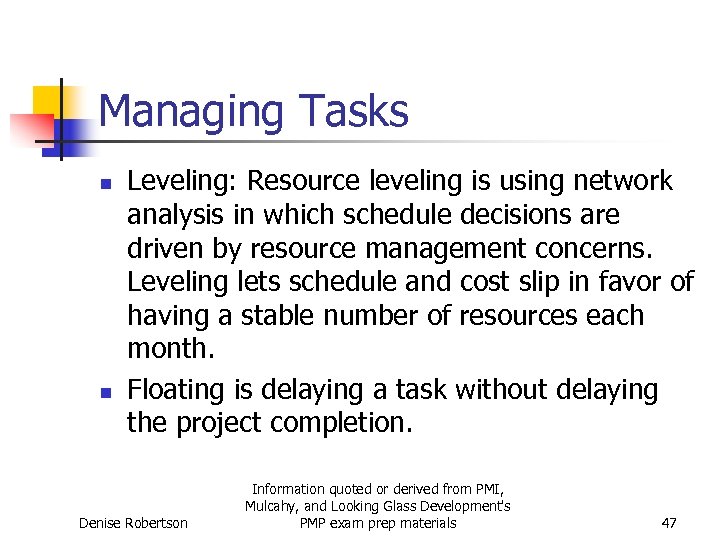 Managing Tasks n n Leveling: Resource leveling is using network analysis in which schedule decisions are driven by resource management concerns. Leveling lets schedule and cost slip in favor of having a stable number of resources each month. Floating is delaying a task without delaying the project completion. Denise Robertson Information quoted or derived from PMI, Mulcahy, and Looking Glass Development's PMP exam prep materials 47