 Скачать презентацию PM Fundamentals — Introduction PM Building Project Management
1.0_Introduction.ppt
- Количество слайдов: 62



PM Fundamentals - Introduction PM “Building Project Management Education, Research and Training Capacity for the Pacific Rim Region” Dr. Jang Ra, Ph. D. , PMP Professor and Chair Engineering, Science & Project Management (ESPM) Graduate Program University of Alaska Anchorage www. uaa. alaska. edu/espm 1 of 54
Today’s Agenda PM • Course Syllabus • Personal Information • Definitions – Project, Management & PM – Vs. Operations – Portfolio, Program, Project, Subproject, Work Package, Task & Activity • Triple Constraint 2 of 54
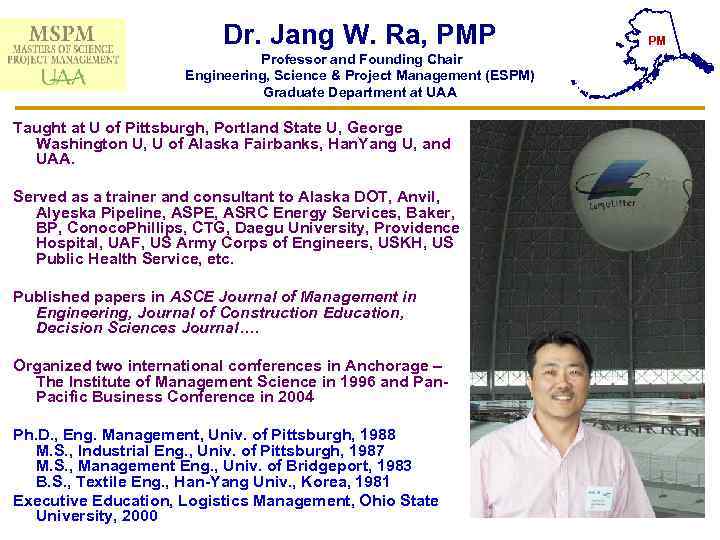
Dr. Jang W. Ra, PMP PM Professor and Founding Chair Engineering, Science & Project Management (ESPM) Graduate Department at UAA Taught at U of Pittsburgh, Portland State U, George Washington U, U of Alaska Fairbanks, Han. Yang U, and UAA. Served as a trainer and consultant to Alaska DOT, Anvil, Alyeska Pipeline, ASPE, ASRC Energy Services, Baker, BP, Conoco. Phillips, CTG, Daegu University, Providence Hospital, UAF, US Army Corps of Engineers, USKH, US Public Health Service, etc. Published papers in ASCE Journal of Management in Engineering, Journal of Construction Education, Decision Sciences Journal…. Organized two international conferences in Anchorage – The Institute of Management Science in 1996 and Pan. Pacific Business Conference in 2004 Ph. D. , Eng. Management, Univ. of Pittsburgh, 1988 M. S. , Industrial Eng. , Univ. of Pittsburgh, 1987 M. S. , Management Eng. , Univ. of Bridgeport, 1983 B. S. , Textile Eng. , Han-Yang Univ. , Korea, 1981 Executive Education, Logistics Management, Ohio State University, 2000 3 of 54
Project Management? PM I define PM as ______________________________________ ___________________ 4 of 54
In U. S. , “The Bush administration PM www. governmententerprise. com/show. Article. jhtml? article. ID=17501376 • has made it clear that departments need to beef up their project-management and planning skills. Mark Forman, who recently resigned as the Office of Management and Budget(OMB)’s associate director for electronic government and IT, where he led the administration’s technology policy, told Congress this spring that more than a third of the largest federal IT projects are in jeopardy because of poor planning More than $21 billion worth of the $59. 3 billion IT projects in the president’s 2004 budget are dubbed “at risk” because of inadequate project planning, he said. About 1, 400 IT projects are under OMB scrutiny, and 700 of them don’t have qualified managers. ” managers • Sept. 2, 2003 publication in “Government Enterprise. ” 5 of 54
What is Happening? PM “? ? . . ? ? State just gets more money and extends the project timeline when they are behind schedule. This is what I experienced!” – Anonymous former State employee 6 of 54
Pareto’s Principle 80/20 Rule! PM • IT Projects are? – Failed / Successful • Who are responsible for? – Managers / Workers • Where are problems in? – Non-technical / Technical Area http: //pmp-study. blogspot. ru/2010/10/blogpost. html 7 of 54
Management Principles: PM • Beware the symptomatic solution. • Solutions that address only the symptoms of a problem, not fundamental causes, tend to have short-term benefits at best. In the long term, the problem resurfaces and there is increased pressure for symptomatic response. 8 of 54
PM Body of Knowledge PM similar to • Traffic signs • Soccer game rules • Etc. . 9 of 54
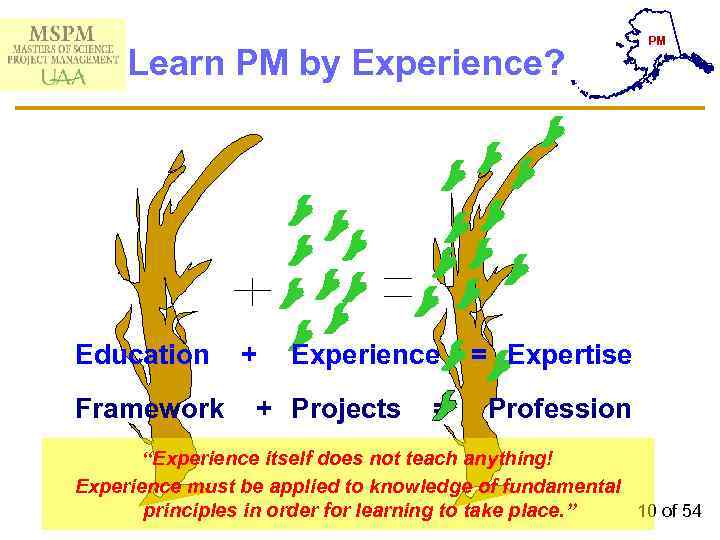
Learn PM by Experience? Education + PM Experience = Expertise Framework + Projects = Profession “Experience itself does not teach anything! Experience must be applied to knowledge of fundamental 10 of 54 principles in order for learning to take place. ”
PM Project Management Institute Defines Project management is the application of knowledge, skills, tools, and techniques to project activities to meet project requirements. PM is accomplished ……. PMBOK Guide p 8 11 of 54
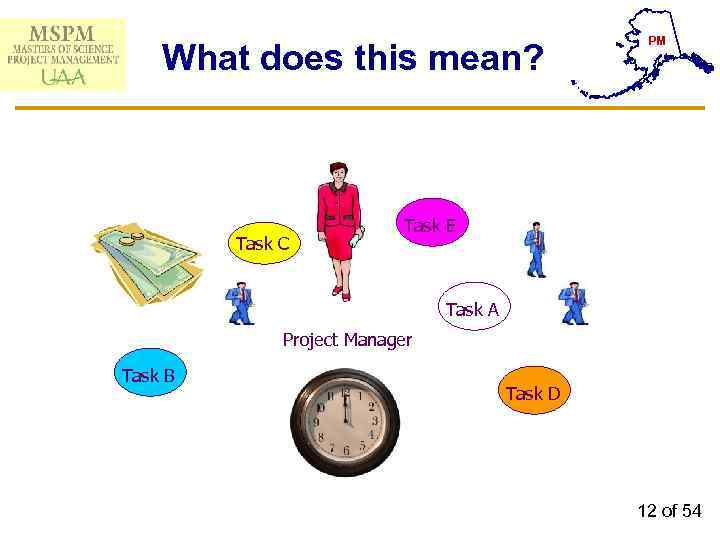
What does this mean? Task C PM Task E Task A Project Manager Task B Task D 12 of 54
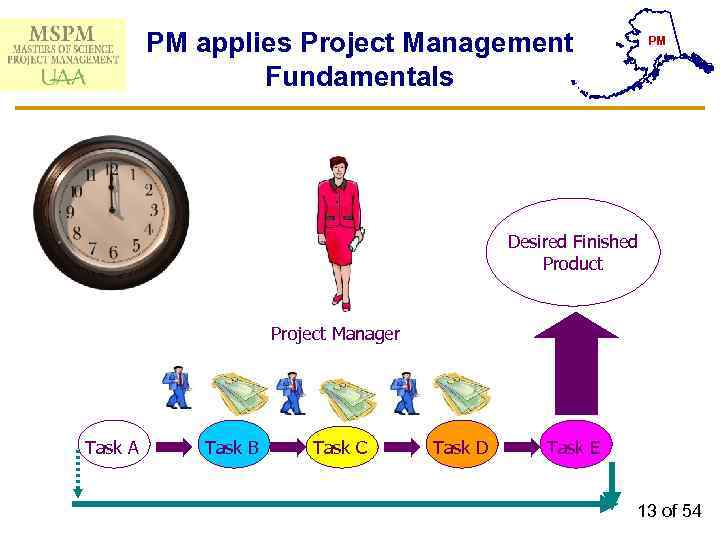
PM applies Project Management Fundamentals PM Desired Finished Product Project Manager Task A Task B Task C Task D Task E 13 of 54
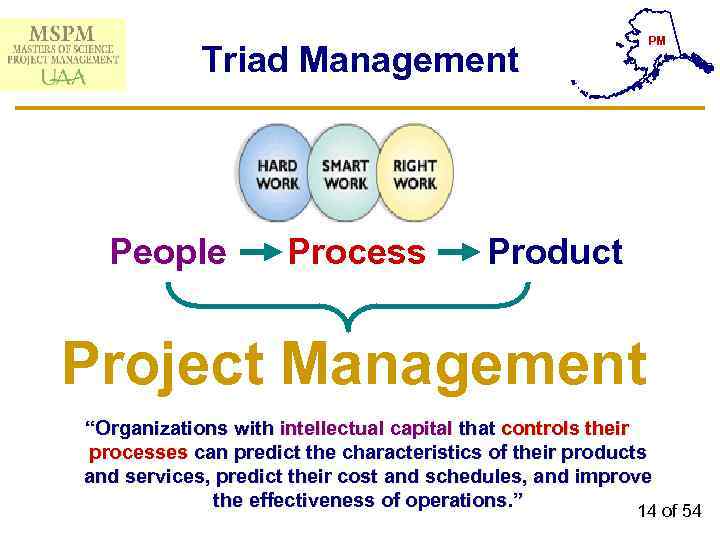
Triad Management PM People Process Product Project Management “Organizations with intellectual capital that controls their processes can predict the characteristics of their products and services, predict their cost and schedules, and improve the effectiveness of operations. ” 14 of 54
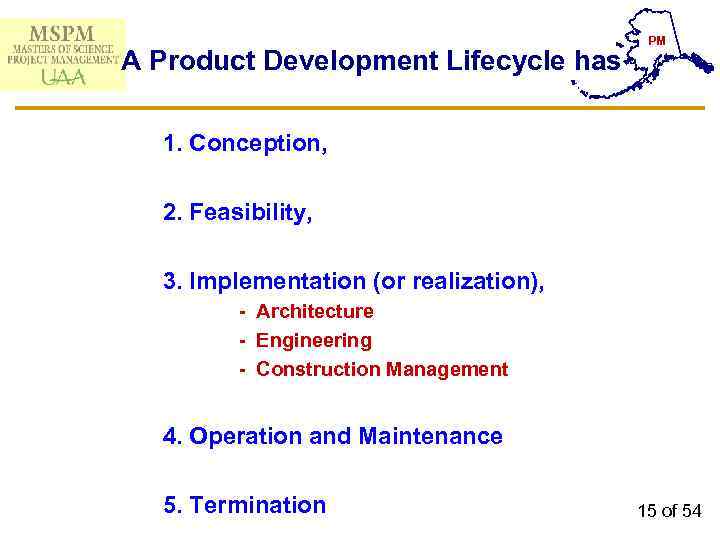
A Product Development Lifecycle has PM 1. Conception, 2. Feasibility, 3. Implementation (or realization), - Architecture - Engineering - Construction Management 4. Operation and Maintenance 5. Termination 15 of 54
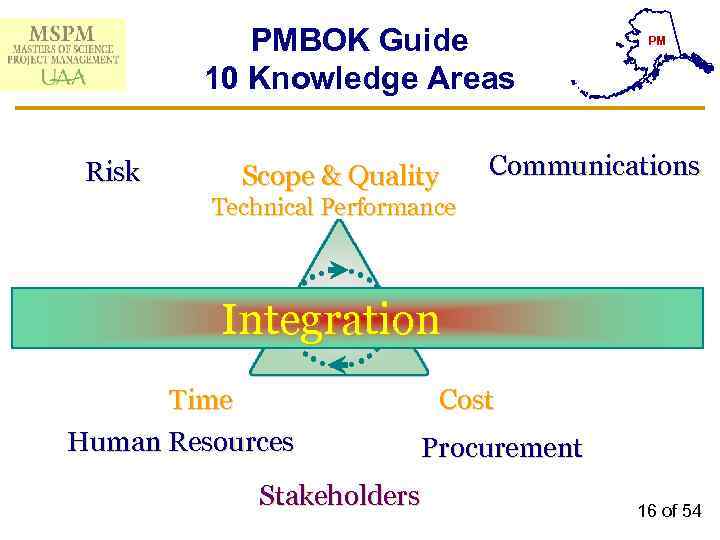
PMBOK Guide 10 Knowledge Areas Risk Scope & Quality PM Communications Technical Performance Integration Time Human Resources Stakeholders Cost Procurement 16 of 54
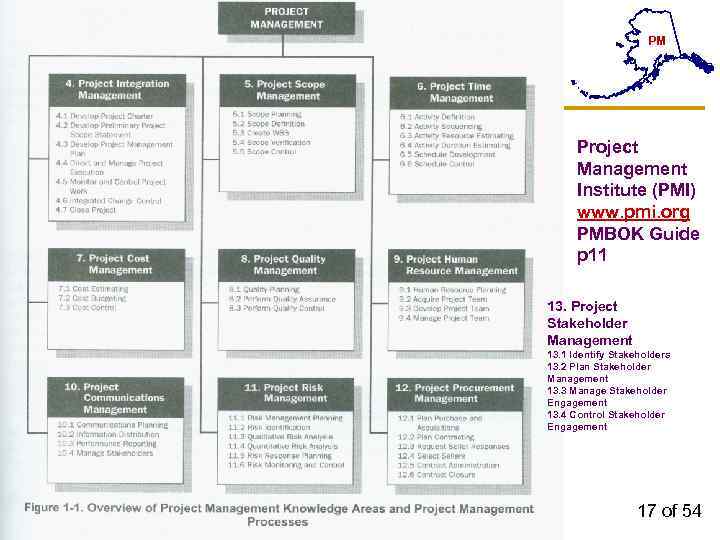
PM Project Management Institute (PMI) www. pmi. org PMBOK Guide p 11 13. Project Stakeholder Management 13. 1 Identify Stakeholders 13. 2 Plan Stakeholder Management 13. 3 Manage Stakeholder Engagement 13. 4 Control Stakeholder Engagement 17 of 54
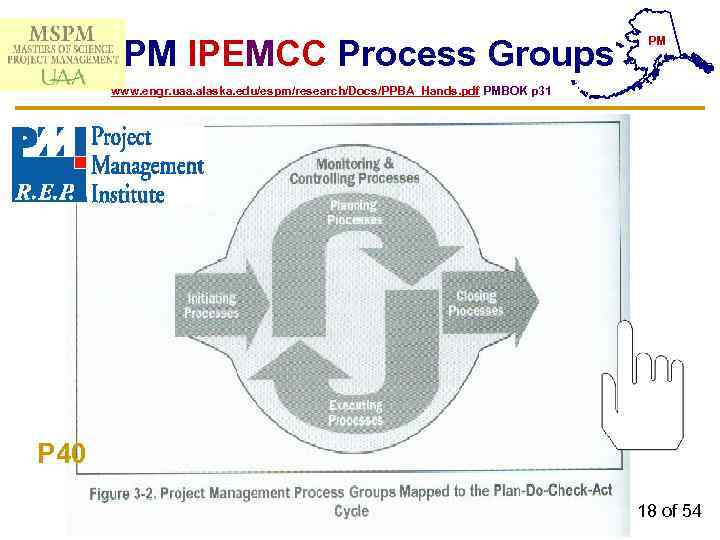
PM IPEMCC Process Groups PM www. engr. uaa. alaska. edu/espm/research/Docs/PPBA_Hands. pdf PMBOK p 31 P 40 18 of 54
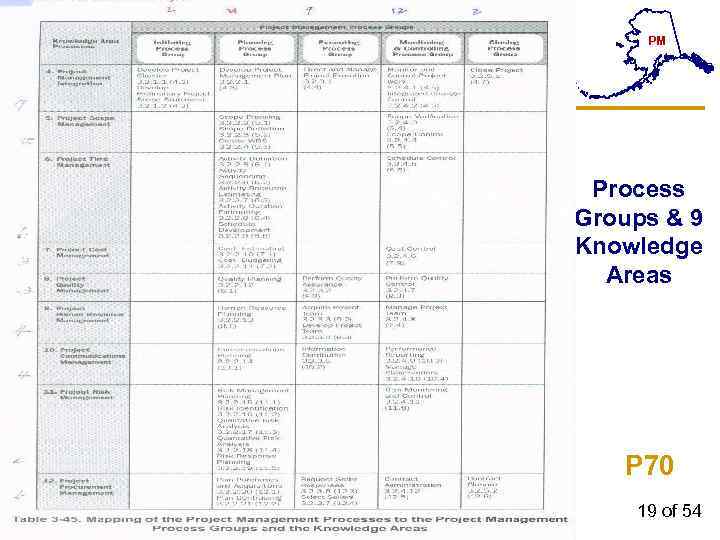
PM Process Groups & 9 Knowledge Areas P 70 19 of 54
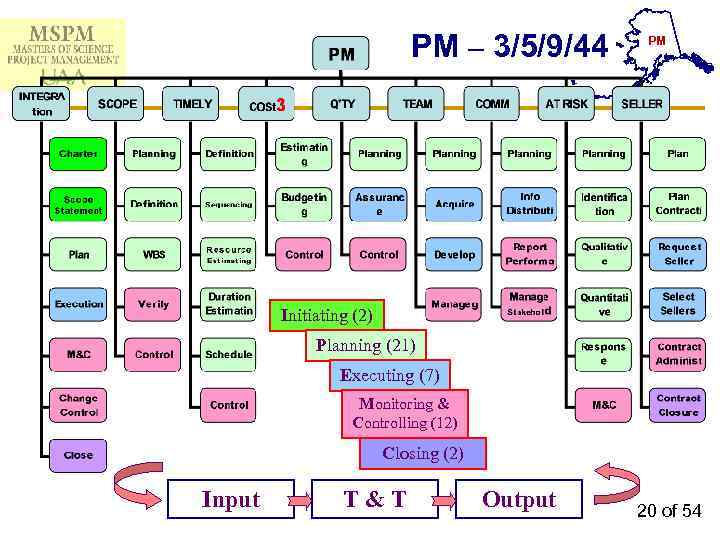
PM – 3/5/9/44 PM Initiating (2) Planning (21) Executing (7) Monitoring & Controlling (12) Closing (2) Input T&T Output 20 of 54
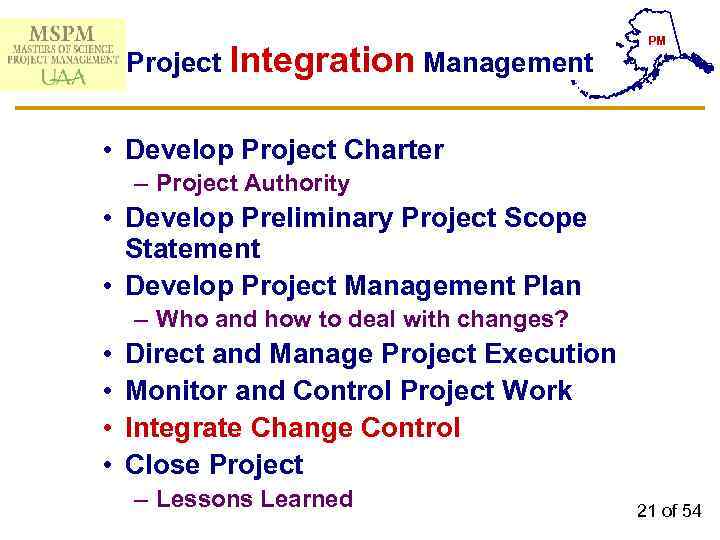
Project Integration Management PM • Develop Project Charter – Project Authority • Develop Preliminary Project Scope Statement • Develop Project Management Plan – Who and how to deal with changes? • • Direct and Manage Project Execution Monitor and Control Project Work Integrate Change Control Close Project – Lessons Learned 21 of 54
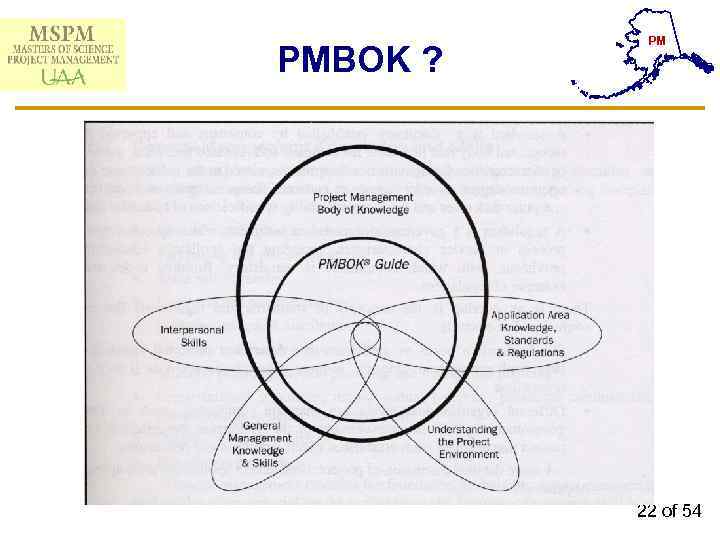
PMBOK ? PM 22 of 54
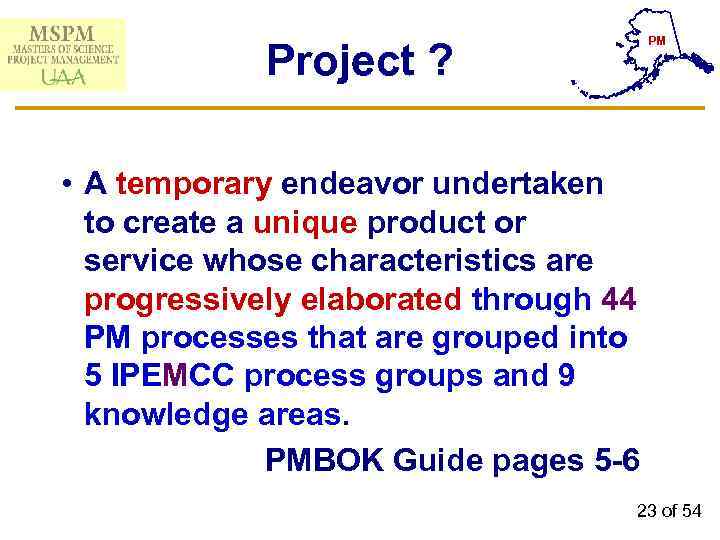
PM Project ? • A temporary endeavor undertaken to create a unique product or service whose characteristics are progressively elaborated through 44 PM processes that are grouped into 5 IPEMCC process groups and 9 knowledge areas. PMBOK Guide pages 5 -6 23 of 54
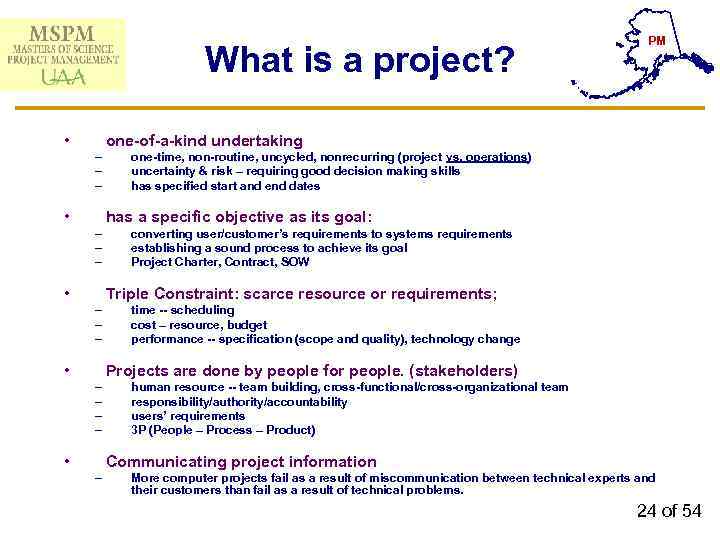
What is a project? • PM one-of-a-kind undertaking – – – • one-time, non-routine, uncycled, nonrecurring (project vs. operations) uncertainty & risk – requiring good decision making skills has specified start and end dates has a specific objective as its goal: – – – • converting user/customer’s requirements to systems requirements establishing a sound process to achieve its goal Project Charter, Contract, SOW Triple Constraint: scarce resource or requirements; – – – • time -- scheduling cost – resource, budget performance -- specification (scope and quality), technology change Projects are done by people for people. (stakeholders) – – • human resource -- team building, cross-functional/cross-organizational team responsibility/authority/accountability users’ requirements 3 P (People – Process – Product) Communicating project information – More computer projects fail as a result of miscommunication between technical experts and their customers than fail as a result of technical problems. 24 of 54
Projects versus Operations PM • Projects – Temporary and unique – Purpose: obtain objective and terminate – Organize activities not addressed within organization’s normal operational limits • Operations – – – Ongoing and repetitive Purpose: sustain the business Adopt new set of objectives and continue work 25 of 54
Program PM • An effort of an organization that may include one or more projects • Projects sometimes become programs, and programs can end up being projects if life spans are shortened or funding is decreased; used synonymously. • Ex) product (car in GM) improvement program -- ongoing and unspecified lifetime technical activity with continuous funding, "Saturn project" “Yellowstone” 26 of 54
Program Example: • • • PM Reduction of corporate overhead Modernization of plant and equipment Simplification of product lines Expansion into global market Initiation of QC Changing (Decentralization/Centralization) of organization structure • Acquisition/divestment of new business • Product elimination • Productivity/Quality improvement 27 of 54
PM Work Package • A sub-element of a project • A WP is a deliverable at the lowest level of WBS. • Should last not more than three reporting periods and no less than one. – Activity – P 3, Sure. Trak – Task – MS Project • We should break project down into work packages which are assignable and for which accountability can be expected. 28 of 54
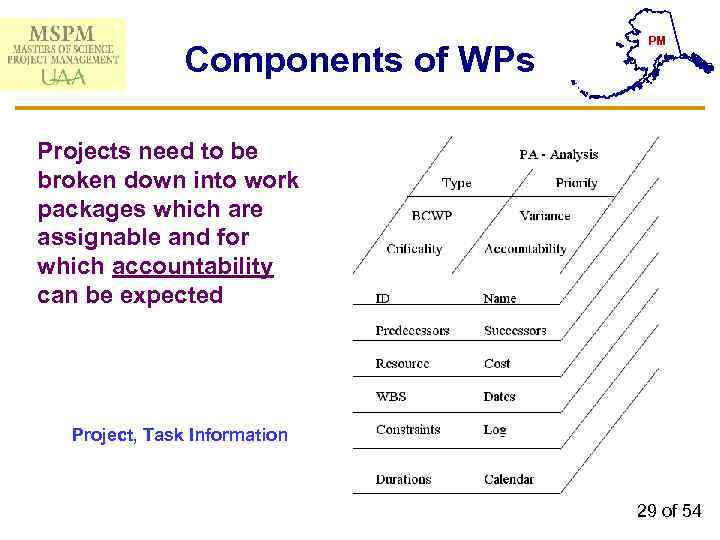
Components of WPs PM Projects need to be broken down into work packages which are assignable and for which accountability can be expected Project, Task Information 29 of 54
WP, Activity/Task PM • Work Package (WP): A deliverable at the lowest level of the Work Breakdown Structure (WBS), when that deliverable may be assigned to another project manager to plan and execute. This may be accomplished through the use of a subproject where the WP may be further decomposed into activities. • Activity/Task : An element of work performed during the course of a project. An activity normally has an expected duration, an expected cost, and expected resource requirements. Lowest level of effort on a project. 30 of 54
Types of Projects: PM Civil Engineering, Construction, Petrochemical, Mining and Quarrying Projects • • remote from the contractor’s head office organization/communication problem massive capital investment working in some kind of joint venture 31 of 54
Types of Projects: PM Manufacturing Projects • usually conducted in a factory or other home-based environment • a piece of equipment or machinery, ship, aircraft, land vehicle, or some other item of specially designed hardware 32 of 54
PM Types of Projects: Management Projects • Every company is expected to have at least one in its lifetime • relocate their headquarters • develop and introduce a new computer system • produce a feasibility or other study report 33 of 54
Types of Projects: PM Research & Development (R&D) Projects • Projects for pure research can consume vast sums of money, last many years, and end up with results that please, surprise or disappoint and produce nothing of value • highest risk • set budgets, control expenditure by conducting regular management reviews and reassessments • the research itself may be outside the scope of project control method 34 of 54
PM Types of Projects: Information Technology/Information System (IT/IS) Projects • users’ requirements • project ends when users actually use the system • post-performance appraisal is forgotten 35 of 54
Types of Projects: PM Service And Outsourcing (SAO) Projects • If a set of operational activities is not part of the organization’s core competency and can be performed at a lower cost by an external organization, then there is opportunity for either a Service or Outsourcing project. Outsourcing is defined as a special case of a service project where either capital or human assets are transferred from the client to the contractor. • Maintenance: facilities and/or equipment • Administration: payroll, billing, systems, networks • Special skills: training, technical writing, publication, mail room • Encompass both the project and operational activities • Lower cost is usually the major reason for initiating a SAO project. • While the client is trying to manage for cost reduction, the contractor may seem to be managing for increased revenue—this is the basis of a 36 of 54 fundamental conflict, because they are managing the same dollars.
Types of Projects: PM Environmental Remediation Projects. . . MORE www. pmi. org/sigs 37 of 54
PM Management? 38 of 54
PM HISTORY: Frederick Taylor (1856 -1915), "The Principles of Scientific Management" • Use "piece rate system" for maximum output, rather than restricted output, in steel cutting operations; emphasize division between profits and pay, not on “fair day’s work” or “fair day’s pay” • Knowing exactly what you want to do and then seeing that they do it in the best and cheapest way • He was concerned with management at lowest position (supervisory at production level) Henry Fayol (1841 - 1925), "Administration Industrielle et Generale“ He found that activities of an industrial undertaking could be divided into six groups: (1) technical (production) (2) commercial (buying, selling, and exchanging) (3) financial (search for, and optimum use of, capital) (4) security (protection of property and persons) (5) accounting (including statistics) (6) managerial (planning, organization, command, coordination, and control) 39 of 54
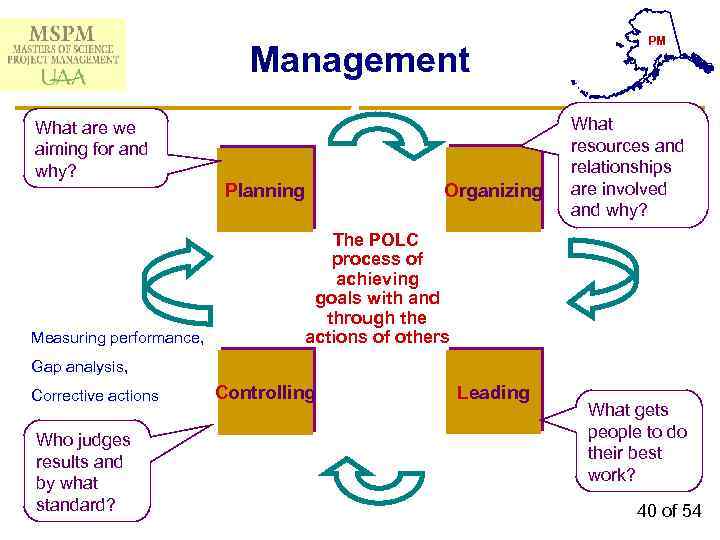
Management What are we aiming for and why? Measuring performance, Planning Organizing PM What resources and relationships are involved and why? The POLC process of achieving goals with and through the actions of others Gap analysis, Corrective actions Who judges results and by what standard? Controlling Leading What gets people to do their best work? 40 of 54
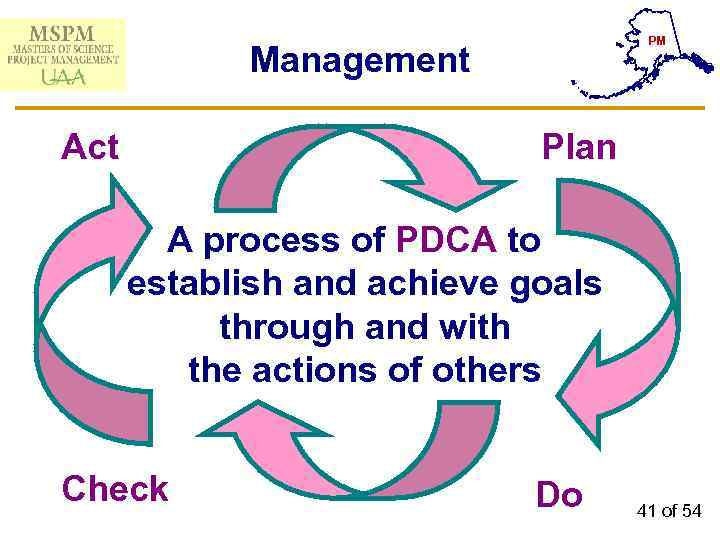
PM Management Act Plan A process of PDCA to establish and achieve goals through and with the actions of others Check Do 41 of 54
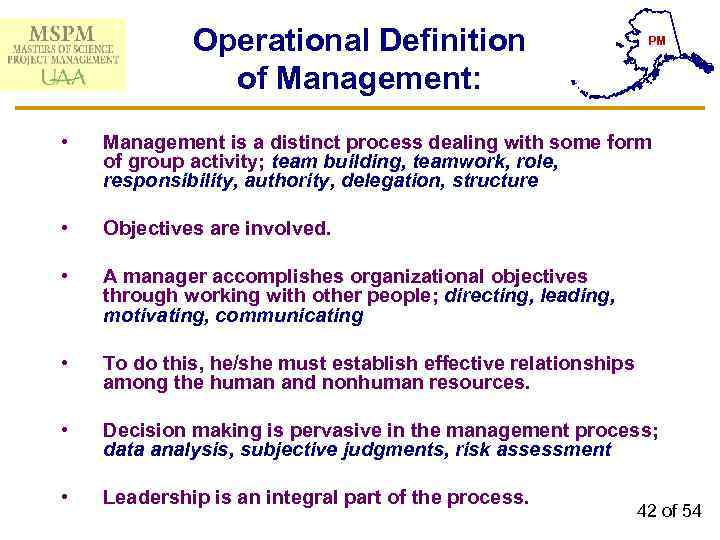
Operational Definition of Management: PM • Management is a distinct process dealing with some form of group activity; team building, teamwork, role, responsibility, authority, delegation, structure • Objectives are involved. • A manager accomplishes organizational objectives through working with other people; directing, leading, motivating, communicating • To do this, he/she must establish effective relationships among the human and nonhuman resources. • Decision making is pervasive in the management process; data analysis, subjective judgments, risk assessment • Leadership is an integral part of the process. 42 of 54
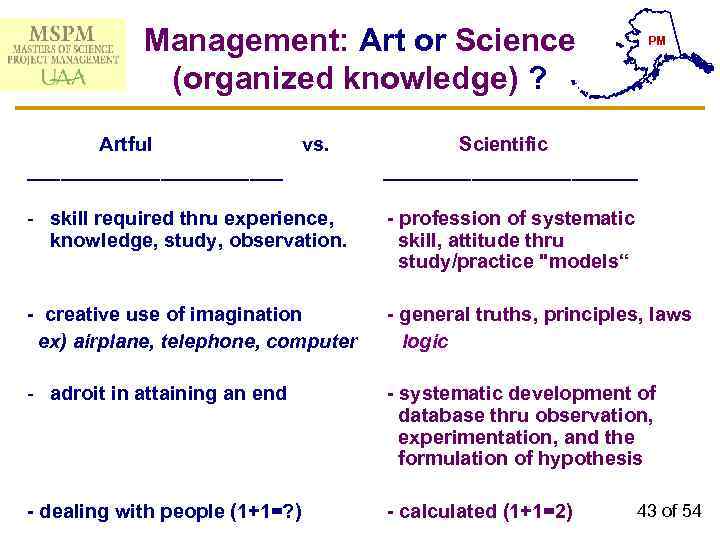
Management: Art or Science (organized knowledge) ? PM Artful vs. Scientific ____________ - skill required thru experience, - profession of systematic knowledge, study, observation. skill, attitude thru study/practice "models“ - creative use of imagination ex) airplane, telephone, computer - general truths, principles, laws logic - adroit in attaining an end - systematic development of database thru observation, experimentation, and the formulation of hypothesis - dealing with people (1+1=? ) - calculated (1+1=2) 43 of 54
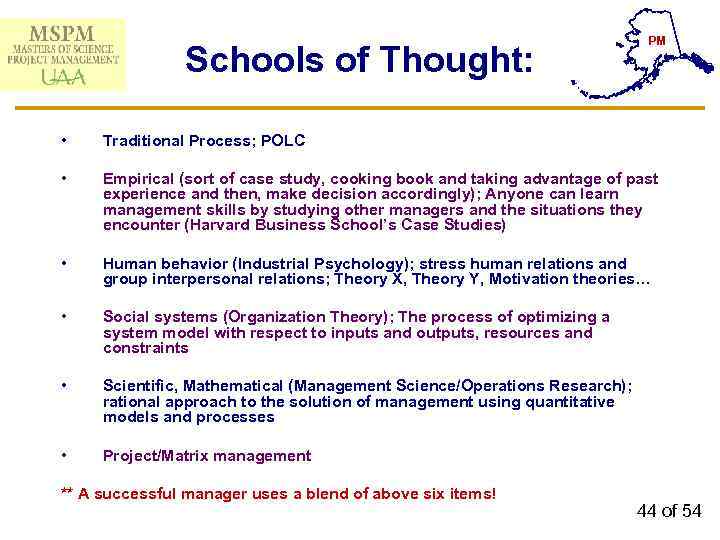
Schools of Thought: PM • Traditional Process; POLC • Empirical (sort of case study, cooking book and taking advantage of past experience and then, make decision accordingly); Anyone can learn management skills by studying other managers and the situations they encounter (Harvard Business School’s Case Studies) • Human behavior (Industrial Psychology); stress human relations and group interpersonal relations; Theory X, Theory Y, Motivation theories… • Social systems (Organization Theory); The process of optimizing a system model with respect to inputs and outputs, resources and constraints • Scientific, Mathematical (Management Science/Operations Research); rational approach to the solution of management using quantitative models and processes • Project/Matrix management ** A successful manager uses a blend of above six items! 44 of 54
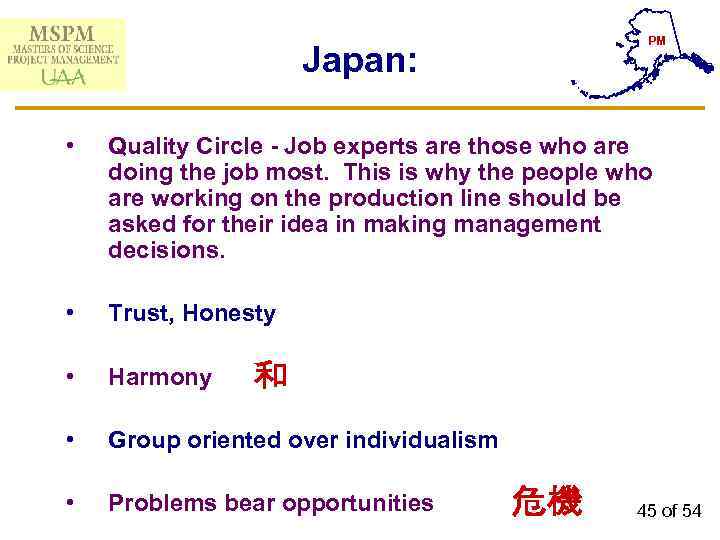
PM Japan: • Quality Circle - Job experts are those who are doing the job most. This is why the people who are working on the production line should be asked for their idea in making management decisions. • Trust, Honesty • Harmony • Group oriented over individualism • Problems bear opportunities 和 危機 45 of 54
VS. Maintenance, Doer PM • Management vs. Maintenance • Manager vs. Doer 46 of 54
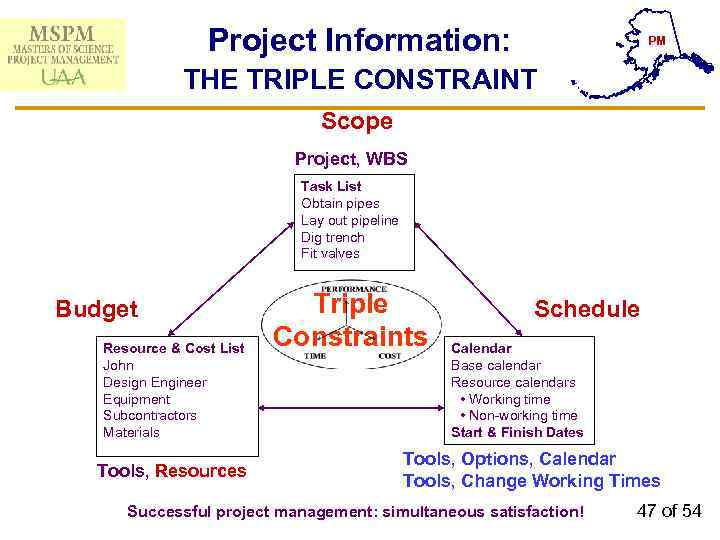
Project Information: THE TRIPLE CONSTRAINT PM Scope Project, WBS Task List Obtain pipes Lay out pipeline Dig trench Fit valves Budget Resource & Cost List John Design Engineer Equipment Subcontractors Materials Tools, Resources Triple Constraints Schedule Calendar Base calendar Resource calendars • Working time • Non-working time Start & Finish Dates Tools, Options, Calendar Tools, Change Working Times Successful project management: simultaneous satisfaction! 47 of 54
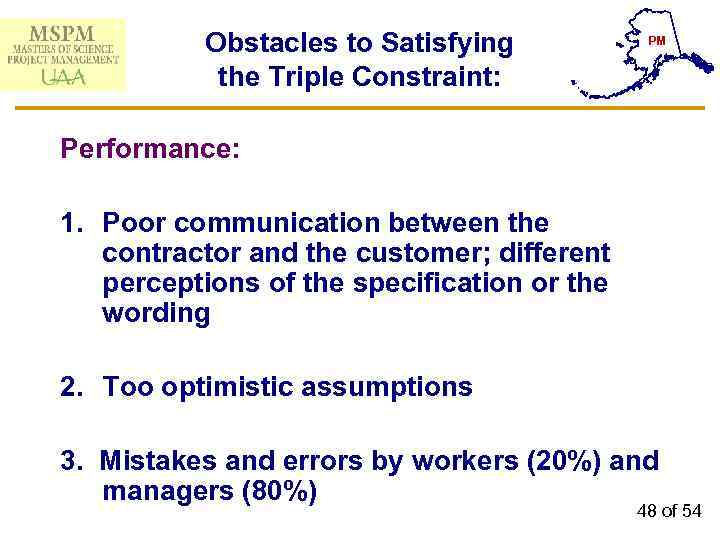
Obstacles to Satisfying the Triple Constraint: PM Performance: 1. Poor communication between the contractor and the customer; different perceptions of the specification or the wording 2. Too optimistic assumptions 3. Mistakes and errors by workers (20%) and managers (80%) 48 of 54
Obstacles to Satisfying the Triple Constraint: PM Time: 1. Overemphasis on the performance dimension; engineers' technical excellence, "better/best" is the enemy of "good enough“ 2. Absence of planned resource 3. Those temporarily assigned are not interested in their tasks. 4. The time schedule should change if the performance specification changes; agreement on additional works w/o technical knowledge 49 of 54
Obstacles to Satisfying the Triple Constraint: PM Cost: 1. Along with time delay 2. "liars contest" that often occurs during contract negotiation 3. Too optimistic for the initial cost estimates 4. Mistakes/errors 5. Inadequate cost consciousness; time value of money, life cycle cost 6. Irregular funding; [three $100 k] vs. [100 k, 50 k, 150 k] 50 of 54
Small projects: • • • PM Cost levels from $5, 000 to $50, 000. Cost levels less than 5% of annual budget for projects. Numerous other similar projects take place concurrently. Labor and equipment resources shared with other projects. The company doing the project is, itself, small. 51 of 54
Managing Small Projects PM Small projects have big problems! - Size belies importance. - Organization is not designed for projects. - A special problem of control • • short project life shared responsibility problems in obtaining actual data many projects to be controlled simultaneously * Needs special management techniques. 52 of 54
PM Internal vs. External Projects Project Charter State of Michigan www. state. mi. us/cio/opm Dept of Information Technology PM Methodology 53 of 54
Characteristics of modern organizations which make management functions difficult to implement are: PM 1. Complexity of modern organization 2. Interdependency specialization integration 3. Change - The environment around us changes. If we do not change, we limit what we can do. Solutions: Systems Approach for 1&2; Life Cycle Approach for 3 54 of 54
The Art of War by Sun Tzu PM So it is said that if you know others and know yourself, you will not be imperiled in a hundred battles; you win one and lose one; if you do not know others and do not know yourself, you will be imperiled in every single battle. 55 of 54
PM Plan for what is difficult while it is easy, do what is great while it is small. The most difficult things in the world must be done while they are still easy, the greatest things in the world must be done while they are still small. For this reason sages never do what is great, and this is why they can achieve that greatness. 56 of 54
PM Indeed, to be able to do something before it exists, sense something before it becomes active, see something before it sprouts, are three abilities that develop interdependently. Then nothings is sensed but is comprehended, nothing is undertaken without response, nowhere does one go without benefit. 57 of 54
PM Deep knowledge is to be aware of disturbance before disturbance, to be aware of danger before danger, to be aware of destruction before destruction, to be aware of calamity before calamity. Strong action is training the body without being burdened by the body, exercising the mind without being used by the mind, working in the world without being affected by the world, carrying out tasks without being obstructed by tasks. By deep knowledge of principle, one can change disturbance into order, change danger into safety, change destruction into survival, change calamity into fortune. 58 of 54
PM By strong action on the Way, one can bring the body to the realm of longevity, bring the mind to the sphere of mystery, bring the world to great peace, and bring tasks to great fulfillment. 59 of 54
The Six Essentials of Problem Solving PM • Generate the Mindset – Develop potent ideas and attitudes • Know the territory – Ask the right questions and get good information • Build the Relationships – Cultivate quality communication and interaction • Manage the Journeys – Choose destinations, and set directions • Create the Solutions – Design, build, and maintain optimal solution • Deliver the Results – Practice intuitive, disciplined execution 60 of 54
The Six Problem Solving Personalities PM • Mindset - The Innovator – Artist, visionary, designer • Territory - The Discoverer – Scientist, researcher, investigator • Relationships - The Communicator – Politician, social worker, publicist • Journeys - Playmaker – Executive, consultant, commander • Solutions - The Creator – Architect, builder, author • Execution - The performer – Customer representative, entertainer athlete 61 of 54
PM • Disciplined Project Manager • Repeatable, Traceable & Defendable Processes • Informed Decisions • Calculated Risk • Shared Responsibilities & Rewards 62 of 54
Скачать презентацию PM Fundamentals — Introduction PM Building Project Management
1.0_Introduction.ppt