


 Скачать презентацию Plug and Pull — Energy Saving in Private
e3fc90b5ef4a39934b54cf1626934113.ppt
- Количество слайдов: 14
 Plug and Pull - Energy Saving in Private Households: Results from a German Study TRANSPOSE mid-term conference, November 2009 Münster Prof. Dr. D. Krömker, Christian Dehmel Slide 1
 Research question and design • Which factors influence energy conservation behaviour in households from the perspective of environmental psychology? • 4 behavioural areas with high energy saving potential – – Replacement of fridges Replacement of TVs Switching electronic devices off regularly Replacement of electric heating systems + general electricity consumption patterns • Phone survey (N=1000) + 125 participants in extra survey about electric heating systems – Questions operationalized on basis of a behavioural model (OSA Heuristic) – Regression analysis and analysis of variance Prof. Dr. D. Krömker, Christian Dehmel Slide 2
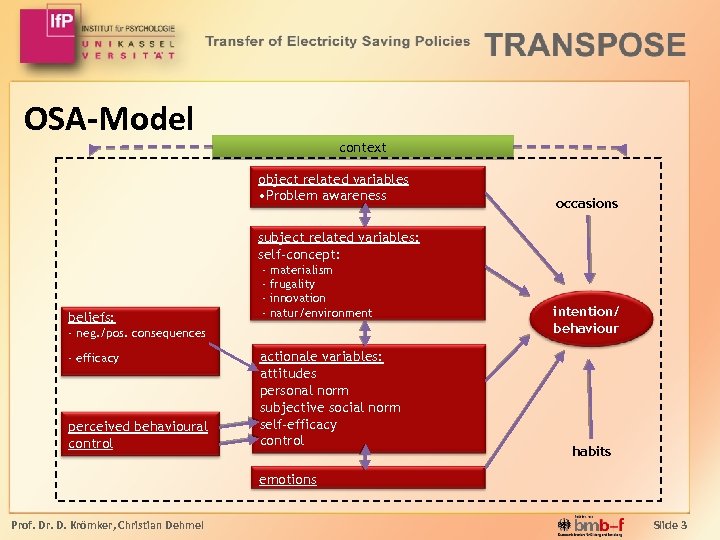 OSA-Model context object related variables • Problem awareness occasions subject related variables: self-concept: beliefs: - materialism frugality innovation natur/environment - neg. /pos. consequences - efficacy perceived behavioural control actionale variables: attitudes personal norm subjective social norm self-efficacy control intention/ behaviour habits emotions Prof. Dr. D. Krömker, Christian Dehmel Slide 3
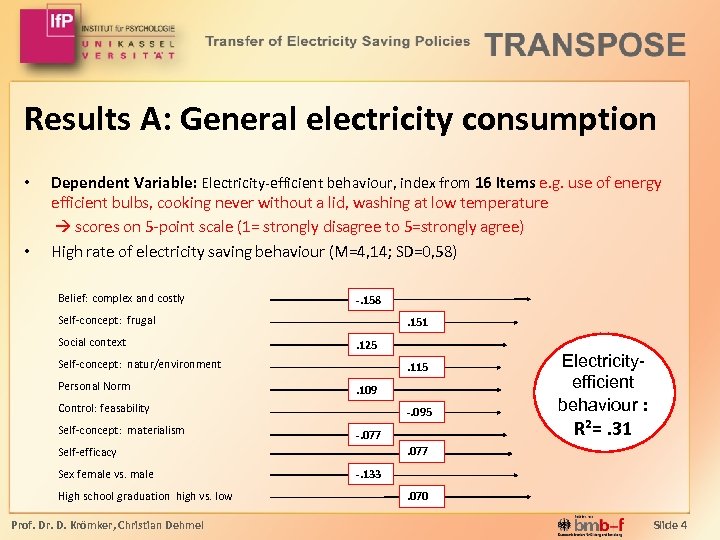 Results A: General electricity consumption • • Dependent Variable: Electricity-efficient behaviour, index from 16 Items e. g. use of energy efficient bulbs, cooking never without a lid, washing at low temperature scores on 5 -point scale (1= strongly disagree to 5=strongly agree) High rate of electricity saving behaviour (M=4, 14; SD=0, 58) Belief: complex and costly -. 158 Self-concept: frugal Social context . 151. 125 Self-concept: natur/environment Personal Norm . 115. 109 Control: feasability Self-concept: materialism -. 095 -. 077 High school graduation high vs. low Prof. Dr. D. Krömker, Christian Dehmel R²=. 31 . 077 Self-efficacy Sex female vs. male Electricityefficient behaviour : -. 133. 070 Slide 4
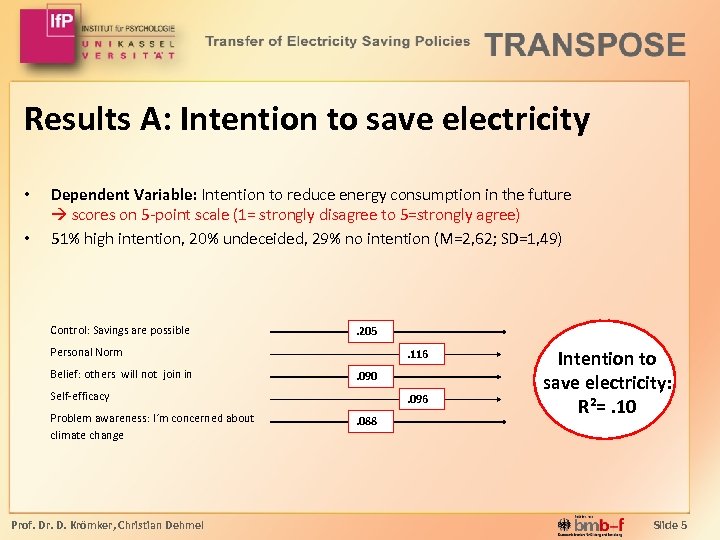 Results A: Intention to save electricity • • Dependent Variable: Intention to reduce energy consumption in the future scores on 5 -point scale (1= strongly disagree to 5=strongly agree) 51% high intention, 20% undeceided, 29% no intention (M=2, 62; SD=1, 49) Control: Savings are possible . 205 Personal Norm Belief: others will not join in . 116. 090 Self-efficacy Problem awareness: I´m concerned about climate change Prof. Dr. D. Krömker, Christian Dehmel . 096. 088 Intention to save electricity: R²=. 10 Slide 5
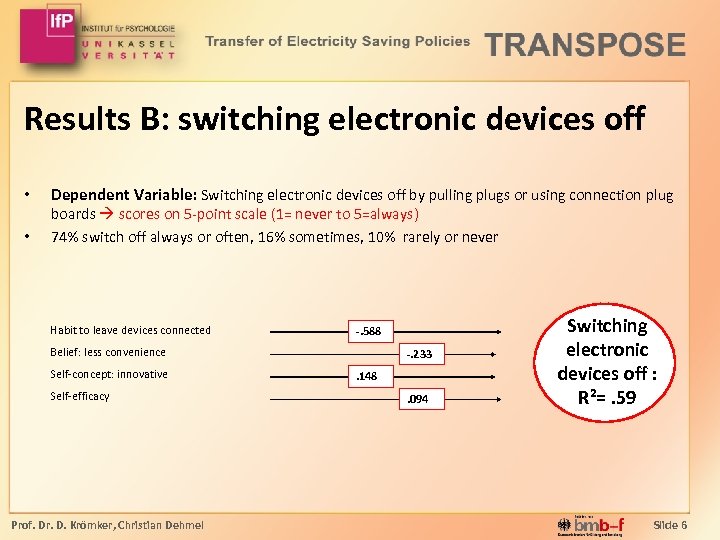 Results B: switching electronic devices off • • Dependent Variable: Switching electronic devices off by pulling plugs or using connection plug boards scores on 5 -point scale (1= never to 5=always) 74% switch off always or often, 16% sometimes, 10% rarely or never Habit to leave devices connected -. 588 Belief: less convenience Self-concept: innovative Self-efficacy Prof. Dr. D. Krömker, Christian Dehmel -. 233. 148. 094 Switching electronic devices off : R²=. 59 Slide 6
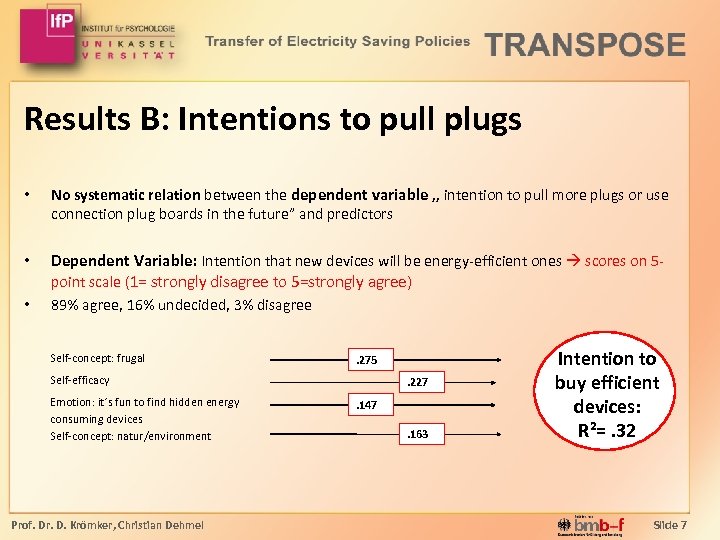 Results B: Intentions to pull plugs • No systematic relation between the dependent variable „ intention to pull more plugs or use connection plug boards in the future” and predictors • Dependent Variable: Intention that new devices will be energy-efficient ones scores on 5 point scale (1= strongly disagree to 5=strongly agree) • 89% agree, 16% undecided, 3% disagree Self-concept: frugal . 275 Self-efficacy Emotion: it´s fun to find hidden energy consuming devices Self-concept: natur/environment Prof. Dr. D. Krömker, Christian Dehmel . 227. 147. 163 Intention to buy efficient devices: R²=. 32 Slide 7
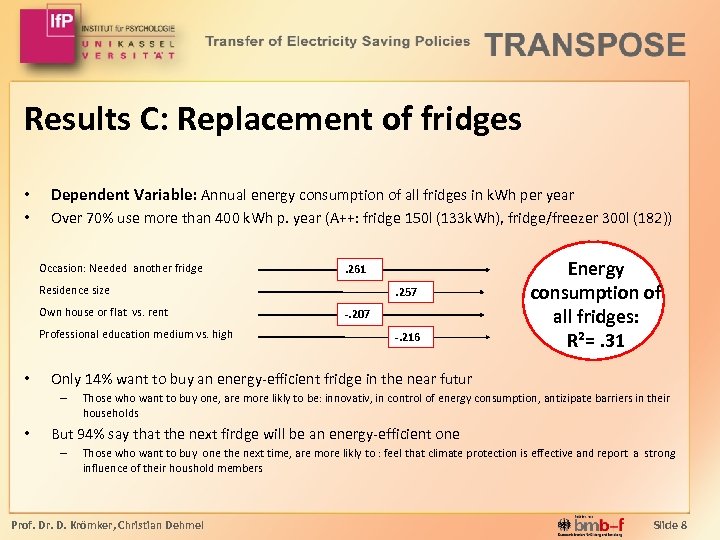 Results C: Replacement of fridges • Dependent Variable: Annual energy consumption of all fridges in k. Wh per year • Over 70% use more than 400 k. Wh p. year (A++: fridge 150 l (133 k. Wh), fridge/freezer 300 l (182)) Occasion: Needed another fridge . 261 Residence size Own house or flat vs. rent Professional education medium vs. high • -. 207 -. 216 Only 14% want to buy an energy-efficient fridge in the near futur – • . 257 Energy consumption of all fridges: R²=. 31 Those who want to buy one, are more likly to be: innovativ, in control of energy consumption, antizipate barriers in their households But 94% say that the next firdge will be an energy-efficient one – Those who want to buy one the next time, are more likly to : feel that climate protection is effective and report a strong influence of their houshold members Prof. Dr. D. Krömker, Christian Dehmel Slide 8
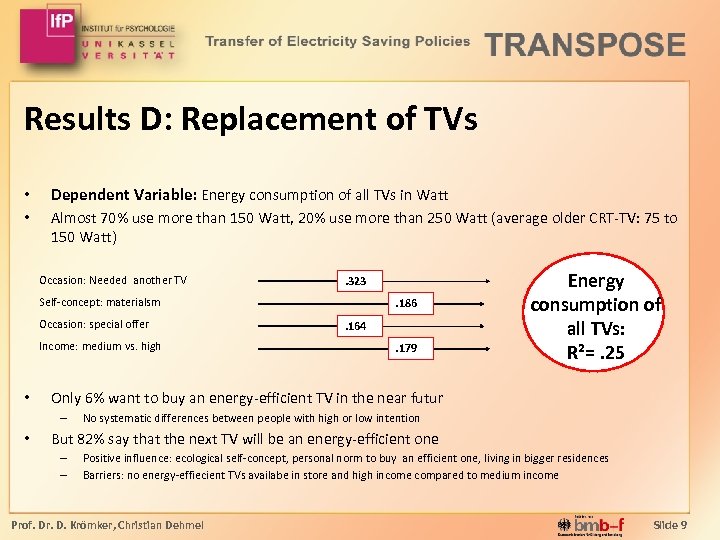 Results D: Replacement of TVs • Dependent Variable: Energy consumption of all TVs in Watt • Almost 70% use more than 150 Watt, 20% use more than 250 Watt (average older CRT-TV: 75 to 150 Watt) Occasion: Needed another TV . 323 Self-concept: materialsm Occasion: special offer Income: medium vs. high • . 164. 179 Only 6% want to buy an energy-efficient TV in the near futur – • . 186 Energy consumption of all TVs: R²=. 25 No systematic differences between people with high or low intention But 82% say that the next TV will be an energy-efficient one – – Positive influence: ecological self-concept, personal norm to buy an efficient one, living in bigger residences Barriers: no energy-effiecient TVs availabe in store and high income compared to medium income Prof. Dr. D. Krömker, Christian Dehmel Slide 9
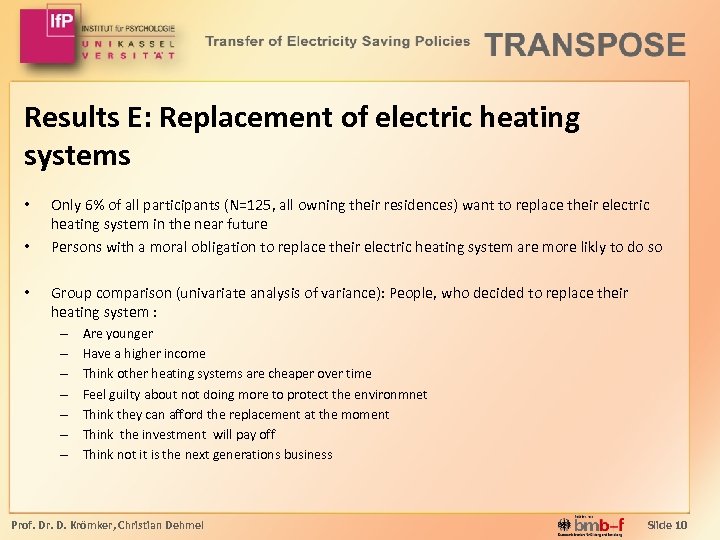 Results E: Replacement of electric heating systems • • • Only 6% of all participants (N=125, all owning their residences) want to replace their electric heating system in the near future Persons with a moral obligation to replace their electric heating system are more likly to do so Group comparison (univariate analysis of variance): People, who decided to replace their heating system : – – – – Are younger Have a higher income Think other heating systems are cheaper over time Feel guilty about not doing more to protect the environmnet Think they can afford the replacement at the moment Think the investment will pay off Think not it is the next generations business Prof. Dr. D. Krömker, Christian Dehmel Slide 10
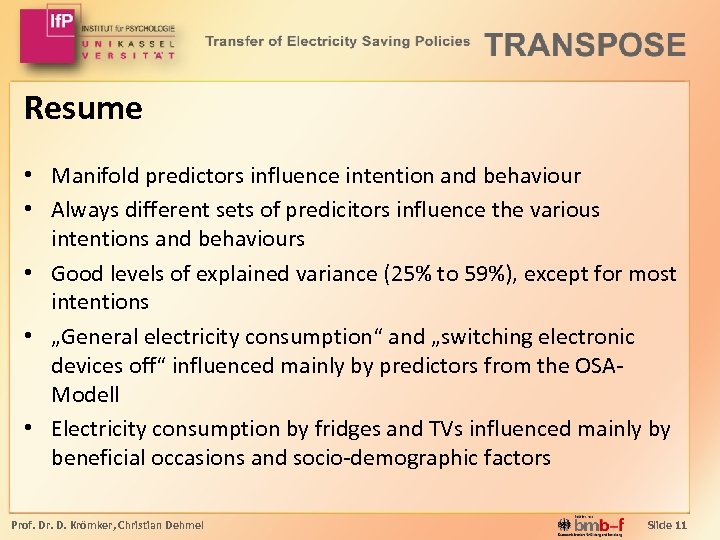 Resume • Manifold predictors influence intention and behaviour • Always different sets of predicitors influence the various intentions and behaviours • Good levels of explained variance (25% to 59%), except for most intentions • „General electricity consumption“ and „switching electronic devices off“ influenced mainly by predictors from the OSAModell • Electricity consumption by fridges and TVs influenced mainly by beneficial occasions and socio-demographic factors Prof. Dr. D. Krömker, Christian Dehmel Slide 11
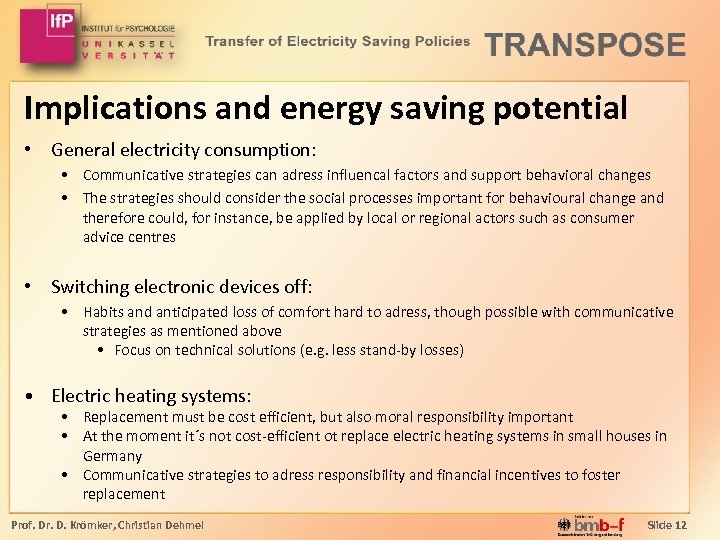 Implications and energy saving potential • General electricity consumption: • Communicative strategies can adress influencal factors and support behavioral changes • The strategies should consider the social processes important for behavioural change and therefore could, for instance, be applied by local or regional actors such as consumer advice centres • Switching electronic devices off: • Habits and anticipated loss of comfort hard to adress, though possible with communicative strategies as mentioned above • Focus on technical solutions (e. g. less stand-by losses) • Electric heating systems: • Replacement must be cost efficient, but also moral responsibility important • At the moment it´s not cost-efficient ot replace electric heating systems in small houses in Germany • Communicative strategies to adress responsibility and financial incentives to foster replacement Prof. Dr. D. Krömker, Christian Dehmel Slide 12
 Implications and energy saving potential • Fridges: • ecological and economical reasonable to exchange devices older than 5 years • Two big fridges (300 l) A++ need less than 400 k. Wh per year: 70% of the sample use more High energy saving potential through exchange • High motivation to buy energy-efficient fridges • Communicative strategies to support exchange of fridges soon • Bonus programs could stimulate exchange • TVs: • 66% of the sample use CRT-TVs, LCD-technology much more efficiant • But: „only“ 50% of the sample use TVs smaller than 70 cm screen size • Electricity consumption is not associated with TVs (no labels) and energy-efficient TVs are not sufficiently visible in stores • Howerver, bonus programs may be ineffective without energy labels and communicative strategies to raise awareness applied at the same time Prof. Dr. D. Krömker, Christian Dehmel Slide 13
 Contact Dörthe Krömker, University of Kassel, doerthe. kroemker@uni-kassel. de Christian Dehmel, University of Muenster, christian. dehmel@uni-muenster. de Prof. Dr. D. Krömker, Christian Dehmel Slide 14