 Скачать презентацию Plenary ACC Workshop Robust and Reconfigurable High Capacity
65a8c6542ab2bfcb62b0cce513d6462b.ppt
- Количество слайдов: 59



Plenary: ACC Workshop Robust and Reconfigurable High. Capacity Optical Communication Systems Alan E. Willner University of Southern California Los Angeles, CA 90089 -2565
Thank You ! … to Drs. Ady, Arie, and Mark. The generous support and collaboration of CISCO, DARPA, HP, Intel, NSF, Packard Foundation and SPAWAR.

John Tyndall
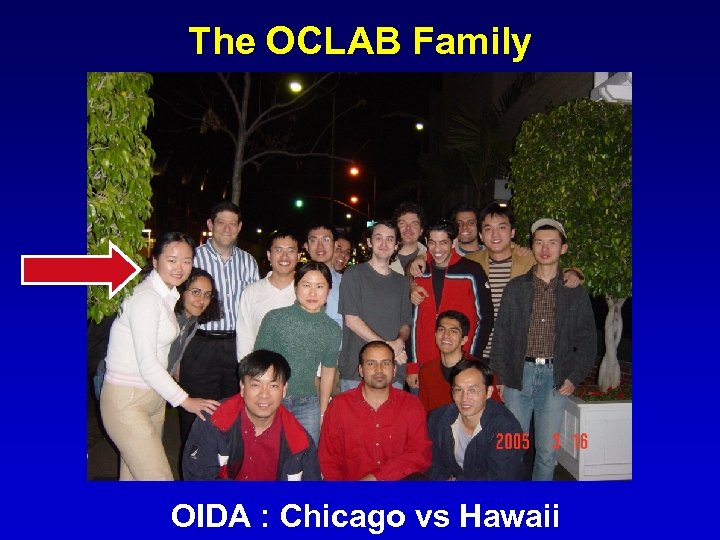
The OCLAB Family OIDA : Chicago vs Hawaii
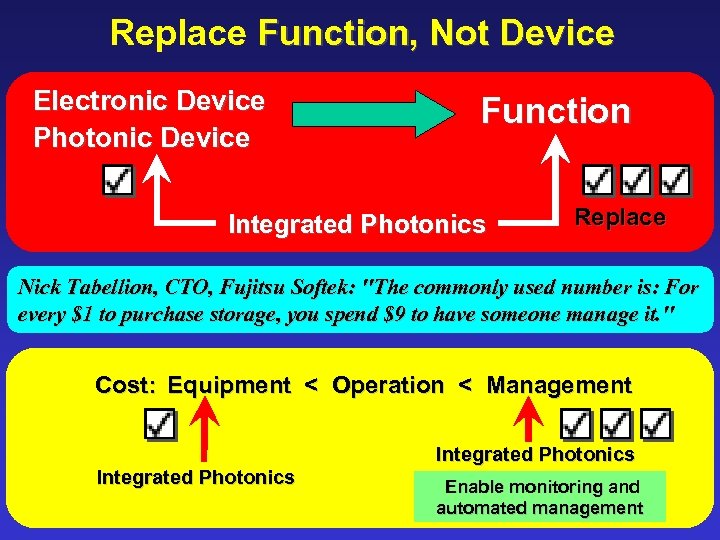
Replace Function, Not Device Electronic Device Photonic Device Function Integrated Photonics Replace Nick Tabellion, CTO, Fujitsu Softek: "The commonly used number is: For every $1 to purchase storage, you spend $9 to have someone manage it. " Cost: Equipment < Operation < Management Integrated Photonics Enable monitoring and automated management
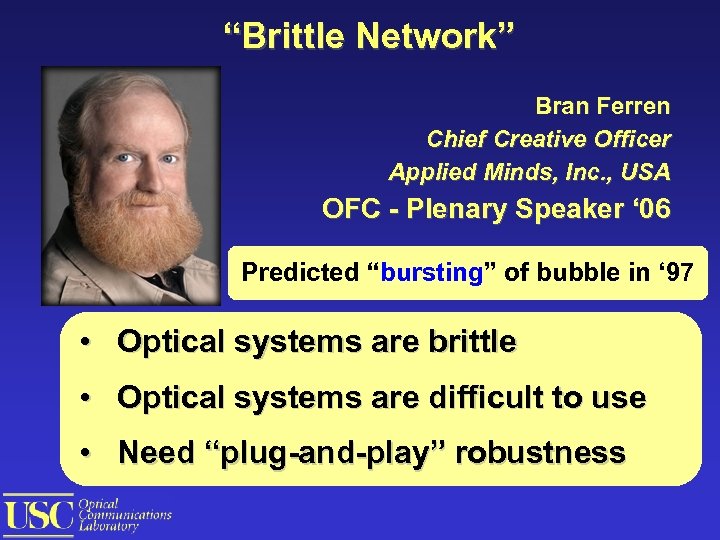
“Brittle Network” Bran Ferren Chief Creative Officer Applied Minds, Inc. , USA OFC - Plenary Speaker ‘ 06 Predicted “bursting” of bubble in ‘ 97 • Optical systems are brittle • Optical systems are difficult to use • Need “plug-and-play” robustness
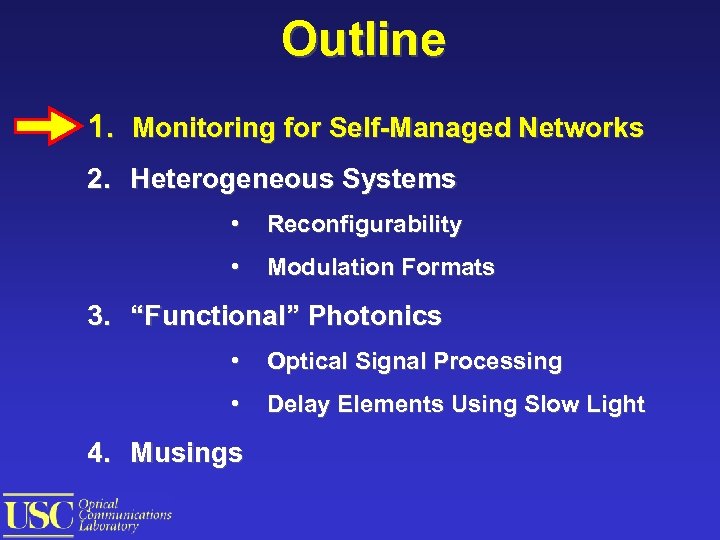
Outline 1. Monitoring for Self-Managed Networks 2. Heterogeneous Systems • Reconfigurability • Modulation Formats 3. “Functional” Photonics • Optical Signal Processing • Delay Elements Using Slow Light 4. Musings
Think “wireless laptop LAN” …
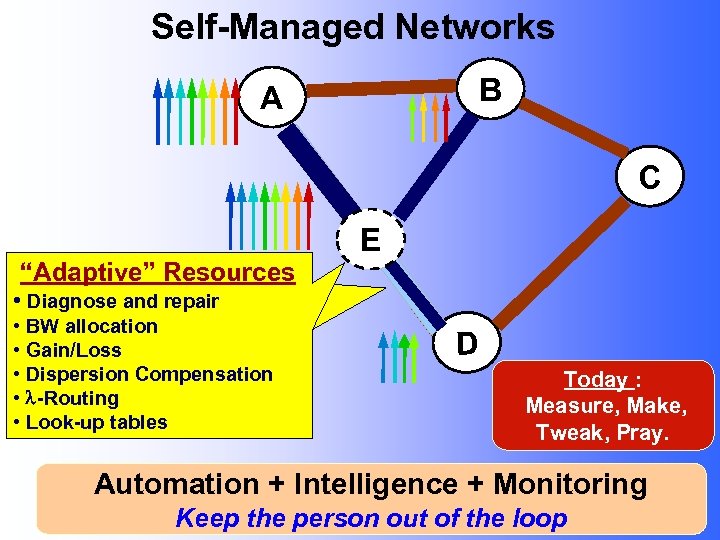
Self-Managed Networks B A C “Adaptive” Resources E • Diagnose and repair • BW allocation • Gain/Loss • Dispersion Compensation • -Routing • Look-up tables D Today : Measure, Make, Tweak, Pray. Automation + Intelligence + Monitoring Keep the person out of the loop
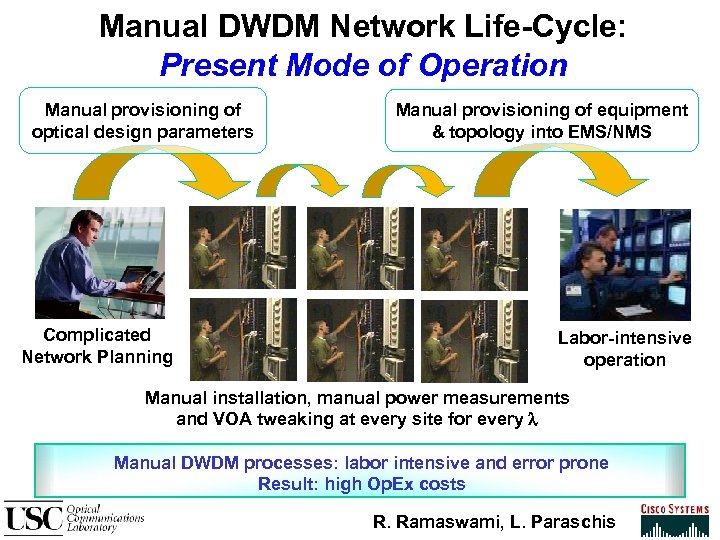
Manual DWDM Network Life-Cycle: Present Mode of Operation Manual provisioning of optical design parameters Complicated Network Planning Manual provisioning of equipment & topology into EMS/NMS Labor-intensive operation Manual installation, manual power measurements and VOA tweaking at every site for every Manual DWDM processes: labor intensive and error prone Result: high Op. Ex costs R. Ramaswami, L. Paraschis
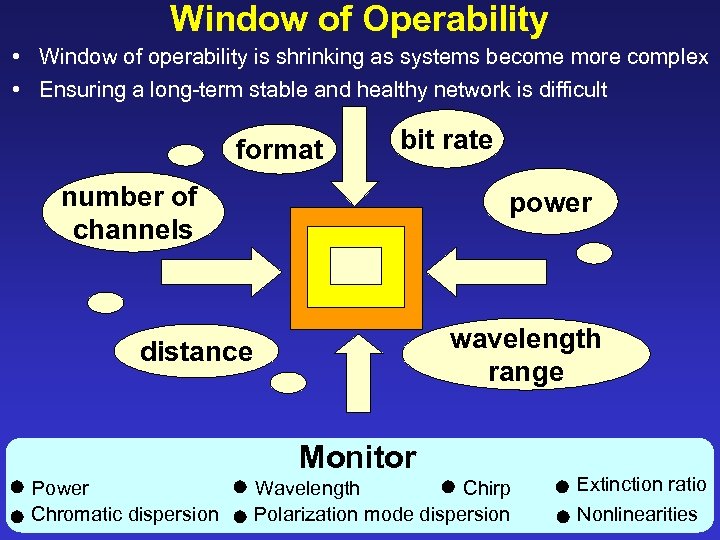
Window of Operability • Window of operability is shrinking as systems become more complex • Ensuring a long-term stable and healthy network is difficult format bit rate number of channels power wavelength range distance Monitor Power Chromatic dispersion Wavelength Chirp Polarization mode dispersion Extinction ratio Nonlinearities
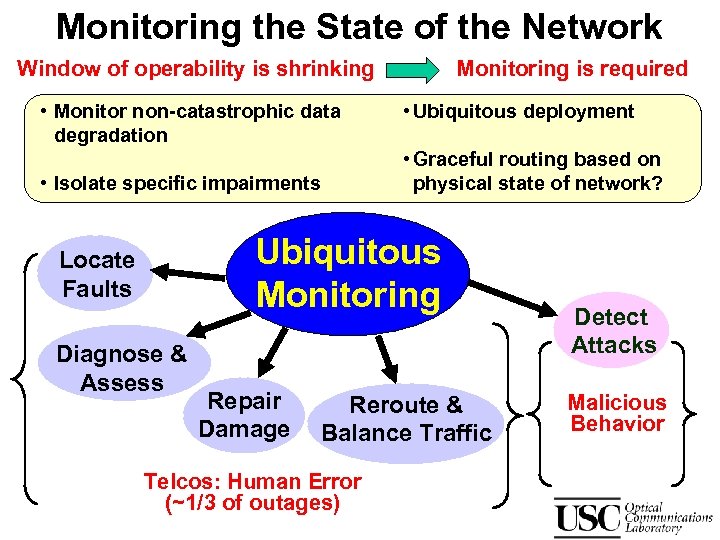
Monitoring the State of the Network Window of operability is shrinking • Monitor non-catastrophic data degradation • Isolate specific impairments Monitoring is required • Ubiquitous deployment • Graceful routing based on physical state of network? Ubiquitous Monitoring Locate Faults Diagnose & Assess Repair Damage Reroute & Balance Traffic Telcos: Human Error (~1/3 of outages) Detect Attacks Malicious Behavior

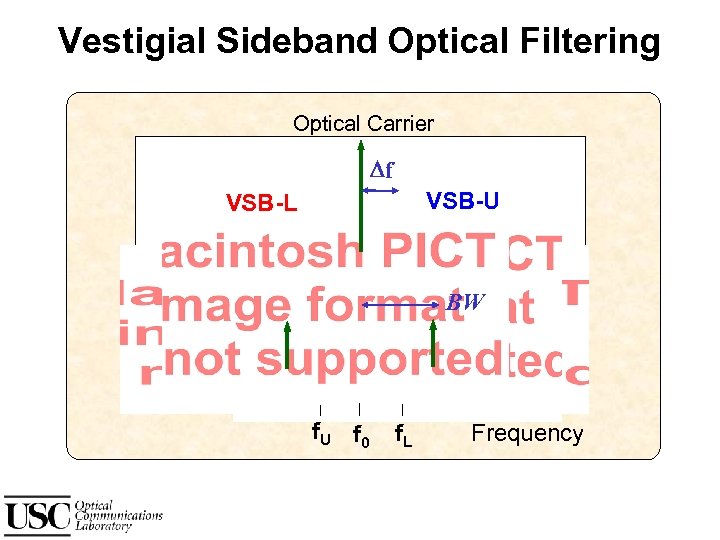
Vestigial Sideband Optical Filtering Optical Carrier f VSB-U VSB-L BW f. U f 0 f. L Frequency

Q. Yu, JLT, 2003
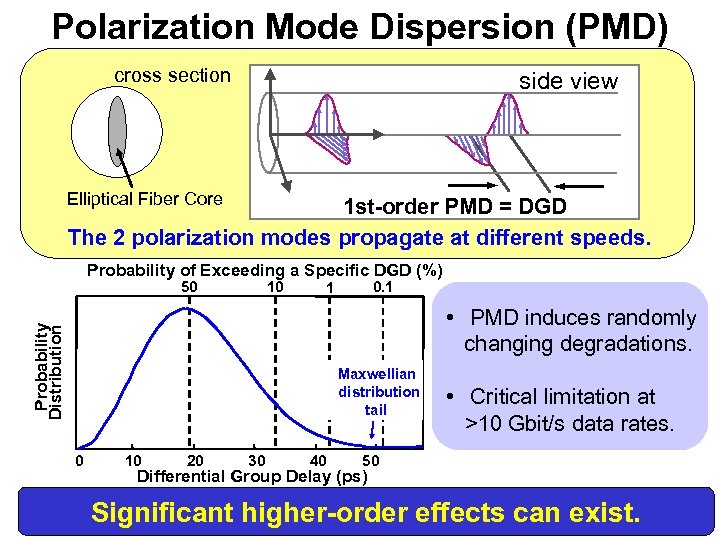
Polarization Mode Dispersion (PMD) cross section side view Elliptical Fiber Core 1 st-order PMD = DGD The 2 polarization modes propagate at different speeds. Probability of Exceeding a Specific DGD (%) 50 10 0. 1 1 Probability Distribution • PMD induces randomly changing degradations. Maxwellian distribution tail 0 10 20 30 40 • Critical limitation at >10 Gbit/s data rates. 50 Differential Group Delay (ps) Significant higher-order effects can exist.
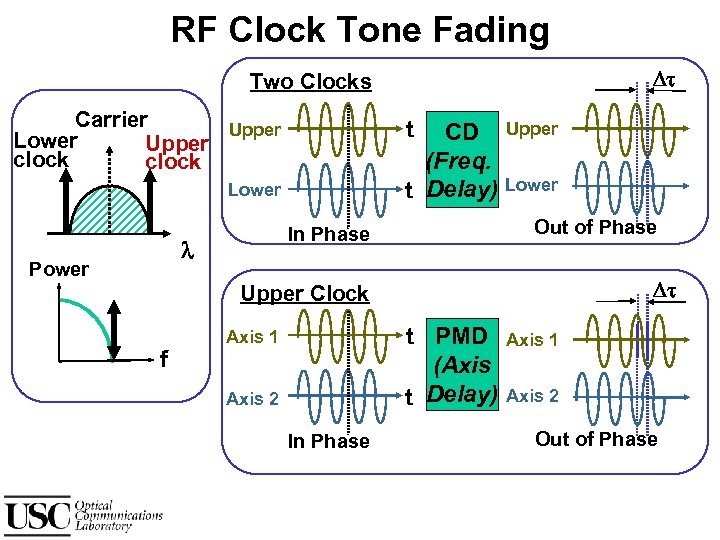
RF Clock Tone Fading Two Clocks Carrier Upper Lower Upper clock t CD (Freq. t Delay) Lower Power Lower Out of Phase In Phase Upper Clock f t PMD (Axis t Delay) Axis 1 Axis 2 In Phase Axis 1 Axis 2 Out of Phase


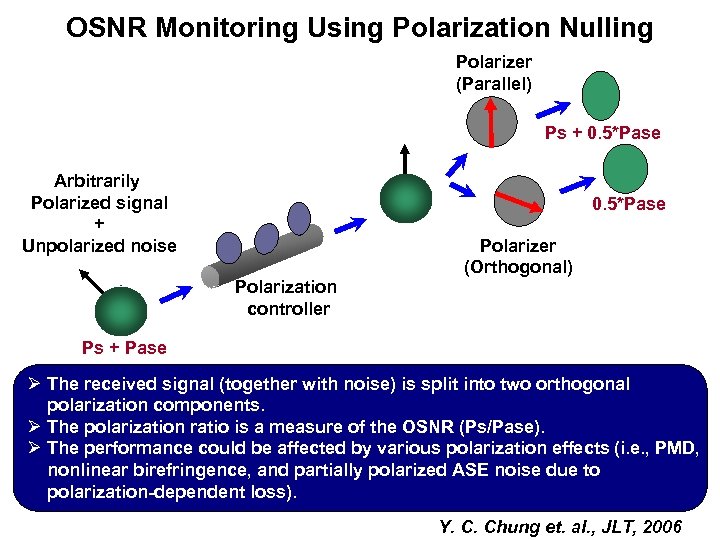
OSNR Monitoring Using Polarization Nulling Polarizer (Parallel) Ps + 0. 5*Pase Arbitrarily Polarized signal + Unpolarized noise 0. 5*Pase Polarization controller Polarizer (Orthogonal) Ps + Pase Ø The received signal (together with noise) is split into two orthogonal polarization components. Ø The polarization ratio is a measure of the OSNR (Ps/Pase). Ø The performance could be affected by various polarization effects (i. e. , PMD, nonlinear birefringence, and partially polarized ASE noise due to polarization-dependent loss). Y. C. Chung et. al. , JLT, 2006
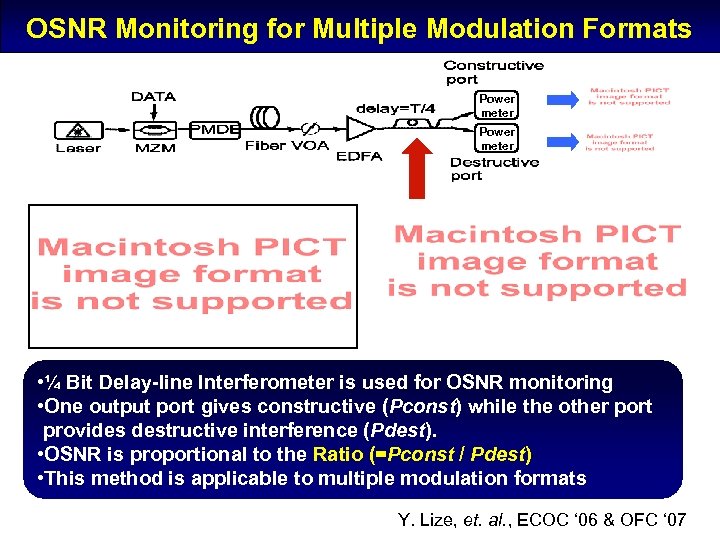
OSNR Monitoring for Multiple Modulation Formats Power meter • ¼ Bit Delay-line Interferometer is used for OSNR monitoring • One output port gives constructive (Pconst) while the other port provides destructive interference (Pdest). • OSNR is proportional to the Ratio (=Pconst / Pdest) • This method is applicable to multiple modulation formats Y. Lize, et. al. , ECOC ‘ 06 & OFC ‘ 07
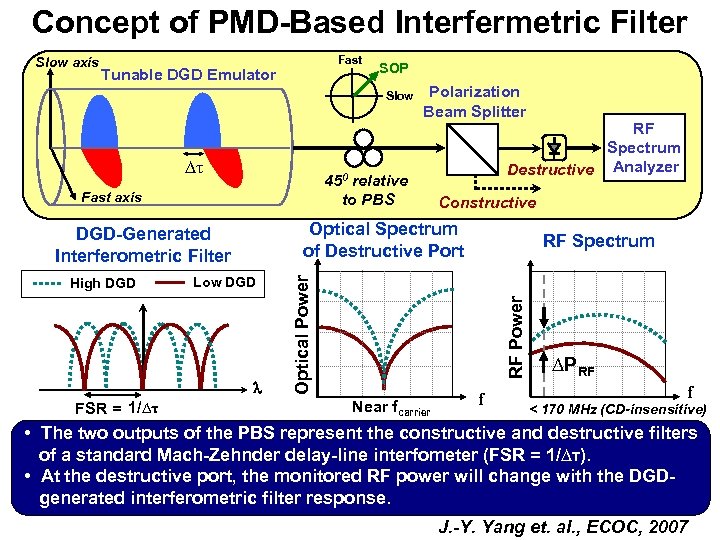
Concept of PMD-Based Interfermetric Filter Slow axis Fast Tunable DGD Emulator SOP Slow ∆τ 450 relative to PBS Fast axis Constructive RF Spectrum RF Power Optical Power Low DGD FSR = 1/∆τ RF Spectrum Destructive Analyzer Optical Spectrum of Destructive Port DGD-Generated Interferometric Filter High DGD Polarization Beam Splitter Near fcarrier f ∆PRF f < 170 MHz (CD-insensitive) • The two outputs of the PBS represent the constructive and destructive filters of a standard Mach-Zehnder delay-line interfometer (FSR = 1/∆τ). • At the destructive port, the monitored RF power will change with the DGDgenerated interferometric filter response. J. -Y. Yang et. al. , ECOC, 2007
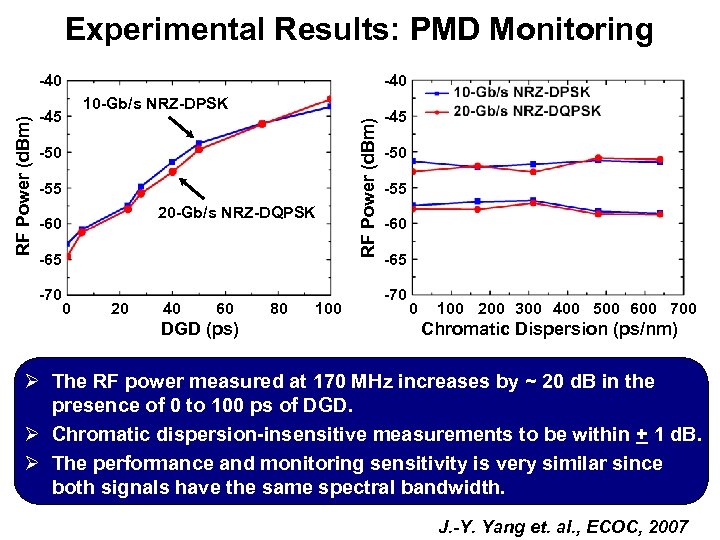
Experimental Results: PMD Monitoring -45 -40 10 -Gb/s NRZ-DPSK -50 -55 20 -Gb/s NRZ-DQPSK -60 -65 -70 0 20 40 60 DGD (ps) 80 100 RF Power (d. Bm) -40 -45 -50 -55 -60 -65 -70 0 100 200 300 400 500 600 700 Chromatic Dispersion (ps/nm) Ø The RF power measured at 170 MHz increases by ~ 20 d. B in the presence of 0 to 100 ps of DGD. Ø Chromatic dispersion-insensitive measurements to be within + 1 d. B. Ø The performance and monitoring sensitivity is very similar since both signals have the same spectral bandwidth. J. -Y. Yang et. al. , ECOC, 2007
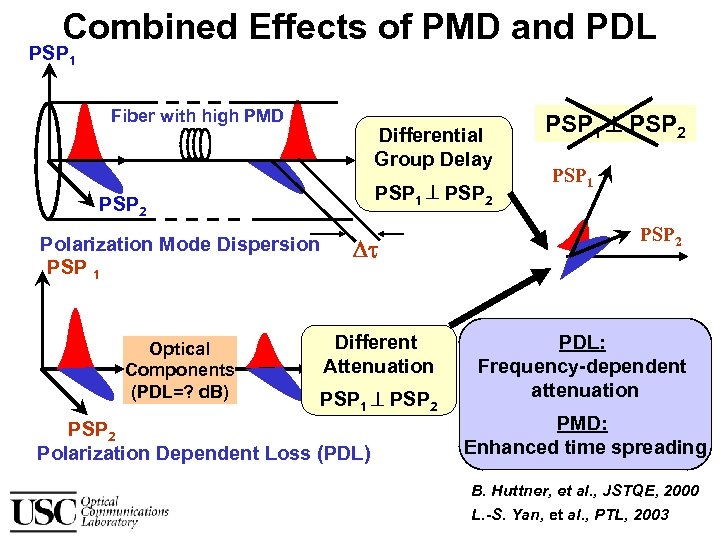
Combined Effects of PMD and PDL PSP 1 Fiber with high PMD Differential Group Delay PSP 1 PSP 2 Polarization Mode Dispersion PSP 1 Optical Components (PDL=? d. B) Different Attenuation PSP 1 PSP 2 Polarization Dependent Loss (PDL) PSP 1 PSP 2 PSP 1 PSP 2 PDL: Frequency-dependent attenuation PMD: Enhanced time spreading B. Huttner, et al. , JSTQE, 2000 L. -S. Yan, et al. , PTL, 2003
Outline 1. Monitoring for Self-Managed Networks 2. Heterogeneous Systems • Reconfigurability • Modulation Formats 3. “Functional” Photonics • Optical Signal Processing • Delay Elements Using Slow Light 4. Musings
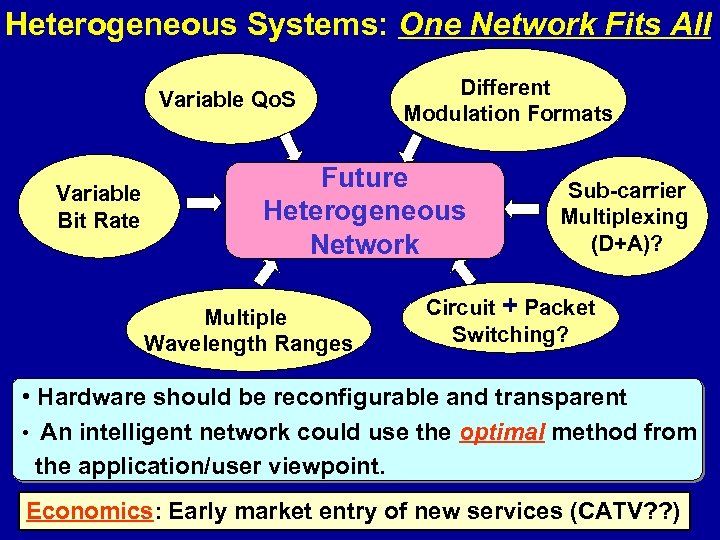
Heterogeneous Systems: One Network Fits All Variable Qo. S Variable Bit Rate Different Modulation Formats Future Heterogeneous Network Multiple Wavelength Ranges Sub-carrier Multiplexing (D+A)? Circuit + Packet Switching? • Hardware should be reconfigurable and transparent • An intelligent network could use the optimal method from the application/user viewpoint. Economics: Early market entry of new services (CATV? ? )
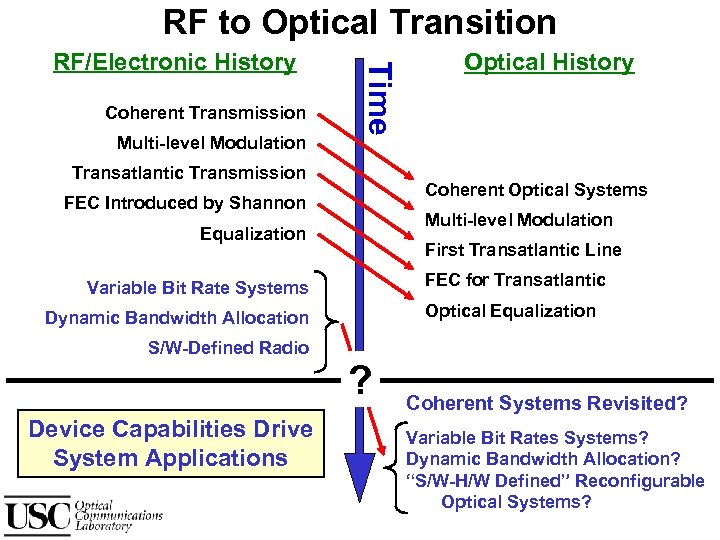
RF to Optical Transition Coherent Transmission Multi-level Modulation Time RF/Electronic History Transatlantic Transmission Coherent Optical Systems FEC Introduced by Shannon Multi-level Modulation Equalization First Transatlantic Line FEC for Transatlantic Variable Bit Rate Systems Optical Equalization Dynamic Bandwidth Allocation S/W-Defined Radio Device Capabilities Drive System Applications Optical History ? Coherent Systems Revisited? Variable Bit Rates Systems? Dynamic Bandwidth Allocation? “S/W-H/W Defined” Reconfigurable Optical Systems?

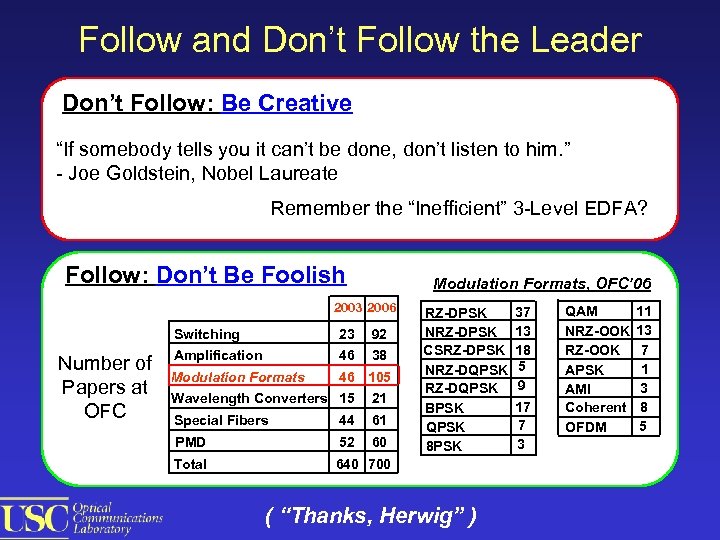
Follow and Don’t Follow the Leader Don’t Follow: Be Creative “If somebody tells you it can’t be done, don’t listen to him. ” - Joe Goldstein, Nobel Laureate Remember the “Inefficient” 3 -Level EDFA? Follow: Don’t Be Foolish Modulation Formats, OFC’ 06 2003 2006 Switching Number of Papers at OFC 23 92 Amplification 46 38 Modulation Formats 46 105 Wavelength Converters 15 21 Special Fibers 44 61 PMD 52 60 Total RZ-DPSK NRZ-DPSK CSRZ-DPSK NRZ-DQPSK BPSK QPSK 8 PSK 640 700 ( “Thanks, Herwig” ) 37 13 18 5 9 17 7 3 QAM NRZ-OOK APSK AMI Coherent OFDM 11 13 7 1 3 8 5
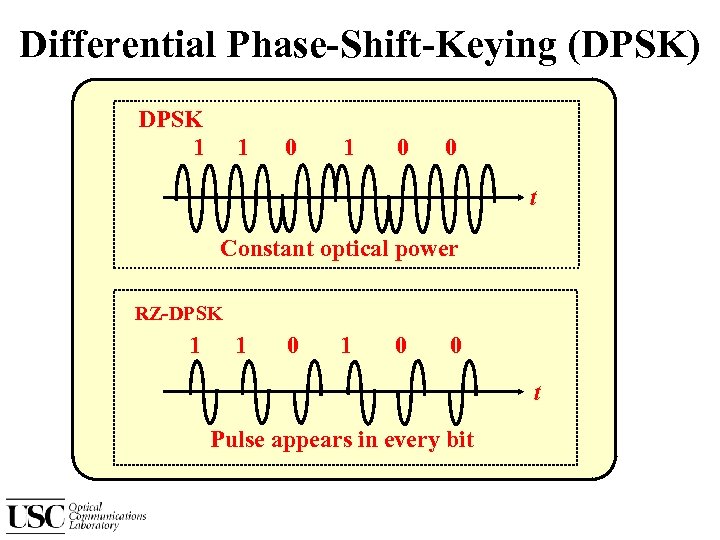
Differential Phase-Shift-Keying (DPSK) DPSK 1 1 0 0 t Constant optical power RZ-DPSK 1 1 0 0 t Pulse appears in every bit
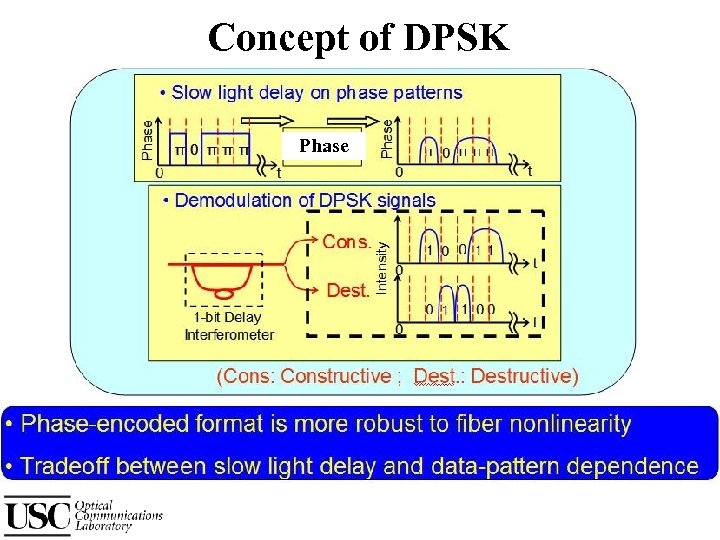
Concept of DPSK Phase
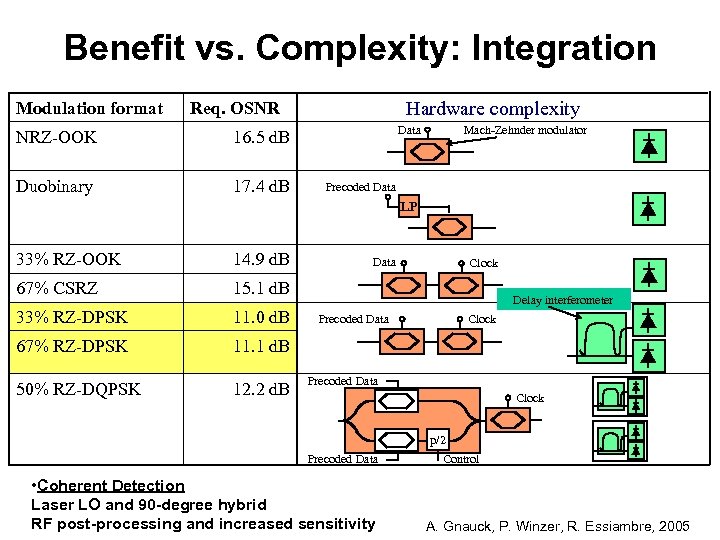
Benefit vs. Complexity: Integration Modulation format Hardware complexity Req. OSNR NRZ-OOK Duobinary 17. 4 d. B Mach-Zehnder modulator Data 16. 5 d. B Precoded Data LP 33% RZ-OOK 14. 9 d. B 67% CSRZ 15. 1 d. B 33% RZ-DPSK 11. 0 d. B 67% RZ-DPSK 11. 1 d. B 50% RZ-DQPSK 12. 2 d. B Data Clock Delay interferometer Precoded Data Clock p/2 Precoded Data • Coherent Detection Laser LO and 90 -degree hybrid RF post-processing and increased sensitivity Control A. Gnauck, P. Winzer, R. Essiambre, 2005
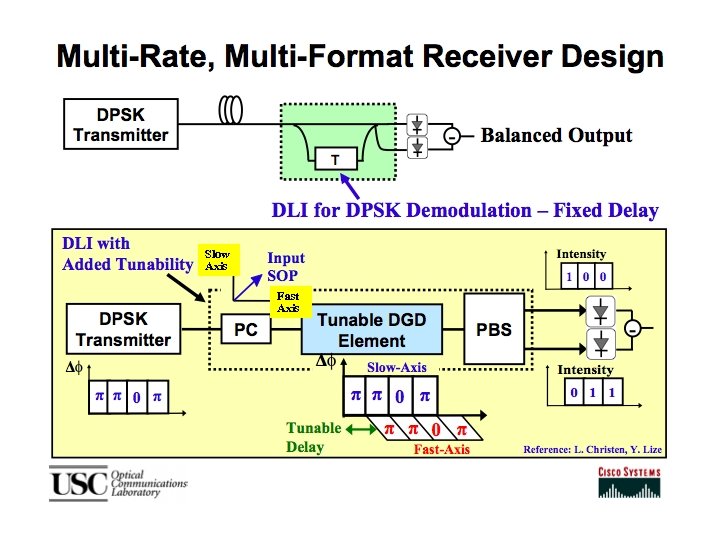
Slow Axis Fast Axis
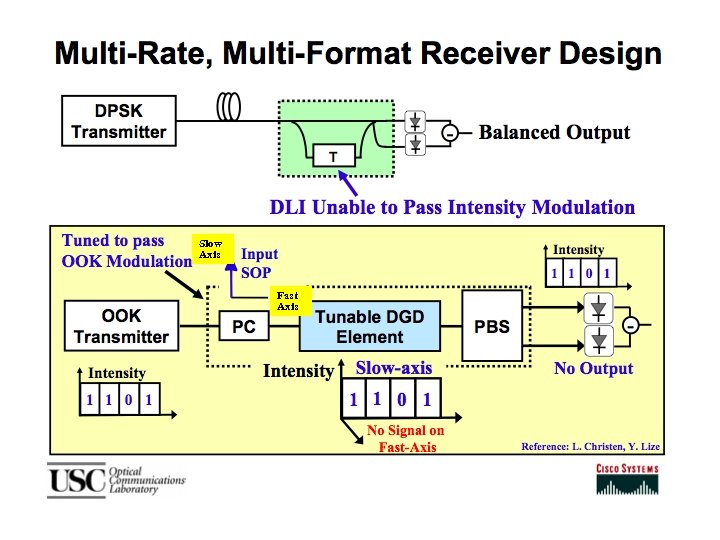
Slow Axis Fast Axis
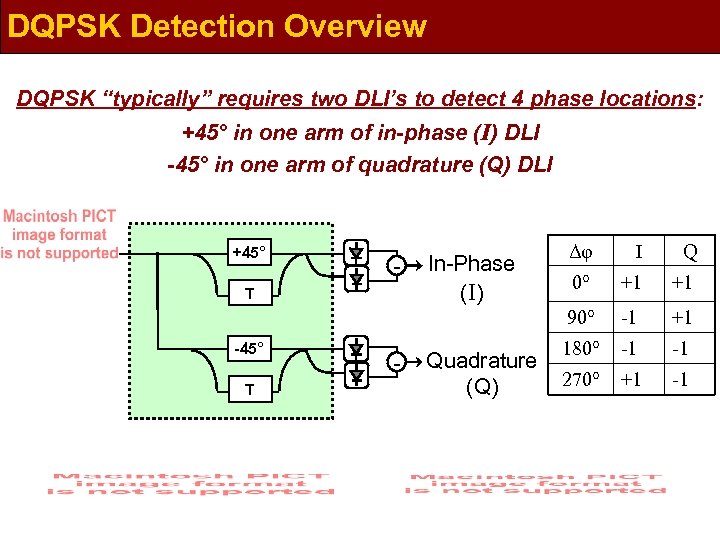
DQPSK Detection Overview DQPSK “typically” requires two DLI’s to detect 4 phase locations: +45° in one arm of in-phase (I) DLI -45° in one arm of quadrature (Q) DLI - T -45° T - In-Phase (I) Quadrature (Q) Δφ I Q 0° +1 +1 90° +45° -1 +1 180° -1 -1 270° +1 -1
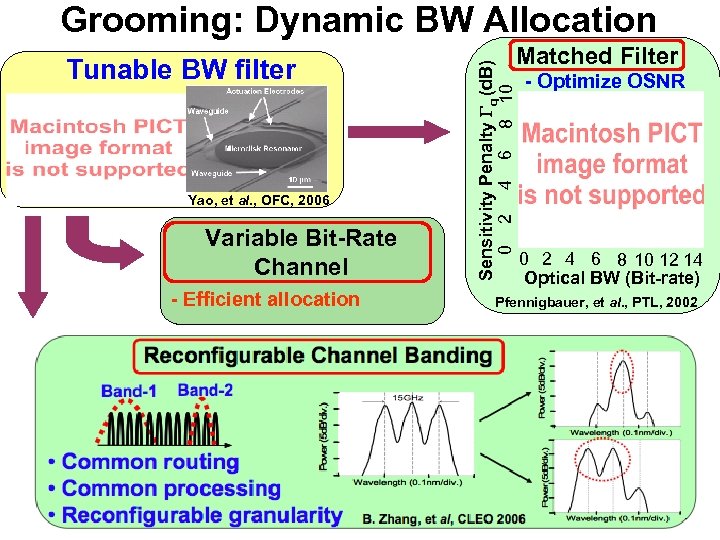
Grooming: Dynamic BW Allocation Yao, et al. , OFC, 2006 Variable Bit-Rate Channel - Efficient allocation Matched Filter Sensitivity Penalty Gq (d. B) 0 2 4 6 8 10 Tunable BW filter - Optimize OSNR 0 2 4 6 8 10 12 14 Optical BW (Bit-rate) Pfennigbauer, et al. , PTL, 2002
Outline 1. Monitoring for Self-Managed Networks 2. Heterogeneous Systems • Reconfigurability • Modulation Formats 3. “Functional” Photonics • Optical Signal Processing • Delay Elements Using Slow Light 4. Musings


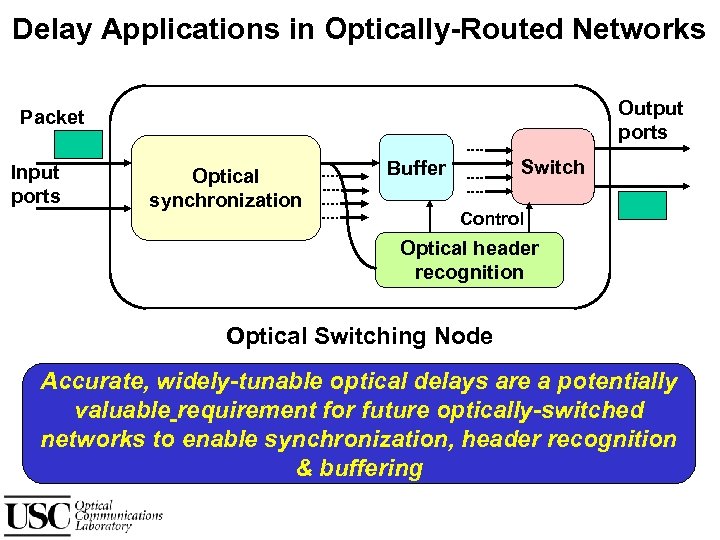
Delay Applications in Optically-Routed Networks Output ports Packet Input ports Optical synchronization Switch Buffer Control Optical header recognition Optical Switching Node Accurate, widely-tunable optical delays are a potentially valuable requirement for future optically-switched networks to enable synchronization, header recognition & buffering
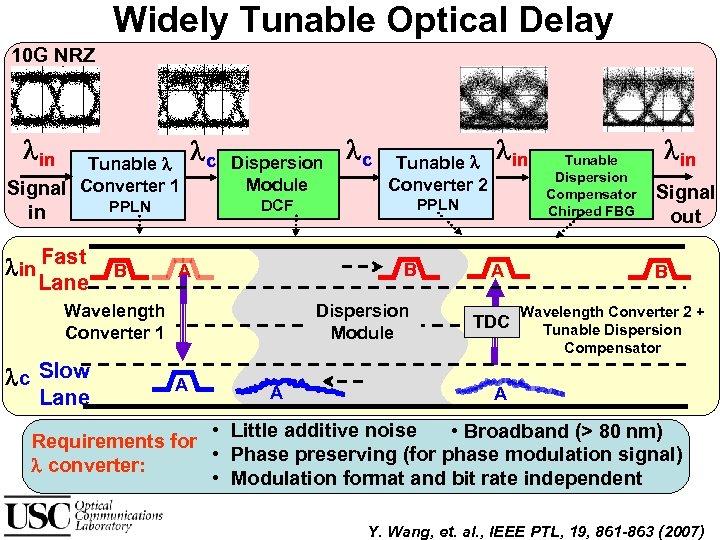
Widely Tunable Optical Delay 10 G NRZ in Tunable Signal Converter 1 c PPLN in Fast Lane B Dispersion Module Lane Tunable Converter 2 B A Dispersion Module A A in PPLN DCF Wavelength Converter 1 c Slow c A TDC Tunable Dispersion Compensator Chirped FBG in Signal out B Wavelength Converter 2 + Tunable Dispersion Compensator A • Little additive noise • Broadband (> 80 nm) Requirements for • Phase preserving (for phase modulation signal) converter: • Modulation format and bit rate independent Y. Wang, et. al. , IEEE PTL, 19, 861 -863 (2007)

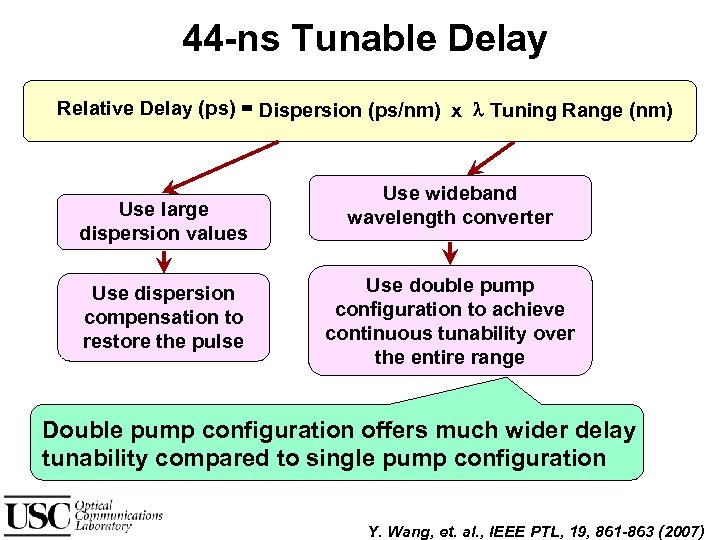
44 -ns Tunable Delay Relative Delay (ps) = Dispersion (ps/nm) x Tuning Range (nm) Use large dispersion values Use dispersion compensation to restore the pulse Use wideband wavelength converter Use double pump configuration to achieve continuous tunability over the entire range Double pump configuration offers much wider delay tunability compared to single pump configuration Y. Wang, et. al. , IEEE PTL, 19, 861 -863 (2007)
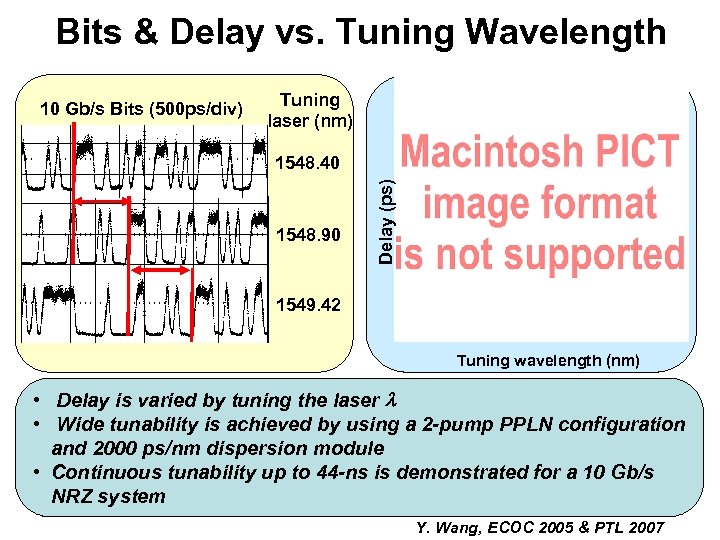
Bits & Delay vs. Tuning Wavelength 10 Gb/s Bits (500 ps/div) Tuning laser (nm) 1548. 90 Delay (ps) 1548. 40 1549. 42 Tuning wavelength (nm) • Delay is varied by tuning the laser • Wide tunability is achieved by using a 2 -pump PPLN configuration and 2000 ps/nm dispersion module • Continuous tunability up to 44 -ns is demonstrated for a 10 Gb/s NRZ system Y. Wang, ECOC 2005 & PTL 2007
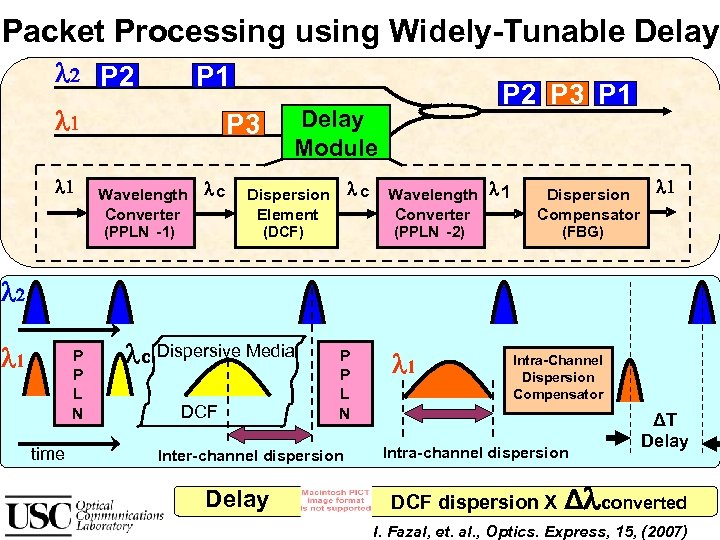
Packet Processing using Widely-Tunable Delay 2 P 1 1 1 Delay Module P 3 Wavelength Converter c (PPLN -1) P 2 P 3 P 1 c Dispersion Element (DCF) Wavelength 1 Converter (PPLN -2) Dispersion Compensator 1 (FBG) 2 1 P P L N time c Dispersive Media DCF P P L N Inter-channel dispersion Delay 1 Intra-Channel Dispersion Compensator ΔT Delay Intra-channel dispersion DCF dispersion X Δ converted I. Fazal, et. al. , Optics. Express, 15, (2007)
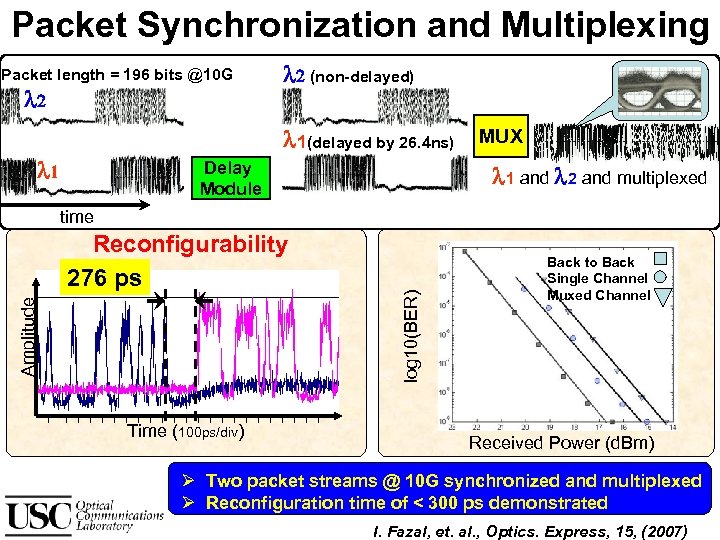
Packet Synchronization and Multiplexing Packet length = 196 bits @10 G 2 2 (non-delayed) 1(delayed by 26. 4 ns) 1 Delay Module MUX 1 and 2 and multiplexed Amplitude Reconfigurability 276 ps Time (100 ps/div) log 10(BER) time Back to Back Single Channel Muxed Channel Received Power (d. Bm) Ø Two packet streams @ 10 G synchronized and multiplexed Ø Reconfiguration time of < 300 ps demonstrated I. Fazal, et. al. , Optics. Express, 15, (2007)
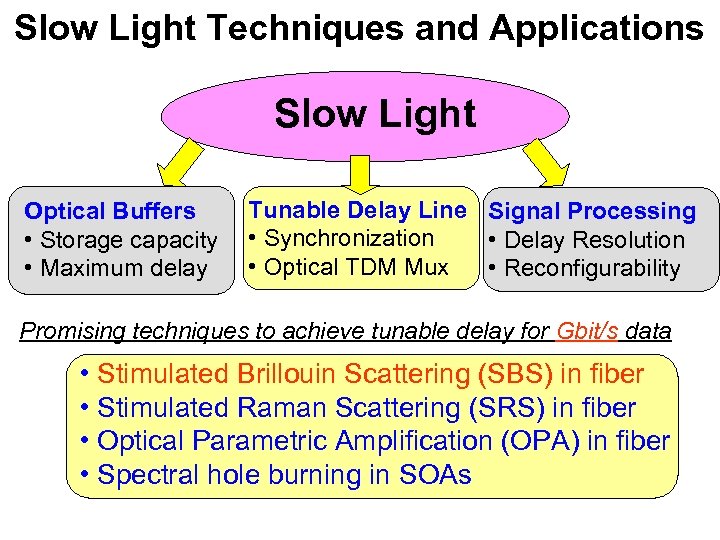
Slow Light Techniques and Applications Slow Light Optical Buffers • Storage capacity • Maximum delay Tunable Delay Line Signal Processing • Synchronization • Delay Resolution • Optical TDM Mux • Reconfigurability Promising techniques to achieve tunable delay for Gbit/s data • Stimulated Brillouin Scattering (SBS) in fiber • Stimulated Raman Scattering (SRS) in fiber • Optical Parametric Amplification (OPA) in fiber • Spectral hole burning in SOAs
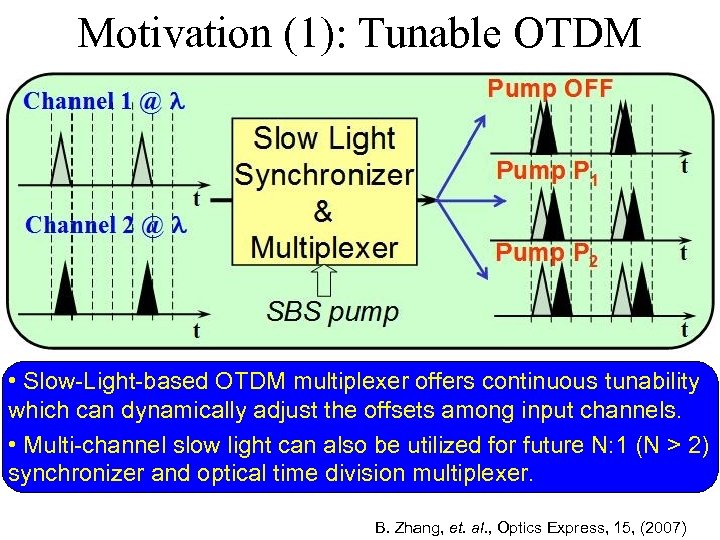
Motivation (1): Tunable OTDM • Slow-Light-based OTDM multiplexer offers continuous tunability which can dynamically adjust the offsets among input channels. • Multi-channel slow light can also be utilized for future N: 1 (N > 2) synchronizer and optical time division multiplexer. B. Zhang, et. al. , Optics Express, 15, (2007)
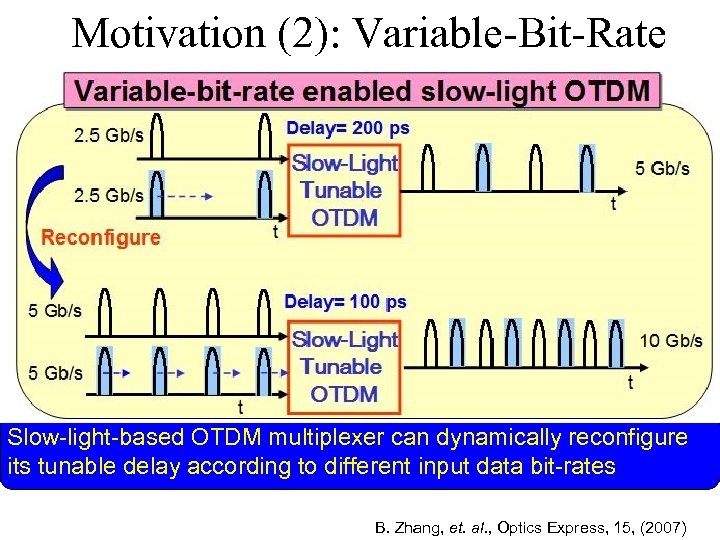
Motivation (2): Variable-Bit-Rate Slow-light-based OTDM multiplexer can dynamically reconfigure its tunable delay according to different input data bit-rates B. Zhang, et. al. , Optics Express, 15, (2007)
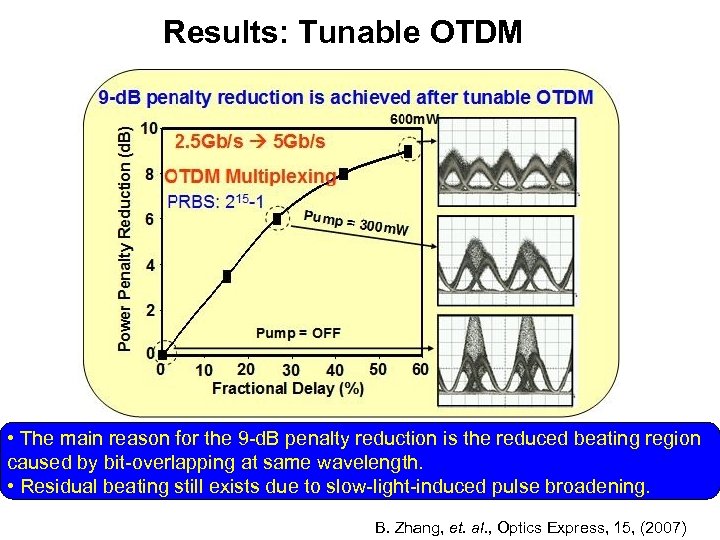
Results: Tunable OTDM • The main reason for the 9 -d. B penalty reduction is the reduced beating region caused by bit-overlapping at same wavelength. • Residual beating still exists due to slow-light-induced pulse broadening. B. Zhang, et. al. , Optics Express, 15, (2007)
Outline 1. Monitoring for Self-Managed Networks 2. Heterogeneous Systems • Reconfigurability • Modulation Formats 3. “Functional” Photonics • Optical Signal Processing • Delay Elements Using Slow Light 4. Musings
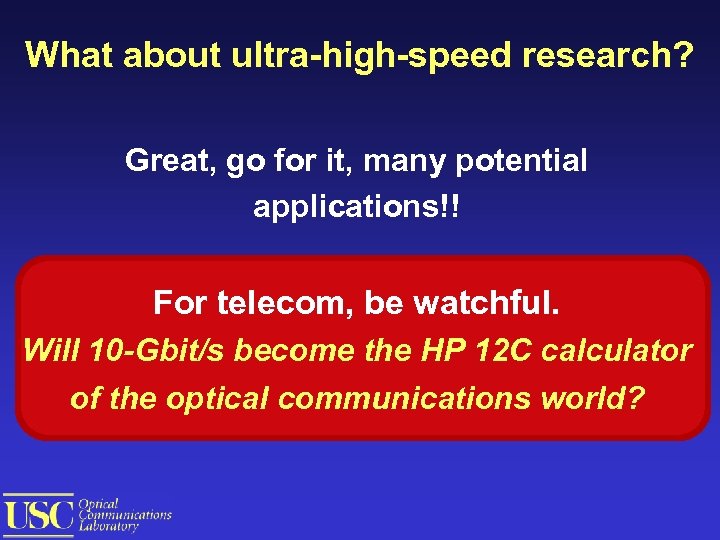
What about ultra-high-speed research? Great, go for it, many potential applications!! For telecom, be watchful. Will 10 -Gbit/s become the HP 12 C calculator of the optical communications world?

Available Jobs Are Like Icebergs Advertised Not advertised • Everything was advertised during “bubble”. • “Normal” hiring is much more ad hoc. • Be proactive. Jobs
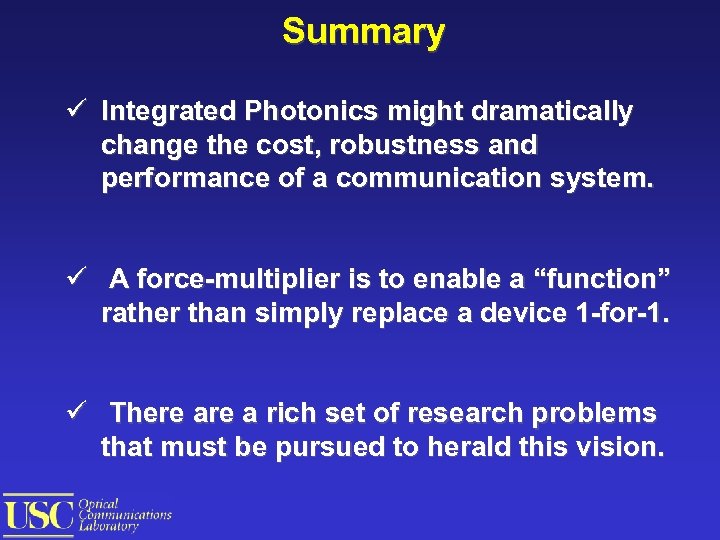
Summary ü Integrated Photonics might dramatically change the cost, robustness and performance of a communication system. ü A force-multiplier is to enable a “function” rather than simply replace a device 1 -for-1. ü There a rich set of research problems that must be pursued to herald this vision.
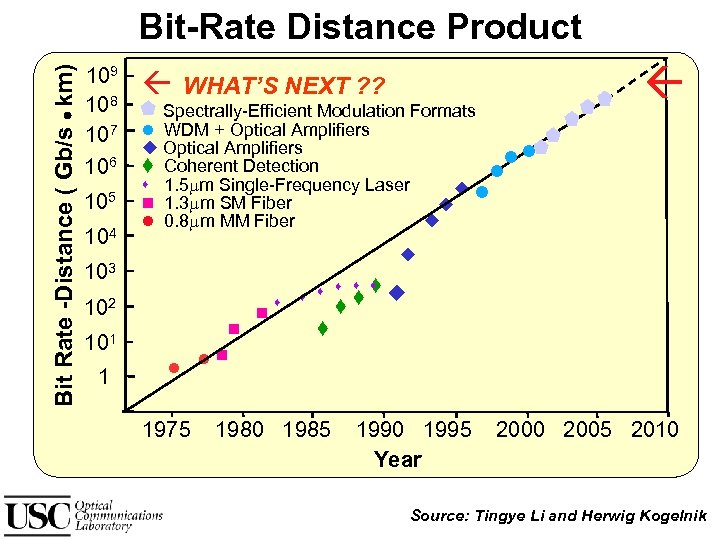
Bit Rate -Distance ( Gb/s km) Bit-Rate Distance Product 109 108 107 106 105 104 WHAT’S NEXT ? ? Spectrally-Efficient Modulation Formats WDM + Optical Amplifiers Coherent Detection 1. 5 m Single-Frequency Laser 1. 3 m SM Fiber 0. 8 m MM Fiber 103 102 101 1 1975 1980 1985 1990 1995 Year 2000 2005 2010 Source: Tingye Li and Herwig Kogelnik
Скачать презентацию Plenary ACC Workshop Robust and Reconfigurable High Capacity
65a8c6542ab2bfcb62b0cce513d6462b.ppt