


play on words Done by: Faculty: PFFL, Group: 217 Nikolskaya Alena Omirzakova Araylim
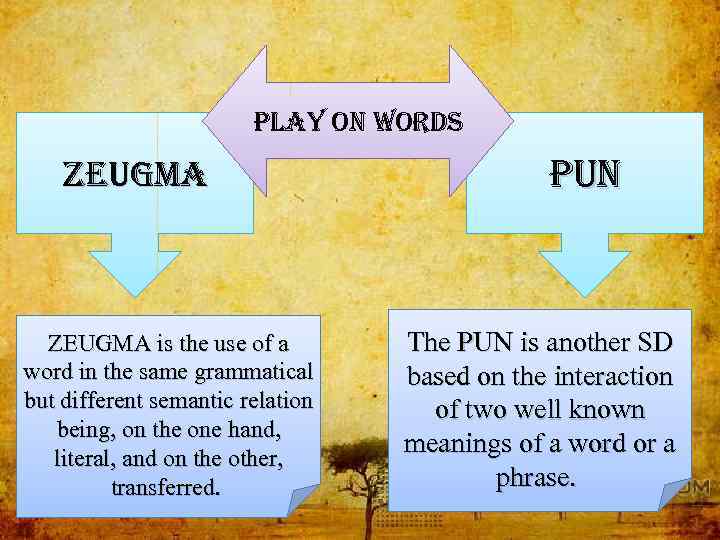
play on words zeugma ZEUGMA is the use of a word in the same grammatical but different semantic relation being, on the one hand, literal, and on the other, transferred. pun The PUN is another SD based on the interaction of two well known meanings of a word or a phrase.
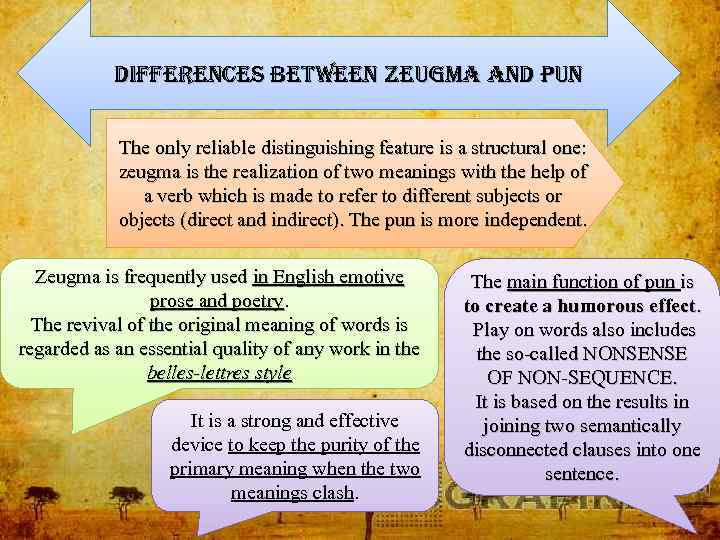
differences between zeugma and pun The only reliable distinguishing feature is a structural one: zeugma is the realization of two meanings with the help of a verb which is made to refer to different subjects or objects (direct and indirect). The pun is more independent. Zeugma is frequently used in English emotive prose and poetry. The revival of the original meaning of words is regarded as an essential quality of any work in the belles-lettres style It is a strong and effective device to keep the purity of the primary meaning when the two meanings clash. The main function of pun is to create a humorous effect. Play on words also includes the so-called NONSENSE OF NON-SEQUENCE. It is based on the results in joining two semantically disconnected clauses into one sentence.
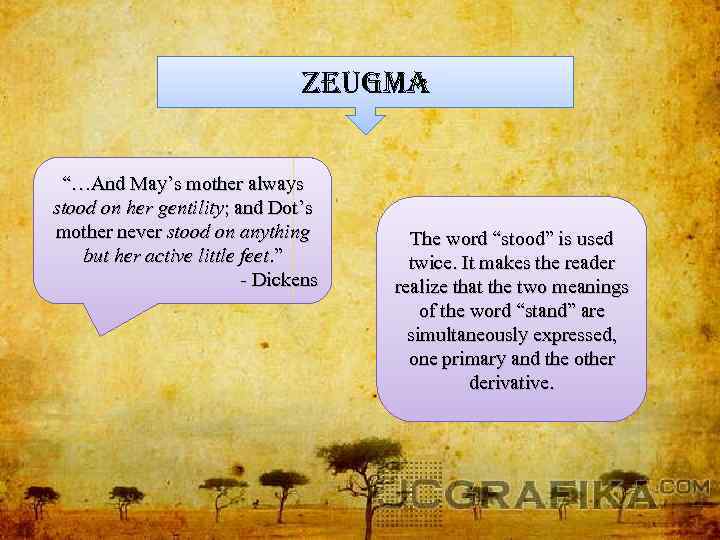
zeugma “…And May’s mother always stood on her gentility; and Dot’s mother never stood on anything but her active little feet. ” - Dickens The word “stood” is used twice. It makes the reader realize that the two meanings of the word “stand” are simultaneously expressed, one primary and the other derivative.
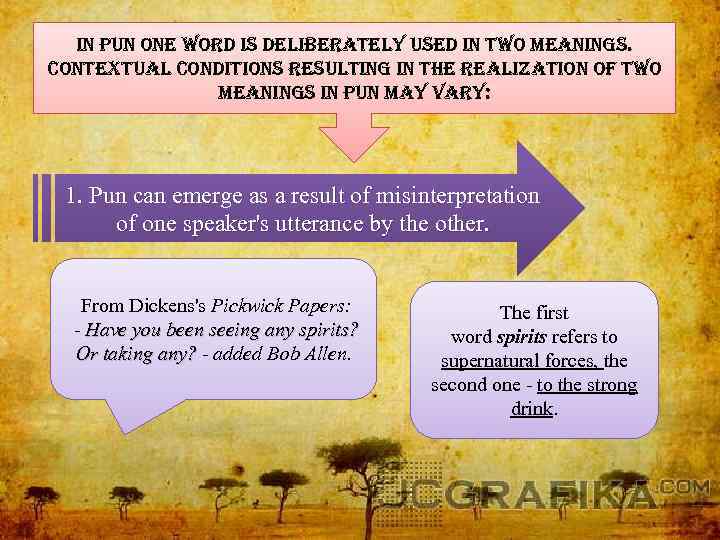
in pun one word is deliberately used in two meanings. contextual conditions resulting in the realization of two meanings in pun may vary: 1. Pun can emerge as a result of misinterpretation of one speaker's utterance by the other. From Dickens's Pickwick Papers: - Have you been seeing any spirits? Or taking any? - added Bob Allen. Or taking any? The first word spirits refers to supernatural forces, the second one - to the strong drink.
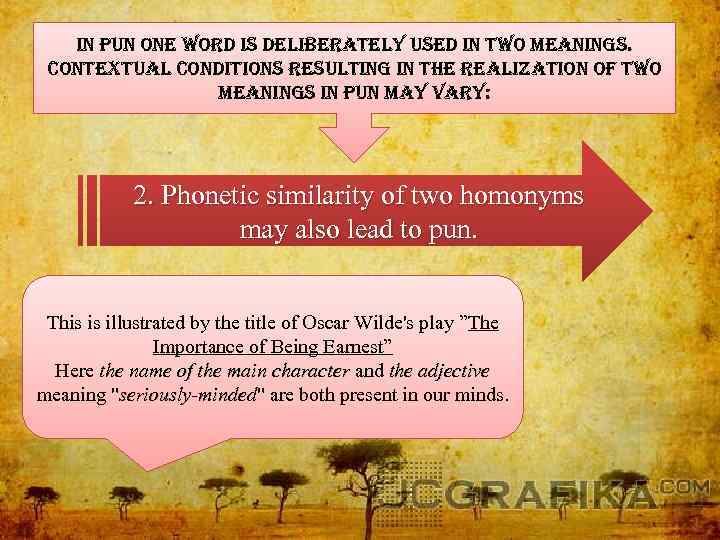
in pun one word is deliberately used in two meanings. contextual conditions resulting in the realization of two meanings in pun may vary: 2. Phonetic similarity of two homonyms may also lead to pun. This is illustrated by the title of Oscar Wilde's play ”The Importance of Being Earnest” Here the name of the main character and the adjective the name of the main character meaning "seriously-minded" are both present in our minds. seriously-minded
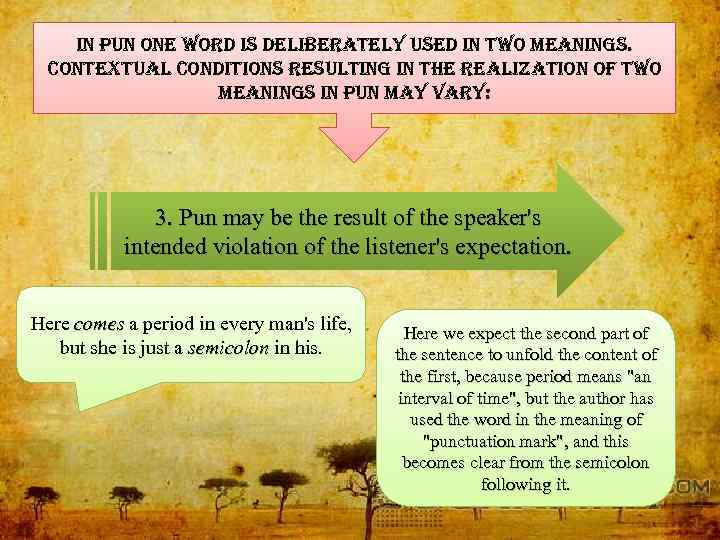
in pun one word is deliberately used in two meanings. contextual conditions resulting in the realization of two meanings in pun may vary: 3. Pun may be the result of the speaker's intended violation of the listener's expectation. Here comes a period in every man's life, comes but she is just a semicolon in his. semicolon Here we expect the second part of the sentence to unfold the content of the first, because period means "an interval of time", but the author has used the word in the meaning of "punctuation mark", and this becomes clear from the semicolon following it.
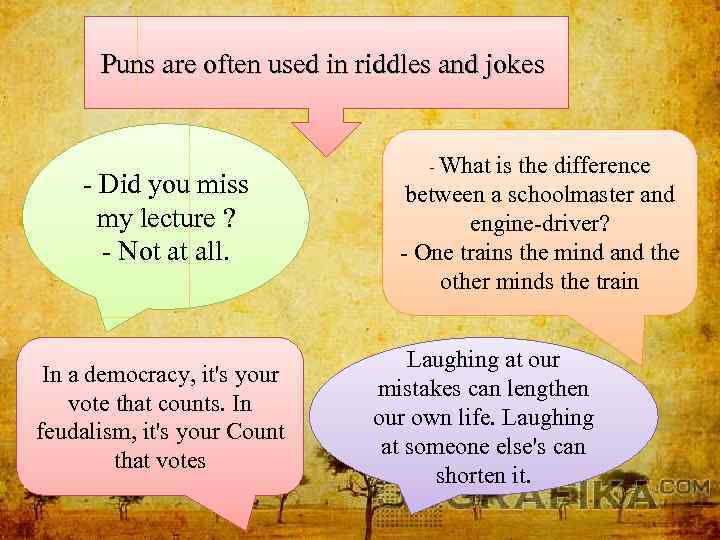
Puns are often used in riddles and jokes - Did you miss my lecture ? - Not at all. In a democracy, it's your vote that counts. In feudalism, it's your Count that votes - What is the difference between a schoolmaster and engine-driver? - One trains the mind and the other minds the train Laughing at our mistakes can lengthen our own life. Laughing at someone else's can shorten it.
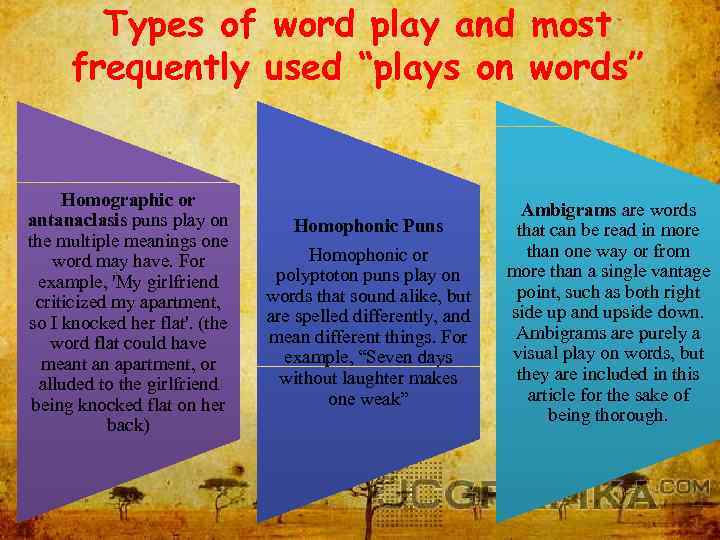
Types of word play and most frequently used “plays on words” Homographic or antanaclasis puns play on the multiple meanings one word may have. For example, 'My girlfriend criticized my apartment, so I knocked her flat'. (the word flat could have meant an apartment, or alluded to the girlfriend being knocked flat on her back) Homophonic Puns Homophonic or polyptoton puns play on words that sound alike, but are spelled differently, and mean different things. For example, “Seven days without laughter makes one weak” Ambigrams are words that can be read in more than one way or from more than a single vantage point, such as both right side up and upside down. Ambigrams are purely a visual play on words, but they are included in this article for the sake of being thorough.
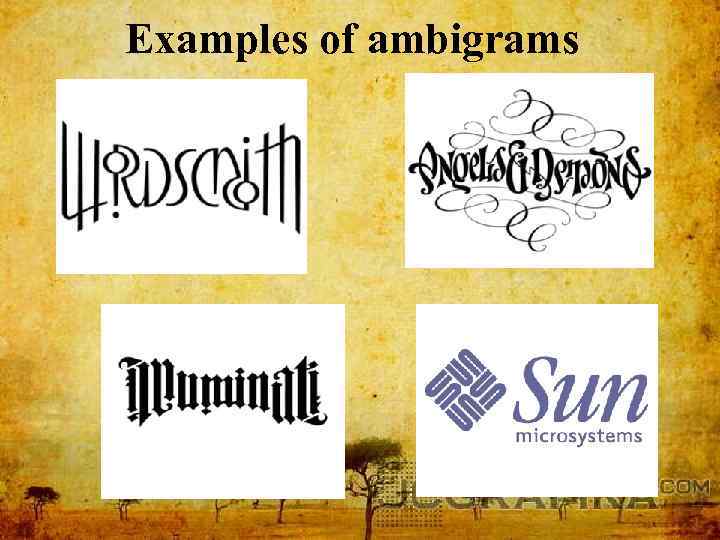
Examples of ambigrams
Palindromes are spelled the same, backwards or forwards, such as 'mom', 'race car', or 'deified'. Entire phrases can be palindromes. Examples: 'Dogma: I am God. ' Golf? No sir, prefer prison-flog. A Santa pets rats, as Pat taps a star step at NASA. Anne, I vote more cars race Rome to Vienna Tom Swifty plays on a relationship between an adverb, and an action spoken in dialogue. The original Tom Swift was a fictional title character in a series of children's books: 'I've lost my trousers, ' Tom said expansively. 'I've returned from the lobotomy, ' Tom said absentmindedly. 'Drop the gun, ' Tom said with a disarming smile Spoonerisms are a result of changing around, especially accidentally, the initial sounds of two or more words when speaking, e. g, 'well-boiled icicle' for well-oiled bicycle. Others include 'sky as a height', 'nark staked', and 'dain brammage'
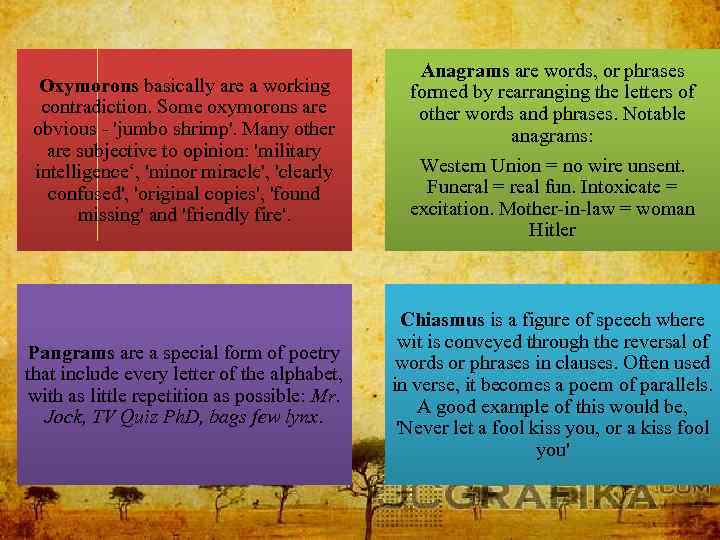
Oxymorons basically are a working contradiction. Some oxymorons are obvious - 'jumbo shrimp'. Many other are subjective to opinion: 'military intelligence‘, 'minor miracle', 'clearly confused', 'original copies', 'found missing' and 'friendly fire'. Anagrams are words, or phrases formed by rearranging the letters of other words and phrases. Notable anagrams: Western Union = no wire unsent. Funeral = real fun. Intoxicate = excitation. Mother-in-law = woman Hitler Pangrams are a special form of poetry that include every letter of the alphabet, with as little repetition as possible: Mr. Jock, TV Quiz Ph. D, bags few lynx. Chiasmus is a figure of speech where wit is conveyed through the reversal of words or phrases in clauses. Often used in verse, it becomes a poem of parallels. A good example of this would be, 'Never let a fool kiss you, or a kiss fool you'
A tongue-twister is an audible play on words, where the intent is to trip up the reader who attempts to speak the twister. Often they are repeated rapidly several times. They are both amusing and frustrating at the same time: The sixth sick sheikh's sixth sheep's sick. Once upon a barren moor There dwelt a bear, also a boar, The bear could not bear the boar Portmanteau words (or blends) are words that are formed by telescoping two other words in on themselves, such as bit (binary unit), avionics (aviation electronics), brunch (breakfast/lunch) and motel (motor hotel). The word portmanteau itself originally meant a case in two halves, for carrying clothing, from the French portmanteau (carry cloak) Sometimes, a clever redefinition of a word can be considered as a pun. For example, 'Flashlight: a carrying case for dead batteries' or 'Shin: a device for finding tables in the dark' and finally, 'Professor: one who talks in someone else's sleep'. The definition is unexpected, and humorous: Dockyard: a physician's garden, pasteurise: too fast to see, crick: the sound that a Japanese camera makes
