Скачать презентацию Plants Colonized Land Land plants evolved from
f277e5f959112e9196f21552093d6b86.ppt
- Количество слайдов: 54
 Plants Colonized Land
 Land plants evolved from green algae G Green algae called charophyceans are the closest relatives of land plants
 Morphological and Biochemical Evidence G Land plants share key traits only with charophyceans: G Peroxisome enzymes G Structure of flagellated sperm G Chlorophyll A
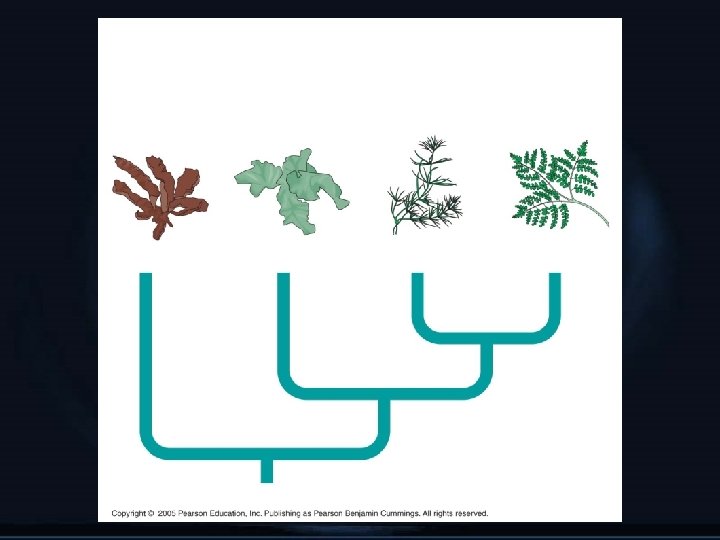 Viridiplantae Streptophyta Plantae Red algae Chlorophytes Ancestral alga Charophyceans Embryophytes
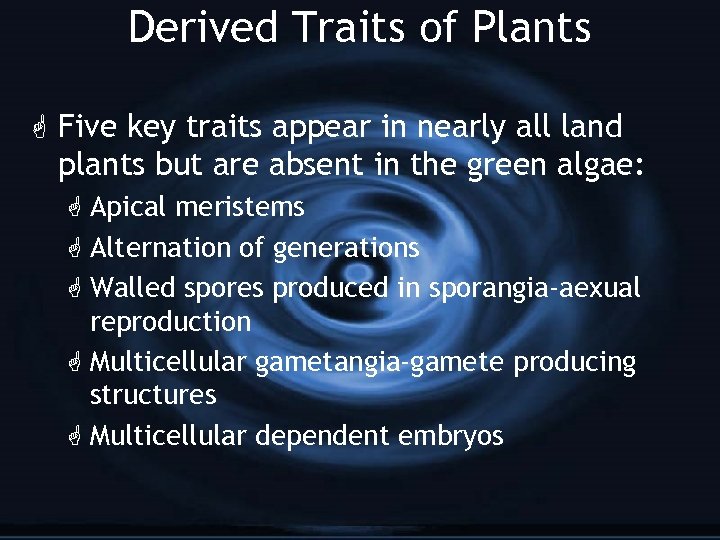 Derived Traits of Plants G Five key traits appear in nearly all land plants but are absent in the green algae: G Apical meristems G Alternation of generations G Walled spores produced in sporangia-aexual reproduction G Multicellular gametangia-gamete producing structures G Multicellular dependent embryos
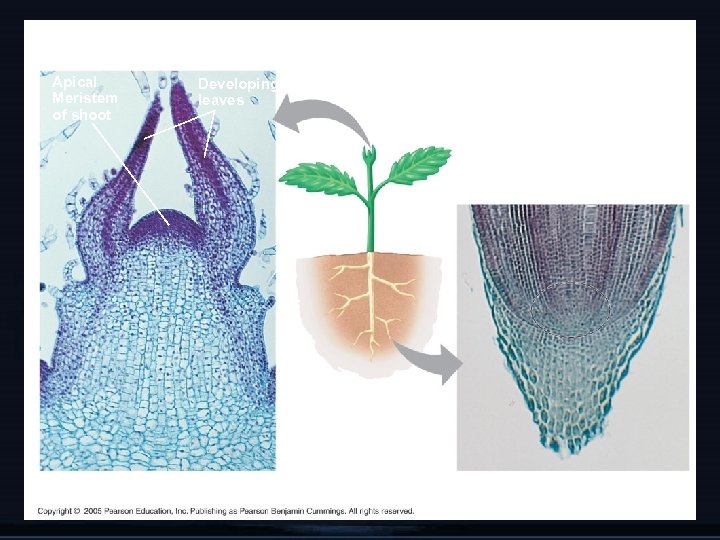 Apical Meristems Apical Meristem of shoot Developing leaves Apical meristem Shoot 100 µm Root 100 µm
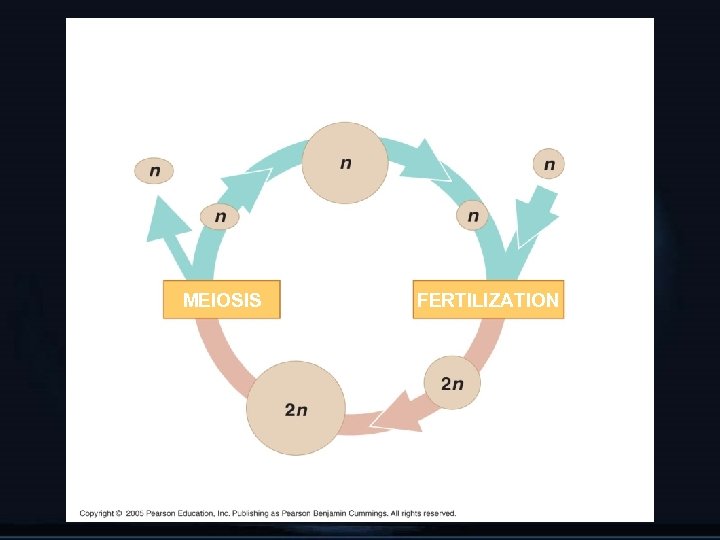 Alternation of Generations Haploid multicellular organism (gametophyte) Mitosis Gametes Spores MEIOSIS FERTILIZATION Zygote Diploid multicellular organism (sporophyte) Mitosis
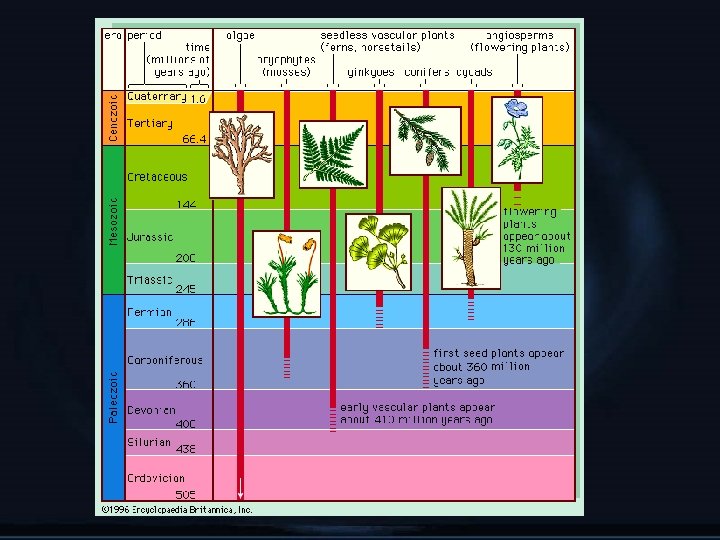
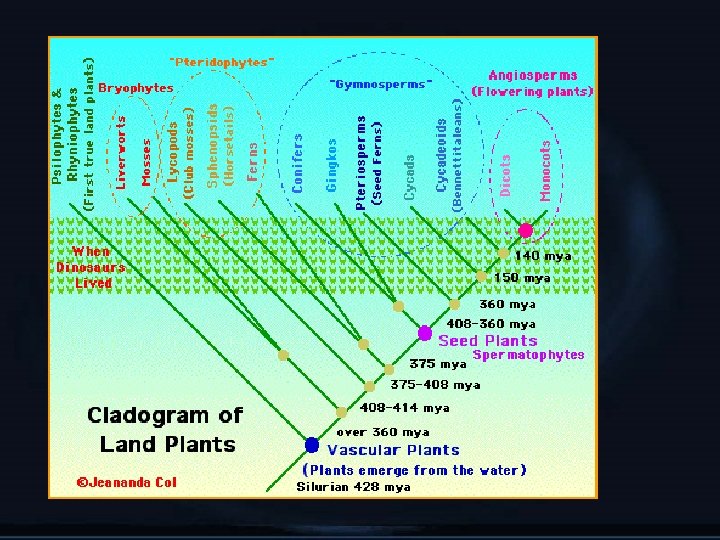
 The Origin and Diversification of Plants G Fossil evidence indicates that plants were on land at least 475 million years ago G Fossilized spores and tissues have been extracted from 475 -million-year-old rocks
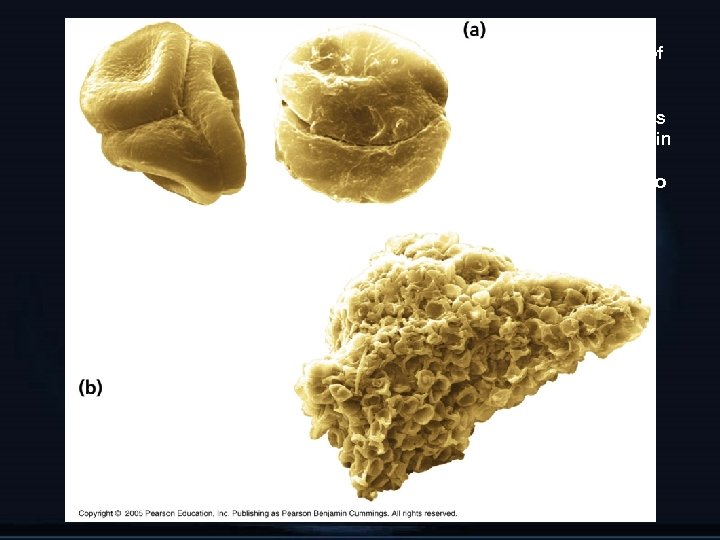 Fossilized spores. Unlike the spores of most living plants, which are single grains, these spores found in Oman are in groups of four (left; one hidden) and two (right). Fossilized sporophyte tissue. The spores were embedded in tissue that appears to be from plants.
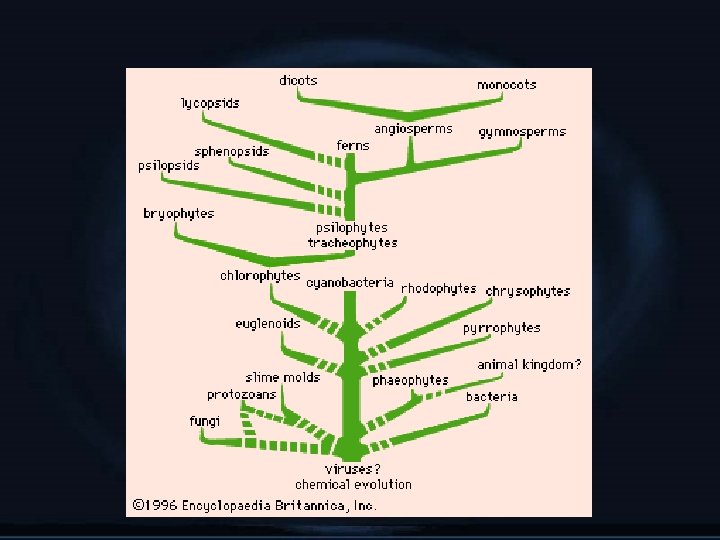
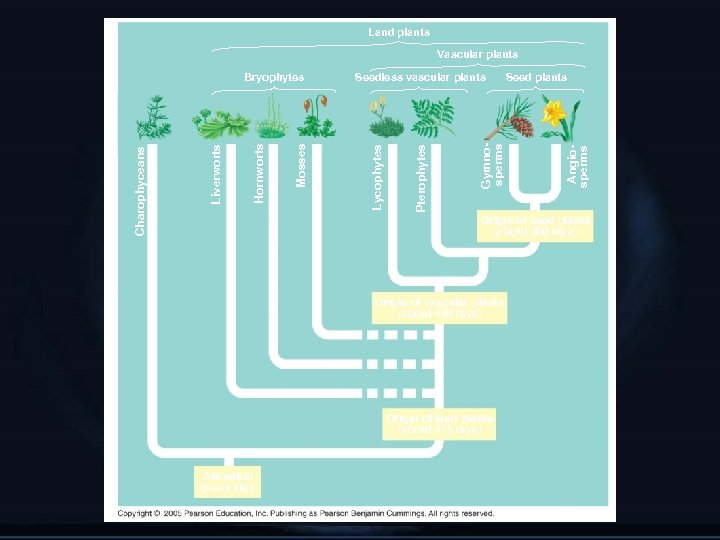 Land plants Vascular plants Seed plants Angiosperms Gymnosperms Pterophytes Seedless vascular plants Lycophytes Mosses Hornworts Liverworts Charophyceans Bryophytes Origin of seed plants (about 360 mya) Origin of vascular plants (about 420 mya) Origin of land plants (about 475 mya) Ancestral green alga
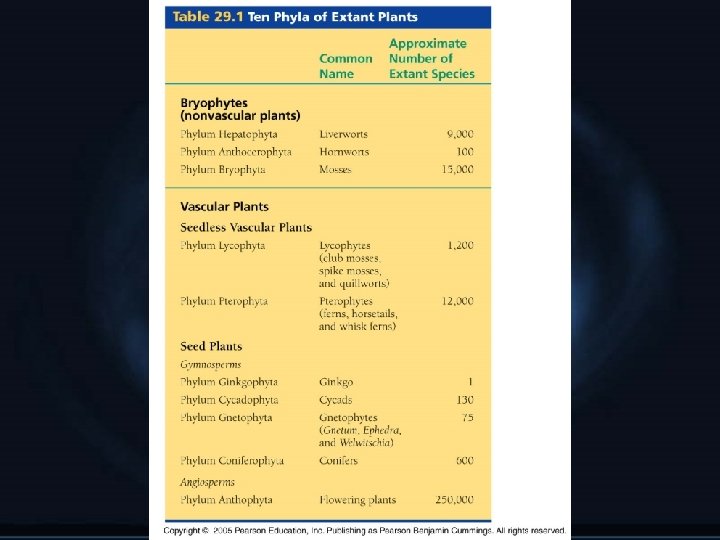
 The life cycles of mosses and other bryophytes are dominated by the gametophyte stage G Bryophytes are represented today by three phyla of small herbaceous (nonwoody) plants: G Liverworts, phylum Hepatophyta G Hornworts, phylum Anthocerophyta G Mosses, phylum Bryophyta
 Bryophyte Gametophytes G In all three bryophyte phyla, gametophytes are larger and longerliving than sporophytes G Sporophytes are typically present only part of the time Animation: Moss Life Cycle
 G Bryophyte gametophytes G Produce flagellated sperm in antheridia G Produce ova in archegonia G Generally form ground-hugging carpets and are at most only a few cells thick G Some mosses have conducting tissues in the center of their “stems” and may grow vertically
 Bryophyte Sporophytes G Bryophyte sporophytes G Grow out of archegonia G Are the smallest and simplest of all extant plant groups G Consist of a foot, a seta, and a sporangium G Hornwort and moss sporophytes have stomata
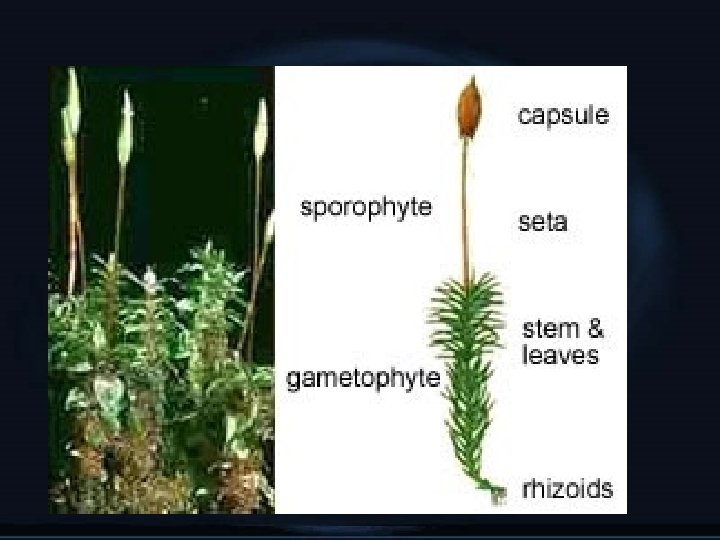 MOSS SPOROPHYTE
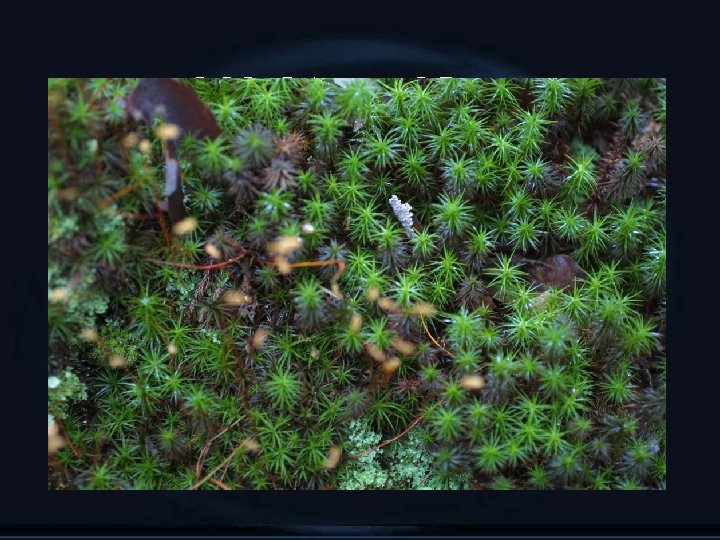 MOSS GAMETOPHYTE
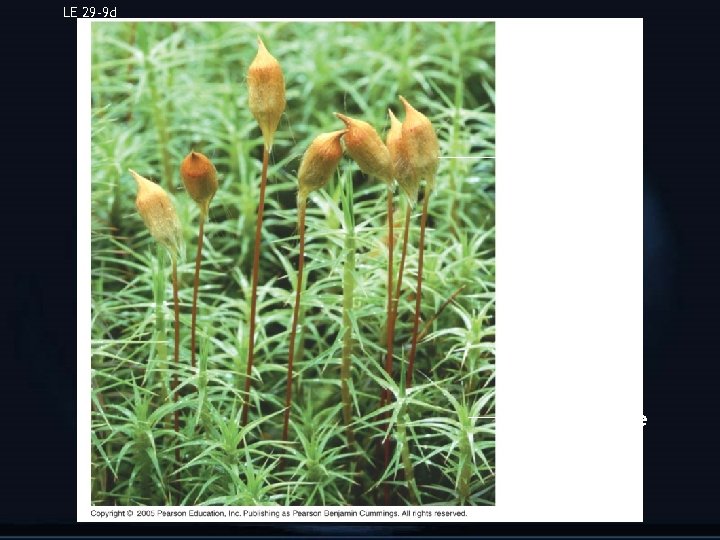 LE 29 -9 d Polytrichum commune, hairy cap moss Sporophyte Gametophyte
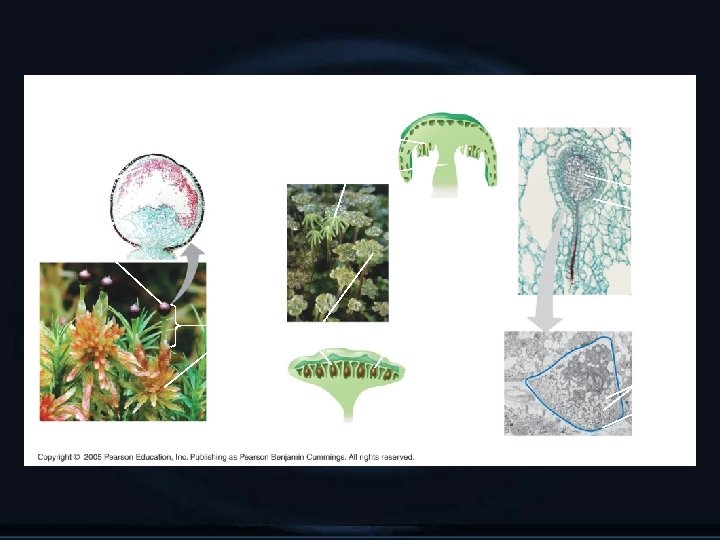 Walled Spores Produced in Sporangia Longitudinal section of Sphagnum sporangium (LM) Multicellular Gametangia Multicellular, Dependent Embryos Archegonium with egg Female gametophyte Spores Embryo Maternal tissue Sporangium 2 µm Sporophyte Gametophyte Male gametophyte 10 µm Antheridium with sperm Wall ingrowths Sporophyte and sporangium of Sphagnum (a moss) Archegonia and antheridia of Marchantia (a liverwort) Placental transfer cell
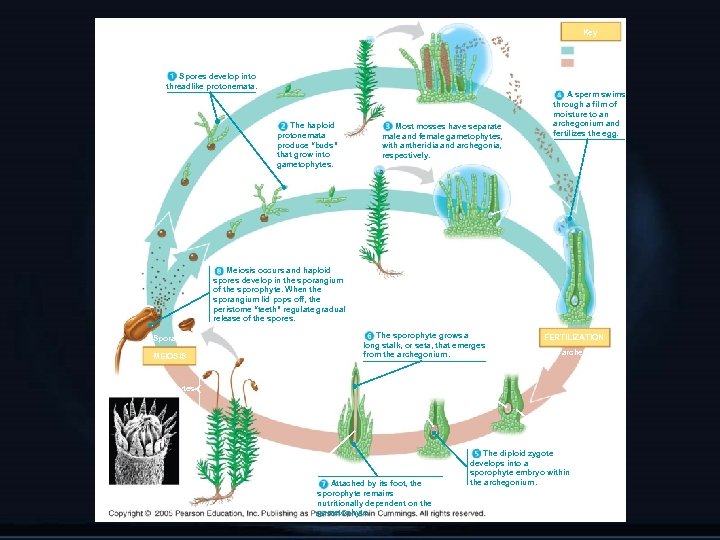 Raindrop Key Male gametophyte Haploid (n) Diploid (2 n) Sperm “Bud” Spores develop into threadlike protonemata. A sperm swims through a film of moisture to an archegonium and fertilizes the egg. Antheridia Protonemata The haploid protonemata produce “buds” that grow into gametophytes. Most mosses have separate male and female gametophytes, with antheridia and archegonia, respectively. “Bud” Egg Gametophore Spores Female Archegonia gametophyte Meiosis occurs and haploid spores develop in the sporangium of the sporophyte. When the sporangium lid pops off, the peristome “teeth” regulate gradual release of the spores. Peristome The sporophyte grows a long stalk, or seta, that emerges from the archegonium. Sporangium MEIOSIS Mature sporophytes Rhizoid Seta Calyptra Capsule (sporangium) Foot FERTILIZATION (within archegonium) Zygote Embryo Archegonium Young sporophyte Capsule with peristome (SEM) Female gametophytes Attached by its foot, the sporophyte remains nutritionally dependent on the gametophyte. The diploid zygote develops into a sporophyte embryo within the archegonium.
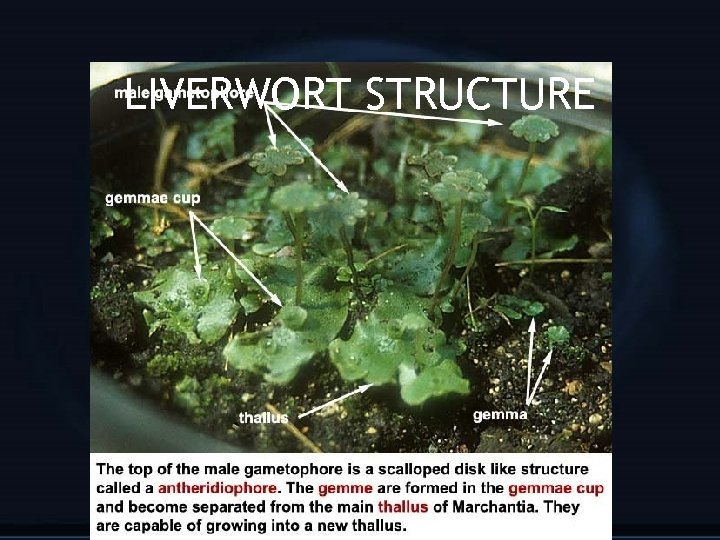 LIVERWORT STRUCTURE
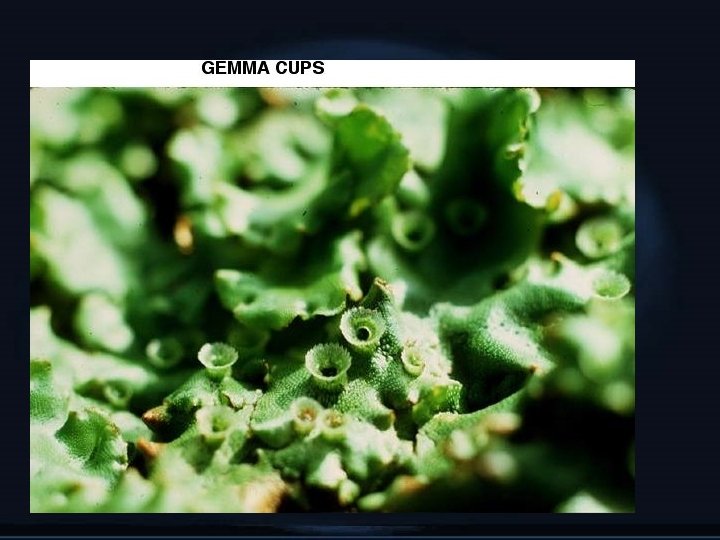 GEMMA CUPS
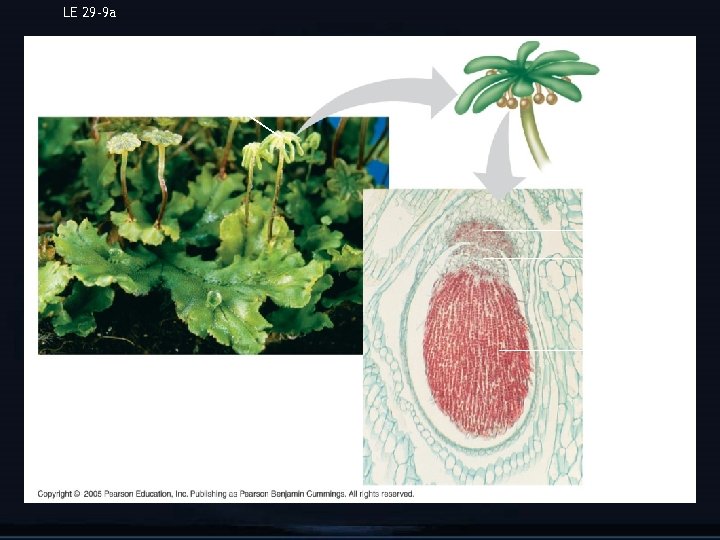 LE 29 -9 a Gametophore of female gametophyte 500 µm Foot Seta Sporangium Marchantia polymorpha, a “thalloid” liverwort Marchantia sporophyte (LM)
 Ecological and Economic Importance of Mosses G Sphagnum, or “peat moss, ” forms extensive deposits of partially decayed organic material known as peat G Sphagnum plays an important role in the Earth’s carbon cycle
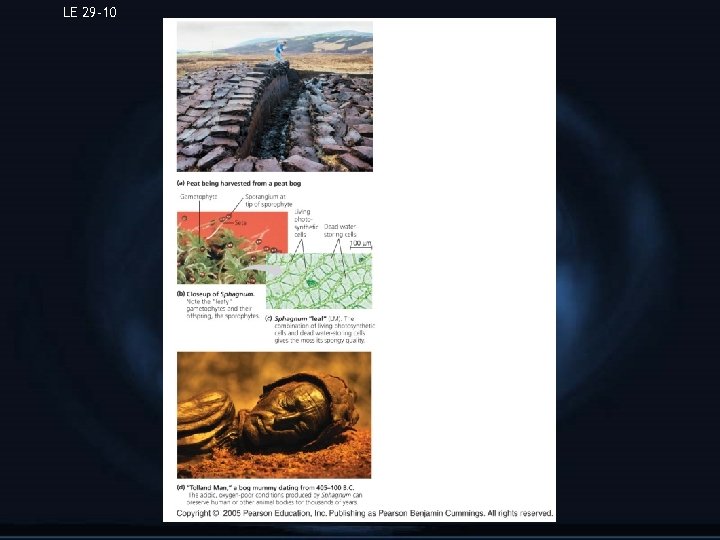 LE 29 -10 A peat bog. Gametophyte Sporangium at tip of sporophyte Living photosynthetic Dead waterstoring cells 100 µm Closeup of Sphagnum. Note the “leafy” Gametophytes and their offspring, the sporophytes. Sphagnum “leaf” (LM). The combination of living photosynthetic cells and dead water-storing cells gives the moss its spongy quality. “Tolland Man, ” a bog mummy dating from 405– 100 B. C. The acidic, oxygen-poor conditions produced by Sphagnum can preserve human or animal bodies for thousands of years.
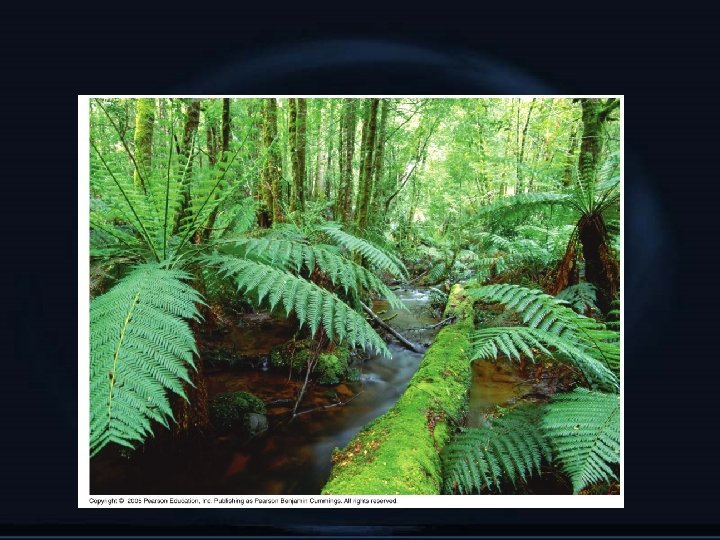
 Ferns and other seedless vascular plants formed the first forests G Bryophytes and bryophyte-like plants were the prevalent vegetation during the first 100 million years of plant evolution G Vascular plants began to diversify during the Carboniferous period G Vascular plants dominate most landscapes today
 Origins and Traits of Vascular Plants G Fossils of the forerunners of vascular plants date back about 420 million years G , branching sporophytes G They lacked other derived These early tiny plants had independent traits of vascular plants
 Life Cycles with Dominant Sporophytes G In contrast with bryophytes, sporophytes of seedless vascular plants are the larger generation, as in the familiar leafy fern G The gametophytes are tiny plants that grow on or below the soil surface Animation: Fern Life Cycle
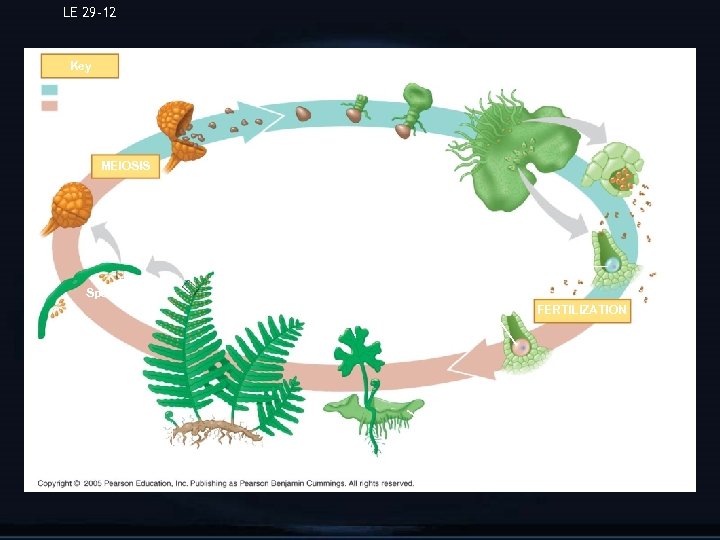 LE 29 -12 Key Haploid (n) Diploid (2 n) Spore MEIOSIS Antheridium Young gametophyte Sporangium Sperm Archegonium Egg Sporangium Mature sporophyte New sporophyte Zygote Sorus Gametophyte Fiddlehead FERTILIZATION
 Transport in Xylem and Phloem G Vascular plants have two types of vascular tissue: xylem and phloem G Xylem conducts most of the water and minerals and includes dead cells called tracheids G Phloem consists of living cells and distributes sugars, amino acids, and other organic products
 Evolution of Roots G Roots are organs that anchor vascular plants G They enable vascular plants to absorb water and nutrients from the soil G Roots may have evolved from subterranean stems
 Evolution of Leaves G Leaves are organs that increase the surface area of vascular plants, thereby capturing more solar energy that is used for photosynthesis
 G Leaves are categorized by two types: G Microphylls, leaves with a single vein G Megaphylls, leaves with a highly branched vascular system G According to one model of evolution, microphylls evolved first, as outgrowths of stems
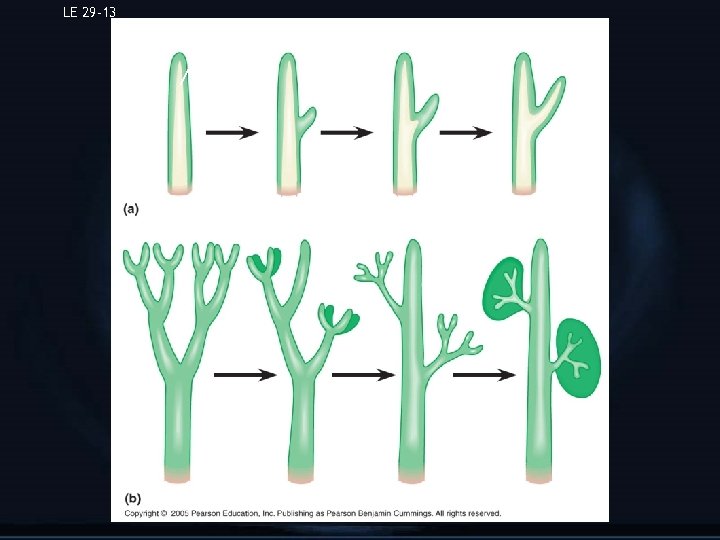 LE 29 -13 Vascular tissue Microphylls Megaphylls
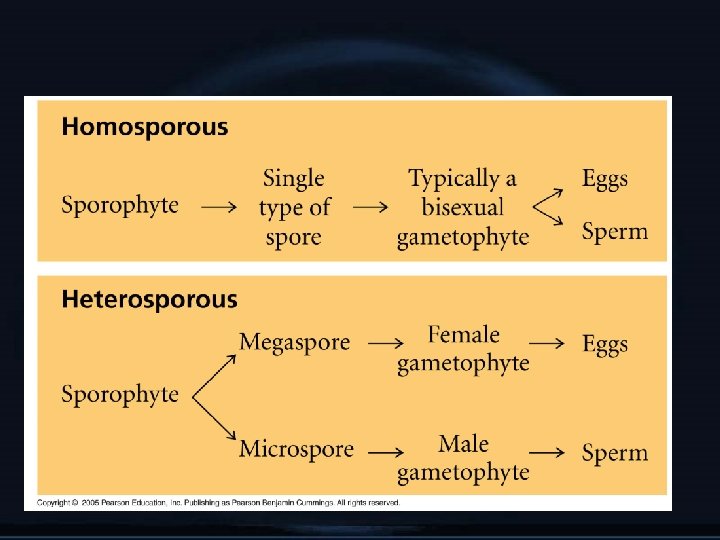
 Sporophylls and Spore Variations G Sporophylls are modified leaves with sporangia G Most seedless vascular plants are homosporous, producing one type of spore that develops into a bisexual gametophyte G All seed plants and some seedless vascular plants are heterosporous, having two types of spores that give rise to male and female gametophytes
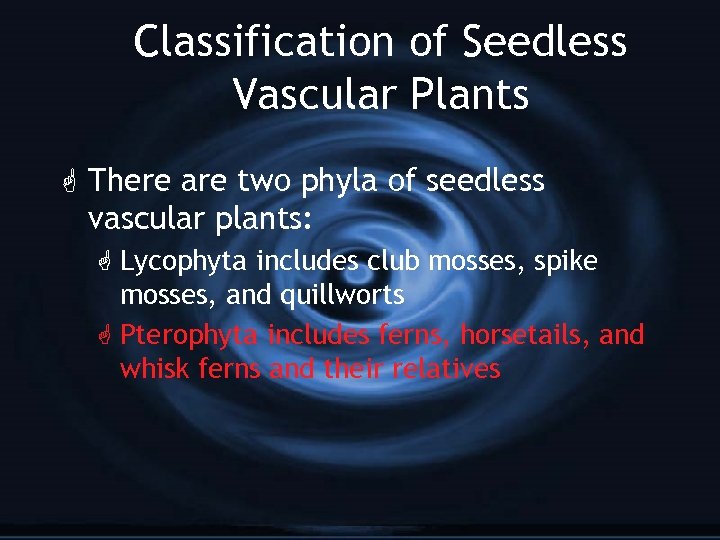 Classification of Seedless Vascular Plants G There are two phyla of seedless vascular plants: G Lycophyta includes club mosses, spike mosses, and quillworts G Pterophyta includes ferns, horsetails, and whisk ferns and their relatives
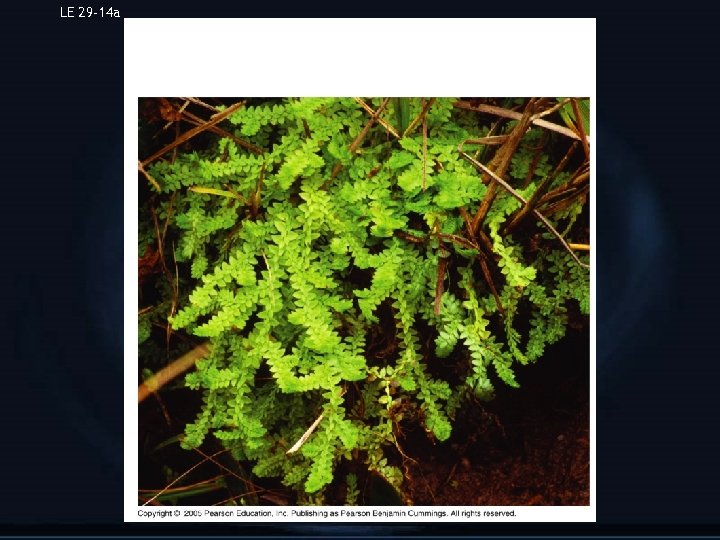 LE 29 -14 a Selaginella apoda, a spike moss
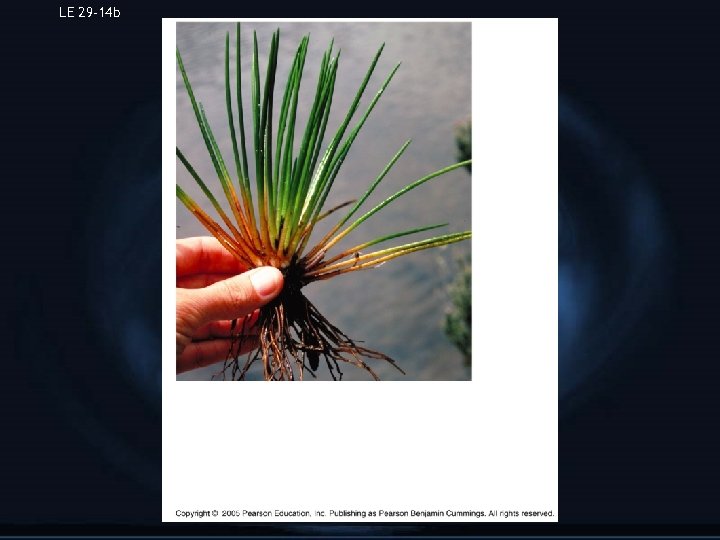 LE 29 -14 b Isoetes gunnii, a quillwort
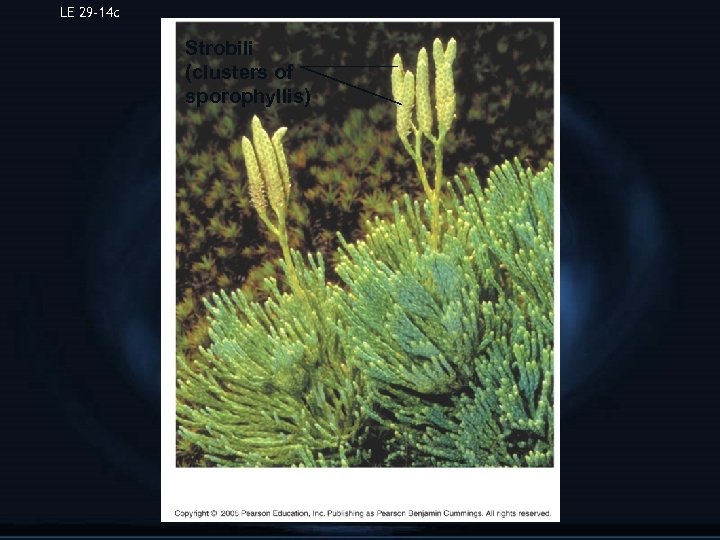 LE 29 -14 c Strobili (clusters of sporophyllis) Diphasiastrum tristachyum, a club moss
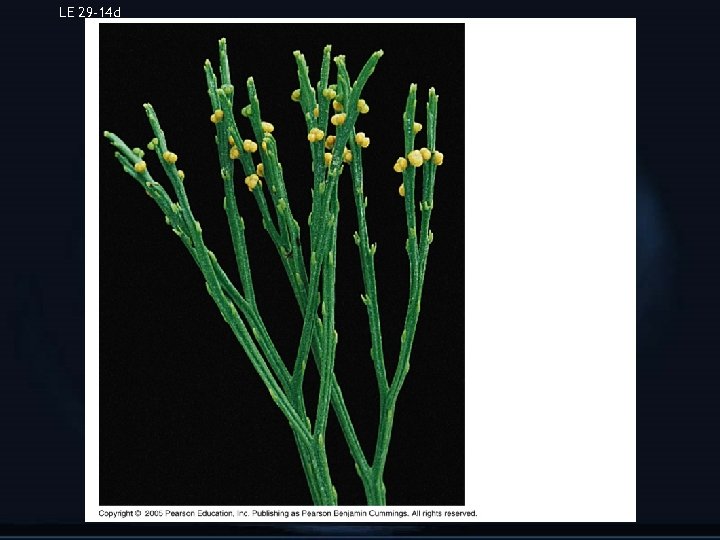 LE 29 -14 d Psilotum nudum, a whisk fern
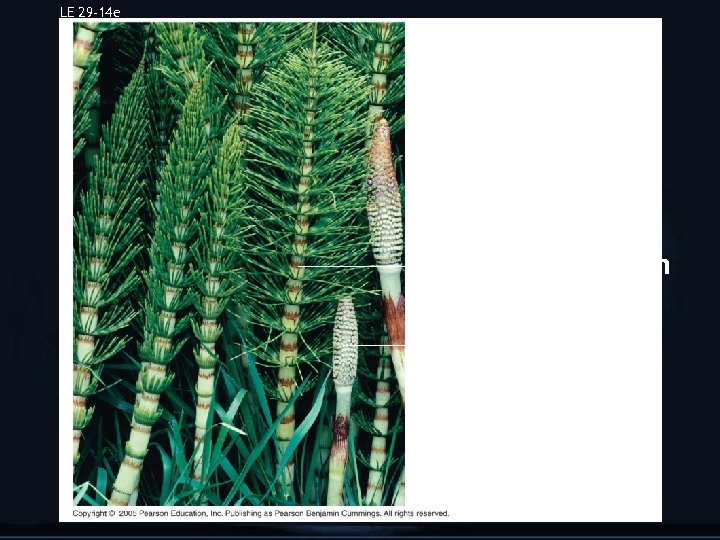 LE 29 -14 e Equisetum arvense, field horsetail Vegetative stem Strobilus on fertile stem
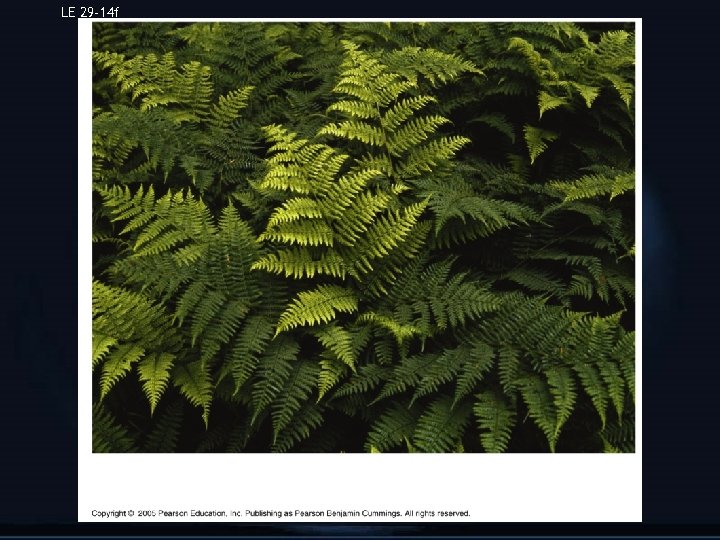 LE 29 -14 f Athyrium filix-femina, lady fern
 Phylum Pterophyta: Ferns, Horsetails, and Whisk Ferns and Relatives G Ferns are the most diverse seedless vascular plants, with more than 12, 000 species G They are most diverse in the tropics but also thrive in temperate forests G Some species are even adapted to arid climates
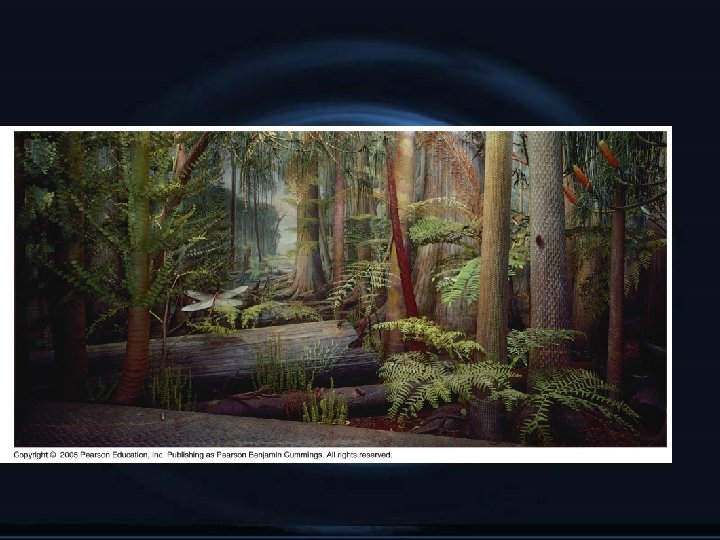
 The Significance of Seedless Vascular Plants G The ancestors of modern lycophytes, horsetails, and ferns grew to great heights during the Carboniferous, forming the first forests G These forests may have helped produce the global cooling at the end of the Carboniferous period G The decaying plants of these Carboniferous forests eventually became coal
 FERNS VS GYMNOSPERMS G Ferns vs Gymnosperms G 1. Two types of spores G a. Megaspores-origin of female gametophyte G 1. Zygote G 2. Embryo-sporophyte G b. Microspores-origin of male gametophytes G 1. Pollen tube/pollen G 2. Separate gametophytes-Separate sexes G 3. Gametophyte much more reduced G a. No chlorophyll/Not free living G 4. No flagella on sperm G 5. Young embryo house within seed G a. Protects embryo / Embryo self sufficient G b. Nutrients from seed to grow
 GYMNOSPERMS- conifers, cycads, ginkgoes Name means "naked seed" G G G G G A. General characteristics 1. Lack separate gametophyte generation 2. Heterosporous 3. Develop seed-no spreading spores a. Contains egg that comes from megaspore b. Contains embryo after fertilization 4. Have pollen a. Microspore turns into pollen b. Develops pollen tube to remove the necessity of water for fertilization-enters thru micropyle of seed
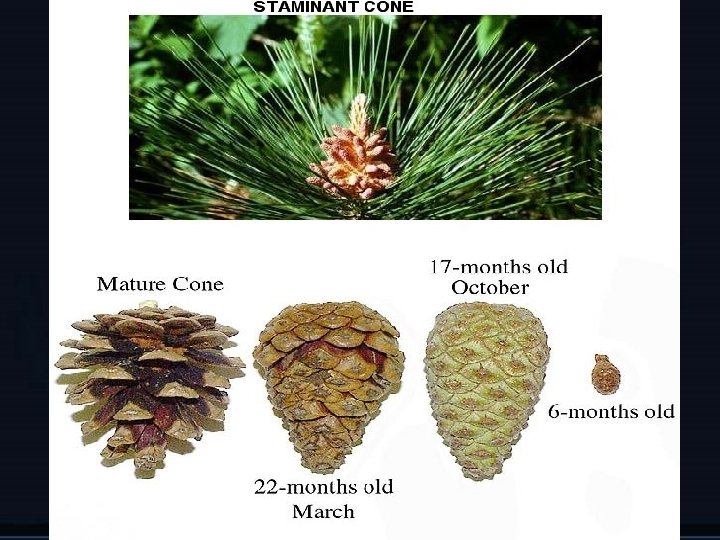
 G 5. Adaptive importance of pollen and seed G G G a. Aids in dispersal-wind-water-insects-etc b. Protects embryonic plant from drying out c. Protects embryo`s food store from predators or parasites d. Food storage analogous to yolk of egg 6. They have no flowers, they have cones a. Staminate cones-male cones that release pollen b. Ovulate cones-female cones that produce egg-ovules B. Development of secondary growth 1. Cell division occurs in regions around periphery 2. Conducting tissues multiplied into cylindrical zone 3. Enables increase in diameter of plant/tree-like height