



PLANT BIOLOGY IN ENGLISH
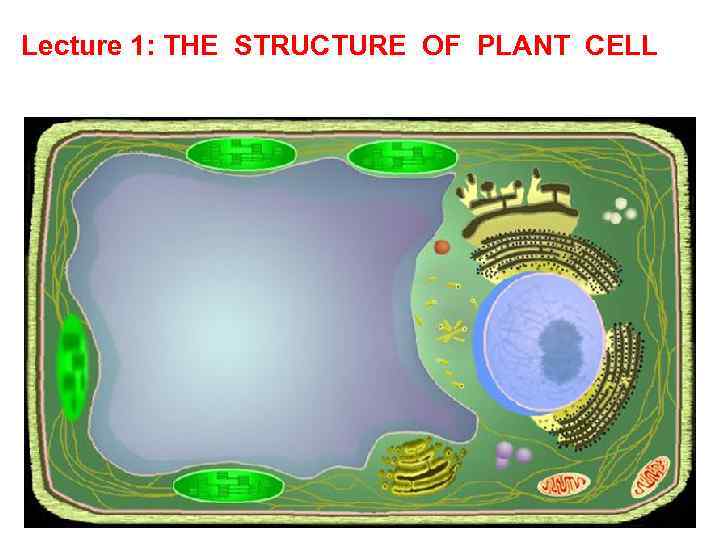
Lecture 1: THE STRUCTURE OF PLANT CELL
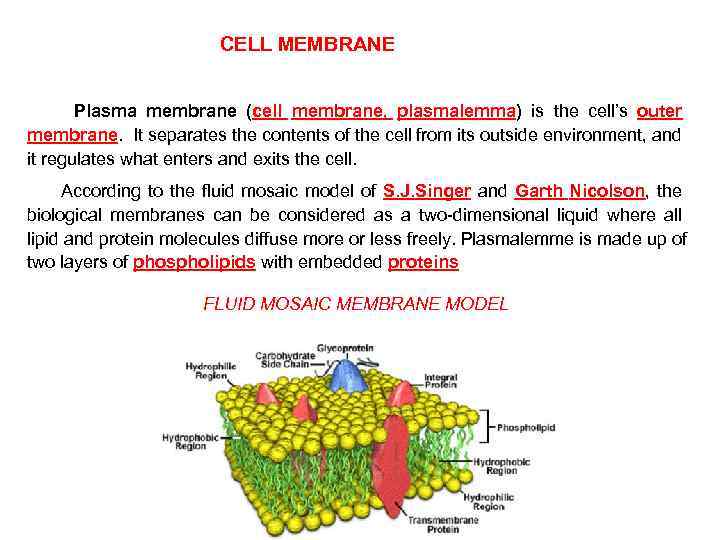
CELL MEMBRANE Plasma membrane (cell membrane, plasmalemma) is the cell’s outer membrane. It separates the contents of the cell from its outside environment, and it regulates what enters and exits the cell. According to the fluid mosaic model of S. J. Singer and Garth Nicolson, the biological membranes can be considered as a two-dimensional liquid where all lipid and protein molecules diffuse more or less freely. Plasmalemme is made up of two layers of phospholipids with embedded proteins FLUID MOSAIC MEMBRANE MODEL
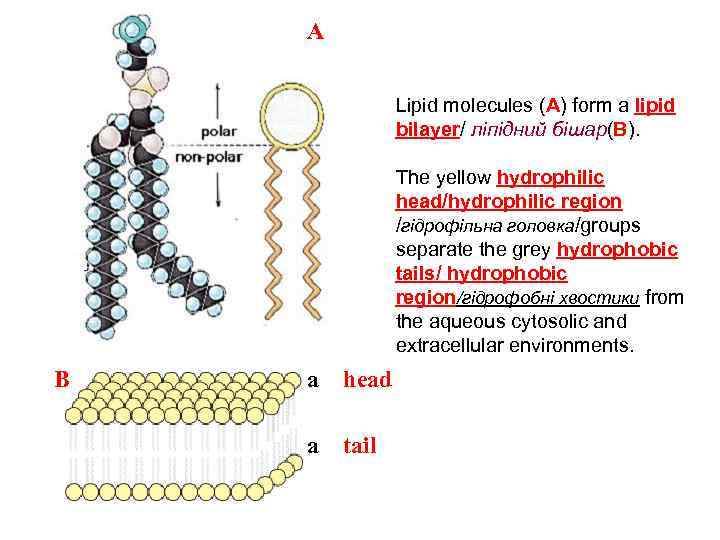
A Lipid molecules (A) form a lipid bilayer/ ліпідний бішар(B). The yellow hydrophilic head/hydrophilic region /гідрофільна головка/groups separate the grey hydrophobic tails/ hydrophobic region/гідрофобні хвостики from the aqueous cytosolic and extracellular environments. B а head а tail
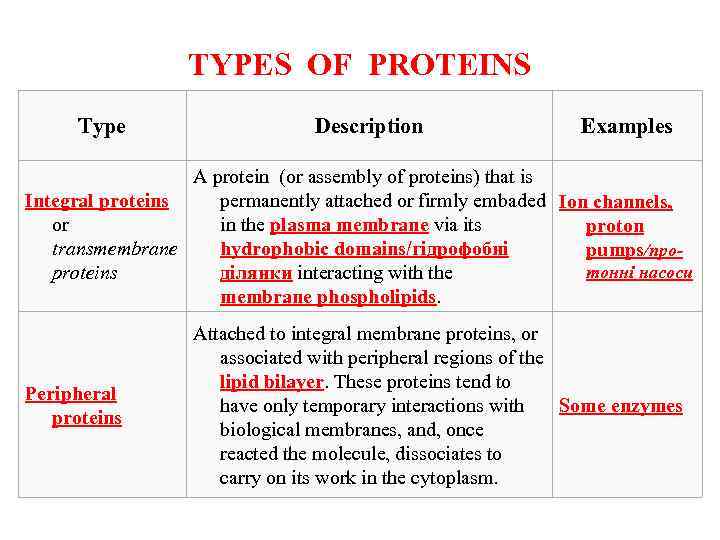
TYPES OF PROTEINS Type Description Examples A protein (or assembly of proteins) that is permanently attached or firmly embaded Ion channels, Integral proteins in the plasma membrane via its or proton transmembrane hydrophobic domains/гідрофобні pumps/протонні насоси proteins ділянки interacting with the membrane phospholipids. Peripheral proteins Attached to integral membrane proteins, or associated with peripheral regions of the lipid bilayer. These proteins tend to have only temporary interactions with Some enzymes biological membranes, and, once reacted the molecule, dissociates to carry on its work in the cytoplasm.
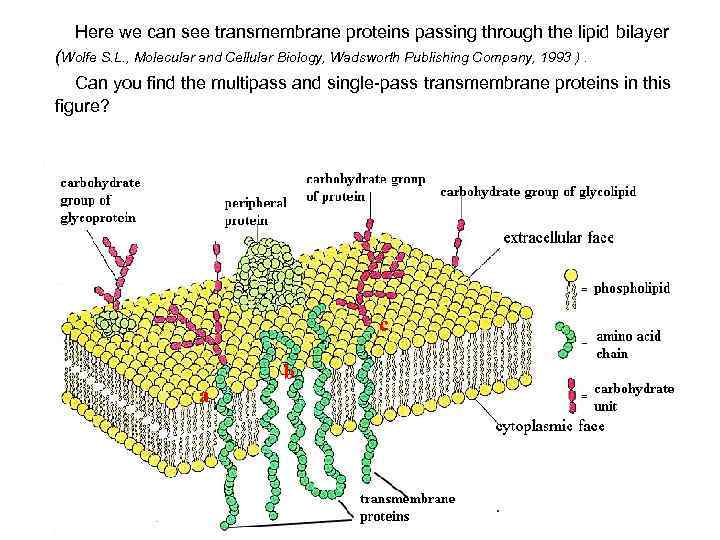
Here we can see transmembrane proteins passing through the lipid bilayer (Wolfe S. L. , Molecular and Cellular Biology, Wadsworth Publishing Company, 1993 ). Can you find the multipass and single-pass transmembrane proteins in this figure? c a b
![Cytoplasm [`saitopl. Fzm] • The cytoplasm is a thick liquid residing between the cell](https://present5.com/presentation/-43520524_131931137/image-7.jpg "Cytoplasm [`saitopl. Fzm] • The cytoplasm is a thick liquid residing between the cell")
Cytoplasm [`saitopl. Fzm] • The cytoplasm is a thick liquid residing between the cell membrane holding all the cell's internal sub-structures (called organelles), except for the nucleus. Eukaryotic cells contain a nucleus that is kept separate from the cytoplasm by a double membrane structure. The cytoplasm contains the rest of the organelles. • It is within the cytoplasm that most cellular activities occur, such as many metabolic pathways including glycolysis, and processes such as cell division. The inner, granular mass is called the endoplasm and the outer, clear and glassy layer is called the ectoplasm. • The part of the cytoplasm that is not held within organelles is called the cytosol. The cytosol makes up about 70% of the cell volume and is composed of water, salts, organic molecules, cytoskeleton filaments.
Cell organells • Double-membrane/double membrane-bound organells • Single-membrane/single membrane-bound organells • Membrane-free/ non-membrane/ nonmembrane-bound organells
![Double-membrane organelles Nucleus [`nju: kli. Fs] • The nucleus commonly the most prominent organelle](https://present5.com/presentation/-43520524_131931137/image-9.jpg "Double-membrane organelles Nucleus [`nju: kli. Fs] • The nucleus commonly the most prominent organelle")
Double-membrane organelles Nucleus [`nju: kli. Fs] • The nucleus commonly the most prominent organelle in the cell • It is a double membrane (nuclear envelope) bound structure that contains the cell's genetic information and controls the cell's growth and reproduction. • The nuclear envelope is composed of two phospholipid bilayers that fuse at various points forming nuclear pores. The function of the nuclear pores is to allow the passage of proteins and ribosomal subunits across the membrane. Singular -us [ F s ] Nucleus [`nju: kli. Fs] LATIN Loans Plural - i [ ai ] Nuclei [`nju: kliai]
![Plastids [`plastədz] Plastids are major organelles found in the cells of plants and algae.](https://present5.com/presentation/-43520524_131931137/image-10.jpg "Plastids [`plastədz] Plastids are major organelles found in the cells of plants and algae.")
Plastids [`plastədz] Plastids are major organelles found in the cells of plants and algae. Plastids are the site of manufacture and storage of important chemical compounds used by the cell. Plastids often contain pigments used in photosynthesis [f. Ot. F`sin. TFsiz]. Plastids are responsible for photosynthesis and storage of products like starch/крохмаль. They have the ability to differentiate, or redifferentiate, between these and other forms. All plastids are derived from proplastids/eoplasts, which are present in the meristematic regions of the plant. In plants, plastids may differentiate into several forms, depending upon which function they need to play in the cell. Undifferentiated plastids (proplastids) may develop into any of the following plastids: Chloroplasts [`kl. Or. Ouplast]: for photosynthesis; Chromoplasts : for pigment synthesis and storage Leucoplasts: for monoterpene synthesis; leucoplasts sometimes differentiate into more specialized plastids: amyloplasts [`am. Fl. Ouplast] which are filled with starch granules and occur in storage tissues in seeds, roots and stems chromoplasts which contain yellow or orange carotenoid pigments and occur in many flowers and fruits etioplasts which develop in tissues in the dark and lack pigments
![CHLOROPLAST [`kl. Or. Fpl. Fst] Chloroplasts are specialized organelles found in all higher plant](https://present5.com/presentation/-43520524_131931137/image-11.jpg "CHLOROPLAST [`kl. Or. Fpl. Fst] Chloroplasts are specialized organelles found in all higher plant")
CHLOROPLAST [`kl. Or. Fpl. Fst] Chloroplasts are specialized organelles found in all higher plant cells. Chloroplasts have a double outer membrane. Within the stroma are other membrane structures – the thylakoids [`Tail. Fk. Oid]. Thylakoids appear in stacks called “grana”. Singular GREEK Plural - a [F ] - ata [ F t F ] stromata Singular LATIN Plural -um [F m ] - a [ F ] granum grana forum fora datum data bacterium bacteria
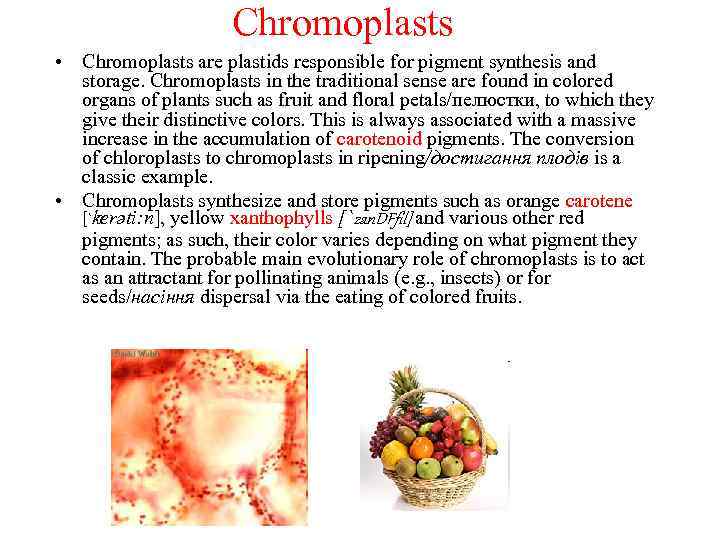
Chromoplasts • Chromoplasts are plastids responsible for pigment synthesis and storage. Chromoplasts in the traditional sense are found in colored organs of plants such as fruit and floral petals/пелюстки, to which they give their distinctive colors. This is always associated with a massive increase in the accumulation of carotenoid pigments. The conversion of chloroplasts to chromoplasts in ripening/достигання плодів is a classic example. • Chromoplasts synthesize and store pigments such as orange carotene [`kerəti: n], yellow xanthophylls [`zan. DFfil] and various other red pigments; as such, their color varies depending on what pigment they contain. The probable main evolutionary role of chromoplasts is to act as an attractant for pollinating animals (e. g. , insects) or for seeds/насіння dispersal via the eating of colored fruits.
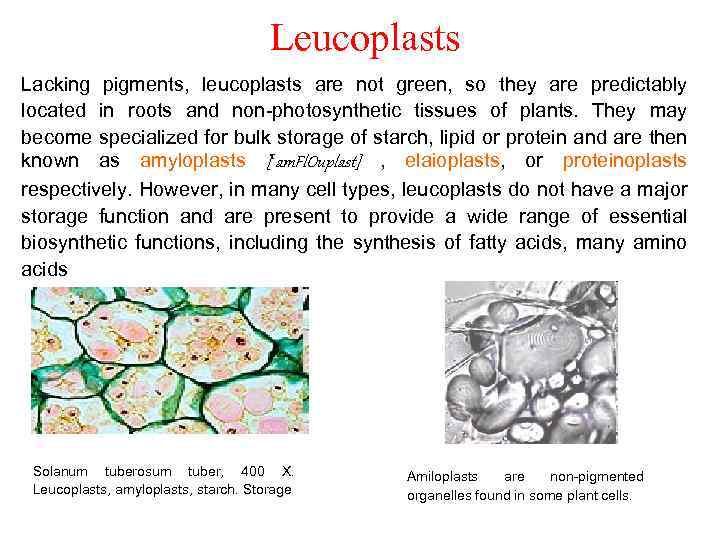
Leucoplasts Lacking pigments, leucoplasts are not green, so they are predictably located in roots and non-photosynthetic tissues of plants. They may become specialized for bulk storage of starch, lipid or protein and are then known as amyloplasts [`am. Fl. Ouplast] , elaioplasts, or proteinoplasts respectively. However, in many cell types, leucoplasts do not have a major storage function and are present to provide a wide range of essential biosynthetic functions, including the synthesis of fatty acids, many amino acids Solanum tuberosum tuber, 400 X. Leucoplasts, amyloplasts, starch. Storage Amiloplasts are non-pigmented organelles found in some plant cells.
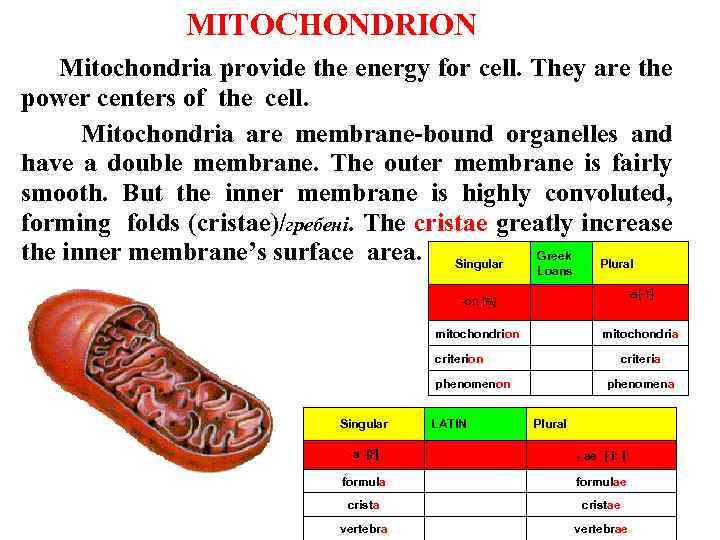
MITOCHONDRION Mitochondria provide the energy for cell. They are the power centers of the cell. Mitochondria are membrane-bound organelles and have a double membrane. The outer membrane is fairly smooth. But the inner membrane is highly convoluted, forming folds (cristae)/гребені. The cristae greatly increase the inner membrane’s surface area. Singular Greek Plural Loans -a[-F] -on [Fn] mitochondrion mitochondria criterion criteria phenomenon Singular LATIN phenomena Plural -a [F] - ae [ i: ] formulae cristae vertebrae
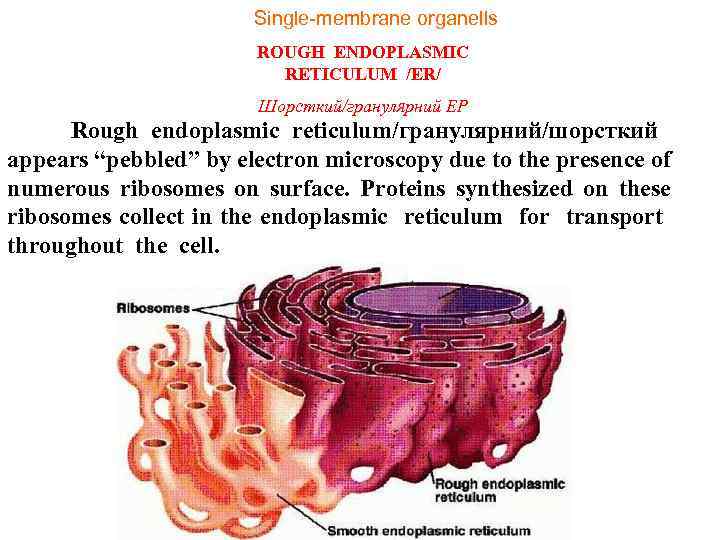
Single-membrane organells ROUGH ENDOPLASMIC RETICULUM /ER/ Шорсткий/гранулярний ЕР Rough endoplasmic reticulum/гранулярний/шорсткий appears “pebbled” by electron microscopy due to the presence of numerous ribosomes on surface. Proteins synthesized on these ribosomes collect in the endoplasmic reticulum for transport throughout the cell.
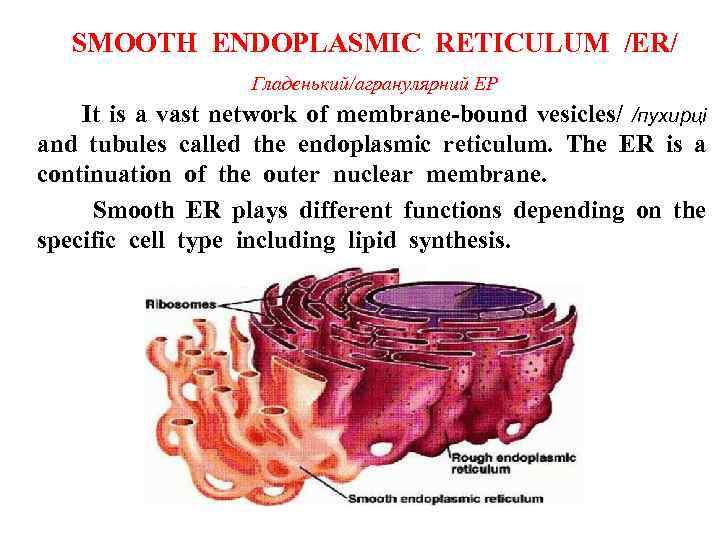
SMOOTH ENDOPLASMIC RETICULUM /ER/ Гладенький/агранулярний ЕР It is a vast network of membrane-bound vesicles/ /пухирці and tubules called the endoplasmic reticulum. The ER is a continuation of the outer nuclear membrane. Smooth ER plays different functions depending on the specific cell type including lipid synthesis.
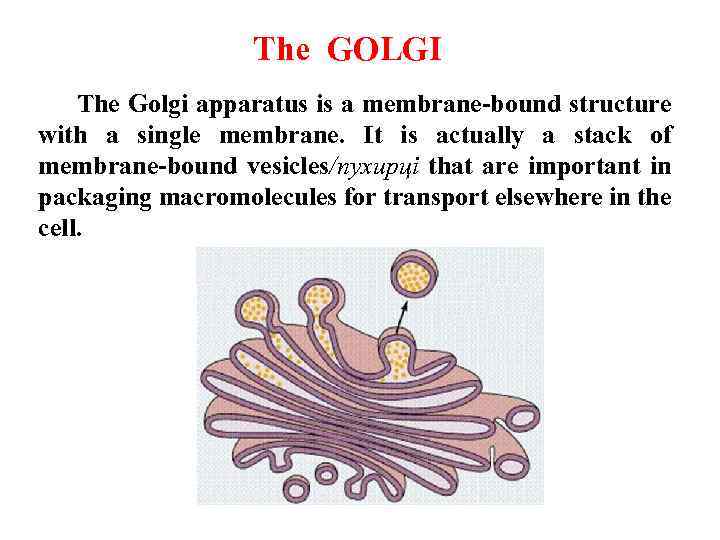
The GOLGI The Golgi apparatus is a membrane-bound structure with a single membrane. It is actually a stack of membrane-bound vesicles/пухирці that are important in packaging macromolecules for transport elsewhere in the cell.

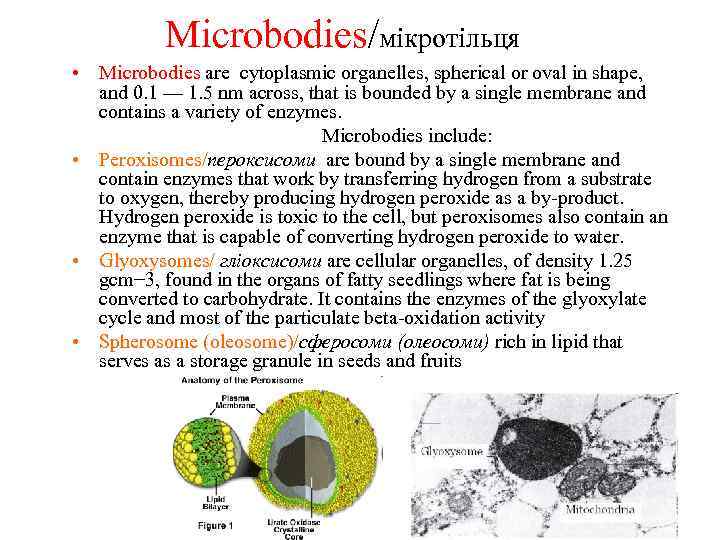
Microbodies/мікротільця • Microbodies are cytoplasmic organelles, spherical or oval in shape, and 0. 1 — 1. 5 nm across, that is bounded by a single membrane and contains a variety of enzymes. Microbodies include: • Peroxisomes/пероксисоми are bound by a single membrane and contain enzymes that work by transferring hydrogen from a substrate to oxygen, thereby producing hydrogen peroxide as a by-product. Hydrogen peroxide is toxic to the cell, but peroxisomes also contain an enzyme that is capable of converting hydrogen peroxide to water. • Glyoxysomes/ гліоксисоми are cellular organelles, of density 1. 25 gcm− 3, found in the organs of fatty seedlings where fat is being converted to carbohydrate. It contains the enzymes of the glyoxylate cycle and most of the particulate beta-oxidation activity • Spherosome (oleosome)/сферосоми (олеосоми) rich in lipid that serves as a storage granule in seeds and fruits
![VACUOLE [`v. Fkju. Olq] A vacuole is a membrane-bound organelle which is present in](https://present5.com/presentation/-43520524_131931137/image-20.jpg "VACUOLE [`v. Fkju. Olq] A vacuole is a membrane-bound organelle which is present in")
VACUOLE [`v. Fkju. Olq] A vacuole is a membrane-bound organelle which is present in all plant cells. Vacuoles are essentially enclosed compartments which are filled with cell sap/клітинний сік that is the water containing inorganic and organic molecules including enzymes in solution. A vacuole is surrounded by a vacuolar membrane called the tonoplast that separates the vacuolar contents from the cell's cytoplasm. As a membrane, it is mainly involved in regulating the movements of ions around the cell, and isolating materials that might be harmful or a threat to the cell. Vacuoles tend to be large in plant cells (typically occupies more than 30% of the cell's volume, and that can occupy as much as 80% of the volume for certain cell types and conditions) and play several roles: storing nutrients and waste products, helping increase cell size during growth. The plant cell vacuole also regulates turgor pressure in the cell which helps to maintain the structural integrity of the plant, along with the support from the cell wall.
![Membrane- free organells CYTOSKELETON [sait. O`skelet. On] As its name implies, the cytoskeleton helps](https://present5.com/presentation/-43520524_131931137/image-21.jpg "Membrane- free organells CYTOSKELETON [sait. O`skelet. On] As its name implies, the cytoskeleton helps")
Membrane- free organells CYTOSKELETON [sait. O`skelet. On] As its name implies, the cytoskeleton helps to maintain cell shape. But the primary importance of the cytoskeleton is in cell motility/рухливість. The internal movement of cell organelles, as well as cell locomotion and muscle fiber contraction could not take place without the cytoskeleton. The cytoskeleton is an organized network of three primary protein filaments: ·microtubulus [m. Ikrot`jubuljus]/мікротрубочки; ·microfilaments (acting filaments) [`filəmənt]/ мікрофіламенти;
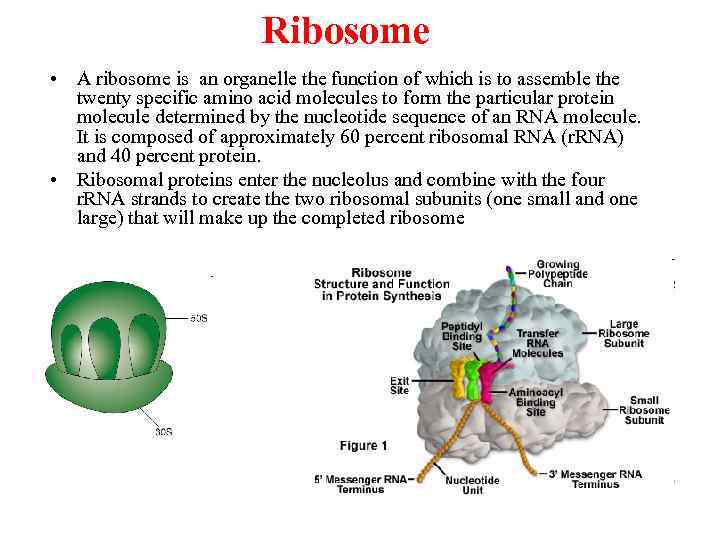
Ribosome • A ribosome is an organelle the function of which is to assemble the twenty specific amino acid molecules to form the particular protein molecule determined by the nucleotide sequence of an RNA molecule. It is composed of approximately 60 percent ribosomal RNA (r. RNA) and 40 percent protein. • Ribosomal proteins enter the nucleolus and combine with the four r. RNA strands to create the two ribosomal subunits (one small and one large) that will make up the completed ribosome
![The Nucleolus [nju: `kli: Fl. Fs] The nucleolus is a non-membrane bound structure composed](https://present5.com/presentation/-43520524_131931137/image-23.jpg "The Nucleolus [nju: `kli: Fl. Fs] The nucleolus is a non-membrane bound structure composed")
The Nucleolus [nju: `kli: Fl. Fs] The nucleolus is a non-membrane bound structure composed of proteins and nucleic acids found within the nucleus. Ribosomal RNA (r. RNA) is transcribed and assembled within the nucleolus. Singular - us [ e s ] LATIN Loans Plural - i [ ai ] Nucleolus Nucleoli [nju: `kli: Fl. Fs] [nju: `kli: Flai] Nucleus Nuclei [`nju: kli. Fs] [`nju: kliai] stimulus stimuli Fungus [`f. ANg. Fs] Fungi [`f. ANgai] [`f. ANGi]
ANSWERS
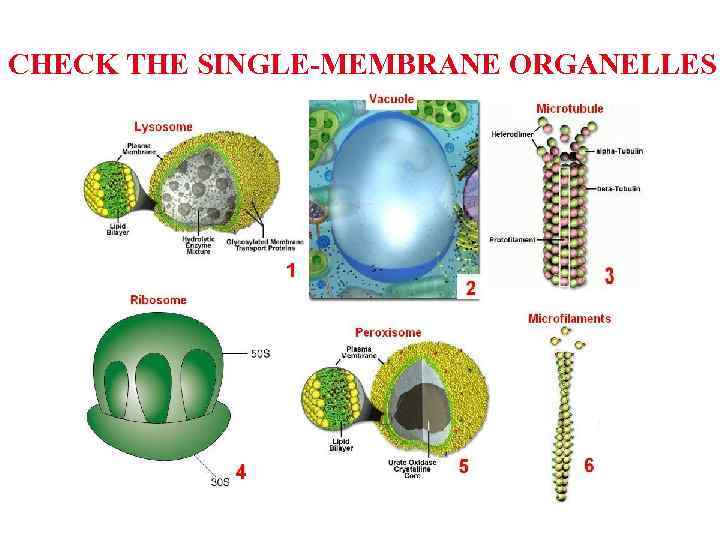
CHECK THE SINGLE-MEMBRANE ORGANELLES
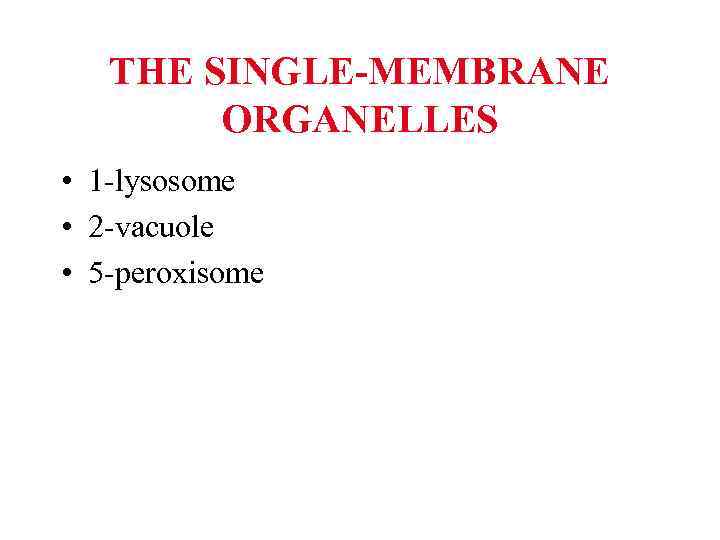
THE SINGLE-MEMBRANE ORGANELLES • 1 -lysosome • 2 -vacuole • 5 -peroxisome
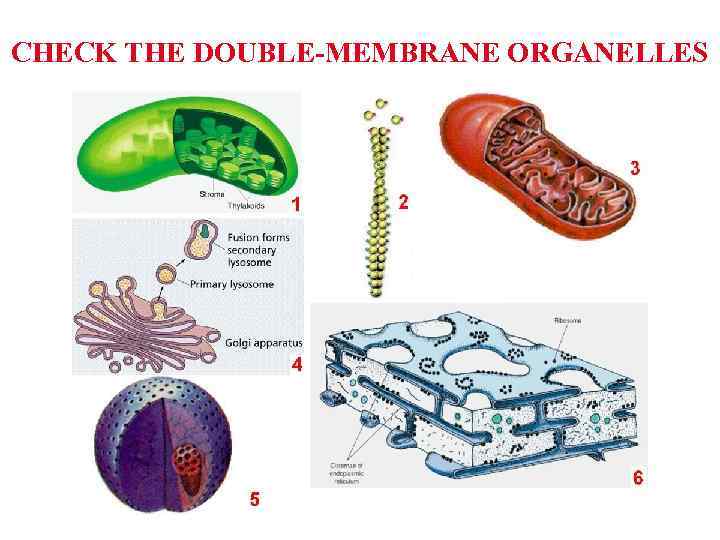
CHECK THE DOUBLE-MEMBRANE ORGANELLES
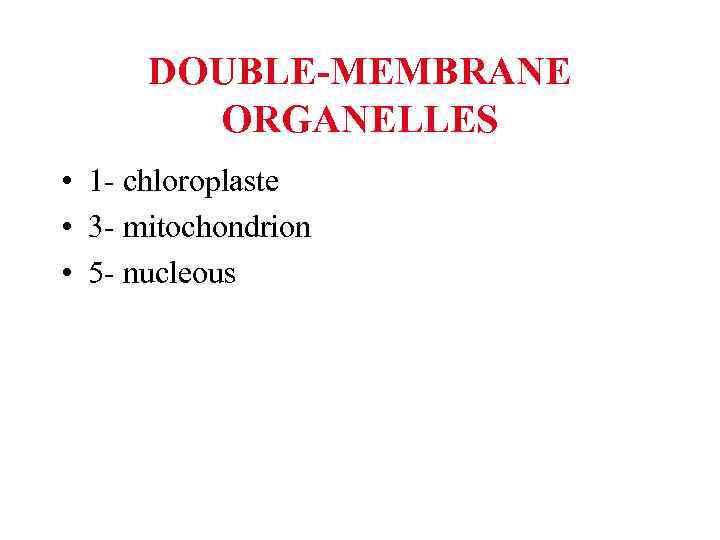
DOUBLE-MEMBRANE ORGANELLES • 1 - chloroplaste • 3 - mitochondrion • 5 - nucleous
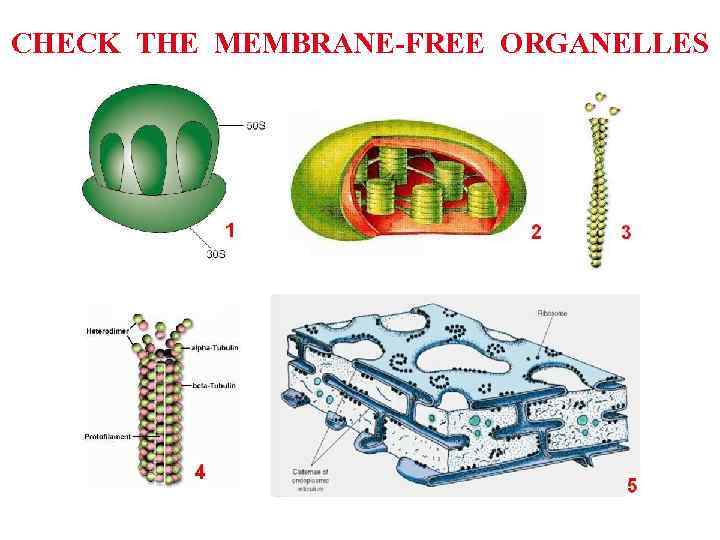
CHECK THE MEMBRANE-FREE ORGANELLES
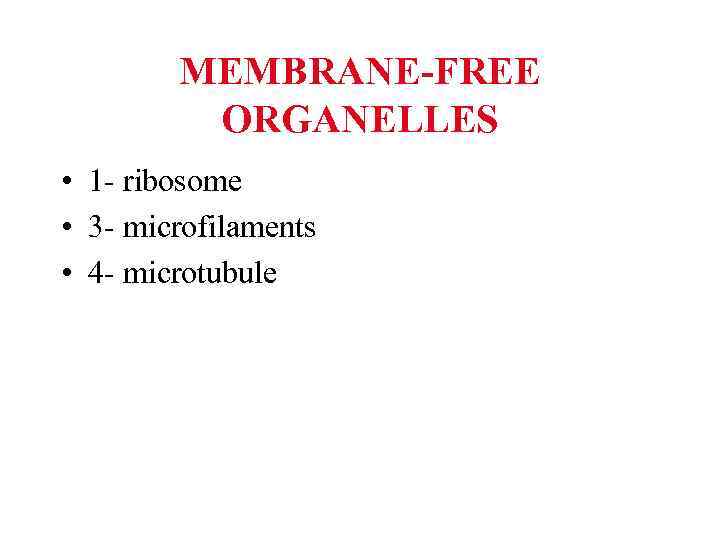
MEMBRANE-FREE ORGANELLES • 1 - ribosome • 3 - microfilaments • 4 - microtubule
CELL WALL A cell wall is a tough/міцний, flexible/гнучкий and sometimes fairly rigid/досить жорсткий layer surrounding a cell, located external to the cell membrane. It provides the cell with structural support, protection, and acts as a filtering mechanism. The cell walls are found in plants, bacteria, fungi, algae. Animals and protozoa do not have cell walls. The materials in a cell wall vary between species, and in plants and fungi also differ between cell types and developmental stages.
![Plant cell wall composition · the main constituent is cellulose [`seljul. Ouz] (polysaccharide of](https://present5.com/presentation/-43520524_131931137/image-33.jpg "Plant cell wall composition · the main constituent is cellulose [`seljul. Ouz] (polysaccharide of")
Plant cell wall composition · the main constituent is cellulose [`seljul. Ouz] (polysaccharide of glucose units, therefore a carbohydrate); forms the framework; · cellulose molecules are linear, ribbon-like chains of glucose [`gluk. Ouz]; linked together to form microfibrils/ мікрофібрили; these are grouped to form macrofibrils/макрофібрили). They forms architecture of the wall · the matrix among the cellulose fibrils is filled Cellulose fibers Macrofibril Microfibril Chains of cellulose molecules by the other constituents : other polysaccharides (e. g. , hemicelluloses, pectin substances); lignin (provides rigidity, chemically complex but is a polymer); fatty compounds (e. g. , cutin [`kjutin], suberin, [`sjuberin ] waxes/віск) on protective surfaces; wide variety of other substances both organic and inorganic including enzymes [`enzaimz] (and other proteins) · plant cells walls also contain numerous enzymes, such as hydrolases, esterases, peroxidases.
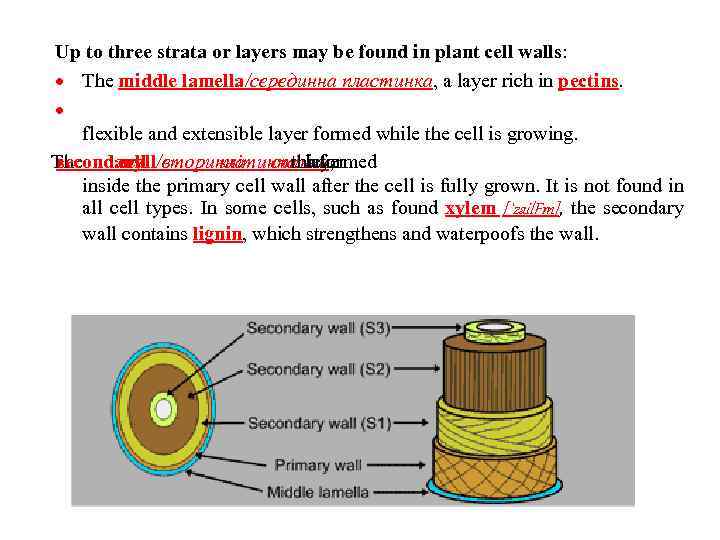
Up to three strata or layers may be found in plant cell walls: · The middle lamella/серединна пластинка, a layer rich in pectins. · flexible and extensible layer formed while the cell is growing. The · secondary cell wall/вторинна стінка, клітинна layer thick a formed inside the primary cell wall after the cell is fully grown. It is not found in all cell types. In some cells, such as found xylem [`zail. Fm], the secondary wall contains lignin, which strengthens and waterpoofs the wall.
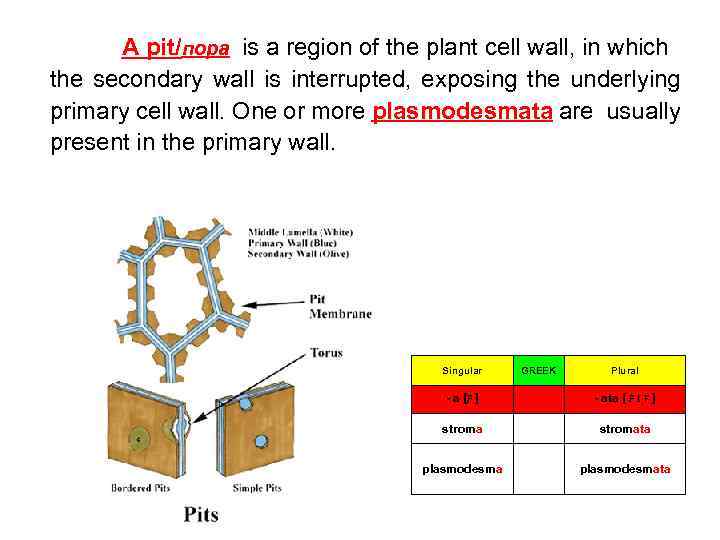
A pit/пора is a region of the plant cell wall, in which the secondary wall is interrupted, exposing the underlying primary cell wall. One or more plasmodesmata are usually present in the primary wall. Singular GREEK Plural - a [F ] - ata [ F t F ] stromata plasmodesmata
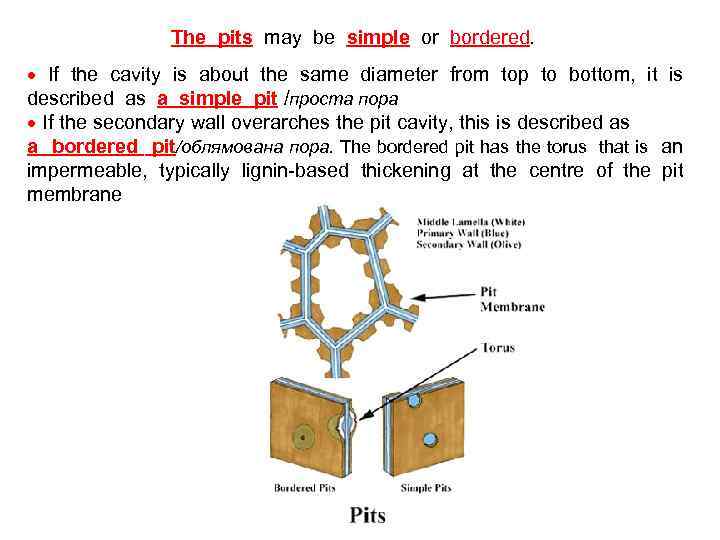
The pits may be simple or bordered. · If the cavity is about the same diameter from top to bottom, it is described as a simple pit /проста пора · If the secondary wall overarches the pit cavity, this is described as a bordered pit/облямована пора. The bordered pit has the torus that is an impermeable, typically lignin-based thickening at the centre of the pit membrane
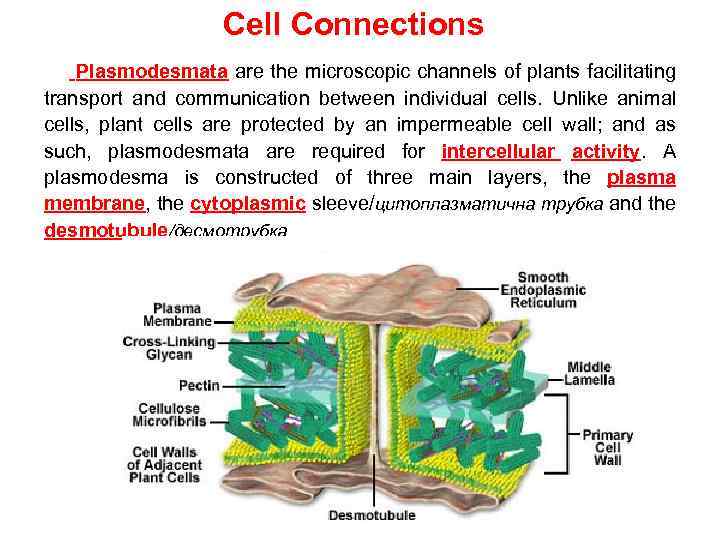
Cell Connections Plasmodesmata are the microscopic channels of plants facilitating transport and communication between individual cells. Unlike animal cells, plant cells are protected by an impermeable cell wall; and as such, plasmodesmata are required for intercellular activity. A plasmodesma is constructed of three main layers, the plasma membrane, the cytoplasmic sleeve/цитоплазматична трубка and the desmotubule/десмотрубка
Some definitions · protoplast = the organized living unit of a cell excluding the cell wall · symplast = all interconnected living cells in the plant · apoplast = all interconnected dead cells, cell walls and intercellular spaces in the plant
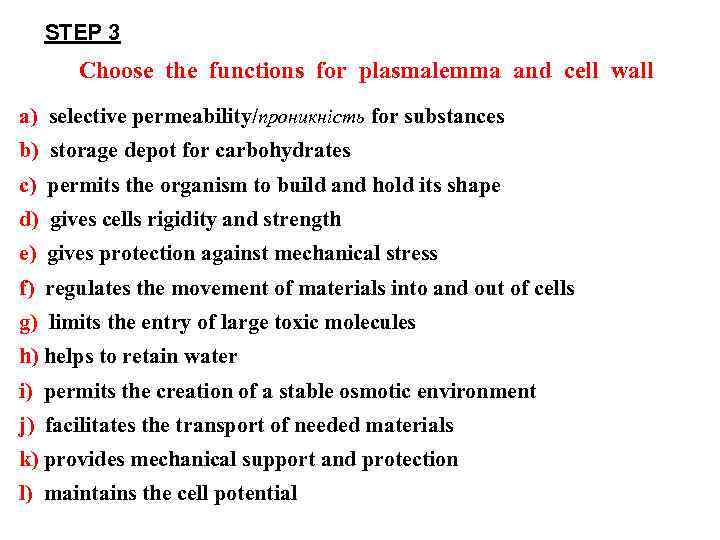
STEP 3 Choose the functions for plasmalemma and cell wall a) selective permeability/проникність for substances b) storage depot for carbohydrates c) permits the organism to build and hold its shape d) gives cells rigidity and strength e) gives protection against mechanical stress f) regulates the movement of materials into and out of cells g) limits the entry of large toxic molecules h) helps to retain water i) permits the creation of a stable osmotic environment j) facilitates the transport of needed materials k) provides mechanical support and protection l) maintains the cell potential
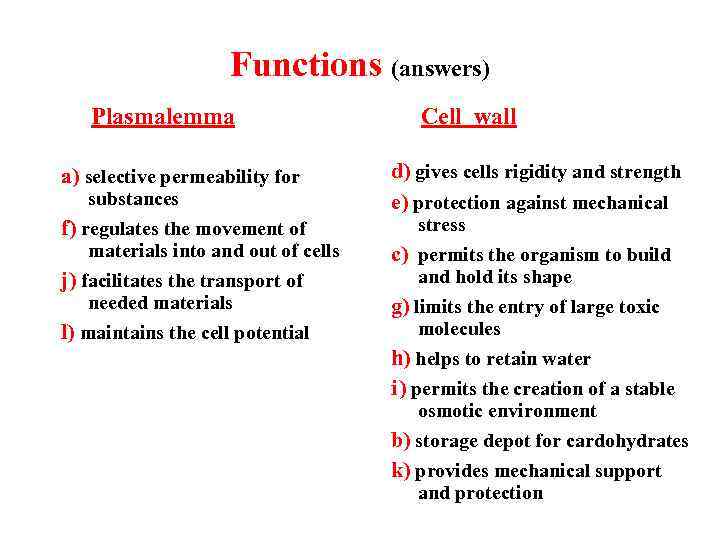
Functions (answers) Plasmalemma a) selective permeability for substances f) regulates the movement of materials into and out of cells j) facilitates the transport of needed materials l) maintains the cell potential Cell wall d) gives cells rigidity and strength e) protection against mechanical stress c) permits the organism to build and hold its shape g) limits the entry of large toxic molecules h) helps to retain water i ) permits the creation of a stable osmotic environment b) storage depot for cardohydrates k) provides mechanical support and protection

THANK YOU FOR ATTENTION! Inside What I Eat (Plant Cell Vegetarian Humor)
