


 Скачать презентацию Plans and Preparations for the PST Energy Act
ec5810104e8c26ae03bf33efb5e18c69.ppt
- Количество слайдов: 37
 Plans and Preparations for the PST Energy Act Investigations Texas Commission on Environmental Quality Environmental Trade Fair May 5 -6, 2015
 Small Business and Local Government Assistance Brian Christian Andy Gardner Division Director Section Manager
 SBLGA Offers: • Technical Compliance Assistance • One on One Help • Compliance Tools • Free & Confidential
 SBLGA Resources • • • Site Visit Program** Enviro. Mentor Program** Regional Staff Hotline number The Advocate
 Site Visit Program • Free to small businesses • Conducted by contractor hired by the SBLGA Section • Completes a 62 point PST checklist • Owner receives a report – Enforcement does not
 Enviro. Mentor Program • Technical Assistance • Volunteer Professionals – Consultants – Engineers – Lawyers – Operators
 Today’s Topics • Update on 40 CFR Part 280 • 3 year Energy Act Investigations • SBLGA Project – Compliance checklists – SBLGA tools – Free PST compliance workshops
 40 CFR Part 280 • Changes to federal UST rules will likely become effective soon • Watch EPA and TCEQ websites for updates • Participate in the rulemaking process
 Federal Energy Act of 2005 • Requires states to inspect facilities with USTs every 3 years • There approximately 21, 000 active facilities with USTs in Texas • TCEQ and agency contractors have performed investigations the past 3+ years
 Federal Energy Act of 2005 • Best option is for facilities to be in compliance before an investigation • More than 680 administrative orders filed by TCEQ in Fiscal Year 2014 • Average penalty greater than $5, 500
 Compliance Checklists • Energy Act – 10 focused points • CEIMOD – Modified compliance evaluation investigation • Temporarily out of service
 Preparing for a PST Focused Energy Act Investigation • Energy Act focused checklist citing mostly Category A violations – requires automatic initiation of formal enforcement action • TCEQ investigators are still looking for compliance with all applicable rules
 Energy Act Focused Checklist • • Self certification Financial assurance Corrosion protection Release detection for tanks and piping Spill and overfill prevention Release reporting Operator training Records
 Self Certification • Is the delivery certificate current, valid? • Applies to USTs containing motor fuel • Required annually • Fuel delivery prohibited without a current, valid delivery certificate
 Financial Assurance • Is the insurance current? • Facilities submit certificate of insurance with self certification form • Does the facility have documentation?
 Corrosion Protection • Are all underground and underwater metal components protected from corrosion? – Steel tanks and lines – Buried metal components – Metal components in contact with water
 Corrosion Protection • Cathodic protection systems must be tested at installation and every three years thereafter • For impressed current systems, rectifier should be read every 60 days and recorded in a log sheet
 Corrosion Protection • FRP Tanks and Composite Tanks don’t require a cathodic protection system • Does the facility have documentation? • What is acceptable documentation?
 Release Detection • Tanks – Monthly method capable of detecting a 0. 2 gph leak rate (ATG & SIR) – Inventory control required if retail or if the method requires it • Accurate, daily readings • Reconcile at the end of each month
 Release Detection • Pressurized Piping – 2 methods required • Automatic line leak detector (3 gph) and be function tested annually and • Monthly release detection (0. 2 gph) or annual piping tightness test (0. 1 gph)
 Release Detection • Suction or Gravity Piping • Monthly or triennial test • Keep documentation to verify compliance
 Spill & Overfill Prevention • Tight fill fitting • Spill bucket -Inspect every 60 days to ensure they’re liquid tight • Overfill Device – Automatic shut-off valve – in fill port – Automatic flow restrictor – in vent line • Keep documentation
 Release Reporting • Were any suspected releases reported within 24 hours and investigated? – Exceeding inventory control reconciliation amount 2 months in a row – Inconclusive or failing SIR or ATG result • System tightness test within 30 days • Keep documentation
 Operator Training • Initial deadline was August 8 th 2012 • Re-train every 3 years • Completion certificate
 Records • Facility should maintain records to determine compliance • It doesn’t count if you can’t prove it
 Common Violations Cited • • • Not doing inventory control No proof of tank test results No 3 year cathodic protection test No documentation of tank material No overfill documentation Insufficient records
 What happens after an investigation? • Exit interview form given to facility • If violations are noted, get in compliance and submit documentation ASAP – it could save $$$$
 Penalty Calculations • Many factors – Amount of throughput – Compliance History – Avoided Costs (not doing a tightness test) – Good faith reduction (25%) – Deferral for agreed order (20%)
 SBLGA’s PST Tools • Free, confidential site visit (if facility is a small business and not in enforcement)* • PST Super Guide (RG-475) • Petroleum Storage Tanks (PST): Compliance Resources webpage
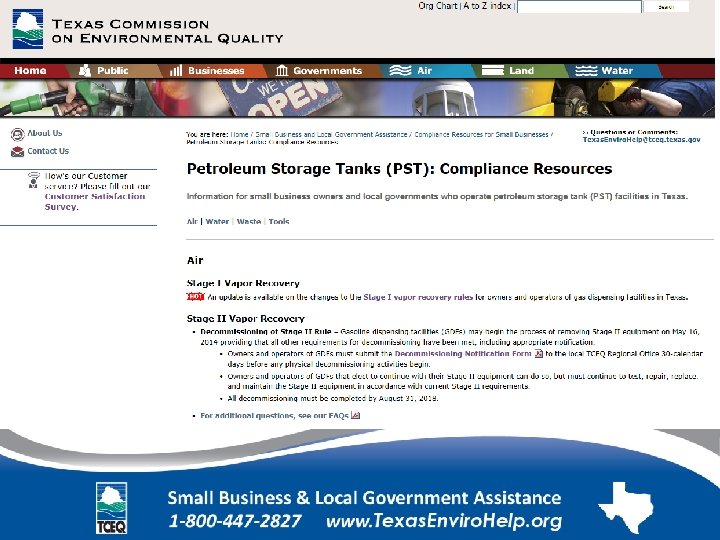 PST Compliance Resources web page
 SBLGA’s PST Tools • Compliance Notebook NEW!! – Example records – Blank log sheets – Place to put necessary records – Follows CEIMOD compliance checklist
 Compliance Notebook Content • • Self-Certification & Registration Financial Assurance Corrosion Protection Tank Release Detection Piping Release Detection Spill and Overfill Prevention Release Reporting
 Compliance Notebook Content • • Miscellaneous Records Operator Training Shear Valves Equipment installed after January 1, 2009 Texas Department of Agriculture Temporarily out of service USTs Stage I and II
 Free PST Workshops • Owners and operators of facilities with USTs invited • Participants receive compliance notebook and discuss content • SBLGA staff present to answer compliance questions
 Free PST Workshops • Austin workshop – May 19, 2015 • Waco workshop – June 11, 2015 • Conducted statewide in Fiscal Year 2016
 For More Information… • www. texasenvirohelp. org • Contact regional SBLGA staff • 1 -800 -447 -2827 - hotline
 • Danielle Cochran – TCEQ Region 4 – Fort Worth – Phone: (817) 588 -5927 – E-Mail: danielle. cochran@tceq. texas. gov • Nathan Weiss – TCEQ Region 13 – San Antonio – Phone: (210) 403 -4092 – E-Mail: nathan. weiss@tceq. texas. gov