 Скачать презентацию Planning to Recover Presented by Dan Pyle Millar
ae19111e4367846dd00e63cd2a0ba6e9.ppt
- Количество слайдов: 38



Planning to Recover Presented by Dan Pyle Millar, Ph. D. , APR, Fellow PRSA 49 th Annual Human Resources Conference Indiana Chamber of Commerce May 7, 2013 Indianapolis, Indiana
Major Thoughts to Remember 1. You company WILL EXPERIENCE a crisis; overtime several. 2. PLANNING INCREASES your chances of managing the crisis and the communication during and following the episode. 3. COMMUNICATING with stakeholders IMPROVES your ability to manage the episode and recover from it.
Definition and Types of Crises. . . A significant disruption of an organization’s normal activities which stimulates negative stakeholder reaction threatening the organization. Types of Crisis sudden perceptual smoldering bizarre
Crisis Characteristics • Significant disruption of operations • Adverse effect on normal operations • Resolution exceeds the organization’s capacity to respond • Generates substantial negative stakeholder reaction • Generates extensive public scrutiny • Generates extensive news coverage • Worldwide coverage via social media
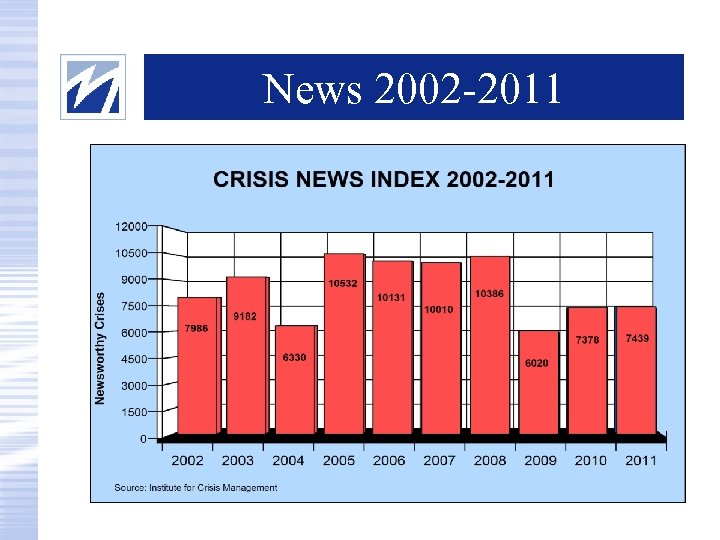
News 2002 -2011
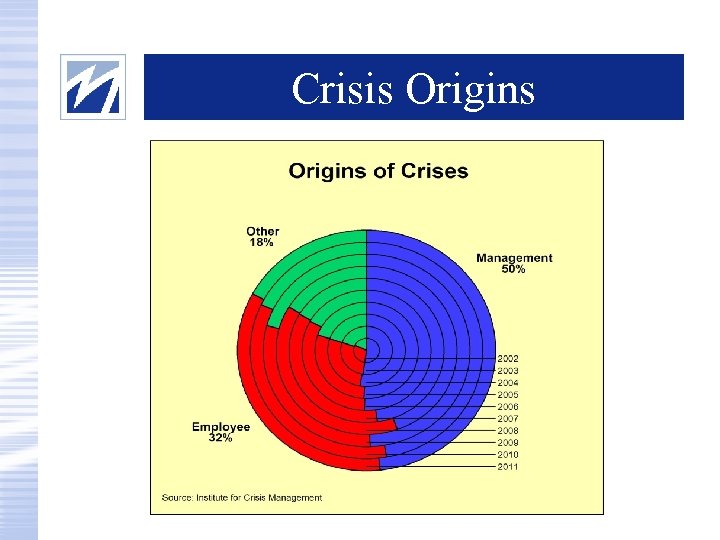
Crisis Origins
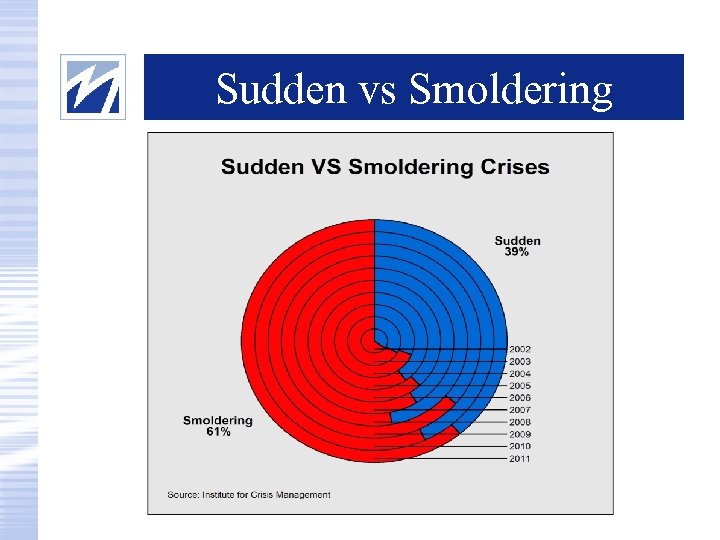
Sudden vs Smoldering
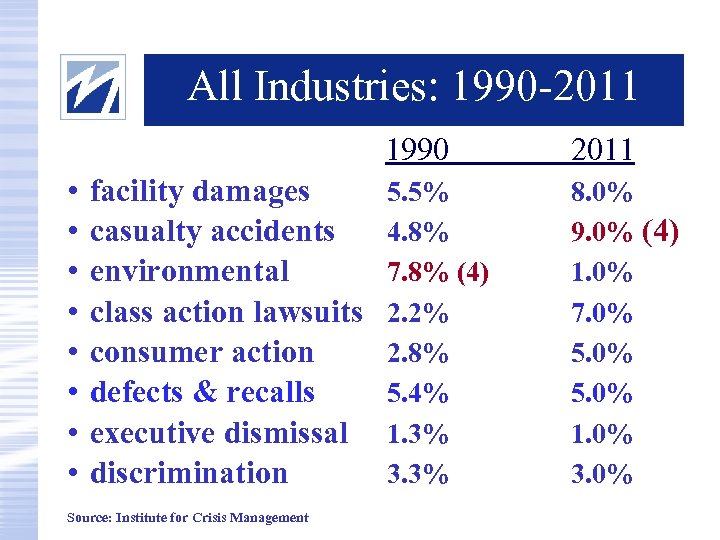
All Industries: 1990 -2011 Crises Happen! 1990 • • facility damages casualty accidents environmental class action lawsuits consumer action defects & recalls executive dismissal discrimination Source: Institute for Crisis Management 2011 5. 5% 4. 8% 7. 8% (4) 2. 2% 2. 8% 5. 4% 1. 3% 3. 3% 8. 0% 9. 0% (4) 1. 0% 7. 0% 5. 0% 1. 0% 3. 0%
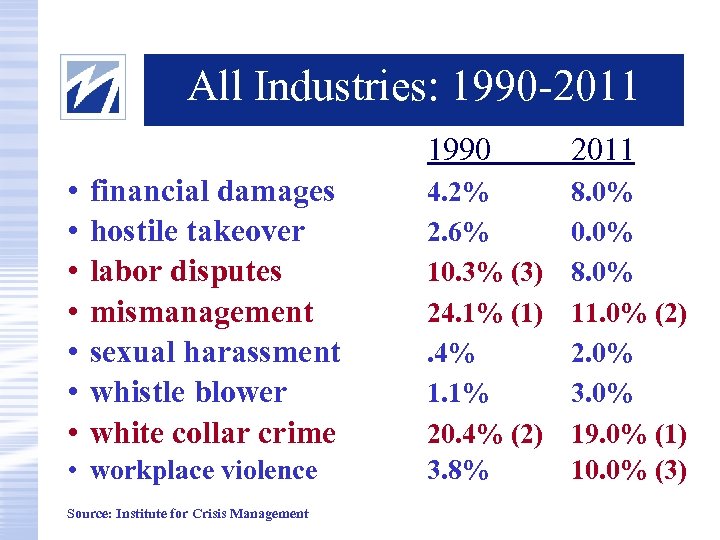
All Industries: 1990 -2011 Crises Happen! 1990 • • financial damages hostile takeover labor disputes mismanagement sexual harassment whistle blower white collar crime • workplace violence Source: Institute for Crisis Management 2011 4. 2% 2. 6% 10. 3% (3) 24. 1% (1). 4% 1. 1% 20. 4% (2) 3. 8% 8. 0% 0. 0% 8. 0% 11. 0% (2) 2. 0% 3. 0% 19. 0% (1) 10. 0% (3)
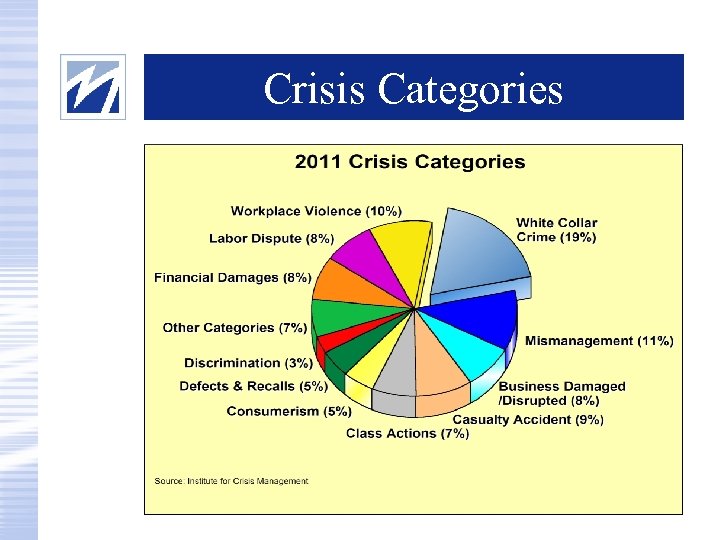
Crisis Categories
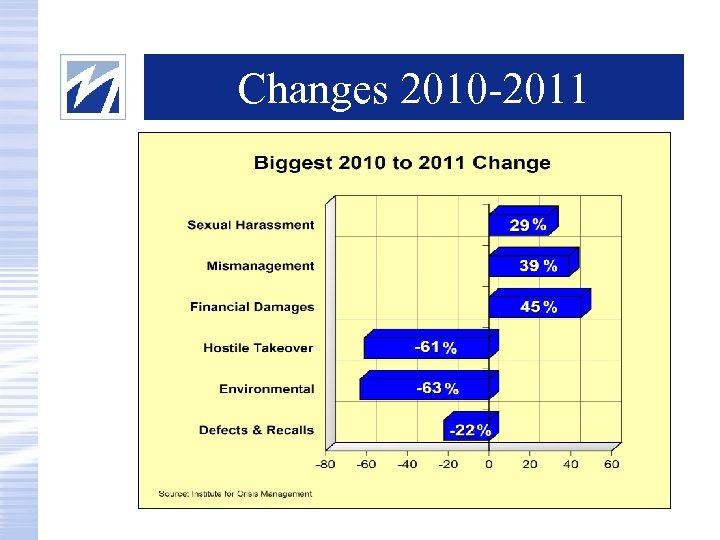
Changes 2010 -2011
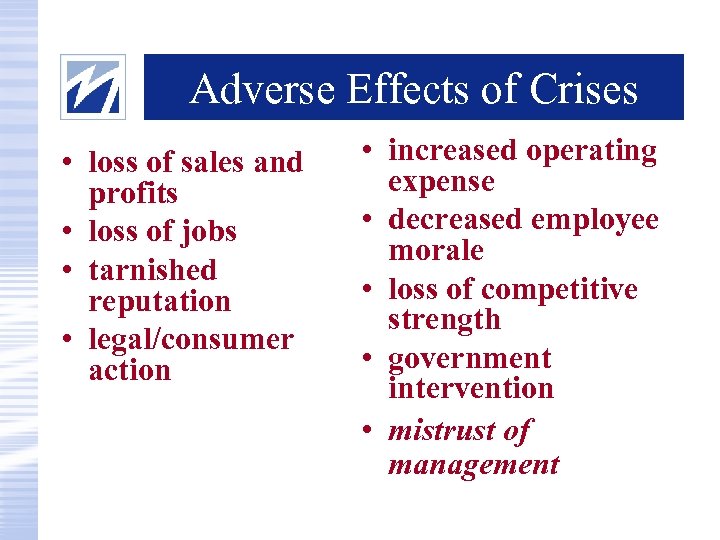
Adverse Effects of Crises • loss of sales and profits • loss of jobs • tarnished reputation • legal/consumer action • increased operating expense • decreased employee morale • loss of competitive strength • government intervention • mistrust of management
Harsh Realities of Crises • Most crisis situations can be PREDICTED and PREVENTED; those that can’t be avoided can be minimized • Serious problems don’t become a “crisis” until the PROBLEM ESCAPES THE ORGANIZATION • The longer a crisis goes on, the MORE DAMAGE to attendance, earnings, stock price, morale, competitive position and trust in management • MANAGEMENT DENIAL is the biggest obstacle to effective crisis management • The primary concern in crisis communication management is the COURT OF PUBLIC OPINION not the court of law
Major Thoughts to Remember 1. You company WILL EXPERIENCE a crisis; overtime several. 2. PLANNING INCREASES your chances of managing the crisis and the communication during and following the episode. 3. COMMUNICATING with stakeholders IMPROVES your ability to manage the episode and recover from it.
Strategic Objectives 1. Keep the business running • every hour lost = lost revenue • return to normalcy quickly = cash flow and stakeholder morale • work and work environment helps employees adjust and adapt 2. Minimize the damage • reputation diminished = reluctance to buy, invest, supply, work for • increased distrust of management • conserve fiscal, physical and human capital
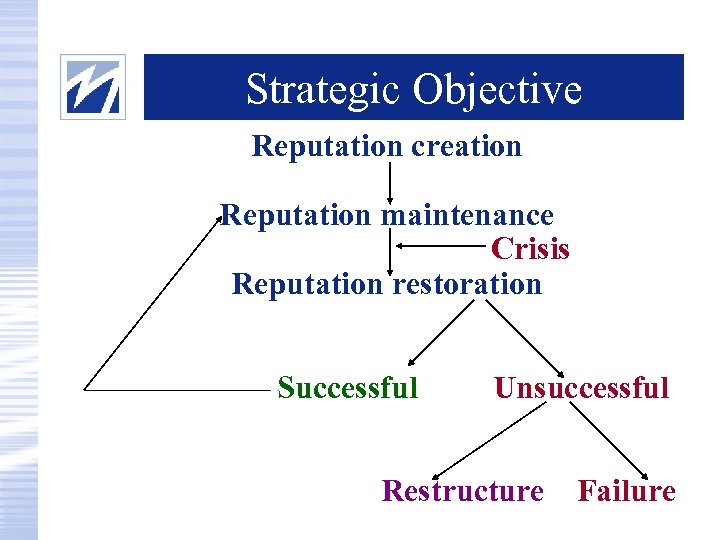
Strategic Objective Reputation creation Reputation maintenance Crisis Reputation restoration Successful Unsuccessful Restructure Failure
Planning to Recover BEFORE: 1. Assess your vulnerabilities 2. Create a plan including: a. Composition and responsibilities of crisis team to monitor the organization before crisis, make decisions during crisis, and guide rebuilding after. b. Means to work in temporary quarters including at home c. Names, contact information of key people including management, experts, security, and media contacts.
Planning to Recover d. Procedures for centralizing information flow. e. Communication kits on personnel/organization including photos, video, backgrounders, sample release forms. f. Key message points grounded in the mission of the organization. 3. Prepare management for open communication with all audiences.
Planning to Recover DURING: 4. Centralize the two-way flow of information. 5. Inform affected publics in the most effective, efficient form. 6. Respond to stakeholders truthfully, openly, quickly, informatively. 7. Treat all stakeholders fairly. 8. Keep all audiences updated as the crisis evolves. 9. Monitor print, broadcast media, and social media; keep records on a timeline.
Planning to Recover AFTER: 10. Debrief everyone involved in the crisis. 11. Write a brief report of causes, responsibilities, successes, failures, and recommendations for improvement. 12. Recognize and reward those who contributed to the management of the crisis. 13. Follow through on recovery plans to rebuild trust, reputation, employee morale, and reduce stress.
Major Thoughts to Remember 1. You company WILL EXPERIENCE a crisis; overtime several. 2. PLANNING INCREASES your chances of managing the crisis and returning to “normal” 3. COMMUNICATING with stakeholders IMPROVES your ability to manage the event and recover from it.
Preparation to Communicate Has NOT Changed Substance of Communication üConfirmation üContainment üCompassion üCooperation with outside agencies üCorrection
Preparation to Communicate Has NOT Changed Create a communication plan INDEPENDENT but INTEGRATED with the organization’s operational and business and continuity plans. • Find your vulnerabilities or threats • Write a plan responding to those threats • Create a message platform • Train personnel to use the plan • Train your spokesperson(s) • Exercise/update the plan (regularly)
You Can’t Hide! Once the crisis escapes the organization. . . • world knows within minutes • pack professional and amateur journalism results • 24/365 news coverage • immediate world-wide distribution: broadcast or Internet, reporters or blogs • instant “experts” and “authorities” will comment
9/11 Raised the Bar The Giuliani Standard: • visible • spoke shortly after the event • spoke with target audience (constituents) • provided useful information (updated) • expressed sorrow, grief, empathy • expressed positive perspective (action and attitude)
Develop a Message Platform Develop your message platform for each potential threat: • based on organizational purpose “we design innovative software solutions for businesses” • organization-general, crisis-specific “our hearts go out to the families of those injured” • phrased in compelling manner and connected to the audiences’ need for information “all employees are safe and accounted for” “on-site counseling will be available--as long as anyone needs it”
Use Your Message Platform First words FRAME the story • reduces confusion • give direction for future comments and activities *shapes your perspective on the event “we are deeply saddened; we lost family too” *emotional connection to publics; compelling “they were a sight for sore eyes” *frame for future statements “we are cooperating with investigating agencies” *platform for future actions “a scholarship fund has been established” “we’ll be back to work on Tuesday” *saying nothing increasing confusion and invites speculation NOT ‘no comment’
Use Current Technology • • • Web site /Intranet site Blogs, tweets, webcasts Hot Lines/800 numbers Facebook, Twitter, etc. Broadcast Email Voicemail automated Cell Phones, tablets Texts Broadcast media
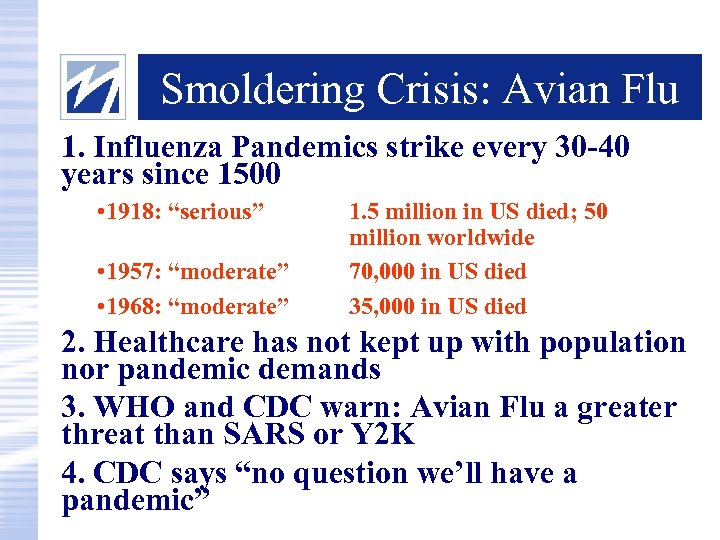
Smoldering Crisis: Avian Flu 1. Influenza Pandemics strike every 30 -40 years since 1500 • 1918: “serious” • 1957: “moderate” • 1968: “moderate” 1. 5 million in US died; 50 million worldwide 70, 000 in US died 35, 000 in US died 2. Healthcare has not kept up with population nor pandemic demands 3. WHO and CDC warn: Avian Flu a greater threat than SARS or Y 2 K 4. CDC says “no question we’ll have a pandemic”
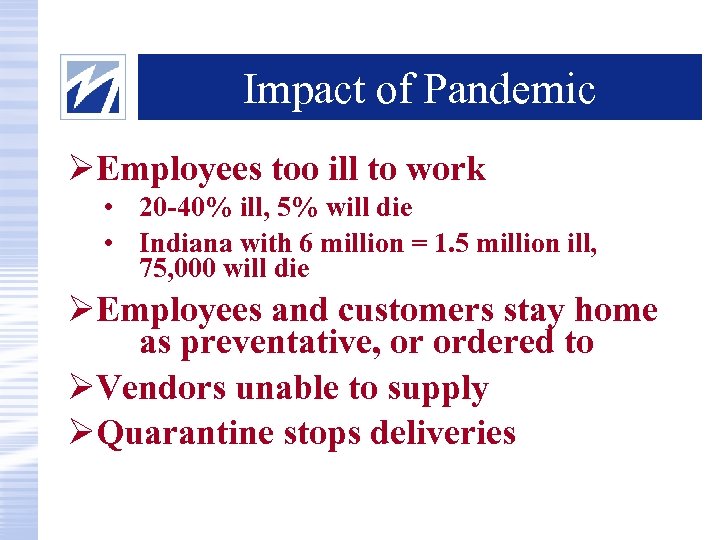
Impact of Pandemic ØEmployees too ill to work • 20 -40% ill, 5% will die • Indiana with 6 million = 1. 5 million ill, 75, 000 will die ØEmployees and customers stay home as preventative, or ordered to ØVendors unable to supply ØQuarantine stops deliveries
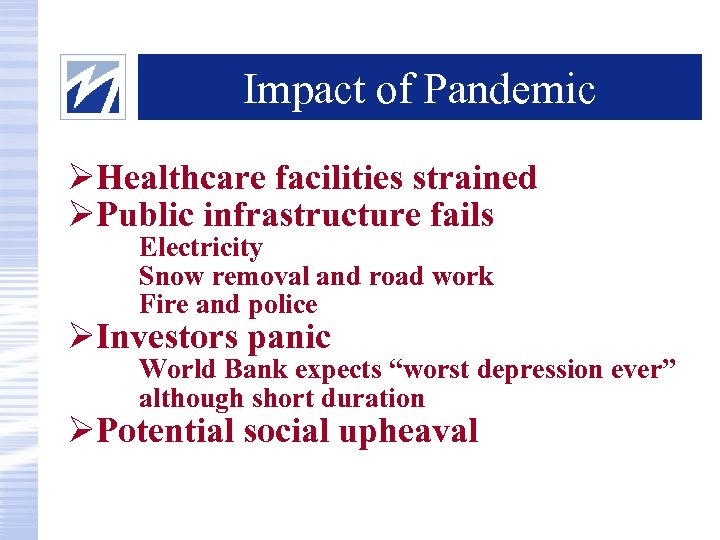
Impact of Pandemic ØHealthcare facilities strained ØPublic infrastructure fails Electricity Snow removal and road work Fire and police ØInvestors panic World Bank expects “worst depression ever” although short duration ØPotential social upheaval
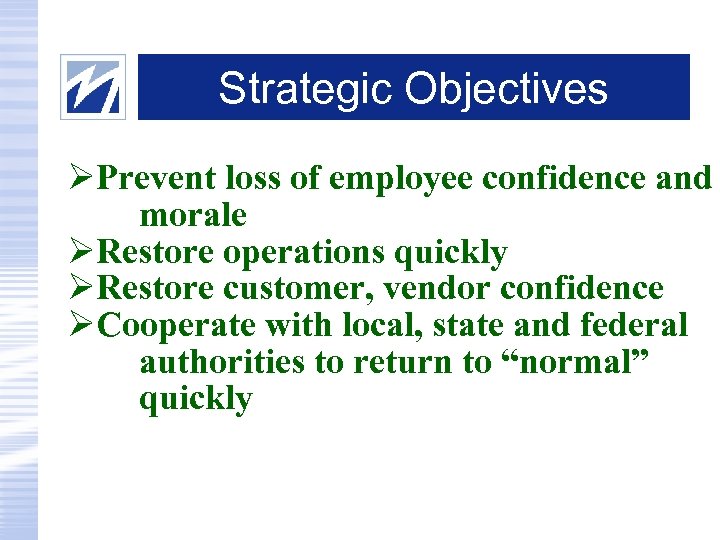
Strategic Objectives ØPrevent loss of employee confidence and morale ØRestore operations quickly ØRestore customer, vendor confidence ØCooperate with local, state and federal authorities to return to “normal” quickly
Key Issues in Planning Financial: cash flow & bill paying Personnel: US norm--work sick! quarantine and ordered “stay home” sick leave paid sick days caregiver days funeral days Legal: attorneys review all contracts HR review and plan exceptions for employee absenc policies Operations: keep the business running as efficiently, effectively and ethically as possible
Items on the To-Do List 1. Prepare for increase/decrease demand of your product or service 2. Prepare operations for disruption of just-in-time delivery 3. Prepare for diminished workforce 4. Plan for domestic and international travel restrictions 5. Set employee access rules 6. Determine extent of employee assistance with healthcare and social services
Items on the To-Do List 7. Set policies of preventing spread of disease in the workplace 8. Establish flexible worksite and hours policies and reporting 9. Arrange for communication with employees, vendors, distributors, customers (e. g. , time, place, technology) 10. Involve employees in planning 11. Set employee access rules 12. Initiate planning with insurance and health plan providers, local healthcare facilities
Major Thoughts to Remember 1. You company WILL EXPERIENCE a crisis; overtime several. 2. PLANNING INCREASES your chances of managing the crisis and the communication during and following the episode. 3. COMMUNICATING with stakeholders IMPROVES your ability to manage the episode and recover from it.
Best Advice Prepare relentlessly! Rudy Giuliani, Leadership, 2002 Communicate consistently! Kay and Dan Millar, 2003
Contact Me E-mail: dpmillar@sbcglobal. net Identify yourself in Subject Line: HR Conference 2013
Скачать презентацию Planning to Recover Presented by Dan Pyle Millar
ae19111e4367846dd00e63cd2a0ba6e9.ppt