


 Скачать презентацию Planning scheduling training requirements for operating Ulysses
7c10104af7ae2a656258943026c4652c.ppt
- Количество слайдов: 59
 Planning, scheduling & training requirements for operating Ulysses through the Nutation anomaly in 2000 -2001 Andy Mc. Garry ESA Ulysses Spacecraft Systems Engineer x 3 -0906, andrew. mcgarry@jpl. nasa. gov ESA Ulysses Flight Control Team Ulysses Nutation Operations 2000 -2001
 Outline of talk • Introduction to Ulysses • The Nutation anomaly • What is the impact of the Nutation anomaly? • How do we control Nutation? • Nutation operations requirements • The unique demands of Nutation operations ESA Ulysses Flight Control Team Ulysses Nutation Operations 2000 -2001 2
 Outline of talk (cont’d) • Lessons learned from Nutation operations in 1994 -5 • How is Nutation in 2000 -1 different from 1994 -5? • Preparations for 2000 -1 Nutation operations • Nutation tracks and operations are different! • Present concerns / Q & A ESA Ulysses Flight Control Team Ulysses Nutation Operations 2000 -2001 3
 Introduction title page Introduction to Ulysses ESA Ulysses Flight Control Team Ulysses Nutation Operations 2000 -2001 4
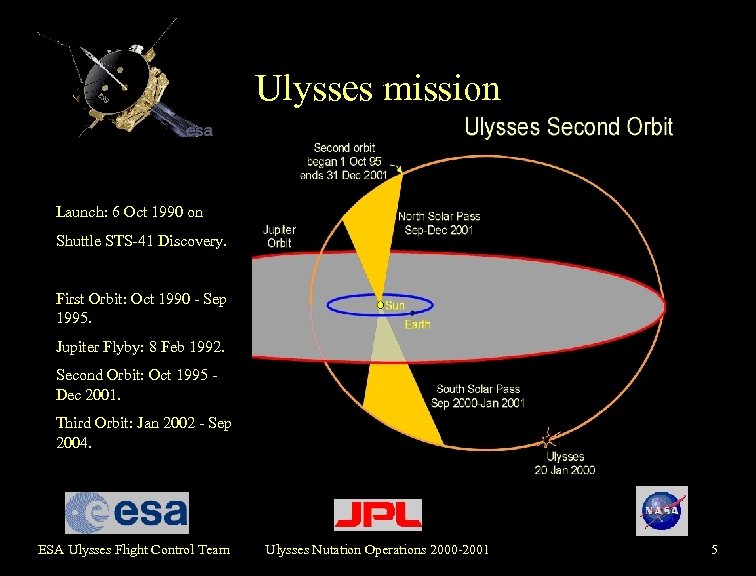 Ulysses mission Launch: 6 Oct 1990 on Shuttle STS-41 Discovery. First Orbit: Oct 1990 - Sep 1995. Jupiter Flyby: 8 Feb 1992. Second Orbit: Oct 1995 Dec 2001. Third Orbit: Jan 2002 - Sep 2004. ESA Ulysses Flight Control Team Ulysses Nutation Operations 2000 -2001 5
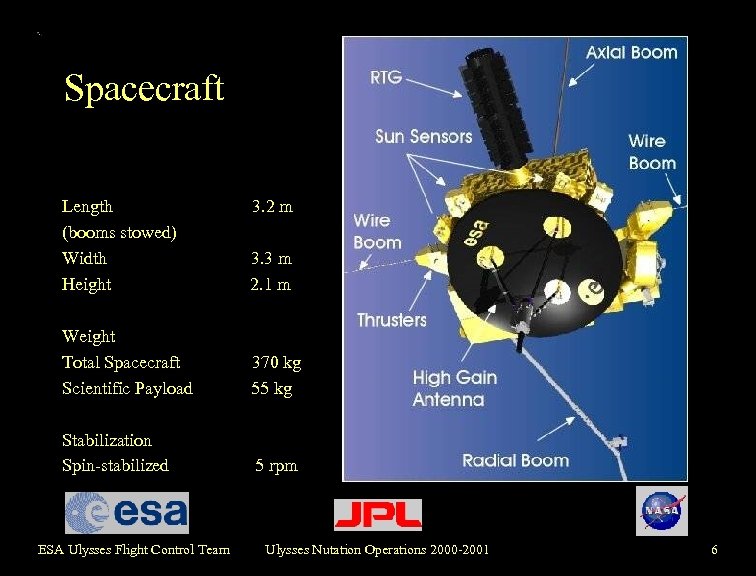 Spacecraft Dimensions Length (booms stowed) Width Height 3. 3 m 2. 1 m Weight Total Spacecraft Scientific Payload 370 kg 55 kg Stabilization Spin-stabilized 5 rpm ESA Ulysses Flight Control Team 3. 2 m Ulysses Nutation Operations 2000 -2001 6
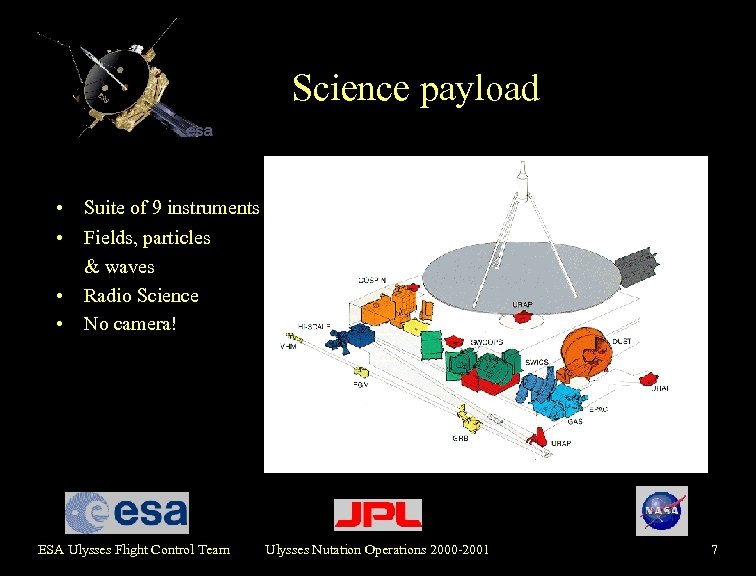 Science payload • • Suite of 9 instruments Fields, particles & waves Radio Science No camera! ESA Ulysses Flight Control Team Ulysses Nutation Operations 2000 -2001 7
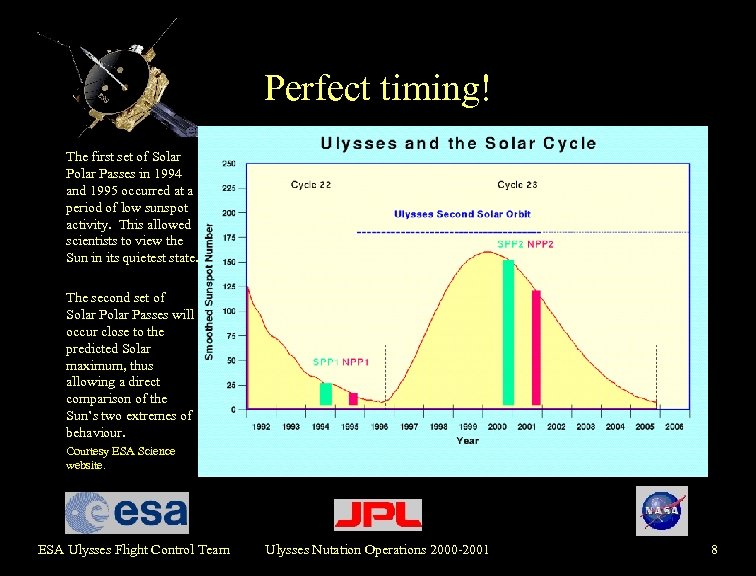 Perfect timing! The first set of Solar Passes in 1994 and 1995 occurred at a period of low sunspot activity. This allowed scientists to view the Sun in its quietest state. The second set of Solar Passes will occur close to the predicted Solar maximum, thus allowing a direct comparison of the Sun’s two extremes of behaviour. Courtesy ESA Science website. ESA Ulysses Flight Control Team Ulysses Nutation Operations 2000 -2001 8
 The Nutation Anomaly title page The Nutation Anomaly ESA Ulysses Flight Control Team Ulysses Nutation Operations 2000 -2001 9
 Nutation Anomaly • First occurred in 1990 • Caused by solar pumping of axial boom + underperformance of passive nutation dampers • Returned in 1994 -5 - successfully controlled • Returning in 2000 -1 ESA Ulysses Flight Control Team Ulysses Nutation Operations 2000 -2001 10
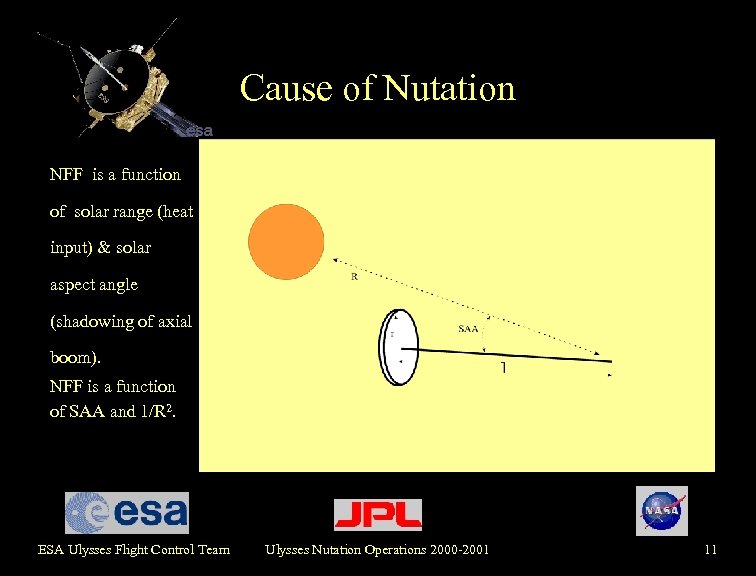 Cause of Nutation NFF is a function of solar range (heat input) & solar aspect angle (shadowing of axial boom). NFF is a function of SAA and 1/R 2. ESA Ulysses Flight Control Team Ulysses Nutation Operations 2000 -2001 11
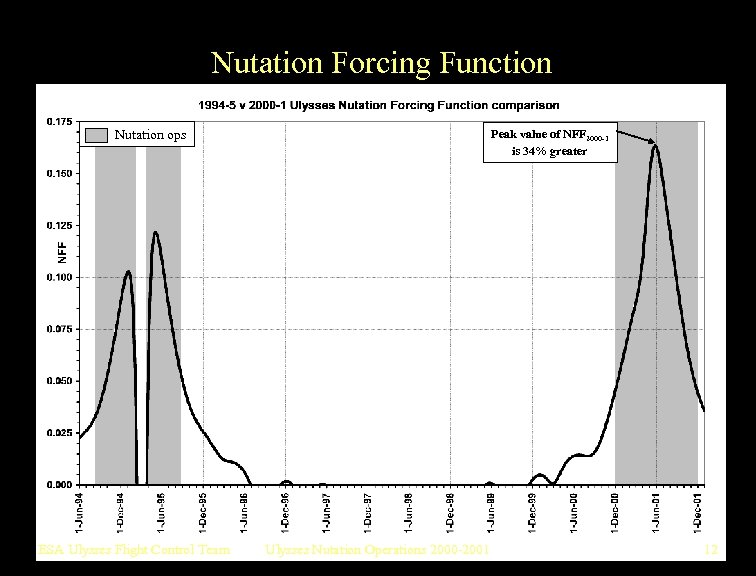 Nutation Forcing Function Nutation ops ESA Ulysses Flight Control Team Peak value of NFF 2000 -1 is 34% greater Ulysses Nutation Operations 2000 -2001 12
 What is the impact of the Nutation Anomaly? title page What is the impact of the Nutation Anomaly? ESA Ulysses Flight Control Team Ulysses Nutation Operations 2000 -2001 13
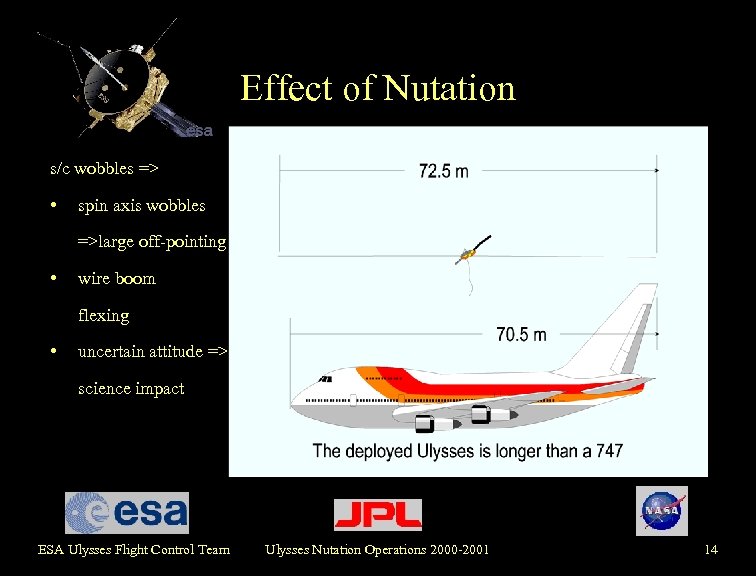 Effect of Nutation s/c wobbles => • spin axis wobbles =>large off-pointing • wire boom flexing • uncertain attitude => science impact ESA Ulysses Flight Control Team Ulysses Nutation Operations 2000 -2001 14
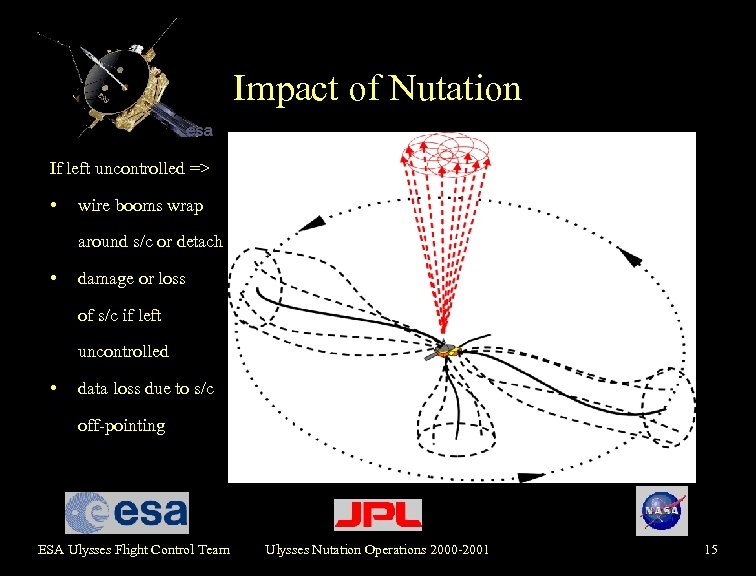 Impact of Nutation If left uncontrolled => • wire booms wrap around s/c or detach • damage or loss of s/c if left uncontrolled • data loss due to s/c off-pointing ESA Ulysses Flight Control Team Ulysses Nutation Operations 2000 -2001 15
 How do we control the Nutation Anomaly? title page How do we control the Nutation Anomaly? ESA Ulysses Flight Control Team Ulysses Nutation Operations 2000 -2001 16
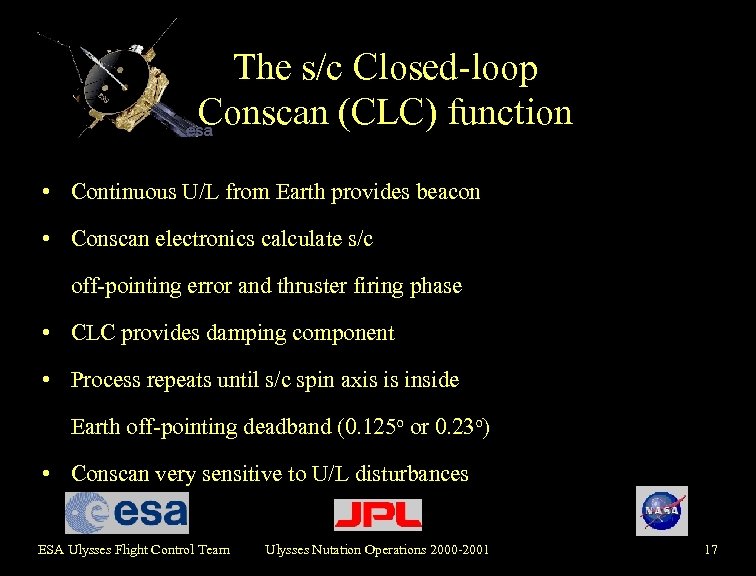 The s/c Closed-loop Conscan (CLC) function • Continuous U/L from Earth provides beacon • Conscan electronics calculate s/c off-pointing error and thruster firing phase • CLC provides damping component s/c AGC DC bias t spin t • Process repeats until s/c spin axis is inside Earth off-pointing deadband (0. 125 o or 0. 23 o) • Conscan very sensitive to U/L disturbances ESA Ulysses Flight Control Team Ulysses Nutation Operations 2000 -2001 17
 Nutation ops depend on steady, continuous uplink • When CLC is disabled, Nutation can grow. • To provide maximum Nutation damping, CLC is continuously enabled. • CLC only disabled during scheduled U/L disturbances e. g. U/L transfers, U/L sweeps, CMD MOD On/Off. • To avoid U/L transients affecting Conscan measurements, we must have: S/c CLC off for 20 mins around U/L transfers. S/c CLC off for (35 mins+gap), around gap in coverage. ESA Ulysses Flight Control Team Ulysses Nutation Operations 2000 -2001 18
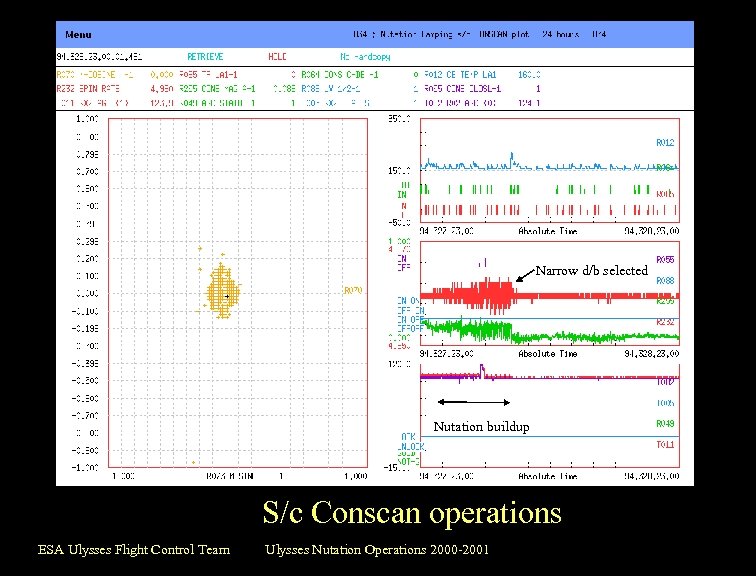 Example of daily Nutation Operations Narrow d/b selected Nutation buildup S/c Conscan operations ESA Ulysses Flight Control Team Ulysses Nutation Operations 2000 -2001
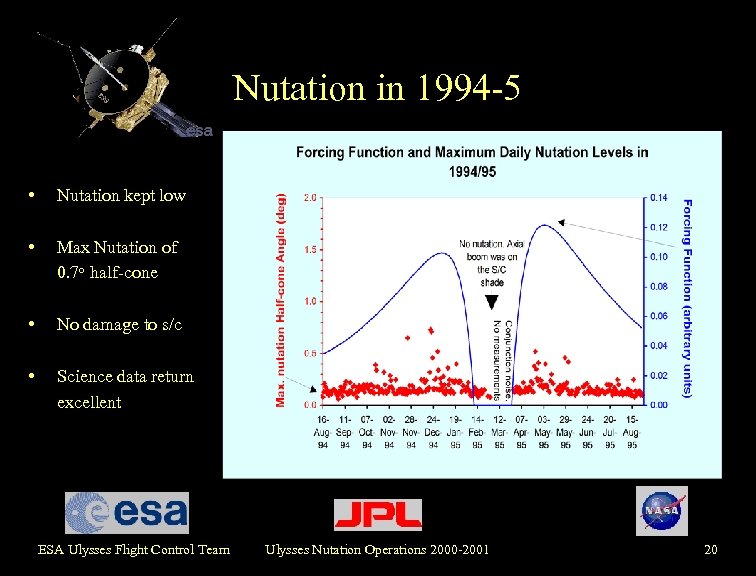 Nutation in 1994 -5 • Nutation kept low • Max Nutation of 0. 7 o half-cone • No damage to s/c • Science data return excellent ESA Ulysses Flight Control Team Ulysses Nutation Operations 2000 -2001 20
 Nutation operations requirements title page Nutation operations requirements ESA Ulysses Flight Control Team Ulysses Nutation Operations 2000 -2001 21
 Nutation operations Goals • Maintain s/c safety • Try to prevent Nutation starting • Keep any Nutation which does start as low as possible ESA Ulysses Flight Control Team Ulysses Nutation Operations 2000 -2001 22
 Basic requirements • Continuous (24 hr) ground station coverage providing: Uplink (TX) as beacon for s/c Conscan Telemetry (TM) to monitor critical s/c parameters Telecommand (TC) capability to respond to contingencies • High resolution Doppler data (from DSN stations only) to provide additional ARGOS monitoring of Nutation levels. ESA Ulysses Flight Control Team Ulysses Nutation Operations 2000 -2001 23
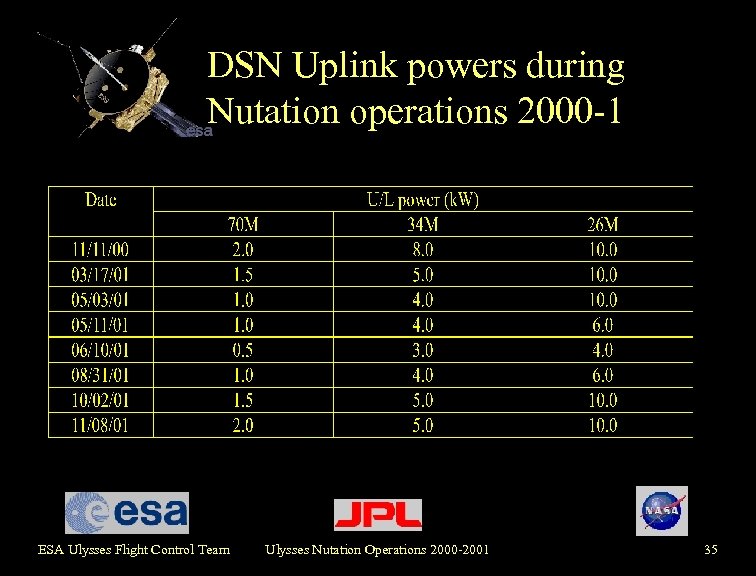
 Detailed requirements • DSN antennas preferred. Kourou has – lower U/L power (noisier Conscan measurements) – lower TM rates (reduced monitoring) – no Doppler (cannot support ARGOS) • Preferable to use as few stations as possible. – simpler s/c operations => fewer errors – simpler g/s operations => fewer errors – fewer breaks in s/c Conscan => maximum Nutation damping • TM essential for monitoring Nutation levels, s/c health & safety. • TC capability frequently used to control Nutation & respond to contingencies. ESA Ulysses Flight Control Team Ulysses Nutation Operations 2000 -2001 24
 The unique demands of Nutation operations title page The unique demands of Nutation operations ESA Ulysses Flight Control Team Ulysses Nutation Operations 2000 -2001 25
 Antenna coverage • High latitude Solar Polar orbit => gaps in DSN coverage. • ESA providing Kourou station to fill in gaps in Canberra coverage from 1 Feb - 31 Mar 2001. • Santiago station requested as backup (uplink only) in case of DSN / Kourou failures from Dec 2000 - July 2001. • Unique geometry causes scheduling and tracking problems. ESA Ulysses Flight Control Team Ulysses Nutation Operations 2000 -2001 26
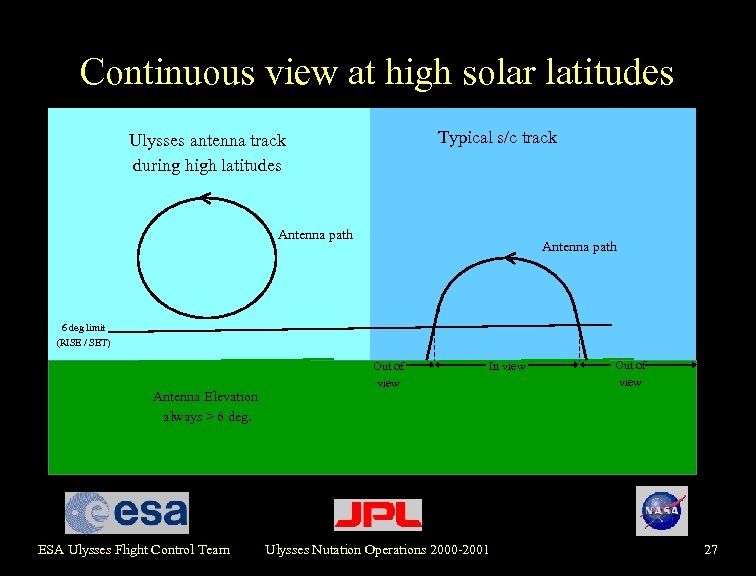 Continuous view at high solar latitudes Typical s/c track Ulysses antenna track during high latitudes Antenna path 6 deg limit (RISE / SET) Antenna Elevation always > 6 deg. ESA Ulysses Flight Control Team Out of view In view Ulysses Nutation Operations 2000 -2001 Out of view 27
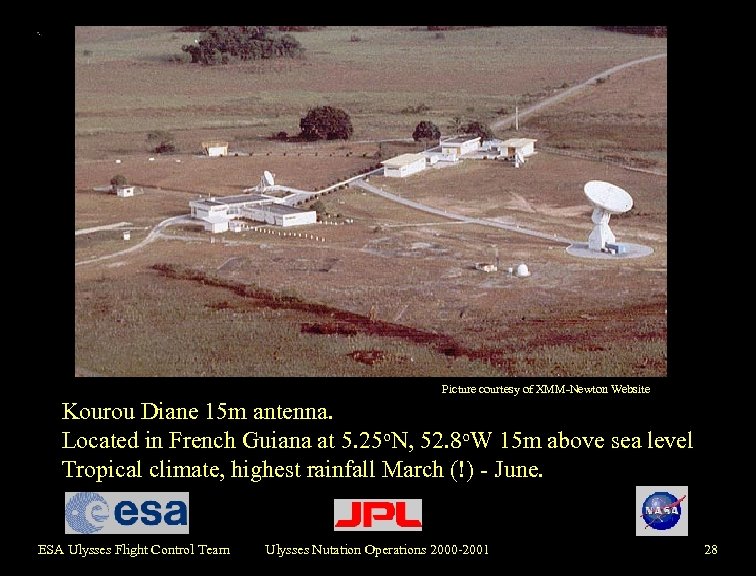 Kourou antenna description Picture courtesy of XMM-Newton Website Kourou Diane 15 m antenna. Located in French Guiana at 5. 25 o. N, 52. 8 o. W 15 m above sea level Tropical climate, highest rainfall March (!) - June. ESA Ulysses Flight Control Team Ulysses Nutation Operations 2000 -2001 28
 Kourou experience with Ulysses • Qualified in 1994 at U/L powers of 0. 4, 1 & 2 k. W • TM tested from 64 bps - 1024 bps. 512 bps used operationally (cooled LNAs). • Supported nutation ops from Aug 1994 - Mar 1995. ESA Ulysses Flight Control Team Ulysses Nutation Operations 2000 -2001 29
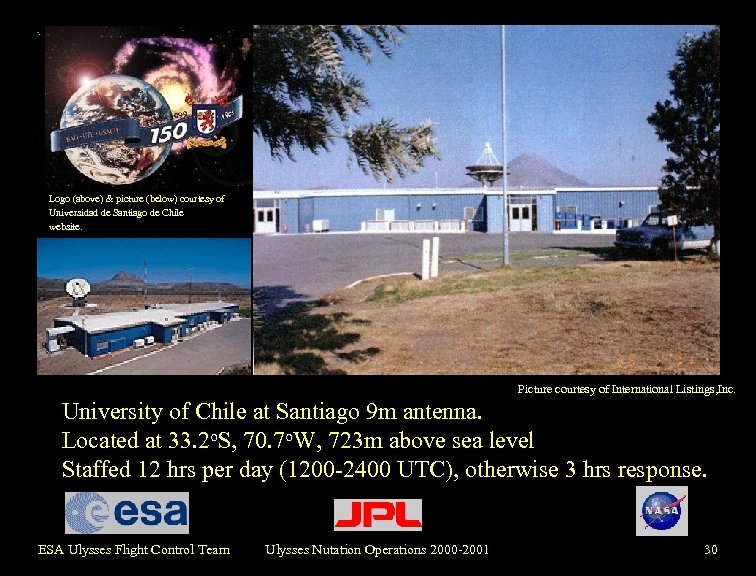 Santiago antenna description Logo (above) & picture (below) courtesy of Universidad de Santiago de Chile website. Picture courtesy of International Listings, Inc. University of Chile at Santiago 9 m antenna. Located at 33. 2 o. S, 70. 7 o. W, 723 m above sea level Staffed 12 hrs per day (1200 -2400 UTC), otherwise 3 hrs response. ESA Ulysses Flight Control Team Ulysses Nutation Operations 2000 -2001 30
 Santiago experience with Ulysses • Qualified in 1994 at U/L powers of 2. 5, 5 & 10 k. W • Downlink carrier successfully acquired via 12 m VLBI antenna. • Used on 27 October 1994 to support real-time ops for 4. 75 hours. Santiago is not scheduled - on standby only for Dec 2000 - July 2001. ESA Ulysses Flight Control Team Ulysses Nutation Operations 2000 -2001 31
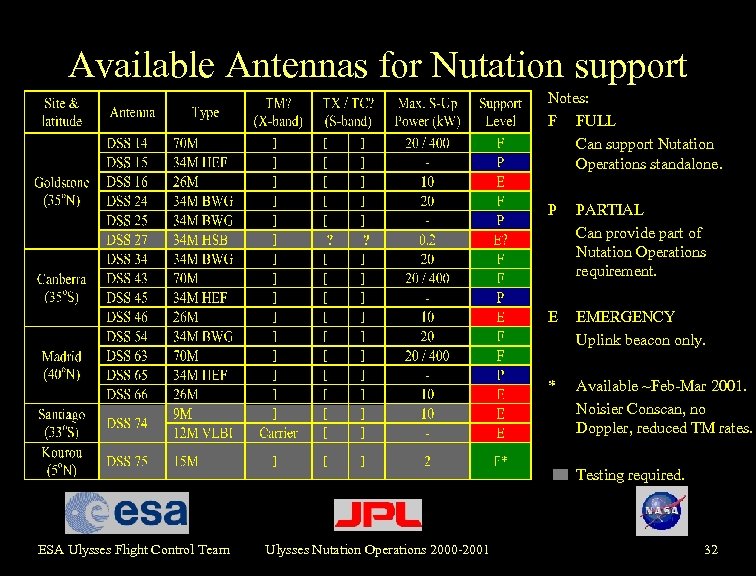 Available Antennas for Nutation support Notes: F FULL Can support Nutation Operations standalone. P PARTIAL Can provide part of Nutation Operations requirement. E EMERGENCY Uplink beacon only. * Available ~Feb-Mar 2001. Noisier Conscan, no Doppler, reduced TM rates. Testing required. ESA Ulysses Flight Control Team Ulysses Nutation Operations 2000 -2001 32
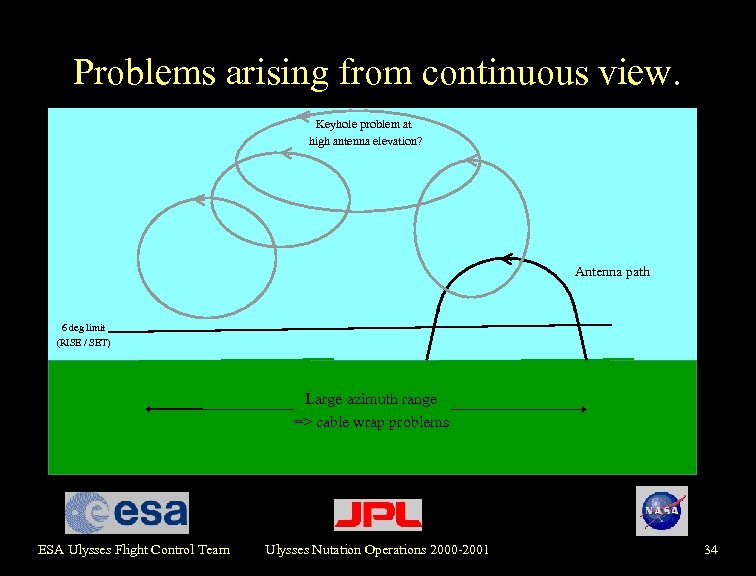
 Continuous tracking • High latitude Solar Polar orbit => Ulysses can be continuously in view. • Good for s/c Conscan (no break in uplink) • Bad for maintenance, predicts (both frequency and pointing data), cable wrap, keyhole problem. • Also stressful on Flight Team, especially ACEs. ESA Ulysses Flight Control Team Ulysses Nutation Operations 2000 -2001 33
 Problems arising from continuous view. Keyhole problem at high antenna elevation? Antenna path 6 deg limit (RISE / SET) Large azimuth range => cable wrap problems ESA Ulysses Flight Control Team Ulysses Nutation Operations 2000 -2001 34
 DSN Uplink powers during Nutation operations 2000 -1 ESA Ulysses Flight Control Team Ulysses Nutation Operations 2000 -2001 35
 Effect of DSN Tx elevation restriction Ulysses Nutation track during high latitudes Typical s/c track Antenna path 10. x deg limit (Tx ON/OFF) 6 deg limit (RISE / SET) No uplink Continuous view, but large gap in uplink ESA Ulysses Flight Control Team Ulysses Nutation Operations 2000 -2001 36
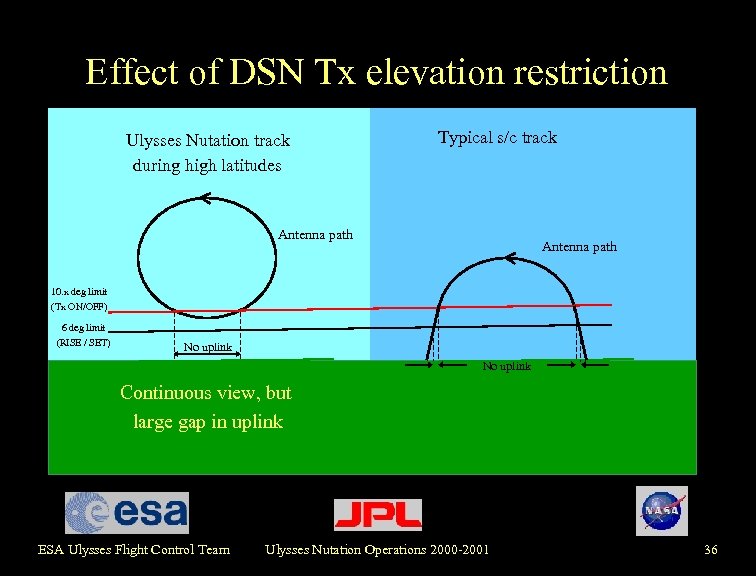
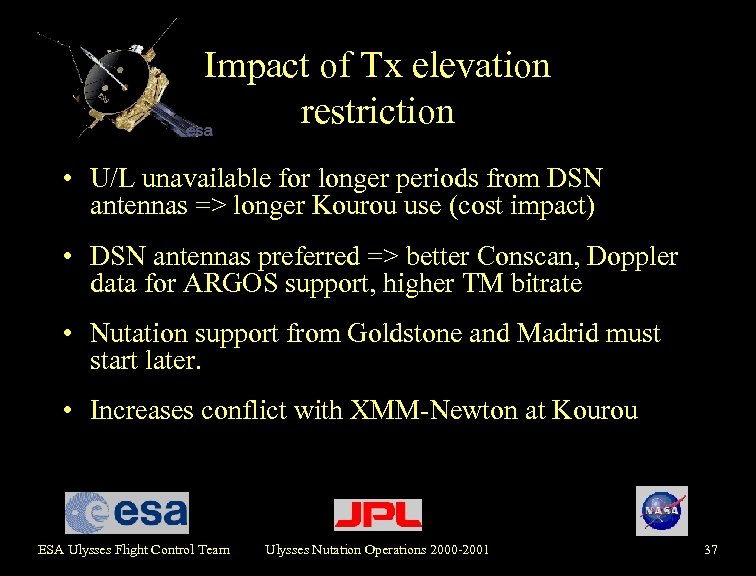 Impact of Tx elevation restriction • U/L unavailable for longer periods from DSN antennas => longer Kourou use (cost impact) • DSN antennas preferred => better Conscan, Doppler data for ARGOS support, higher TM bitrate • Nutation support from Goldstone and Madrid must start later. • Increases conflict with XMM-Newton at Kourou ESA Ulysses Flight Control Team Ulysses Nutation Operations 2000 -2001 37
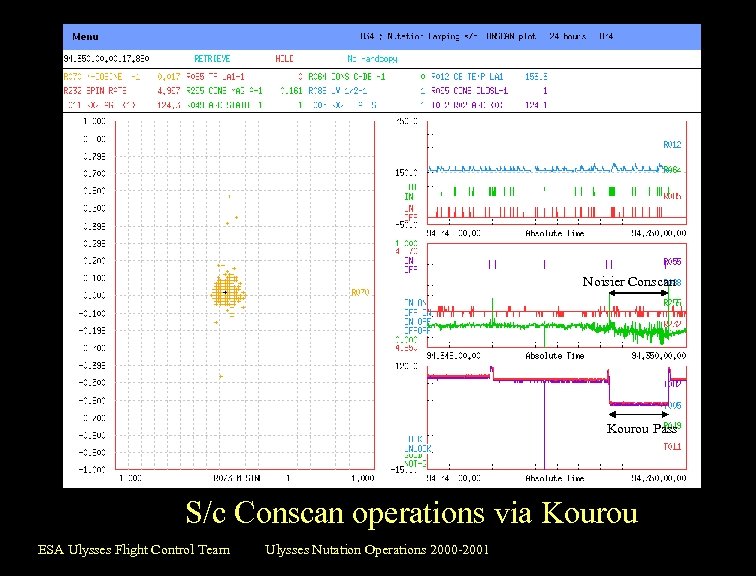 Example of S/c Conscan operations via Kourou Noisier Conscan Kourou Pass S/c Conscan operations via Kourou ESA Ulysses Flight Control Team Ulysses Nutation Operations 2000 -2001
 Lessons learned from 1994 -1995 Nutation title page Lessons learned from 1994 -1995 Nutation ESA Ulysses Flight Control Team Ulysses Nutation Operations 2000 -2001 39
 Lessons learned from 1994 -1995 Nutation • • • Continuous tracking: ~7 -day tracks with 4 hour maintenance period in between. Cable wrap: If not correctly initialized before beginning of long pass, possible to wrap antenna cabling beyond limit. The pass, and s/c Conscan, would have to be interrupted to correct the problem. Keyhole problem: Ulysses reached high elevations & required tracking through the antenna zenith. S/c Conscan had to be disabled for 10 -20 minutes either side of zenith. Antenna predicts: Antenna pointing predicts lost their accuracy during the 7 day passes. Uplink frequencies: U/L frequencies traditionally optimized for passes < 24 hrs. Thus U/L frequency had to be calculated for a 7 -day pass. ESA Ulysses Flight Control Team Ulysses Nutation Operations 2000 -2001 40
 How is Nutation in 2000 -1 different from 1994 -1995? title page How is Nutation in 2000 -1 different from 1994 -1995? ESA Ulysses Flight Control Team Ulysses Nutation Operations 2000 -2001 41
 Differences in 2000 -1 Nutation Compared to 1994 -5 the following points are different: • NFF greater, Earth drift rate lower => greater ops challenge • NFF is continuously high for one year - no break in Nutation ops. • Kourou is a shared resource. Used for XMM-Newton & LEOP support • Kourou will provide lower bitrates => reduced monitoring capability. • Most operations personnel have moved on => training required. • Some g/s equipment or capabilities changed / removed e. g. 26 M cmd. • It was a long time ago => all staff need refresher training ESA Ulysses Flight Control Team Ulysses Nutation Operations 2000 -2001 42
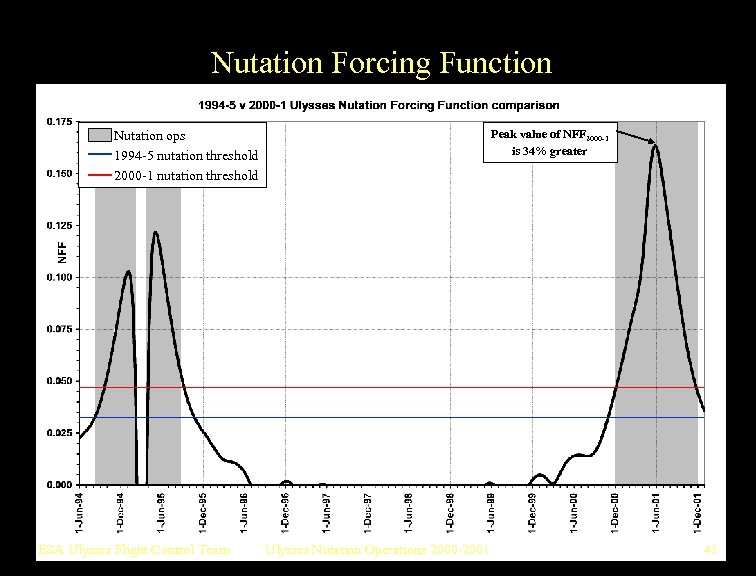 Nutation Forcing Function Nutation ops 1994 -5 nutation threshold 2000 -1 nutation threshold ESA Ulysses Flight Control Team Peak value of NFF 2000 -1 is 34% greater Ulysses Nutation Operations 2000 -2001 43
 Differences in 2000 -1 NFF Comparison of NFF in 2000 -1 with 1994 -5: • Peak value of NFF 2000 -1 is 34% greater • NFF 2000 -1 is higher than peak value of NFF 1994 -5 from April - July 2001. • Highest Nutation increase rate in 1994 -5 was 68% per hour. • Highest Nutation increase rate in 2000 -1 predicted at 115% per hour. ESA Ulysses Flight Control Team Ulysses Nutation Operations 2000 -2001 44
 Preparations for 2000 -2001 Nutation operations title page Preparations for 2000 -2001 Nutation operations. ESA Ulysses Flight Control Team Ulysses Nutation Operations 2000 -2001 45
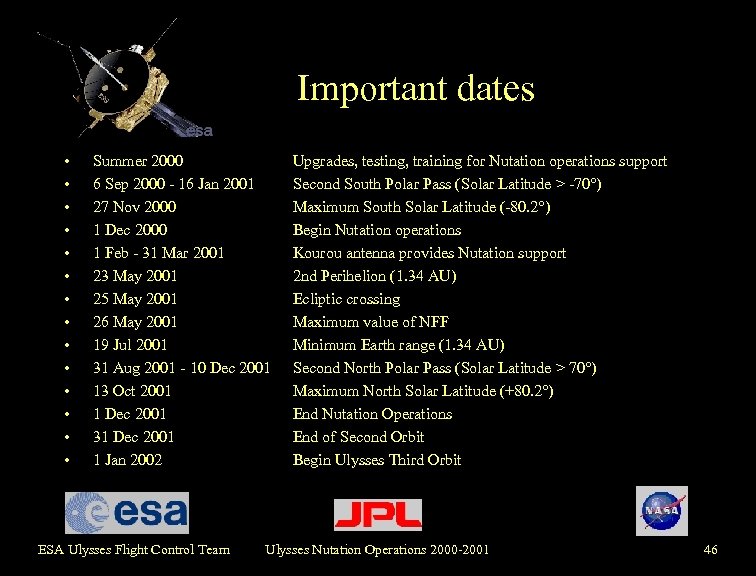 Important dates • • • • Summer 2000 6 Sep 2000 - 16 Jan 2001 27 Nov 2000 1 Dec 2000 1 Feb - 31 Mar 2001 23 May 2001 25 May 2001 26 May 2001 19 Jul 2001 31 Aug 2001 - 10 Dec 2001 13 Oct 2001 1 Dec 2001 31 Dec 2001 1 Jan 2002 ESA Ulysses Flight Control Team Upgrades, testing, training for Nutation operations support Second South Polar Pass (Solar Latitude > -70°) Maximum South Solar Latitude (-80. 2°) Begin Nutation operations Kourou antenna provides Nutation support 2 nd Perihelion (1. 34 AU) Ecliptic crossing Maximum value of NFF Minimum Earth range (1. 34 AU) Second North Polar Pass (Solar Latitude > 70°) Maximum North Solar Latitude (+80. 2°) End Nutation Operations End of Second Orbit Begin Ulysses Third Orbit Ulysses Nutation Operations 2000 -2001 46
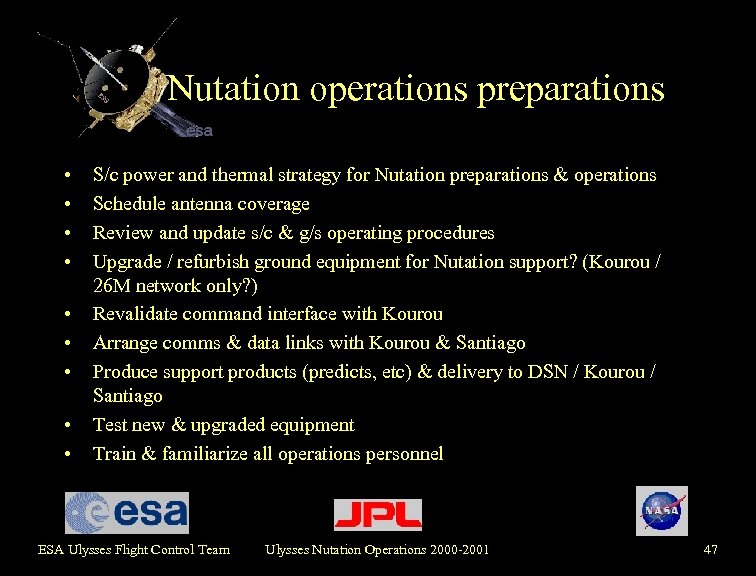 Nutation operations preparations • • • S/c power and thermal strategy for Nutation preparations & operations Schedule antenna coverage Review and update s/c & g/s operating procedures Upgrade / refurbish ground equipment for Nutation support? (Kourou / 26 M network only? ) Revalidate command interface with Kourou Arrange comms & data links with Kourou & Santiago Produce support products (predicts, etc) & delivery to DSN / Kourou / Santiago Test new & upgraded equipment Train & familiarize all operations personnel ESA Ulysses Flight Control Team Ulysses Nutation Operations 2000 -2001 47
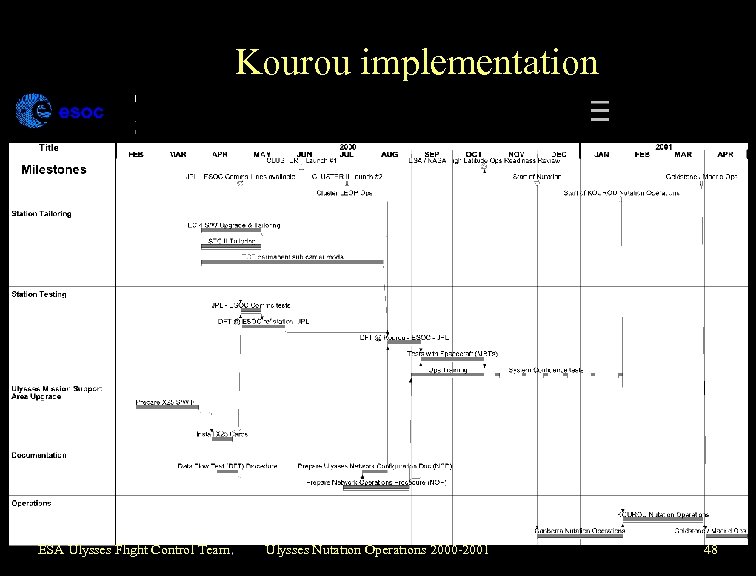 Kourou implementation ESA Ulysses Flight Control Team Ulysses Nutation Operations 2000 -2001 48
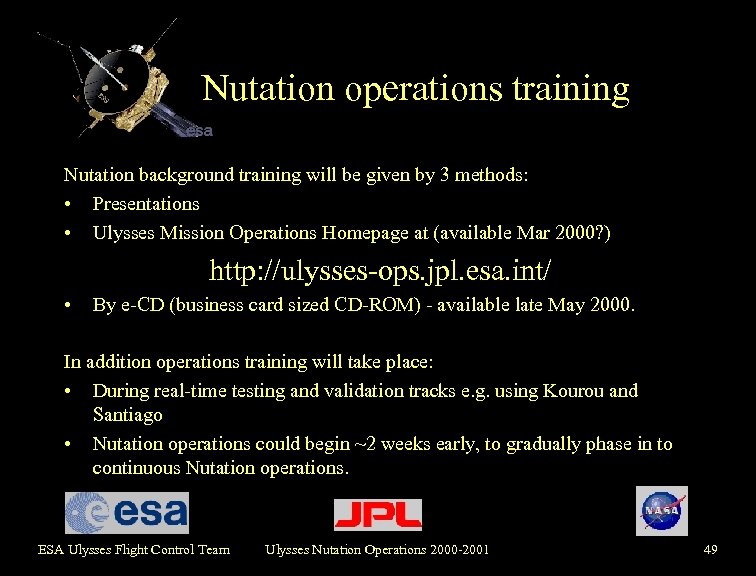 Nutation operations training Nutation background training will be given by 3 methods: • Presentations • Ulysses Mission Operations Homepage at (available Mar 2000? ) http: //ulysses-ops. jpl. esa. int/ • By e-CD (business card sized CD-ROM) - available late May 2000. In addition operations training will take place: • During real-time testing and validation tracks e. g. using Kourou and Santiago • Nutation operations could begin ~2 weeks early, to gradually phase in to continuous Nutation operations. ESA Ulysses Flight Control Team Ulysses Nutation Operations 2000 -2001 49
 Nutation tracks and operations are different title page Nutation tracks and operations are different. ESA Ulysses Flight Control Team Ulysses Nutation Operations 2000 -2001 50
 Nutation ops depend on ground ops Compared to current Ulysses operations, Nutation operations are: • More complicated - many events, stations • More time critical - s/c & ground events precisely scheduled • More sensitive - s/c Conscan very responsive to U/L power ESA Ulysses Flight Control Team Ulysses Nutation Operations 2000 -2001 51
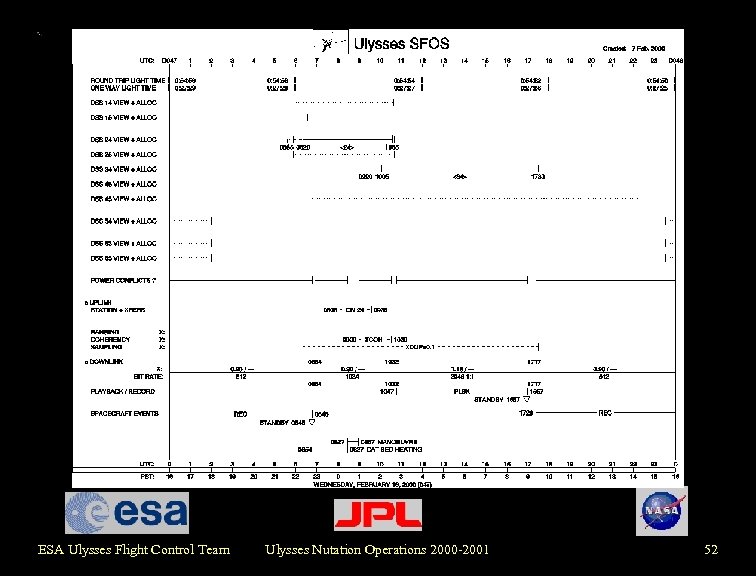 Routine s/c and g/s operations simple SFOS ESA Ulysses Flight Control Team Ulysses Nutation Operations 2000 -2001 52
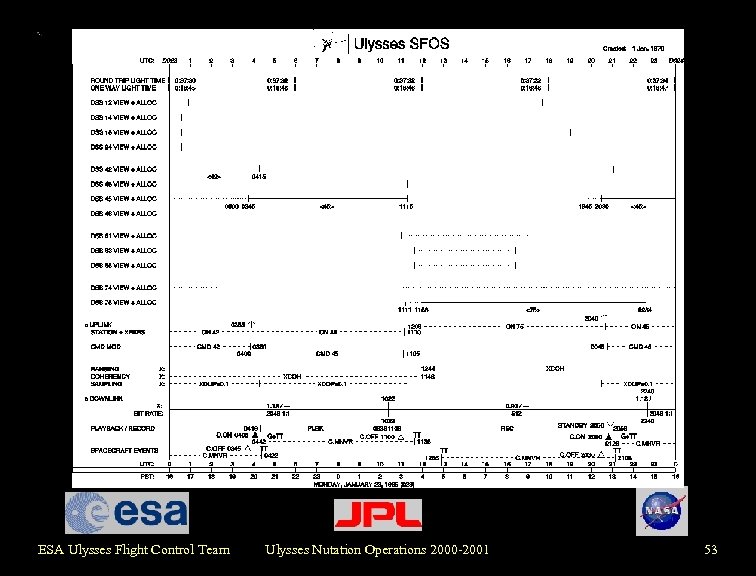 Nutation s/c and g/s operations complex SFOS ESA Ulysses Flight Control Team Ulysses Nutation Operations 2000 -2001 53
 Nutation ops depend on steady Uplink • Must not use ground Conscan => “duelling Conscans” • S/c Conscan depends on steady uplink power. Conscan measurement strongly affected by – Power level: U/L must be smooth and stable for as long as possible. Watch for power drift. – Command modulation: Only switch ON or OFF when scheduled or requested by ACE – Polarization: U/L must be RCP. Wrong polarization is very, very bad!!! – Antenna tracking: Problems with subreflector or tracking quickly gives erroneous Conscan measurements. ESA Ulysses Flight Control Team Ulysses Nutation Operations 2000 -2001 54
 What if there’s a problem? • Maximum Allowable Nutation => 0. 5 o half-cone is max. operational level of Nutation • The MAGIC number. Maximum Allowable Gap in Coverage defined as time to go from 0. 25 o to 0. 5 o nutation. MAGIC number used as guideline in determining when to declare a s/c emergency in order to secure additional resources to cope with g/s problems. For example if MAGIC = 1 hour, but problem will be fixed in 45 minutes, then OK. ESA Ulysses Flight Control Team Ulysses Nutation Operations 2000 -2001 55
 Use of Santiago U/L for Ulysses Criteria for use • No other suitable DSN or ESTRACK resources available. • Declaration of s/c emergency by Ulysses FCT? • Santiago provides U/L only support. • If situation deteriorates, may view TM carrier using VLBI antenna. ESA Ulysses Flight Control Team Ulysses Nutation Operations 2000 -2001 56
 Current concerns title page Current concerns. Question & Answer session. ESA Ulysses Flight Control Team Ulysses Nutation Operations 2000 -2001 57
 Current concerns • Elevation limit of 10. xo or 6. 0 o at DSN stations? • Possible coverage conflict with NEAR at Canberra in Jan 2001 • Conflicts with XMM-Newton at Kourou in Feb-Mar 2001 • Loss of TC capability over 26 M network in late 2000. ESA Ulysses Flight Control Team Ulysses Nutation Operations 2000 -2001 58
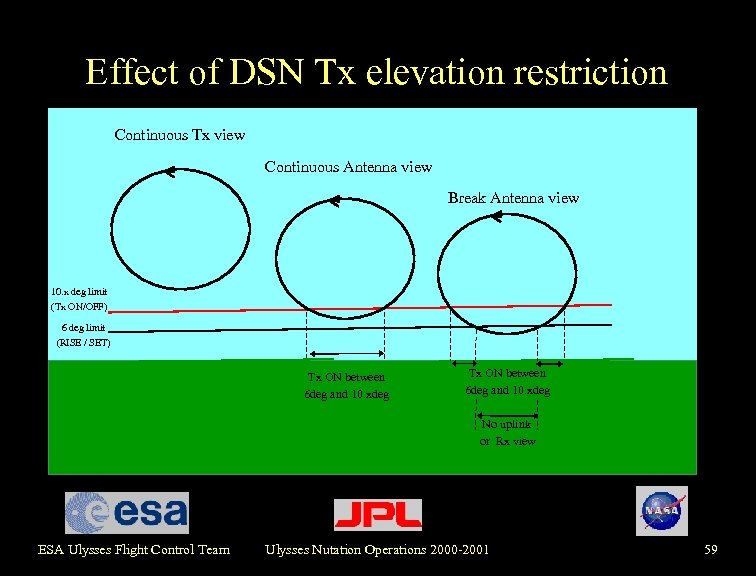 Effect of DSN Tx elevation restriction Continuous Tx view Continuous Antenna view Break Antenna view 10. x deg limit (Tx ON/OFF) 6 deg limit (RISE / SET) Tx ON between 6 deg and 10. xdeg No uplink or Rx view ESA Ulysses Flight Control Team Ulysses Nutation Operations 2000 -2001 59