


 Скачать презентацию Planning Future Knowledge Economies a perfect storm for
daadf0fd93ff6395875b8675a8ced17c.ppt
- Количество слайдов: 23
 Planning Future Knowledge Economies “a perfect storm” for global higher education Presentation Education India Conference April 2003 by Ronald Perkinson International Finance Corporation
 “Social and economic progress are achieved principally through the advancement and application of knowledge. ” (World Development Report 1998/99)
 Highlights 1. Knowledge Societies – the 4 pillars 2. Comparative trends for higher education – a reflection 3. The private sector – a future partner 4. Charting a new course – new missions and goals 5. The ‘perfect storm’ – some options for higher education
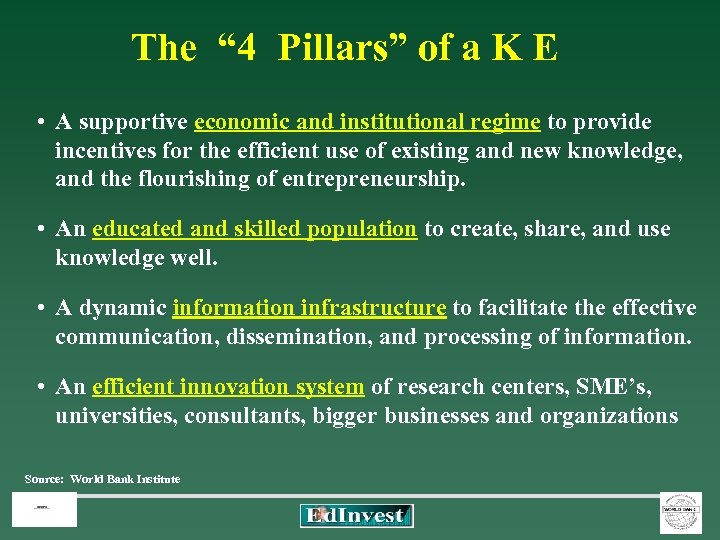 The “ 4 Pillars” of a K E • A supportive economic and institutional regime to provide incentives for the efficient use of existing and new knowledge, and the flourishing of entrepreneurship. • An educated and skilled population to create, share, and use knowledge well. • A dynamic information infrastructure to facilitate the effective communication, dissemination, and processing of information. • An efficient innovation system of research centers, SME’s, universities, consultants, bigger businesses and organizations Source: World Bank Institute
 Knowledge Societies . . . supported by regulatory policies & frameworks • Knowledge – will not transform economies on its own! • Appropriate systems required • Education & training – disseminates knowledge to the labor force and society • Systems – supported by regulatory policies and frameworks • Appropriate systems ‘connect’ with the private sector
 Comparative Trends & Impacts “Education is a ‘pre-condition’ to economic health!” Some Comparatives – the Bologna Declaration • Different states; diversity of languages, culture, HEI types, curricula orientation – under one ‘umbrella’ • By Yr 2010 – a common framework of degrees • Europe-wide credits system – transferability • Common standards for QA and competencies • Compatibility with needs of employers – relevance
 More Trends & Impacts • Partnerships with government – less about Dependency • Both re-organizing – to accommodate learning and training • Greater demand for lifelong learning – rather than full time education for only a limited number of years • Government role – moving ‘controller’ to ‘facilitator’ • Greater challenges to support rural & SME sectors • Mobilizing public and private investment in ICT’s
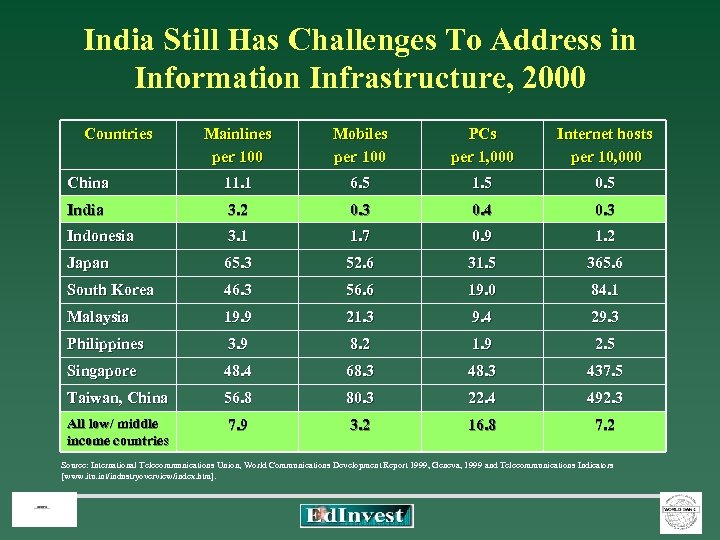 India Still Has Challenges To Address in Information Infrastructure, 2000 Countries Mainlines per 100 Mobiles per 100 PCs per 1, 000 Internet hosts per 10, 000 China 11. 1 6. 5 1. 5 0. 5 India 3. 2 0. 3 0. 4 0. 3 Indonesia 3. 1 1. 7 0. 9 1. 2 Japan 65. 3 52. 6 31. 5 365. 6 South Korea 46. 3 56. 6 19. 0 84. 1 Malaysia 19. 9 21. 3 9. 4 29. 3 Philippines 3. 9 8. 2 1. 9 2. 5 Singapore 48. 4 68. 3 437. 5 Taiwan, China 56. 8 80. 3 22. 4 492. 3 All low/ middle income countries 7. 9 3. 2 16. 8 7. 2 Source: International Telecommunications Union, World Communications Development Report 1999, Geneva, 1999 and Telecommunications Indicators [www. itu. int/industryoverview/index. htm].
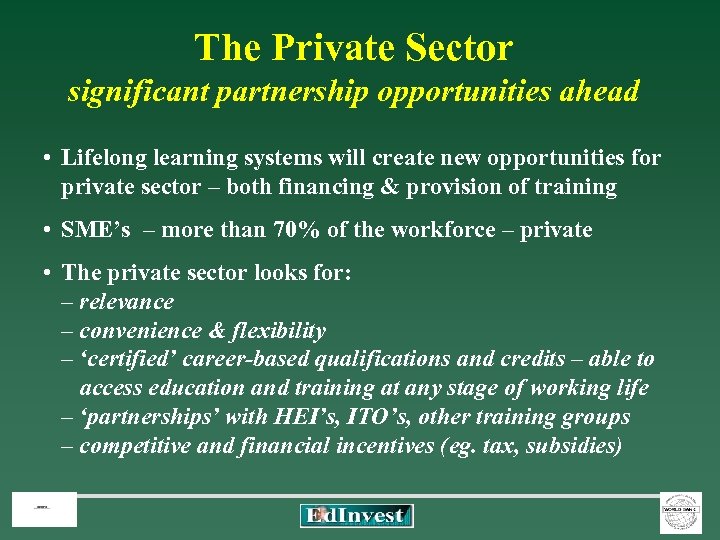 The Private Sector significant partnership opportunities ahead • Lifelong learning systems will create new opportunities for private sector – both financing & provision of training • SME’s – more than 70% of the workforce – private • The private sector looks for: – relevance – convenience & flexibility – ‘certified’ career-based qualifications and credits – able to access education and training at any stage of working life – ‘partnerships’ with HEI’s, ITO’s, other training groups – competitive and financial incentives (eg. tax, subsidies)
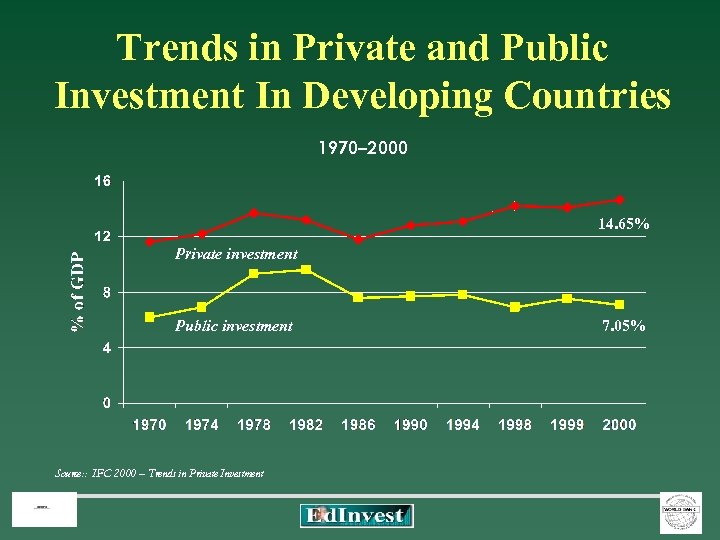 Trends in Private and Public Investment In Developing Countries 1970– 2000 14. 65% Private investment Public investment Source: : IFC 2000 – Trends in Private Investment 7. 05%
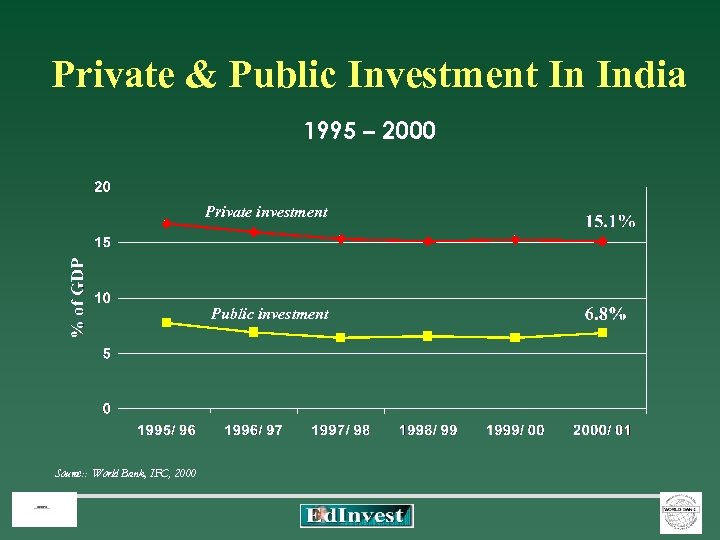 Private & Public Investment In India 1995 – 2000 Private investment Public investment Source: : World Bank, IFC, 2000
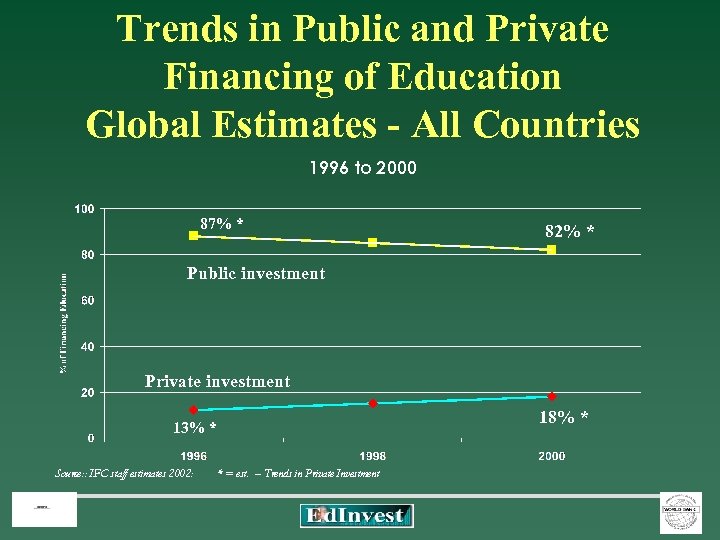 Trends in Public and Private Financing of Education Global Estimates - All Countries 1996 to 2000 87% * 82% * Public investment Private investment 18% * 13% * Source: : IFC staff estimates 2002: * = est. – Trends in Private Investment
 Charting A New Course The role of the State includes – • Defining a coherent strategic vision • More the ‘enabler’ – less the ‘controller’ • Designing a positive regulatory framework • Incentives for future investment in Higher Education • An enabling framework for lifelong learning supported by accreditation & quality systems But – it is not just the responsibility of the state! There are ‘bottom-up’ initiatives that HEI’s can do now!
 Charting A New Course new missions & goals • Will lifelong learning changes, be on the ‘periphery’ – or will it shape change at the ‘core’ of each HEI? • Learning & skills-based assessment – with portability of ‘certified’ acquired knowledge • Re-educating graduates, mid-life executives, entrepreneurs, public officials and working adults – scalable opportunities! • Optimize gains resulting from globalization • Chart course that optimizes use of ICT’s and the Internet – and different modalities of delivery
 . . in the eye of the storm. . • With over 250 universities, 10, 750 colleges, 8 m students – India has one of the world’s largest higher education systems • HEI enrollments suffer through slow progress in primary & secondary schooling • Affiliating universities – centrally controlled curricula. Can affiliated colleges respond to changing demand for ‘certified’ training? • Some mismatch – lack of qualified manpower to advance traditional occupations, where 80% of workforce is • Advancing SME sector – critical to growth of Indian economy
 The Parallel Training Universe • New players in higher education offering education and training in more advanced technologies. • Global I. T. companies / I. T. training providers – operate outside certified higher ed credentials and accreditation. • In Yr 2000, global I. T. companies ‘certified’ 1. 6 million students worldwide with 2. 4 million certificates in Information Technologies. • Cisco alone offers certificated training in 19 languages. • Corporate Universities – > 2000 in Yr 2001 in the US.
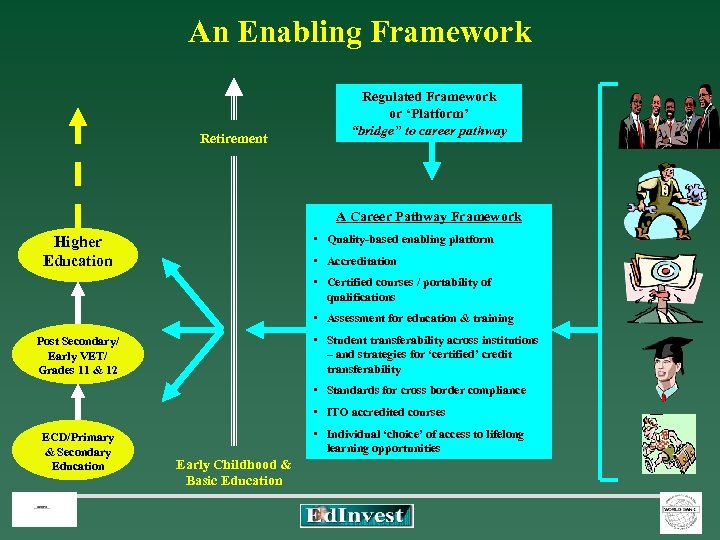 An Enabling Framework Retirement Regulated Framework or ‘Platform’ “bridge” to career pathway A Career Pathway Framework • Quality-based enabling platform Higher Education • Accreditation • Certified courses / portability of qualifications • Assessment for education & training • Student transferability across institutions – and strategies for ‘certified’ credit transferability Post Secondary/ Early VET/ Grades 11 & 12 • Standards for cross border compliance • ITO accredited courses ECD/Primary & Secondary Education • Individual ‘choice’ of access to lifelong learning opportunities Early Childhood & Basic Education
 China Is Charting A New Course • Heightened emphasis on services and knowledge-based dvpt • Has est. 700 million people in rural areas – need to create 300 million new jobs by Yr 2010 • Gross enrollment in higher education increased from 6% in 1996 to around 10% in 2000/01 – about 1% growth rate p. a. • Further education reforms critical – 2003 China govt. planning new lifelong learning system – upgrade education and training • Has over 1200 private HEI’s – new private education law • Increasing information infrastructure through increased competition, foreign investment, support to SME’s. .
 Highlights 1. Knowledge Societies – the 4 pillars 2. Comparative trends for higher education – a reflection 3. Charting a new course – new missions and goals 4. The private sector – a future partner 5. The ‘perfect storm’ – some options for higher education
 Changing Weather Patterns Ahead Four convergent impacts ahead: 1. The further impact of globalization 2. The increasing importance of knowledge 3. The impact of increasing competition 4. The continuing Information & Communications Technologies revolution – all combine to impact on the way society will view higher education in the future
 Evaluating the Options India’s future strategies for knowledge development, economic & social transformation – how will they: – Accommodate Lifelong Learning? – Address system / processes for quality improvement? – Promote flexibility to accommodate new types of learners? – Accommodate continuous growing demand for skilled labor? – Enable HEI’s to be more responsive to increased competition from foreign institutions – resident and distance? – Adjust regulatory frameworks to mobilize private sector investment and participation – financing and provision – incentives to invest and train the workforce? – Accommodate transferability of students & ‘certified’ credits across higher education – state / national / international?
 Planning For A New System Of Knowledge Development & Lifelong Learning. . . ‘the perfect storm’. . . the converging forces ahead for India’s higher education system
 Ed. Invest http: //www. ifc. org/edinvest • Joint WBG/IFC private sector initiative • Country Market Reports for investors • Exchange of ideas/market information • Regional conferences • Consulting and advisory services