


 Скачать презентацию PLANNING FOR THE FUTURE OF U S LAND
a3b7f5220f57f6148b9b7d0bfaaa5661.ppt
- Количество слайдов: 20
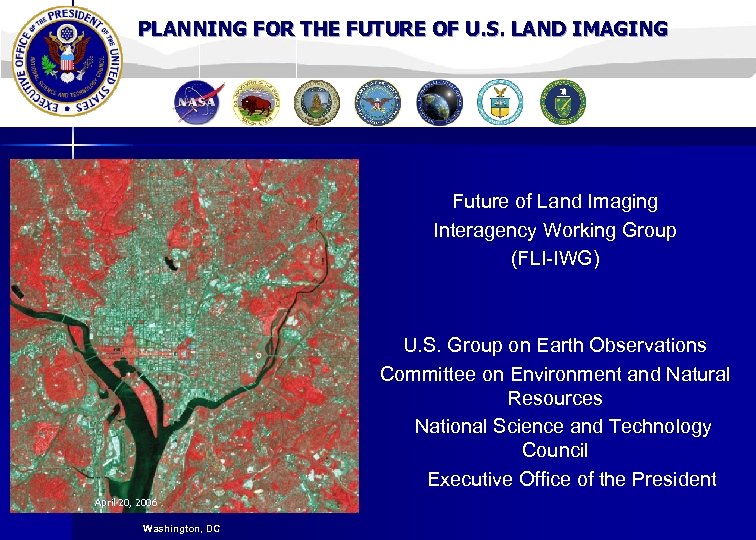 PLANNING FOR THE FUTURE OF U. S. LAND IMAGING Future of Land Imaging Interagency Working Group (FLI-IWG) U. S. Group on Earth Observations Committee on Environment and Natural Resources National Science and Technology Council Executive Office of the President April 20, 2006 Washington, DC
 FLI-IWG Guidance ü What are the key societal benefits of moderate resolution land imaging? ü What are the options for acquiring moderate resolution capabilities or data? ü How should U. S. land imaging be managed and governed? 2 Future of Land Imaging – Interagency Working Group
 NASA/USGS LDCM Mission Responsibilities n NASA: n – Procure LDCM space segment: sensor, spacecraft, flight software, and launch service – Integrate end-to-end mission components – Lead on-orbit checkout and acceptance testing – Transfer flight segment to USGS – Provide pre- and post-launch technical support to USGS – Co-chair Landsat Science Team USGS: – Procure and develop LDCM ground system: flight operations facility, data capture sites, data archive and processing systems, data access and distribution systems – Operate space segment and ground system – Lead on-orbit data calibration activities – Provide pre-launch technical support to NASA – Co-chair and fund Landsat Science Team 3 Future of Land Imaging – Interagency Working Group
 Origins of a National Land Imaging Program n January through December 2006, a Future of Land Imaging Interagency Working Group (FLI IWG) met weekly to explore future U. S. operational options for acquiring Landsat-type data: – A Landsat instrument would no longer be flown on NPOESS, the earlier approach to making land imaging operational – A single free-flyer satellite, like the Landsat Data Continuity Mission, is not an operational solution n A call to establish a National Land Imaging Program, hosted by the U. S. Department of the Interior, emerged from these discussions 4 Future of Land Imaging – Interagency Working Group
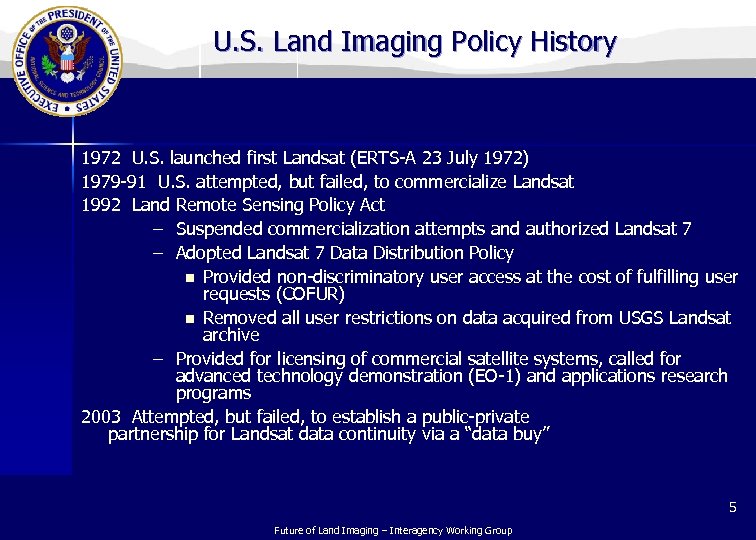 U. S. Land Imaging Policy History 1972 U. S. launched first Landsat (ERTS-A 23 July 1972) 1979 -91 U. S. attempted, but failed, to commercialize Landsat 1992 Land Remote Sensing Policy Act – Suspended commercialization attempts and authorized Landsat 7 – Adopted Landsat 7 Data Distribution Policy n Provided non-discriminatory user access at the cost of fulfilling user requests (COFUR) n Removed all user restrictions on data acquired from USGS Landsat archive – Provided for licensing of commercial satellite systems, called for advanced technology demonstration (EO-1) and applications research programs 2003 Attempted, but failed, to establish a public-private partnership for Landsat data continuity via a “data buy” 5 Future of Land Imaging – Interagency Working Group
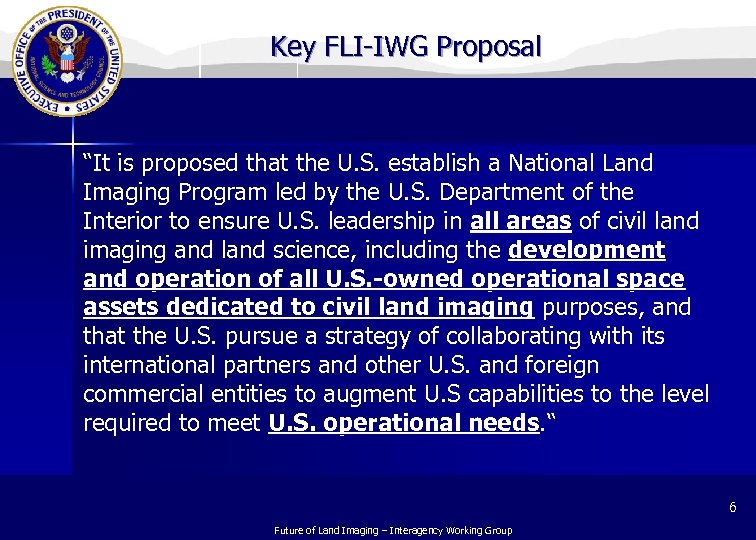 Key FLI-IWG Proposal “It is proposed that the U. S. establish a National Land Imaging Program led by the U. S. Department of the Interior to ensure U. S. leadership in all areas of civil land imaging and land science, including the development and operation of all U. S. -owned operational space assets dedicated to civil land imaging purposes, and that the U. S. pursue a strategy of collaborating with its international partners and other U. S. and foreign commercial entities to augment U. S capabilities to the level required to meet U. S. operational needs. “ 6 Future of Land Imaging – Interagency Working Group
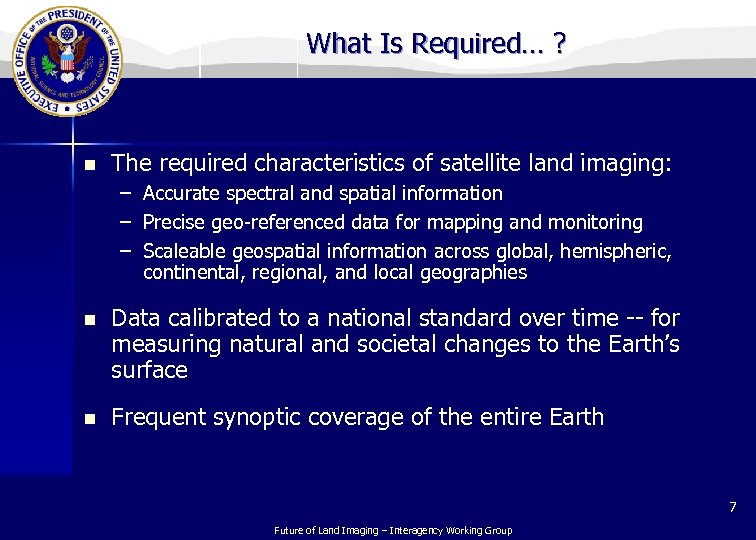 What Is Required… ? n The required characteristics of satellite land imaging: – Accurate spectral and spatial information – Precise geo-referenced data for mapping and monitoring – Scaleable geospatial information across global, hemispheric, continental, regional, and local geographies n Data calibrated to a national standard over time -- for measuring natural and societal changes to the Earth’s surface n Frequent synoptic coverage of the entire Earth 7 Future of Land Imaging – Interagency Working Group
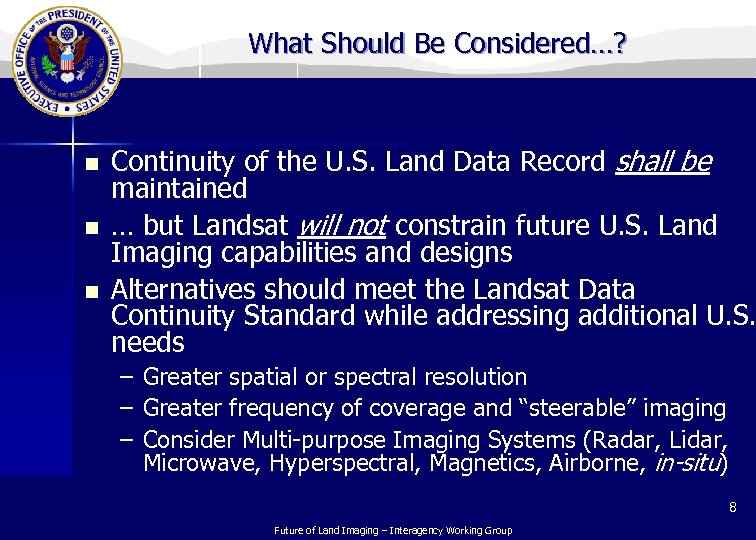 What Should Be Considered…? n n n Continuity of the U. S. Land Data Record shall be maintained … but Landsat will not constrain future U. S. Land Imaging capabilities and designs Alternatives should meet the Landsat Data Continuity Standard while addressing additional U. S. needs – Greater spatial or spectral resolution – Greater frequency of coverage and “steerable” imaging – Consider Multi-purpose Imaging Systems (Radar, Lidar, Microwave, Hyperspectral, Magnetics, Airborne, in-situ) 8 Future of Land Imaging – Interagency Working Group
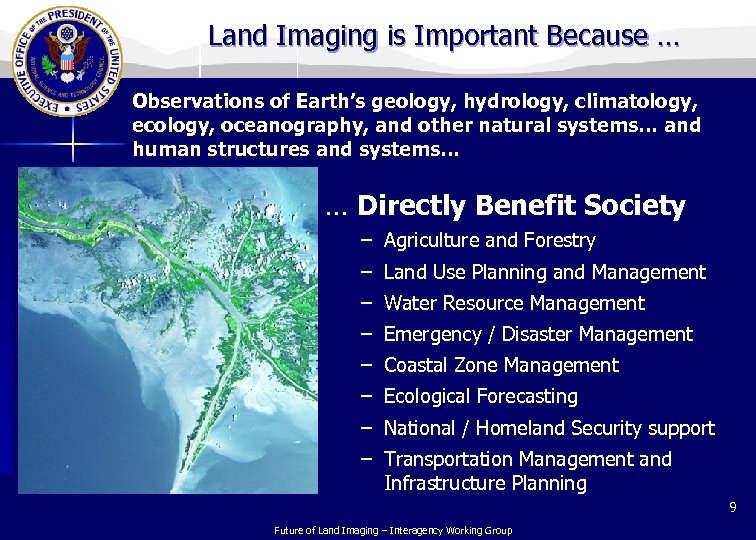 Land Imaging is Important Because … Observations of Earth’s geology, hydrology, climatology, ecology, oceanography, and other natural systems… and human structures and systems… … Directly Benefit Society – Agriculture and Forestry – Land Use Planning and Management – Water Resource Management – Emergency / Disaster Management – Coastal Zone Management – Ecological Forecasting – National / Homeland Security support – Transportation Management and Infrastructure Planning 9 Future of Land Imaging – Interagency Working Group
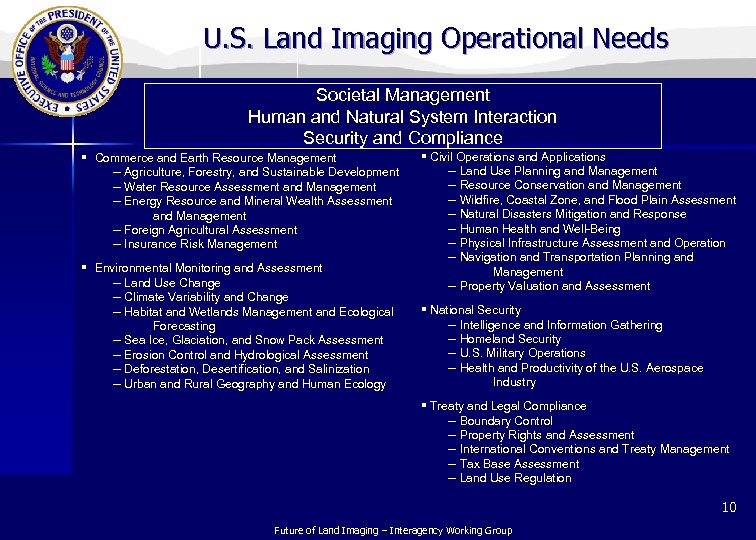 U. S. Land Imaging Operational Needs Societal Management Human and Natural System Interaction Security and Compliance § Commerce and Earth Resource Management -- Agriculture, Forestry, and Sustainable Development -- Water Resource Assessment and Management -- Energy Resource and Mineral Wealth Assessment and Management -- Foreign Agricultural Assessment -- Insurance Risk Management § Environmental Monitoring and Assessment -- Land Use Change -- Climate Variability and Change -- Habitat and Wetlands Management and Ecological Forecasting -- Sea Ice, Glaciation, and Snow Pack Assessment -- Erosion Control and Hydrological Assessment -- Deforestation, Desertification, and Salinization -- Urban and Rural Geography and Human Ecology § Civil Operations and Applications -- Land Use Planning and Management -- Resource Conservation and Management -- Wildfire, Coastal Zone, and Flood Plain Assessment -- Natural Disasters Mitigation and Response -- Human Health and Well-Being -- Physical Infrastructure Assessment and Operation -- Navigation and Transportation Planning and Management -- Property Valuation and Assessment § National Security -- Intelligence and Information Gathering -- Homeland Security -- U. S. Military Operations -- Health and Productivity of the U. S. Aerospace Industry § Treaty and Legal Compliance -- Boundary Control -- Property Rights and Assessment -- International Conventions and Treaty Management -- Tax Base Assessment -- Land Use Regulation 10 Future of Land Imaging – Interagency Working Group
 How will U. S. Data Requirements be Met? n n Solutions should be flexible and focus on fulfilling U. S. national needs for U. S. and global land imaging source data In the near-term, U. S. Land Imaging needs will be met by sustaining Landsat 5 & 7 to their End-of-Life, developing a follow-on Landsat satellite (Government owned and operated), and looking for alternatives to fill any “gap” In the meantime, transition to management by a U. S. National Land Imaging Program would begin – with full authority to acquire space systems and data to fulfill U. S. Land Imaging needs on behalf of the U. S. Government Planning for the next generation of Land Imaging Satellite Systems would commence as soon as possible – – – Informed by GEOSS and IEOS Desires, Needs, and Specifications Guided by U. S. Operational Land Imaging Requirements Augmented, Integrated, and Supported through Collaboration with Other Space. Faring Nations – Adaptive / Receptive to Commercial Sources of Data and Information 11 Future of Land Imaging – Interagency Working Group
 NLIP Management Characteristics n n Above all else, “Ensure availability, access, and ease of use of land imaging data for the Nation” Focused Federal Leadership for the U. S. Land Imaging Community – Unified planning and operations responsibility – Coordination responsibility for: n n n Determining U. S. land imaging needs Primary Source data acquisition and distribution Technology R&D and system acquisition – Broker-agent for U. S. Civil Government and commercial sources of data – Single U. S. point-of-contact for international partnerships and arrangements n n Point-of-accountability for performance Flexibility as technical, fiscal, and political variables change 12 Future of Land Imaging – Interagency Working Group
 Why the Department of the Interior? n n The Department’s leadership in managing U. S. public lands and the territorial interests of the U. S. since 1849, including oversight of U. S. land management and land use planning, managing civil geospatial programs and interests of the U. S. , and conducting a program of land science in support of the Nation. The role the Department played in furthering the interests of U. S. land imaging through the creation and sponsorship -- in 1966 -- of what later became known as the Landsat program. The Department’s distinguished reputation as manager of the Nation’s land imagery assets through the U. S. National Satellite Land Remote Sensing Data Archive. National Space Policy assigns to the Department the responsibility to “…collect, archive, process, and distribute land surface data to the United States Government and other users and determine operational requirements for land surface data. ” 13 Future of Land Imaging – Interagency Working Group
 NLIP Powers and Duties n n n Manage the operational land imagery needs of the Nation, including the acquisition and operation of U. S. -owned land imaging assets and facilities. Achieve the widest beneficial use of civil operational land imaging consistent with the economic, scientific, security, and foreign policy interests of the United States. Lead U. S. efforts to negotiate and ensure U. S. access to imagery data and products from any and all U. S. and international sources. Assure that land imagery data and information are available throughout the U. S. for all public and private purposes. Promote and expand the range of uses of land imagery and related products to meet public needs. Carry out an advanced technology program. 14 Future of Land Imaging – Interagency Working Group
 Federal Land Imaging Council * The program will also be advised by a Federal Advisory Committee composed of U. S. Non-Federal Users and Suppliers. 15 Future of Land Imaging – Interagency Working Group
 FLI – IWG Members n Jeffrey S. Amthor, Department of Energy n Craig Baker, Department of Defense n Glenn R. Bethel, Department of Agriculture n Barron R. Bradford, Department of the Interior n Raymond A. Byrnes, Department of the Interior n John W. Cullen, Department of the Interior n Bradley D. Doorn, Department of Agriculture n Eve Douglas, Department of Commerce n Fernando R. Echavarria, Department of State n Jay W. Feuquay, Department of the Interior n Edward C. Grigsby, National Aeronautics and Space Administration 16 Future of Land Imaging – Interagency Working Group
 FLI – IWG Members n n n Michael B. Hales, Department of Defense Theodore F. Hammer, National Aeronautics and Space Administration James D. Hipple, Department of Agriculture Riley D. Jay, Department of Defense Douglas P. Mc. Govern, Department of Defense Rick Mueller, Department of Agriculture Bruce K. Quirk, Department of the Interior Colonel Patrick H. Rayermann, Department of Defense D. Brent Smith, Department of Commerce Kuppusamy Thirumalai, Department of Transportation Gene Whitney, Office of Science and Technology Policy Charles Wooldridge, Department of Commerce 17 Future of Land Imaging – Interagency Working Group
 For Further Information… n Background, Public Workshop, etc. : – http: //www. landimaging. gov n National Land Imaging Report (release date TBD): – http: //www. ostp. gov n Go to “Documents/Reports” then “NSTC Reports” 18 Future of Land Imaging – Interagency Working Group
 Landsat 5 Status n L 5 and its Thematic Mapper (TM) sensor have been operating on orbit for 23 years; three year design life – Large fuel tank was designed to lower orbit for Shuttle retrieval – No onboard data recorder – US and 9 International Cooperators (12 ground stations) capture TM data – Some subsystems running on back-up components – Solar array drive malfunctioned in November 2005 and again later; operations changed in 2007 to fixed-array mode – Full US and partial global coverage still being captured – Fuel to be depleted in 2010, possibly later – Satellite could fail anytime before launch of LDCM in 2011 19 Future of Land Imaging – Interagency Working Group
 Landsat 7 Status n L 7 and its Enhanced Thematic Mapper-Plus (ETM+) sensor have been operating on orbit for 8 years; five year design life – ETM+ scan line corrector (SLC) failed May 2003; USGS developed filler products – 1 of 3 L 7 gyros turned off May 2004; USGS developing 1 -gyro flight capability – Other subsystems still operating nominally – Landsat 7 data still worthwhile for some users (global change monitoring, etc. ), but is of limited use for others (near-real-time crop assessments, etc. ) – Full US and seasonal global coverage continues for long-term archive – Fuel to be depleted in 2010, possibly later – Satellite could fail anytime before launch of LDCM in 2011 20 Future of Land Imaging – Interagency Working Group