


 Скачать презентацию Planning Chapter 11 1 -11 3 Some material
660c1b8ca58674ea8fd3ce7337e09011.ppt
- Количество слайдов: 50
 Planning Chapter 11. 1 -11. 3 Some material adopted from notes by Andreas Geyer-Schulz 1 and Chuck Dyer
 Overview • What is planning? • Approaches to planning – GPS / STRIPS – Situation calculus formalism [revisited] – Partial-order planning 2
 Planning problem • Find a sequence of actions that achieves a given goal when executed from a given initial world state. I. e. , given – a set of operator descriptions (defining the possible primitive actions by the agent), – an initial state description, and – a goal state description or predicate, compute a plan, which is – a sequence of operator instances, such that executing them in the initial state will change the world to a state satisfying the goal-state description. • Goals are usually specified as a conjunction of goals to be achieved 3
 Planning vs. problem solving • Planning and problem solving methods can often solve the same sorts of problems • Planning is more powerful because of the representations and methods used • States, goals, and actions are decomposed into sets of sentences (usually in first-order logic) • Search often proceeds through plan space rather than state space (though there also state-space planners) • Subgoals can be planned independently, reducing the complexity of the planning problem 4
 Typical assumptions • Atomic time: Each action is indivisible • No concurrent actions are allowed (though actions do not need to be ordered with respect to each other in the plan) • Deterministic actions: The result of actions are completely determined—there is no uncertainty in their effects • Agent is the sole cause of change in the world • Agent is omniscient: Has complete knowledge of the state of the world • Closed World Assumption: everything known to be true in the world is included in the state description. Anything not listed is false. 5
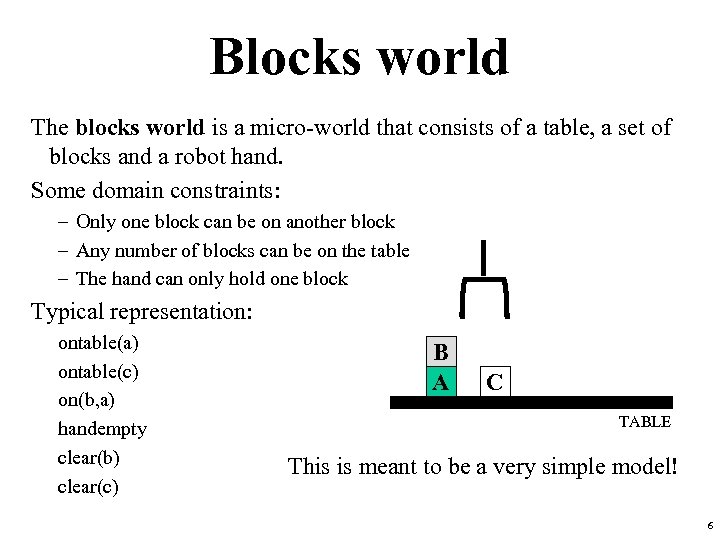 Blocks world The blocks world is a micro-world that consists of a table, a set of blocks and a robot hand. Some domain constraints: – Only one block can be on another block – Any number of blocks can be on the table – The hand can only hold one block Typical representation: ontable(a) ontable(c) on(b, a) handempty clear(b) clear(c) B A C TABLE This is meant to be a very simple model! 6
 Major approaches • Planning as search? • GPS / STRIPS • Situation calculus • Partial order planning • Hierarchical decomposition (HTN planning) • Planning with constraints (SATplan, Graphplan) • Reactive planning 7
 Planning as Search? • Actions: generate successor states • States: completely described & only used for successor generation, heuristic fn. Evaluation & goal testing. • Goals: represented as a goal test and using a heuristic function These are black boxes; we can’t look inside to select actions that might be useful • Plan representation: an unbroken sequences of actions forward from initial states (or backward from goal state) 8
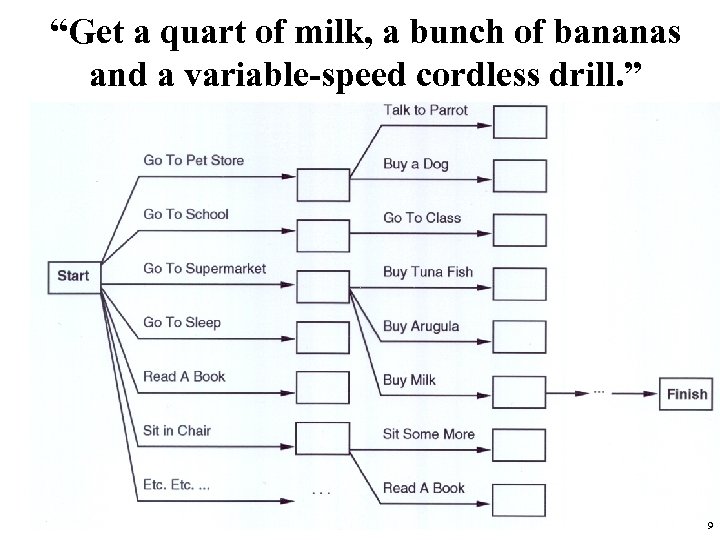 “Get a quart of milk, a bunch of bananas and a variable-speed cordless drill. ” 9
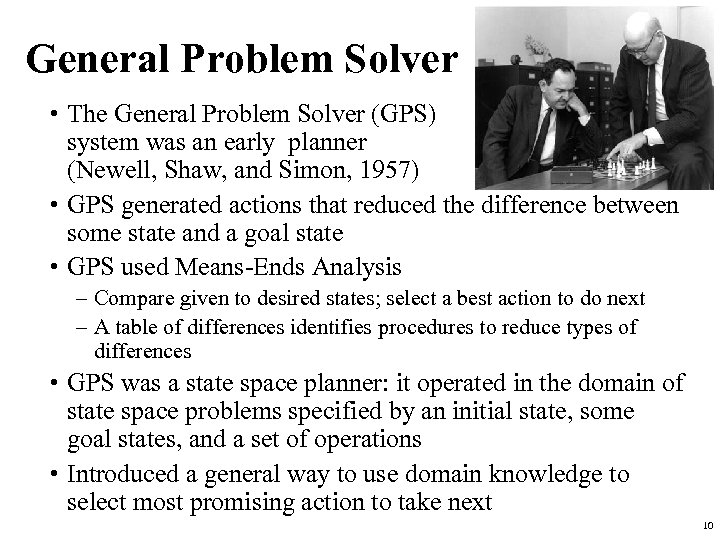 General Problem Solver • The General Problem Solver (GPS) system was an early planner (Newell, Shaw, and Simon, 1957) • GPS generated actions that reduced the difference between some state and a goal state • GPS used Means-Ends Analysis – Compare given to desired states; select a best action to do next – A table of differences identifies procedures to reduce types of differences • GPS was a state space planner: it operated in the domain of state space problems specified by an initial state, some goal states, and a set of operations • Introduced a general way to use domain knowledge to select most promising action to take next 10
 Situation calculus planning • Intuition: Represent the planning problem using first-order logic – Situation calculus lets us reason about changes in the world – Use theorem proving to “prove” that a particular sequence of actions, when applied to the situation characterizing the world state, will lead to a desired result • This is how the “neats” approach the problem 11
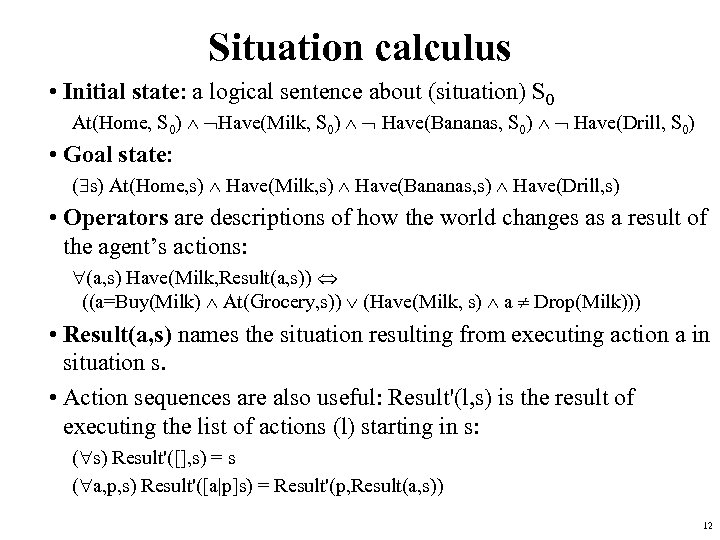 Situation calculus • Initial state: a logical sentence about (situation) S 0 At(Home, S 0) Have(Milk, S 0) Have(Bananas, S 0) Have(Drill, S 0) • Goal state: ( s) At(Home, s) Have(Milk, s) Have(Bananas, s) Have(Drill, s) • Operators are descriptions of how the world changes as a result of the agent’s actions: (a, s) Have(Milk, Result(a, s)) ((a=Buy(Milk) At(Grocery, s)) (Have(Milk, s) a Drop(Milk))) • Result(a, s) names the situation resulting from executing action a in situation s. • Action sequences are also useful: Result'(l, s) is the result of executing the list of actions (l) starting in s: ( s) Result'([], s) = s ( a, p, s) Result'([a|p]s) = Result'(p, Result(a, s)) 12
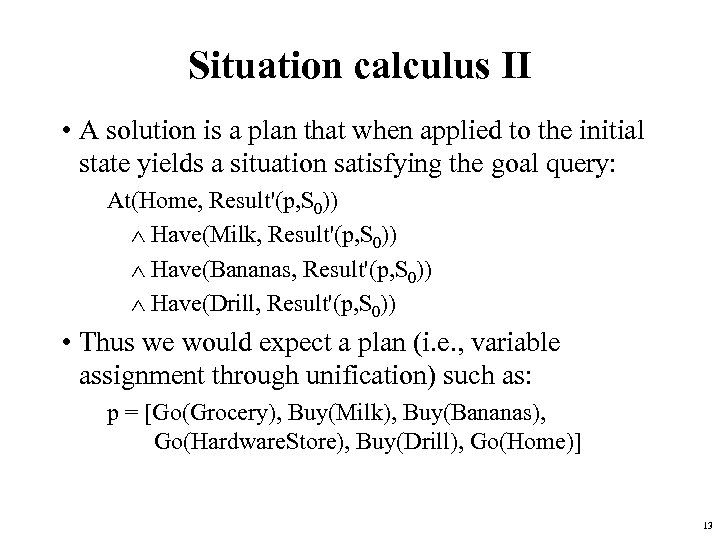 Situation calculus II • A solution is a plan that when applied to the initial state yields a situation satisfying the goal query: At(Home, Result'(p, S 0)) Have(Milk, Result'(p, S 0)) Have(Bananas, Result'(p, S 0)) Have(Drill, Result'(p, S 0)) • Thus we would expect a plan (i. e. , variable assignment through unification) such as: p = [Go(Grocery), Buy(Milk), Buy(Bananas), Go(Hardware. Store), Buy(Drill), Go(Home)] 13
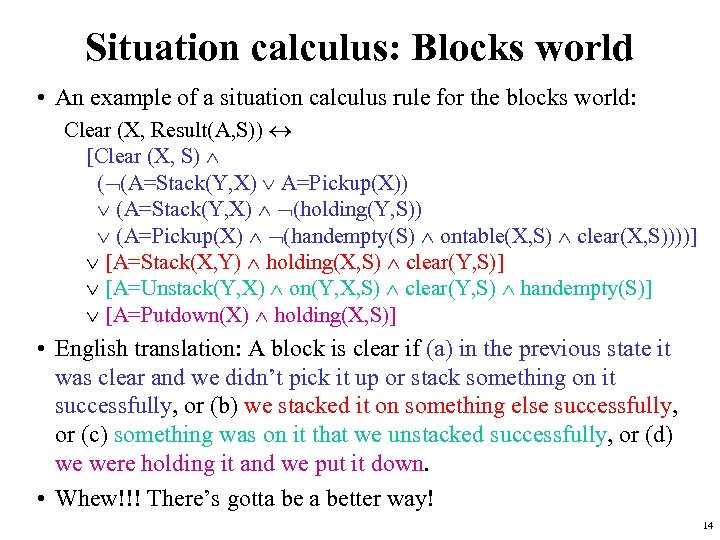 Situation calculus: Blocks world • An example of a situation calculus rule for the blocks world: Clear (X, Result(A, S)) [Clear (X, S) ( (A=Stack(Y, X) A=Pickup(X)) (A=Stack(Y, X) (holding(Y, S)) (A=Pickup(X) (handempty(S) ontable(X, S) clear(X, S))))] [A=Stack(X, Y) holding(X, S) clear(Y, S)] [A=Unstack(Y, X) on(Y, X, S) clear(Y, S) handempty(S)] [A=Putdown(X) holding(X, S)] • English translation: A block is clear if (a) in the previous state it was clear and we didn’t pick it up or stack something on it successfully, or (b) we stacked it on something else successfully, or (c) something was on it that we unstacked successfully, or (d) we were holding it and we put it down. • Whew!!! There’s gotta better way! 14
 Situation calculus planning: Analysis • This is fine in theory, but remember that problem solving (search) is exponential in the worst case • Also, resolution theorem proving only finds a proof (plan), not necessarily a good plan • So we restrict the language and use a specialpurpose algorithm (a planner) rather than general theorem prover • Since planning is a ubiquitous task for an intelligent agent, it’s reasonable to develop a special purpose subsystem for it. 15
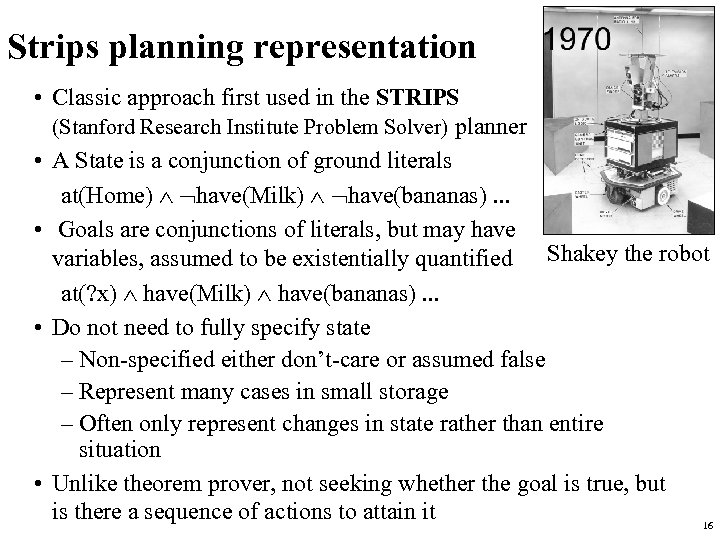 Strips planning representation • Classic approach first used in the STRIPS (Stanford Research Institute Problem Solver) planner • A State is a conjunction of ground literals at(Home) have(Milk) have(bananas). . . • Goals are conjunctions of literals, but may have variables, assumed to be existentially quantified Shakey the robot at(? x) have(Milk) have(bananas). . . • Do not need to fully specify state – Non-specified either don’t-care or assumed false – Represent many cases in small storage – Often only represent changes in state rather than entire situation • Unlike theorem prover, not seeking whether the goal is true, but is there a sequence of actions to attain it 16
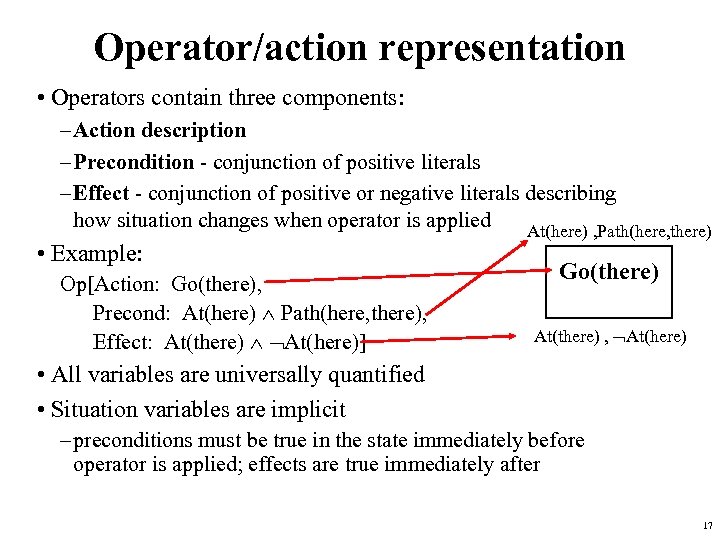 Operator/action representation • Operators contain three components: – Action description – Precondition - conjunction of positive literals – Effect - conjunction of positive or negative literals describing how situation changes when operator is applied At(here) , Path(here, there) • Example: Op[Action: Go(there), Precond: At(here) Path(here, there), Effect: At(there) At(here)] Go(there) At(there) , At(here) • All variables are universally quantified • Situation variables are implicit – preconditions must be true in the state immediately before operator is applied; effects are true immediately after 17
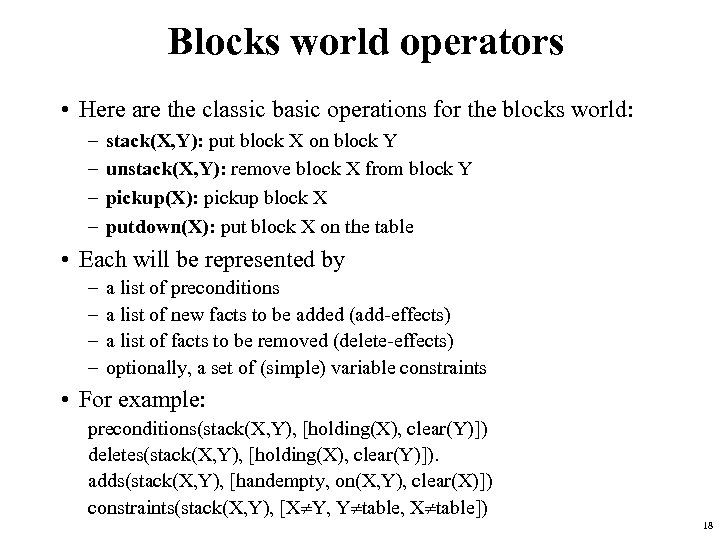 Blocks world operators • Here are the classic basic operations for the blocks world: – – stack(X, Y): put block X on block Y unstack(X, Y): remove block X from block Y pickup(X): pickup block X putdown(X): put block X on the table • Each will be represented by – – a list of preconditions a list of new facts to be added (add-effects) a list of facts to be removed (delete-effects) optionally, a set of (simple) variable constraints • For example: preconditions(stack(X, Y), [holding(X), clear(Y)]) deletes(stack(X, Y), [holding(X), clear(Y)]). adds(stack(X, Y), [handempty, on(X, Y), clear(X)]) constraints(stack(X, Y), [X Y, Y table, X table]) 18
![Blocks world operators II operator(unstack(X, Y), operator(stack(X, Y), [on(X, Y), clear(X), handempty], Precond [holding(X),](https://present5.com/presentation/660c1b8ca58674ea8fd3ce7337e09011/image-19.jpg "Blocks world operators II operator(unstack(X, Y), operator(stack(X, Y), [on(X, Y), clear(X), handempty], Precond [holding(X),") Blocks world operators II operator(unstack(X, Y), operator(stack(X, Y), [on(X, Y), clear(X), handempty], Precond [holding(X), clear(Y)], Add [handempty, on(X, Y), clear(X)], [handempty, clear(X), on(X, Y)], Delete [holding(X), clear(Y)], [X Y, Y table, X table]). Constr [X Y, Y table, X table]). operator(pickup(X), [ontable(X), clear(X), handempty], [holding(X)], [ontable(X), clear(X), handempty], [X table]). operator(putdown(X), [holding(X)], [ontable(X), handempty, clear(X)], [holding(X)], [X table]). 19
Blocks world operators II operator(unstack(X, Y), operator(stack(X, Y), [on(X, Y), clear(X), handempty], Precond [holding(X), clear(Y)], Add [handempty, on(X, Y), clear(X)], [handempty, clear(X), on(X, Y)], Delete [holding(X), clear(Y)], [X Y, Y table, X table]). Constr [X Y, Y table, X table]). operator(pickup(X), [ontable(X), clear(X), handempty], [holding(X)], [ontable(X), clear(X), handempty], [X table]). operator(putdown(X), [holding(X)], [ontable(X), handempty, clear(X)], [holding(X)], [X table]). 19
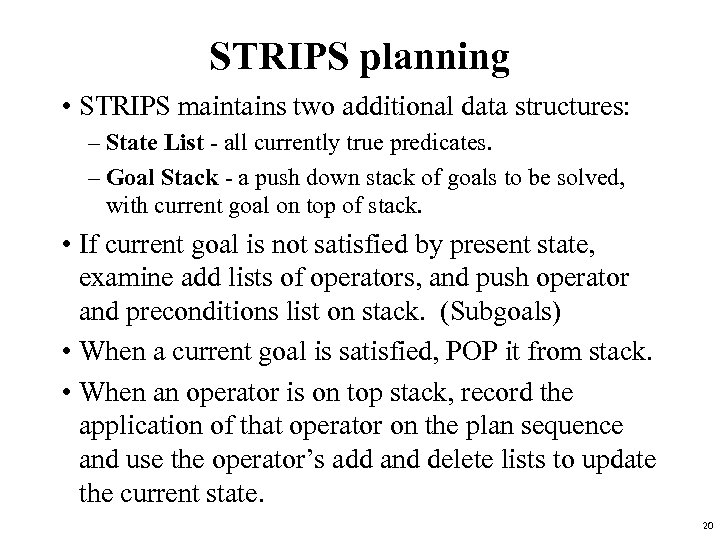 STRIPS planning • STRIPS maintains two additional data structures: – State List - all currently true predicates. – Goal Stack - a push down stack of goals to be solved, with current goal on top of stack. • If current goal is not satisfied by present state, examine add lists of operators, and push operator and preconditions list on stack. (Subgoals) • When a current goal is satisfied, POP it from stack. • When an operator is on top stack, record the application of that operator on the plan sequence and use the operator’s add and delete lists to update the current state. 20
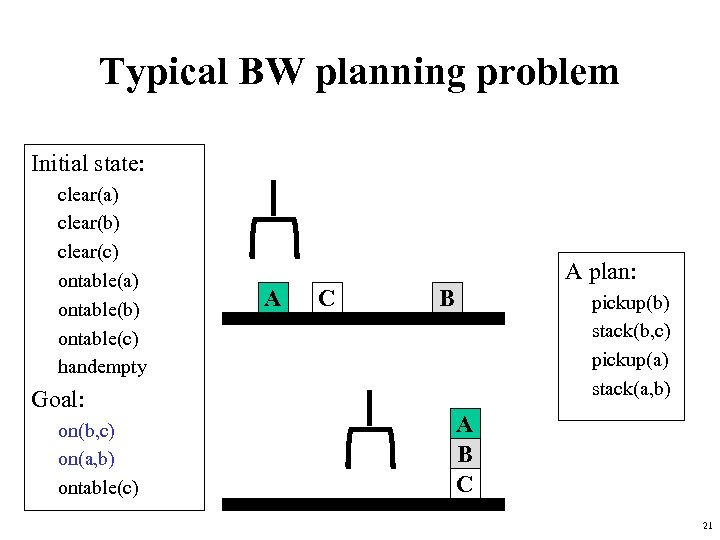 Typical BW planning problem Initial state: clear(a) clear(b) clear(c) ontable(a) ontable(b) ontable(c) handempty Goal: on(b, c) on(a, b) ontable(c) A plan: A C B pickup(b) stack(b, c) pickup(a) stack(a, b) A B C 21
![Trace strips([on(b, c), on(a, b), ontable(c)], [clear(a), clear(b), clear(c), ontable(a), ontable(b), ontable(c), handempty], [])](https://present5.com/presentation/660c1b8ca58674ea8fd3ce7337e09011/image-22.jpg "Trace strips([on(b, c), on(a, b), ontable(c)], [clear(a), clear(b), clear(c), ontable(a), ontable(b), ontable(c), handempty], [])") Trace strips([on(b, c), on(a, b), ontable(c)], [clear(a), clear(b), clear(c), ontable(a), ontable(b), ontable(c), handempty], []) Achieve on(b, c) via stack(b, c) with preconds: [holding(b), clear(c)] strips([holding(b), clear(c)], [clear(a), clear(b), clear(c), ontable(a), ontable(b), ontable(c), handempty], []) Achieve holding(b) via pickup(b) with preconds: [ontable(b), clear(b), handempty] strips([ontable(b), clear(b), handempty], [clear(a), clear(b), clear(c), ontable(a), ontable(b), ontable(c), handempty], []) Applying pickup(b) strips([holding(b), clear(c)], [clear(a), clear(c), holding(b), ontable(a), ontable(c)], [pickup(b)]) Applying stack(b, c) strips([on(b, c), on(a, b), ontable(c)], [handempty, clear(a), clear(b), ontable(a), ontable(c), on(b, c)], [stack(b, c), pickup(b)]) Achieve on(a, b) via stack(a, b) with preconds: [holding(a), clear(b)] strips([holding(a), clear(b)], [handempty, clear(a), clear(b), ontable(a), ontable(c), on(b, c)], [stack(b, c), pickup(b)]) Achieve holding(a) via pickup(a) with preconds: [ontable(a), clear(a), handempty] strips([ontable(a), clear(a), handempty], [handempty, clear(a), clear(b), ontable(a), ontable(c), on(b, c)], [stack(b, c), pickup( b)]) Applying pickup(a) strips([holding(a), clear(b)], [clear(b), holding(a), ontable(c), on(b, c)], [pickup(a), stack(b, c), pickup(b)]) Applying stack(a, b) strips([on(b, c), on(a, b), ontable(c)], [handempty, clear(a), ontable(c), on(a, b), on(b, c)], [stack(a, b), pickup(a), stack(b, c), pickup( b)]) 22
Trace strips([on(b, c), on(a, b), ontable(c)], [clear(a), clear(b), clear(c), ontable(a), ontable(b), ontable(c), handempty], []) Achieve on(b, c) via stack(b, c) with preconds: [holding(b), clear(c)] strips([holding(b), clear(c)], [clear(a), clear(b), clear(c), ontable(a), ontable(b), ontable(c), handempty], []) Achieve holding(b) via pickup(b) with preconds: [ontable(b), clear(b), handempty] strips([ontable(b), clear(b), handempty], [clear(a), clear(b), clear(c), ontable(a), ontable(b), ontable(c), handempty], []) Applying pickup(b) strips([holding(b), clear(c)], [clear(a), clear(c), holding(b), ontable(a), ontable(c)], [pickup(b)]) Applying stack(b, c) strips([on(b, c), on(a, b), ontable(c)], [handempty, clear(a), clear(b), ontable(a), ontable(c), on(b, c)], [stack(b, c), pickup(b)]) Achieve on(a, b) via stack(a, b) with preconds: [holding(a), clear(b)] strips([holding(a), clear(b)], [handempty, clear(a), clear(b), ontable(a), ontable(c), on(b, c)], [stack(b, c), pickup(b)]) Achieve holding(a) via pickup(a) with preconds: [ontable(a), clear(a), handempty] strips([ontable(a), clear(a), handempty], [handempty, clear(a), clear(b), ontable(a), ontable(c), on(b, c)], [stack(b, c), pickup( b)]) Applying pickup(a) strips([holding(a), clear(b)], [clear(b), holding(a), ontable(c), on(b, c)], [pickup(a), stack(b, c), pickup(b)]) Applying stack(a, b) strips([on(b, c), on(a, b), ontable(c)], [handempty, clear(a), ontable(c), on(a, b), on(b, c)], [stack(a, b), pickup(a), stack(b, c), pickup( b)]) 22
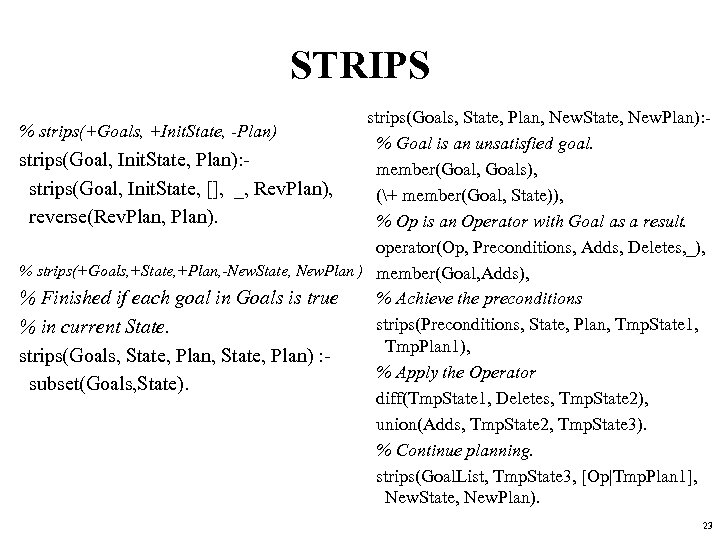 STRIPS strips(Goals, State, Plan, New. State, New. Plan): % strips(+Goals, +Init. State, -Plan) % Goal is an unsatisfied goal. strips(Goal, Init. State, Plan): member(Goal, Goals), strips(Goal, Init. State, [], _, Rev. Plan), (+ member(Goal, State)), reverse(Rev. Plan, Plan). % Op is an Operator with Goal as a result. operator(Op, Preconditions, Adds, Deletes, _), % strips(+Goals, +State, +Plan, -New. State, New. Plan ) member(Goal, Adds), % Finished if each goal in Goals is true % Achieve the preconditions strips(Preconditions, State, Plan, Tmp. State 1, % in current State. Tmp. Plan 1), strips(Goals, State, Plan) : % Apply the Operator subset(Goals, State). diff(Tmp. State 1, Deletes, Tmp. State 2), union(Adds, Tmp. State 2, Tmp. State 3). % Continue planning. strips(Goal. List, Tmp. State 3, [Op|Tmp. Plan 1], New. State, New. Plan). 23
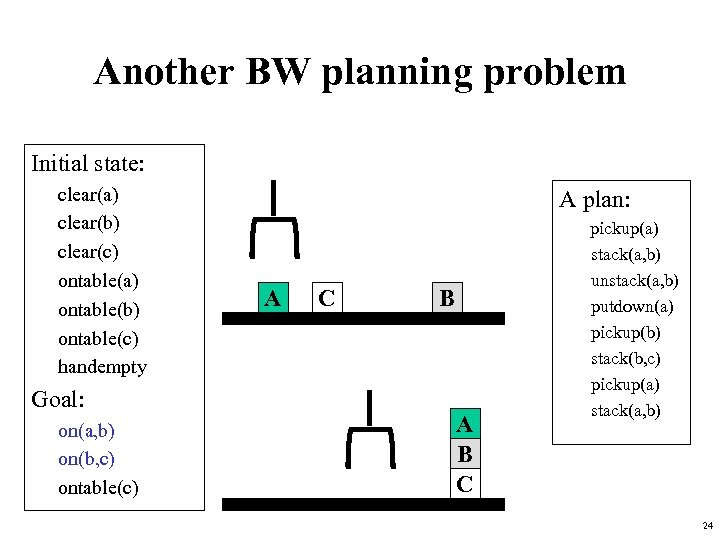 Another BW planning problem Initial state: clear(a) clear(b) clear(c) ontable(a) ontable(b) ontable(c) handempty Goal: on(a, b) on(b, c) ontable(c) A plan: A C B A B C pickup(a) stack(a, b) unstack(a, b) putdown(a) pickup(b) stack(b, c) pickup(a) stack(a, b) 24
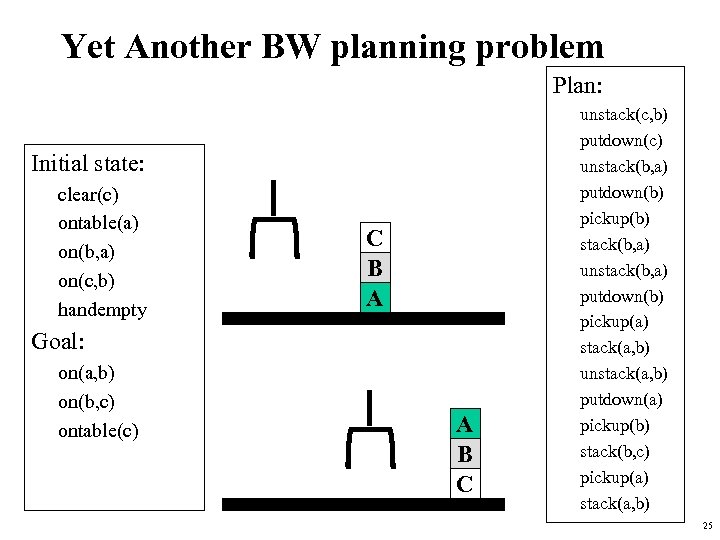 Yet Another BW planning problem Plan: Initial state: clear(c) ontable(a) on(b, a) on(c, b) handempty C B A Goal: on(a, b) on(b, c) ontable(c) A B C unstack(c, b) putdown(c) unstack(b, a) putdown(b) pickup(b) stack(b, a) unstack(b, a) putdown(b) pickup(a) stack(a, b) unstack(a, b) putdown(a) pickup(b) stack(b, c) pickup(a) stack(a, b) 25
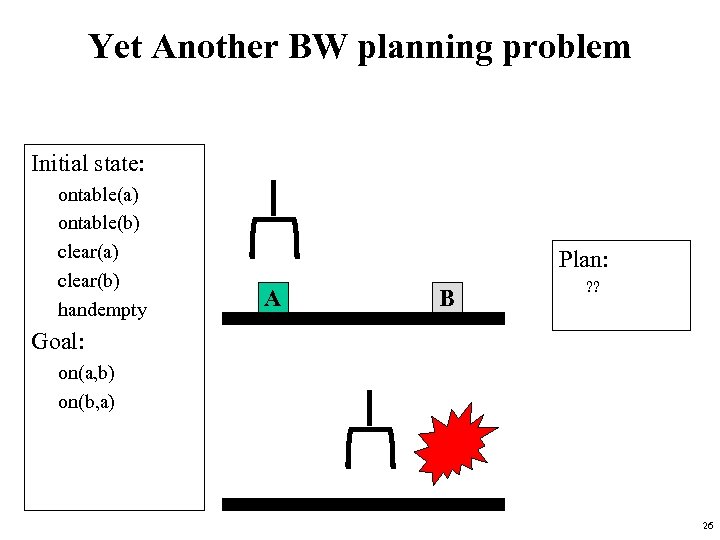 Yet Another BW planning problem Initial state: ontable(a) ontable(b) clear(a) clear(b) handempty Plan: A B ? ? Goal: on(a, b) on(b, a) 26
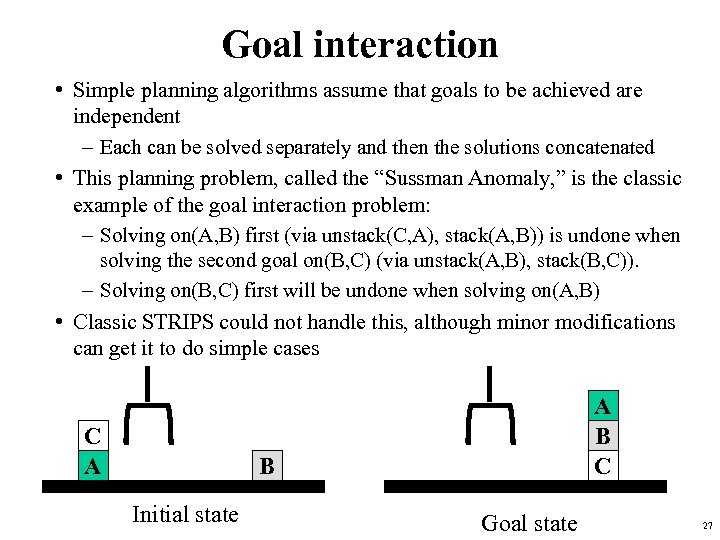 Goal interaction • Simple planning algorithms assume that goals to be achieved are independent – Each can be solved separately and then the solutions concatenated • This planning problem, called the “Sussman Anomaly, ” is the classic example of the goal interaction problem: – Solving on(A, B) first (via unstack(C, A), stack(A, B)) is undone when solving the second goal on(B, C) (via unstack(A, B), stack(B, C)). – Solving on(B, C) first will be undone when solving on(A, B) • Classic STRIPS could not handle this, although minor modifications can get it to do simple cases C A A B C B Initial state Goal state 27
![Sussman Anomaly Achieve on(a, b) via stack(a, b) with preconds: [holding(a), clear(b)] |Achieve holding(a)](https://present5.com/presentation/660c1b8ca58674ea8fd3ce7337e09011/image-28.jpg "Sussman Anomaly Achieve on(a, b) via stack(a, b) with preconds: [holding(a), clear(b)] |Achieve holding(a)") Sussman Anomaly Achieve on(a, b) via stack(a, b) with preconds: [holding(a), clear(b)] |Achieve holding(a) via pickup(a) with preconds: [ontable(a), clear(a), handempty] ||Achieve clear(a) via unstack(_1584, a) with preconds: [on(_1584, a), clear(_1584), handempty] ||Applying unstack(c, a) ||Achieve handempty via putdown(_2691) with preconds: [holding(_2691)] ||Applying putdown(c) |Applying pickup(a) Applying stack(a, b) Achieve on(b, c) via stack(b, c) with preconds: [holding(b), clear(c)] |Achieve holding(b) via pickup(b) with preconds: [ontable(b), clear(b), handempty] ||Achieve clear(b) via unstack(_5625, b) with preconds: [on(_5625, b), clear(_5625), handempty] ||Applying unstack(a, b) ||Achieve handempty via putdown(_6648) with preconds: [holding(_6648)] ||Applying putdown(a) |Applying pickup(b) Applying stack(b, c) Achieve on(a, b) via stack(a, b) with preconds: [holding(a), clear(b)] |Achieve holding(a) via pickup(a) with preconds: [ontable(a), clear(a), handempty] |Applying pickup(a) Applying stack(a, b) C A Initial state B From [clear(b), clear(c), ontable(a), ontable(b), on( c, a), handempty] To [on(a, b), on(b, c), ontable(c)] Do: unstack(c, a) putdown(c) pickup(a) stack(a, b) unstack(a, b) putdown(a) pickup(b) stack(b, c) pickup(a) stack(a, b) Goal state A B C 28
Sussman Anomaly Achieve on(a, b) via stack(a, b) with preconds: [holding(a), clear(b)] |Achieve holding(a) via pickup(a) with preconds: [ontable(a), clear(a), handempty] ||Achieve clear(a) via unstack(_1584, a) with preconds: [on(_1584, a), clear(_1584), handempty] ||Applying unstack(c, a) ||Achieve handempty via putdown(_2691) with preconds: [holding(_2691)] ||Applying putdown(c) |Applying pickup(a) Applying stack(a, b) Achieve on(b, c) via stack(b, c) with preconds: [holding(b), clear(c)] |Achieve holding(b) via pickup(b) with preconds: [ontable(b), clear(b), handempty] ||Achieve clear(b) via unstack(_5625, b) with preconds: [on(_5625, b), clear(_5625), handempty] ||Applying unstack(a, b) ||Achieve handempty via putdown(_6648) with preconds: [holding(_6648)] ||Applying putdown(a) |Applying pickup(b) Applying stack(b, c) Achieve on(a, b) via stack(a, b) with preconds: [holding(a), clear(b)] |Achieve holding(a) via pickup(a) with preconds: [ontable(a), clear(a), handempty] |Applying pickup(a) Applying stack(a, b) C A Initial state B From [clear(b), clear(c), ontable(a), ontable(b), on( c, a), handempty] To [on(a, b), on(b, c), ontable(c)] Do: unstack(c, a) putdown(c) pickup(a) stack(a, b) unstack(a, b) putdown(a) pickup(b) stack(b, c) pickup(a) stack(a, b) Goal state A B C 28
 Sussman Anomaly • Classic Strips assumed that once a goal had been satisfied it would stay satisfied. • Our simple Prolog version selects any currently unsatisfied goal to tackle at each iteration. • This can handle this problem, at the expense of looping for other problems. • What’s needed? -- a notion of “protecting” a subgoal so that it isn’t undone by some later step. 29
 State-space planning • STRIPS searches thru a space of situations (where you are, what you have, etc. ) – The plan is a solution found by “searching” through the situations to get to the goal • A progression planner searches forward from initial state to goal state – Usually results in a high branching factor • A regression planner searches backward from the goal – OK if operators have enough information to go both ways – Ideally this leads to reduced branching –you are only considering things that are relevant to the goal – Handling a conjunction of goals is difficult (e. g. , STRIPS) 30
 Plan-space planning • An alternative is to search through the space of plans, rather than situations. • Start from a partial plan which is expanded and refined until a complete plan that solves the problem is generated. • Refinement operators add constraints to the partial plan and modification operators for other changes. • We can still use STRIPS-style operators: Op(ACTION: Right. Shoe, PRECOND: Right. Sock. On, EFFECT: Right. Shoe. On) Op(ACTION: Right. Sock, EFFECT: Right. Sock. On) Op(ACTION: Left. Shoe, PRECOND: Left. Sock. On, EFFECT: Left. Shoe. On) Op(ACTION: Left. Sock, EFFECT: left. Sock. On) could result in a partial plan of [ … Right. Shoe … Left. Shoe …] 31
 Partial-order planning • A linear planner builds a plan as a totally ordered sequence of plan steps • A non-linear planner (aka partial-order planner) builds up a plan as a set of steps with some temporal constraints – constraints like S 1
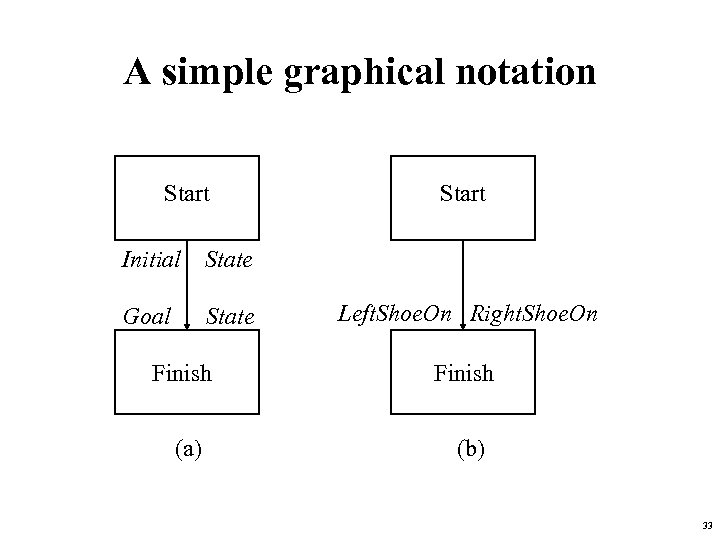 A simple graphical notation Start Initial State Goal State Start Left. Shoe. On Right. Shoe. On Finish (a) (b) 33
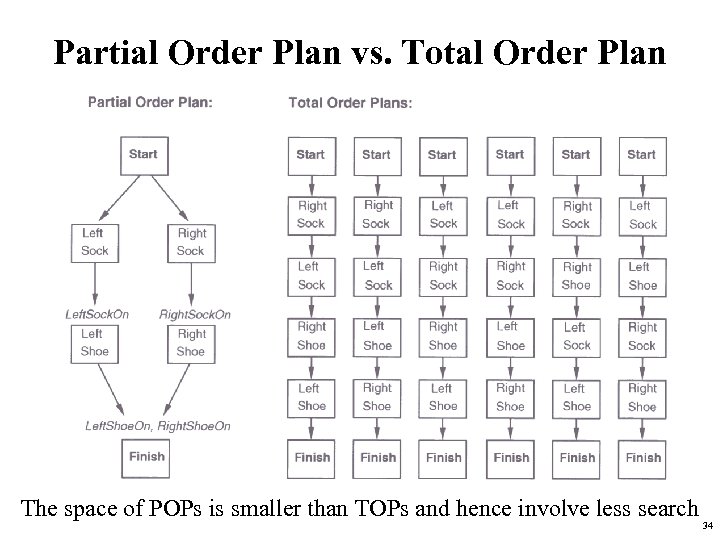 Partial Order Plan vs. Total Order Plan The space of POPs is smaller than TOPs and hence involve less search 34
 Least commitment • Non-linear planners embody the principle of least commitment – only choose actions, orderings, and variable bindings absolutely necessary, leaving other decisions till later – avoids early commitment to decisions that don’t really matter • A linear planner always chooses to add a plan step in a particular place in the sequence • A non-linear planner chooses to add a step and possibly some temporal constraints 35
 Non-linear plan • A non-linear plan consists of (1) A set of steps {S 1, S 2, S 3, S 4…} Steps have operator descriptions, preconditions and post-conditions (2) A set of causal links { … (Si, C, Sj) …} Meaning: purpose of step Si is to achieve precondition C of step Sj (3) A set of ordering constraints { … Si
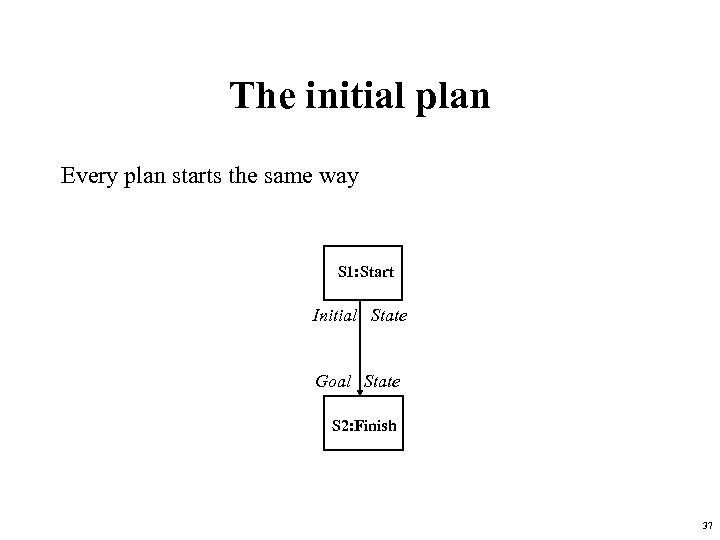 The initial plan Every plan starts the same way S 1: Start Initial State Goal State S 2: Finish 37
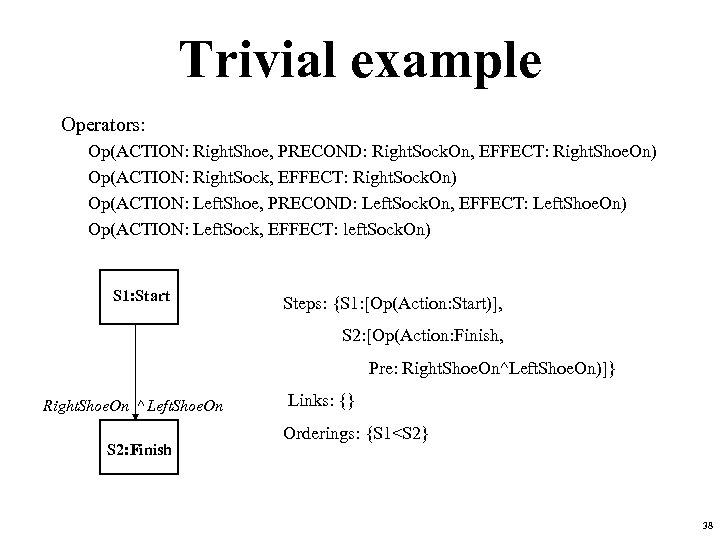 Trivial example Operators: Op(ACTION: Right. Shoe, PRECOND: Right. Sock. On, EFFECT: Right. Shoe. On) Op(ACTION: Right. Sock, EFFECT: Right. Sock. On) Op(ACTION: Left. Shoe, PRECOND: Left. Sock. On, EFFECT: Left. Shoe. On) Op(ACTION: Left. Sock, EFFECT: left. Sock. On) S 1: Start Steps: {S 1: [Op(Action: Start)], S 2: [Op(Action: Finish, Pre: Right. Shoe. On^Left. Shoe. On)]} Right. Shoe. On ^ Left. Shoe. On S 2: Finish Links: {} Orderings: {S 1
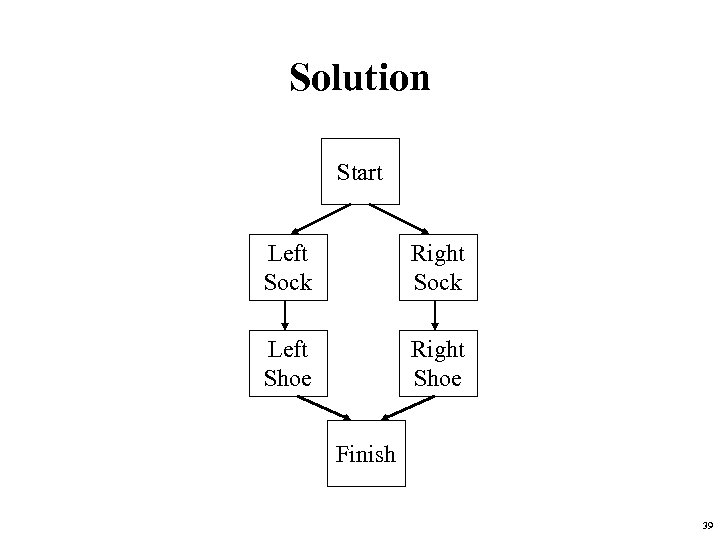 Solution Start Left Sock Right Sock Left Shoe Right Shoe Finish 39
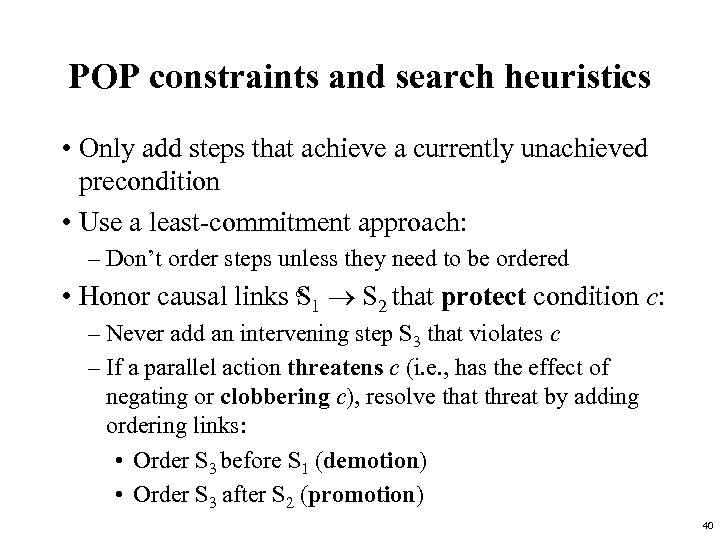 POP constraints and search heuristics • Only add steps that achieve a currently unachieved precondition • Use a least-commitment approach: – Don’t order steps unless they need to be ordered • Honor causal links c 1 S 2 that protect condition c: S – Never add an intervening step S 3 that violates c – If a parallel action threatens c (i. e. , has the effect of negating or clobbering c), resolve that threat by adding ordering links: • Order S 3 before S 1 (demotion) • Order S 3 after S 2 (promotion) 40
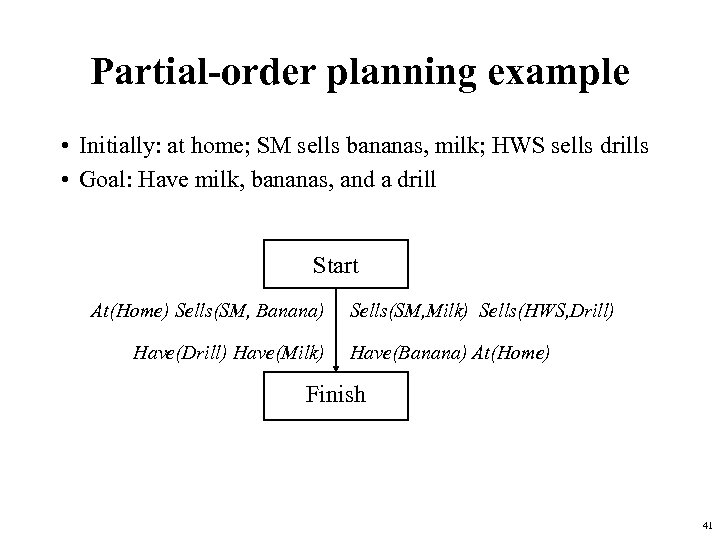 Partial-order planning example • Initially: at home; SM sells bananas, milk; HWS sells drills • Goal: Have milk, bananas, and a drill Start At(Home) Sells(SM, Banana) Have(Drill) Have(Milk) Sells(SM, Milk) Sells(HWS, Drill) Have(Banana) At(Home) Finish 41
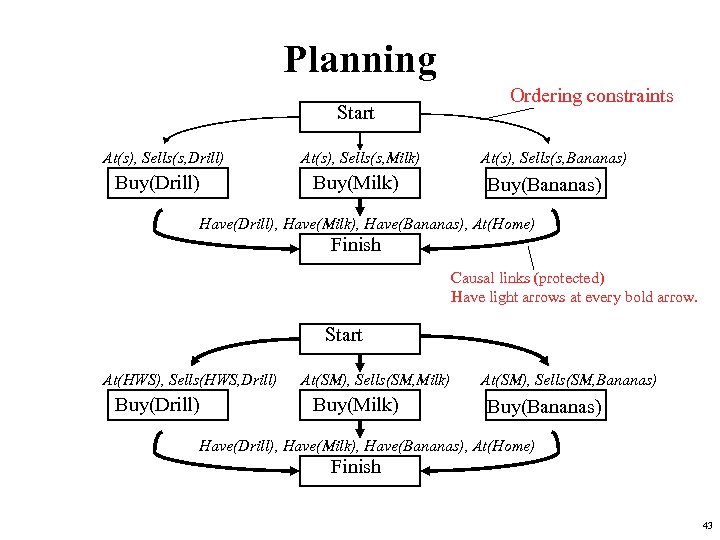 Planning Start At(s), Sells(s, Drill) Buy(Drill) At(s), Sells(s, Milk) Buy(Milk) Ordering constraints At(s), Sells(s, Bananas) Buy(Bananas) Have(Drill), Have(Milk), Have(Bananas), At(Home) Finish Causal links (protected) Have light arrows at every bold arrow. Start At(HWS), Sells(HWS, Drill) Buy(Drill) At(SM), Sells(SM, Milk) Buy(Milk) At(SM), Sells(SM, Bananas) Buy(Bananas) Have(Drill), Have(Milk), Have(Bananas), At(Home) Finish 43
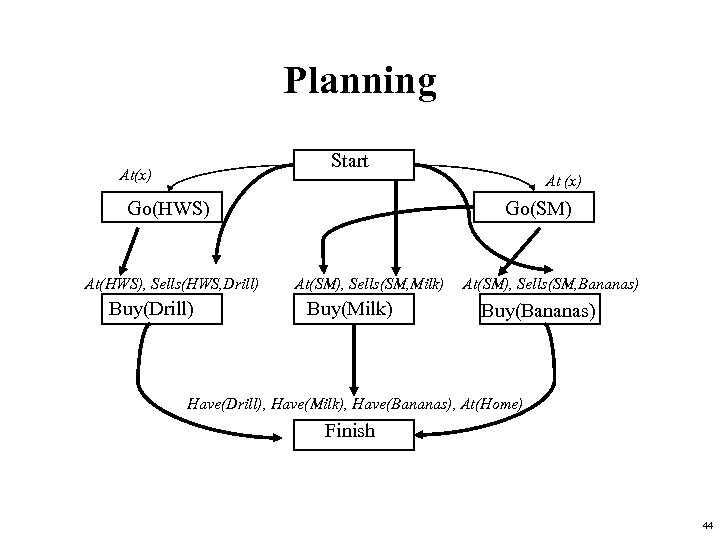 Planning Start At(x) At (x) Go(HWS) At(HWS), Sells(HWS, Drill) Buy(Drill) Go(SM) At(SM), Sells(SM, Milk) Buy(Milk) At(SM), Sells(SM, Bananas) Buy(Bananas) Have(Drill), Have(Milk), Have(Bananas), At(Home) Finish 44
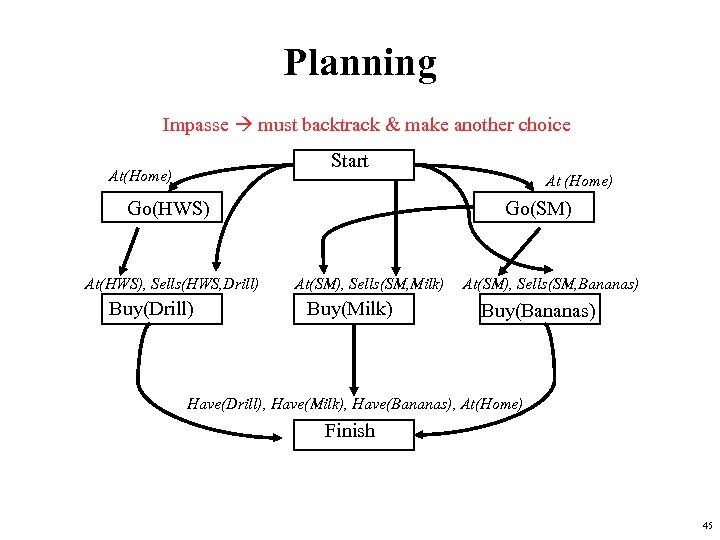 Planning Impasse must backtrack & make another choice Start At(Home) At (Home) Go(HWS) At(HWS), Sells(HWS, Drill) Buy(Drill) Go(SM) At(SM), Sells(SM, Milk) Buy(Milk) At(SM), Sells(SM, Bananas) Buy(Bananas) Have(Drill), Have(Milk), Have(Bananas), At(Home) Finish 45
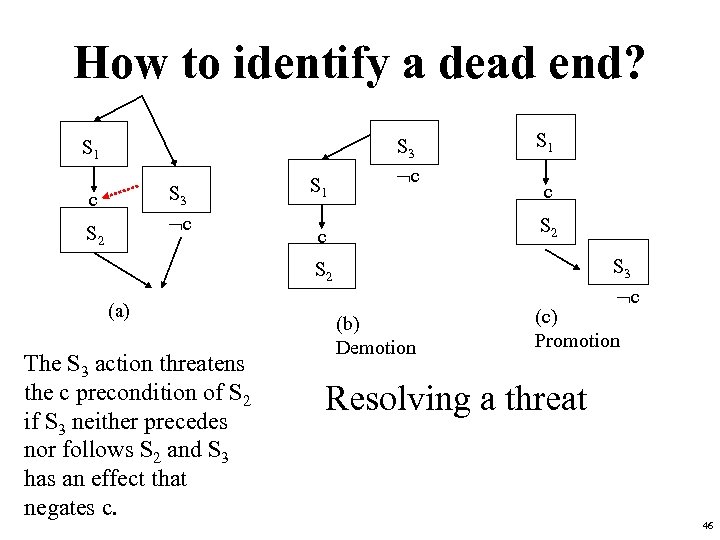 How to identify a dead end? S 1 S 3 c c S 2 S 1 S 3 c S 1 c S 2 c S 3 S 2 (a) The S 3 action threatens the c precondition of S 2 if S 3 neither precedes nor follows S 2 and S 3 has an effect that negates c. c (b) Demotion (c) Promotion Resolving a threat 46
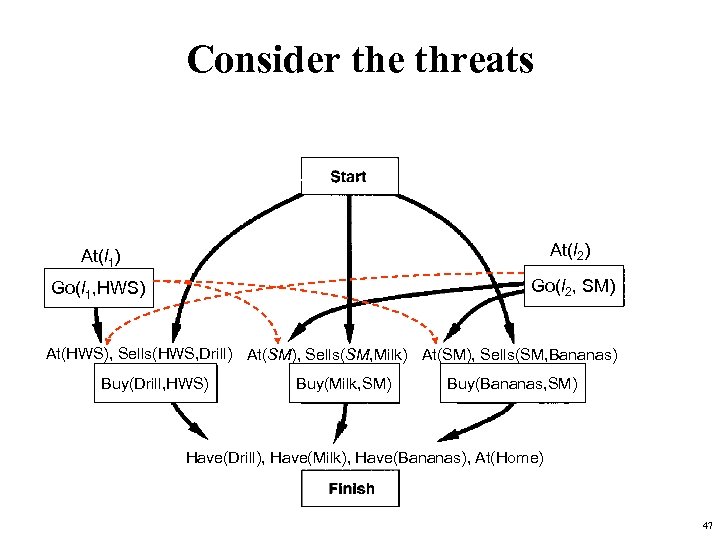 Consider the threats At(l 1) At(l At(x)2) Go(l 1, HWS) Go(l 2, SM) At(HWS), Sells(HWS, Drill) At(SM), Sells(SM, Milk) At(SM), Sells(SM, Bananas) Buy(Drill, HWS) Buy(Milk, SM) Buy(Bananas, SM) Have(Drill), Have(Milk), Have(Bananas), At(Home) 47
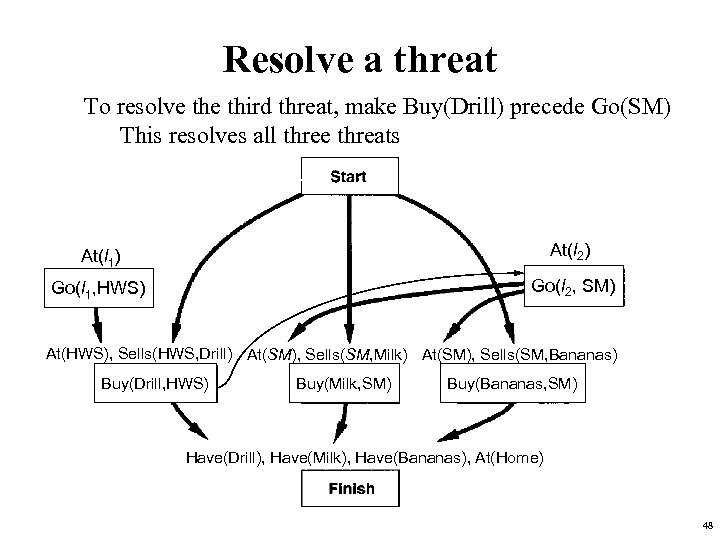 Resolve a threat To resolve third threat, make Buy(Drill) precede Go(SM) This resolves all three threats • To resolve third threat, make Buy(Drill) precede Go(SM) – This resolves all three threats At(l 1) At(l At(x)2) Go(l 1, HWS) Go(l 2, SM) At(HWS), Sells(HWS, Drill) At(SM), Sells(SM, Milk) At(SM), Sells(SM, Bananas) Buy(Drill, HWS) Buy(Milk, SM) Buy(Bananas, SM) Have(Drill), Have(Milk), Have(Bananas), At(Home) 48
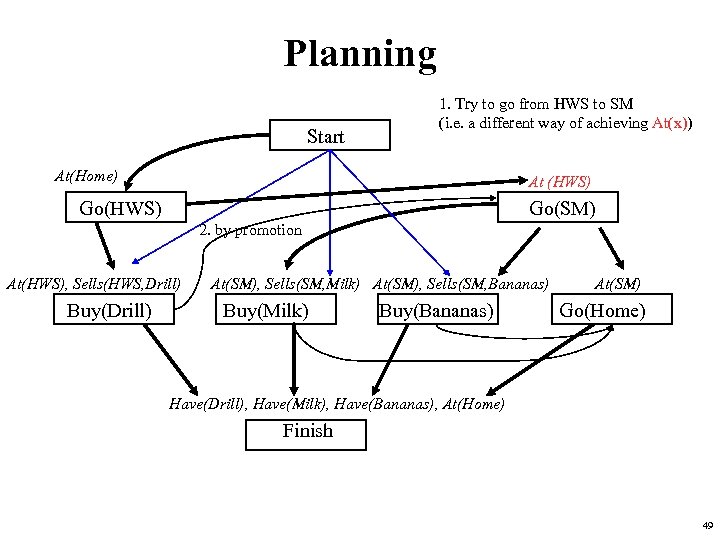 Planning Start 1. Try to go from HWS to SM (i. e. a different way of achieving At(x)) At(Home) At (HWS) Go(SM) 2. by promotion At(HWS), Sells(HWS, Drill) Buy(Drill) At(SM), Sells(SM, Milk) At(SM), Sells(SM, Bananas) Buy(Milk) Buy(Bananas) At(SM) Go(Home) Have(Drill), Have(Milk), Have(Bananas), At(Home) Finish 49
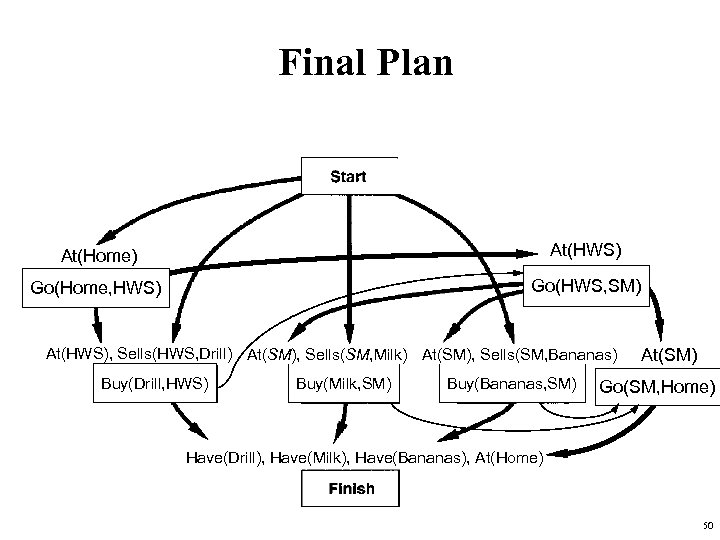 Final Plan • Establish At(l 3) with l 3=SM At(Home) At(HWS) At(x) Go(Home, HWS) Go(HWS, SM) At(HWS), Sells(HWS, Drill) At(SM), Sells(SM, Milk) At(SM), Sells(SM, Bananas) Buy(Drill, HWS) Buy(Milk, SM) Buy(Bananas, SM) At(SM) Go(SM, Home) Have(Drill), Have(Milk), Have(Bananas), At(Home) 50
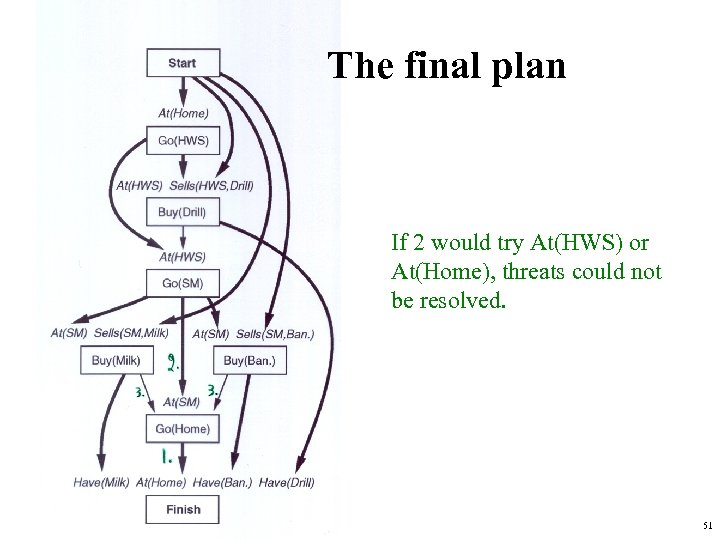 The final plan If 2 would try At(HWS) or At(Home), threats could not be resolved. 51