


 Скачать презентацию PLANNING AND IMPLEMENTING CENSUS MAPPING PROGRAMME United Nations
4664447318bdfdedb3e937ddaf13da65.ppt
- Количество слайдов: 35
 PLANNING AND IMPLEMENTING CENSUS MAPPING PROGRAMME United Nations Regional Workshop on the 2020 World Programme on Population and Housing Censuses: International Standards and Contemporary Technologies Dar es Salaam, Tanzania, 29 May -1 June, 2017 Frederick Okwayo UNFPA ESARO Technical Adviser, Population Data Policy
 Outline § § § § § Roles of maps in the census Considerations for mapping method Some advantages in using geospatial technologies Consideration for delineation of EAs and examples of EAs Main aspects in a mapping programme Main phases of implementation Examples of planning process in mapping programme Testing the planned mapping programme Challenges in mapping
 International standards and recommendations Main documents for 2020 round of censuses § UNSD, 2009. Handbook on Geospatial Infrastructure in Support of Census Activities, New York § UNSD, 2015. Principles and Recommendations for Population and Housing Censuses, rev 3, New York (section on census mapping) § UNSD, 2015. Handbook on Census Management, New York
 Roles of maps in the Census § Ensures coverage and facilitates census planning process (pre-enumeration phase) § Supports data collection and helps supervise census activities (pre-enumeration and enumeration phase) § Makes it easier to present, analyze and disseminate census results (post-enumeration phase) § Supports linking census data with data from other sources (geo-spatial analyses) § Development of sampling frames including agriculture censuses
 Considerations for mapping methods • Planning must be done early considering the following factors: – – – available geographic resources requirements for new technologies available resources and allocated time frame staff capacity needed for new approaches Requirements for developing an ongoing geographic system • The assessment of all these factors will determine the best mix of technology and approaches for each individual cases
 Approaches for mapping techniques • Traditional mapping techniques used over the years – still applicable in some parts of the countries especially remote areas • Digital mapping techniques motivated by new technologies, can greatly improve census operations • Application of new technologies requires more careful and long term operational and managerial plans based on realistic assessment of cost and human resources required • If there is minimal internal capacity, consideration for out-sourcing should be examined
 Technological advances • New technological advances include widespread availability of laptops computers, handheld devices, global positioning system (GPS), Geographical information system (GIS) software, and low-cost aerial and satellite imagery (no need to procure very expense satellite imagery) • These advancements makes NSOs to collect more accurate and timely information, can contribute to the analysis and presentations of the census results
 Partnerships • Census Office should consider to collaborate with other relevant agencies with comparative advantages in mapping (dept. of survey, defense, UN agencies, training institutions, etc. ) • Census may be a catalyst for the statistical agencies to work together to the benefit of both agencies and the community • Goal is to develop a statistical geo-spatial framework that creates accurate, authoritative, reliable geo-spatial information
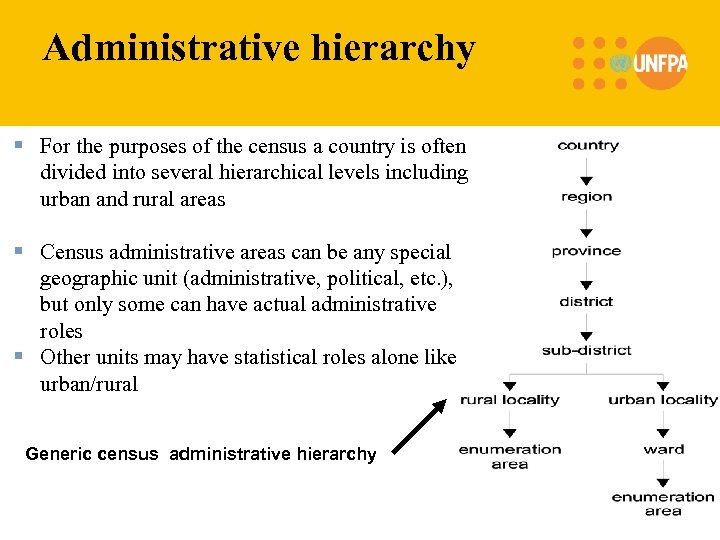 Administrative hierarchy § For the purposes of the census a country is often divided into several hierarchical levels including urban and rural areas § Census administrative areas can be any special geographic unit (administrative, political, etc. ), but only some can have actual administrative roles § Other units may have statistical roles alone like urban/rural Generic census administrative hierarchy
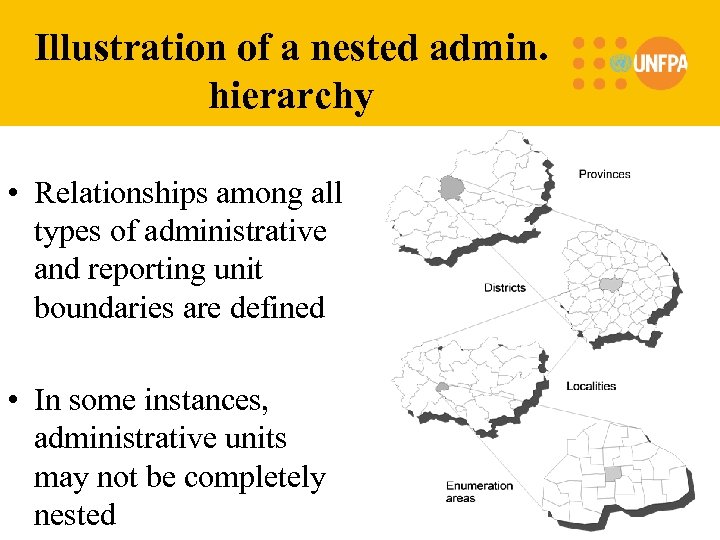 Illustration of a nested admin. hierarchy • Relationships among all types of administrative and reporting unit boundaries are defined • In some instances, administrative units may not be completely nested
 Criteria for delineation of EAs • Critical Factors of EAs: – – – Be mutually exclusive and exhaustive; Have easily identifiable boundaries on the ground; Be consistent with the administrative hierarchy; Be of approximately equally sized population; Be of reasonable size and accessible to be covered by an enumerator; – Be large enough to guarantee data privacy; – Be useful for other types of data collection activities.
 Criteria and process for ground delineation of EAs (cont. ) • Size of EAs can be defined in 2 ways: 1. Population (most important in terms of censuses) • The chosen population size varies from country to country and is determined based generally on pretest results. • For most practical purposes, the population size of an enumeration area will be in the low to mid hundreds. 2. Surface Area (accessibility) • Enumeration can proceed more quickly in towns and cities than in the countryside so accessibility and time require consideration
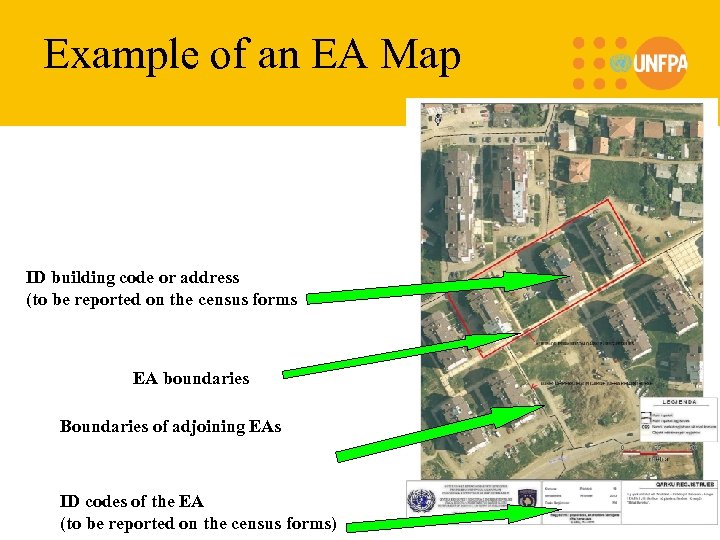 Example of an EA Map ID building code or address (to be reported on the census forms EA boundaries Boundaries of adjoining EAs ID codes of the EA (to be reported on the census forms)
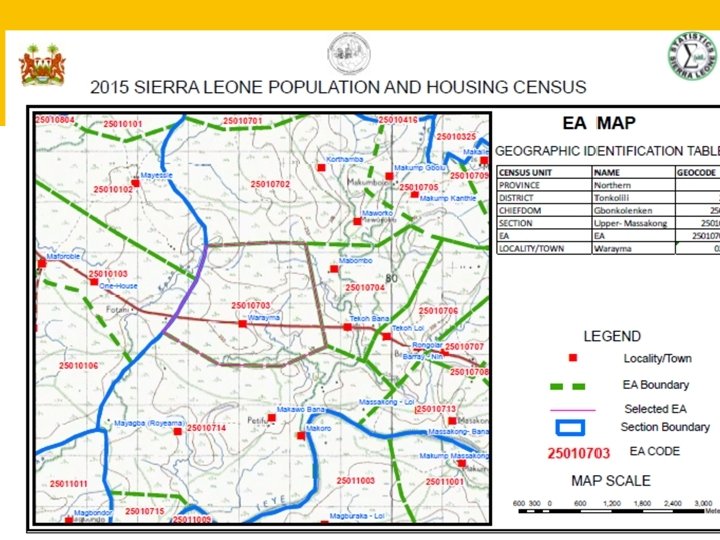 Consider Sierra Leone and TLS
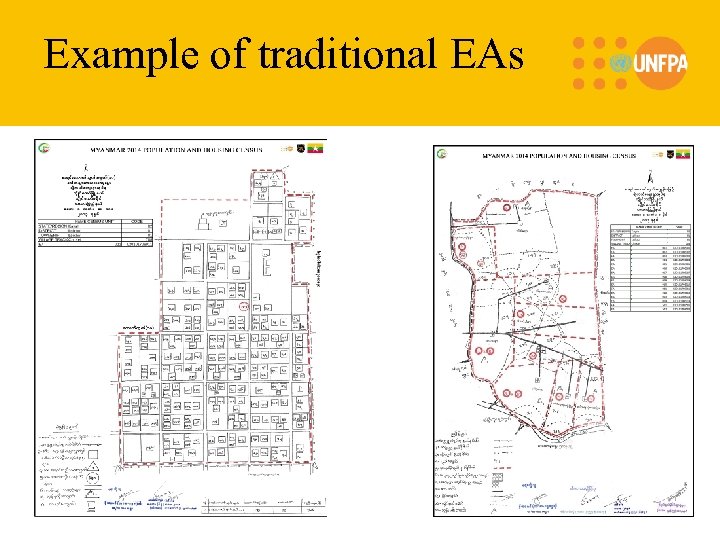 Example of traditional EAs
 Some advantages in using geospatial technologies § After the initial large investment, GIS reduces the cost and time required to collect, compile, update, duplicate and distribute geographic information § The integrated use of remote sensing, GIS and GPS may improve accuracy in the boundary delineation of EAs § With GIS, the required space to store maps is drastically reduced § GIS allows to perform spatial queries and disseminate census results by maps § The use of PDAs or pocket PCs may speed up census operations and increase data accuracy
 How maps support the census planning process § Maximizing coverage: coverage errors refer to the omission or double-counting of persons, households or housing units that may lead to under-counting or over-counting, respectively § Definition of the census geography: hierarchical subdivision of the whole territory into administrative, geographic and statistical areas (Enumeration Areas, groups of EAs under responsibility of supervisors) § Estimating staff, materials, trainings, logistical requirements, etc. § Definition of operational zones (or census management areas) for data collection
 How maps to support fieldwork operations § Maps showing buildings, streets, addresses, points of interest (landmarks), help enumerators for field orientation and to enumerate census units § ID codes and addresses on the EA maps are reported by enumerators on the census forms § EA maps allow supervisors to monitor that the assigned area is completely covered by enumerators
 Maps contribute to statistical analysis and dissemination § Spatial analysis techniques (queries, measures, etc. ) § Thematic mapping § Static and dynamic census atlases
 Main aspects in census mapping programme § § § § Planning and testing, reviewing/evaluating Institutional arrangements and capacity in the country Use of geo-spatial technologies Base maps and map integration Census geography (determination of coding system) Consistency with census geography of previous censuses Delineation of EAs GIS database design GIS database management Map updating Data quality (positional and logical) and confidentiality Metadata Dissemination
 Main phases of implementation § Management and technical coordination at the NSO § Definition of needs on census mapping § Institutional arrangements and/or outsourcing § Definition of the census geography, geocoding approach, coding scheme, use of geospatial technologies, outputs § Drafting a plan and a budget § Realization of a test at EA level § Analysis of the results of the test § Revision of the plan and budget
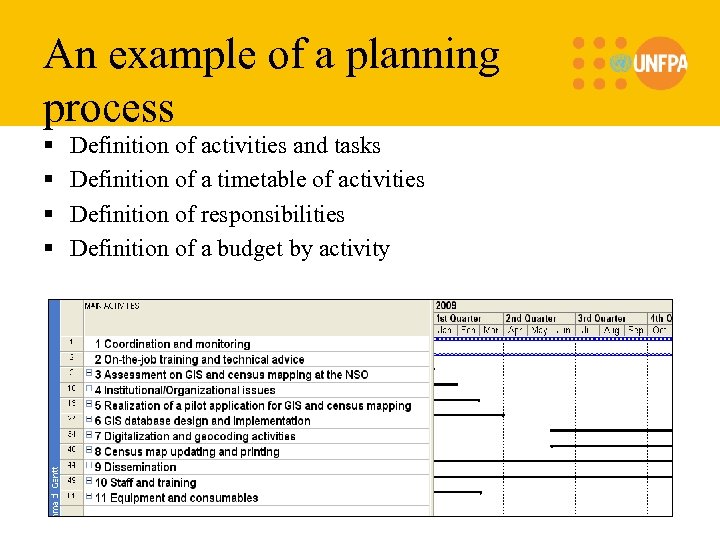 An example of a planning process § § Definition of activities and tasks Definition of a timetable of activities Definition of responsibilities Definition of a budget by activity
 An example of a planning process Assessment on GIS and census mapping at the NSO § Definition of needs and collection of available cartographic data § Analysis of the collected cartographic data and information § Analysis and definition of spatial levels (Administrative, statistical and geographic units) § Assessing the use of cartography and GIS at the NSO and in the country § Expert interviews and visit of relevant National offices § Draft of a preparatory work plan for census mapping
 An example of a planning process Institutional/Organizational issues § Definition of Institutional arrangements with other National Institutions dealing with mapping (e. g. National Mapping Agencies, Private companies, Universities, etc. ) contributing to the development of a National Spatial Data Infrastructure § Setting up a technical team for census mapping activities § Definition of the census geography, geo-coding approach, coding scheme, use of geospatial technologies, outputs, etc. § Definition of a strategy to support capacity building in country, outside the country, study tours, etc.
 An example of a planning process Realization of a test § Acquisition of cartography (aerial and satellite imagery, paper maps, vector files, etc. ) for the pilot area § Importing and integrating administrative records, spatial levels and EA boundaries of previous censuses § Development of a preliminary GIS data model § Preparation of maps and forms of the pilot area § Recruitment of staff and training for fieldwork activities § Field operations and data collection § Data entry § Data analysis and evaluation § Revision of the plan § Preparation of a reference manuals for GIS and census mapping including definitions and a glossary of terms
 An example of a planning process GIS database design § Definition of the final GIS data model (layers, coding scheme, geocoding model) § Definition and implementation of the ICT infrastructure § Definition of technical specifications and metadata for the GIS census database
 An example of a planning process Digitization and geocoding activities § Importing and integrating administrative records, spatial levels and EA boundaries of previous censuses § Improving the digitization (addresses, street names, points of interest, building boundaries, city blocks, and other relevant spatial data) § Geocoding census spatial levels, EAs, addresses and buildings § Fieldwork activities for dwellings listing (or through remote sensing data) § Delineation and digitization of the census EA boundaries
 An example of a planning process Census map updating and printing § Map updating § Implementation of the data management system and updating procedures of the GIS database § Preparation of census EAs and supervisory maps § Map printing, packaging and dispatch to field § Updating maps based on comments from data collection § Finalization of GIS/mapping database
 An example of a planning process Dissemination § Definition of the strategy for census spatial data dissemination § Spatial data analysis – main, thematic reports § Preparation of census atlas (static or dynamic) § Interactive maps with census results
 An example of a planning process Staff and training § Recruitment of technical staff for fieldwork and office activities § Training on Census Mapping guidelines and recommendations for population censuses § Training on GIS software § Study-tours to other Statistical Offices § Training on census spatial data analysis
 An example of a planning process Equipment and consumables § Acquisition of a first set of hardware (small number of computers and a large format printer for the pilot application) § Acquisition of a second set of hardware (Server and clients, printers, data storage units, GPS/GIS and handheld units, etc. ) § Acquisition of software based on recommendations and assessments (Commercial: ESRI’s Arc. GIS, GPS Utility, Easy. GPS, etc. ) § Acquisition of office furniture and consumables
 Testing, Testing q Main objective: testing and improving the census mapping programme drafted in the planning process q Specific objectives are to: § test the suitability of census base maps (satellite/aerial imagery) in urban and rural areas § test the proposed geocoding model (matching approach/direct collection) § investigate changes occurred since the last census in the size of EAs, to ensure data comparability, and to improve the appropriate strategy for the demarcation of EAs § test the GIS database model, the coding scheme and the linkage between GIS layers and census data § estimate time and resources to implement the overall census mapping programme
 Challenges • Late allocation of resources for census in most countries • High cost of equipment and software for census mapping • Acquisition of base maps or cost of satellite imageries – use of Google maps. – Subscription services to Satellite Images: such as Global Basemap® by Digital Globe www. digitalgloble. com • Attraction of qualified staff from census office • Definition of urban areas • Institutional EAs with large populations
 Challenges (cont. ) • In cases where administrative and reporting units are not hierarchical, special coding conventions need to be developed • Important to be completely consistent in defining and using the administrative unit identifiers, since they are the link between the GIS boundaries and the tabular census data – Use of different coding system within a country • The census office should therefore maintain a master list of EAs and administrative units and their respective codes and communicate any changes made to the master list to the GIS and census databases
 ASANTE SANA