


 Скачать презентацию PLANET International Summer School On AI Planning 2002
fee1706fc9c7d2d7fa1878454f7080c0.ppt
- Количество слайдов: 67
 PLANET International Summer School On AI Planning 2002 Planning and Execution Martha E. Pollack University of Michigan www. eecs. umich. edu/~pollackm © Martha E. Pollack
 Planning and Execution • Last time: Execution – Well-formed problems – Precise solutions that cohere • This time: Planning and Execution – More open-ended questions – Partial answers – Opportunity for lots of good research! © Martha E. Pollack
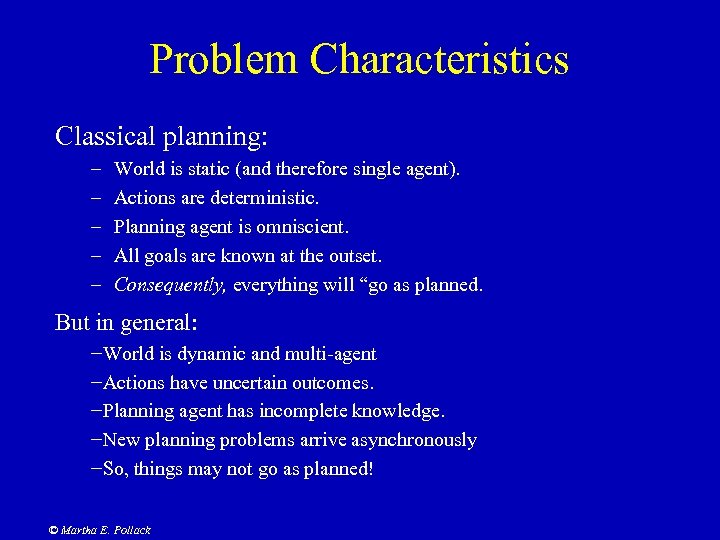 Problem Characteristics Classical planning: – – – World is static (and therefore single agent). Actions are deterministic. Planning agent is omniscient. All goals are known at the outset. Consequently, everything will “go as planned. But in general: −World is dynamic and multi-agent −Actions have uncertain outcomes. −Planning agent has incomplete knowledge. −New planning problems arrive asynchronously −So, things may not go as planned! © Martha E. Pollack
 Today’s Outline 1. Handling Potential Plan Failures 2. Managing Deliberation Resources 3. Other P&E Issues © Martha E. Pollack
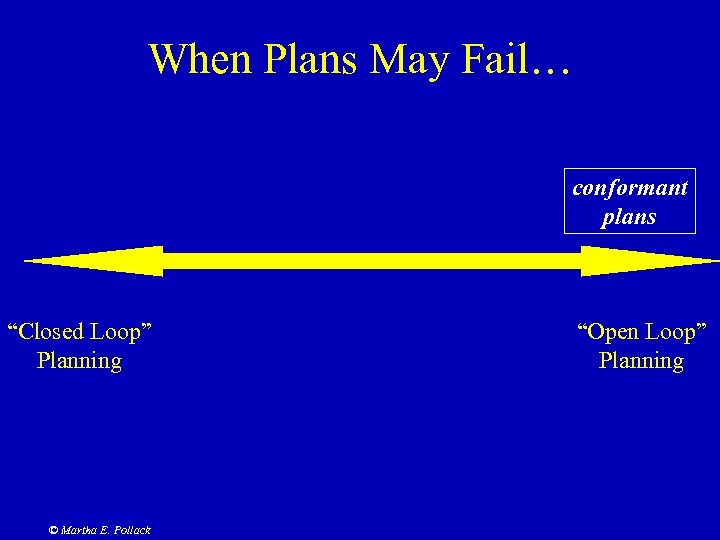 When Plans May Fail… conformant plans “Closed Loop” Planning © Martha E. Pollack “Open Loop” Planning
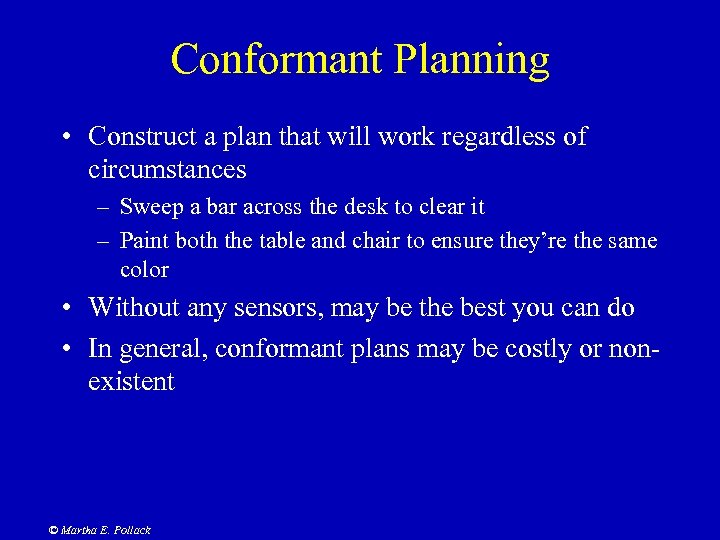 Conformant Planning • Construct a plan that will work regardless of circumstances – Sweep a bar across the desk to clear it – Paint both the table and chair to ensure they’re the same color • Without any sensors, may be the best you can do • In general, conformant plans may be costly or nonexistent © Martha E. Pollack
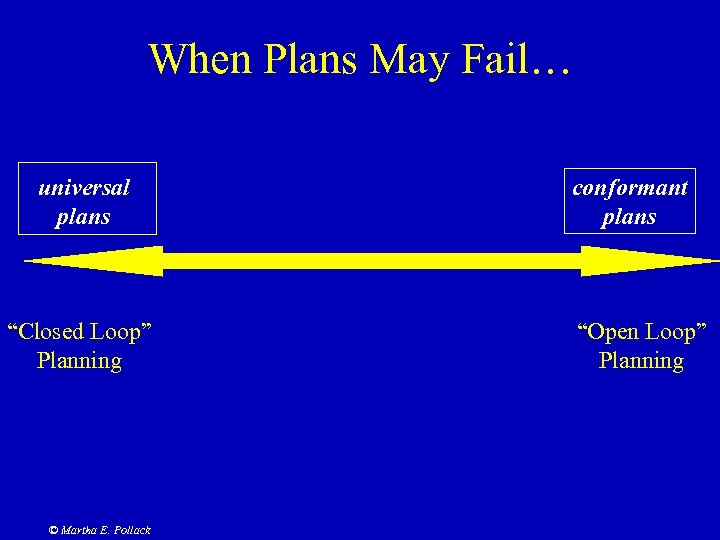 When Plans May Fail… universal plans “Closed Loop” Planning © Martha E. Pollack conformant plans “Open Loop” Planning
![Universal Plans [Schoppers] • Construct a complete function from states to actions • Observe](https://present5.com/presentation/fee1706fc9c7d2d7fa1878454f7080c0/image-8.jpg "Universal Plans [Schoppers] • Construct a complete function from states to actions • Observe") Universal Plans [Schoppers] • Construct a complete function from states to actions • Observe state—take one step—loop • Essentially follow a decision tree • Assumes you can completely observe state • May be a huge number of states! © Martha E. Pollack
Universal Plans [Schoppers] • Construct a complete function from states to actions • Observe state—take one step—loop • Essentially follow a decision tree • Assumes you can completely observe state • May be a huge number of states! © Martha E. Pollack
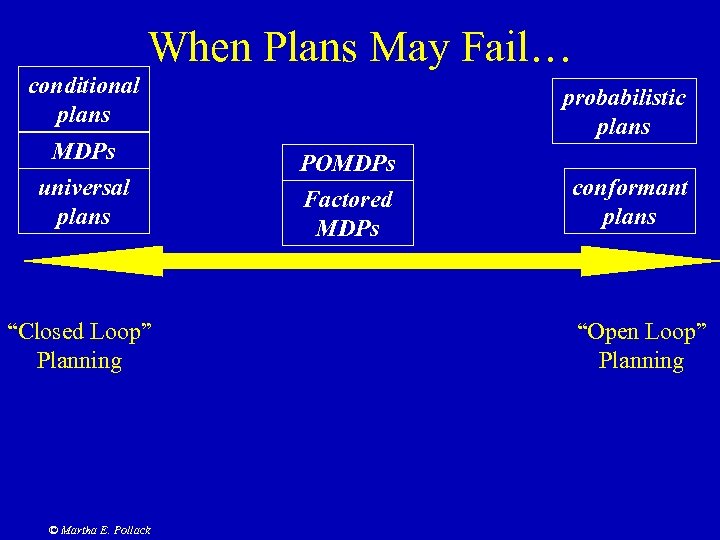 When Plans May Fail… conditional plans MDPs universal plans “Closed Loop” Planning © Martha E. Pollack probabilistic plans POMDPs Factored MDPs conformant plans “Open Loop” Planning
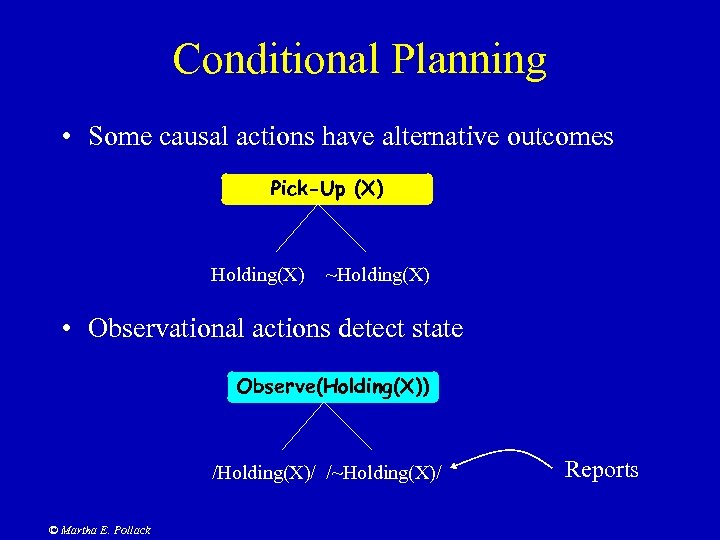 Conditional Planning • Some causal actions have alternative outcomes Pick-Up (X) Holding(X) ~Holding(X) • Observational actions detect state Observe(Holding(X)) /Holding(X)/ /~Holding(X)/ © Martha E. Pollack Reports
 Plan Generation with Contexts • Context = possible outcome of conditional steps in the plan • Generate a plan with branches for every possible outcome of conditional steps – Do this by creating a new goal state for the negation of the current contexts © Martha E. Pollack
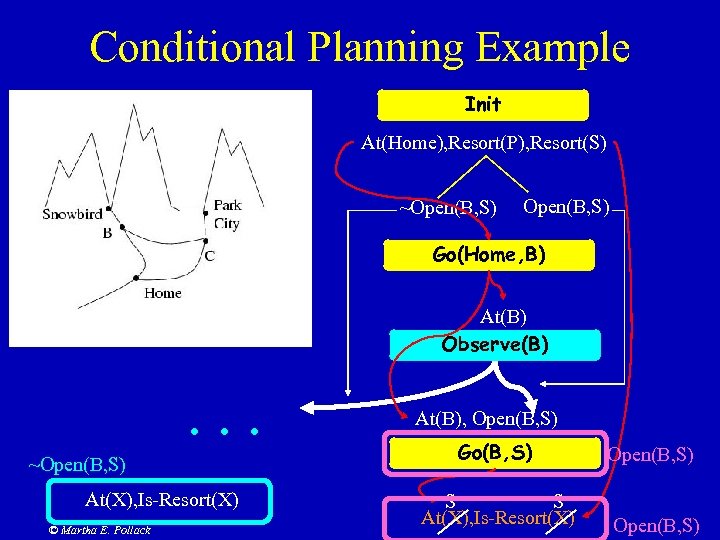 Conditional Planning Example Init At(Home), Resort(P), Resort(S) ~Open(B, S) Go(Home, B) At(B) Observe(B) . . . ~Open(B, S) At(X), Is-Resort(X) © Martha E. Pollack At(B), Open(B, S) Go(B, S) Open(B, S) S S At(X), Is-Resort(X) Open(B, S)
 Corrective Repair • “Correct” the problems encountered, by specifying what to do in alternative contexts • Requires observational actions, but not probabilities • Plan for C 1; ~C 1 ^ C 2; ~C 1 ^ ~C 2 ^ C 3; . . . • Disjunction of contexts is a tautology—cover all cases! – In practice, may be impossible © Martha E. Pollack
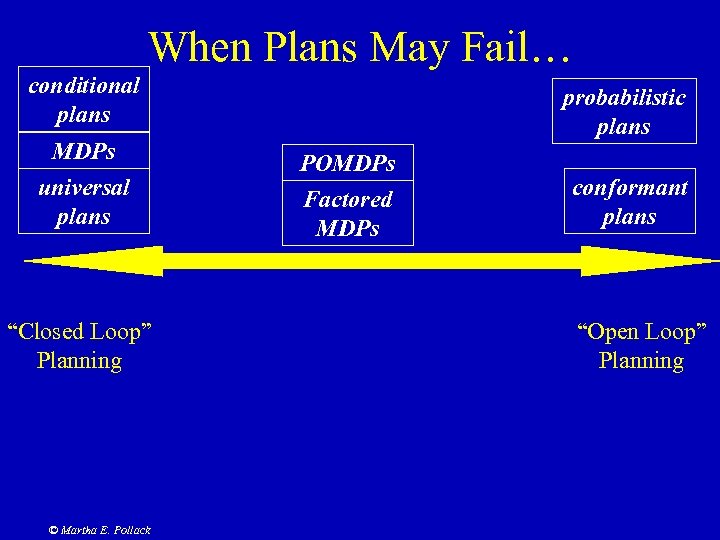 When Plans May Fail… conditional plans MDPs universal plans “Closed Loop” Planning © Martha E. Pollack probabilistic plans POMDPs Factored MDPs conformant plans “Open Loop” Planning
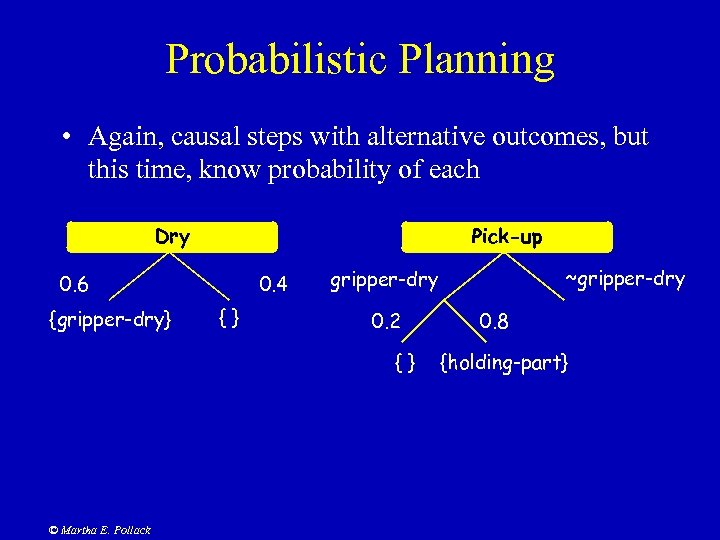 Probabilistic Planning • Again, causal steps with alternative outcomes, but this time, know probability of each Dry Pick-up 0. 6 {gripper-dry} 0. 4 {} 0. 2 {} © Martha E. Pollack ~gripper-dry 0. 8 {holding-part}
 Planning to a Guaranteed Threshold • Generate a plan that achieves goal with probability exceeding some threshold • Don’t need observation actions © Martha E. Pollack
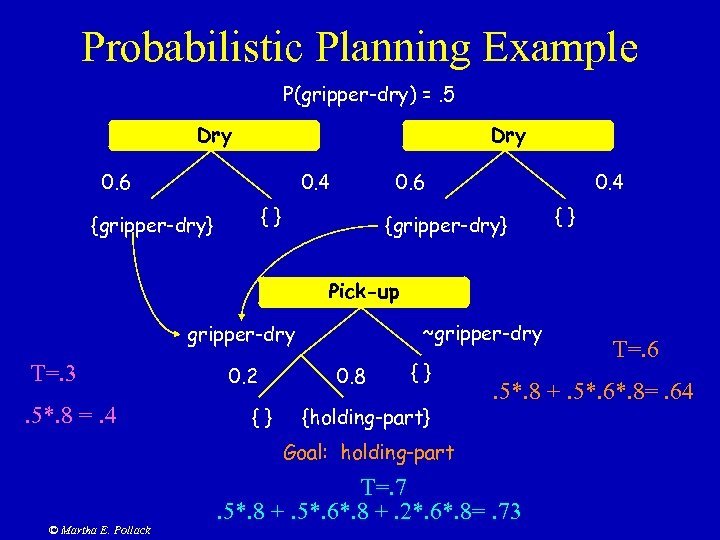 Probabilistic Planning Example P(gripper-dry) =. 5 Dry 0. 6 0. 4 0. 6 {} {gripper-dry} 0. 4 {gripper-dry} {} Pick-up ~gripper-dry T=. 3. 5*. 8 =. 4 0. 2 {} 0. 8 {} {holding-part} . 5*. 8 +. 5*. 6*. 8=. 64 Goal: holding-part © Martha E. Pollack T=. 6 T=. 7. 5*. 8 +. 5*. 6*. 8 +. 2*. 6*. 8=. 73
 Preventive Repair • Probabilistic planning “prevents” problems from arising • Success measured w. r. t. a threshold • Don’t require observational actions (although in practice, may allow them) • Exist SAT-based probabilistic planners – MAXPLAN © Martha E. Pollack
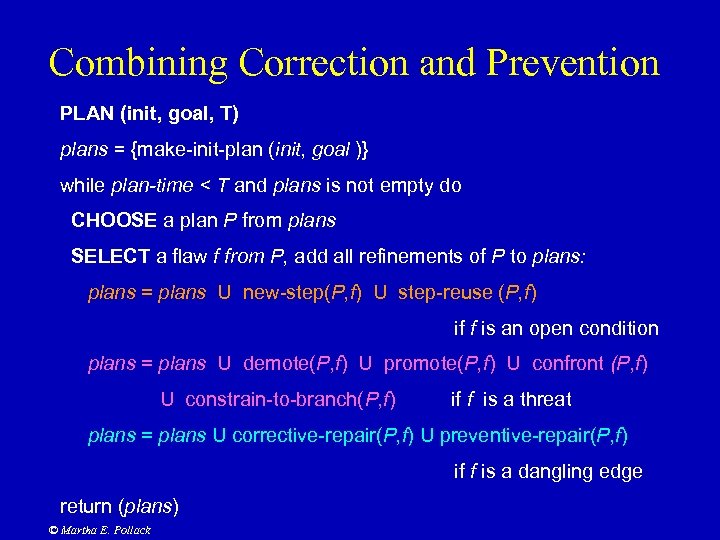 Combining Correction and Prevention PLAN (init, goal, T) plans = {make-init-plan (init, goal )} while plan-time < T and plans is not empty do CHOOSE a plan P from plans SELECT a flaw f from P, add all refinements of P to plans: plans = plans U new-step(P, f) U step-reuse (P, f) if f is an open condition plans = plans U demote(P, f) U promote(P, f) U confront (P, f) U constrain-to-branch(P, f) if f is a threat plans = plans U corrective-repair(P, f) U preventive-repair(P, f) if f is a dangling edge return (plans) © Martha E. Pollack
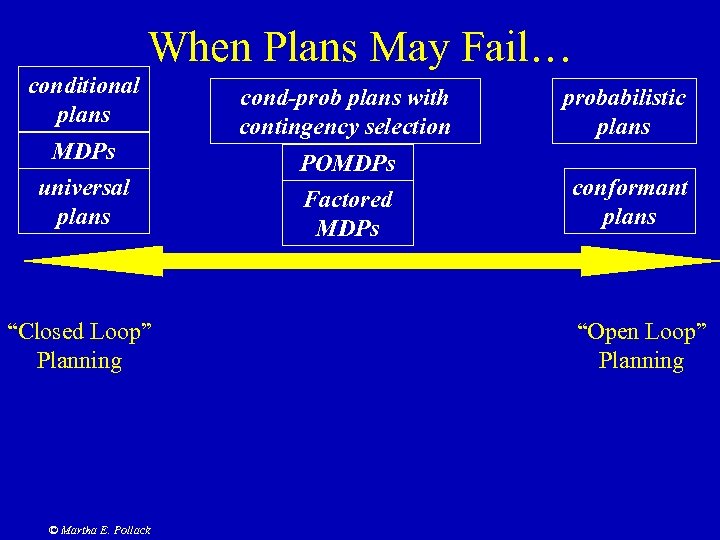 When Plans May Fail… conditional plans MDPs universal plans “Closed Loop” Planning © Martha E. Pollack cond-prob plans with contingency selection probabilistic plans POMDPs Factored MDPs conformant plans “Open Loop” Planning
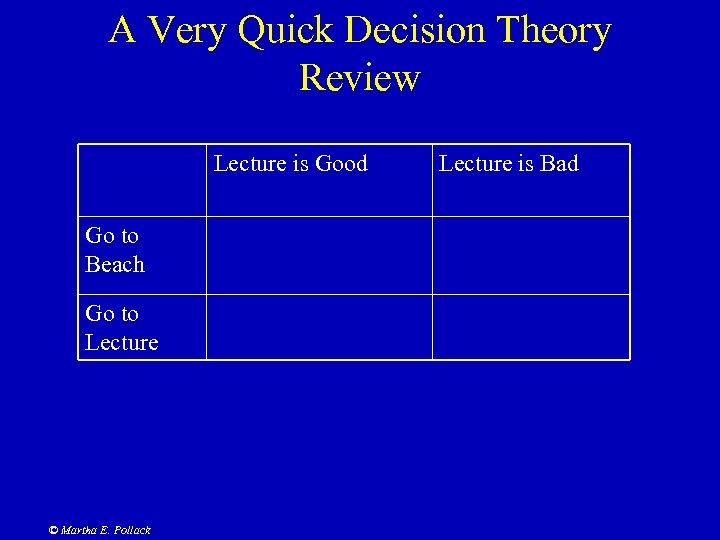 A Very Quick Decision Theory Review Lecture is Good Go to Beach Go to Lecture © Martha E. Pollack Lecture is Bad
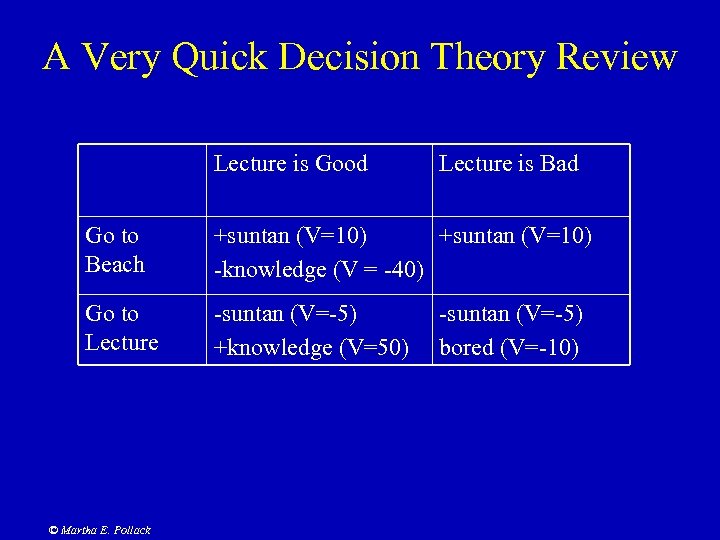 A Very Quick Decision Theory Review Lecture is Good Lecture is Bad Go to Beach +suntan (V=10) -knowledge (V = -40) Go to Lecture -suntan (V=-5) +knowledge (V=50) © Martha E. Pollack -suntan (V=-5) bored (V=-10)
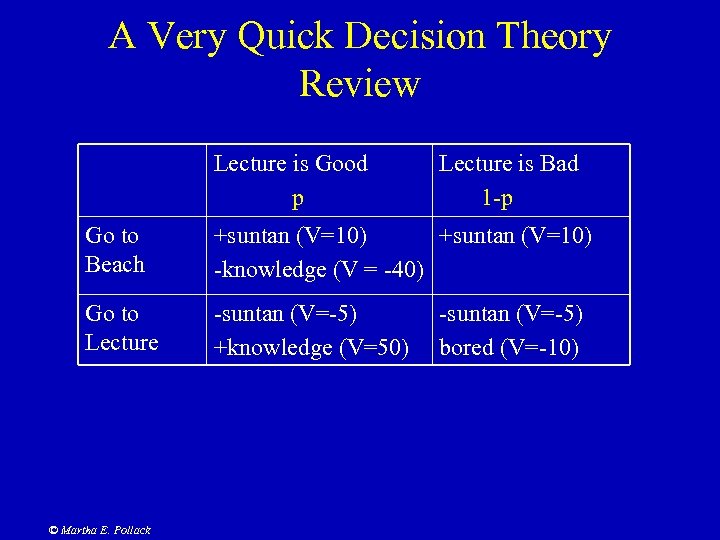 A Very Quick Decision Theory Review Lecture is Good p Lecture is Bad 1 -p Go to Beach +suntan (V=10) -knowledge (V = -40) Go to Lecture -suntan (V=-5) +knowledge (V=50) © Martha E. Pollack -suntan (V=-5) bored (V=-10)
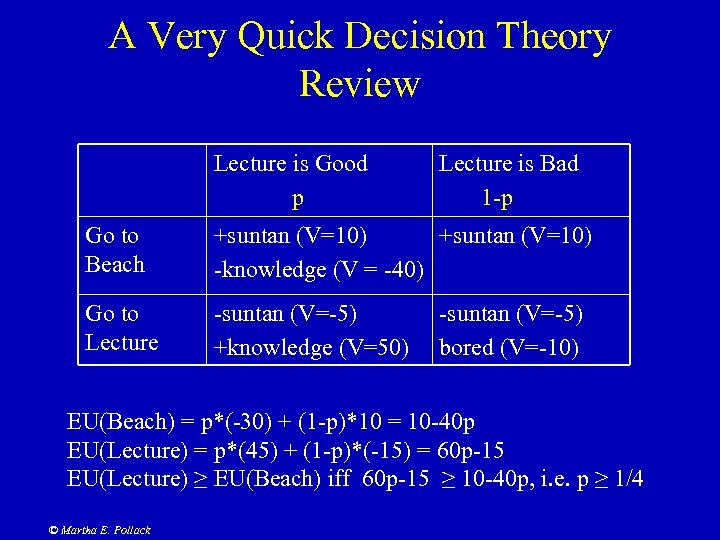 A Very Quick Decision Theory Review Lecture is Good p Lecture is Bad 1 -p Go to Beach +suntan (V=10) -knowledge (V = -40) Go to Lecture -suntan (V=-5) +knowledge (V=50) -suntan (V=-5) bored (V=-10) EU(Beach) = p*(-30) + (1 -p)*10 = 10 -40 p EU(Lecture) = p*(45) + (1 -p)*(-15) = 60 p-15 EU(Lecture) ≥ EU(Beach) iff 60 p-15 ≥ 10 -40 p, i. e. p ≥ 1/4 © Martha E. Pollack
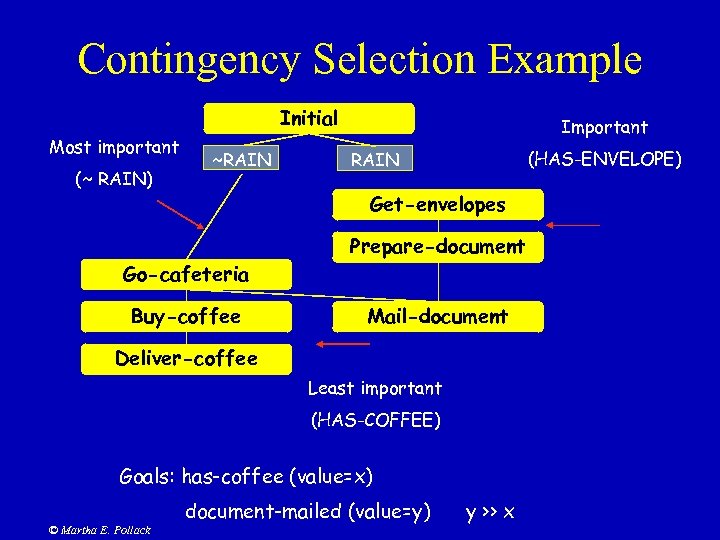 Contingency Selection Example Initial Most important (~ RAIN) ~RAIN Important (HAS-ENVELOPE) RAIN Get-envelopes Go-cafeteria Buy-coffee Prepare-document Mail-document Deliver-coffee Least important (HAS-COFFEE) Goals: has-coffee (value=x) © Martha E. Pollack document-mailed (value=y) y >> x
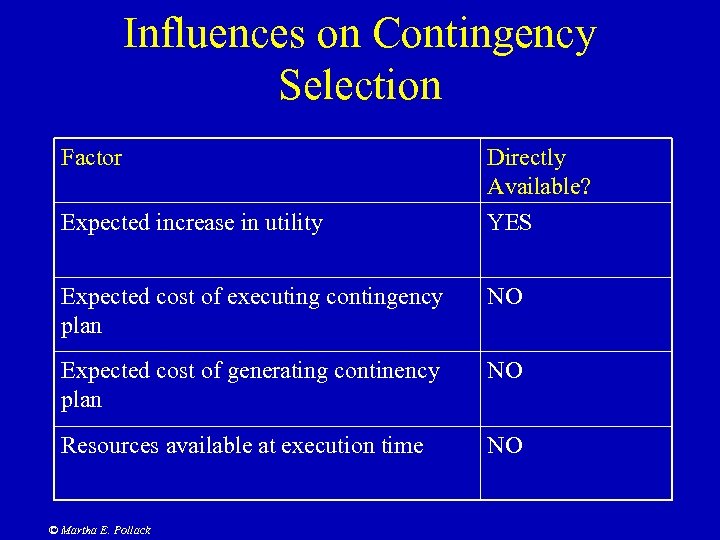 Influences on Contingency Selection Factor Directly Available? Expected increase in utility YES Expected cost of executing contingency plan NO Expected cost of generating continency plan NO Resources available at execution time NO © Martha E. Pollack
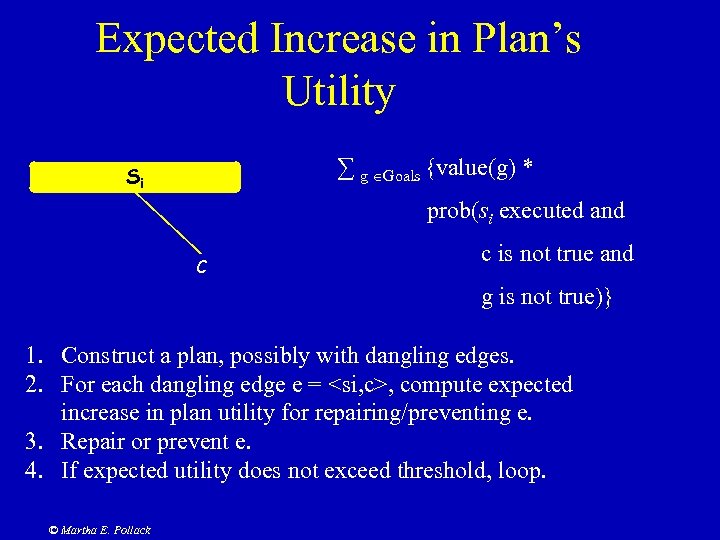 Expected Increase in Plan’s Utility ∑ g Goals {value(g) * Si prob(si executed and C c is not true and g is not true)} 1. Construct a plan, possibly with dangling edges. 2. For each dangling edge e =
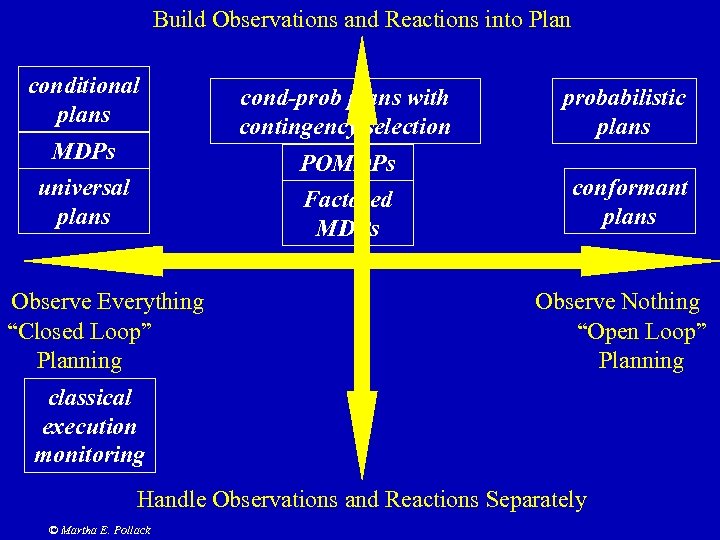 Build Observations and Reactions into Plan conditional plans Observe Everything “Closed Loop” Planning probabilistic plans POMDPs Factored MDPs universal plans cond-prob plans with contingency selection conformant plans Observe Nothing “Open Loop” Planning classical execution monitoring Handle Observations and Reactions Separately © Martha E. Pollack
![at(home) near(keys) Triangle Tables put(keys, pocket) holding(keys) [Fikes & Nilsson] bus(home, office) open(office, keys)](https://present5.com/presentation/fee1706fc9c7d2d7fa1878454f7080c0/image-29.jpg "at(home) near(keys) Triangle Tables put(keys, pocket) holding(keys) [Fikes & Nilsson] bus(home, office) open(office, keys)") at(home) near(keys) Triangle Tables put(keys, pocket) holding(keys) [Fikes & Nilsson] bus(home, office) open(office, keys) 1 2 3 init near(keys) at(home) 4 1 © Martha E. Pollack put(keys, pocket) bus(home, office) at(office) in(office) open(office, holding(keys) in(office) 2 3 4 Find largest n s. t. nth kernal enabled Execute nth action.
at(home) near(keys) Triangle Tables put(keys, pocket) holding(keys) [Fikes & Nilsson] bus(home, office) open(office, keys) 1 2 3 init near(keys) at(home) 4 1 © Martha E. Pollack put(keys, pocket) bus(home, office) at(office) in(office) open(office, holding(keys) in(office) 2 3 4 Find largest n s. t. nth kernal enabled Execute nth action.
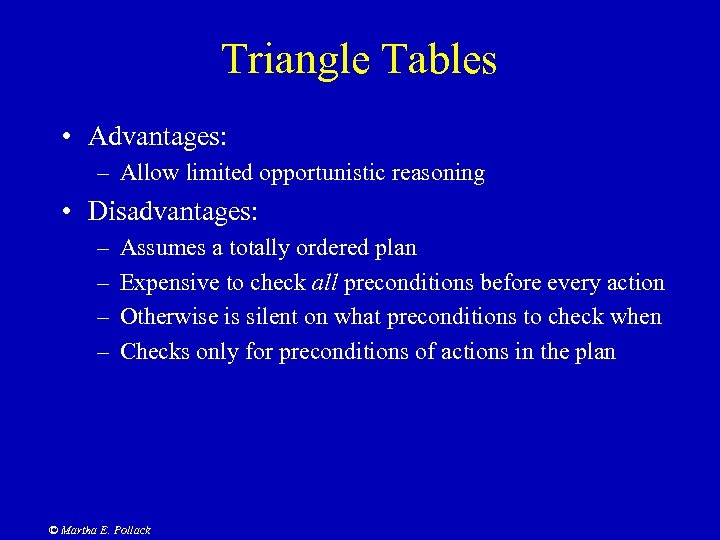 Triangle Tables • Advantages: – Allow limited opportunistic reasoning • Disadvantages: – – Assumes a totally ordered plan Expensive to check all preconditions before every action Otherwise is silent on what preconditions to check when Checks only for preconditions of actions in the plan © Martha E. Pollack
![Monitoring for Alternatives [Veloso, Pollack, & Cox] • May want to change the plan](https://present5.com/presentation/fee1706fc9c7d2d7fa1878454f7080c0/image-31.jpg "Monitoring for Alternatives [Veloso, Pollack, & Cox] • May want to change the plan") Monitoring for Alternatives [Veloso, Pollack, & Cox] • May want to change the plan even if it can still succeed • Monitor for conditions that caused rejection of alternatives during planning • May be useful during planning as well as during execution © Martha E. Pollack
Monitoring for Alternatives [Veloso, Pollack, & Cox] • May want to change the plan even if it can still succeed • Monitor for conditions that caused rejection of alternatives during planning • May be useful during planning as well as during execution © Martha E. Pollack
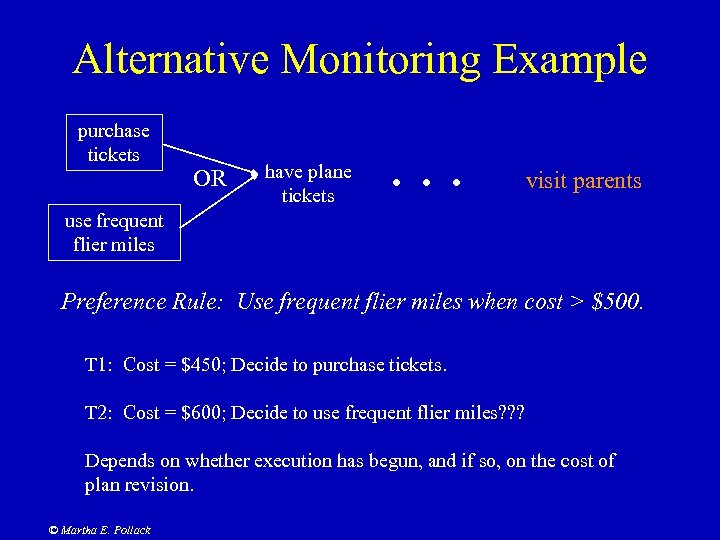 Alternative Monitoring Example purchase tickets OR have plane tickets . . . visit parents use frequent flier miles Preference Rule: Use frequent flier miles when cost > $500. T 1: Cost = $450; Decide to purchase tickets. T 2: Cost = $600; Decide to use frequent flier miles? ? ? Depends on whether execution has begun, and if so, on the cost of plan revision. © Martha E. Pollack
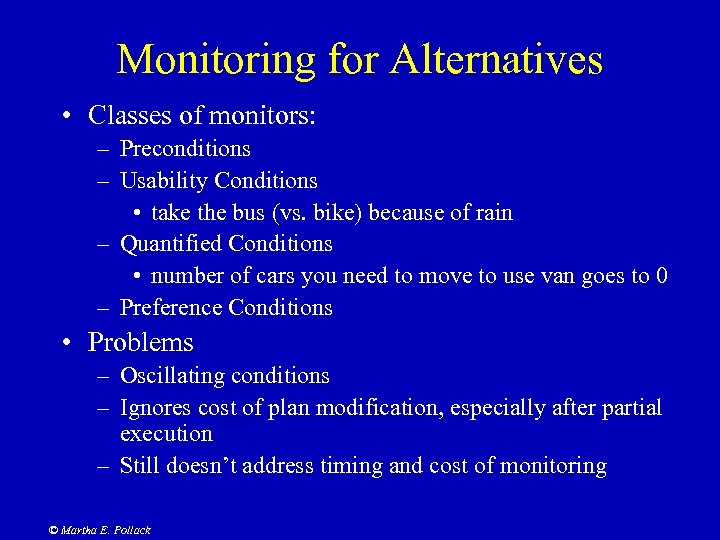 Monitoring for Alternatives • Classes of monitors: – Preconditions – Usability Conditions • take the bus (vs. bike) because of rain – Quantified Conditions • number of cars you need to move to use van goes to 0 – Preference Conditions • Problems – Oscillating conditions – Ignores cost of plan modification, especially after partial execution – Still doesn’t address timing and cost of monitoring © Martha E. Pollack
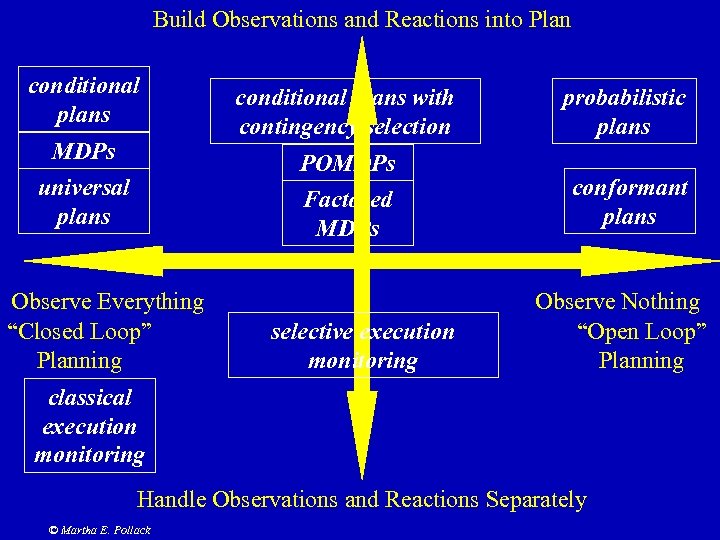 Build Observations and Reactions into Plan conditional plans Observe Everything “Closed Loop” Planning probabilistic plans POMDPs Factored MDPs universal plans conditional plans with contingency selection conformant plans selective execution monitoring Observe Nothing “Open Loop” Planning classical execution monitoring Handle Observations and Reactions Separately © Martha E. Pollack
![Decision-Theoretic Selection of [Boutilier] Monitors • Monitor selection is actually a sequential decision problem](https://present5.com/presentation/fee1706fc9c7d2d7fa1878454f7080c0/image-35.jpg "Decision-Theoretic Selection of [Boutilier] Monitors • Monitor selection is actually a sequential decision problem") Decision-Theoretic Selection of [Boutilier] Monitors • Monitor selection is actually a sequential decision problem • At each stage: – – Decide what (if anything) to monitor Update beliefs on the basis of monitoring results Decide whether to continue or abandon the plan If continue, update beliefs after acting • Formulate as a POMDP © Martha E. Pollack
Decision-Theoretic Selection of [Boutilier] Monitors • Monitor selection is actually a sequential decision problem • At each stage: – – Decide what (if anything) to monitor Update beliefs on the basis of monitoring results Decide whether to continue or abandon the plan If continue, update beliefs after acting • Formulate as a POMDP © Martha E. Pollack
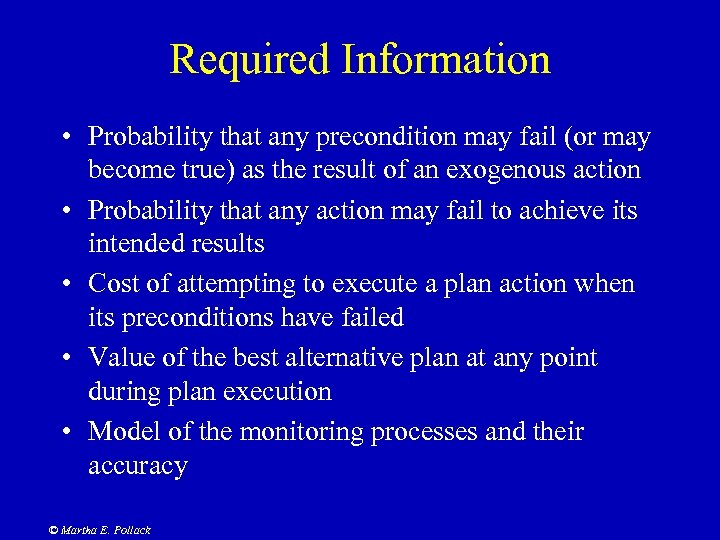 Required Information • Probability that any precondition may fail (or may become true) as the result of an exogenous action • Probability that any action may fail to achieve its intended results • Cost of attempting to execute a plan action when its preconditions have failed • Value of the best alternative plan at any point during plan execution • Model of the monitoring processes and their accuracy © Martha E. Pollack
 Heuristic Monitoring • Solving the POMDP is computationally quite costly • Effective alternative: Construct and solve a separate POMDP for each stage of the plan; combine results online © Martha E. Pollack
 Today’s Outline 1. Handling Potential Plan Failures 2. Managing Deliberation Resources © Martha E. Pollack
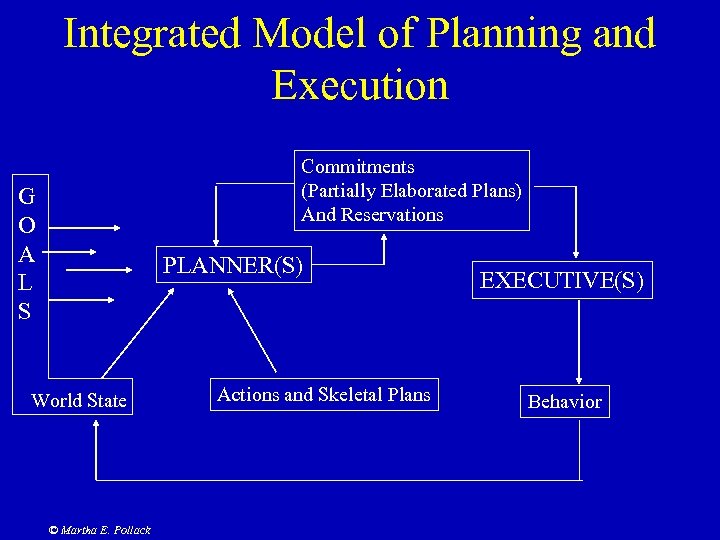 Integrated Model of Planning and Execution Commitments (Partially Elaborated Plans) And Reservations G O A L S PLANNER(S) World State © Martha E. Pollack Actions and Skeletal Plans EXECUTIVE(S) Behavior
 Deliberation Management • Have planning problems for goals G 1, G 2, . . . , Gn, and possibly competing execution step X. • What should the agent do? • A decision problem: can we apply decision theory? © Martha E. Pollack
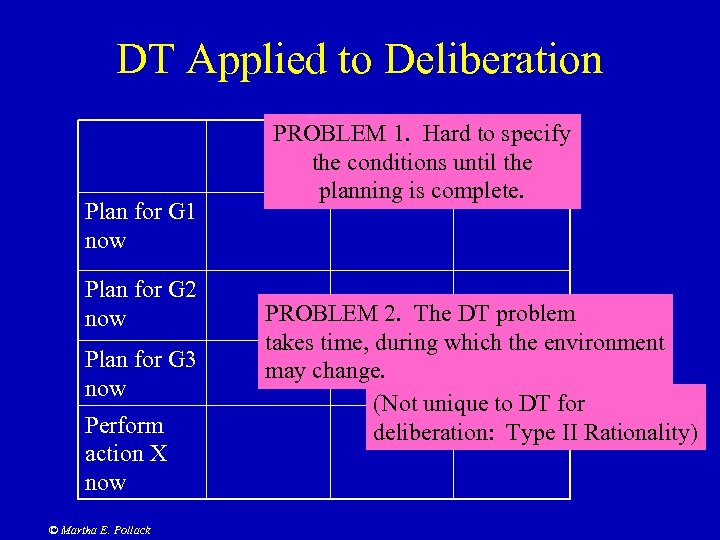 DT Applied to Deliberation Plan for G 1 now Plan for G 2 now Plan for G 3 now Perform action X now © Martha E. Pollack PROBLEM 1. Hard to specify the conditions until the planning is complete. PROBLEM 2. The DT problem takes time, during which the environment may change. (Not unique to DT for deliberation: Type II Rationality)
![Bounded Optimality [Russell & Subramanian] • Start with a method for evaluating agent behavior](https://present5.com/presentation/fee1706fc9c7d2d7fa1878454f7080c0/image-42.jpg "Bounded Optimality [Russell & Subramanian] • Start with a method for evaluating agent behavior") Bounded Optimality [Russell & Subramanian] • Start with a method for evaluating agent behavior • Basic idea: – Recognize that all agents have computational limits as a result of being implemented on physical architecture – Treat an agent as (boundedly) optimal if it performs at least as well as other agents with identical architectures © Martha E. Pollack
Bounded Optimality [Russell & Subramanian] • Start with a method for evaluating agent behavior • Basic idea: – Recognize that all agents have computational limits as a result of being implemented on physical architecture – Treat an agent as (boundedly) optimal if it performs at least as well as other agents with identical architectures © Martha E. Pollack
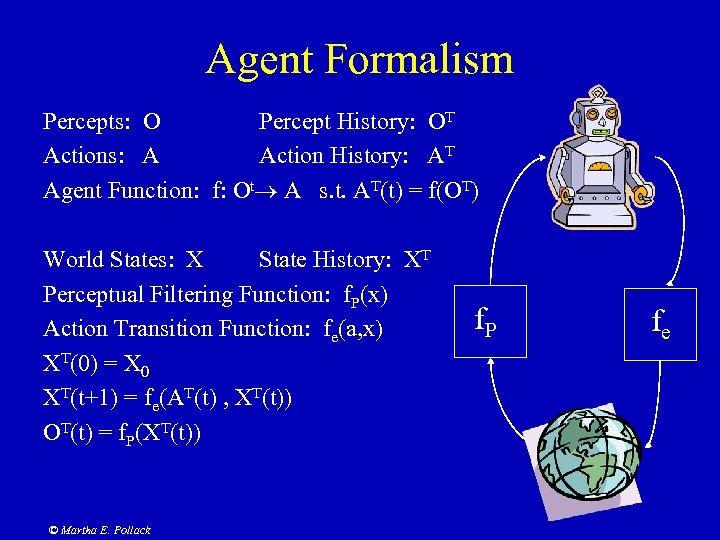 Agent Formalism Percepts: O Percept History: OT Actions: A Action History: AT Agent Function: f: Ot A s. t. AT(t) = f(OT) World States: X State History: XT Perceptual Filtering Function: f. P(x) Action Transition Function: fe(a, x) XT(0) = X 0 XT(t+1) = fe(AT(t) , XT(t)) OT(t) = f. P(XT(t)) © Martha E. Pollack f. P fe
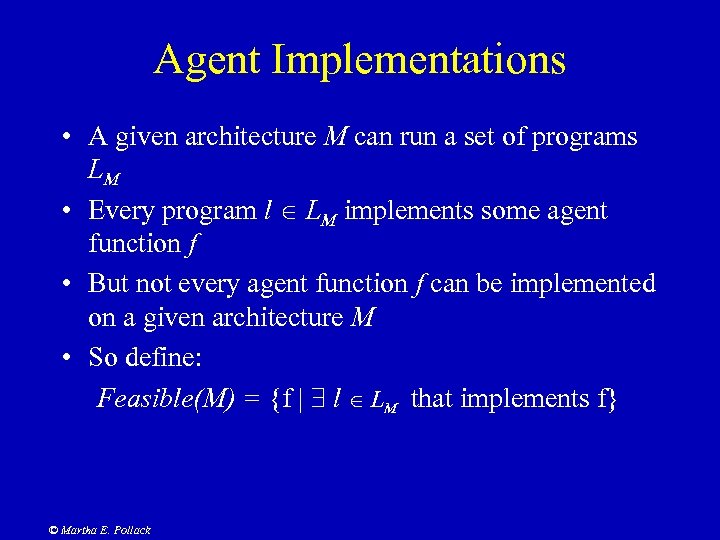 Agent Implementations • A given architecture M can run a set of programs LM • Every program l LM implements some agent function f • But not every agent function f can be implemented on a given architecture M • So define: Feasible(M) = {f | l LM that implements f} © Martha E. Pollack
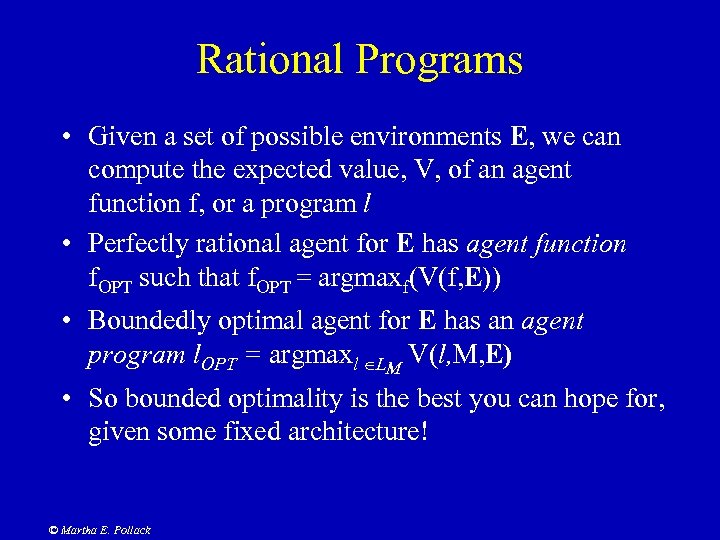 Rational Programs • Given a set of possible environments E, we can compute the expected value, V, of an agent function f, or a program l • Perfectly rational agent for E has agent function f. OPT such that f. OPT = argmaxf(V(f, E)) • Boundedly optimal agent for E has an agent program l. OPT = argmaxl LM V(l, M, E) • So bounded optimality is the best you can hope for, given some fixed architecture! © Martha E. Pollack
 Back to Deliberation Management “The gap between theory and practice is bigger in practice than in theory. ” Bounded Optimality not (yet? ) applied to the problem of deciding amongst planning problems. Has been applied to certain cases of deciding amongst decision procedures (planners). © Martha E. Pollack
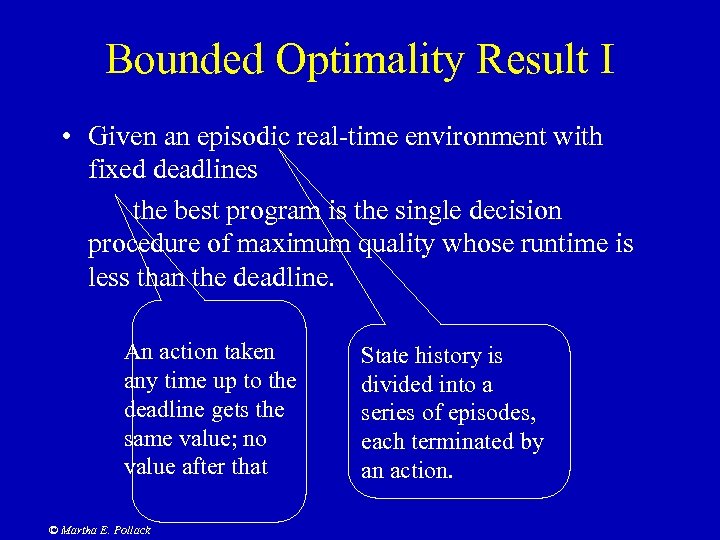 Bounded Optimality Result I • Given an episodic real-time environment with fixed deadlines the best program is the single decision procedure of maximum quality whose runtime is less than the deadline. An action taken any time up to the deadline gets the same value; no value after that © Martha E. Pollack State history is divided into a series of episodes, each terminated by an action.
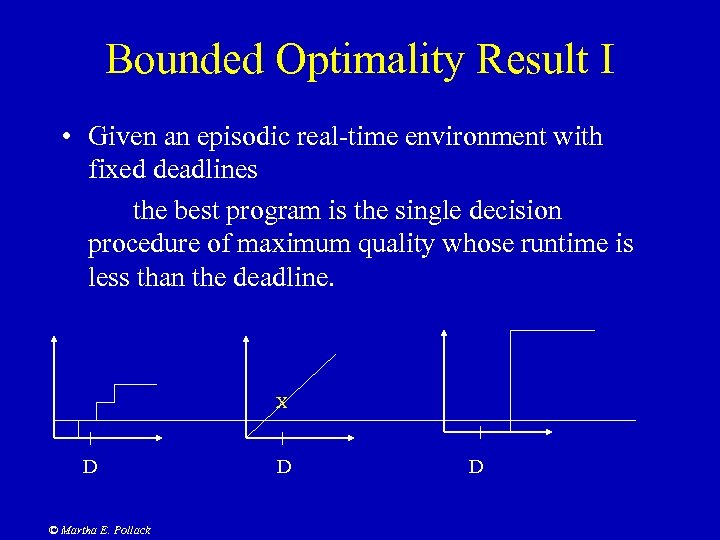 Bounded Optimality Result I • Given an episodic real-time environment with fixed deadlines the best program is the single decision procedure of maximum quality whose runtime is less than the deadline. X D © Martha E. Pollack D D
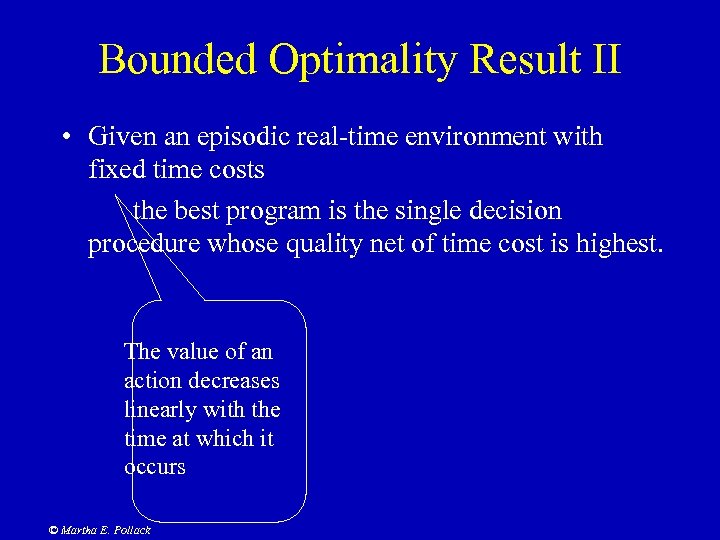 Bounded Optimality Result II • Given an episodic real-time environment with fixed time costs the best program is the single decision procedure whose quality net of time cost is highest. The value of an action decreases linearly with the time at which it occurs © Martha E. Pollack
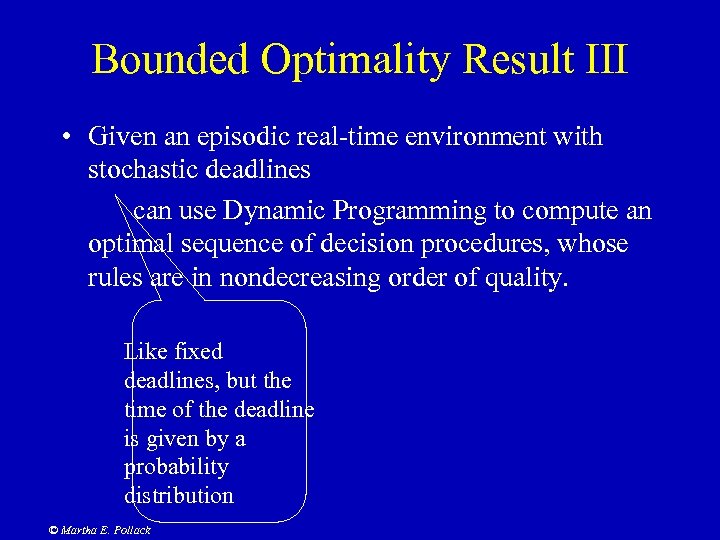 Bounded Optimality Result III • Given an episodic real-time environment with stochastic deadlines can use Dynamic Programming to compute an optimal sequence of decision procedures, whose rules are in nondecreasing order of quality. Like fixed deadlines, but the time of the deadline is given by a probability distribution © Martha E. Pollack
 Challenge • Develop an account of bounded optimality for the deliberation management problem! © Martha E. Pollack
![An Alternative Account [Bratman, Pollack, & Israel] • Heuristic approach, based on BDI (Belief-Desire.](https://present5.com/presentation/fee1706fc9c7d2d7fa1878454f7080c0/image-52.jpg "An Alternative Account [Bratman, Pollack, & Israel] • Heuristic approach, based on BDI (Belief-Desire.") An Alternative Account [Bratman, Pollack, & Israel] • Heuristic approach, based on BDI (Belief-Desire. Intention) theory • Grew out of philosophy of intention • Was influential in the development of PRS (Procedural Reasoning System) © Martha E. Pollack
An Alternative Account [Bratman, Pollack, & Israel] • Heuristic approach, based on BDI (Belief-Desire. Intention) theory • Grew out of philosophy of intention • Was influential in the development of PRS (Procedural Reasoning System) © Martha E. Pollack
 The Philosophical Motivation • Question: Why Plan (Make Commitments)? – Metaphysically Objectionable (action at a distance) or – Rationally Objectionable (if commitments are irrevocable) or – A Waste of Time (if you maintain commitments only when you’re form the commitment anyway) • One Answer: Plans help with deliberation management, by constraining future actions © Martha E. Pollack
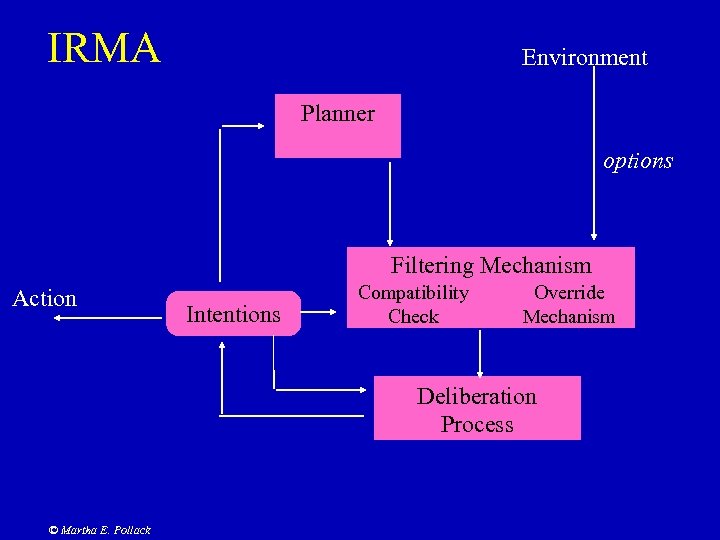 IRMA Environment Planner options Filtering Mechanism Action Intentions Compatibility Check Override Mechanism Deliberation Process © Martha E. Pollack
 Filtering • Mechanism for maintaining stability of intentions in order to focus reasoning • Designer must balance appropriate sensitivity to environmental change against reasonable stability of plans • Can't expect perfection: Need to trade occasional wasted reasoning and locally suboptimal behavior for overall effectiveness © Martha E. Pollack
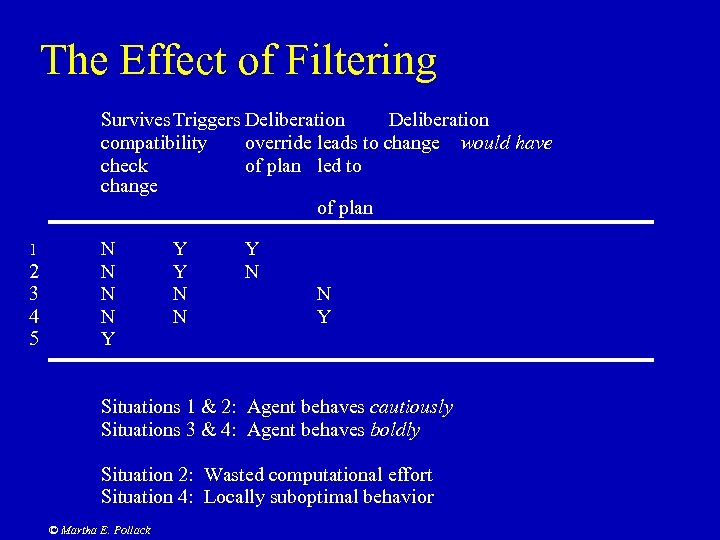 The Effect of Filtering Survives Triggers Deliberation compatibility override leads to change would have check of plan led to change of plan 1 2 3 4 5 N N Y Y Y N N Y Situations 1 & 2: Agent behaves cautiously Situations 3 & 4: Agent behaves boldly Situation 2: Wasted computational effort Situation 4: Locally suboptimal behavior © Martha E. Pollack
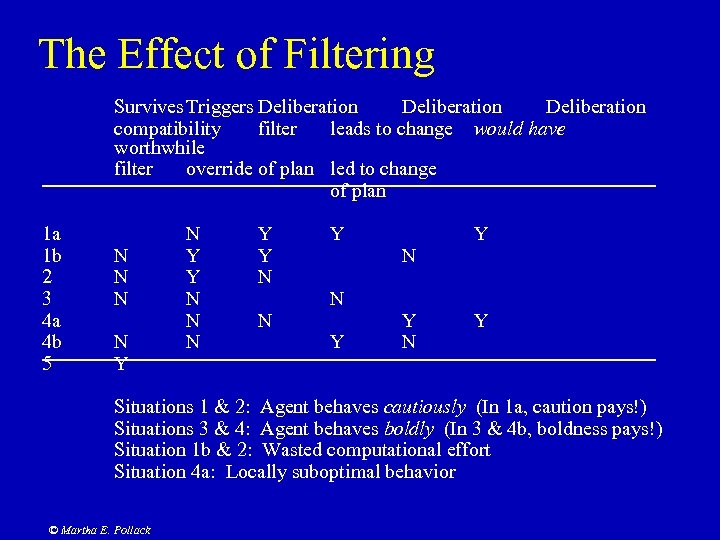 The Effect of Filtering Survives Triggers Deliberation compatibility filter leads to change would have worthwhile filter override of plan led to change of plan 1 a 1 b 2 3 4 a 4 b 5 N N Y N Y Y N N Y N Y N Y Y Situations 1 & 2: Agent behaves cautiously (In 1 a, caution pays!) Situations 3 & 4: Agent behaves boldly (In 3 & 4 b, boldness pays!) Situation 1 b & 2: Wasted computational effort Situation 4 a: Locally suboptimal behavior © Martha E. Pollack
 From Theory to Practice “The gap between theory and practice is bigger in practice than in theory. ” • Most results were shown in an artificial, simulated environment: The Tileworld • More recent work: – Refined account in which filtering is not all-or-nothing: the greater the potential value of a new option, the more change to the background plan allowed. – Based on account of computing the cost of actions in the context of other plans. © Martha E. Pollack
 Planning and Execution—Other Issues • Goal identification • Cost/benefit assessment of plans • Replanning techniques and priorities • Execution Systems: PRS • Real-Time Planning Systems: MARUTI, CIRCA © Martha E. Pollack
 Conclusion © Martha E. Pollack
 References 1. Temporal Constraint Networks Dechter, R. , I. Meiri, and J. Pearl, “Temporal Constraint Networks, ” Artificial Intelligence 49: 61 -95, 1991. 2. Temporal Plan Dispatch Muscettola, N. , P. Morris, and I. Tsamardinos, “Reformulating Temporal Plans for Efficient Execution, ” in Proc. of the 6 th Conf. on Principles of Knowledge Representation and Reasoning, 1998. Tsamardinos, I. , P. Morris, and N. Muscettola, “Fast Transformation of Temporal Plans for Efficient Execution, ” in Proc. of the 15 th Nat’l. Conf. on Artificial Intelligence, pp. 254 -161, 1998. Wallace, R. J. and E. C. Freuder, “Dispatchable Execution of Schedules Involving Consumable Resources, ” in Proc. of the 5 th Int’l. Conf. On AI Planning and Scheduling, pp. 283 -290, 2000. I. Tsamardinos, M. E. Pollack, and P. Ganchev, “Flexible Dispatch of Disjunctive Plans, ” in Proc. of the 6 th European Conf. on Planning, 2001. © Martha E. Pollack
 References (2) 3. Disjunctive Temporal Problems Oddi, A. and A. Cesta, “Incremental Forward Checking for the Disjunctive Temporal Problem, ” in Proc. of the European Conf. On Artificial Intelligence, 2000. Stergiou, K. and M. Koubarakis, “Backtracking Algorithms for Disjunctions of Temporal Constraints, ” Artificial Intelligence 120: 81 -117, 2000. Armando, A. , C. Castellini, and E. Guinchiglia, “SAT-Based Procedures for Temporal Reasoning, ” in Proc. Of the 5 th European Conf. On Planning, 1999. Tsamardinos, I. Constraint-Based Temporal Reasoning Algorithms with Applications to Planning, Univ. of Pittsburgh Ph. D. Dissertation, 2001. 4. CSTP Tsamardinos, I. , T. Vidal, and M. E. Pollack, “CTP: A New Constraint-Based Formalism for Conditional, Temporal Planning, ” to appear in Constraints, 2002. © Martha E. Pollack
 References (3) 5. STP-u Khatib, L. , P. Morris, R. Morris, and F. Rossi, “Temporal Reasoning with Preferences, ” in Proc. of the 17 th Int’l. Joint Conf. on Artificial Intelligence, pp. 322 -327, 2001. Morris, P. , N. Muscettola, and T. Vida, “Dynamic Control of Plans with Temporal Uncertainty, ” in Proc. of the 17 th Int’l. Joint Conf. on Artificial Intelligence, pp. 494 -499, 2001. 6. The Nursebot Project M. E. Pollack, “Planning Technology for Intelligent Cognitive Orthotics, ” in Proc. of the 6 th Intl. Conf. on AI Planning and Scheduling, pp. 322 -331, 2002. M. E. Pollack, S. Engberg, J. T. Matthews, S. Thrun, L. Brown, D. Colbry, C. Orosz, B. Peintner, S. Ramakrishnan, J. Dunbar-Jacob, C. Mc. Carthy, M. Montemerlo, J. Pineau, and N. Roy, “Pearl: A Mobile Robotic Assistant for the Elderly, ” in AAAI Workshop on Automation as Caregiver, 2002 © Martha E. Pollack
 References (4) 7. Conformant Planning Smith, D. and D. Weld, “Conformant Graphplan, ” in Proc. Of the 15 th Nat’l. Conf. on Artificial Intelligence, pp. 889 -896, 1998. Kurien, J. , P. Nayak, and D. Smith, “Fragment-Based Conformant Planning, ” in Proc. of the 6 th Int’l. Conf. on AI Planning and Scheduling, pp. 153 -162, 2002. Castellini, C. , E. Giunchiglia, and A. Tacchella, “Improvements to SAT-Based Conformant Planning, ” in Proc. of the 6 th European Conf. on Planning, 2001. 8. Universal Plans Schoppers, M. , “Universal plans for reactive robots in unpredictable environments, ” in Proc. of the 10 th Int’l. Joint Conf. on Artificial Intelligence, 1987. Ginsberg, M. , “Universal planning: an (almost) universally bad idea, ” AI Magazine, 10: 40 -44, 1989. Schoppers, M. , “In defense of reaction plans as caches, ” AI Magazine, 10: 51 -60, 1989. © Martha E. Pollack
 References (5) 7. Conditional and Probabilistic Planning Peot, M. and D. Smith, “Conditional Nonlinear Planning, in Proc. of the 1 st Int’l. Conf. On AI Planning Systems, pp. 189 -197, 1992. Kushmerick, N. , S. Hanks, and D. Weld, “An Algorithm for Probabilistic Least. Commitment Planning, ” in Proc. Of the 12 th Nat’l. Conf. On AI, pp. 10731078, 1994. Draper, D. , S. Hanks, and D. Weld, “Probabilistic Planning with Information Gathering and Contingent Execution, ” in Proc. of the 2 nd In’l. Conf. on AI Planning Systems, p. 31 -26, 1994. Pryor, L. and G. Collins, “Planning for Contingencies: A Decision-Based Approach, ” Journal of Artificial Intelligence Research, 4: 287 -339, 1996. Blythe, J. , Planning under Uncertainty in Dynamic Domains, Ph. D. Thesis, Carnegie Mellon Univ. , 1998. Majercik, S. and M. Littman, “MAXPLAN: A New Approach to Probabilistic Planning, ” in Proc. of 4 th Int’l. Conf. On AI Planning Systems, pp. 86 -93, 1998. Onder, N. and M. E. Pollack, “Conditional, Probabilistic Planning: A Unifying Algorithm and Effective Search Control Mechanisms, ” in Proc. Of the 16 th Nat’l. Conf. On Artificial Intelligence, pp. 577 -584, 1999. © Martha E. Pollack
 References (6) 8. Decision Theory Jeffrey, R. The Logic of Decision, 2 nd Ed. , Chicago: Univ. of Chicago Press, 1983. 9. Execution Monitoring Fikes, R. , P. Hart, and N. Nilsson, “Learning and Executing Generalized Robot Plans, ” Artificial Intelligence, 3: 251 -288, 1972. Veloso, M. E. Pollack, and M. Cox, “Rationale-Based Monitoring for Continuous Planning in Dynamic Environments, ” in Proc. of the 4 th Int’l. Conf. on AI Planning Systems, pp. 171 -179, 1998. Fernandez, J. and R. Simmons, “Robust Execution Monitoring for Navigation Plans, ” in Int’l. Conf. on Intelligent Robotic Systems, 1998. Boutilier, C. , “Approximately Optimal Monitoring of Plan Preconditions, ” in Proc. of the 16 th Conf. on Uncertainty in AI, 2000. © Martha E. Pollack
 References (7) 10. Bounded Optimality Russell, S. and D. Subramanian, “Provably Bounded-Optimal Agents, ” Journal of Artificial Intelligence Research, 2: 575 -609, 1995. 11. Commitment Strategies for Deliberation Management Bratman, M. , D. Israel, and M. E. Pollack, “Plans and Resource-Bounded Practical Reasoning, ” Computational Intelligence, 4: 349 -255, 1988. Pollack, M. E. , “The Uses of Plans, ” Artificial Intelligence, 57: 43 -69, 1992. Horty, J. F. and M. E. Pollack, “Evaluating New Options in the Context of Existing Plans, ” Artificial Intelligence, 127: 199 -220, 2001. © Martha E. Pollack