


 Скачать презентацию Plan Recognition Henry Kautz Computer Science Engineering
d73e144e7ec003734be3baee28fb8263.ppt
- Количество слайдов: 23
 Plan Recognition Henry Kautz Computer Science & Engineering University of Washington Seattle, WA
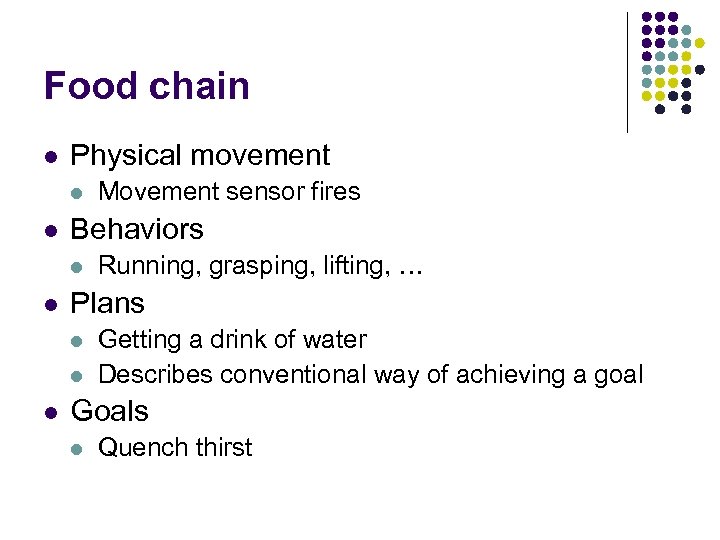 Food chain l Physical movement l l Behaviors l l Running, grasping, lifting, … Plans l l l Movement sensor fires Getting a drink of water Describes conventional way of achieving a goal Goals l Quench thirst
 Dimensions of the plan recognition problem l Keyhole versus interactive l Keyhole l l Determine how an agent’s actions contribute to achieving possible or stipulated goals Model § § l World Agent’s beliefs No model of the observer – fly on the wall
 Dimensions of the plan recognition problem l Keyhole versus interactive l Interactive l Agent acts in order to signal his beliefs and desires to other agents § l Discourse conventions § § l Speech acts – inform, request, … “Two PI’s made it to the Darpa meeting” Evolution of cooperation Symbolic actions § § The Statue of Liberty 9/11?
 Dimensions of the plan recognition problem l Ideal versus fallible agents l Mistaken beliefs l l Cognitive errors l l John drives to Reagan, but flight leaves Dulles. Distracted by the radio, John drives past the exit. Irrationality l John furiously blows his horn at the car in front of him.
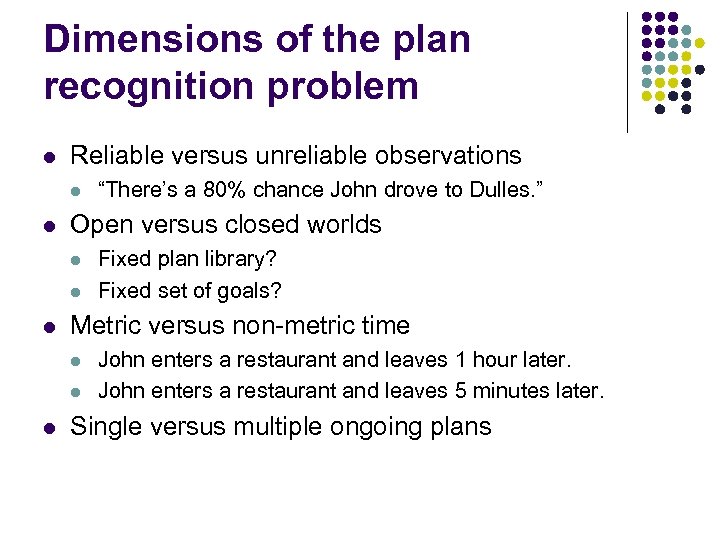 Dimensions of the plan recognition problem l Reliable versus unreliable observations l l Open versus closed worlds l l l Fixed plan library? Fixed set of goals? Metric versus non-metric time l l l “There’s a 80% chance John drove to Dulles. ” John enters a restaurant and leaves 1 hour later. John enters a restaurant and leaves 5 minutes later. Single versus multiple ongoing plans
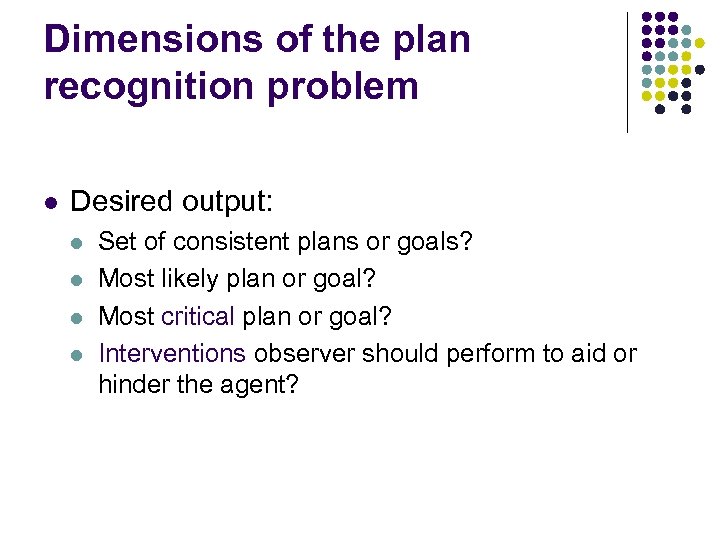 Dimensions of the plan recognition problem l Desired output: l l Set of consistent plans or goals? Most likely plan or goal? Most critical plan or goal? Interventions observer should perform to aid or hinder the agent?
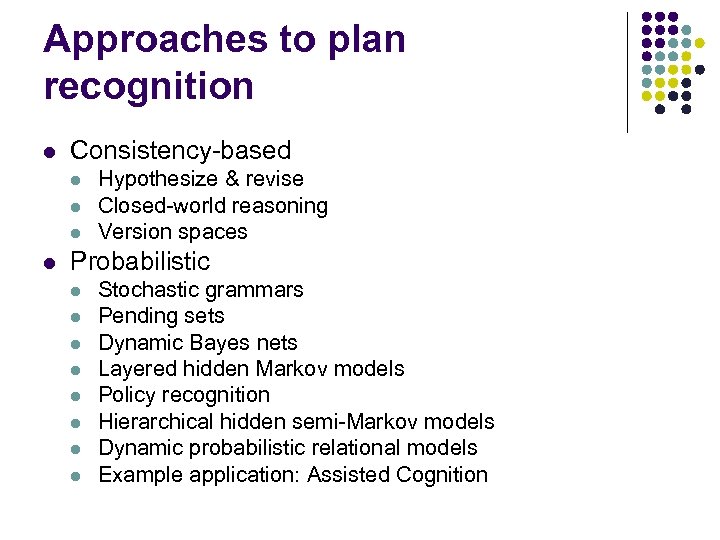 Approaches to plan recognition l Consistency-based l l Hypothesize & revise Closed-world reasoning Version spaces Probabilistic l l l l Stochastic grammars Pending sets Dynamic Bayes nets Layered hidden Markov models Policy recognition Hierarchical hidden semi-Markov models Dynamic probabilistic relational models Example application: Assisted Cognition
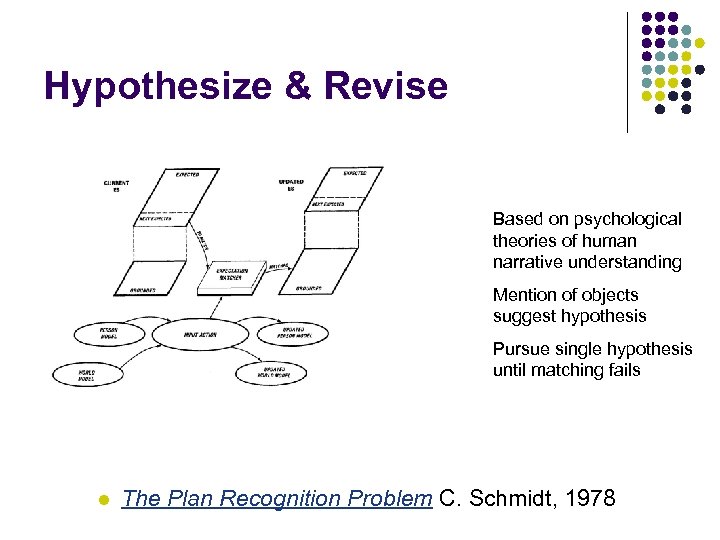 Hypothesize & Revise Based on psychological theories of human narrative understanding Mention of objects suggest hypothesis Pursue single hypothesis until matching fails l The Plan Recognition Problem C. Schmidt, 1978
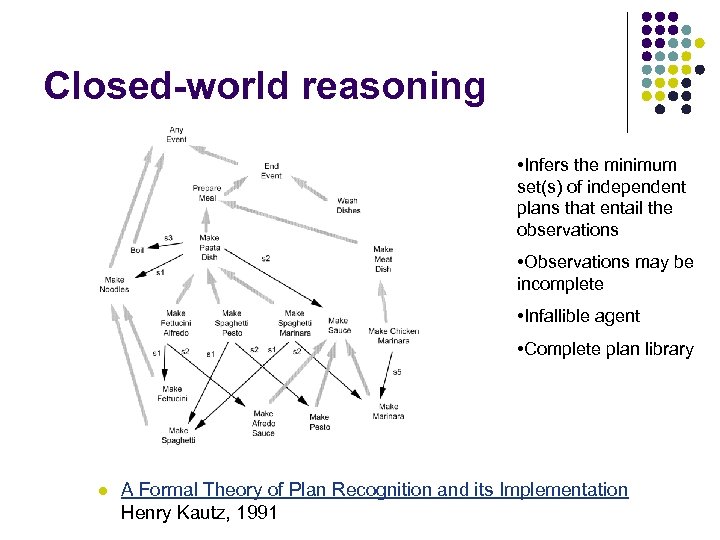 Closed-world reasoning • Infers the minimum set(s) of independent plans that entail the observations • Observations may be incomplete • Infallible agent • Complete plan library l A Formal Theory of Plan Recognition and its Implementation Henry Kautz, 1991
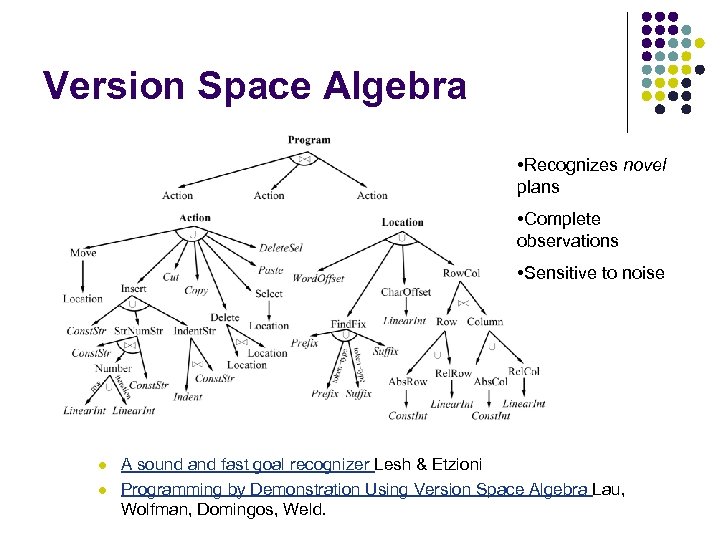 Version Space Algebra • Recognizes novel plans • Complete observations • Sensitive to noise l l A sound and fast goal recognizer Lesh & Etzioni Programming by Demonstration Using Version Space Algebra Lau, Wolfman, Domingos, Weld.
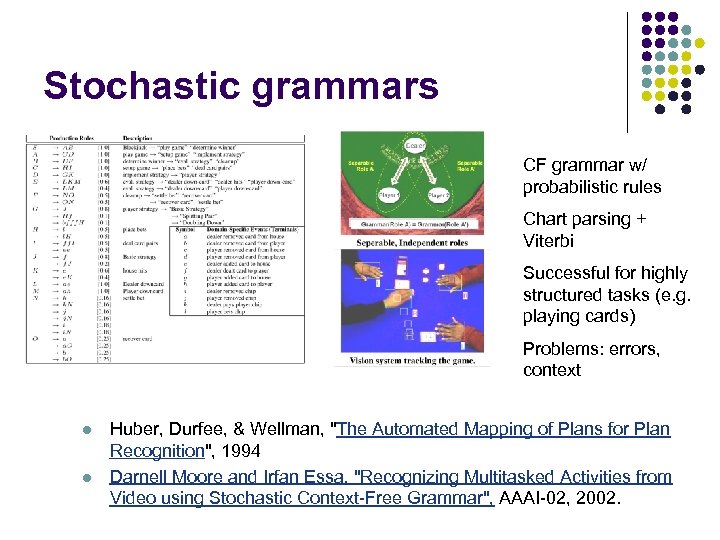 Stochastic grammars CF grammar w/ probabilistic rules Chart parsing + Viterbi Successful for highly structured tasks (e. g. playing cards) Problems: errors, context l l Huber, Durfee, & Wellman, "The Automated Mapping of Plans for Plan Recognition", 1994 Darnell Moore and Irfan Essa, "Recognizing Multitasked Activities from Video using Stochastic Context-Free Grammar", AAAI-02, 2002.
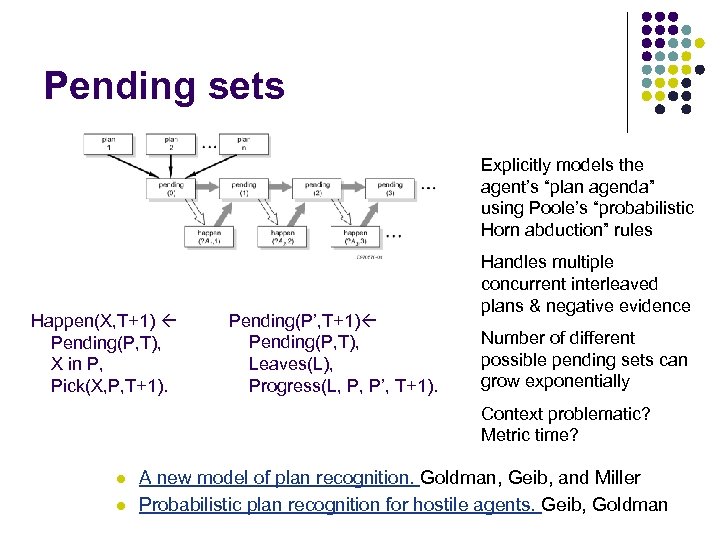 Pending sets Explicitly models the agent’s “plan agenda” using Poole’s “probabilistic Horn abduction” rules Happen(X, T+1) Pending(P, T), X in P, Pick(X, P, T+1). Pending(P’, T+1) Pending(P, T), Leaves(L), Progress(L, P, P’, T+1). l l Handles multiple concurrent interleaved plans & negative evidence Number of different possible pending sets can grow exponentially Context problematic? Metric time? A new model of plan recognition. Goldman, Geib, and Miller Probabilistic plan recognition for hostile agents. Geib, Goldman
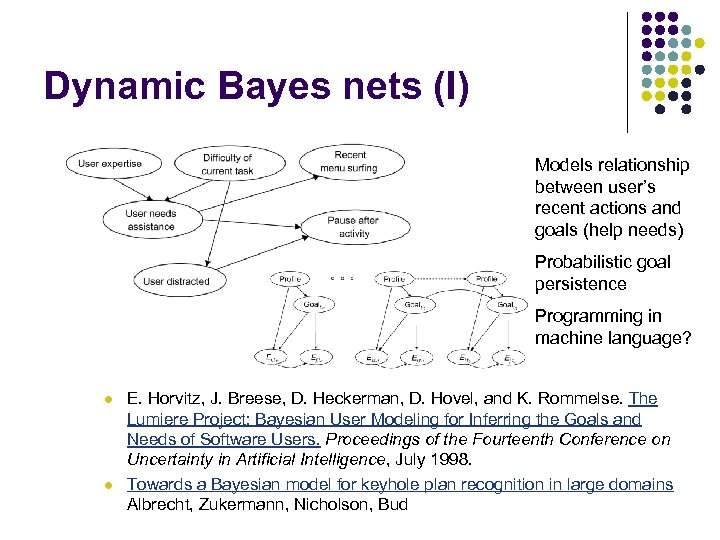 Dynamic Bayes nets (I) Models relationship between user’s recent actions and goals (help needs) Probabilistic goal persistence Programming in machine language? l l E. Horvitz, J. Breese, D. Heckerman, D. Hovel, and K. Rommelse. The Lumiere Project: Bayesian User Modeling for Inferring the Goals and Needs of Software Users. Proceedings of the Fourteenth Conference on Uncertainty in Artificial Intelligence, July 1998. Towards a Bayesian model for keyhole plan recognition in large domains Albrecht, Zukermann, Nicholson, Bud
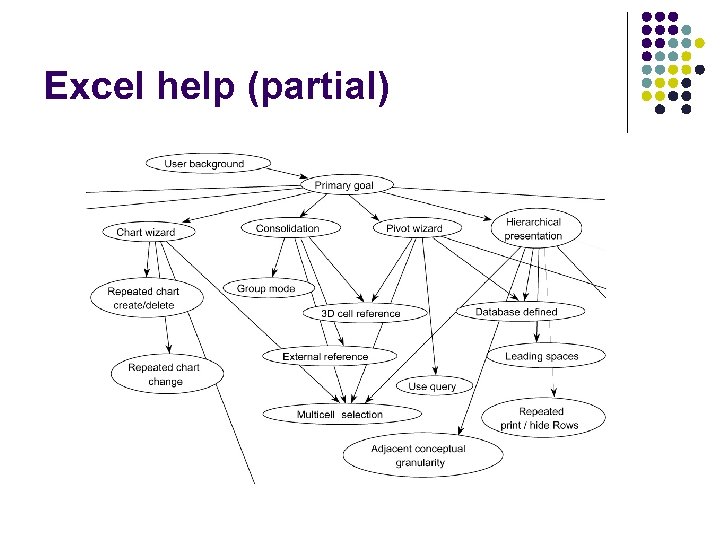 Excel help (partial)
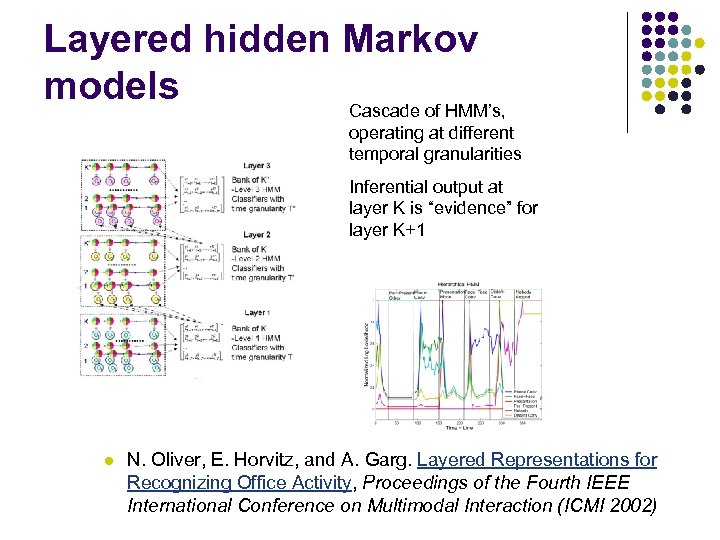 Layered hidden Markov models Cascade of HMM’s, operating at different temporal granularities Inferential output at layer K is “evidence” for layer K+1 l N. Oliver, E. Horvitz, and A. Garg. Layered Representations for Recognizing Office Activity, Proceedings of the Fourth IEEE International Conference on Multimodal Interaction (ICMI 2002)
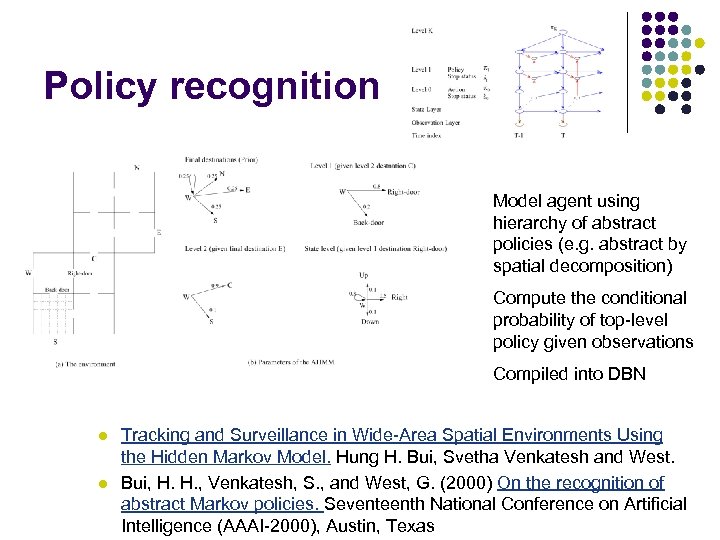 Policy recognition Model agent using hierarchy of abstract policies (e. g. abstract by spatial decomposition) Compute the conditional probability of top-level policy given observations Compiled into DBN l l Tracking and Surveillance in Wide-Area Spatial Environments Using the Hidden Markov Model. Hung H. Bui, Svetha Venkatesh and West. Bui, H. H. , Venkatesh, S. , and West, G. (2000) On the recognition of abstract Markov policies. Seventeenth National Conference on Artificial Intelligence (AAAI-2000), Austin, Texas
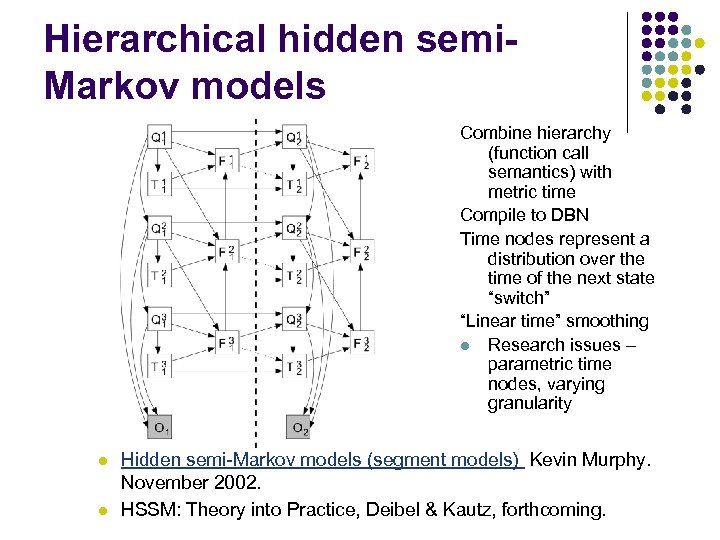 Hierarchical hidden semi. Markov models Combine hierarchy (function call semantics) with metric time Compile to DBN Time nodes represent a distribution over the time of the next state “switch” “Linear time” smoothing l Research issues – parametric time nodes, varying granularity l l Hidden semi-Markov models (segment models) Kevin Murphy. November 2002. HSSM: Theory into Practice, Deibel & Kautz, forthcoming.
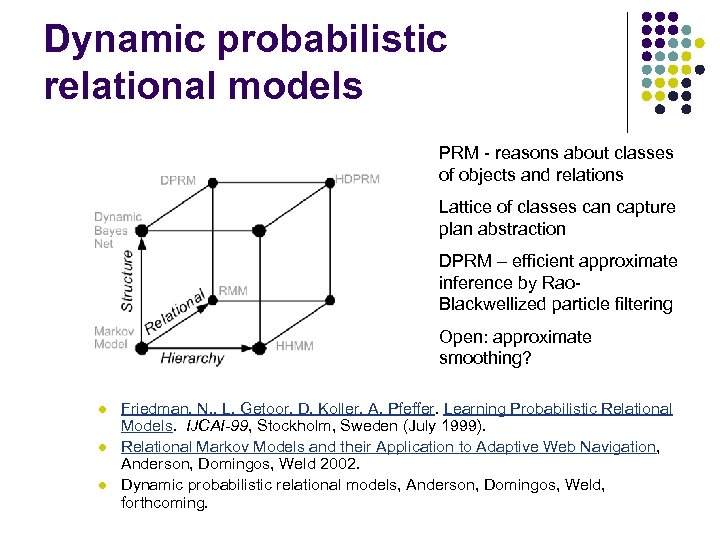 Dynamic probabilistic relational models PRM - reasons about classes of objects and relations Lattice of classes can capture plan abstraction DPRM – efficient approximate inference by Rao. Blackwellized particle filtering Open: approximate smoothing? l l l Friedman, N. , L. Getoor, D. Koller, A. Pfeffer. Learning Probabilistic Relational Models. IJCAI-99, Stockholm, Sweden (July 1999). Relational Markov Models and their Application to Adaptive Web Navigation, Anderson, Domingos, Weld 2002. Dynamic probabilistic relational models, Anderson, Domingos, Weld, forthcoming.
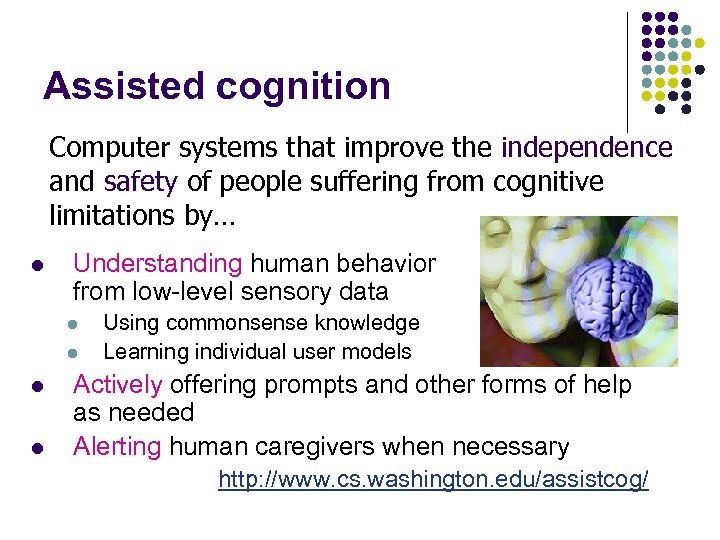 Assisted cognition Computer systems that improve the independence and safety of people suffering from cognitive limitations by… l Understanding human behavior from low-level sensory data l l Using commonsense knowledge Learning individual user models Actively offering prompts and other forms of help as needed Alerting human caregivers when necessary http: //www. cs. washington. edu/assistcog/
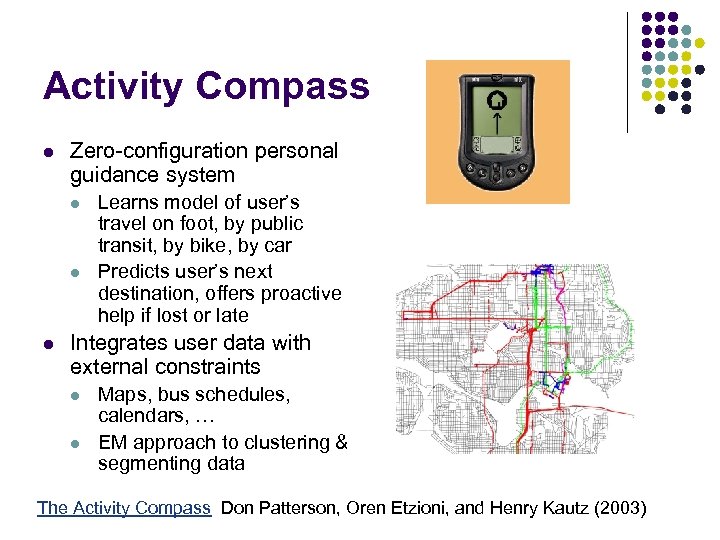 Activity Compass l Zero-configuration personal guidance system l l l Learns model of user’s travel on foot, by public transit, by bike, by car Predicts user’s next destination, offers proactive help if lost or late Integrates user data with external constraints l l Maps, bus schedules, calendars, … EM approach to clustering & segmenting data The Activity Compass Don Patterson, Oren Etzioni, and Henry Kautz (2003)
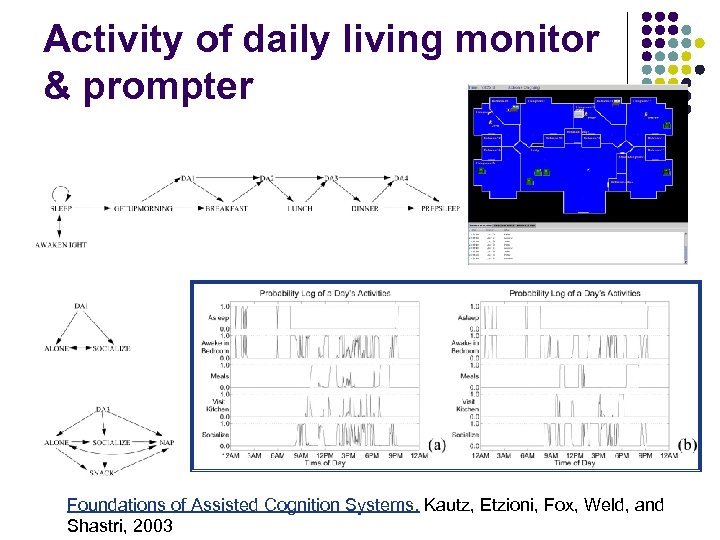 Activity of daily living monitor & prompter Foundations of Assisted Cognition Systems. Kautz, Etzioni, Fox, Weld, and Shastri, 2003
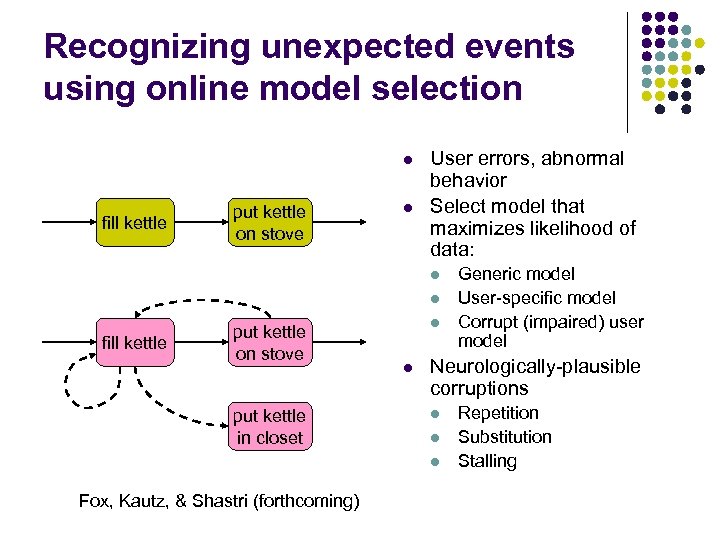 Recognizing unexpected events using online model selection l fill kettle put kettle on stove l User errors, abnormal behavior Select model that maximizes likelihood of data: l l fill kettle put kettle on stove put kettle in closet l l Neurologically-plausible corruptions l l l Fox, Kautz, & Shastri (forthcoming) Generic model User-specific model Corrupt (impaired) user model Repetition Substitution Stalling