 Скачать презентацию Placement SAE Modified by Georgia Agricultural Education Curriculum
36aae1a61b09d92067331ee3a0a7d419.ppt
- Количество слайдов: 35




Placement SAE Modified by Georgia Agricultural Education Curriculum Office July, 2002
Problem Areas What is Placement SAE? How do I plan for Placement SAE? What are legal considerations? How do I supervise a placement SAE?
Background n n n 90% of all students work for pay by senior year Over half of all HS seniors work majority of senior year Typical senior works half time Work is mostly for higher consumption and luxury Very little work is for experience or learning
The Realities n n Over 20 hours per week detracts from homework Jrs and Srs tend to decrease course load to accommodate work GPA tends to increase for students who work up to 20 hrs per week then decrease for those who work over 20 hours per week Students working over 20 hrs per week have lower educational aspirations
School to Work Transition n n Youngsters seek jobs for short term reasons Lacking guidance, students gain little usable experience from part-time work Graduates seek jobs based on peer information, convenience, and ignorance Poor school-to-work transition hurts everybody
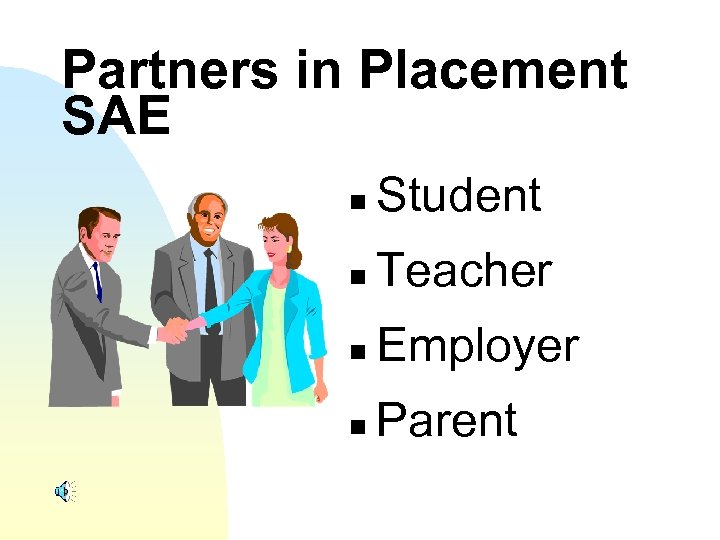
Partners in Placement SAE n Student n Teacher n Employer n Parent
Student Responsibilities n n n n Specified occupational objective Agree to and sign training agreement Work setting related to specified objective Work part time under supervision Receive pay AND credit Supervised by employer AND teacher Enroll in in-school class related to OJT
Teacher Responsibilities students Identify and counsel prospective n n n n Help students identify and state occupational objectives Agree to and sign training agreement Provides in-school related instruction Evaluates and approves training stations Places students in appropriate training stations Visits, observes, supervises, and evaluates on site
Employer Responsibilities n n n Agree to and sign training agreement Assign qualified training sponsor Participate in program planning, evaluation, and revision
Training Sponsor (Supervisor) n n n May be employer Work with teacher in setting up a training plan Remain aware of related class instruction Provide OJT learning experiences Follow the training plan
What is Cooperative Education n Method of Instruction Combines vocational classroom instruction with DIRECTLY-RELATED paid employment Both classroom work and employment are planned and supervised by BOTH the school and employer so that each contributes to the student’s occupational objective
Do NOT Confuse These: n n Cooperative Education General Work Experience n Work Study
Effective Co-op Programs Have detailed, written Placement SAE n n n policy Have functioning Advisory Councils Have experienced, competent teachers Provide time for coordination Match: ustudent occupational objectives unature of training station uin-class instruction
Virginia DOE Guidelines n n n Teacher must be endorsed in program in which co-op is offered Minimum 270 hours work for 1 academic credit (Ag Ed) Summer hours may count toward minimum for academic credit
Virginia DOE Guidelines n n Teacher must be assigned extended contract, typically 11 -month Class size may not exceed 20 students Minimum 1 coordination visit/month Teacher must have 1 coordination period per co-op class
Virginia DOE Guidelines n n n Students must enroll in in-school related class to enroll for work release credit Student enrollment counts for FTE for both courses for which enrolled Minimum student age 16 unless Employment Certificate is secured
Virginia DOE Guidelines n Training Agreement specifying responsibilities of and signed by: u. Student u. Employer u. Teacher u. Parent n or Guardian Training Plan specifying both technical & employability skills is required
School Records Required n n n Training Agreement Training Plan Competency record Hours and wages Record Documentation of coordination activities and visits
Labor Law: Minors < 16 Employment Certificate required for any employment EXCEPT: Farm, garden, and orchard work u Volunteer work u Non-manufacturing job owned by parent/guardian u Page/Clerk for VA House or Senate u Employed by state of Virginia u Occasional jobs around private homes u
Labor Law: Work Hours n n Age 16 -17, hours not regulated Age 14 -15: Work during school hours only with Work Training Certificate u No work after 7: 00 pm; after 9: 00 pm between June 1 and Labor Day) u No work before 7: 00 am (except newspaper carriers) u
Labor Law: Work Certificates n Vacation/Part Time Employment Certificate (age 14 -15) u Available for work only: F during school vacation F days when school is not in session F hours before & after school day n n Work-Training Employment Certificate (age 14 -15) u Required for work during school hours Age Certificate u Issued to minors over 16 as proof of age
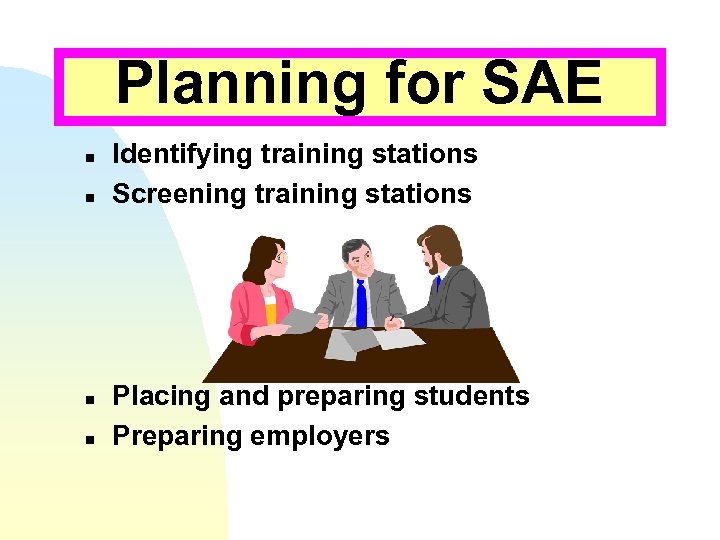
Planning for SAE n n Identifying training stations Screening training stations Placing and preparing students Preparing employers
n Identifying Training Stations Develop promotional materials u brochure, fact/info sheet, introduction letter u sample training agreement, training plan n Ag business survey (Prog Planning Class) u develop instrument u develop list of employers u personal visits to collect data/make contacts n n Compile and Analyze Results Follow-up visits with letter to all, subsequent contacts with potential training sites
Screening Training Stations n n n Is employer willing to provide training as well as job? Training consistent with student occupational objectives or interests Training station compatible with school policy, community ethics, accessible, safe, and in compliance with labor laws.
Placing Students n n n n Personal data sheet or resume Match objectives to training stations Complete application forms Introduction letter or card Practice interviews Actual interviews Follow-up
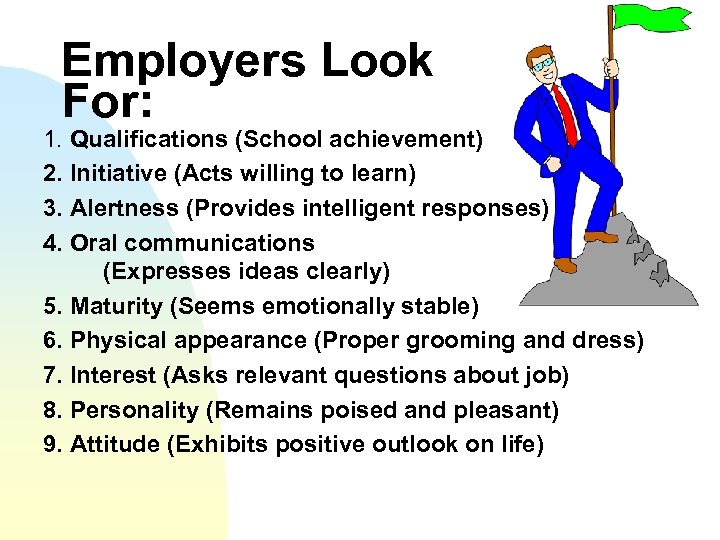
Employers Look For: 1. Qualifications (School achievement) 2. Initiative (Acts willing to learn) 3. Alertness (Provides intelligent responses) 4. Oral communications (Expresses ideas clearly) 5. Maturity (Seems emotionally stable) 6. Physical appearance (Proper grooming and dress) 7. Interest (Asks relevant questions about job) 8. Personality (Remains poised and pleasant) 9. Attitude (Exhibits positive outlook on life)
Interview Don’ts 1. Be late 2. Chew gum or smoke 3. Try to take over 4. Appear too aggressive 5. Be too “chatty” 6. Be overly concerned with money 7. Wear inappropriate clothing 8. Let negative emotions come out
Preparing Training Sponsor n n n This is new to most first line supervisors (FLS) Orient to placement program Discuss role of training sponsor Discuss role of student Discuss role of teacher Provide checklist
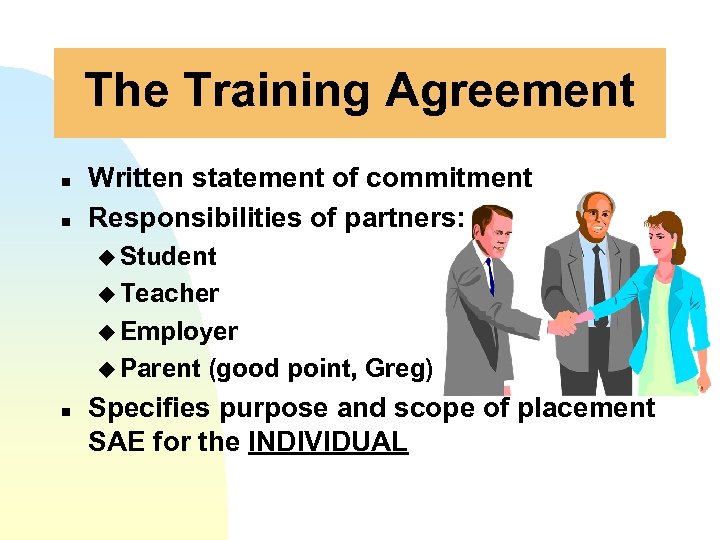
The Training Agreement n n Written statement of commitment Responsibilities of partners: u Student u Teacher u Employer u Parent n (good point, Greg) Specifies purpose and scope of placement SAE for the INDIVIDUAL
The Training Plan n n Includes tasks to be done on the job Serves as evaluation tool for student Never finished Review on every coordination visit u Accomplishments u Changes n needed Use checklist
Initial Coordination Visit n n n May occur after student is selected but before student reports for work Make appointment Allow 30 -45 minutes Plan visit and take needed materials Discuss FLS role u Review Training Agreement u Develop Training Plan u Explain Evaluation Form
Routine Coordination Visits n n n n Check Visitation Record for unresolved issues or questions Inform employer or FLS of related instruction Student evaluation Observe student on the job Identify and resolve problems before they become serious Update Training Plan with FLS and student input Record visit
Making Coordination Visits n n n Check the visitation record for unresolved issues and to see what is due Plan the purpose of the visit Put together any needed materials Make advance appointment Arrive on time -- not too early, not late Meet with employer or FLS briefly in private u Promotes honest, open discussion u Allows to concentrate on matter at hand
To Recap n n What is Placement SAE? How do I plan for Placement SAE? What are legal considerations? How do I supervise a Placement SAE?
The Last Word Placement SAE may be Virginia Agricultural Education's least used, best kept secret Placement SAE works. Try it, you’ll like it!!
Скачать презентацию Placement SAE Modified by Georgia Agricultural Education Curriculum
36aae1a61b09d92067331ee3a0a7d419.ppt