


 Скачать презентацию Placement and Routing A Lecture in CE Freshman
901c920d26c37477259f1928742334a9.ppt
- Количество слайдов: 27
 Placement and Routing A Lecture in CE Freshman Seminar Series: Puzzling Problems in Computer Engineering Apr. 2016 Placement and Routing Slide 1
 About This Presentation This presentation belongs to the lecture series entitled “Ten Puzzling Problems in Computer Engineering, ” devised for a ten-week, one-unit, freshman seminar course by Behrooz Parhami, Professor of Computer Engineering at University of California, Santa Barbara. The material can be used freely in teaching and other educational settings. Unauthorized uses, including any use for financial gain, are prohibited. © Behrooz Parhami Edition Released Revised First Apr. 2007 Apr. 2008 Apr. 2009 Apr. 2010 Mar. 2011 Apr. 2012 Apr. 2015 Apr. 2016 Placement and Routing Slide 2
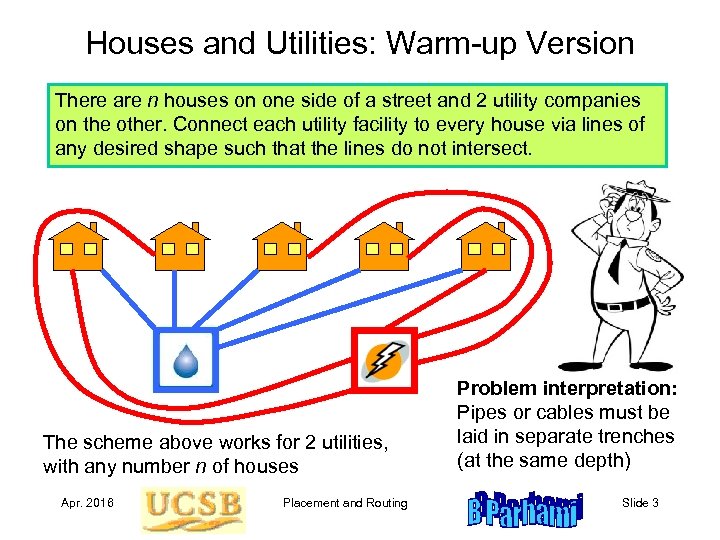 Houses and Utilities: Warm-up Version There are n houses on one side of a street and 2 utility companies on the other. Connect each utility facility to every house via lines of any desired shape such that the lines do not intersect. The scheme above works for 2 utilities, with any number n of houses Apr. 2016 Placement and Routing Problem interpretation: Pipes or cables must be laid in separate trenches (at the same depth) Slide 3
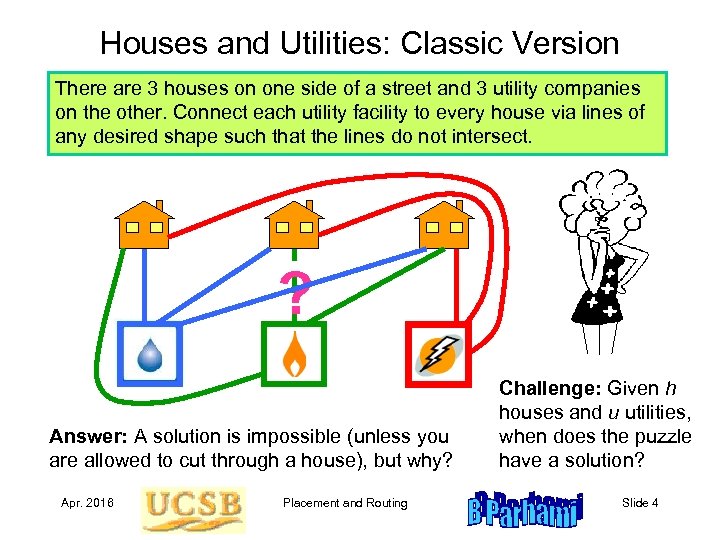 Houses and Utilities: Classic Version There are 3 houses on one side of a street and 3 utility companies on the other. Connect each utility facility to every house via lines of any desired shape such that the lines do not intersect. ? Answer: A solution is impossible (unless you are allowed to cut through a house), but why? Apr. 2016 Placement and Routing Challenge: Given h houses and u utilities, when does the puzzle have a solution? Slide 4
 History and Equivalent Puzzles “Houses and utilities” has a long history and has appeared in many different forms over the years Even though many authors characterize the puzzle as “ancient, ” the first published version dates back to 1917 A less pleasant, pre-gas/electricity variant: Three people live in adjacent houses next to three wells. Because wells may run dry on occasion, each person needs paths to all wells. After a while, the residents develop strong dislikes for each other and try to construct their paths so that they never have to meet. . . A violent version: There are three families. Any member of one family will try to kill members of the other families if their paths cross. However, the well, the market, and the church are, by tradition, neutral places. . . Apr. 2016 Placement and Routing Slide 5
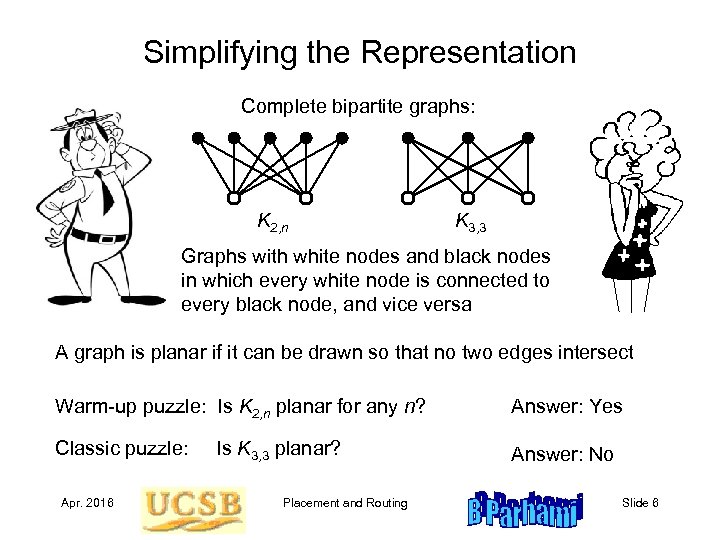 Simplifying the Representation Complete bipartite graphs: K 2, n K 3, 3 Graphs with white nodes and black nodes in which every white node is connected to every black node, and vice versa A graph is planar if it can be drawn so that no two edges intersect Warm-up puzzle: Is K 2, n planar for any n? Classic puzzle: Answer: Yes Answer: No Apr. 2016 Is K 3, 3 planar? Placement and Routing Slide 6
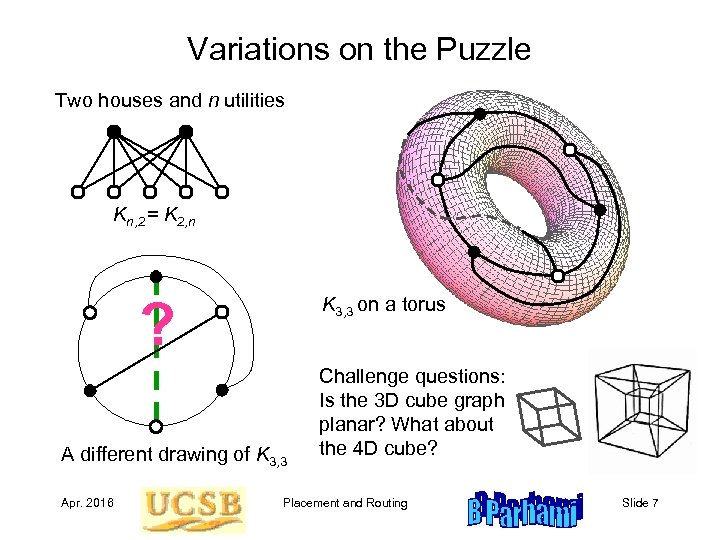 Variations on the Puzzle Two houses and n utilities Kn, 2 = K 2, n ? K 3, 3 on a torus A different drawing of K 3, 3 Apr. 2016 Challenge questions: Is the 3 D cube graph planar? What about the 4 D cube? Placement and Routing Slide 7
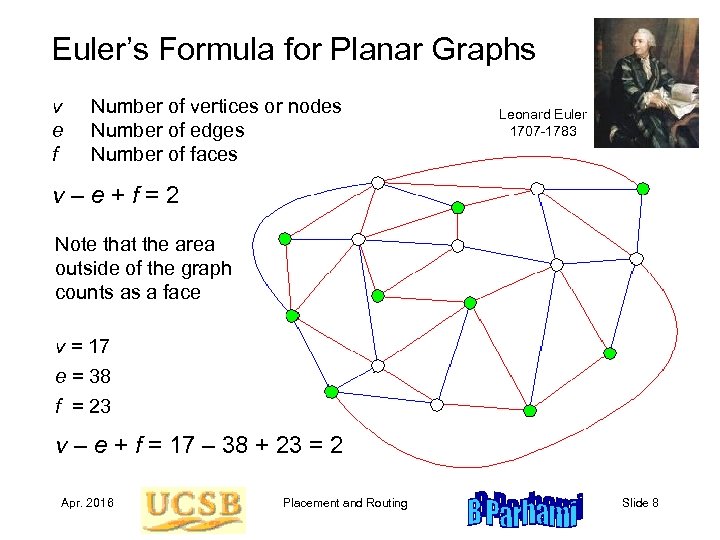 Euler’s Formula for Planar Graphs v e f Number of vertices or nodes Number of edges Number of faces Leonard Euler 1707 -1783 v–e+f=2 Note that the area outside of the graph counts as a face v = 17 e = 38 f = 23 v – e + f = 17 – 38 + 23 = 2 Apr. 2016 Placement and Routing Slide 8
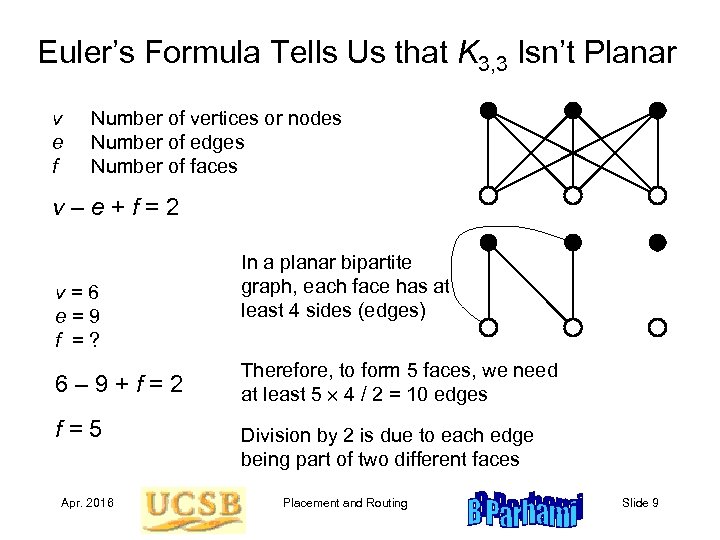 Euler’s Formula Tells Us that K 3, 3 Isn’t Planar v e f Number of vertices or nodes Number of edges Number of faces v–e+f=2 v=6 e=9 f =? 6– 9+f=2 f=5 Apr. 2016 In a planar bipartite graph, each face has at least 4 sides (edges) Therefore, to form 5 faces, we need at least 5 4 / 2 = 10 edges Division by 2 is due to each edge being part of two different faces Placement and Routing Slide 9
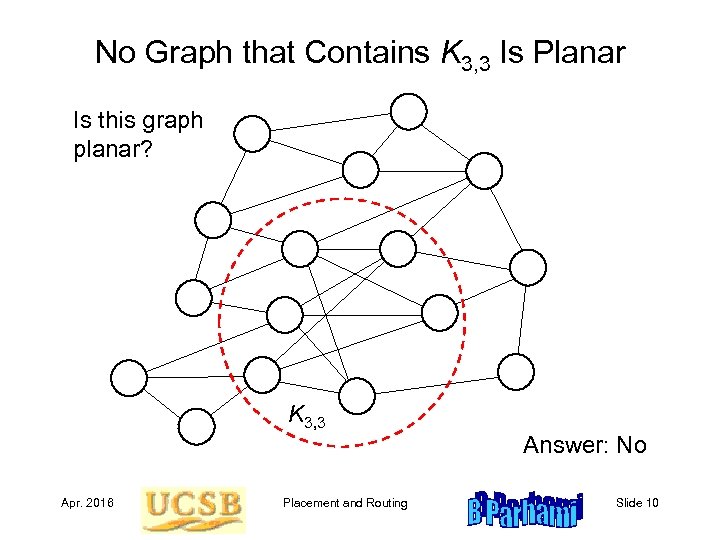 No Graph that Contains K 3, 3 Is Planar Is this graph planar? K 3, 3 Answer: No Apr. 2016 Placement and Routing Slide 10
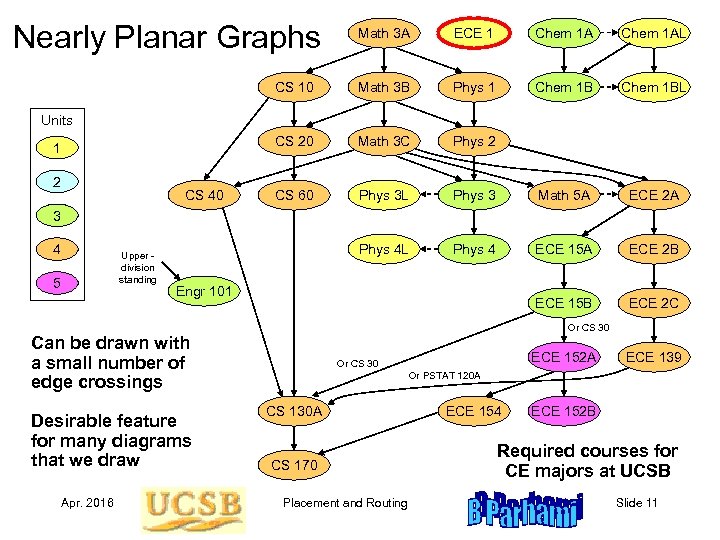 Nearly Planar Graphs Math 3 A ECE 1 Chem 1 AL CS 10 Math 3 B Phys 1 Chem 1 BL CS 20 Math 3 C Phys 2 CS 60 Phys 3 L Phys 3 Math 5 A ECE 2 A Phys 4 L Phys 4 ECE 15 A ECE 2 B ECE 15 B ECE 2 C Units 1 2 CS 40 3 4 Upper division standing 5 Engr 101 Or CS 30 Can be drawn with a small number of edge crossings Desirable feature for many diagrams that we draw Apr. 2016 ECE 152 A Or CS 30 ECE 139 Or PSTAT 120 A CS 130 A CS 170 Placement and Routing ECE 154 ECE 152 B Required courses for CE majors at UCSB Slide 11
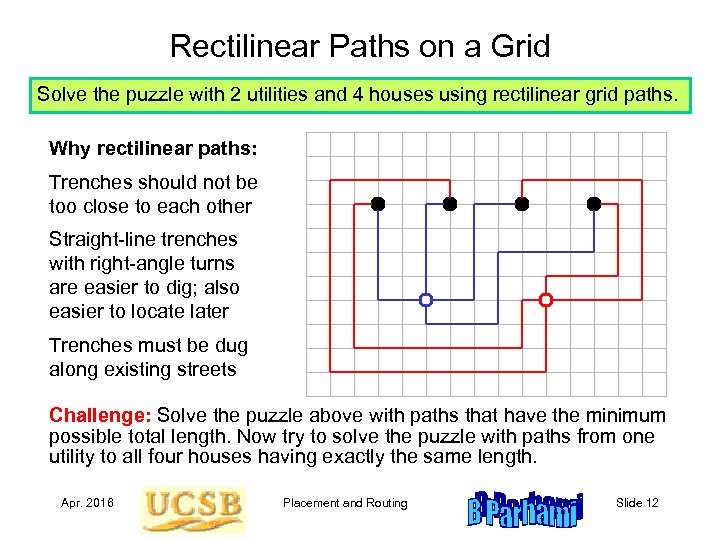 Rectilinear Paths on a Grid Solve the puzzle with 2 utilities and 4 houses using rectilinear grid paths. Why rectilinear paths: Trenches should not be too close to each other Straight-line trenches with right-angle turns are easier to dig; also easier to locate later Trenches must be dug along existing streets Challenge: Solve the puzzle above with paths that have the minimum possible total length. Now try to solve the puzzle with paths from one utility to all four houses having exactly the same length. Apr. 2016 Placement and Routing Slide 12
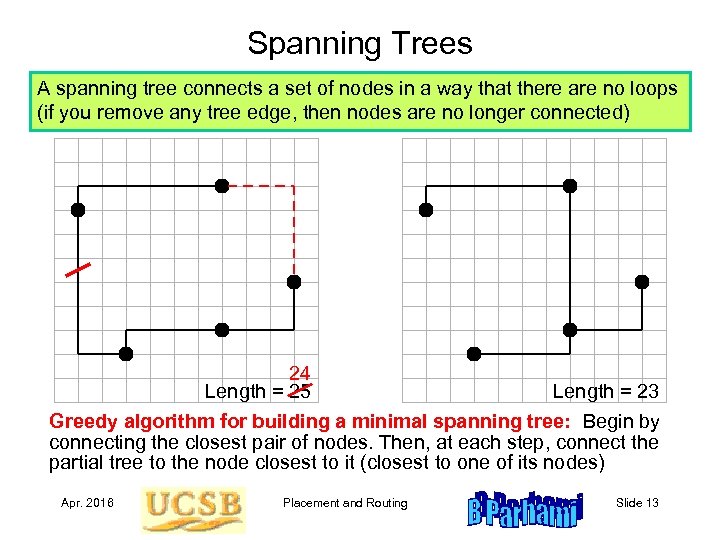 Spanning Trees A spanning tree connects a set of nodes in a way that there are no loops (if you remove any tree edge, then nodes are no longer connected) 24 Length = 25 Length = 23 Greedy algorithm for building a minimal spanning tree: Begin by connecting the closest pair of nodes. Then, at each step, connect the partial tree to the node closest to it (closest to one of its nodes) Apr. 2016 Placement and Routing Slide 13
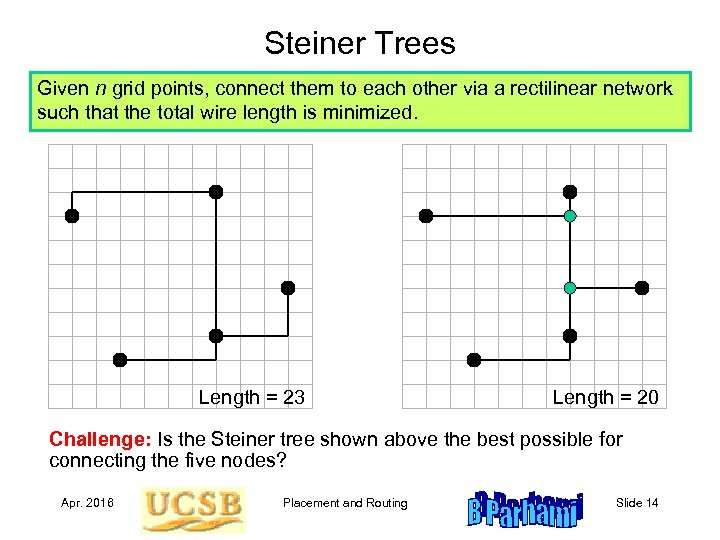 Steiner Trees Given n grid points, connect them to each other via a rectilinear network such that the total wire length is minimized. Length = 23 Length = 20 Challenge: Is the Steiner tree shown above the best possible for connecting the five nodes? Apr. 2016 Placement and Routing Slide 14
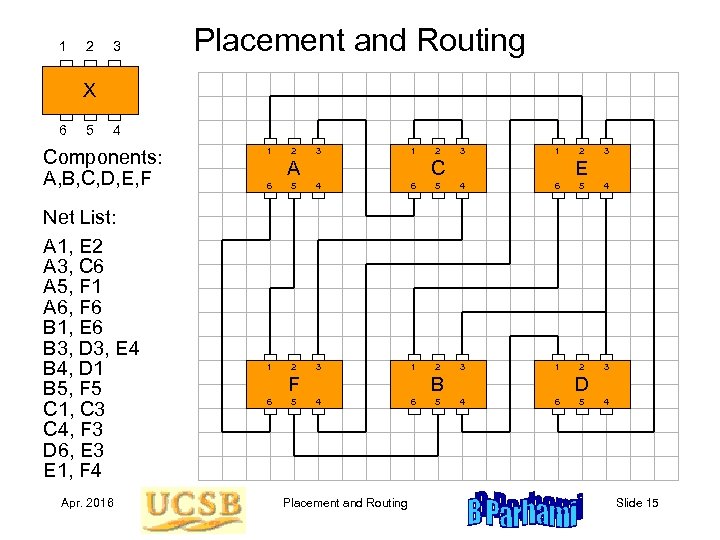 1 2 3 Placement and Routing X 6 5 4 Components: A, B, C, D, E, F Net List: A 1, E 2 A 3, C 6 A 5, F 1 A 6, F 6 B 1, E 6 B 3, D 3, E 4 B 4, D 1 B 5, F 5 C 1, C 3 C 4, F 3 D 6, E 3 E 1, F 4 Apr. 2016 1 2 3 1 A 2 3 1 C 2 3 E 6 5 4 1 2 3 F 6 5 B 4 Placement and Routing 6 5 D 4 6 5 4 Slide 15
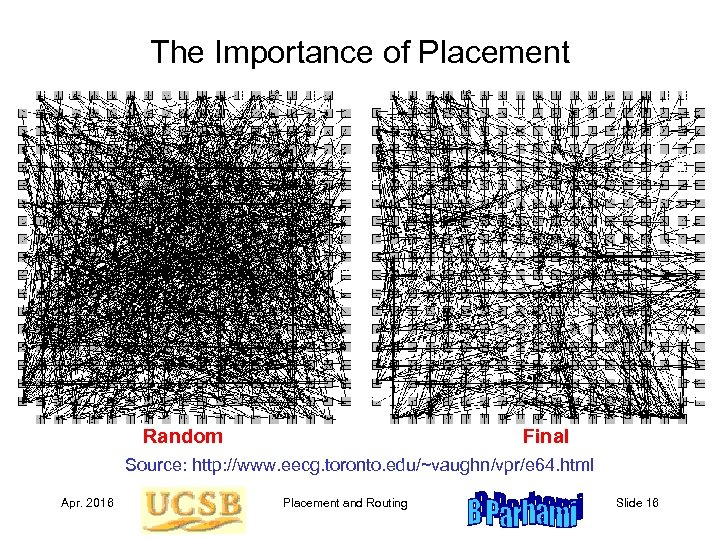 The Importance of Placement Random Final Source: http: //www. eecg. toronto. edu/~vaughn/vpr/e 64. html Apr. 2016 Placement and Routing Slide 16
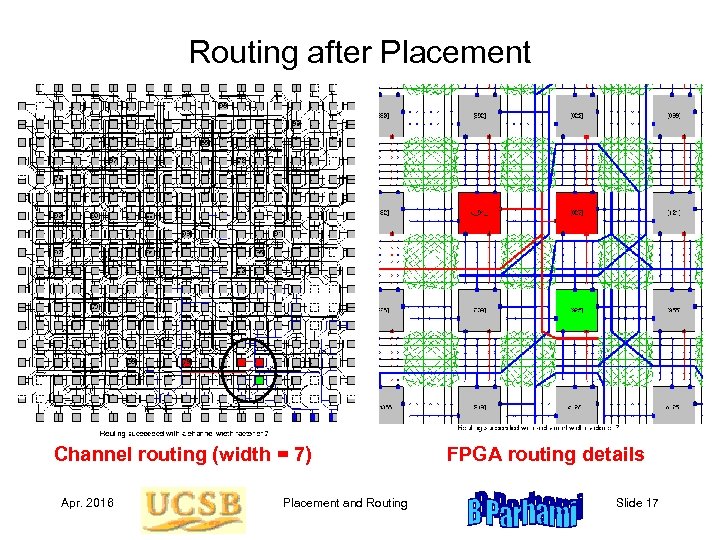 Routing after Placement Channel routing (width = 7) Apr. 2016 Placement and Routing FPGA routing details Slide 17
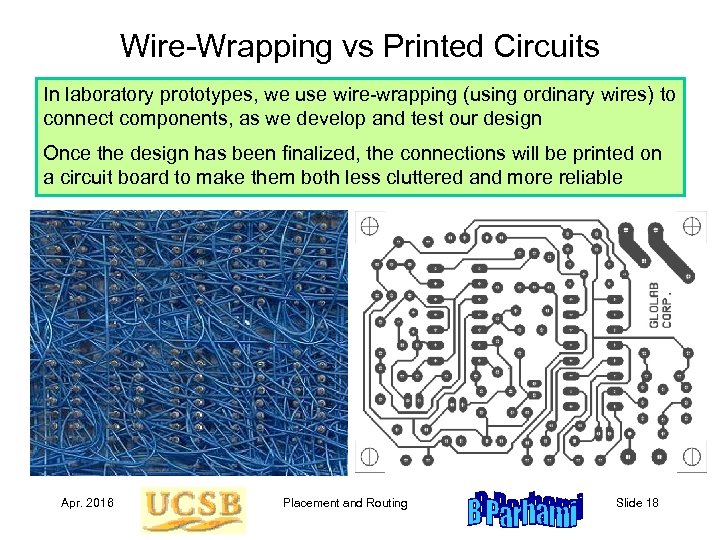 Wire-Wrapping vs Printed Circuits In laboratory prototypes, we use wire-wrapping (using ordinary wires) to connect components, as we develop and test our design Once the design has been finalized, the connections will be printed on a circuit board to make them both less cluttered and more reliable Apr. 2016 Placement and Routing Slide 18
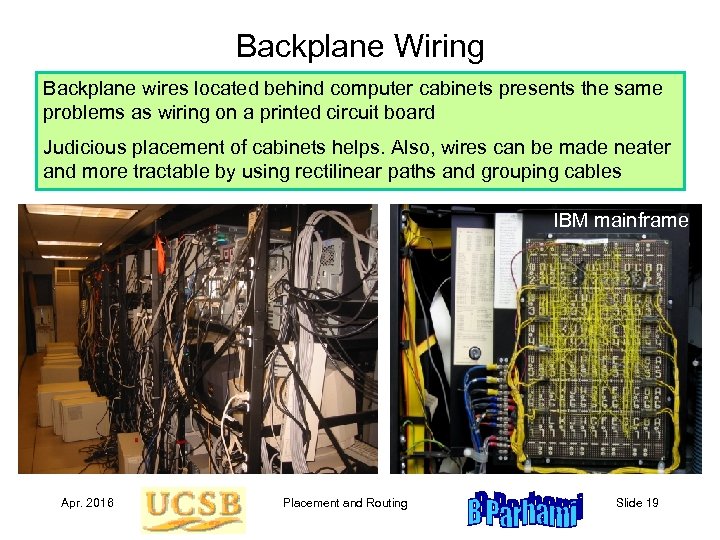 Backplane Wiring Backplane wires located behind computer cabinets presents the same problems as wiring on a printed circuit board Judicious placement of cabinets helps. Also, wires can be made neater and more tractable by using rectilinear paths and grouping cables IBM mainframe Apr. 2016 Placement and Routing Slide 19
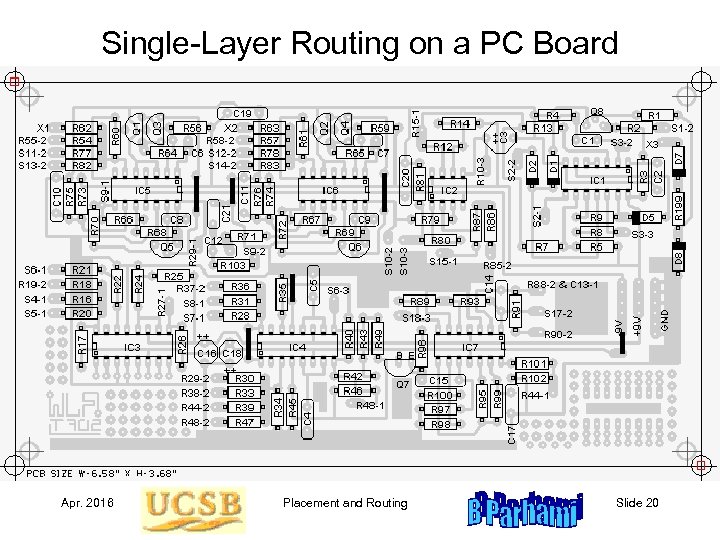 Single-Layer Routing on a PC Board Apr. 2016 Placement and Routing Slide 20
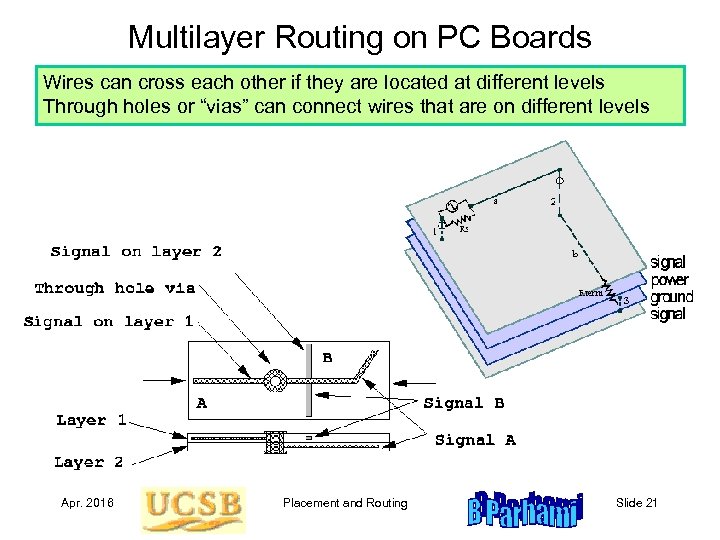 Multilayer Routing on PC Boards Wires can cross each other if they are located at different levels Through holes or “vias” can connect wires that are on different levels Apr. 2016 Placement and Routing Slide 21
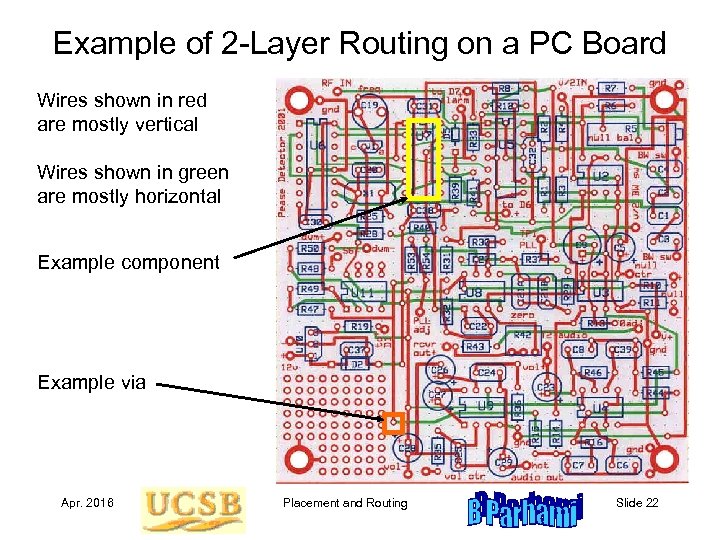 Example of 2 -Layer Routing on a PC Board Wires shown in red are mostly vertical Wires shown in green are mostly horizontal Example component Example via Apr. 2016 Placement and Routing Slide 22
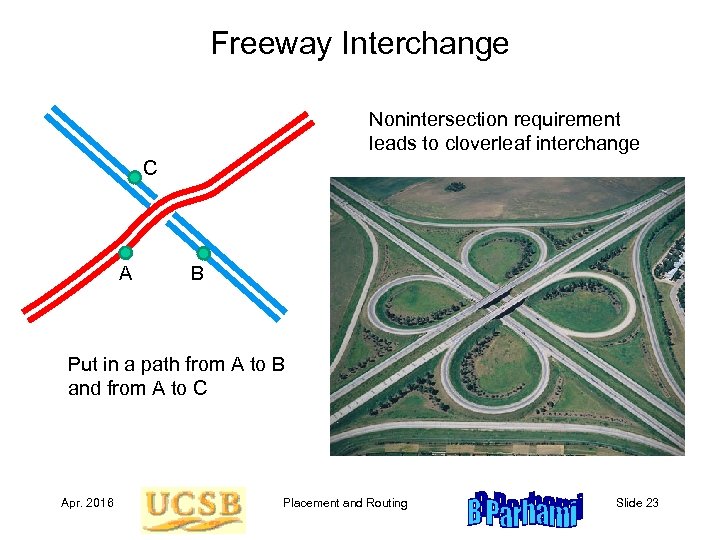 Freeway Interchange Nonintersection requirement leads to cloverleaf interchange C A B Put in a path from A to B and from A to C Apr. 2016 Placement and Routing Slide 23
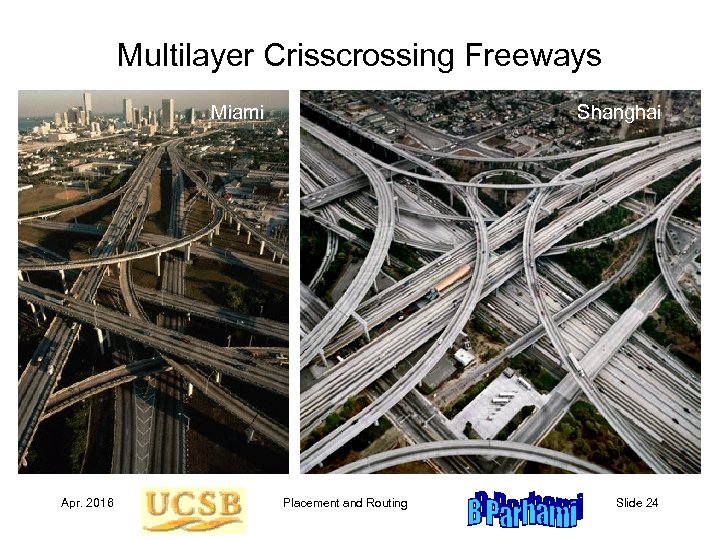 Multilayer Crisscrossing Freeways Miami Apr. 2016 Shanghai Placement and Routing Slide 24
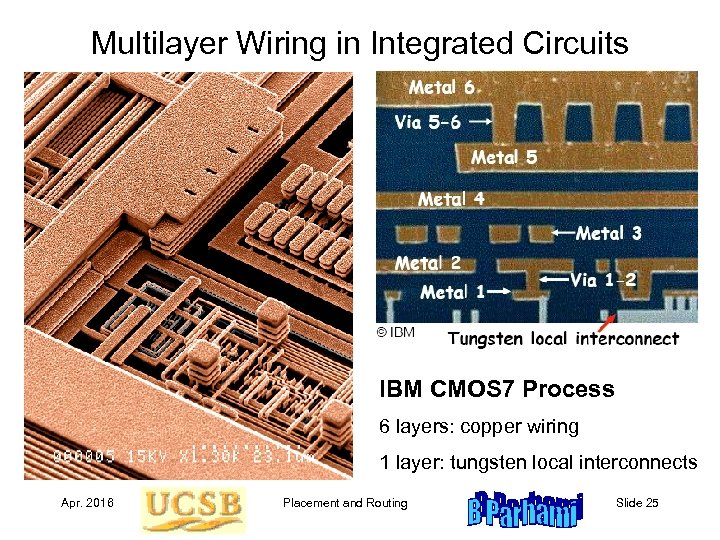 Multilayer Wiring in Integrated Circuits IBM CMOS 7 Process 6 layers: copper wiring 1 layer: tungsten local interconnects Apr. 2016 Placement and Routing Slide 25
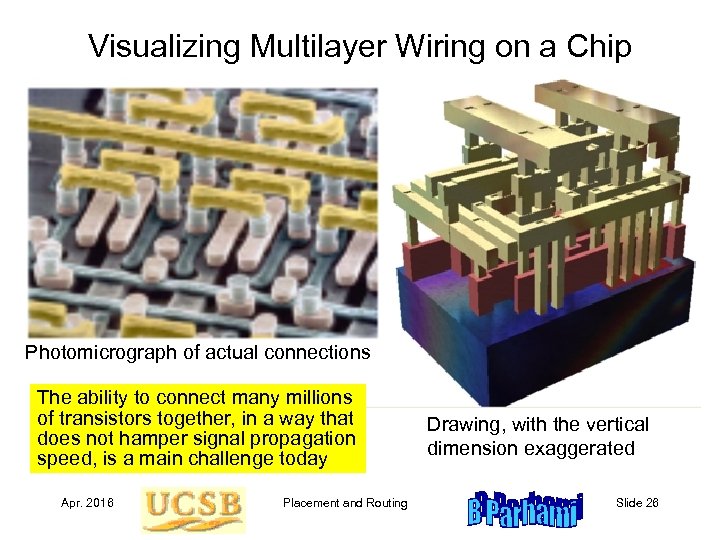 Visualizing Multilayer Wiring on a Chip Photomicrograph of actual connections The ability to connect many millions of transistors together, in a way that does not hamper signal propagation speed, is a main challenge today Apr. 2016 Placement and Routing Drawing, with the vertical dimension exaggerated Slide 26
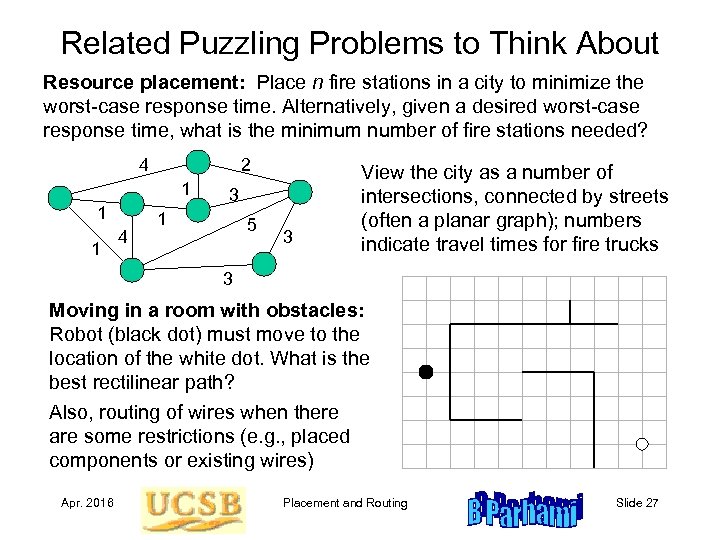 Related Puzzling Problems to Think About Resource placement: Place n fire stations in a city to minimize the worst-case response time. Alternatively, given a desired worst-case response time, what is the minimum number of fire stations needed? 4 2 1 1 1 4 3 1 5 3 View the city as a number of intersections, connected by streets (often a planar graph); numbers indicate travel times for fire trucks 3 Moving in a room with obstacles: Robot (black dot) must move to the location of the white dot. What is the best rectilinear path? Also, routing of wires when there are some restrictions (e. g. , placed components or existing wires) Apr. 2016 Placement and Routing Slide 27