


 Скачать презентацию Place the following presidents in the order they
17158c5fe4ba7ec609ccf368603d9449.ppt
- Количество слайдов: 119

 Place the following presidents in the order they served: James Monroe John Q. Adams James Madison George Washington Thomas Jefferson John Adams
 Place the following presidents in the order they served: James Monroe John Q. Adams James Madison George Washington Thomas Jefferson John Adams
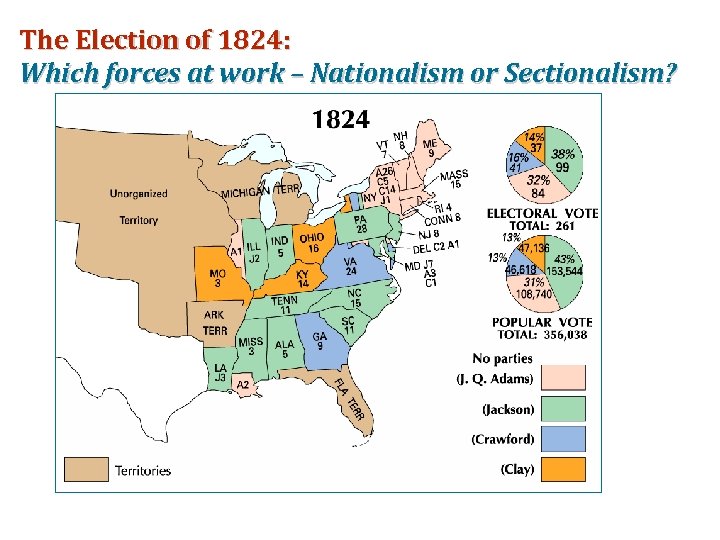 The Election of 1824: Which forces at work – Nationalism or Sectionalism?
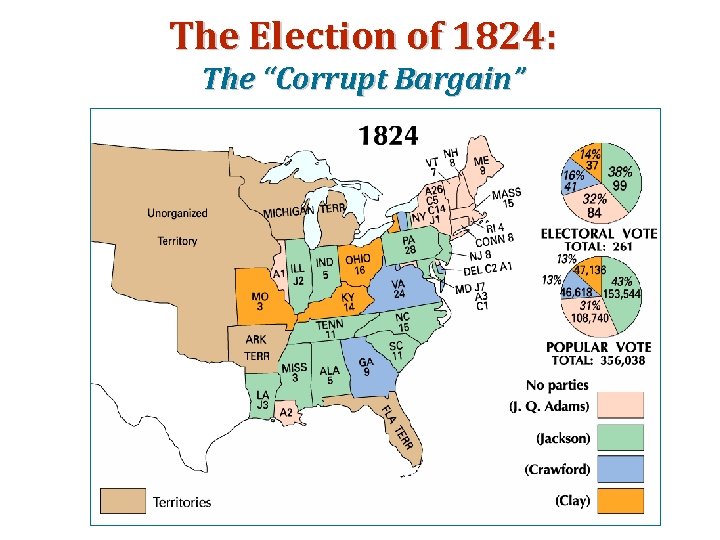
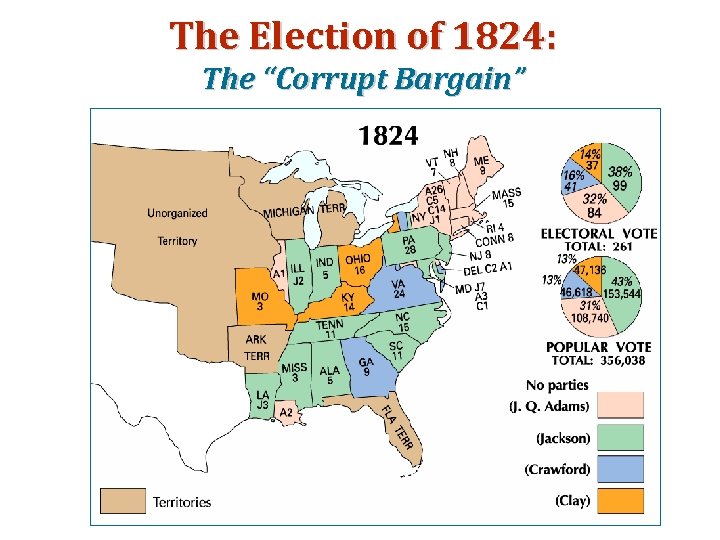 The Election of 1824: The “Corrupt Bargain”
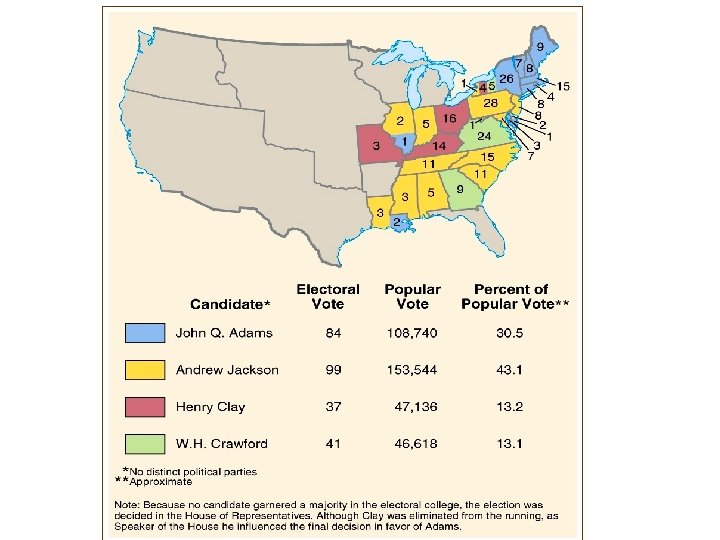
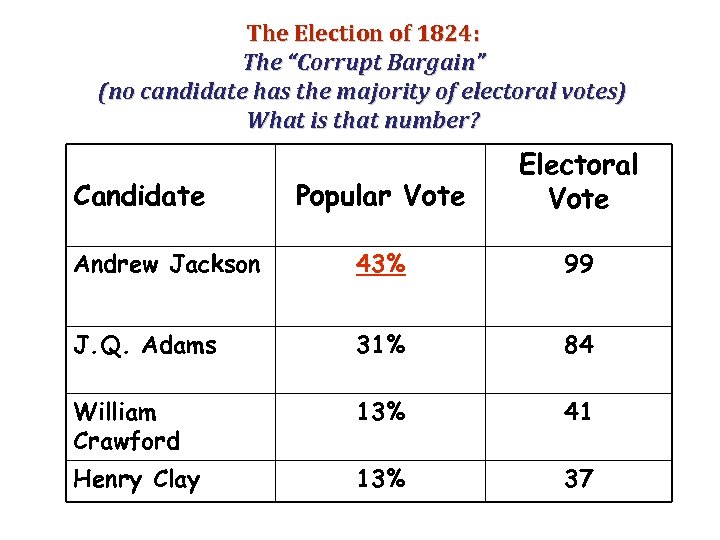 The Election of 1824: The “Corrupt Bargain” (no candidate has the majority of electoral votes) What is that number? Popular Vote Electoral Vote Andrew Jackson 43% 99 J. Q. Adams 31% 84 William Crawford 13% 41 Henry Clay 13% 37 Candidate
 Read “Adams Defeats Jackson in 1824” on page 396
 John Quincy Adams’ Presidency https: //www. youtube. com/watch? v=a. H 7 Oq. CB Yf. HQ

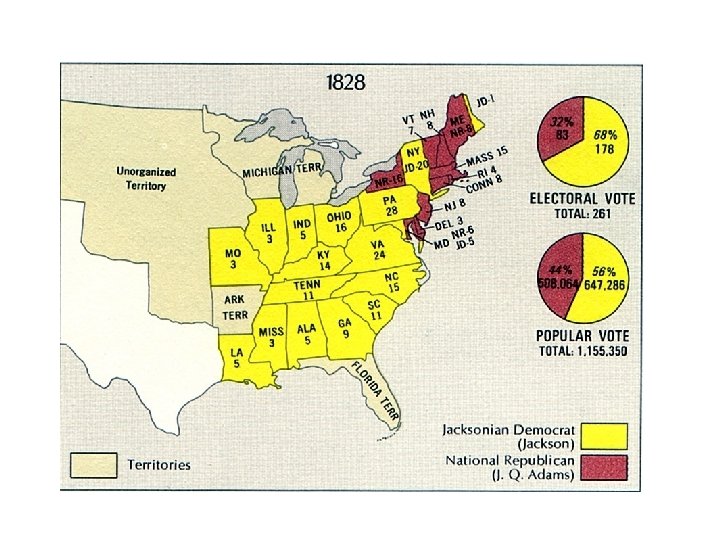
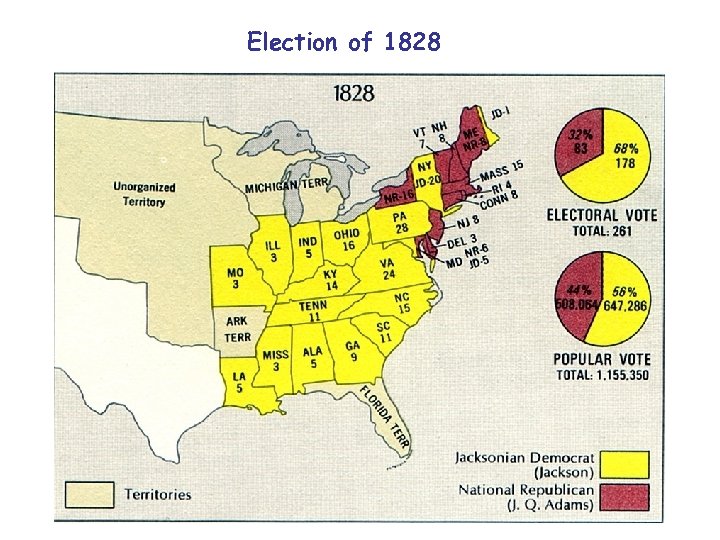 Election of 1828
 Chapter 12 The Age of Jackson
 Today’s learning targets - CHAPTER 12. 1 Summarize how democracy changed during Andrew Jackson’s Presidency Identify the issues that increased tension within the states
 12. 1 Amoeba activity

 Read, “One American’s Story”, p. 395 How was America politically divided during the election of 1824? (Who were the candidates? )
 Read, “One American’s Story”, p. 395 How was America politically divided during the election of 1824? (Who were the candidates? )
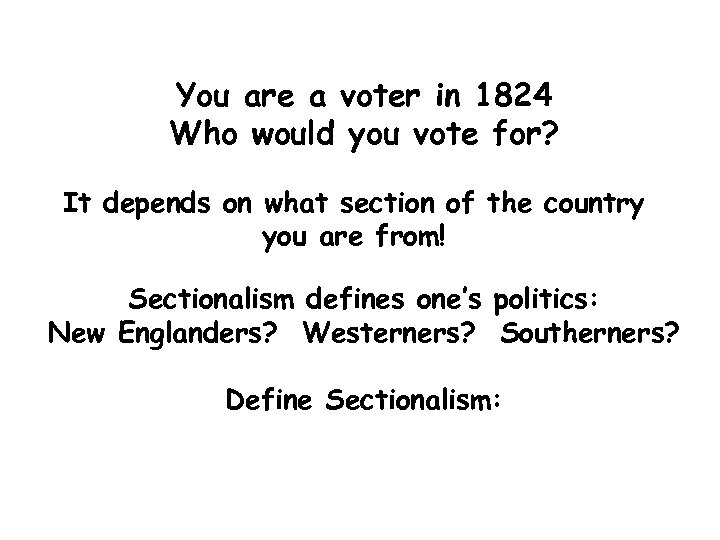
 Summarize how democracy changed during Andrew Jackson’s Presidency CHAPTER 12. 1: THE AGE OF JACKSON 1. Who were the candidates in the 1824 election and their supporters? All were Democratic-Republicans John Quincy Adams – New Englanders issues? William Crawford – Southerners issues? Henry Clay & Andrew Jackson – Westerners issues?
 2. What was the outcome of the 1824 election? • Jackson won thepopular vote but not a majority of the electoral votes • Adams and Clay make a deal that made Adams president “ A Corrupt Bargain”
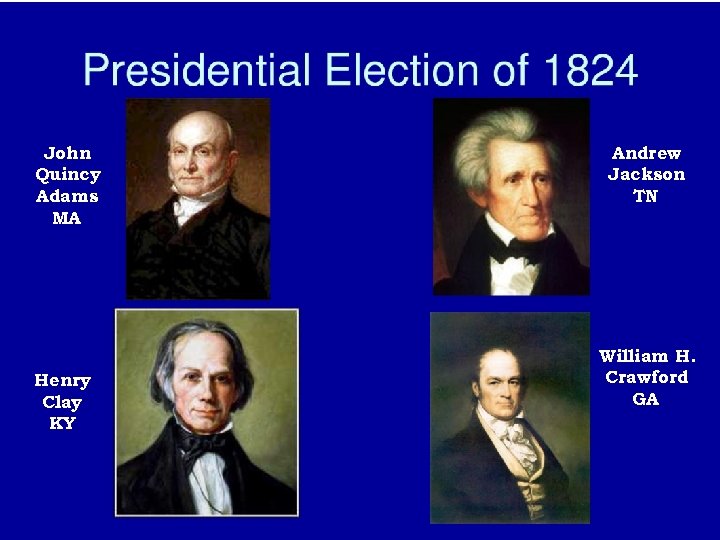 John Quincy Adams MA Henry Clay KY Andrew Jackson TN William H. Crawford GA
 The Election of 1824: The “Corrupt Bargain”

 Voter Turnout: 1824 - 1860 What is significant in 1828 v. 1824? Over a 100% Increase in 1828!
 You are a voter in 1824 Who would you vote for? It depends on what section of the country you are from! Sectionalism defines one’s politics: New Englanders? Westerners? Southerners? Define Sectionalism:
 New England voters: States rights/reduce federal government interference Support National Bank for business development Protection of slavery High Protective Tariffs Western development To expand trade
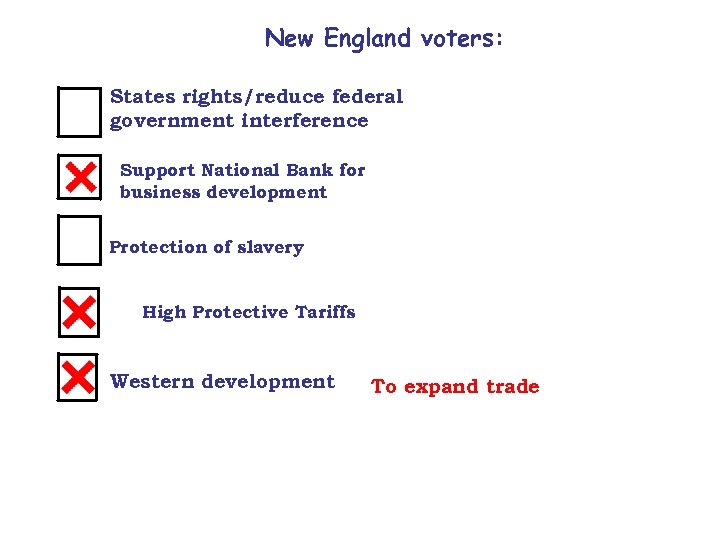
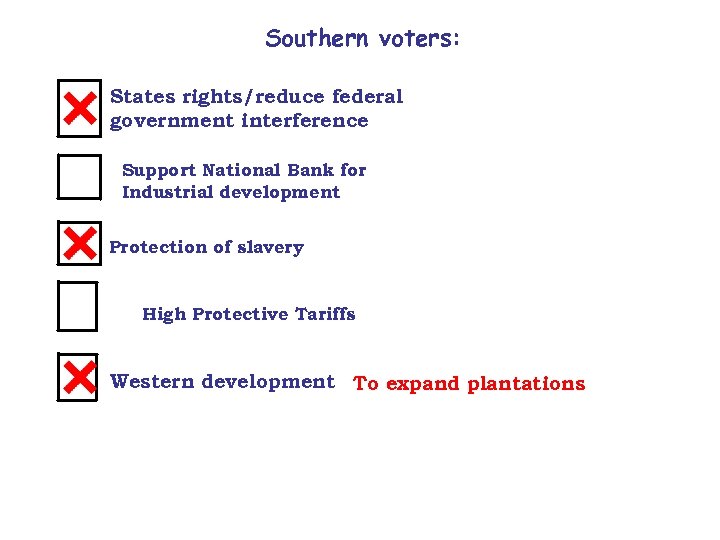 Southern voters: States rights/reduce federal government interference Support National Bank for Industrial development Protection of slavery High Protective Tariffs Western development To expand plantations
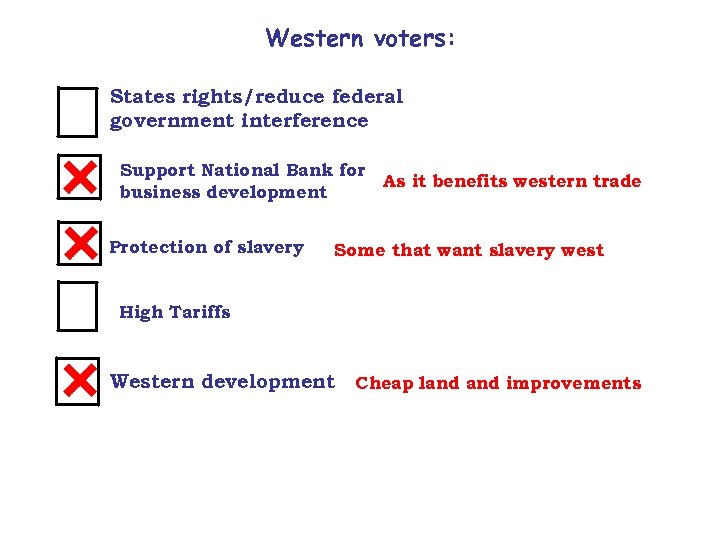 Western voters: States rights/reduce federal government interference Support National Bank for As it benefits western trade business development Protection of slavery Some that want slavery west High Tariffs Western development Cheap land improvements
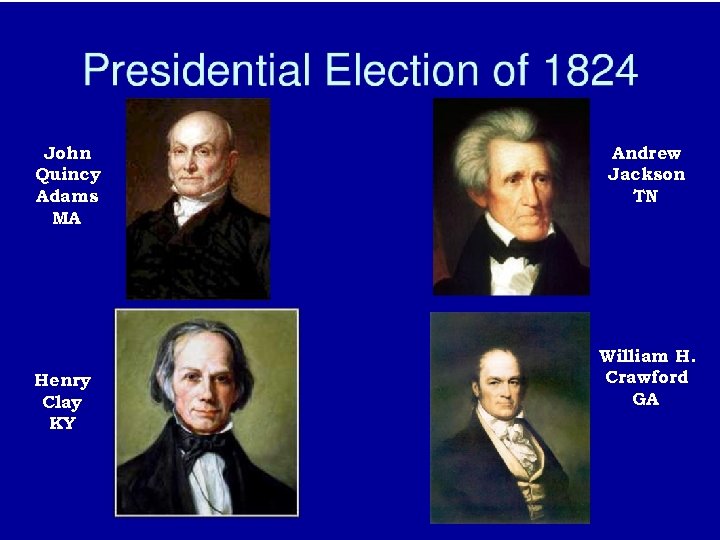 John Quincy Adams MA Henry Clay KY Andrew Jackson TN William H. Crawford GA
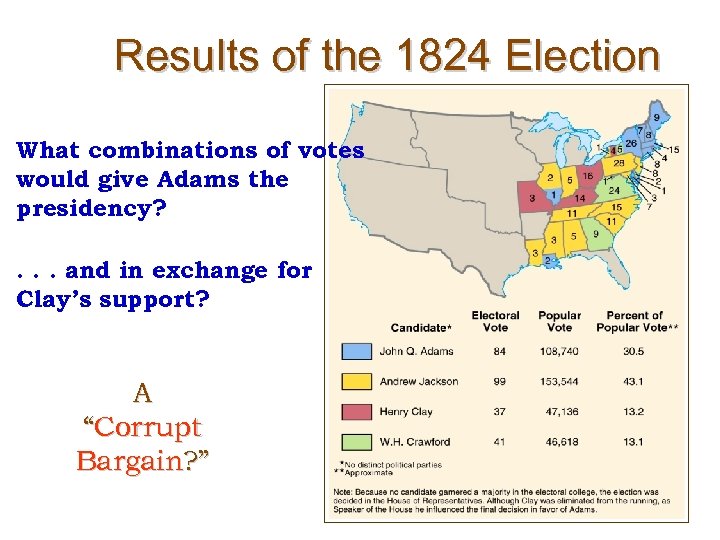 Results of the 1824 Election What combinations of votes would give Adams the presidency? . . . and in exchange for Clay’s support? A “Corrupt Bargain? ”
 3. What happened as a result of the 1824 elections? • Democratic-Republican party split, Jackson & his supporters becoming Democrats • Adams & his supporters becoming National Republicans. • Jackson began campaigning for the presidency in the next election. https: //www. youtube. com/watch? v=r q. OKnk 5 w. PQc ~6: 50 min
 Review items 2 & 3 of handout 12. 1 How did Jackson use the results of the election of 1824 to win the election of 1828?
 Andrew Jackson https: //www. youtube. com/watch? v=o x. Dq. OH 6 H 4 FQ
 Election of 1828 https: //www. youtube. com/watch? v=rq. OKnk 5 w. PQc Begin ~6: 50 min (The campaign & Jackson’s character)
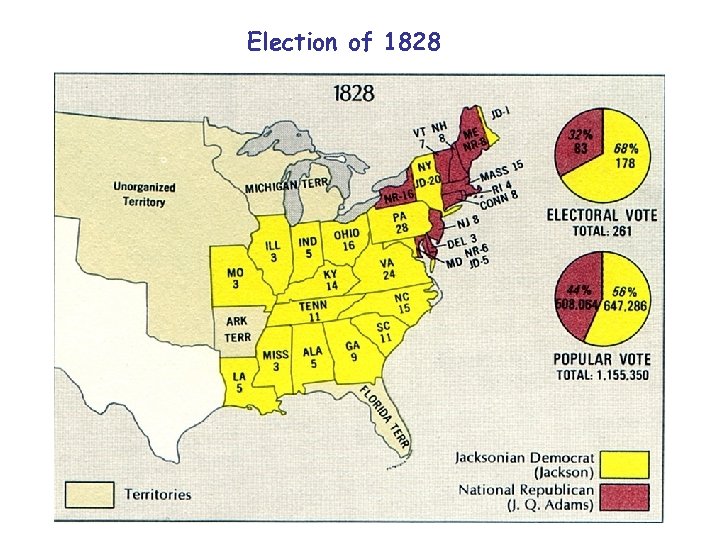 Election of 1828
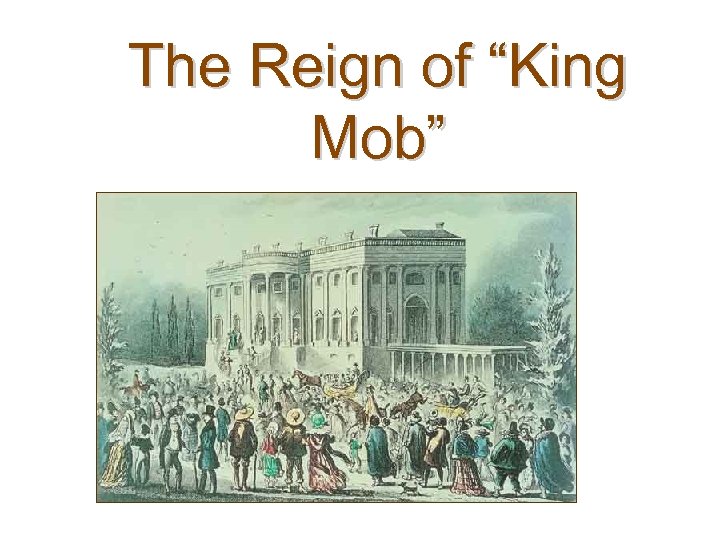
 4. How did expanding democracy bring Andrew Jackson to power? • easing of voting restrictions in the states increased the number of common people who could vote • Jackson was a hero to the common people.
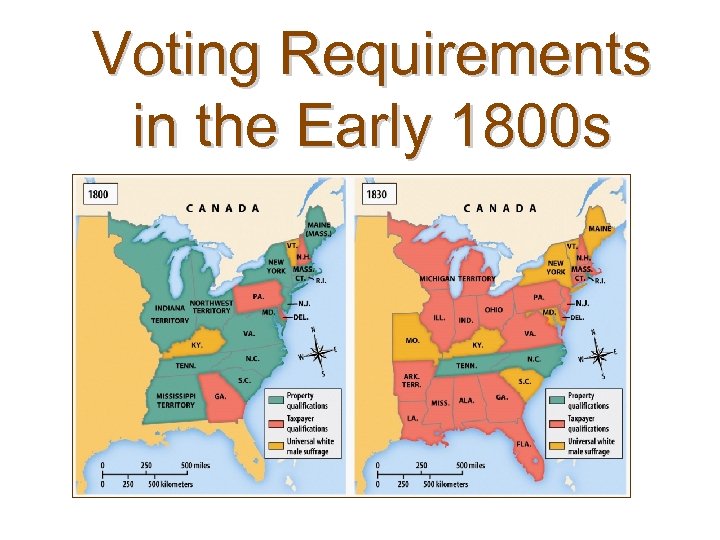 Voting Requirements in the Early 1800 s
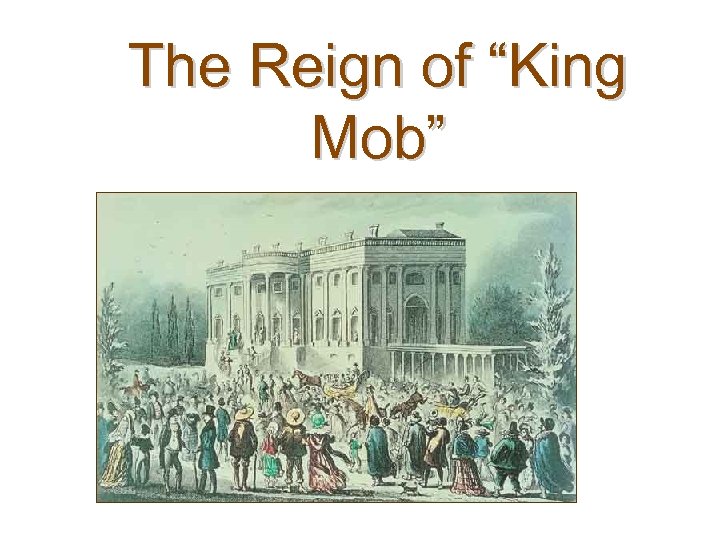 The Reign of “King Mob”
 5. What qualities made Andrew Jackson a popular candidate and leader? • humble background • reputation for toughness • success as a military leader
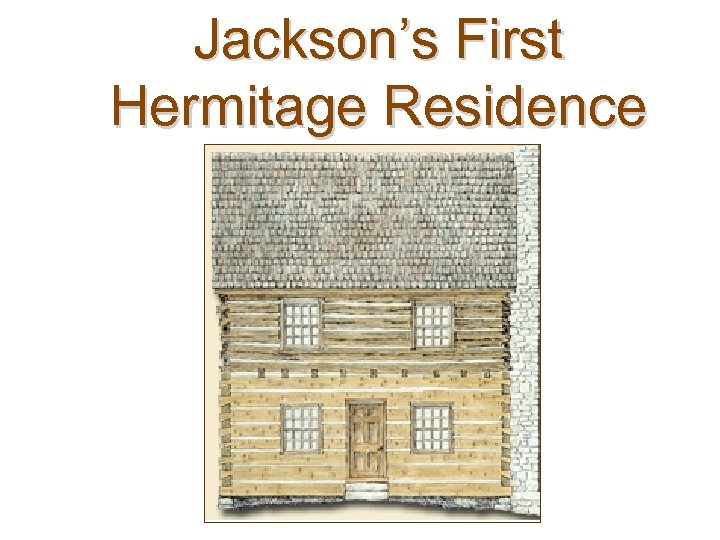 Jackson’s First Hermitage Residence
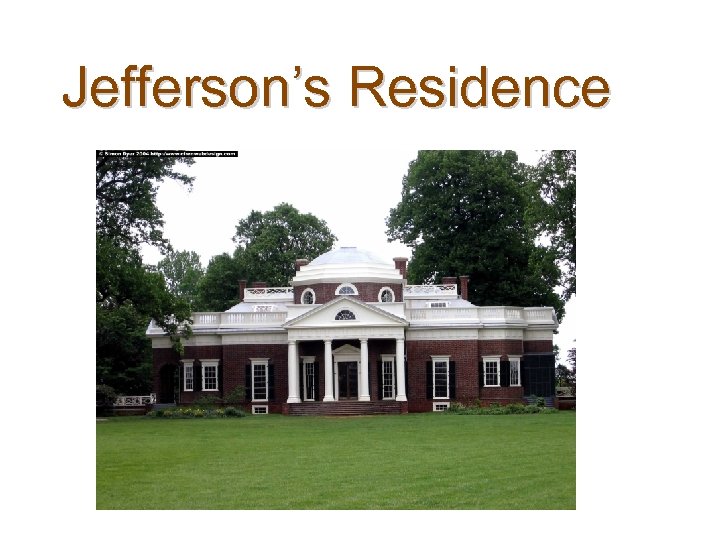 Jefferson’s Residence
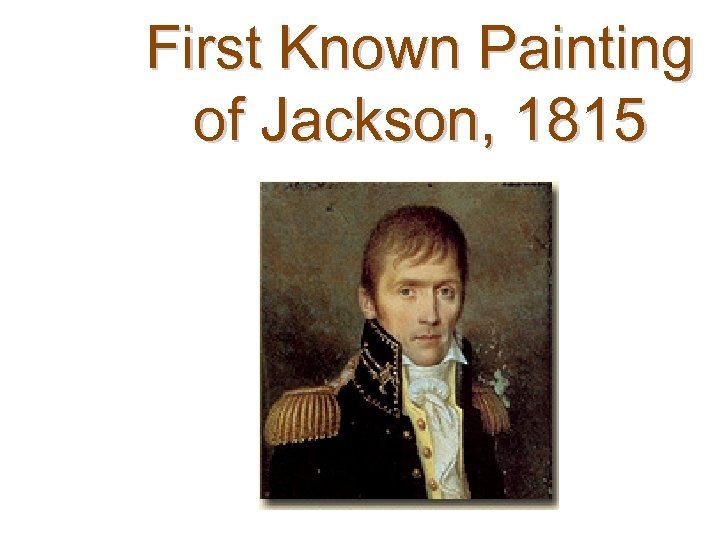 First Known Painting of Jackson, 1815
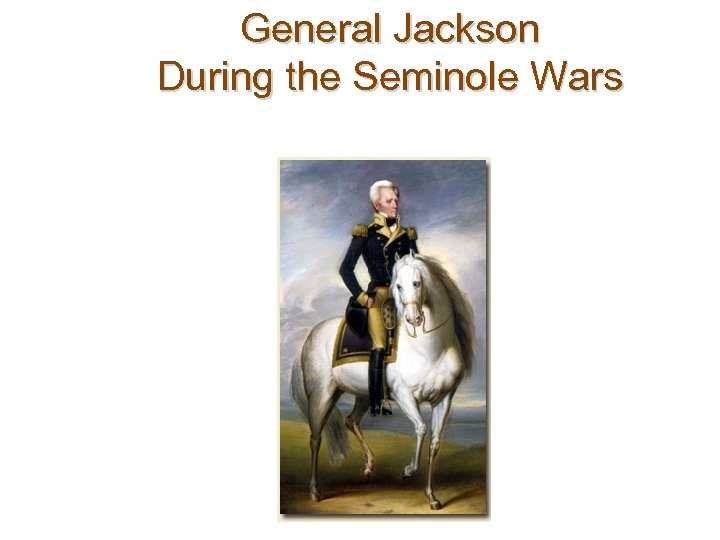 General Jackson During the Seminole Wars
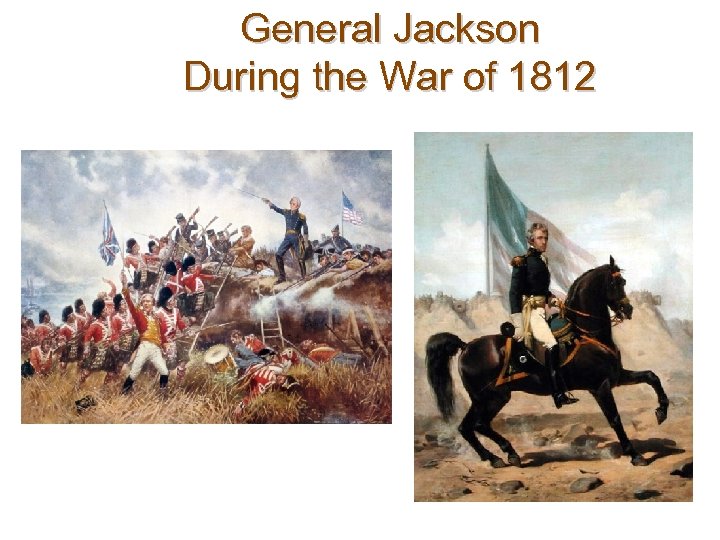 General Jackson During the War of 1812
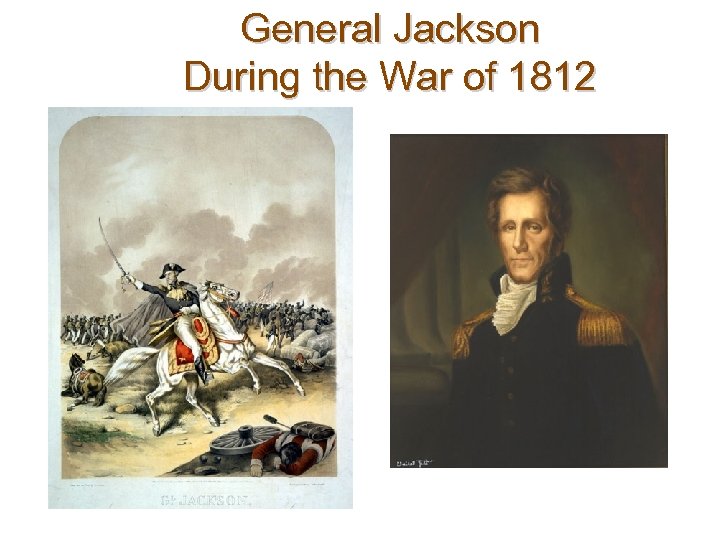 General Jackson During the War of 1812
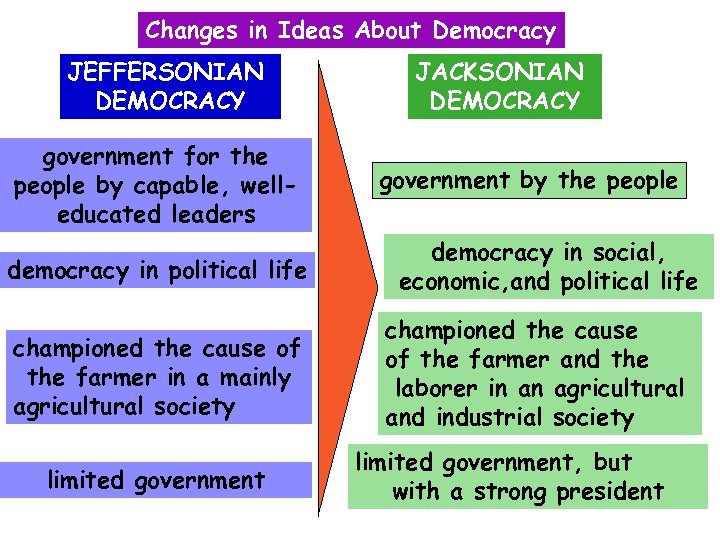
 6. What were the characteristics of Jacksonian democracy? • Government by the people; more could vote • democracy (equality) in social, economic, and political life • support for the farmer & laborer • Limited govt with a strong president • Spoils system (reward supporters)
 B. What changes in the U. S. did Jackson’s election signal? The expansion of Democracy and the common people now had a voice in political life. A shifting of political power to the “west”
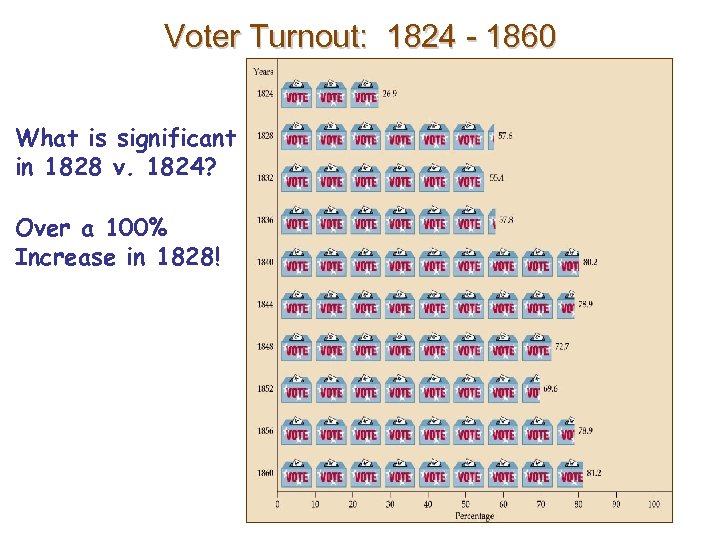
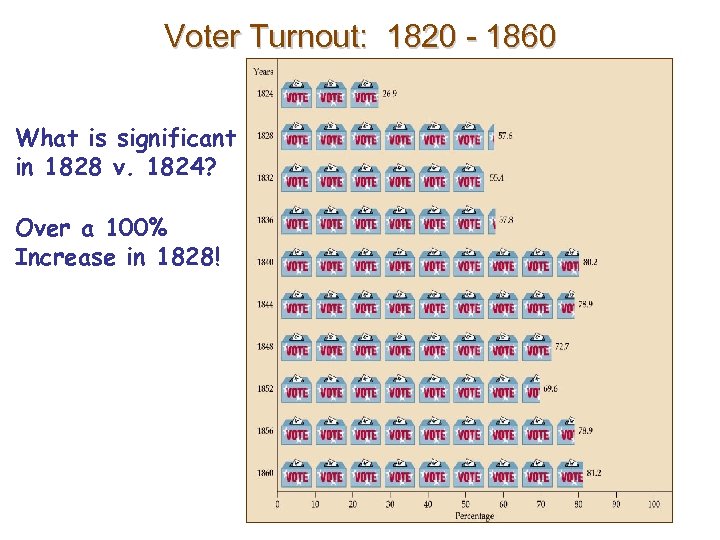 Voter Turnout: 1820 - 1860 What is significant in 1828 v. 1824? Over a 100% Increase in 1828!
 Election of 1828
 What was the effect of expanding voting rights? The election of a president who was a champion of the common people.
 Why Democracy Increased? 3 White male suffrage (voting) increased 3 Party nomination conventions 3 Spoils system. 3 Rise of Third Parties. 3 Popular campaigning (parades, rallies, floats, etc. )
 Why did Jackson Appeal to the “Common Man” 3 He distrusts Eastern rich folks; hates business monopolies, & special privilege of elites 3 His heart & soul was with the “plain folk. ” He was a simple man. 3 Belief that the common man was capable of uncommon achievements.
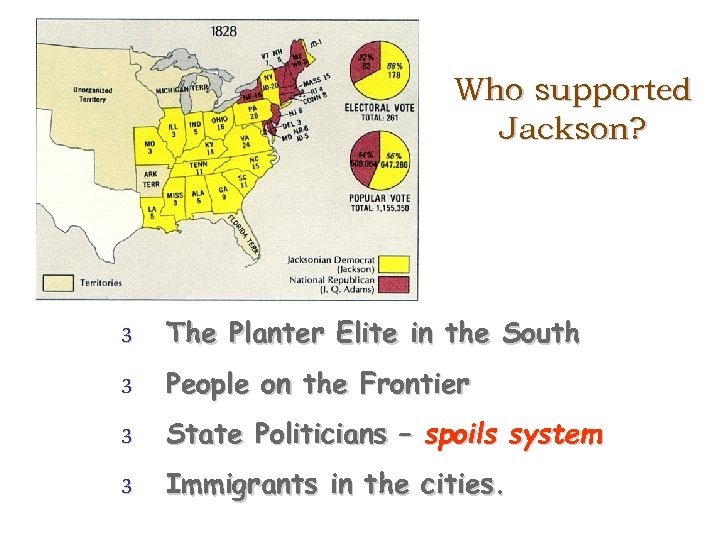 Who supported Jackson? 3 The Planter Elite in the South 3 People on the Frontier 3 State Politicians – spoils system 3 Immigrants in the cities.
 2) Identify economic issues that increased tension within the states Read about early issues in Jackson’s presidency in Section 12. 1 (p. 400) and answer the question below: Add to 12. 1 handout or separate sheet: Define and explain how the Tariff of Abominations , John C. Calhoun and Doctrine of Nullification , are related:
 Identify economic issues that increased tension within the states Q: Define and explain how the Tariff of Abominations John C. Calhoun and Doctrine of , , Nullificationare related: • The Tariff of Abominations was a 1828 tax that significantly raised tariffs on imports & southerners hated it. Jackson’s Vice President, John C. Calhounof South Carolina threatened secessionif it wasn’t reduced. • • Calhoun’s solution was the Doctrine of Nullification which gave the states rights to reject a law they felt was unconstitutional.

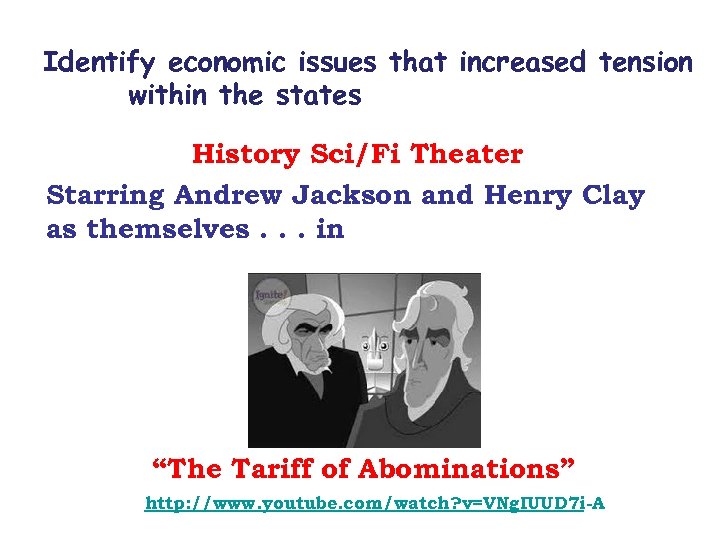 Identify economic issues that increased tension within the states History Sci/Fi Theater Starring Andrew Jackson and Henry Clay as themselves. . . in “The Tariff of Abominations” http: //www. youtube. com/watch? v=VNg. IUUD 7 i-A
 Turn to page 399 Read, summarize & illustrate the topics: • # 1 & 5 Rising Sectional Differences p. 398 -399 • # 2 & 6 Federal Government v. The States & Nullification Crisis p. 399 -400 # 3 & 7 Jackson’s Position & South Carolina Threatens to Secede p. 400 -401 # 4 & 8 – Q # 9, p. 414 Vocabulary Activity
 What factors helped Jackson win the presidency in 1828? • His background • His appeal to the common people • The expansion of voting rights
 The Reign of “King Mob”
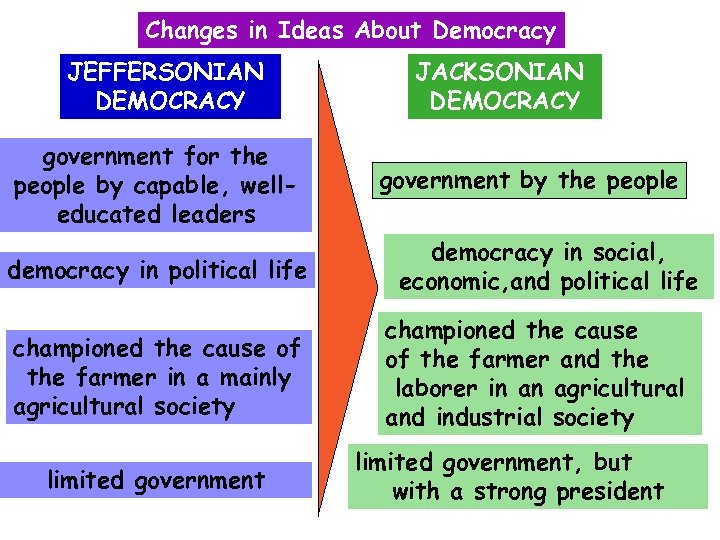 Changes in Ideas About Democracy JEFFERSONIAN DEMOCRACY government for the people by capable, welleducated leaders democracy in political life championed the cause of the farmer in a mainly agricultural society limited government JACKSONIAN DEMOCRACY government by the people democracy in social, economic, and political life championed the cause of the farmer and the laborer in an agricultural and industrial society limited government, but with a strong president
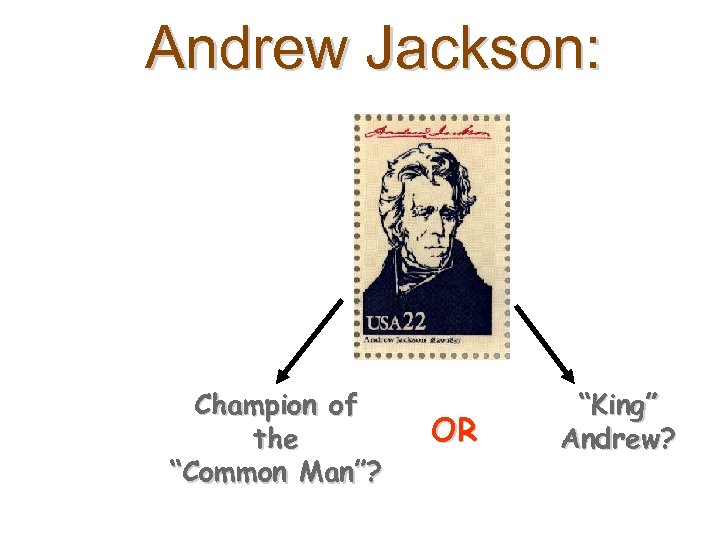 Andrew Jackson: Champion of the “Common Man”? OR “King” Andrew?
 Changes in Ideas About Democracy JEFFERSONIAN DEMOCRACY government for the people by capable, welleducated leaders democracy in political life championed the cause of the farmer in a mainly agricultural society limited government JACKSONIAN DEMOCRACY government by the people democracy in social, economic, and political life championed the cause of the farmer and the laborer in an agricultural and industrial society limited government, but with a strong president
 What qualities made Andrew Jackson a popular candidate in the election of 1828? What were the effects of expanding democracy on his election?
 Finish Ch. 11 Draw & Write then take out chapter 12 map – Indian Removal and quietly finish the activit

 Turn to page 399 Identify economic issues that increased tension within the states
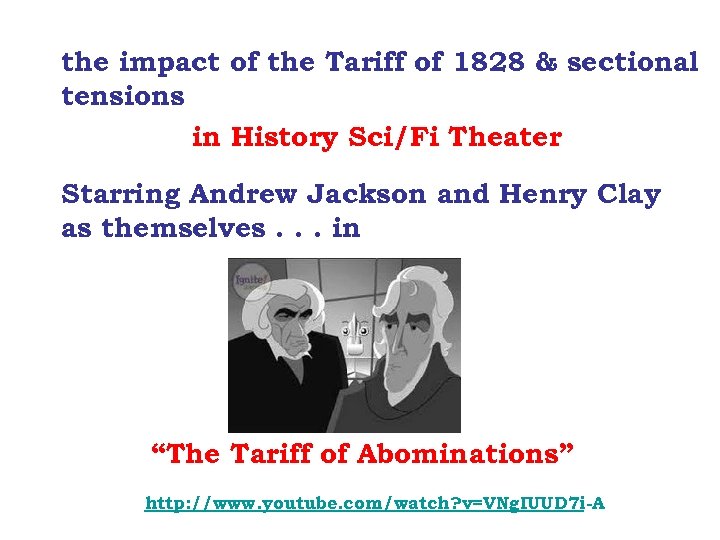 the impact of the Tariff of 1828 & sectional tensions in History Sci/Fi Theater Starring Andrew Jackson and Henry Clay as themselves. . . in “The Tariff of Abominations” http: //www. youtube. com/watch? v=VNg. IUUD 7 i-A
 Chapter 12. 2 Read, “One American’s Story” p. 403
 So, President Jackson, how do you really feel about Native Americans? “What good man would prefer a country covered with forests and ranged by a few thousand savages to our extensive Republic, studded with cities, towns, and prosperous farms embellished with all the improvements which art can devise or industry execute. . . ” - Andrew Jackson
 “What good man would prefer a country covered with forests and ranged by a few thousand savages to our extensive Republic, studded with cities, towns, and prosperous farms embellished with all the improvements which art can devise or industry execute. . . ” - Andrew Jackson 1. How does feel about the Natives? 2. What two cultures is he comparing & how does evaluate them? 3. What does he imply how the “good man” ought to prefer? Much of the attitude towards the natives and others racism is attributed to. . .
 Ch. 12. 2 Jackson’s Indian Removal policy Today’s Learning Target(s) Summarize the effects of the Indian Removal Act, 1830
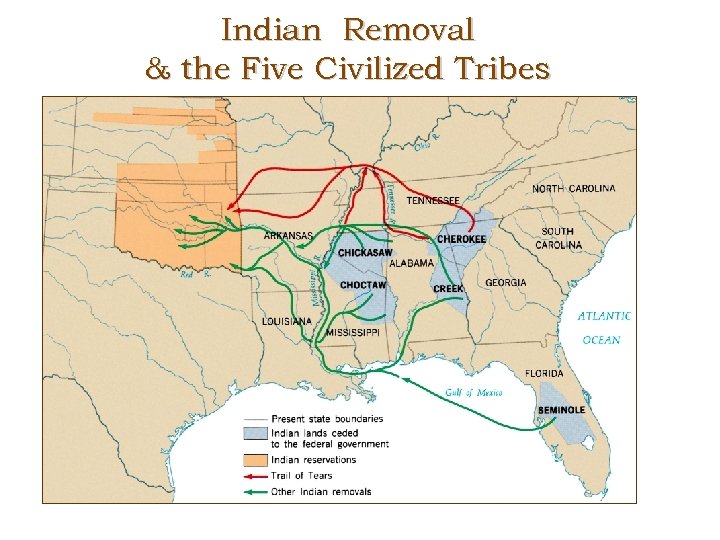 Indian Removal & the Five Civilized Tribes
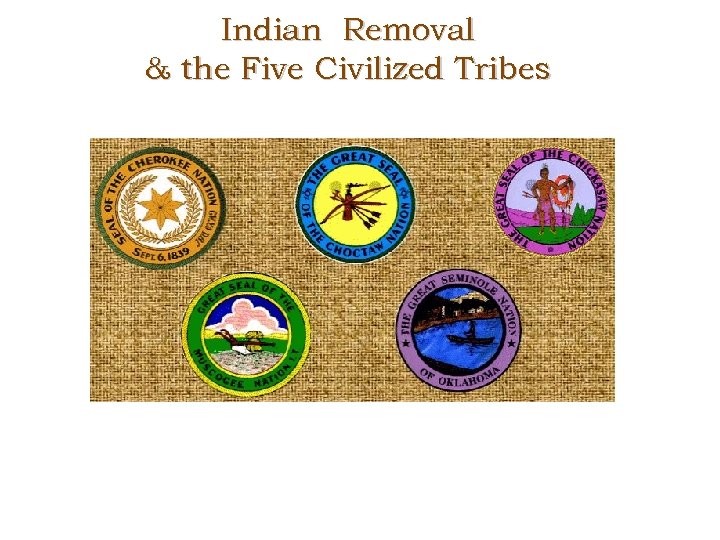 Indian Removal & the Five Civilized Tribes
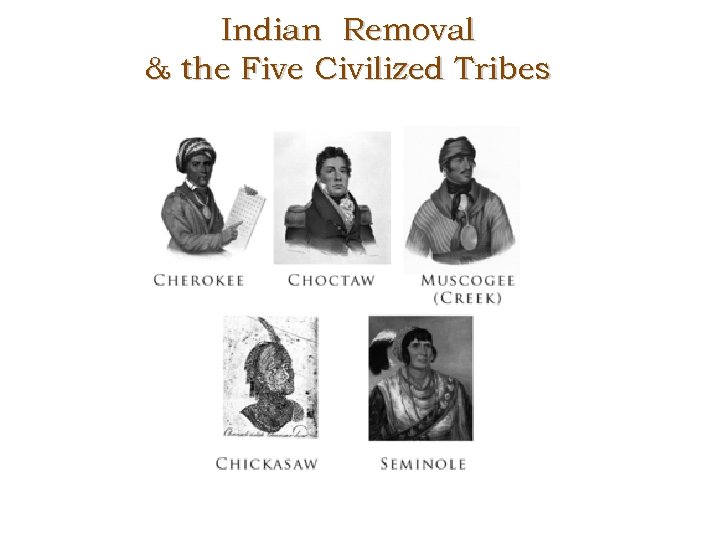 Indian Removal & the Five Civilized Tribes
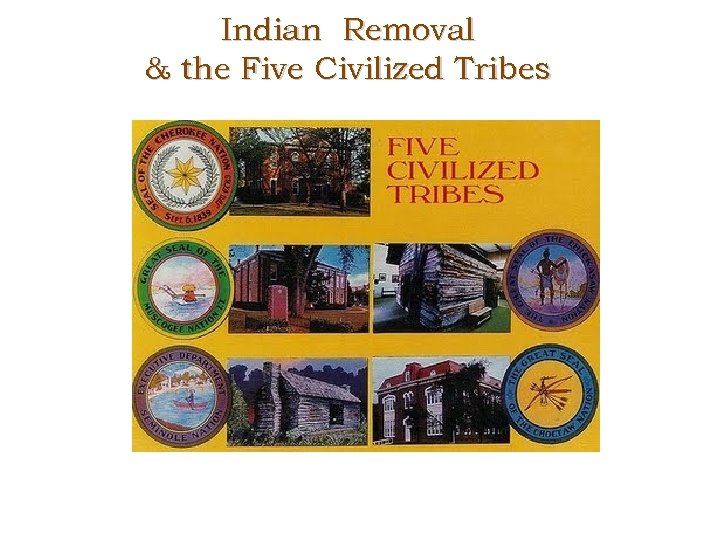 Indian Removal & the Five Civilized Tribes
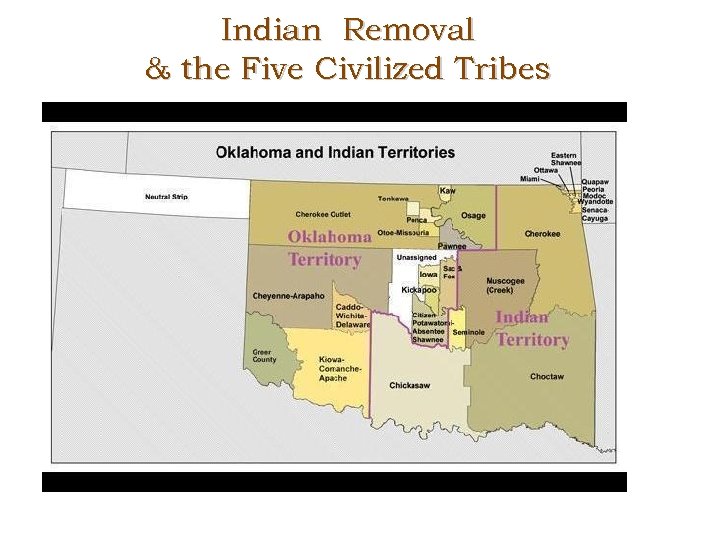 Indian Removal & the Five Civilized Tribes
 1. In what ways was the Cherokee Nation like the United States? Both had democratic self- government & a constitution, adopted American culture 2. What did the Indian Removal Act call for, and why did Jackson support it? • Make treaties that would require Natives to relocate west • He viewed the Natives as conquered subjects and their land was needed for U. S. expansion
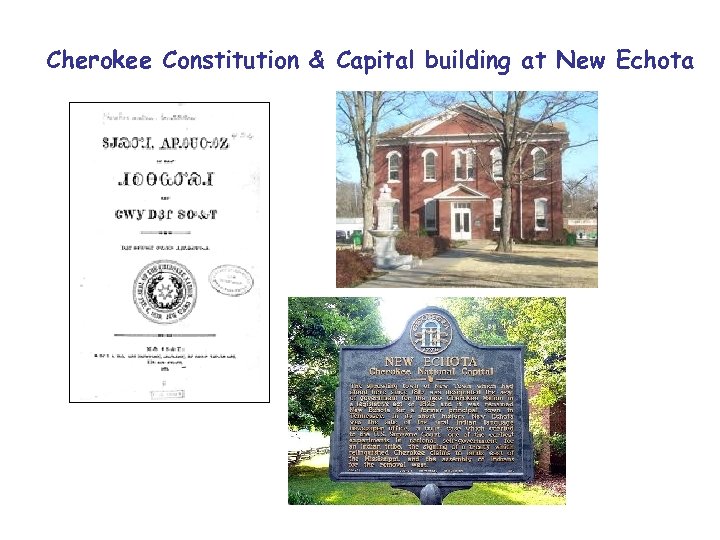 Cherokee Constitution & Capital building at New Echota
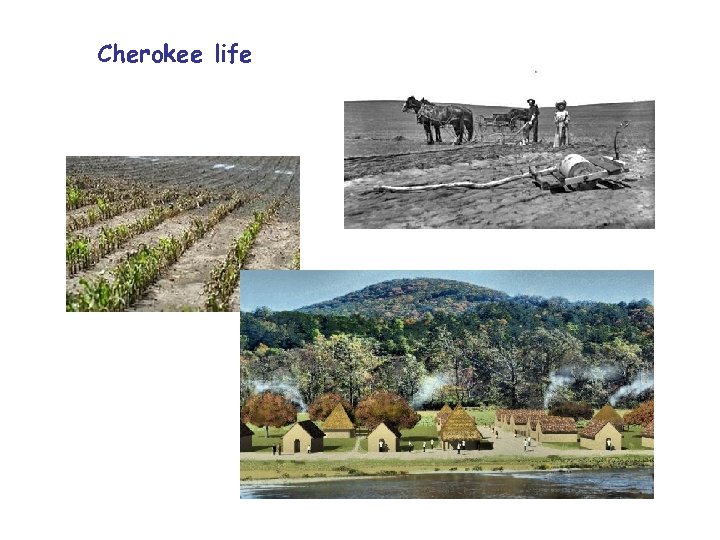 Cherokee life
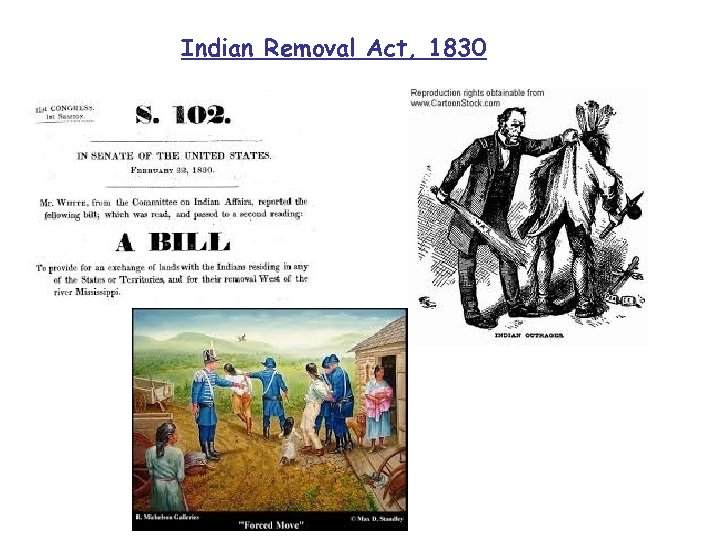 Indian Removal Act, 1830
 3. What did the Supreme Court decide in the case, and what was Jackson’s response to the court ruling? • Georgia laws didn’t apply to Cherokee • Georgia (and Jackson) ignored the ruling and he committed federal troops to help remove Natives. 4. What was the outcome of the Seminoles’ refusal? They fought (and lost) the second Seminole War to resist relocation.
 5. Why is the forced removal of the Cherokees referred to as the Trail of Tears? Because so many lives were lost on the harsh journey to the Indian Territories in the west. at least 4, 000 died
 Write these questions in your notebooks: 1. What was the Indian Removal Act of 1830? 2. How did President Jackson justify the Indian Removal Act? 3. In what ways did Native Americans resist the Indian Removal Act? 4. What were the consequences of the Indian Removal Act?
 1. What was the Indian Removal Act of 1830? Federal law that required Natives to negotiate treaties to relocate west of Mississippi river. 2. How did President Jackson justify the Indian Removal Act? U. S. had right to regulate the natives. Either adopt White culture or move. 3. In what ways did Native Americans resist the Indian Removal Act? They took up arms; fought against relocation; went into hiding; used the courts (Supreme Court) for help. 4. What were the consequences of the Indian Removal Act? Native Americans lost land, property, and homes; loss of their culture; many died.
 Indian Removal Jackson’s Goal? 1830 Indian Removal Act Cherokee Nation v. GA (1831) Chief Justice Marshall: “domestic dependent nation” Jackson: “John Marshall has made his decision, now let him enforce it!”
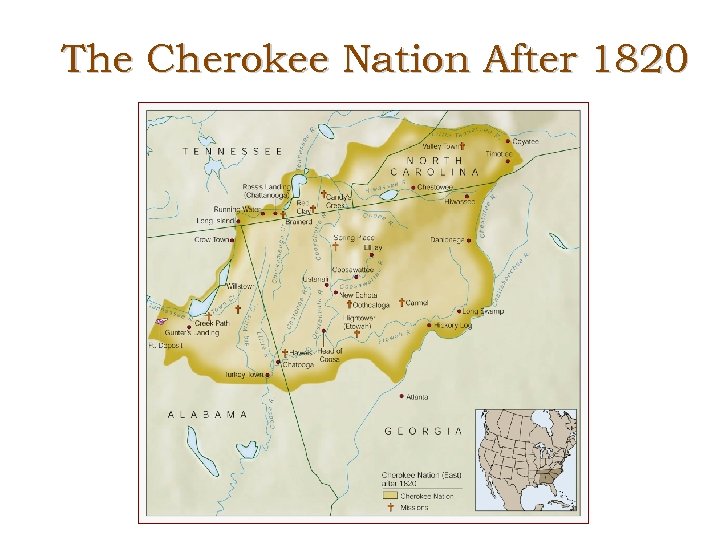 The Cherokee Nation After 1820
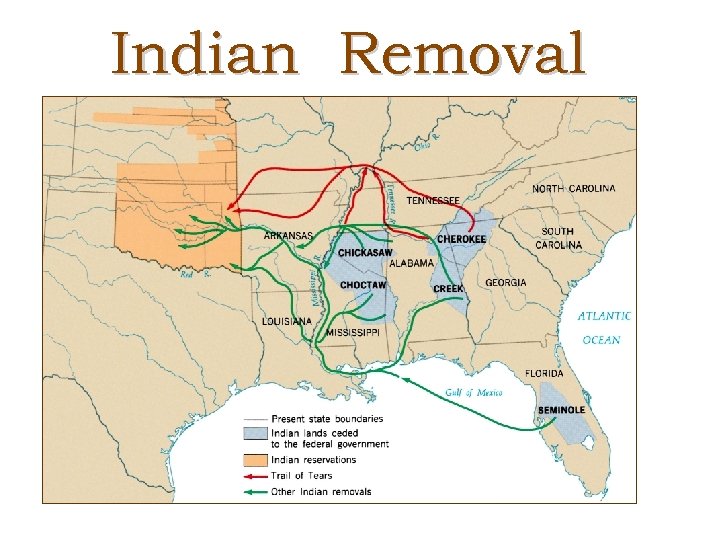 Indian Removal
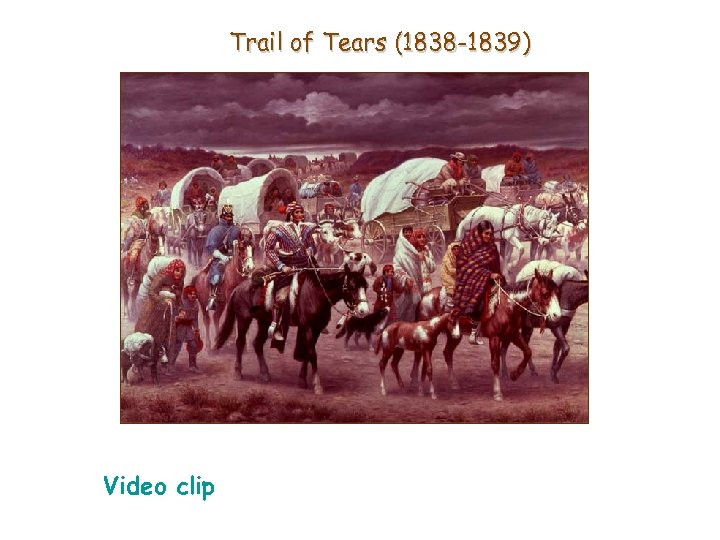 Trail of Tears (1838 -1839) Video clip
 Primary Source Analysis: A Petition by Cherokee Women 1. To whom did the women address their petition? 2. What was happening to the boundaries of their lands? 3. From where did the Cherokee get their lands? 4. Why do Cherokee have a right to their land? 5. In what ways did the Cherokee change their way of life? 6. Why do the Cherokee women criticize the white men who have married into Cherokee society?
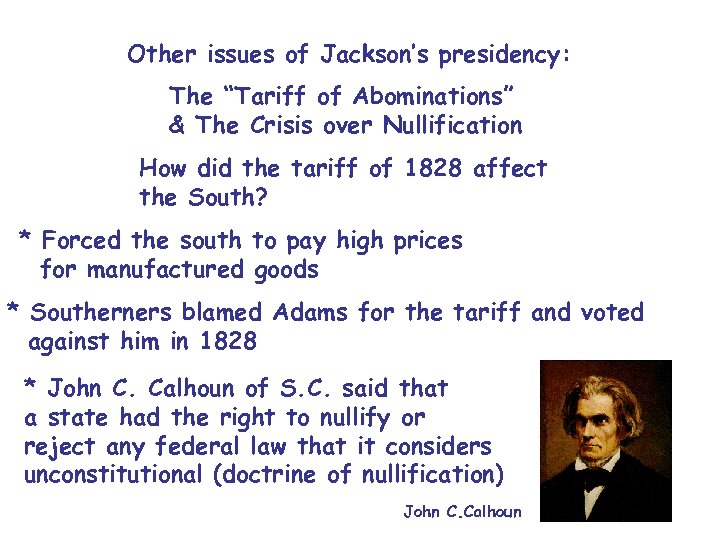 Other issues of Jackson’s presidency: The “Tariff of Abominations” & The Crisis over Nullification How did the tariff of 1828 affect the South? * Forced the south to pay high prices for manufactured goods * Southerners blamed Adams for the tariff and voted against him in 1828 * John C. Calhoun of S. C. said that a state had the right to nullify or reject any federal law that it considers unconstitutional (doctrine of nullification) John C. Calhoun
 Calhoun argued: The Union was a league of sovereign, or self. Governing, states that had the right to limit The federal government A state could nullify, or make void, a federal Law within its borders Believed that Congress had no right to impose a tariff That favored one section of the country An extreme form of States’ Rights – theory that States have the right to judge whether a law of Congress in unconstitutional
 Complete 12. 3 handout If your birthday is the month of: do these Questions Jan. /Feb = # 1 March/April = # 2 May/June = # 3 July/August = # 1 Sept. /October = # 2 Nov. /Dec. = # 3
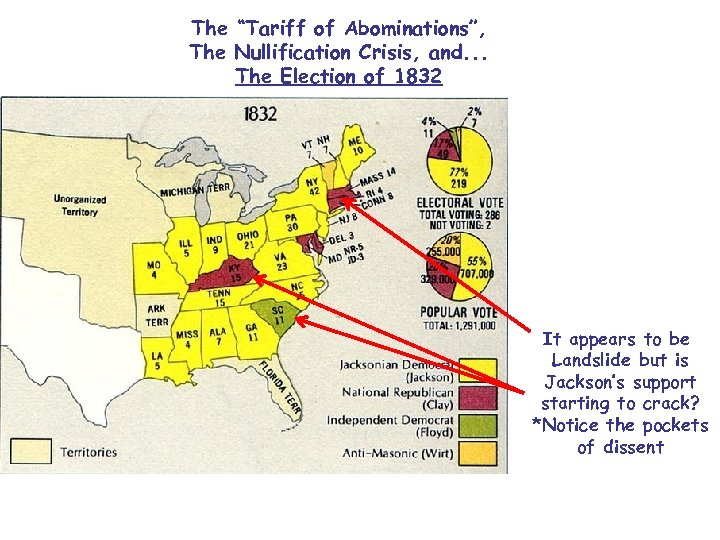 The “Tariff of Abominations”, The Nullification Crisis, and. . . The Election of 1832 It appears to be Landslide but is Jackson’s support starting to crack? *Notice the pockets of dissent

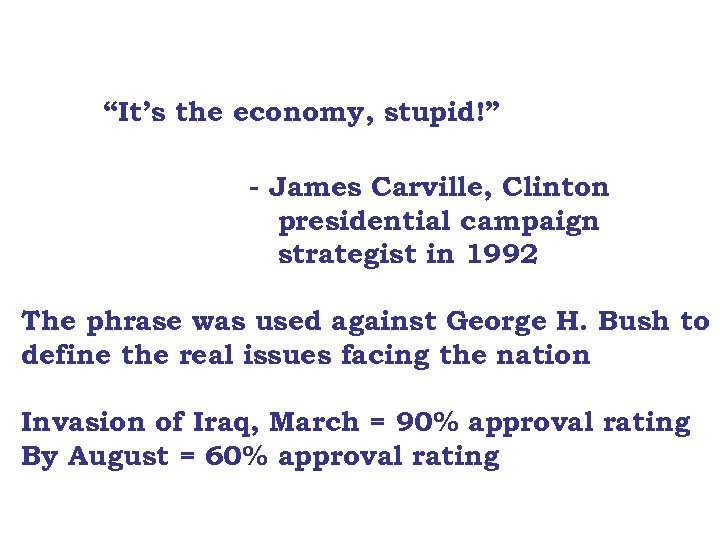 “It’s the economy, stupid!” - James Carville, Clinton presidential campaign strategist in 1992 The phrase was used against George H. Bush to define the real issues facing the nation Invasion of Iraq, March = 90% approval rating By August = 60% approval rating
 Chapter 12. 3 – Prosperity and Panic
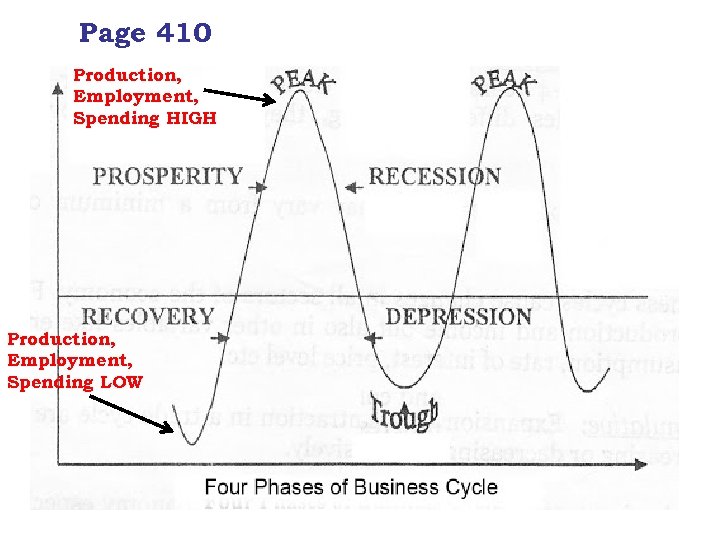
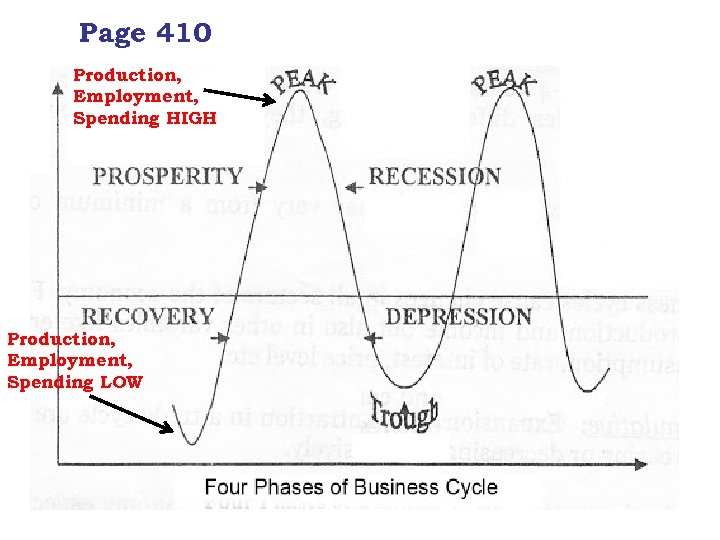
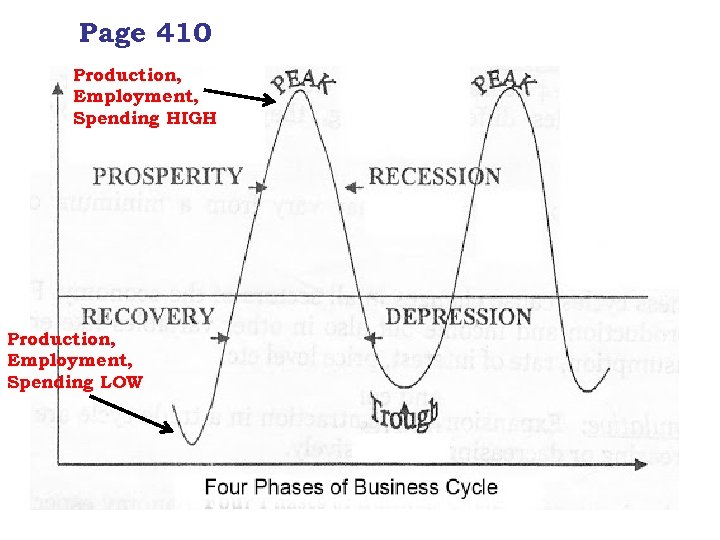 Page 410 Production, Employment, Spending HIGH Production, Employment, Spending LOW
 Chapter 12. 3 – Prosperity and Panic Today’s Learning Target(s): I. D. the causes & effects of Jackson’s destruction of the National Bank Explain the formation of the Whig Party
 Read, “One American’s Story” p. 409. How does/can government step in and help the economy? 1. taxing & spending) – fiscal 2. Setting interest rates – money supply As you read Section 12. 3 place the events listed in the correct position in the sequence diagram. Complete side 1 & 2
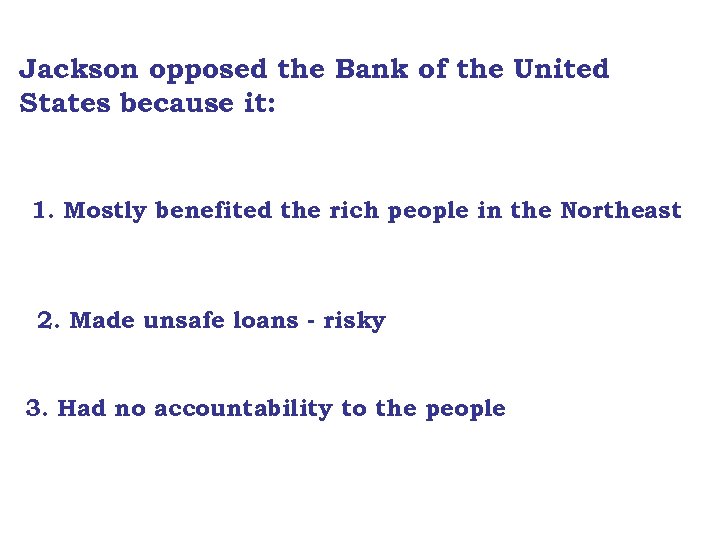 Jackson opposed the Bank of the United States because it: 1. Mostly benefited the rich people in the Northeast 2. Made unsafe loans - risky 3. Had no accountability to the people
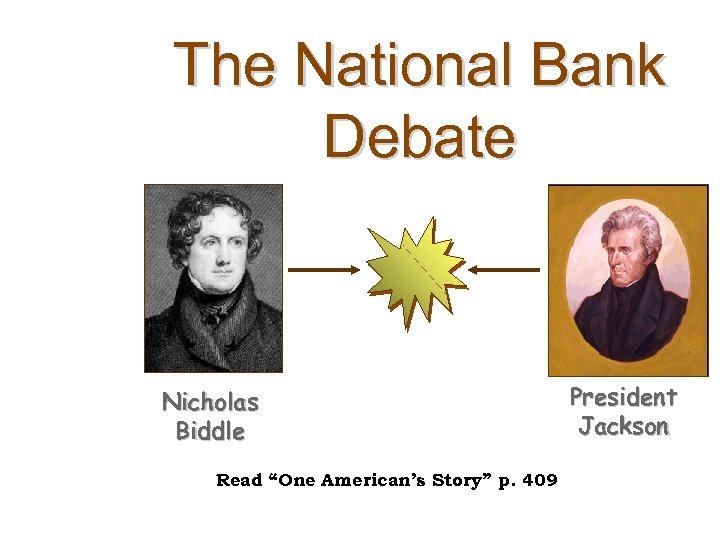 The National Bank Debate Nicholas Biddle Read “One American’s Story” p. 409 President Jackson
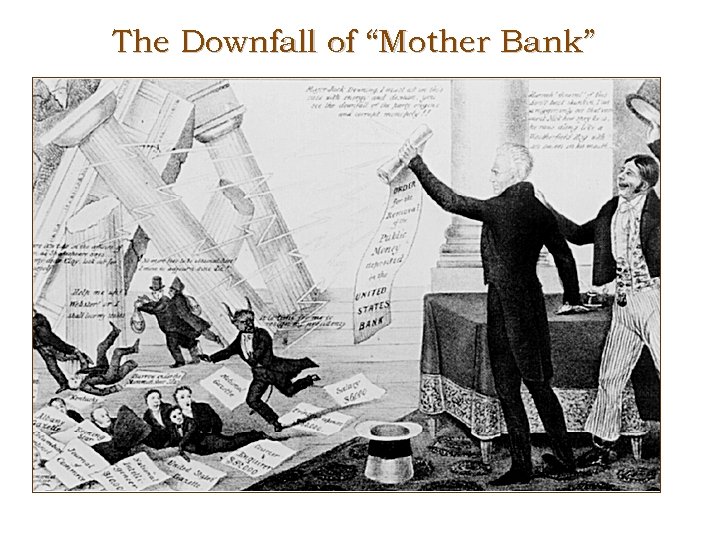 The Downfall of “Mother Bank”
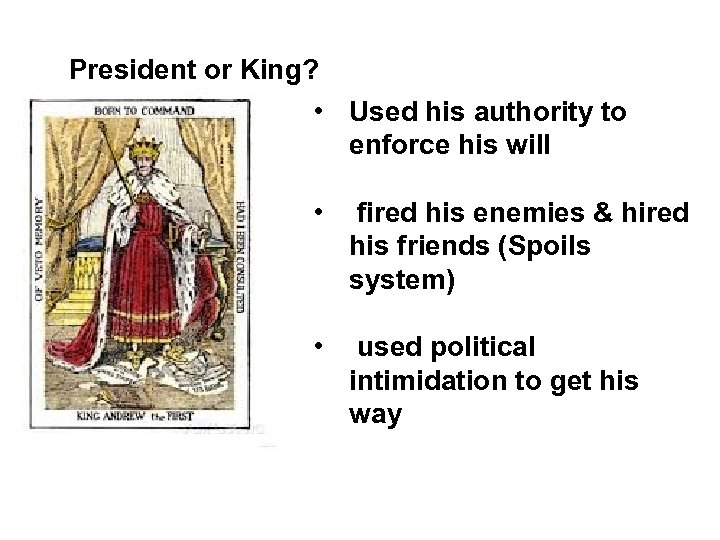 President or King? • Used his authority to enforce his will • fired his enemies & hired his friends (Spoils system) • used political intimidation to get his way
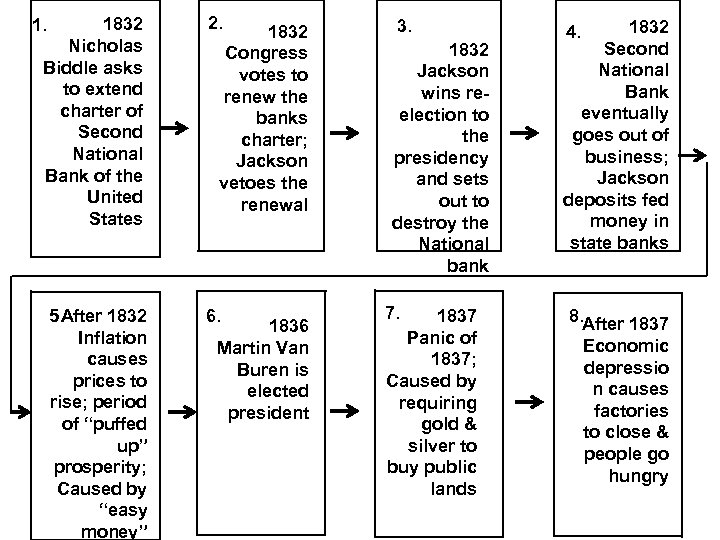
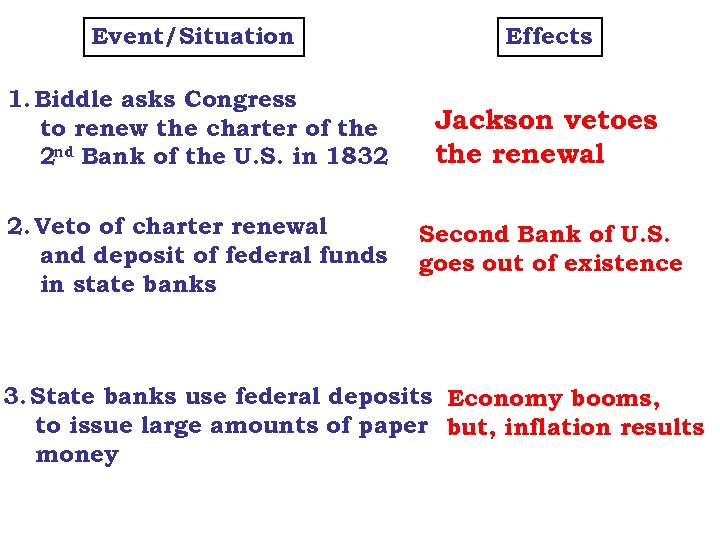 Event/Situation Effects 1. Biddle asks Congress to renew the charter of the 2 nd Bank of the U. S. in 1832 Jackson vetoes the renewal 2. Veto of charter renewal and deposit of federal funds in state banks Second Bank of U. S. goes out of existence 3. State banks use federal deposits Economy booms, to issue large amounts of paper but, inflation results money
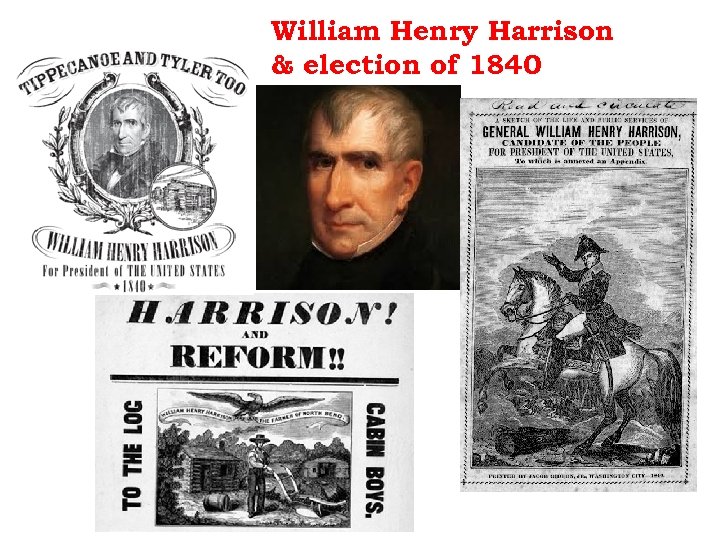
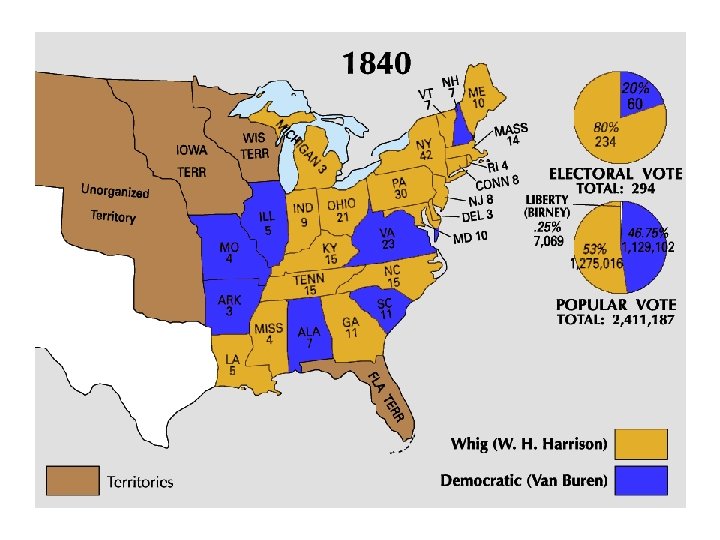
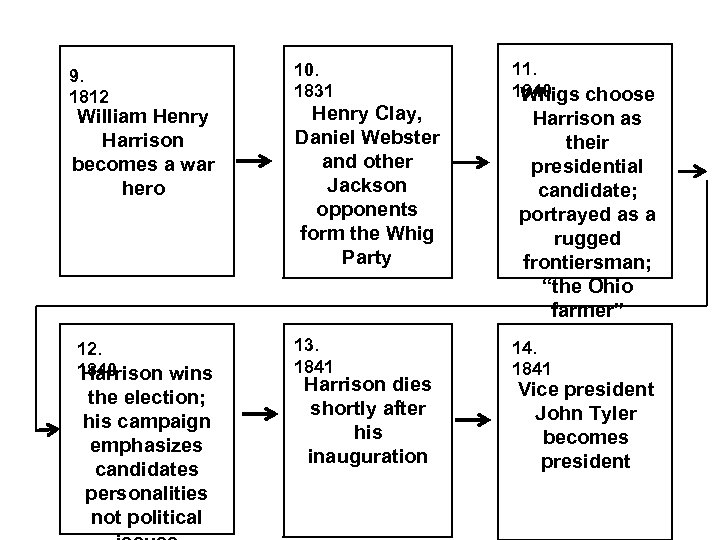
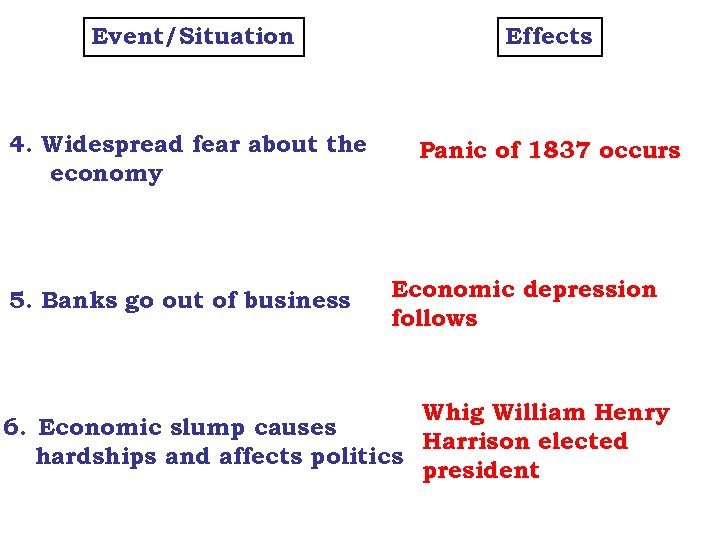 Event/Situation Effects 4. Widespread fear about the economy Panic of 1837 occurs 5. Banks go out of business Economic depression follows Whig William Henry 6. Economic slump causes Harrison elected hardships and affects politics president
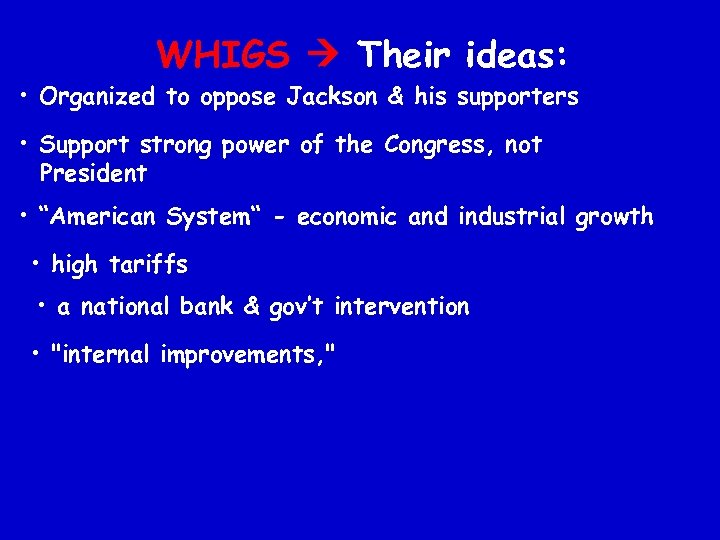 WHIGS Their ideas: • Organized to oppose Jackson & his supporters • Support strong power of the Congress, not President • “American System“ - economic and industrial growth • high tariffs • a national bank & gov’t intervention • "internal improvements, "
 Henry Clay Daniel Webster
 William Henry Harrison & election of 1840
 Andrew Jackson https: //www. youtube. com/watch? v=o x. Dq. OH 6 H 4 FQ
 The “Monster” Is Destroyed! “pet banks”? 1832 Jackson vetoed the extension of the 2 nd National Bank of the United States. 1836 the charter expired. 1841 the bank went bankrupt!
 Prosperity Becomes Panic “pet banks” issue too much paper money (inflation results) Jackson issued an order that required people to pay in gold or silver for public land People took their paper money to the banks demanded gold and silver exchange in (Panic of 1837) Banks quickly ran out of gold & silver and went out of business A depressionresulted (severe economic slump)
 Page 410 Production, Employment, Spending HIGH Production, Employment, Spending LOW

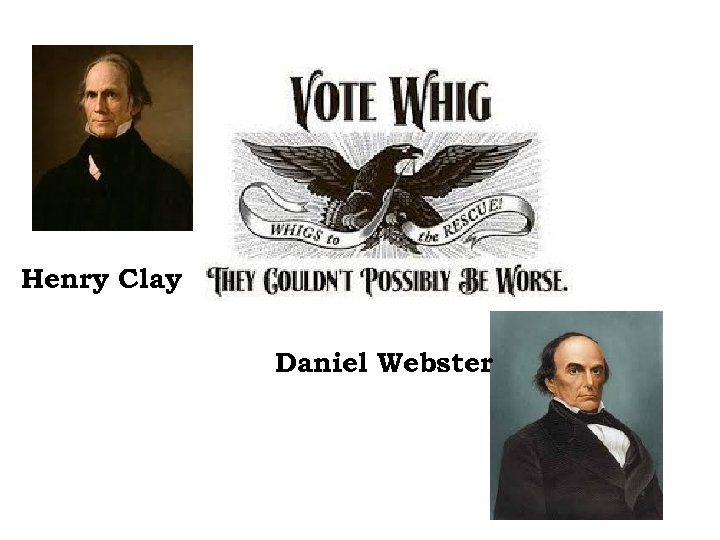
 9. 1812 William Henry Harrison becomes a war hero 12. 1840 Harrison wins the election; his campaign emphasizes candidates personalities not political 10. 1831 Henry Clay, Daniel Webster and other Jackson opponents form the Whig Party 13. 1841 Harrison dies shortly after his inauguration 11. 1840 Whigs choose Harrison as their presidential candidate; portrayed as a rugged frontiersman; “the Ohio farmer” 14. 1841 Vice president John Tyler becomes president
 1832 Nicholas Biddle asks to extend charter of Second National Bank of the United States 2. 5. After 1832 Inflation causes prices to rise; period of “puffed up” prosperity; Caused by “easy money” 6. 1832 Congress votes to renew the banks charter; Jackson vetoes the renewal 1836 Martin Van Buren is elected president 3. 1832 Jackson wins reelection to the presidency and sets out to destroy the National bank 7. 1837 Panic of 1837; Caused by requiring gold & silver to buy public lands 1832 Second National Bank eventually goes out of business; Jackson deposits fed money in state banks 4. 8. After 1837 Economic depressio n causes factories to close & people go hungry
 Page 410 Production, Employment, Spending HIGH Production, Employment, Spending LOW