 Скачать презентацию PKI Buy vs Build Decision at UW-Madison Presented
e6d16f28efe014fce0827356495aad4d.ppt
- Количество слайдов: 27



PKI Buy vs. Build Decision at UW-Madison Presented by Nicholas Davis PKI Project Leader UW—Madison, Division of Information Technology 1
Overview • • • Brief history of PKI at UW-Madison IT environment PKI requirements gathering effort Comparison of benefits of buy vs. build in our environment Our experience so far Integration with existing systems Critical success factors Future considerations What we have learned 2
History of PKI at UW-Madison • October 2000 Internet 2 Public Key Infrastructure Lab established at UWMadison. • 2002 Provided certificates to Shibboleth testing community • 2004 Campus requirements gathering initiative • Spring 2005 RFI review • August 2005 Geotrust selected 3
UW-Madison IT Environment • • • Serving a universe of 50, 000 Faculty, Staff, Students Highly decentralized Public institution Research driven environment 4
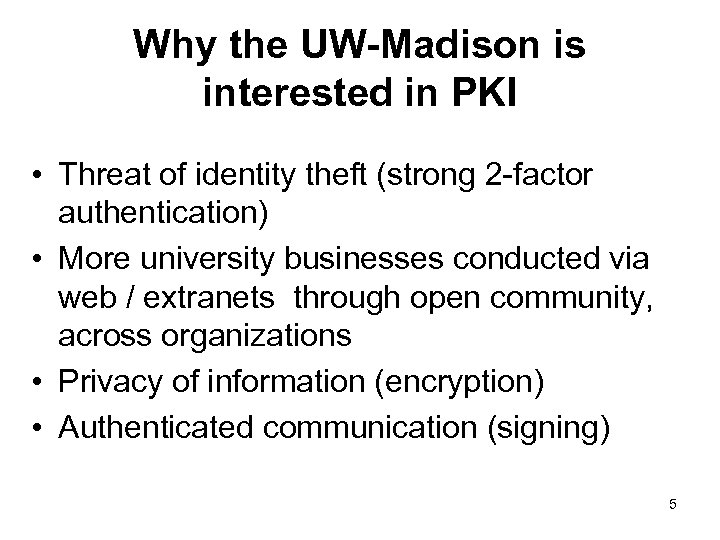
Why the UW-Madison is interested in PKI • Threat of identity theft (strong 2 -factor authentication) • More university businesses conducted via web / extranets through open community, across organizations • Privacy of information (encryption) • Authenticated communication (signing) 5
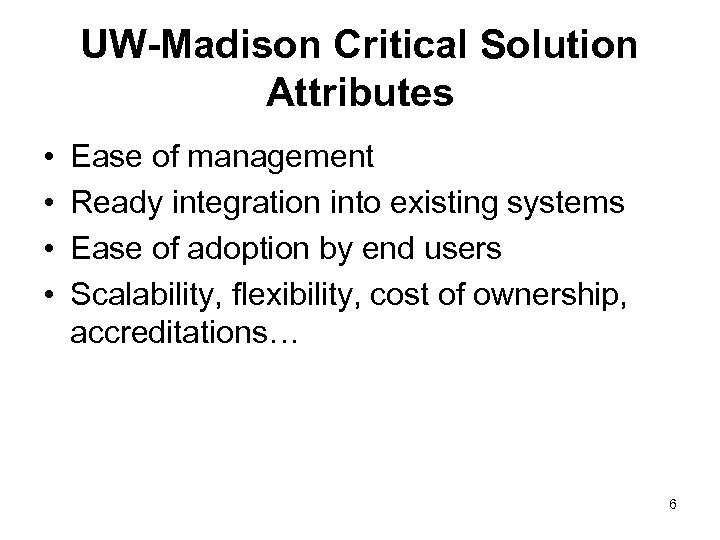
UW-Madison Critical Solution Attributes • • Ease of management Ready integration into existing systems Ease of adoption by end users Scalability, flexibility, cost of ownership, accreditations… 6
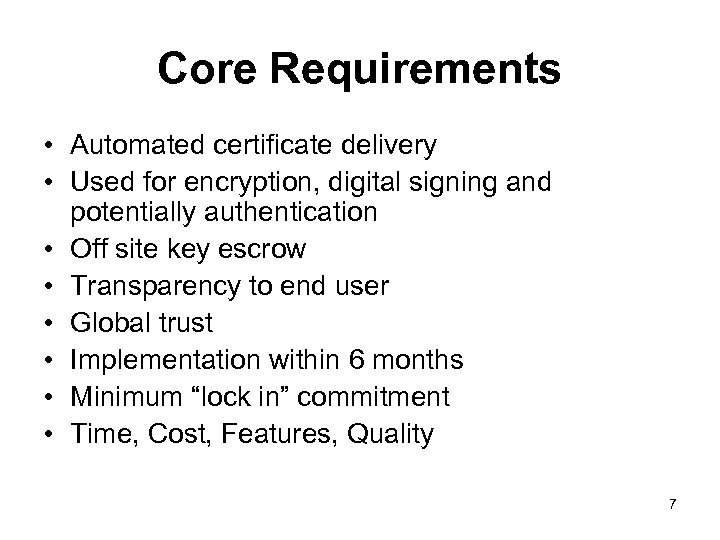
Core Requirements • Automated certificate delivery • Used for encryption, digital signing and potentially authentication • Off site key escrow • Transparency to end user • Global trust • Implementation within 6 months • Minimum “lock in” commitment • Time, Cost, Features, Quality 7
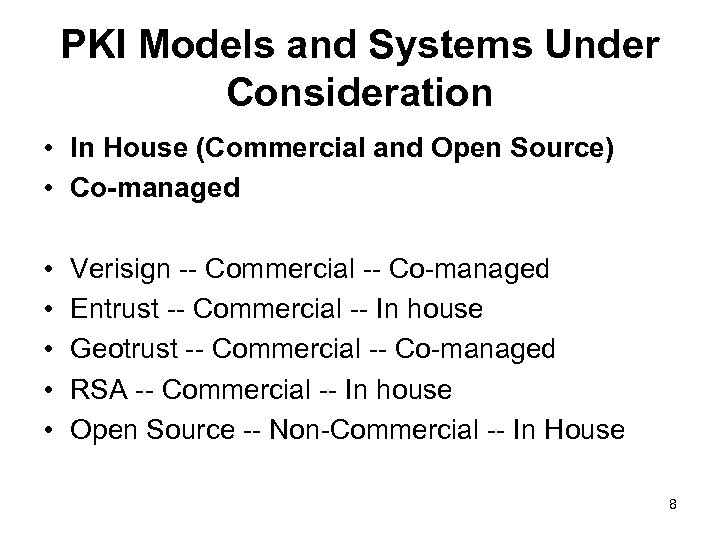
PKI Models and Systems Under Consideration • In House (Commercial and Open Source) • Co-managed • • • Verisign -- Commercial -- Co-managed Entrust -- Commercial -- In house Geotrust -- Commercial -- Co-managed RSA -- Commercial -- In house Open Source -- Non-Commercial -- In House 8
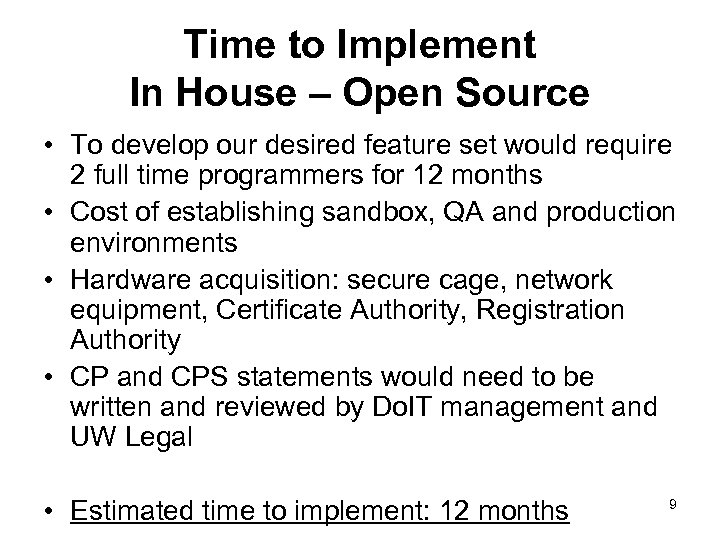
Time to Implement In House – Open Source • To develop our desired feature set would require 2 full time programmers for 12 months • Cost of establishing sandbox, QA and production environments • Hardware acquisition: secure cage, network equipment, Certificate Authority, Registration Authority • CP and CPS statements would need to be written and reviewed by Do. IT management and UW Legal • Estimated time to implement: 12 months 9
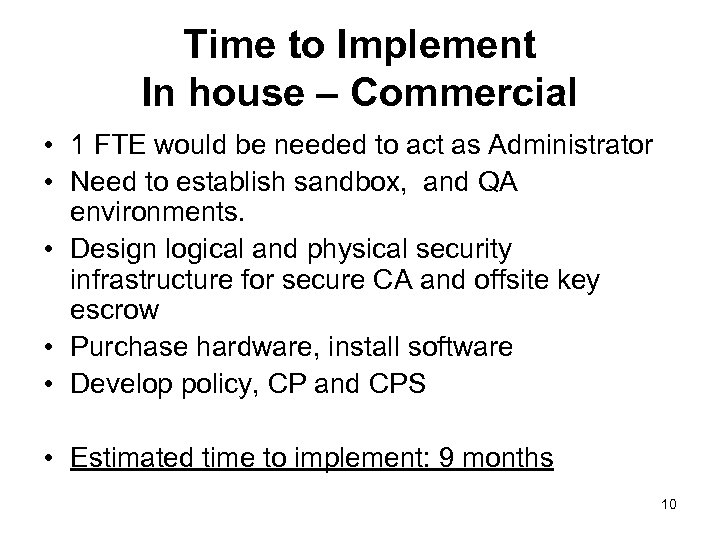
Time to Implement In house – Commercial • 1 FTE would be needed to act as Administrator • Need to establish sandbox, and QA environments. • Design logical and physical security infrastructure for secure CA and offsite key escrow • Purchase hardware, install software • Develop policy, CP and CPS • Estimated time to implement: 9 months 10
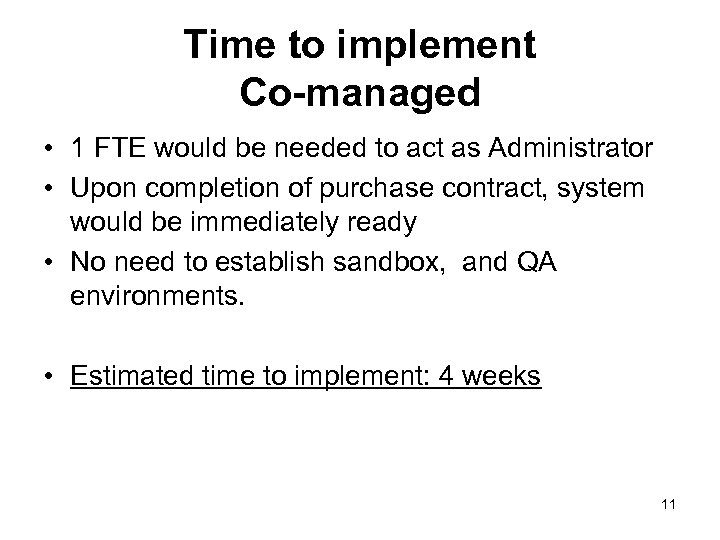
Time to implement Co-managed • 1 FTE would be needed to act as Administrator • Upon completion of purchase contract, system would be immediately ready • No need to establish sandbox, and QA environments. • Estimated time to implement: 4 weeks 11
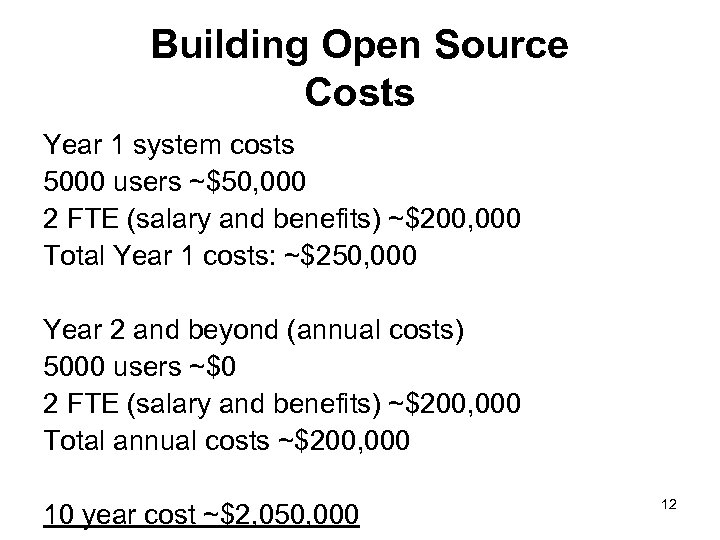
Building Open Source Costs Year 1 system costs 5000 users ~$50, 000 2 FTE (salary and benefits) ~$200, 000 Total Year 1 costs: ~$250, 000 Year 2 and beyond (annual costs) 5000 users ~$0 2 FTE (salary and benefits) ~$200, 000 Total annual costs ~$200, 000 10 year cost ~$2, 050, 000 12
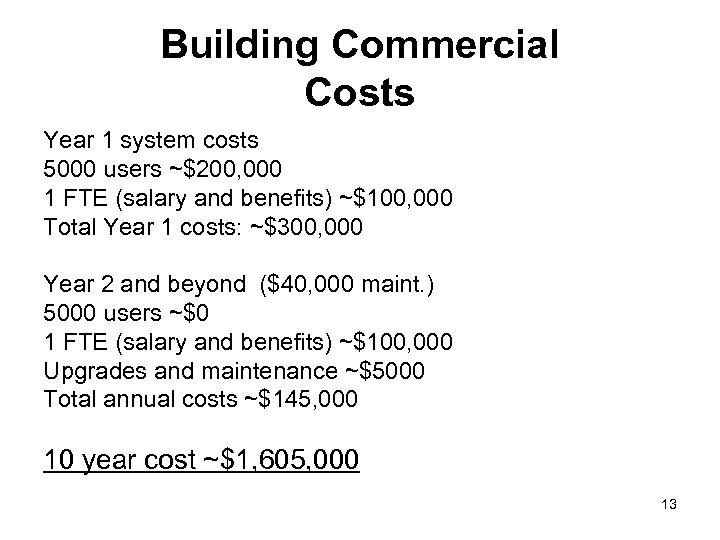
Building Commercial Costs Year 1 system costs 5000 users ~$200, 000 1 FTE (salary and benefits) ~$100, 000 Total Year 1 costs: ~$300, 000 Year 2 and beyond ($40, 000 maint. ) 5000 users ~$0 1 FTE (salary and benefits) ~$100, 000 Upgrades and maintenance ~$5000 Total annual costs ~$145, 000 10 year cost ~$1, 605, 000 13
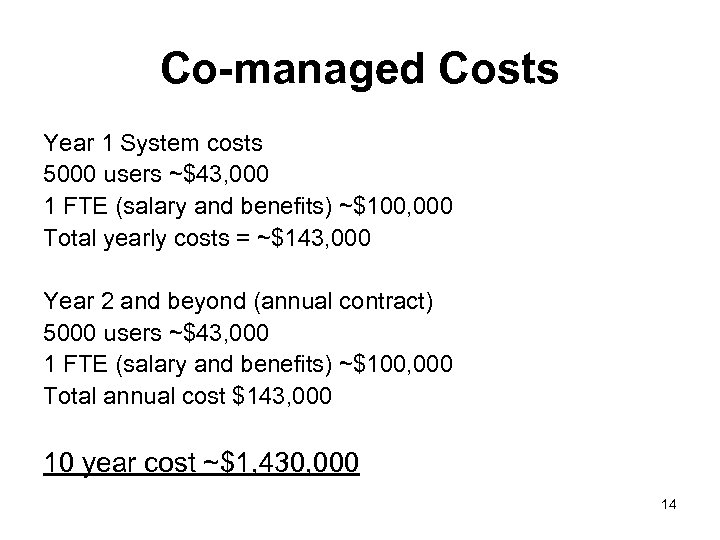
Co-managed Costs Year 1 System costs 5000 users ~$43, 000 1 FTE (salary and benefits) ~$100, 000 Total yearly costs = ~$143, 000 Year 2 and beyond (annual contract) 5000 users ~$43, 000 1 FTE (salary and benefits) ~$100, 000 Total annual cost $143, 000 10 year cost ~$1, 430, 000 14
Annual Cost Summary • 1 year • 10 year • There is no free lunch, even with open source • The price of entry for infrastructure can be cost prohibitive and a major sticking point for organizational commitment 15
Feature Set – No Trusted Root With Open Source Unsigned Root means distrust both within and outside our core universe Who are you serving? Internal customers? External customers? Both? 16
Benefits of co-managed solution Seamless trust let’s us play globally via The Equifax Secure e. Business CA 1 Logistical, financial and political issues with Building true off site key escrow Keys are securely kept offsite 17
Benefits of co-managed solution (continued) All the user needs is a web browser in order to get theircertificate Quality co-managed PKI systems are constantly monitored, patched, upgraded and backed up at a remote location 18
Our experience so far Customers appreciate: • Automated certificate delivery • Trusted Root • Key Escrow Uses: • Using certificates for digital signing • Using certificates for encrypted email • Digital signing of mass email to campus 19
Integration With Existing Systems • Easily scalable – Load users in CSV format in batch • Public keys are exportable to LDAP and University White Pages • CRL is automated via True Credentials system • Third party software available for high assurance server authentication 20
Critical Success Factors • A focus on the customer requirements is of pinnacle importance • Financial lifecycle modeling for both short and long term • Being careful not to reinvent the wheel simply for the sake of pride • Top down support from the CIO’s office 21
Summary of Benefits • • Lower upfront fixed costs Lower 10 year costs Faster road to implementation Trusted Root Off Site Key Escrow Automated certificate delivery UW-Madison common look and feel No long term lock in 22
Future Considerations • The beneficial cost argument may change if our user population grows dramatically • Widespread adoption of the Higher Education Bridge CA (HEBCA) may alter our reliance on a commercial pre-installed root 23
What We Have Learned • Don’t let your pride dictate your choice of PKI model • Focus effort on things which have not already been done and on providing utility to the end user, not on where your CA hardware is located • A certificate is a certificate 24
What We Have Learned (continued) • The key to success in a decentralized environment lies in motivating your users, not obligating your users • Whether you choose to build or buy, remember to keep it simple for the customers • Don’t spend time on duplication of effort 25
What We Have Learned (continued) • What matters most is what your organization does with the certificate once it is issued • The challenge of implementing PKI is 30% technical and 70% user education, marketing and acceptance 26

Questions, Comments Contact information: Nicholas Davis University of Wisconsin—Madison Division of Information Technology Email: ndavis 1@wisc. edu Telephone: 608 -262 -3837 27
Скачать презентацию PKI Buy vs Build Decision at UW-Madison Presented
e6d16f28efe014fce0827356495aad4d.ppt