


 Скачать презентацию PKCS 1 v 2 1 RSA Cryptography Standard
915e48930d64859e54aa2250ef2bb9fa.ppt
- Количество слайдов: 56
 PKCS #1 v 2. 1: RSA Cryptography Standard Burt Kaliski, RSA Laboratories PKCS Workshop, 30 September 1999
 Summary • PKCS #1 v 1. 5 published in November 1993 • Wide deployment, in parallel with increased understanding of security of RSA-based techniques • PKCS #1 v 2. 0 released in July 1998 with OAEP (Optimal Asymmetric Encryption Padding) for enhanced security of encryption schemes – OAEP developed by M. Bellare and P. Rogaway, 1994 • PKCS #1 v 2. 1 draft incorporates the companion technique for digital signatures, PSS (Probabilistic Signature Scheme) – PSS developed by same authors, 1996
 Goals of Presentation • Part I: Review the current draft • Part II: Propose a strategy for RSA signature standards • Part III: Discuss several other topics related to the draft
 Part I: The Current Draft
 Status • PKCS #1 v 2. 1 adds PSS signature scheme, includes some editorial improvements • Draft 1 released 21 September for 30 -day review
 Outline • What is PSS? • General Model for Signature Schemes • Draft Specification of PSS • ASN. 1 Syntax • Example Applications • PSS Advantages and Alternatives • Patent Issues • Recommended Deployment • A Brief Security Update
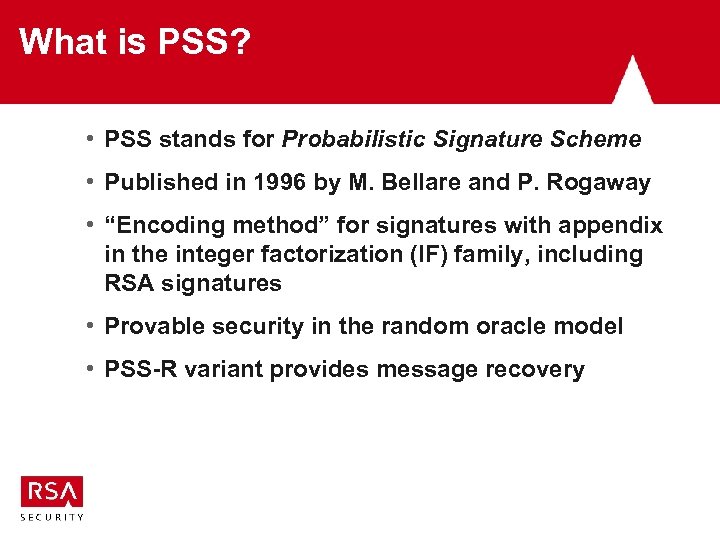 What is PSS? • PSS stands for Probabilistic Signature Scheme • Published in 1996 by M. Bellare and P. Rogaway • “Encoding method” for signatures with appendix in the integer factorization (IF) family, including RSA signatures • Provable security in the random oracle model • PSS-R variant provides message recovery
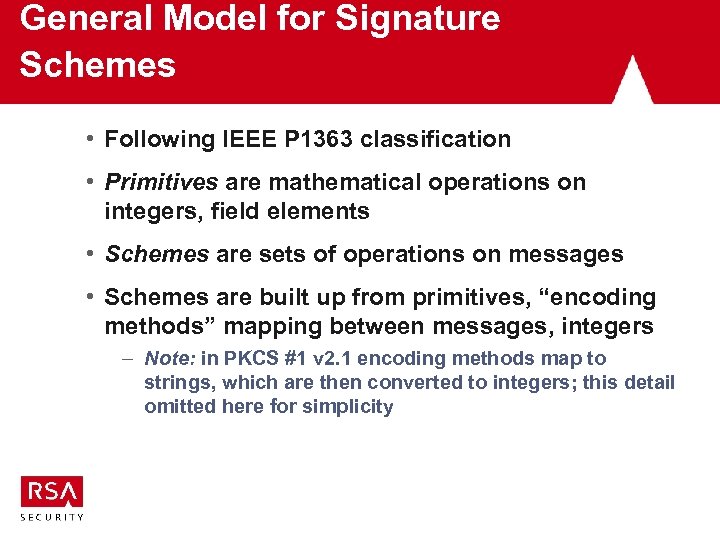 General Model for Signature Schemes • Following IEEE P 1363 classification • Primitives are mathematical operations on integers, field elements • Schemes are sets of operations on messages • Schemes are built up from primitives, “encoding methods” mapping between messages, integers – Note: in PKCS #1 v 2. 1 encoding methods map to strings, which are then converted to integers; this detail omitted here for simplicity
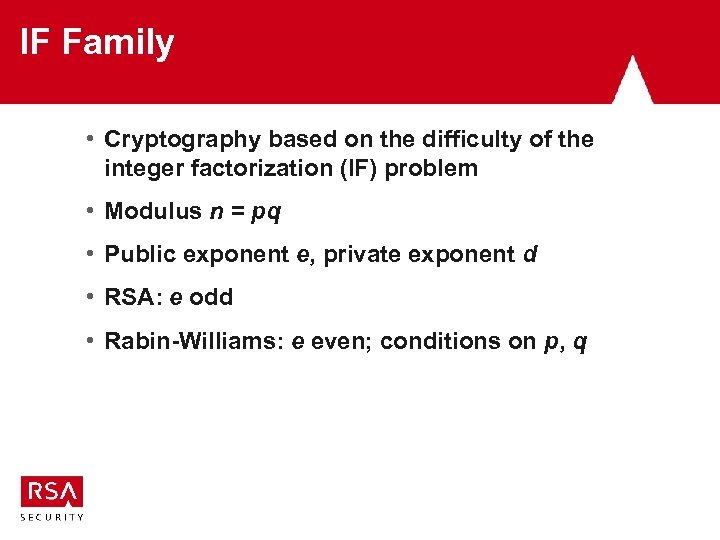 IF Family • Cryptography based on the difficulty of the integer factorization (IF) problem • Modulus n = pq • Public exponent e, private exponent d • RSA: e odd • Rabin-Williams: e even; conditions on p, q
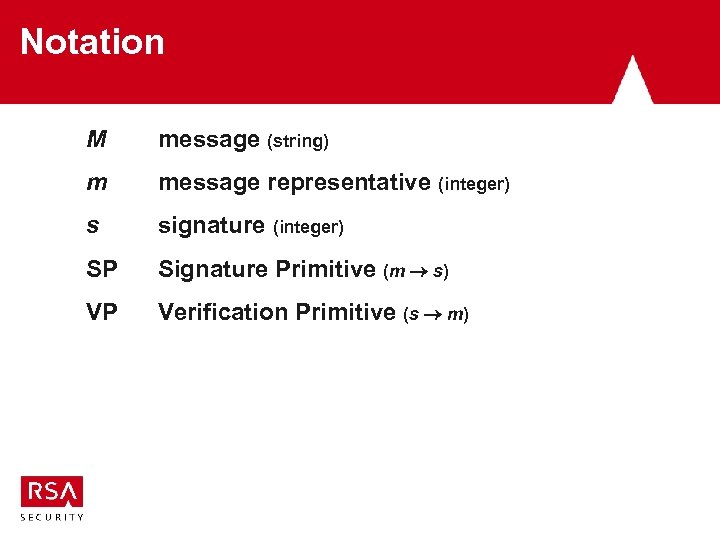 Notation M message (string) m message representative (integer) s signature (integer) SP Signature Primitive (m s) VP Verification Primitive (s m)
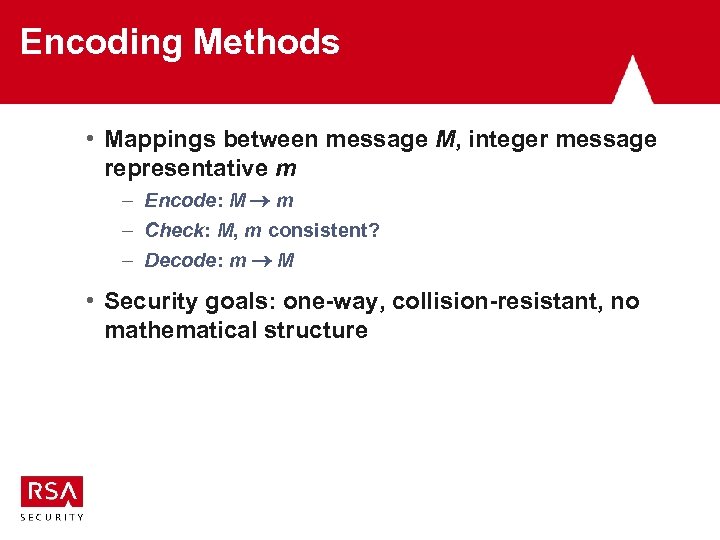 Encoding Methods • Mappings between message M, integer message representative m – Encode: M m – Check: M, m consistent? – Decode: m M • Security goals: one-way, collision-resistant, no mathematical structure
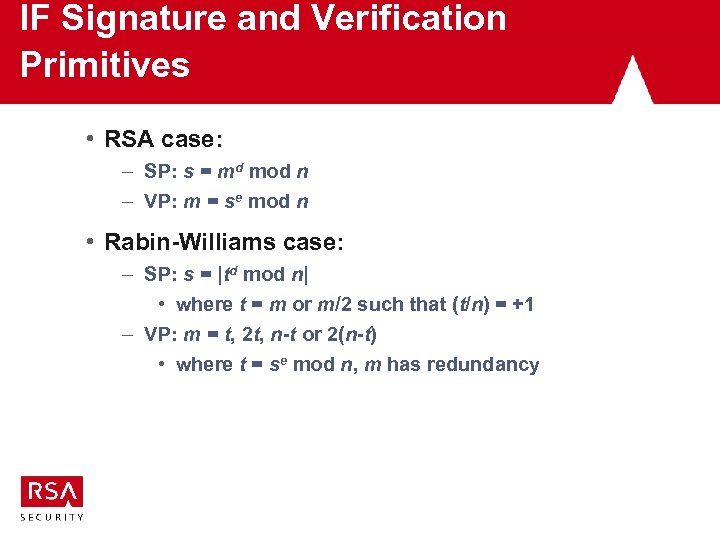 IF Signature and Verification Primitives • RSA case: – SP: s = md mod n – VP: m = se mod n • Rabin-Williams case: – SP: s = |td mod n| • where t = m or m/2 such that (t/n) = +1 – VP: m = t, 2 t, n-t or 2(n-t) • where t = se mod n, m has redundancy
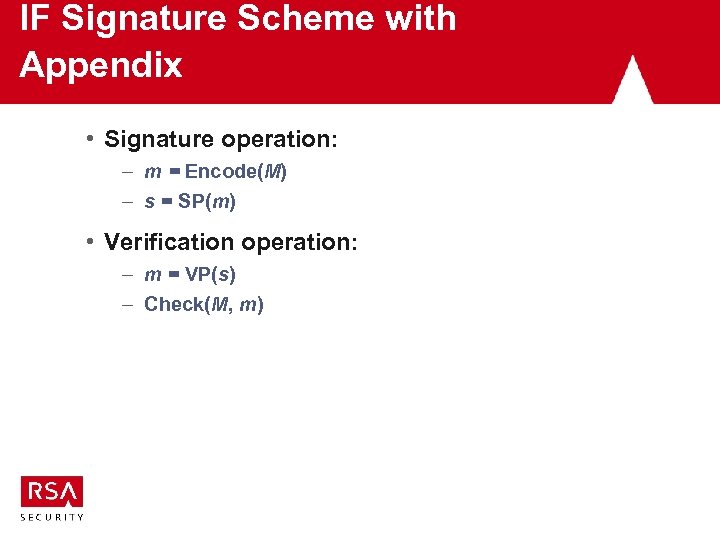 IF Signature Scheme with Appendix • Signature operation: – m = Encode(M) – s = SP(m) • Verification operation: – m = VP(s) – Check(M, m)
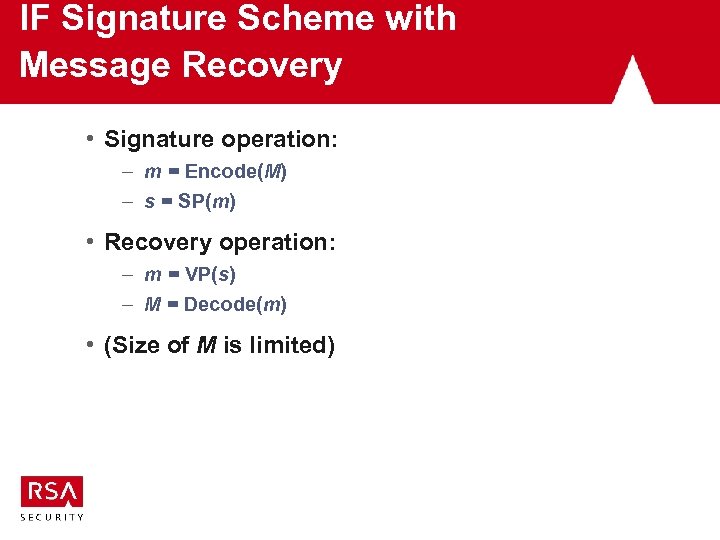 IF Signature Scheme with Message Recovery • Signature operation: – m = Encode(M) – s = SP(m) • Recovery operation: – m = VP(s) – M = Decode(m) • (Size of M is limited)
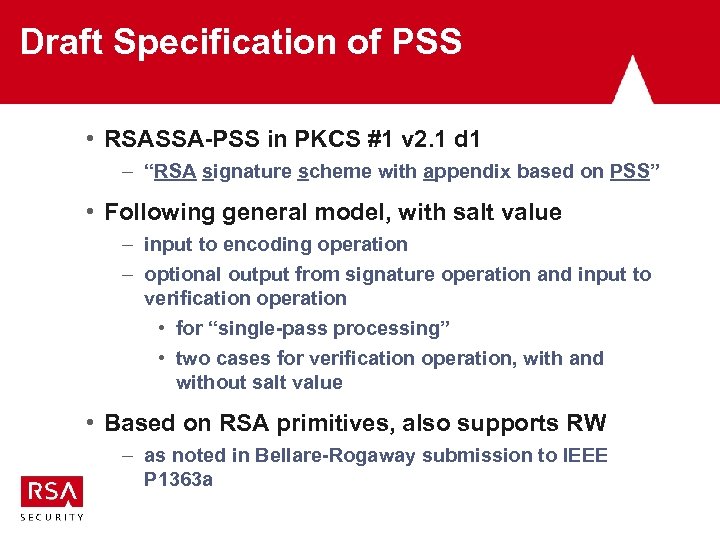 Draft Specification of PSS • RSASSA-PSS in PKCS #1 v 2. 1 d 1 – “RSA signature scheme with appendix based on PSS” • Following general model, with salt value – input to encoding operation – optional output from signature operation and input to verification operation • for “single-pass processing” • two cases for verification operation, with and without salt value • Based on RSA primitives, also supports RW – as noted in Bellare-Rogaway submission to IEEE P 1363 a
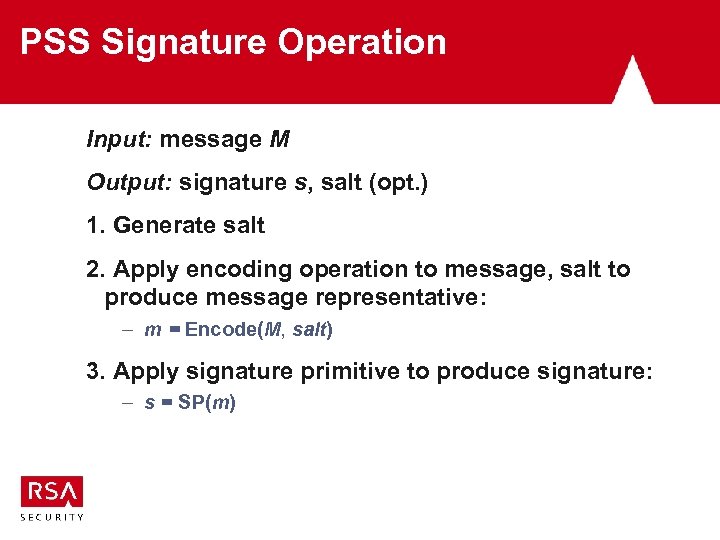 PSS Signature Operation Input: message M Output: signature s, salt (opt. ) 1. Generate salt 2. Apply encoding operation to message, salt to produce message representative: – m = Encode(M, salt) 3. Apply signature primitive to produce signature: – s = SP(m)
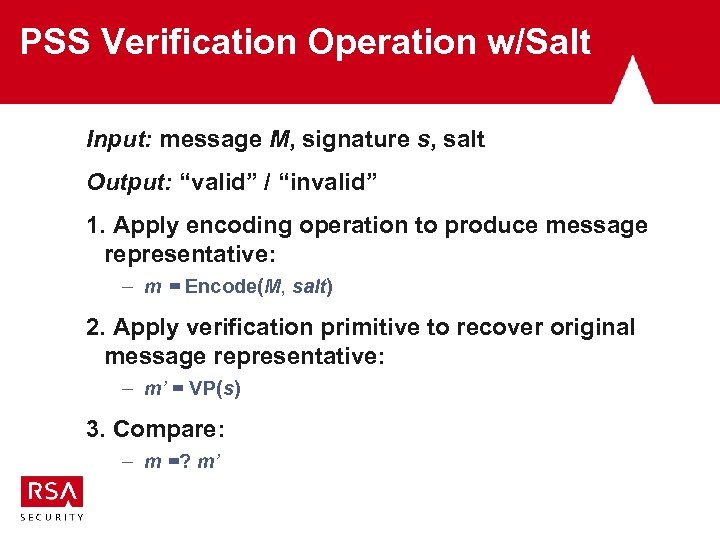 PSS Verification Operation w/Salt Input: message M, signature s, salt Output: “valid” / “invalid” 1. Apply encoding operation to produce message representative: – m = Encode(M, salt) 2. Apply verification primitive to recover original message representative: – m’ = VP(s) 3. Compare: – m =? m’
 PSS Verification Operation w/o Salt Input: message M, signature s Output: “valid” / “invalid” 1. Apply verification primitive to recover original message representative: – m = VP(s) 2. Apply checking operation to determine whether message representative is valid: – Check(M, m)
 PSS Encoding Method • Following general model, with encoding and checking operations • Salt is additional input to encoding operation – same length as hash function output • Message representative is one byte shorter than modulus • Based on underlying hash function, mask generation function
 PSS Encoding Operation Input: message M, salt Output: message representative m 1. Hash message and salt: – H = Hash (salt || M) 2. Add padding to salt to form data block: – DB = salt || 00 … 00 3. Expand hash and mask data block: – masked. DB = DB xor MGF(H) 4. Format message representative: – m = H || masked. DB
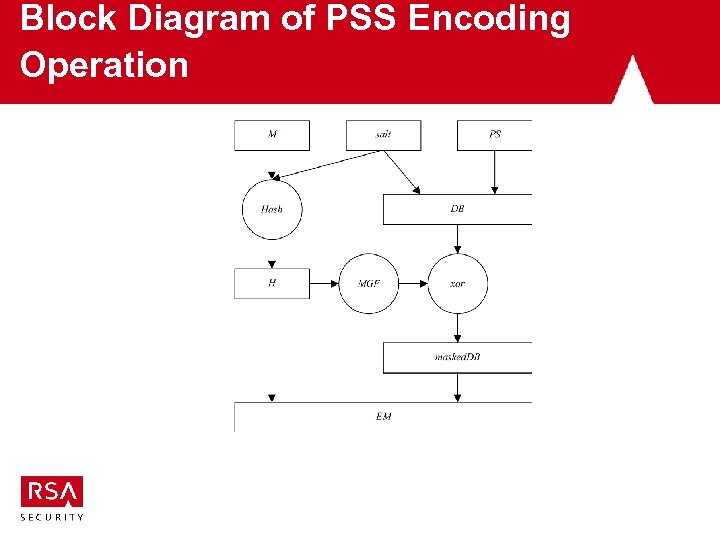 Block Diagram of PSS Encoding Operation
 Observations • Message is hashed with random salt – improves security proof – reduces reliance on hash function security • Hash value is expanded to full length – randomizes input to primitive – removes multiplicative structure – enables proof • Salt value is xored into expanded hash – shortens signature overhead – part of message may also be xored
 PSS Checking Operation Input: message M, message representative m Output: “consistent” / “inconsistent” 1. Parse message representative: – H || masked. DB = m 2. Expand hash value and unmask data block: – DB = masked. DB xor MGF(H) 3. Check and remove padding to recover salt: – salt || 00 … 00 =? DB 4. Rehash message and salt and compare: – H =? Hash (salt || M)
 PSS Advantages • Provable security under random oracle model – other methods have “ad hoc” security, not a proof • Reduced reliance on hash function security – “birthday attack” collisions not useful due to random salt • Natural extension to message recovery
 What’s Provable? • Suppose an algorithm A can forge PSS signatures without access to the details of Hash, MGF – Hash, MGF are effectively “random oracles” that can only be queried • Then an algorithm B can invert RSA in about the same time using algorithm A as a subroutine • If RSA is hard to invert, then PSS is secure
 Proof Method • Inverting algorithm B “builds” Hash, MGF that appear random to forgery algorithm A, but embed an instance to be inverted • When A succeeds at forgery, B succeeds at inverting RSA • Random salt is key to “tight” proof, but even if not random, proof still holds
 What about the Random Oracle Model? • Some concerns have been raised about the relevance of proofs in the random oracle model: – some on theoretical grounds – others on practicality of “instantiating” a random oracle with a real hash or mask generation function • But although the proof may “overestimate” the properties of Hash and MGF, it underestimates properties of RSA – e. g. , bit security properties are not considered • Thus, in practice, PSS may well provide high security even without the random oracle model
 Alternatives to PSS • Current methods – but not provably secure (“what if? ”) • Full Domain Hashing (Bellare-Rogaway 1993) – but security proof not as tight – not as flexible • Future research
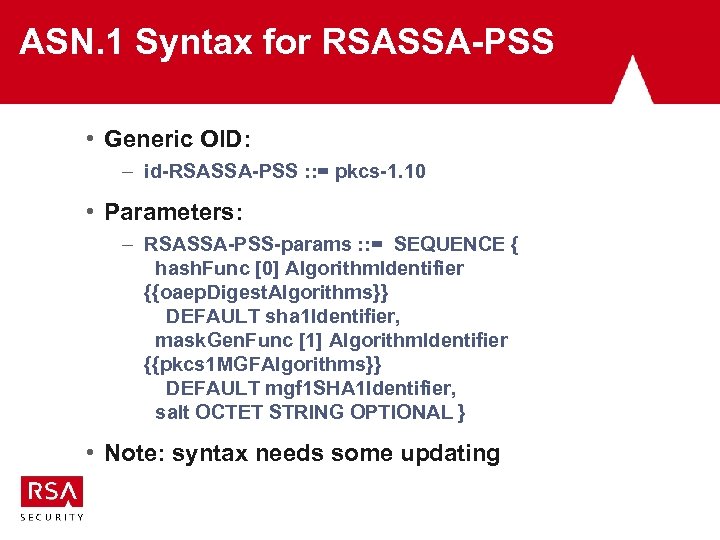 ASN. 1 Syntax for RSASSA-PSS • Generic OID: – id-RSASSA-PSS : : = pkcs-1. 10 • Parameters: – RSASSA-PSS-params : : = SEQUENCE { hash. Func [0] Algorithm. Identifier {{oaep. Digest. Algorithms}} DEFAULT sha 1 Identifier, mask. Gen. Func [1] Algorithm. Identifier {{pkcs 1 MGFAlgorithms}} DEFAULT mgf 1 SHA 1 Identifier, salt OCTET STRING OPTIONAL } • Note: syntax needs some updating
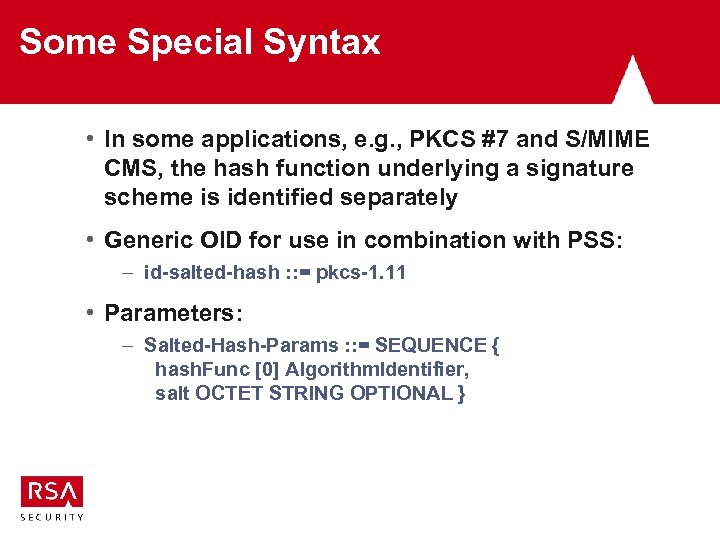 Some Special Syntax • In some applications, e. g. , PKCS #7 and S/MIME CMS, the hash function underlying a signature scheme is identified separately • Generic OID for use in combination with PSS: – id-salted-hash : : = pkcs-1. 11 • Parameters: – Salted-Hash-Params : : = SEQUENCE { hash. Func [0] Algorithm. Identifier, salt OCTET STRING OPTIONAL }
 Example Application: X. 509 Certificates • Signature algorithm identified in two places: – body of certificate – adjacent to signature • To save space, both identifiers should specify id. RSASSA-PSS without salt • Salt can be recovered from signature during verification
 Example Application: S/MIME Signed Messages • Relevant algorithms are identified in three places: – underlying hash function before message and in Signer. Info after message – signature algorithm in Signer. Info • To facilitate single-pass processing, identifier before message should specify id-salted-hash with underlying hash function, salt • Hash function identifier in Signer. Info should specify id-salted-hash without salt • Signature algorithm identifier should specify id. RSASSA-PSS without salt
 Patent Issues • University of California has applied for a patent (U. S. only) on PSS and PSS-R • In a letter to IEEE P 1363, UC has offered to waive licensing on PSS for signatures with appendix if adopted as an IEEE standard • Reasonable and non-discriminatory licensing for signatures with message recovery
 Recommended Deployment • A gradual transition to PSS is recommended in the interest of prudent security – rollover, along with AES, new hash functions, … • PKCS #1 v 1. 5 signature scheme is still appropriate for new applications • Different than situation with PKCS #1 v 1. 5 encryption scheme, where only OAEP is recommended for new applications
 A Brief Security Update • At Crypto ’ 99, J. -S. Coron, D. Naccache and J. Stern give a thorough analysis of security of RSAbased signature schemes against attacks based on factoring message representatives – stronger versions of Desmedt-Odylzko attack (1985) • PKCS #1 v 1. 5 fared very well – attacks are impractical, more expensive than finding hash function collisions (280 operations) – design considerations by R. Rivest (1991) provide resistance • D. Coppersmith, S. Halevi and C. Jutla extended the attack to break ISO/IEC 9796 -1 (Crypto ’ 99 rump session)
 Part II: RSA Standards Strategy
 Introduction • Various methods today for digital signatures in the integer factorization / RSA family • Standards, practice, theory differ • How to harmonize?
 Major Signature Schemes in the IF Family • Signature schemes with appendix: – ANSI X 9. 31 – PKCS #1 v 1. 5 (also in v 2. 0, v 2. 1 draft) – Bellare-Rogaway FDH and PSS • Signature schemes with message recovery: – ISO/IEC 9796 -1 – Bellare-Rogaway PSS-R • This discussion focuses on the first set
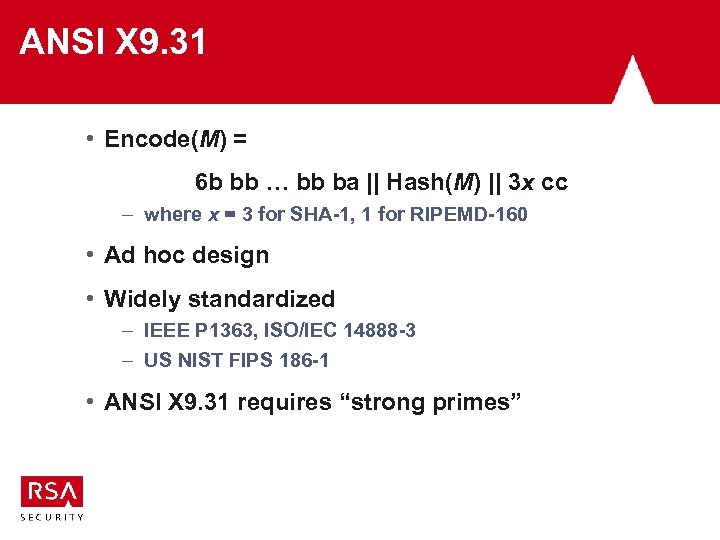 ANSI X 9. 31 • Encode(M) = 6 b bb … bb ba || Hash(M) || 3 x cc – where x = 3 for SHA-1, 1 for RIPEMD-160 • Ad hoc design • Widely standardized – IEEE P 1363, ISO/IEC 14888 -3 – US NIST FIPS 186 -1 • ANSI X 9. 31 requires “strong primes”
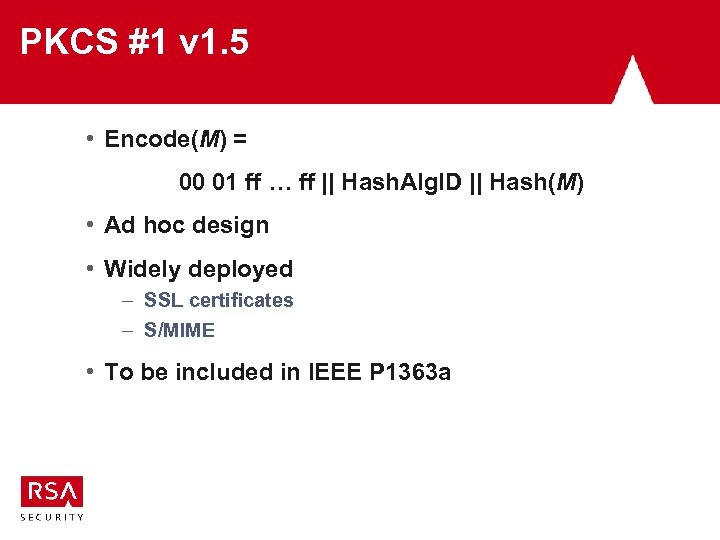 PKCS #1 v 1. 5 • Encode(M) = 00 01 ff … ff || Hash. Alg. ID || Hash(M) • Ad hoc design • Widely deployed – SSL certificates – S/MIME • To be included in IEEE P 1363 a
 Bellare-Rogaway FDH (Full Domain Hashing, ACM CCCS ’ 93) • Encode(M) = 00 || Full-Length-Hash(m) • Provably secure design • To be included in IEEE P 1363 a
 PSS vs. FDH: Technical Comparison • PSS is probabilistic, FDH is deterministic • Both provably secure – same paradigm as Optimal Asymmetric Encryption Padding (OAEP) • PSS has tighter security proof, is less dependent on security of hash function • PSS-R variant supports message recovery, partial message recovery • PSS is patent pending (but generously licensed)
 ANSI X 9. 31 vs. PKCS #1 v 1. 5: Technical Comparison • Both are deterministic • Both include a hash function identifier • Both are ad hoc designs – both resist Coron-Naccache-Stern / Coppersmith-Halevi -Jutla attacks on ISO/IEC 9796 -1, -2 • Both support RSA and RW primitives – see IEEE P 1363 a contribution on PKCS #1 signatures for discussion • No patents have been reported to IEEE P 1363 or ANSI X 9. 31 for these encoding methods
 Standards vs. Theory vs. Practice • ANSI X 9. 31 is widely standardized • PSS is widely considered secure • PKCS #1 v 1. 5 is widely deployed • How to harmonize?
 Challenges • Infrastructure changes take time – particularly on the user side • ANSI X 9. 31 is more than just another encoding method, also specifies “strong primes” – a controversial topic • Many communities involved – formal standards bodies, IETF, browser vendors, certificate authorities
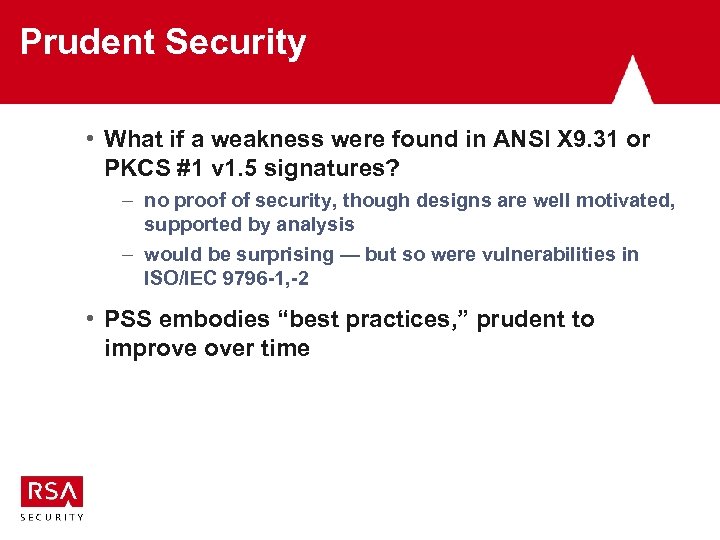 Prudent Security • What if a weakness were found in ANSI X 9. 31 or PKCS #1 v 1. 5 signatures? – no proof of security, though designs are well motivated, supported by analysis – would be surprising — but so were vulnerabilities in ISO/IEC 9796 -1, -2 • PSS embodies “best practices, ” prudent to improve over time
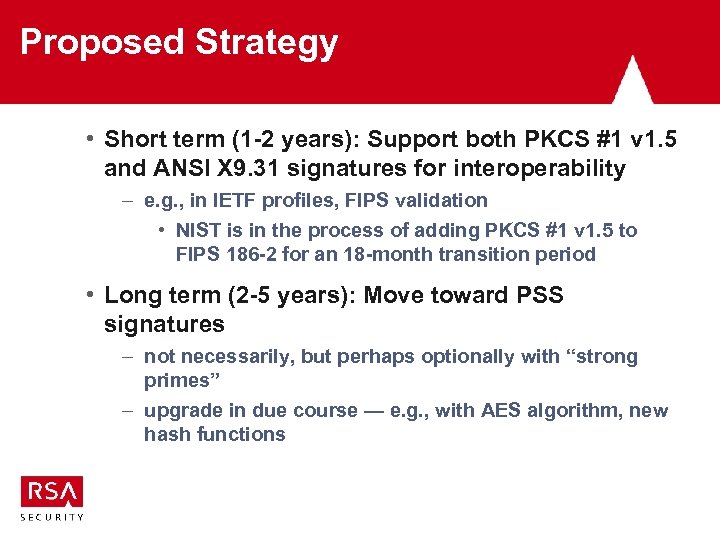 Proposed Strategy • Short term (1 -2 years): Support both PKCS #1 v 1. 5 and ANSI X 9. 31 signatures for interoperability – e. g. , in IETF profiles, FIPS validation • NIST is in the process of adding PKCS #1 v 1. 5 to FIPS 186 -2 for an 18 -month transition period • Long term (2 -5 years): Move toward PSS signatures – not necessarily, but perhaps optionally with “strong primes” – upgrade in due course — e. g. , with AES algorithm, new hash functions
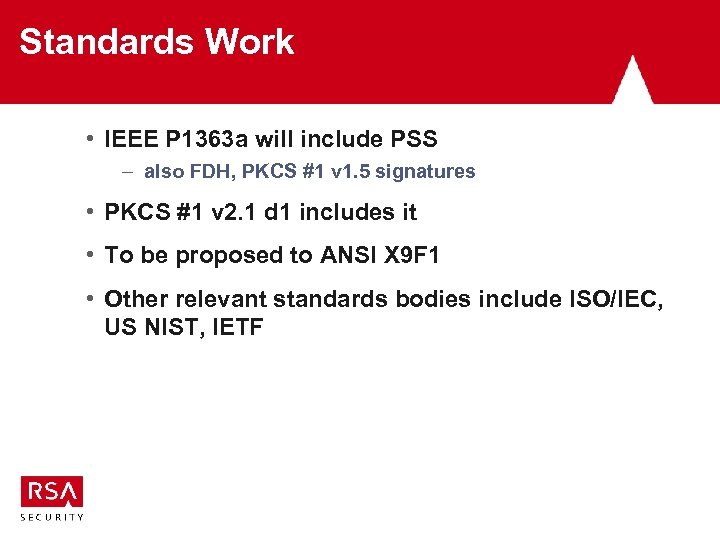 Standards Work • IEEE P 1363 a will include PSS – also FDH, PKCS #1 v 1. 5 signatures • PKCS #1 v 2. 1 d 1 includes it • To be proposed to ANSI X 9 F 1 • Other relevant standards bodies include ISO/IEC, US NIST, IETF
 Part III: Some Discussion Topics
 Outline • PSS-R • ANSI X 9. 31 encoding method • Composite hash functions • New mask generation functions • Rabin-Williams support
 PSS-R • Should PKCS #1 v 2. 1 include the PSS-R encoding method? • ISO/IEC 9796 -1, -2 may be updated with new and potentially different signature scheme with message recovery • PSS-R to be included in IEEE P 1363 a
 ANSI X 9. 31 Encoding Method • Should PKCS #1 v 2. 1 include the ANSI X 9. 31 encoding method? • ANSI X 9. 31 is a banking standard • FIPS 186 -1 includes it
 Composite Hash Functions • Should PKCS #1 v 2. 1 specify “composite” hash functions? – raised by Tom Gindin, IBM • Example: – SHA-1 -MD 5(M) = SHA-1(M) || MD 5(M) • A simple method to increase security in a modular fashion • Could be combined with PKCS #1 v 1. 5 encoding method, or PSS
 New Mask Generation Functions • Should PKCS #1 v 2. 1 define new mask generation functions? • Example: – MGF 2(Z) = HMAC(Z, 0) || HMAC(Z, 1) || … • Current method lacks HMAC’s security proof: – MGF 1(Z) = Hash(0 || Z) || Hash(1 || Z) || …
 Rabin-Williams Support • Should PKCS #1 v 2. 1 include the RW primitives for even exponents? • Would be consistent with ANSI X 9. 31, X 9. 44 draft, IEEE P 1363 • PKCS #1 v 1. 5, PSS versions require slightly different primitives than currently specified – cf. relevant submissions to IEEE P 1363 a
 Conclusions • A new draft of PKCS #1 nearing completion • Standards strategy for RSA signatures emerging – PSS a prudent choice for long-term security, harmonization of standards • For future work? – PKCS #1 usage guidelines – key generation and validation specifications