


 Скачать презентацию Pisa University Department of Mechanical Nuclear and Production
044977bfddc2ee7bae61e74107fb45fb.ppt
- Количество слайдов: 28
 Pisa University Department of Mechanical, Nuclear and Production Engineering Ministry of the Interior Italian National Fire Corps 420064_FIRE PREVENTION TECHNICAL RULE FOR GASEOUS HYDROGEN REFUELLING STATIONS Grasso, N. , Ciannelli, N. , Pilo, F. , Carcassi, M. and Ceccherini, F. International Conference on Hydrogen Safety - Pisa September 9, 2005 09/09/2005 Fire prevention technical rule for hydrogen refuelling stations
 Summary 1. Italian National Fire Corps activity for the fire prevention 2. The Working Group on hydrogen fire prevention safety issues 3. The fire prevention technical rule concerning gaseous hydrogen refuelling stations ICHS - Pisa - 09/09/2005 Fire prevention technical rule for hydrogen refuelling stations
 Italian National Fire Corps fire prevention and protection activity (1) • The Italian National Fire Corps is an Institute under the Italian Ministry of the Interior and it is charged of the fire prevention activity • Regulation in force subdivides the Italian National Fire Corps activity concerning the observance of fire prevention safety conditions into the following two coordinated phases: 1. assessment of either new facilities plans and constructions, or changes made in those existing this assessment is aimed at giving judgement on the compliance with the fire prevention rules 2. control inspection aimed at verifying, also on the basis of suitable technical documentation, both the correspondence of the work carried out to the approved plan and the keeping of the fire prevention requirements in force this control inspection finishes with the issuing of the so called Fire Prevention Certificate (C. P. I. ) ICHS - Pisa - 09/09/2005 Fire prevention technical rule for hydrogen refuelling stations
 Italian National Fire Corps fire prevention and protection activity (2) • Facilities and activities under National Fire Corps control are listed by an Italian Decree (they are 97) Gaseous hydrogen refuelling stations are included in the generic activity named “Gaseous Fuels Dispensing Stations for Automotive Applications” • Some listed activities are regulated by proper fire prevention technical rule containing the requirements which have to be observed Regulated activity: it has to be proved the observance of the specific fire prevention and protection technical requirements Not regulated activity: it has to be proved the observance of fire prevention criteria by the fire hazards identification, the assessment of the relevant risks and the description of the measures aimed at reducing these risks • Requirements and general fire prevention and protection technical criteria are checked by the Provincial Headquarters having jurisdiction on the territory ICHS - Pisa - 09/09/2005 Fire prevention technical rule for hydrogen refuelling stations
 The Working Group on hydrogen fire prevention safety issues (1) • Formation: 2002, by Ministry of the Interior - • the Working Group is constituted by both Technical Officials from the National Fire Corps and leading members from the academic world (Pisa University) Reasons: - the lack of suitable set of rules concerning fire prevention and protection - • several hydrogen projects started (in Turin, in Milan and later in Mantua) providing for refuelling stations for gaseous hydrogen motor vehicles (buses, cars) the lack of suitable fire prevention set of rules could make plausible having on national territory refuelling stations complying with different safety strategies and objectives Mission: to collect, assess, assemble all the technical and scientific contributions available in order to produce normative documents, guidelines, etc. expressly aimed at ensuring the fire prevention safety ICHS - Pisa - 09/09/2005 Fire prevention technical rule for hydrogen refuelling stations
 The Working Group on hydrogen fire prevention safety issues (2) • Results achieved up to now: drawing up of the following documents: Fire prevention technical rule for design, construction and operation of gaseous hydrogen filling stations - contributions coming from Italian companies in the forefront of techologies connected with the hydrogen production, distribution and use - approval by the Ministry of the Interior’s Technical Scientific Central Committee for fire prevention (June 2004) - positive judgement by other competent Ministries (Industry, Transportation) - it has to carry out the “Community procedure for the provision of information” Draft document on hydrogen vehicles components, with particular attention to the storage system (in progress) • More activities: hydrogen transportation by pipelines; the Working Group aims at studying hydrogen releases from pipelines and consequently at writing a fire prevention rule ICHS - Pisa - 09/09/2005 Fire prevention technical rule for hydrogen refuelling stations
 The approved technical rule (1) • The approved technical rule is aimed at issuing fire prevention requirements for the gaseous hydrogen refuelling stations design, construction and operation • The text of the document follows the standard model of fire prevention technical rule that regulates natural gas refuelling stations (D. M. 24/05/02); it was adapted to the specificities of hydrogen motor vehicles refuelling - to take advantage of its well-established and reliable structure, that makes its contents readily accessible by experts - to exploit the prescribing approach distinguishing this model; it has been thought especially suitable in order to standardize the safety features of the future first hydrogen refuelling stations following its requirements and contents ICHS - Pisa - 09/09/2005 Fire prevention technical rule for hydrogen refuelling stations
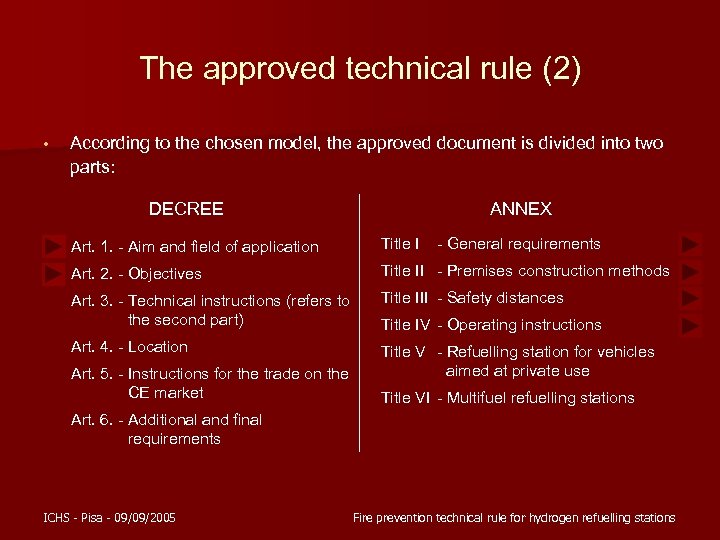 The approved technical rule (2) • According to the chosen model, the approved document is divided into two parts: DECREE ANNEX Art. 1. - Aim and field of application Title I - General requirements Art. 2. - Objectives Title II - Premises construction methods Art. 3. - Technical instructions (refers to the second part) Title III - Safety distances Art. 4. - Location Title V - Refuelling station for vehicles aimed at private use Art. 5. - Instructions for the trade on the CE market Title IV - Operating instructions Title VI - Multifuel refuelling stations Art. 6. - Additional and final requirements ICHS - Pisa - 09/09/2005 Fire prevention technical rule for hydrogen refuelling stations
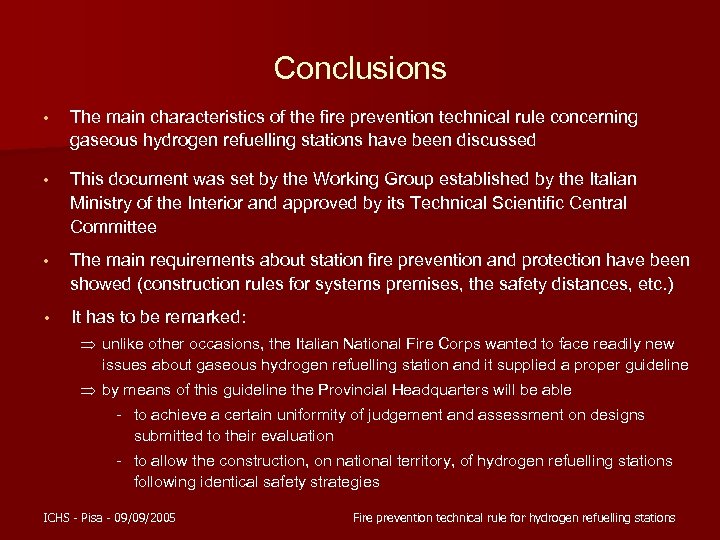 Conclusions • The main characteristics of the fire prevention technical rule concerning gaseous hydrogen refuelling stations have been discussed • This document was set by the Working Group established by the Italian Ministry of the Interior and approved by its Technical Scientific Central Committee • The main requirements about station fire prevention and protection have been showed (construction rules for systems premises, the safety distances, etc. ) • It has to be remarked: unlike other occasions, the Italian National Fire Corps wanted to face readily new issues about gaseous hydrogen refuelling station and it supplied a proper guideline by means of this guideline the Provincial Headquarters will be able - to achieve a certain uniformity of judgement and assessment on designs submitted to their evaluation - to allow the construction, on national territory, of hydrogen refuelling stations following identical safety strategies ICHS - Pisa - 09/09/2005 Fire prevention technical rule for hydrogen refuelling stations
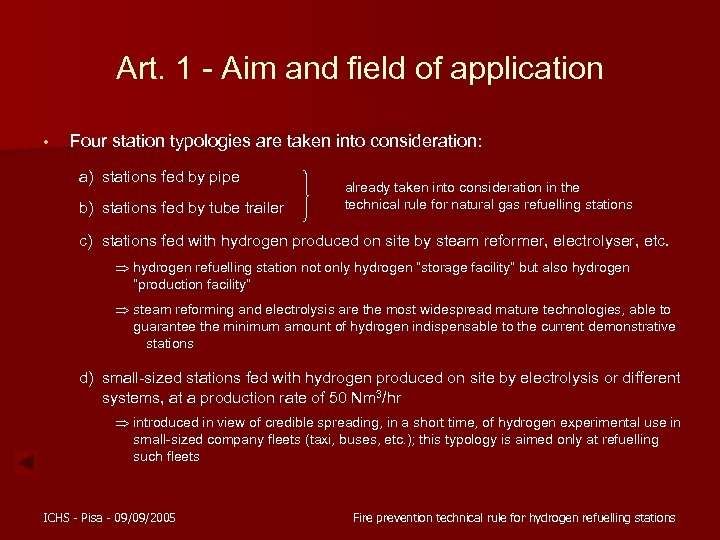 Art. 1 - Aim and field of application • Four station typologies are taken into consideration: a) stations fed by pipe b) stations fed by tube trailer already taken into consideration in the technical rule for natural gas refuelling stations c) stations fed with hydrogen produced on site by steam reformer, electrolyser, etc. hydrogen refuelling station not only hydrogen “storage facility” but also hydrogen “production facility” steam reforming and electrolysis are the most widespread mature technologies, able to guarantee the minimum amount of hydrogen indispensable to the current demonstrative stations d) small-sized stations fed with hydrogen produced on site by electrolysis or different systems, at a production rate of 50 Nm 3/hr introduced in view of credible spreading, in a short time, of hydrogen experimental use in small-sized company fleets (taxi, buses, etc. ); this typology is aimed only at refuelling such fleets ICHS - Pisa - 09/09/2005 Fire prevention technical rule for hydrogen refuelling stations
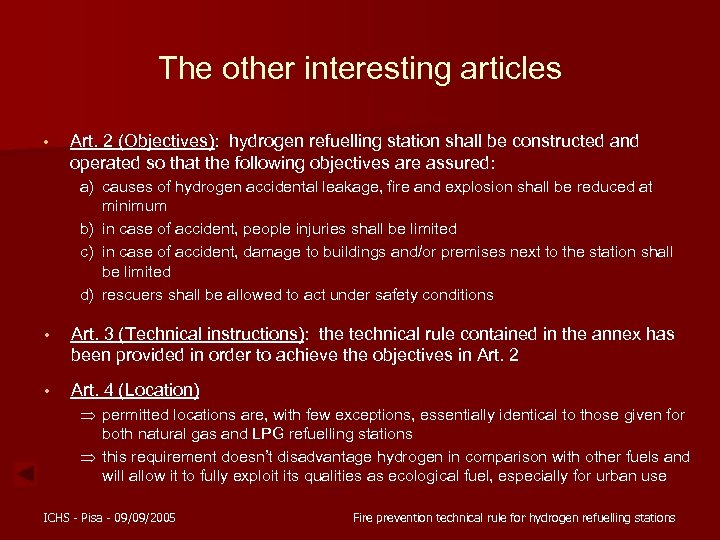 The other interesting articles • Art. 2 (Objectives): hydrogen refuelling station shall be constructed and operated so that the following objectives are assured: a) causes of hydrogen accidental leakage, fire and explosion shall be reduced at minimum b) in case of accident, people injuries shall be limited c) in case of accident, damage to buildings and/or premises next to the station shall be limited d) rescuers shall be allowed to act under safety conditions • Art. 3 (Technical instructions): the technical rule contained in the annex has been provided in order to achieve the objectives in Art. 2 • Art. 4 (Location) permitted locations are, with few exceptions, essentially identical to those given for both natural gas and LPG refuelling stations this requirement doesn’t disadvantage hydrogen in comparison with other fuels and will allow it to fully exploit its qualities as ecological fuel, especially for urban use ICHS - Pisa - 09/09/2005 Fire prevention technical rule for hydrogen refuelling stations
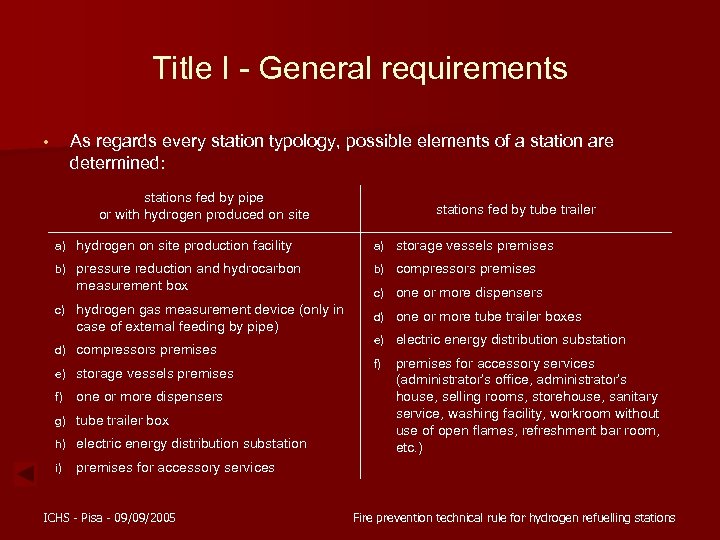 Title I - General requirements As regards every station typology, possible elements of a station are determined: • stations fed by pipe or with hydrogen produced on site stations fed by tube trailer a) hydrogen on site production facility a) storage vessels premises b) pressure reduction and hydrocarbon b) compressors premises measurement box c) hydrogen gas measurement device (only in case of external feeding by pipe) d) compressors premises e) storage vessels premises f) one or more dispensers g) tube trailer box h) electric energy distribution substation i) c) one or more dispensers d) one or more tube trailer boxes e) electric energy distribution substation f) premises for accessory services (administrator’s office, administrator’s house, selling rooms, storehouse, sanitary service, washing facility, workroom without use of open flames, refreshment bar room, etc. ) premises for accessory services ICHS - Pisa - 09/09/2005 Fire prevention technical rule for hydrogen refuelling stations
 Title II - Premises construction methods (1) • Among possible elements of a station are specified those that could be provided with 1 st or 2 nd level of safety features according whether their premises characteristics guarantee, in the event of a possible burst: - either materials containment both in side direction and in upward direction (1 st safety level) or only in side direction (2 nd safety level) • 1 st or 2 nd safety levels are achieved by protections in accordance with the premises construction rules in Title II • The required premises construction rules are identical to those provided in D. M. 24/05/02 for possible elements of a natural gas refuelling station because they are common construction methods believed suitable when compressed gases are used ICHS - Pisa - 09/09/2005 Fire prevention technical rule for hydrogen refuelling stations
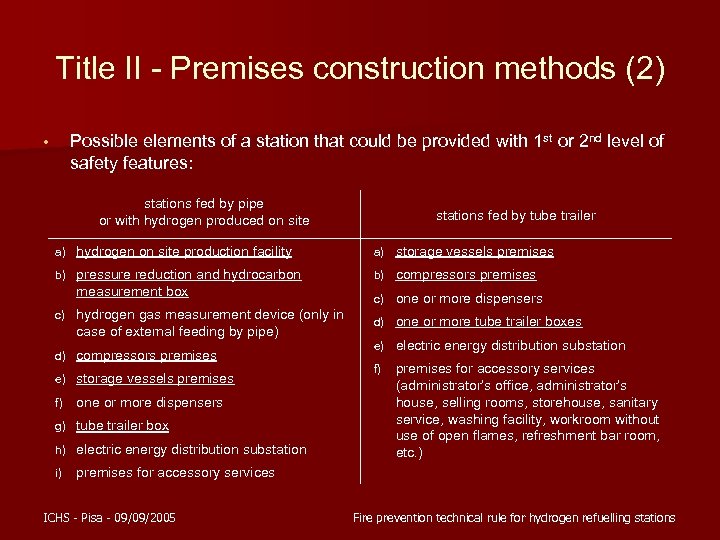 Title II - Premises construction methods (2) Possible elements of a station that could be provided with 1 st or 2 nd level of safety features: • stations fed by pipe or with hydrogen produced on site stations fed by tube trailer a) hydrogen on site production facility a) storage vessels premises b) pressure reduction and hydrocarbon b) compressors premises measurement box c) hydrogen gas measurement device (only in case of external feeding by pipe) d) compressors premises e) storage vessels premises f) one or more dispensers g) tube trailer box h) electric energy distribution substation i) c) one or more dispensers d) one or more tube trailer boxes e) electric energy distribution substation f) premises for accessory services (administrator’s office, administrator’s house, selling rooms, storehouse, sanitary service, washing facility, workroom without use of open flames, refreshment bar room, etc. ) premises for accessory services ICHS - Pisa - 09/09/2005 Fire prevention technical rule for hydrogen refuelling stations
 More safety measures in Title II (1) • Gas system (it means the assembly of piping, valves as well as equipment making up gas feeding, compression, damping, bulk storage, dispensing network and emergency system) The components are required to be designed in accordance with requirements of Pressure Equipment Directive (PED) 97/23/EC Among the provided solutions, it has to be reminded the use of pressure relief valves, stop valves, excess flow valves, venting device The technical rule allows a maximum dispenser pressure equal to 350 bar • Emergency system (automatic or manual activation) completely isolate delivery lines to dispensers completely isolate low pressure line from compressors intake or inlet integrally disconnect the electric circuit of the station ICHS - Pisa - 09/09/2005 Fire prevention technical rule for hydrogen refuelling stations
 More safety measures in Title II (2) • Detection systems • Electrical system, grounding system, protection system against atmospheric discharges • Fire fighting protection system The fire fighting systems to be envisaged on the station are specified: fire hydrants network, automatic quenching systems, extinguishers ICHS - Pisa - 09/09/2005 Fire prevention technical rule for hydrogen refuelling stations
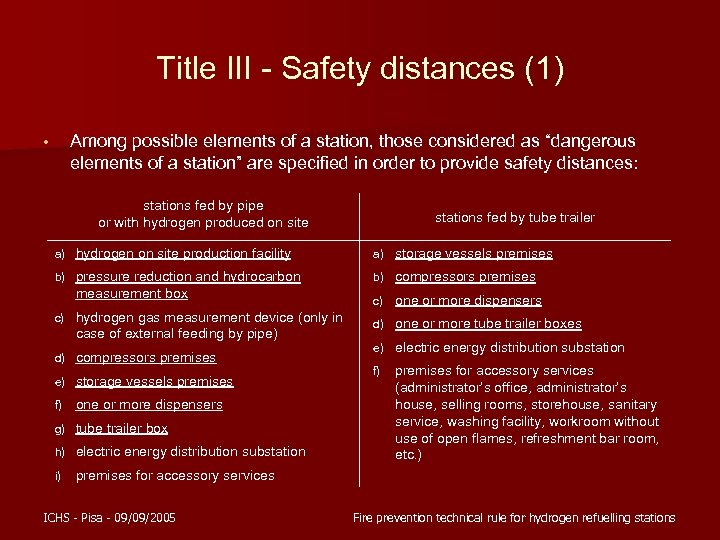 Title III - Safety distances (1) Among possible elements of a station, those considered as “dangerous elements of a station” are specified in order to provide safety distances: • stations fed by pipe or with hydrogen produced on site stations fed by tube trailer a) hydrogen on site production facility a) storage vessels premises b) pressure reduction and hydrocarbon b) compressors premises measurement box c) hydrogen gas measurement device (only in case of external feeding by pipe) d) compressors premises e) storage vessels premises f) one or more dispensers g) tube trailer box h) electric energy distribution substation i) c) one or more dispensers d) one or more tube trailer boxes e) electric energy distribution substation f) premises for accessory services (administrator’s office, administrator’s house, selling rooms, storehouse, sanitary service, washing facility, workroom without use of open flames, refreshment bar room, etc. ) premises for accessory services ICHS - Pisa - 09/09/2005 Fire prevention technical rule for hydrogen refuelling stations
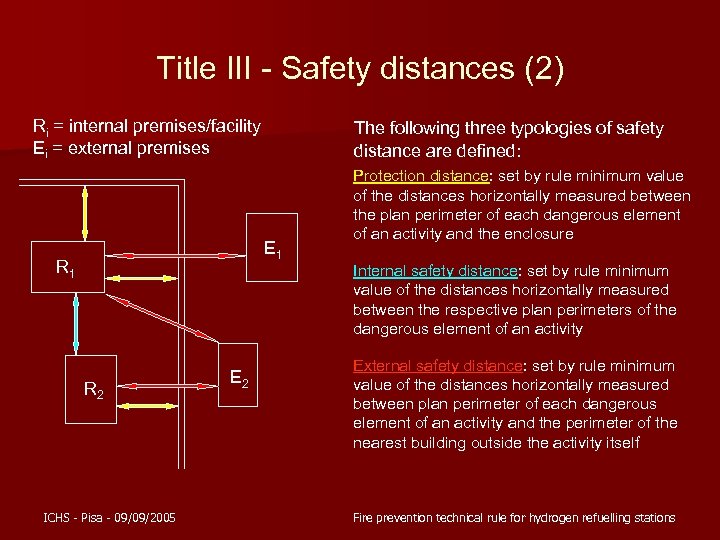 Title III - Safety distances (2) Ri = internal premises/facility Ei = external premises The following three typologies of safety distance are defined: E 1 R 1 Protection distance: set by rule minimum value of the distances horizontally measured between the plan perimeter of each dangerous element of an activity and the enclosure Internal safety distance: set by rule minimum value of the distances horizontally measured between the respective plan perimeters of the dangerous element of an activity R 2 ICHS - Pisa - 09/09/2005 E 2 External safety distance: set by rule minimum value of the distances horizontally measured between plan perimeter of each dangerous element of an activity and the perimeter of the nearest building outside the activity itself Fire prevention technical rule for hydrogen refuelling stations
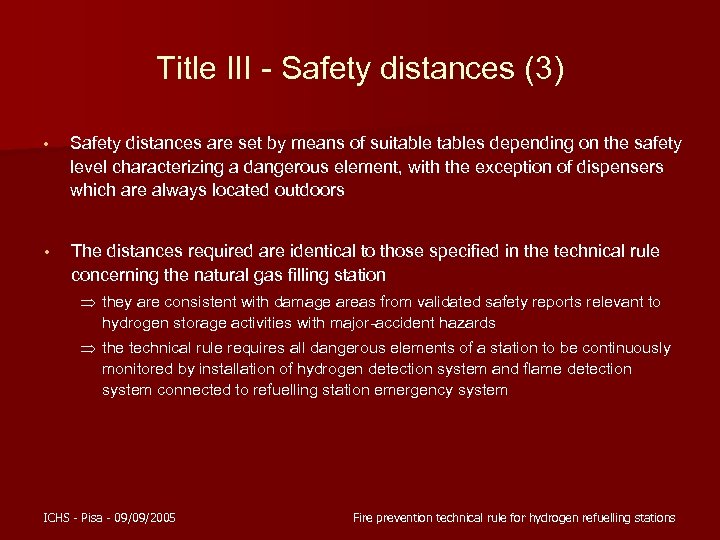 Title III - Safety distances (3) • Safety distances are set by means of suitables depending on the safety level characterizing a dangerous element, with the exception of dispensers which are always located outdoors • The distances required are identical to those specified in the technical rule concerning the natural gas filling station they are consistent with damage areas from validated safety reports relevant to hydrogen storage activities with major-accident hazards the technical rule requires all dangerous elements of a station to be continuously monitored by installation of hydrogen detection system and flame detection system connected to refuelling station emergency system ICHS - Pisa - 09/09/2005 Fire prevention technical rule for hydrogen refuelling stations
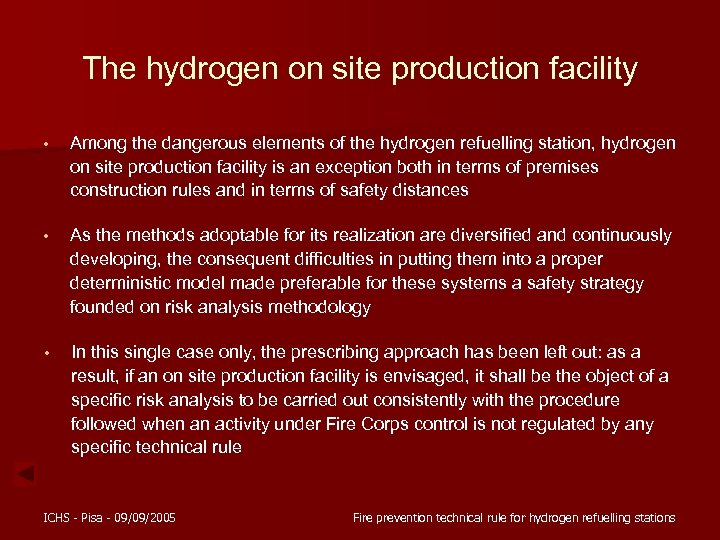 The hydrogen on site production facility • Among the dangerous elements of the hydrogen refuelling station, hydrogen on site production facility is an exception both in terms of premises construction rules and in terms of safety distances • As the methods adoptable for its realization are diversified and continuously developing, the consequent difficulties in putting them into a proper deterministic model made preferable for these systems a safety strategy founded on risk analysis methodology • In this single case only, the prescribing approach has been left out: as a result, if an on site production facility is envisaged, it shall be the object of a specific risk analysis to be carried out consistently with the procedure followed when an activity under Fire Corps control is not regulated by any specific technical rule ICHS - Pisa - 09/09/2005 Fire prevention technical rule for hydrogen refuelling stations
 Remaining Titles • Title IV (Operating instructions): it contains the instructions for the refuelling station operation (for instance operation only under surveillance staff, use of a suitable safety system of signs) • Title V (Refuelling station for vehicles aimed at private use): it covers specifically the station typology “small-sized stations fed with hydrogen produced on site by electrolysis or different systems, at a production rate of 50 Nm 3/hr” (typology in Art. 1, letter d)) • Title VI (Multifuel refuelling stations): it provides requirements aimed at integrating hydrogen refuelling stations within refuelling stations for different fuels, that’s to say at accomplishing a so called multifuel station Safety distance is the instrument used to allow installation of a multifuel station: the technical rule prescribes the separation distances between the various dangerous elements (they are internal safety distances) ICHS - Pisa - 09/09/2005 Fire prevention technical rule for hydrogen refuelling stations
 ICHS - Pisa - 09/09/2005 Fire prevention technical rule for hydrogen refuelling stations
 ICHS - Pisa - 09/09/2005 Fire prevention technical rule for hydrogen refuelling stations
 Working Group members The Working Group is coordinated by: Eng. Fabrizio Ceccherini Fire Corps Regional Director for Liguria and is composed by: Prof. Eng. Marco N. Carcassi Eng. Nicola Grasso Eng. Alessia Marangon Department of Mechanical, Nuclear and Production Engineering - Pisa University Eng. Vincenzo Ciani Chief at Fire Corps Provincial Headquarters at Foggia Eng. Nicola Ciannelli (Technical Secretary of the Working Group) Official at Fire Corps Provincial Headquarters at Livorno Eng. Francesco Pilo Official at Fire Corps Provincial Headquarters at Venezia ICHS - Pisa - 09/09/2005 Fire prevention technical rule for hydrogen refuelling stations
![Safety distances Element protection distance [m] internal safety distance [m] external safety distance [m]](https://present5.com/presentation/044977bfddc2ee7bae61e74107fb45fb/image-25.jpg "Safety distances Element protection distance [m] internal safety distance [m] external safety distance [m]") Safety distances Element protection distance [m] internal safety distance [m] external safety distance [m] Pressure reduction and hydrocarbon measurement box 2 - / 10 * 10 5 / 10 * - / 10 * 10 / 20 * 5 - 10 Tube trailer box 5 / 10 * - / 10 * 10 / 20 * Dispensers *** 10 8 20 Compressors premises Storage vessels premises ** * 1 st safety level / 2 nd safety level ** storage vessels premises shall be provided exclusively with 1 st safety level *** dispensers are always located outdoors ICHS - Pisa - 09/09/2005 Fire prevention technical rule for hydrogen refuelling stations
Safety distances Element protection distance [m] internal safety distance [m] external safety distance [m] Pressure reduction and hydrocarbon measurement box 2 - / 10 * 10 5 / 10 * - / 10 * 10 / 20 * 5 - 10 Tube trailer box 5 / 10 * - / 10 * 10 / 20 * Dispensers *** 10 8 20 Compressors premises Storage vessels premises ** * 1 st safety level / 2 nd safety level ** storage vessels premises shall be provided exclusively with 1 st safety level *** dispensers are always located outdoors ICHS - Pisa - 09/09/2005 Fire prevention technical rule for hydrogen refuelling stations
![Multifuel stations: safety distances Safety distances for multifuel stations [m] Type of exposition Dangerous](https://present5.com/presentation/044977bfddc2ee7bae61e74107fb45fb/image-26.jpg "Multifuel stations: safety distances Safety distances for multifuel stations [m] Type of exposition Dangerous") Multifuel stations: safety distances Safety distances for multifuel stations [m] Type of exposition Dangerous elements of hydrogen refuelling station Gasoline and diesel oil tanks Hydrogen dispensers 10 LPG tanks 20 10 Dangerous elements of natural gas refuelling station 15 8 Dispensers ICHS - Pisa - 09/09/2005 8 Fire prevention technical rule for hydrogen refuelling stations
Multifuel stations: safety distances Safety distances for multifuel stations [m] Type of exposition Dangerous elements of hydrogen refuelling station Gasoline and diesel oil tanks Hydrogen dispensers 10 LPG tanks 20 10 Dangerous elements of natural gas refuelling station 15 8 Dispensers ICHS - Pisa - 09/09/2005 8 Fire prevention technical rule for hydrogen refuelling stations
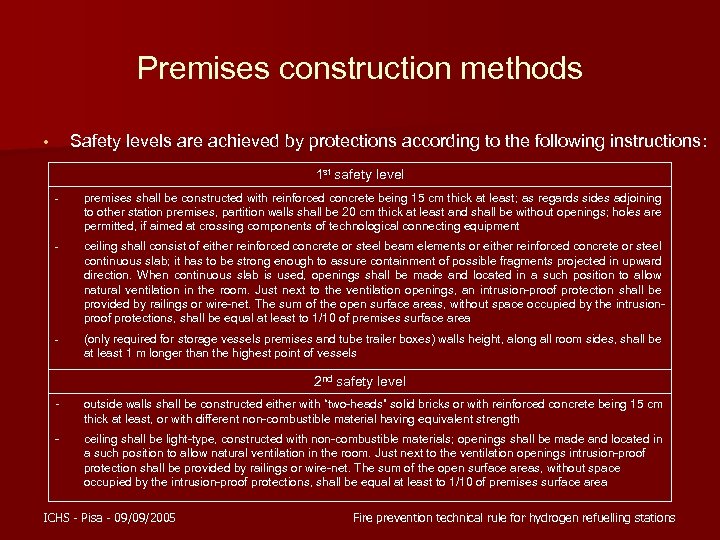 Premises construction methods Safety levels are achieved by protections according to the following instructions: • 1 st safety level - premises shall be constructed with reinforced concrete being 15 cm thick at least; as regards sides adjoining to other station premises, partition walls shall be 20 cm thick at least and shall be without openings; holes are permitted, if aimed at crossing components of technological connecting equipment - ceiling shall consist of either reinforced concrete or steel beam elements or either reinforced concrete or steel continuous slab; it has to be strong enough to assure containment of possible fragments projected in upward direction. When continuous slab is used, openings shall be made and located in a such position to allow natural ventilation in the room. Just next to the ventilation openings, an intrusion-proof protection shall be provided by railings or wire-net. The sum of the open surface areas, without space occupied by the intrusionproof protections, shall be equal at least to 1/10 of premises surface area - (only required for storage vessels premises and tube trailer boxes) walls height, along all room sides, shall be at least 1 m longer than the highest point of vessels 2 nd safety level - outside walls shall be constructed either with “two-heads” solid bricks or with reinforced concrete being 15 cm thick at least, or with different non-combustible material having equivalent strength - ceiling shall be light-type, constructed with non-combustible materials; openings shall be made and located in a such position to allow natural ventilation in the room. Just next to the ventilation openings intrusion-proof protection shall be provided by railings or wire-net. The sum of the open surface areas, without space occupied by the intrusion-proof protections, shall be equal at least to 1/10 of premises surface area ICHS - Pisa - 09/09/2005 Fire prevention technical rule for hydrogen refuelling stations
 Dangerous elements and safety distances • Safety distances are assigned by a specific fire prevention technical rule to the “dangerous elements of a facility”; they are chosen according to: • • the major or minor probability of having fuel leakage • • the fuel amount handled by a specific element (the so called “fire load”) the possible negative consequences coming from such leakage as regards both activities carried out inside the facility and activities or buildings in the neighbourhood The Italian fire prevention regulation in force defines the following three typologies of safety distance: • protection distance • internal safety distance • external safety distance ICHS - Pisa - 09/09/2005 Fire prevention technical rule for hydrogen refuelling stations