


 Скачать презентацию Pioneer Venus Mission Characterization Dr Andrew Ketsdever
7f471bec8f471cabd3863dbb21e105e6.ppt
- Количество слайдов: 43
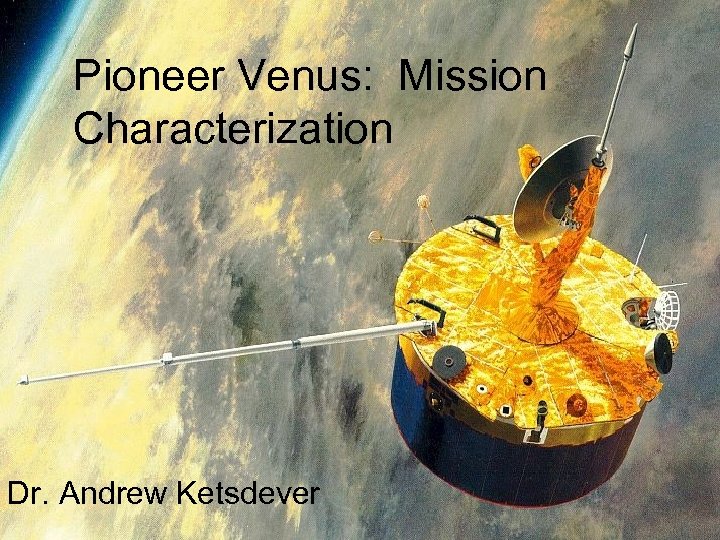 Pioneer Venus: Mission Characterization Dr. Andrew Ketsdever
 Background • Pioneer Venus evolved from recommendations from the Space Science Board of the National Academy of Sciences – “Need” for relatively low-cost orbiters and landers to explore the planet Venus – Earth’s closest neighbor, yet relatively little was known (especially about the lower atmosphere) – What was known raised many scientific questions
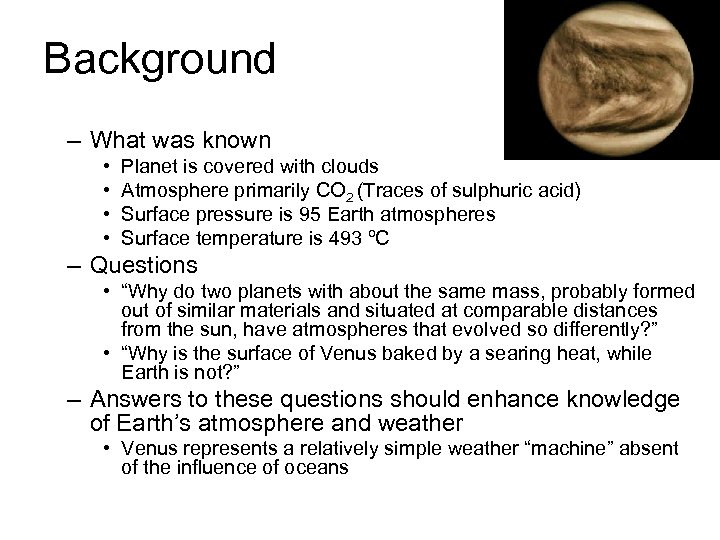 Background – What was known • • Planet is covered with clouds Atmosphere primarily CO 2 (Traces of sulphuric acid) Surface pressure is 95 Earth atmospheres Surface temperature is 493 ºC – Questions • “Why do two planets with about the same mass, probably formed out of similar materials and situated at comparable distances from the sun, have atmospheres that evolved so differently? ” • “Why is the surface of Venus baked by a searing heat, while Earth is not? ” – Answers to these questions should enhance knowledge of Earth’s atmosphere and weather • Venus represents a relatively simple weather “machine” absent of the influence of oceans
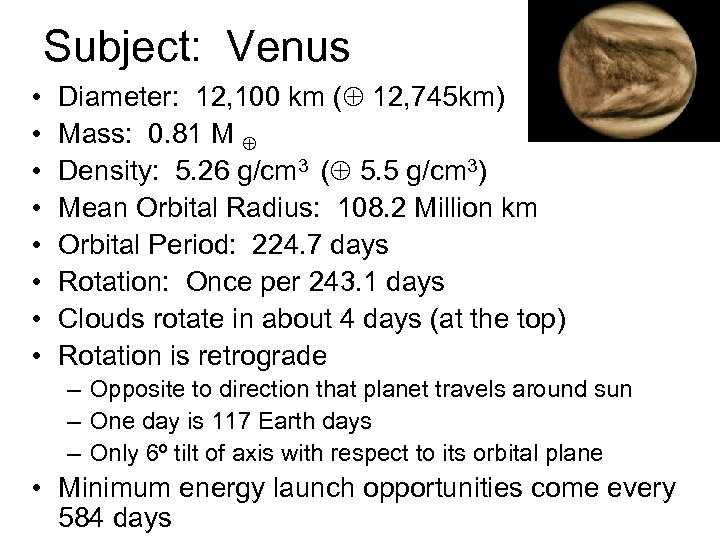 Subject: Venus • • Diameter: 12, 100 km ( 12, 745 km) Mass: 0. 81 M Density: 5. 26 g/cm 3 ( 5. 5 g/cm 3) Mean Orbital Radius: 108. 2 Million km Orbital Period: 224. 7 days Rotation: Once per 243. 1 days Clouds rotate in about 4 days (at the top) Rotation is retrograde – Opposite to direction that planet travels around sun – One day is 117 Earth days – Only 6º tilt of axis with respect to its orbital plane • Minimum energy launch opportunities come every 584 days
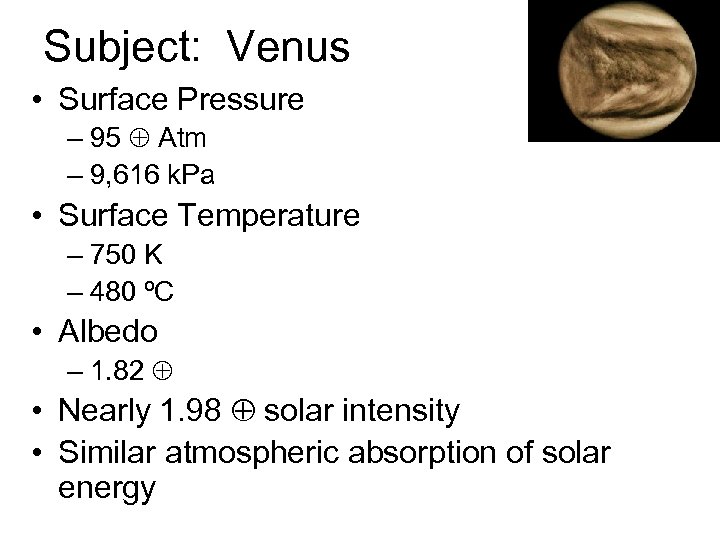 Subject: Venus • Surface Pressure – 95 Atm – 9, 616 k. Pa • Surface Temperature – 750 K – 480 ºC • Albedo – 1. 82 • Nearly 1. 98 solar intensity • Similar atmospheric absorption of solar energy
 Mission Objectives • Subject: Characterization of the atmosphere, ionosphere, and surface of Venus • Objectives – Determine the composition of the clouds – Determine the composition and structure of the atmosphere from the surface to high altitude – Determine the composition and structure of the ionosphere – Determine the characteristics of the surface on a planetary scale – Investigate the interactions of the magnetic field and the solar wind – Investigate the planet’s gravitational field harmonics
 Mission Concept • Two spacecraft – Orbiter • Spacecraft subsystems • 12 scientific instruments (payloads) – Multi-probe • Spacecraft bus • 3 small probes • 1 large probes DRIVER: Determine the composition and structure of the atmosphere from the surface to high altitude
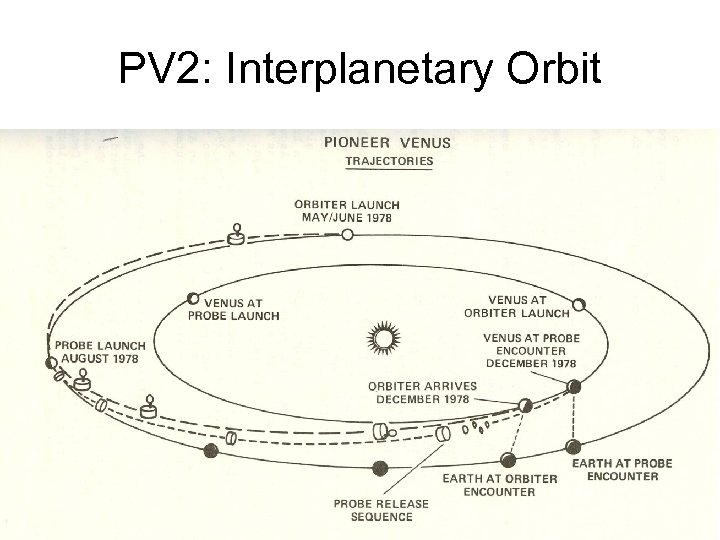
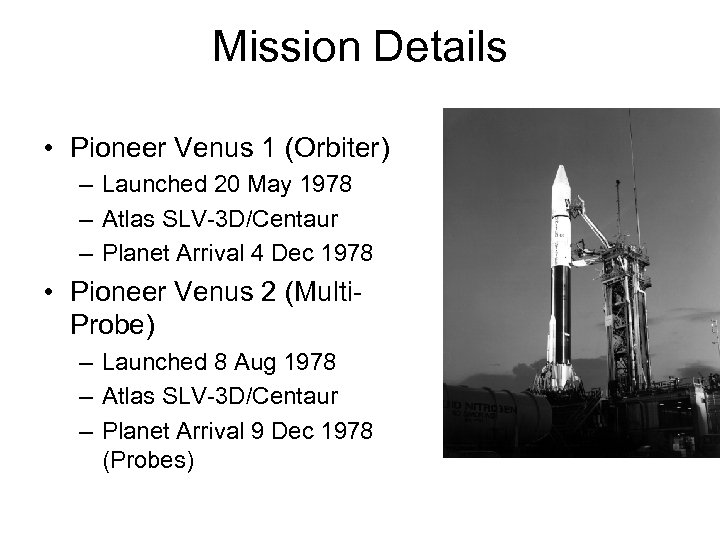 Mission Details • Pioneer Venus 1 (Orbiter) – Launched 20 May 1978 – Atlas SLV-3 D/Centaur – Planet Arrival 4 Dec 1978 • Pioneer Venus 2 (Multi. Probe) – Launched 8 Aug 1978 – Atlas SLV-3 D/Centaur – Planet Arrival 9 Dec 1978 (Probes)
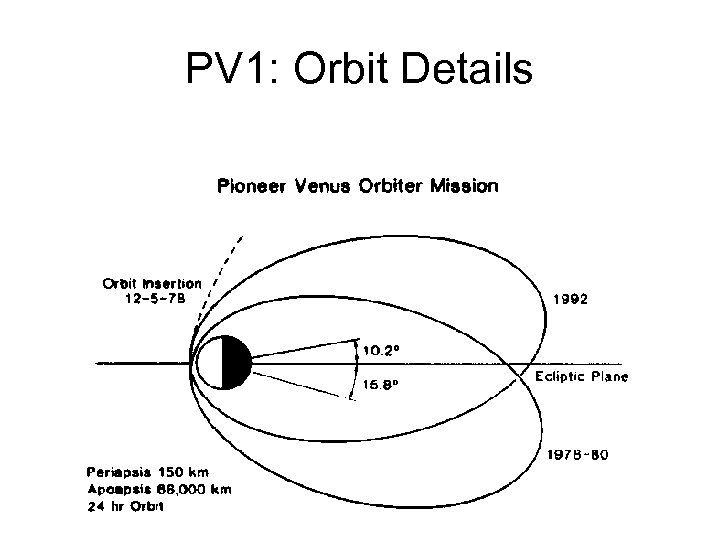
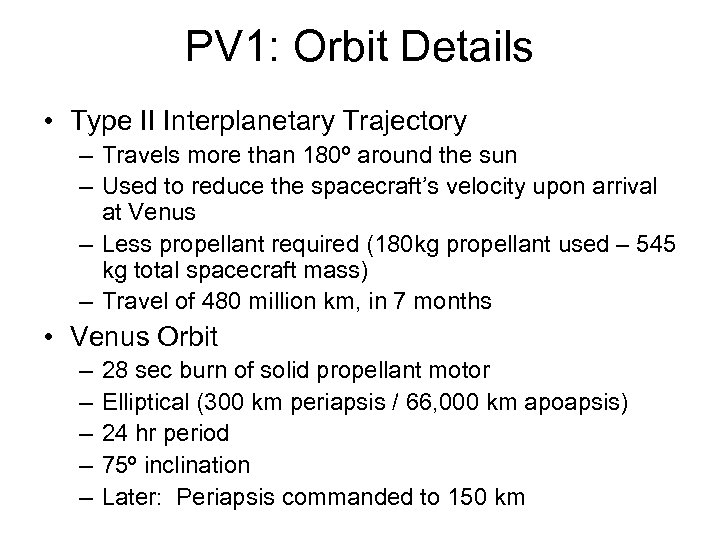 PV 1: Orbit Details • Type II Interplanetary Trajectory – Travels more than 180º around the sun – Used to reduce the spacecraft’s velocity upon arrival at Venus – Less propellant required (180 kg propellant used – 545 kg total spacecraft mass) – Travel of 480 million km, in 7 months • Venus Orbit – – – 28 sec burn of solid propellant motor Elliptical (300 km periapsis / 66, 000 km apoapsis) 24 hr period 75º inclination Later: Periapsis commanded to 150 km
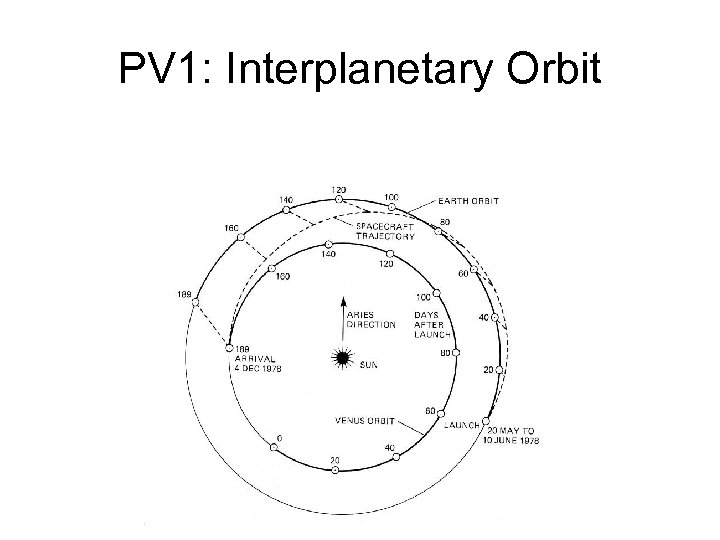 PV 1: Interplanetary Orbit
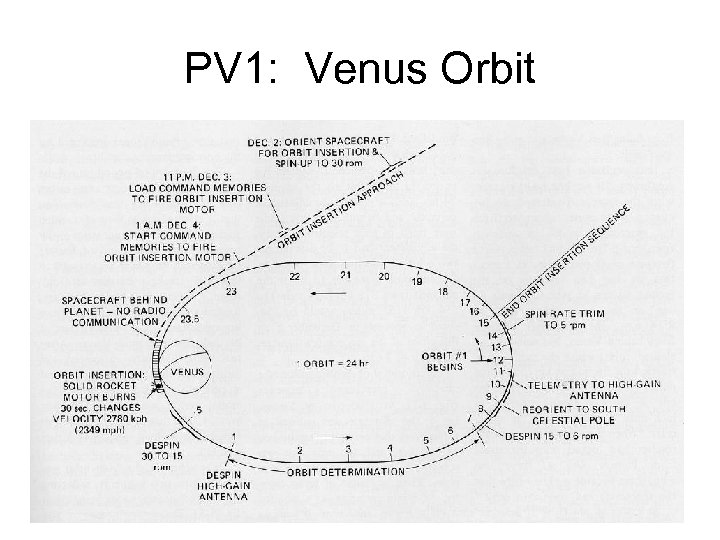 PV 1: Venus Orbit
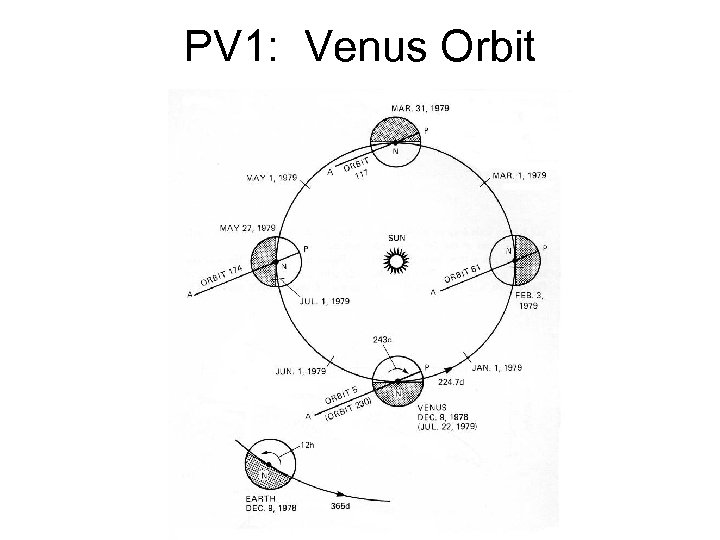 PV 1: Venus Orbit
 PV 1: Orbit Details
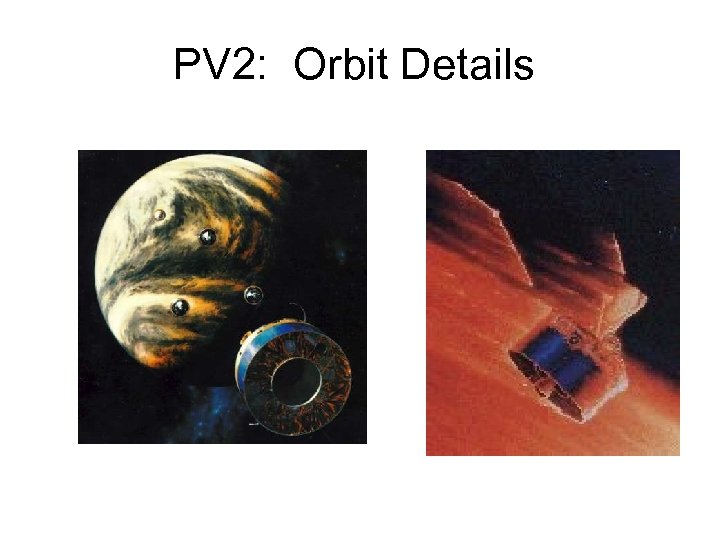
 PV 2: Orbit Details • Type I Interplanetary Trajectory – Travels less than 180º around the sun – Launched a few days after PV 1 crossed back inside Earth’s orbit – 4 month trip time – Arrival speed at Venus 19, 500 km/hr (5. 4 km/s) – 24 days to Venus: Large probe released – 20 days to Venus: Small probes released – Bus re-entry in Venus atmosphere
 PV 2: Interplanetary Orbit
 PV 2: Orbit Details
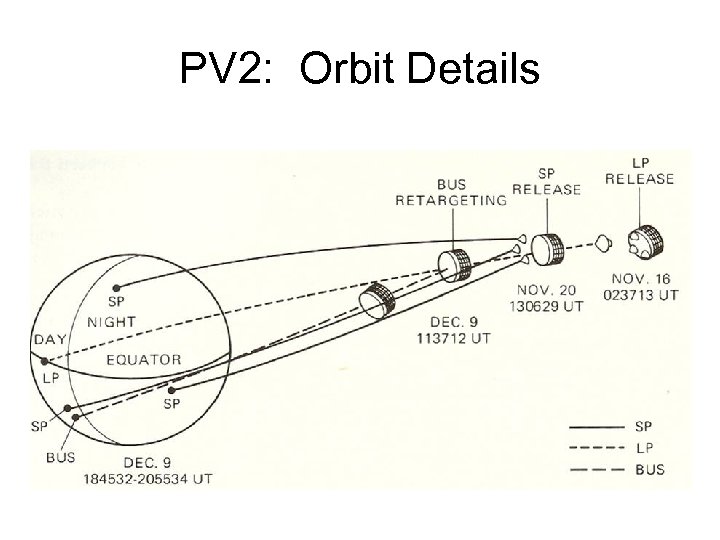 PV 2: Orbit Details
 The Spacecraft • Built by Hughes “Aircraft” Company • Project was managed by NASA Ames RC – Expertise • High velocity (hypersonic) flight dynamics • Re-entry • Planetary atmosphere sensing (Earth demonstrations) • We will look at some of the design specifics – Orbiter (PV 1) • Accomplish retro-fire at Venus to achieve specified orbit • Accommodate 47. 6 kg of scientific payloads • Support dual frequency (S and X bands) for occultation exp – Multiprobe (PV 2) • Mechanically and electrically support probes (1 large / 3 small) • Target and release probes at Venus • Accommodate 57. 6 kg of scientific payloads
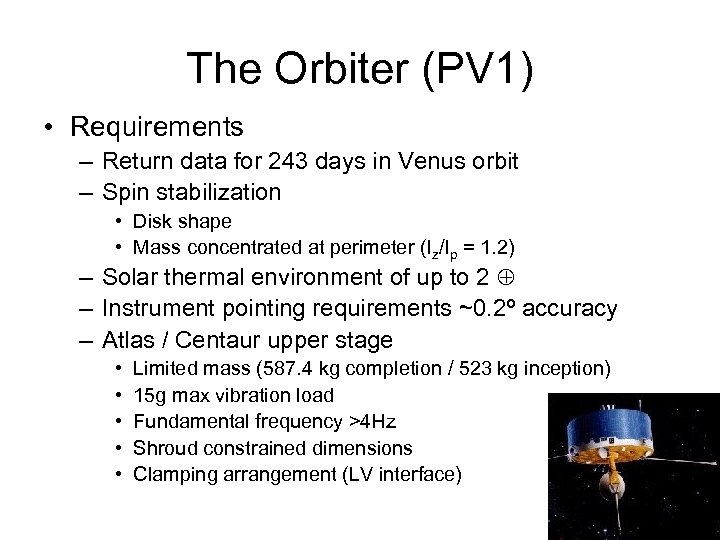 The Orbiter (PV 1) • Requirements – Return data for 243 days in Venus orbit – Spin stabilization • Disk shape • Mass concentrated at perimeter (Iz/Ip = 1. 2) – Solar thermal environment of up to 2 – Instrument pointing requirements ~0. 2º accuracy – Atlas / Centaur upper stage • • • Limited mass (587. 4 kg completion / 523 kg inception) 15 g max vibration load Fundamental frequency >4 Hz Shroud constrained dimensions Clamping arrangement (LV interface)
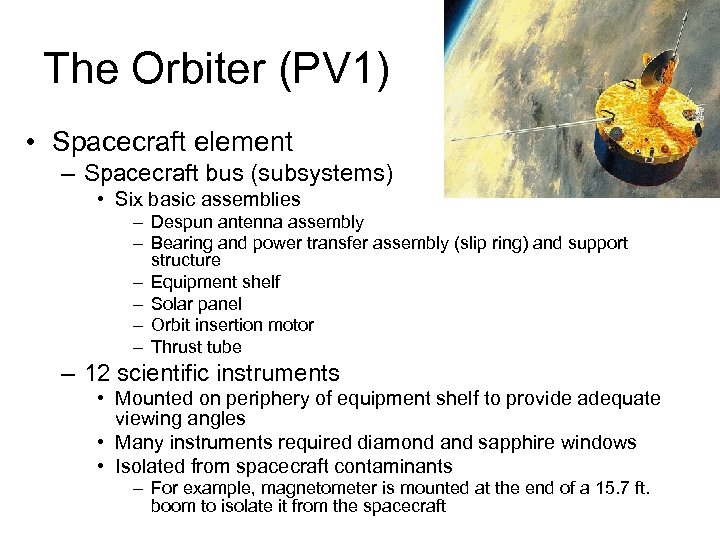 The Orbiter (PV 1) • Spacecraft element – Spacecraft bus (subsystems) • Six basic assemblies – Despun antenna assembly – Bearing and power transfer assembly (slip ring) and support structure – Equipment shelf – Solar panel – Orbit insertion motor – Thrust tube – 12 scientific instruments • Mounted on periphery of equipment shelf to provide adequate viewing angles • Many instruments required diamond and sapphire windows • Isolated from spacecraft contaminants – For example, magnetometer is mounted at the end of a 15. 7 ft. boom to isolate it from the spacecraft
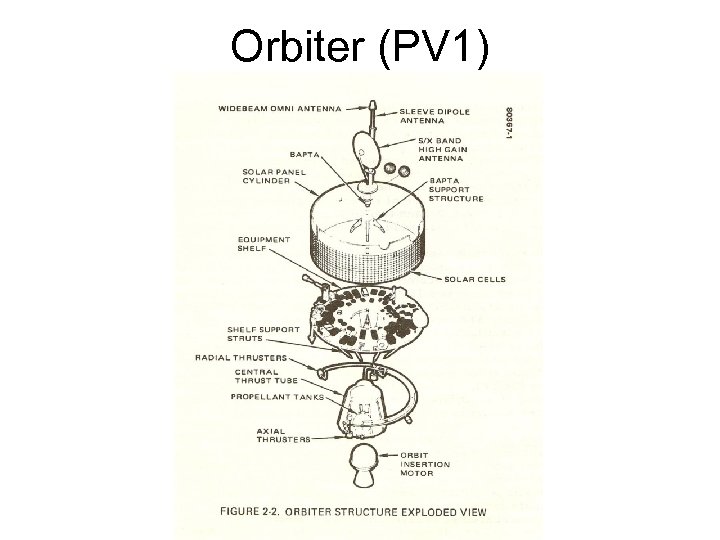 Orbiter (PV 1)
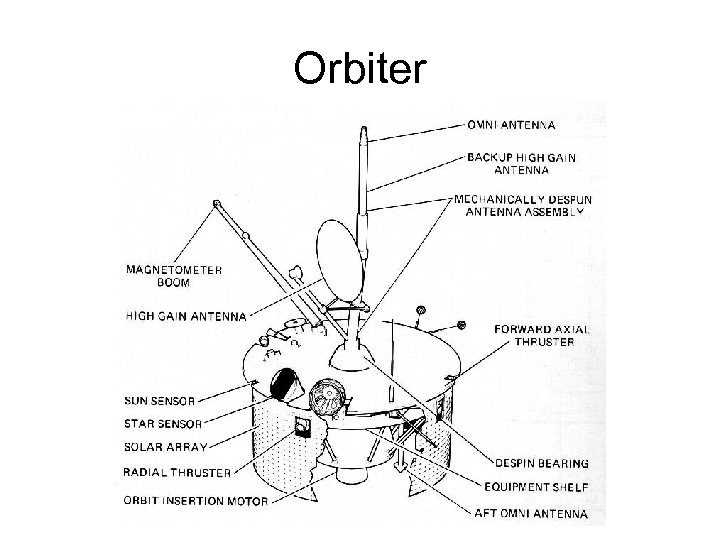 Orbiter
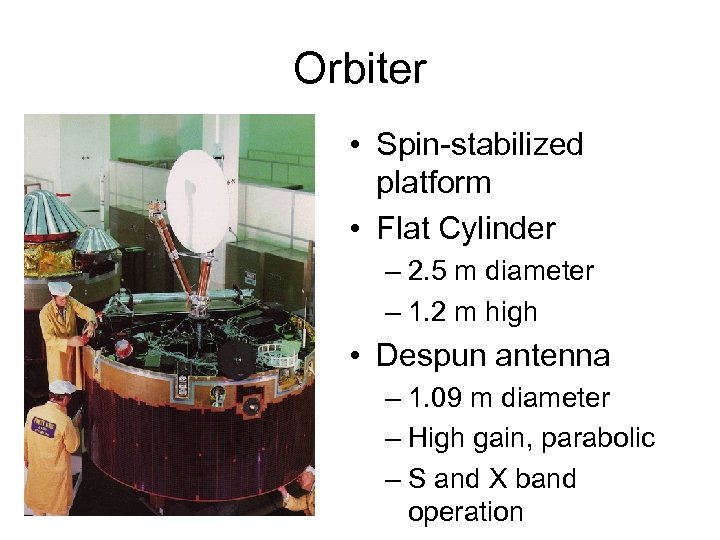 Orbiter • Spin-stabilized platform • Flat Cylinder – 2. 5 m diameter – 1. 2 m high • Despun antenna – 1. 09 m diameter – High gain, parabolic – S and X band operation
 Payloads • 12 scientific instruments – Cloud Photopolarimeter (OCPP) • Measure vertical distribution of cloud and haze particles • 5 kg, 5. 4 W • 3. 7 cm aperture telescope with filter wheel – Surface Radar Mapper (ORAD) • Produce first maps of large areas of Venus not observable from Earth • 9. 7 kg, 18 W • 150 m resolution – Infrared Radiometer (OIR) • Measure infrared radiation emitted by the atmosphere at various altitudes • 5. 9 kg, 5. 2 W • Determine where maximum deposition from solar energy is located
 Payloads – Airglow Ultraviolet Spectrometer (OUVS) • Measure UV light scattered or emitted by clouds • 3. 1 kg, 1. 7 W • Airglow is the absorption of UV light by gases in the upper atmosphere – Neutral Mass Spectrometer (ONMS) • Measure neutral atom and molecular densities • 3. 8 kg, 12 W • Vertical and horizontal distribution of neutral gases – Solar Wind Plasma Analyzer (OPA) • Measure properties of the solar wind at Venus (density, velocity, flow direction, temperature) • 3. 9 kg, 5 W • Electrostatic energy analyzer – Magnetometer • Investigate weak magnetic field of Venus • 2 kg, 2. 2 W • Weak magnetic field may play an important role in solar wind interactions
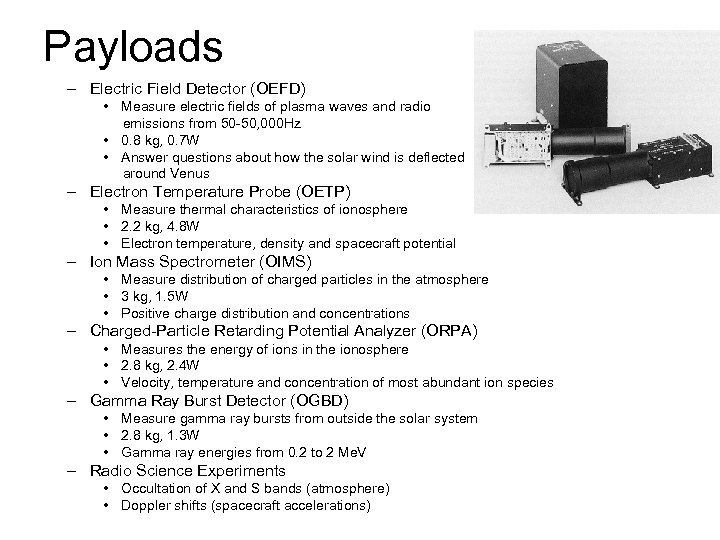 Payloads – Electric Field Detector (OEFD) • Measure electric fields of plasma waves and radio emissions from 50 -50, 000 Hz • 0. 8 kg, 0. 7 W • Answer questions about how the solar wind is deflected around Venus – Electron Temperature Probe (OETP) • Measure thermal characteristics of ionosphere • 2. 2 kg, 4. 8 W • Electron temperature, density and spacecraft potential – Ion Mass Spectrometer (OIMS) • Measure distribution of charged particles in the atmosphere • 3 kg, 1. 5 W • Positive charge distribution and concentrations – Charged-Particle Retarding Potential Analyzer (ORPA) • Measures the energy of ions in the ionosphere • 2. 8 kg, 2. 4 W • Velocity, temperature and concentration of most abundant ion species – Gamma Ray Burst Detector (OGBD) • Measure gamma ray bursts from outside the solar system • 2. 8 kg, 1. 3 W • Gamma ray energies from 0. 2 to 2 Me. V – Radio Science Experiments • Occultation of X and S bands (atmosphere) • Doppler shifts (spacecraft accelerations)
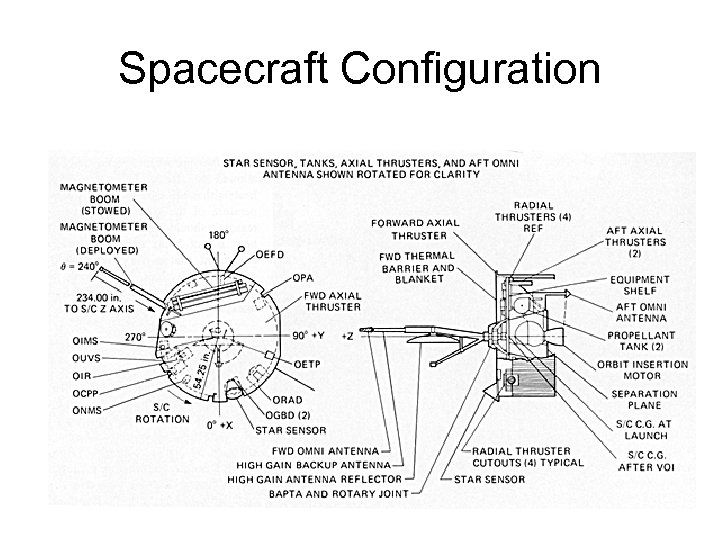 Spacecraft Configuration
 Attitude Determination and Control • Shape and weight distribution conform to basic mechanical requirements for a spin stabilized vehicle – Roll-to-Pitch Ratio greater than one • Attitude determination – Dual slit sun sensor (x 3) – Star sensor • Propulsion provided control – Spin rate – Attitude control – Orbit insertion
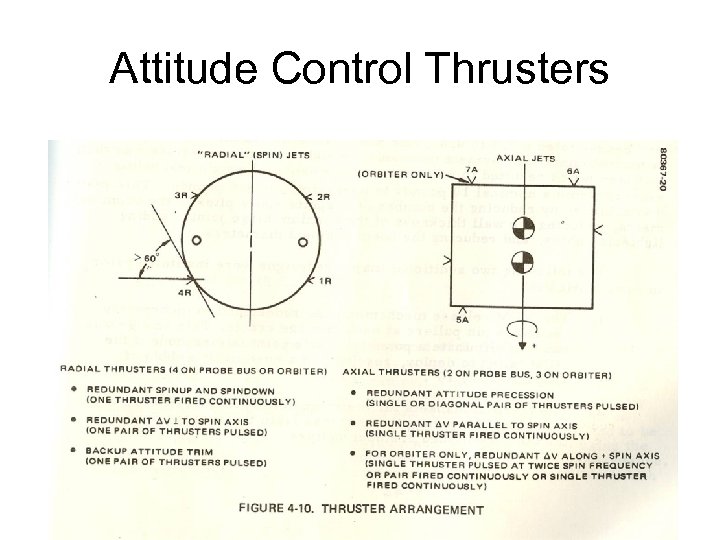 Attitude Control Thrusters
 Propulsion • Attitude control – 7 total thrusters • • • Liquid monopropellant hydrazine (N 2 H 4) 23. 78 kg of propellant required (spin, despin, orientation) Catalytic decomposition 4. 45 N of thrust (each) Blow-down mode System – Tanks and Pressurant (He) – Resevoir (60 sec of propellant – 5 sec of spin up thrust required) – Filters – Feedlines – Heaters (to prevent freezing) – Valves – Thrust chamber – Nozzle
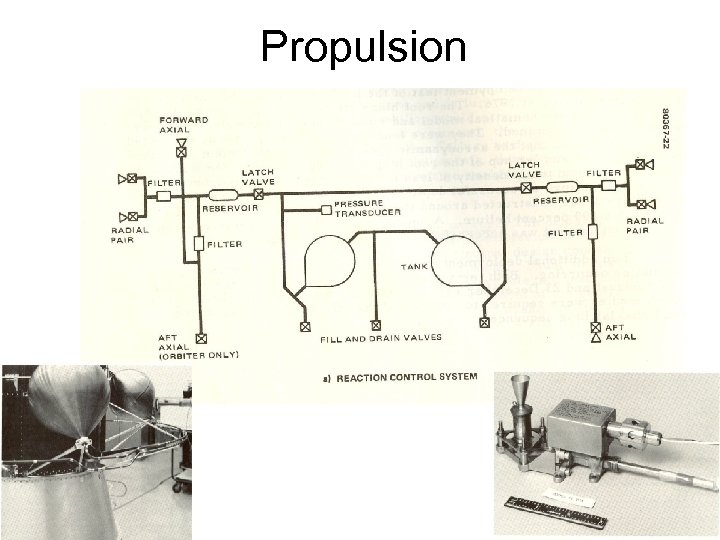 Propulsion
 Propulsion • Orbit insertion – 1 thruster • Solid propellant • 18000 N of thrust provided • ΔV ~ 1. 05 km/sec – System • • Tank Insulation Safe and arm unit (igniter) Nozzle
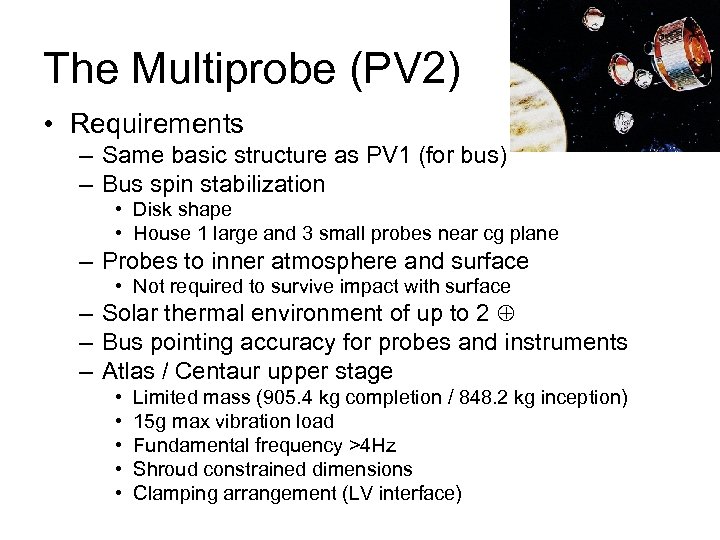 The Multiprobe (PV 2) • Requirements – Same basic structure as PV 1 (for bus) – Bus spin stabilization • Disk shape • House 1 large and 3 small probes near cg plane – Probes to inner atmosphere and surface • Not required to survive impact with surface – Solar thermal environment of up to 2 – Bus pointing accuracy for probes and instruments – Atlas / Centaur upper stage • • • Limited mass (905. 4 kg completion / 848. 2 kg inception) 15 g max vibration load Fundamental frequency >4 Hz Shroud constrained dimensions Clamping arrangement (LV interface)
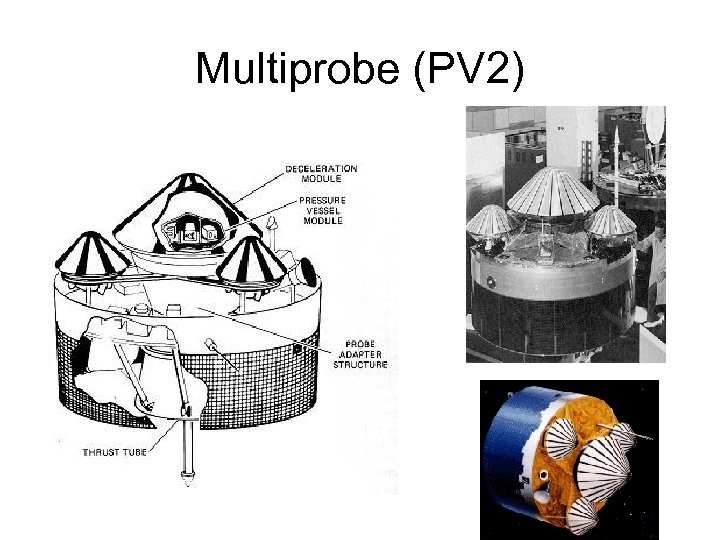
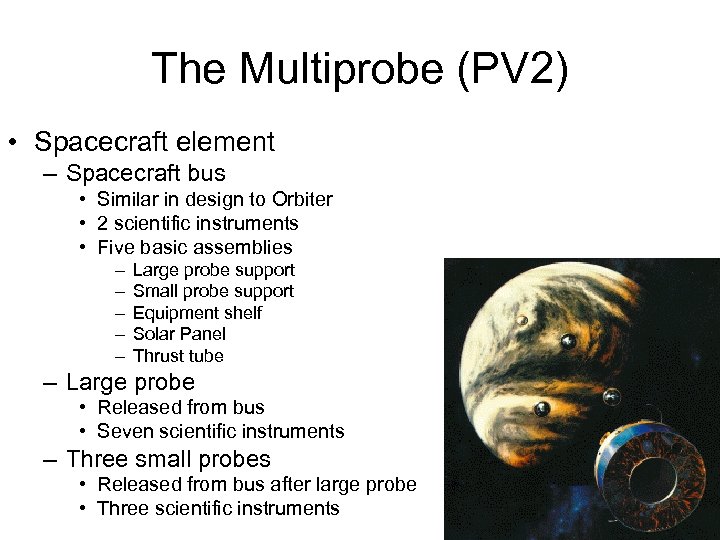 The Multiprobe (PV 2) • Spacecraft element – Spacecraft bus • Similar in design to Orbiter • 2 scientific instruments • Five basic assemblies – – – Large probe support Small probe support Equipment shelf Solar Panel Thrust tube – Large probe • Released from bus • Seven scientific instruments – Three small probes • Released from bus after large probe • Three scientific instruments
 Multiprobe (PV 2)
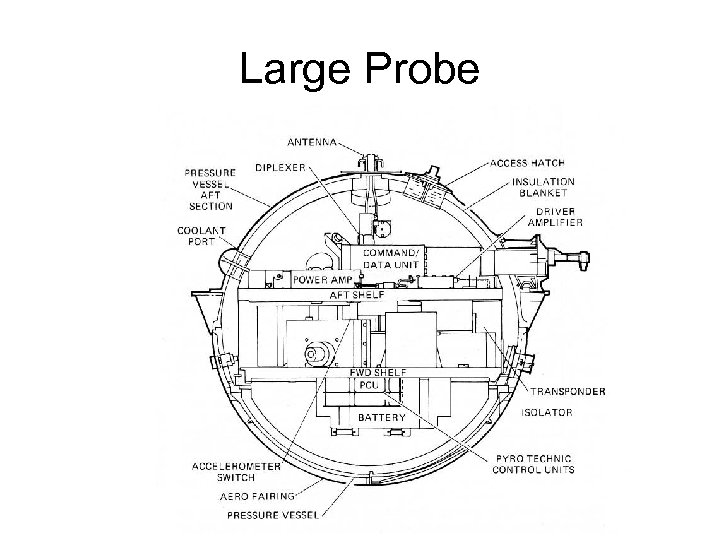
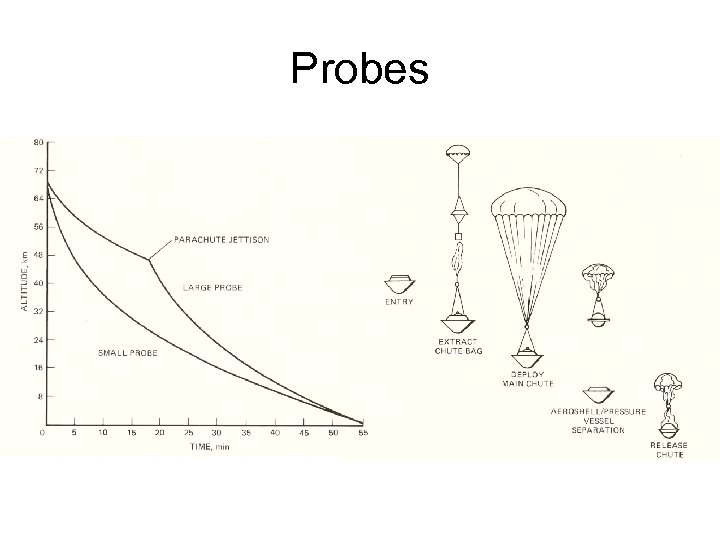
 Large Probe (Payload) • The Pioneer Venus large probe was equipped with 7 science experiments, contained within a sealed spherical pressure vessel. • After deceleration from initial atmospheric entry at about 11. 5 km/s near the equator on the Venus night side, a parachute was deployed at 47 km altitude. • The large probe was about 1. 5 m in diameter and the pressure vessel itself was 73. 2 cm in diameter. Pressure vessel was Titanium filled with 102 k. Pa of Nitrogen. • Weight: 315 kg • The science experiments were: – a neutral mass spectrometer to measure the atmospheric composition – a gas chromatograph to measure the atmospheric composition – a solar flux radiometer to measure solar flux penetration in the atmosphere – an infrared radiometer to measure distribution of infrared radiation – a cloud particle size spectrometer to measure particle size and shape – a nephelometer to search for cloud particles – temperature, pressure, and acceleration sensors
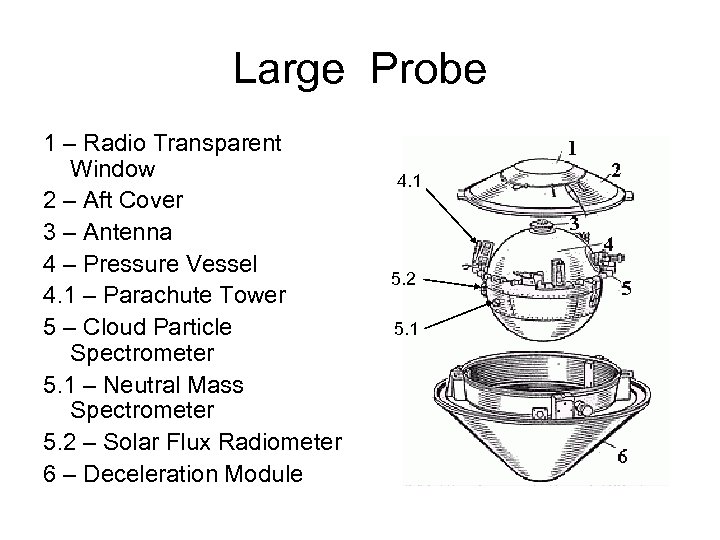 Large Probe 1 – Radio Transparent Window 2 – Aft Cover 3 – Antenna 4 – Pressure Vessel 4. 1 – Parachute Tower 5 – Cloud Particle Spectrometer 5. 1 – Neutral Mass Spectrometer 5. 2 – Solar Flux Radiometer 6 – Deceleration Module 4. 1 5. 2 5. 1
 Large Probe
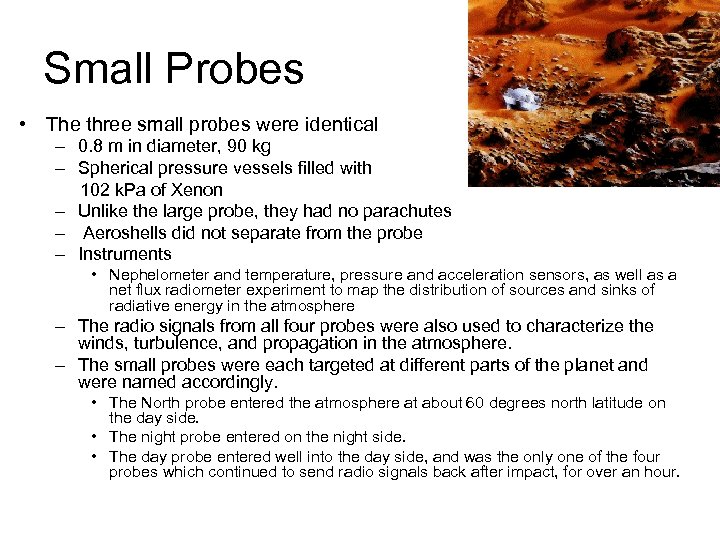 Small Probes • The three small probes were identical – 0. 8 m in diameter, 90 kg – Spherical pressure vessels filled with 102 k. Pa of Xenon – Unlike the large probe, they had no parachutes – Aeroshells did not separate from the probe – Instruments • Nephelometer and temperature, pressure and acceleration sensors, as well as a net flux radiometer experiment to map the distribution of sources and sinks of radiative energy in the atmosphere – The radio signals from all four probes were also used to characterize the winds, turbulence, and propagation in the atmosphere. – The small probes were each targeted at different parts of the planet and were named accordingly. • The North probe entered the atmosphere at about 60 degrees north latitude on the day side. • The night probe entered on the night side. • The day probe entered well into the day side, and was the only one of the four probes which continued to send radio signals back after impact, for over an hour.
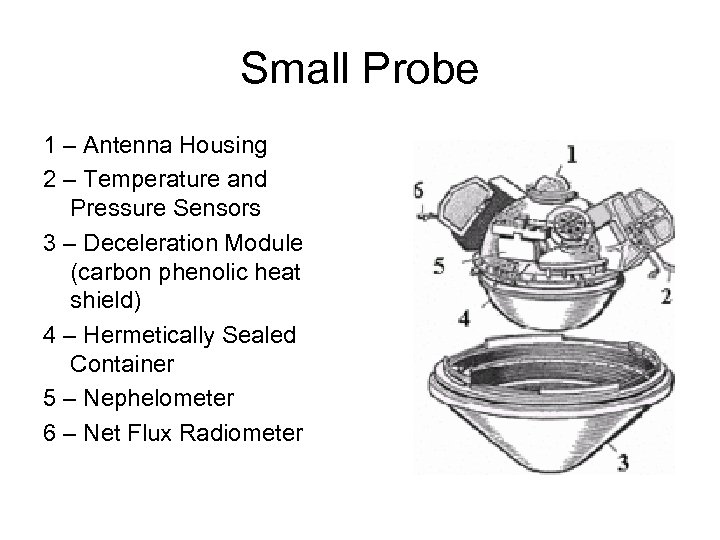 Small Probe 1 – Antenna Housing 2 – Temperature and Pressure Sensors 3 – Deceleration Module (carbon phenolic heat shield) 4 – Hermetically Sealed Container 5 – Nephelometer 6 – Net Flux Radiometer
 Probes
 Propulsion • Attitude control – Same as for Orbiter with one less thruster – 6 total thrusters • Liquid monopropellant hydrazine (N 2 H 4) • 15. 34 kg of propellant required (ΔV, spin, despin, orientation) • Catalytic decomposition • 4. 45 N of thrust (each) • Blow-down mode • No orbit insertion motor required
 REFERENCES • Fimmel, R. , Colin, L. , Burgess, E. , Pioneer Venus, NASA SP-461, 1983. • Brodsky, R. , Pioneer Venus: Case Study in Spacecraft Design, AIAA, 1980. • “Pioneer Venus”, Press Kit, Release 78 -68, NASA, 1978. • Venus and Mars: Atmospheres, Ionospheres and Solar Wind Interactions. (edited by J. G. Luhmann, M. Tatrallyay and R. O. Pepin) 225236, American Geophysical Union, 1992.