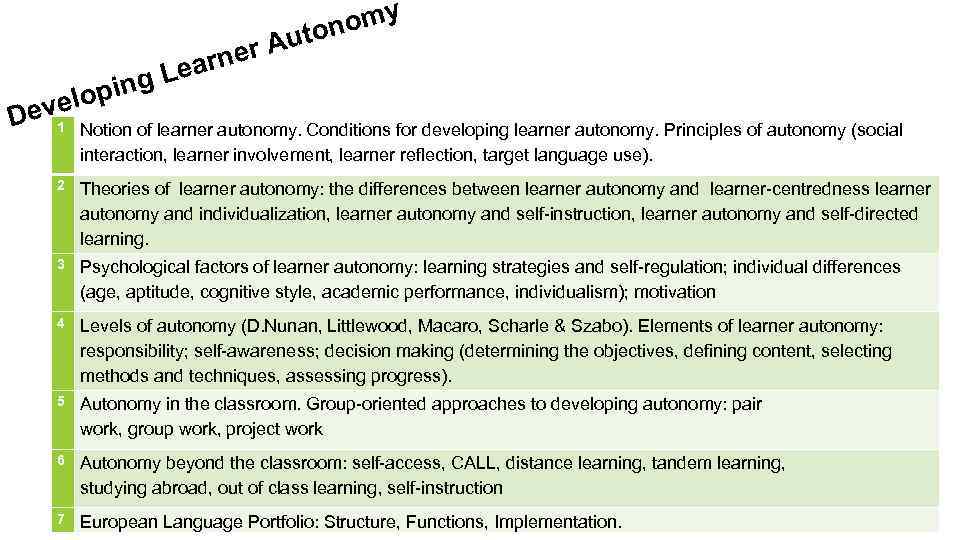
 ping velo De rner Lea omy uton A 1 Notion of learner autonomy. Conditions for developing learner autonomy. Principles of autonomy (social interaction, learner involvement, learner reflection, target language use). 2 Theories of learner autonomy: the differences between learner autonomy and learner-centredness learner autonomy and individualization, learner autonomy and self-instruction, learner autonomy and self-directed learning. 3 Psychological factors of learner autonomy: learning strategies and self-regulation; individual differences (age, aptitude, cognitive style, academic performance, individualism); motivation 4 Levels of autonomy (D. Nunan, Littlewood, Macaro, Scharle & Szabo). Elements of learner autonomy: responsibility; self-awareness; decision making (determining the objectives, defining content, selecting methods and techniques, assessing progress). 5 Autonomy in the classroom. Group-oriented approaches to developing autonomy: pair work, group work, project work 6 Autonomy beyond the classroom: self-access, CALL, distance learning, tandem learning, studying abroad, out of class learning, self-instruction 7 European Language Portfolio: Structure, Functions, Implementation.
 What is Learner Autonomy?
 Split into two groups and make up the definition of the term “Learner Autonomy”
 Holec (1981): “Learner autonomy is the ability to take charge of one’s own learning” “self-direction in learning must remain a possibility offered to and not forced upon learners”
 In language education the term is used in at least five different ways: 1. for situations in which learners study entirely on their own 2. for a set of skills which can be learned and applied in self-directed learning 3. for an inborn capacity which is suppressed by institutional education 4. for the exercise of learners’ responsibility for their own learning 5. for the right of learners to determine the direction of their own learning. (Benson and Voller, 1997: 1 – 2).
 learner autonomy and learner-centredness the key difference between learner-centred and traditional curriculum development is that, in the former, the curriculum is a collaborative effort between teachers and learners, since learners are closely involved in the decision-making process regarding the content of the curriculum and how it is taught (Nunan, 1988: 2)
 learner autonomy and individualization • individualized programmes have strong face validity and imply that the learner's needs are recognized • individualization means much more than that learners' needs are being addressed: it also means that individual learners are working towards autonomy in ways uniquely relevant to their own needs
 learner autonomy and self-instruction Self-instruction as applied to foreign-language learning has two different definitions, which may be called "broad" and "narrow" respectively. In the broad sense (Dickinson, 1987: 5), it describes "situations in which a learner, with others, or alone, is working without the direct control of a teacher". In the narrow sense (Jones, 1998; cf. Benson, 2001: 131), it is "a deliberate long-term learning project instigated, planned and carried out by the learner alone, without teacher intervention": unlike the broad definition, this excludes autonomous activities or sessions within a taught course.
 learner autonomy and self-directed learning • Self-directed learning is a concept that came out of the humanistic tradition of adult education in the second half of the twentieth century. One of the first researchers on the topic, the Canadian scholar Allen Tough, viewed self-directed learning largely as an expression of human personal agency. • Man, according to this view, can be active, energetic, free, and aware. He often chooses his goals, direction, and behavior; he is not always pushed and pulled by his environment and by unconscious inner forces. (Tough 1979, p. 45)
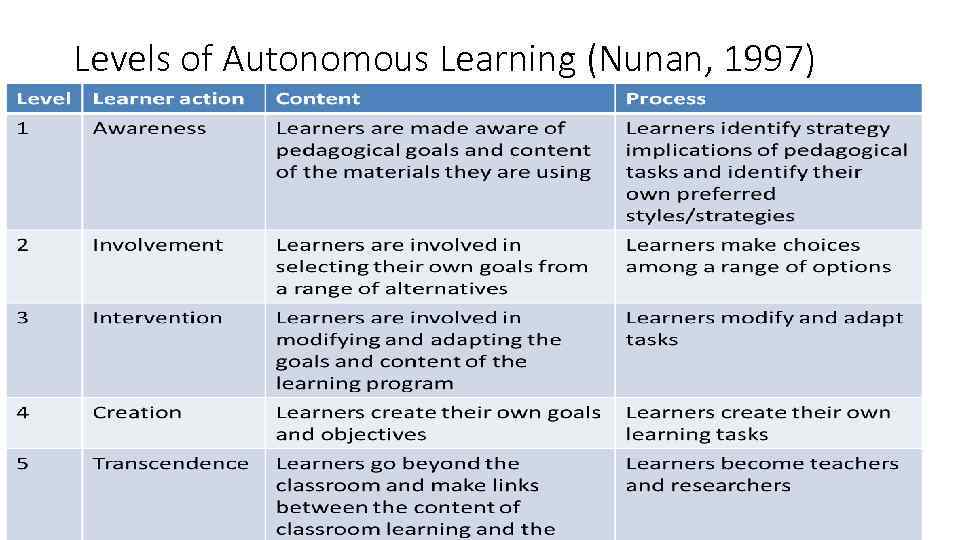 Levels of Autonomous Learning (Nunan, 1997)
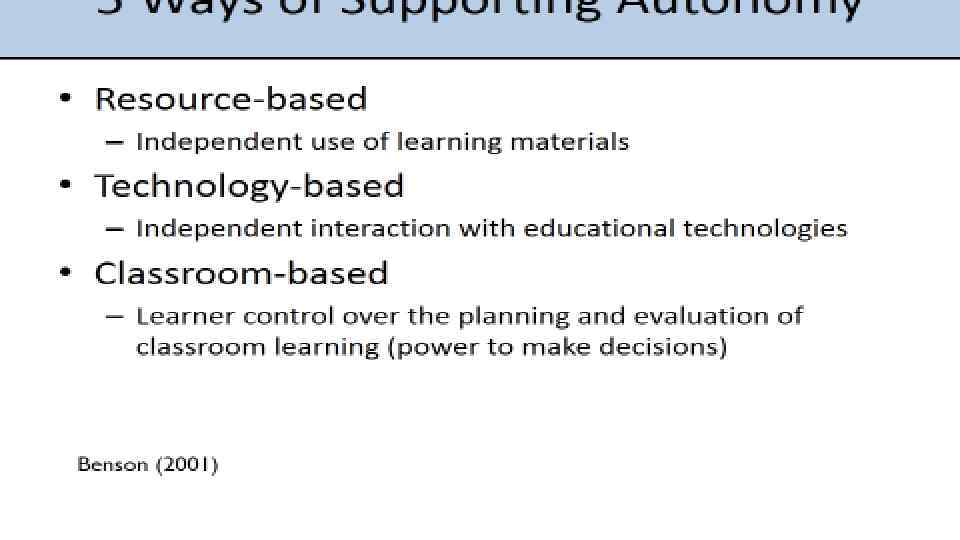
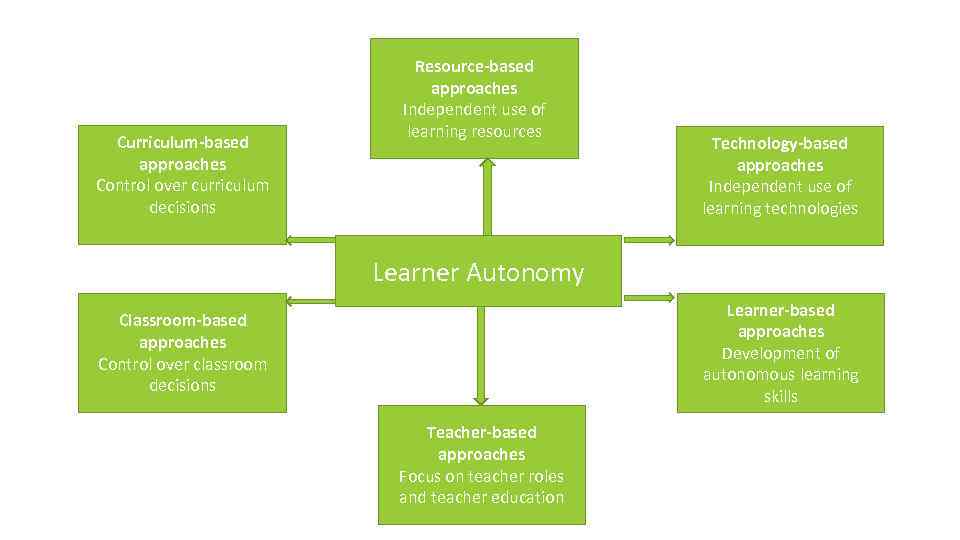 Curriculum-based approaches Control over curriculum decisions Resource-based approaches Independent use of learning resources Technology-based approaches Independent use of learning technologies Learner Autonomy Learner-based approaches Development of autonomous learning skills Classroom-based approaches Control over classroom decisions Teacher-based approaches Focus on teacher roles and teacher education
 What does it look like?