 Скачать презентацию Pilgrim shrines Pilgrim places belong to the
Pilgrim places and specialst values.pptx
- Количество слайдов: 26




Pilgrim shrines
Pilgrim places belong to the most frequnetly visited destinations in Poland. Especially during religious celebration. Pilgrimages are journeys of belivers to the holy places called sanctuary. Pilgrimage is a form of celebration and it has both religious and psychological meaning. Sanctuaries in Poland are mostly historical objects. They were the places of preserving the Polish nationality during the partition in 19 th century. However the pilgrims have got many characteristics of tourist movement. The belivers follow the pilgrim paths and trails to the destinations with the both religious and tourist infrastructure. Some of the religious places are located in the popular tourst areas (Święta Lipka- Mazuria).
Sanctuary is usually a complex of buldings having firslty religious and charitative attributes. It has also patriotic and artistic characteristics. There are usually hospices for pilgrims in the area of sanctuaries and/or pensions around it. There are often religious celebrations, services , festives, processions which increase the tourist movement. The pilgrim palces are often visited as a interesting sightseeing. Some of them are even regarded as a main attraction in terms of its value.
Poland belongs to one of the most active countries in Europe in terms of christian pilgrimage movement. Polish are estimated to account for 20% of the total pilgrims. There about 500 sanctuaries all over Poland. 85 % of them are dedicated to our Lady. 200 of them are crowned by the Vatican.
Jasna Góra (Częstochowa- Upper Silesia) is the most popular sanctuary in Poland. It houses the famous picture of Our Lady taken to the monastry of Paulin monk order from Ruthenia in 1382. There are up to 5 million visit to Jasna Góra every year. The second strongly visited place is Licheń close to Konin. There is a biggest church in Poland there built 2004. Therefore it attracts many tourists. Łagiewniki in Kraków is the third most important sanctuary. It was built in 2002 it is connected with the cultivation of Jesus merciful. It attracts strongly international pilgrims. The second important group of sanctuaries are those in Kalwaria Zebrzydowska (Lesser Poland), Saint Ann Mount (Opolskie region) and Niepokalanów
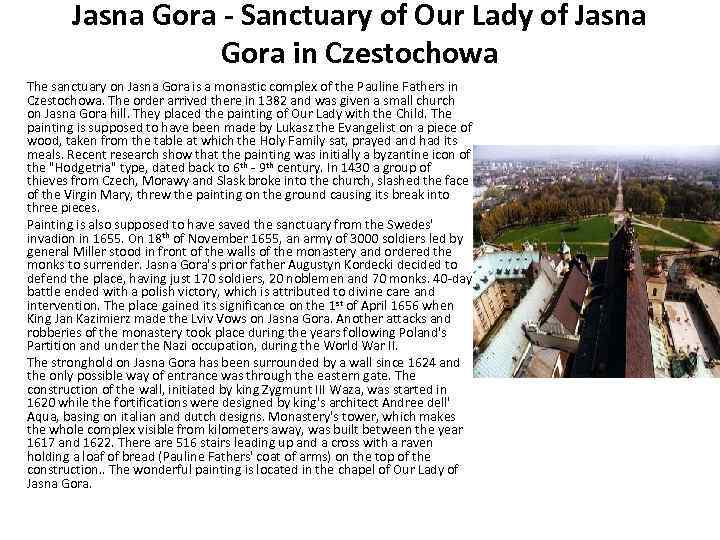
Jasna Gora - Sanctuary of Our Lady of Jasna Gora in Czestochowa The sanctuary on Jasna Gora is a monastic complex of the Pauline Fathers in Czestochowa. The order arrived there in 1382 and was given a small church on Jasna Gora hill. They placed the painting of Our Lady with the Child. The painting is supposed to have been made by Lukasz the Evangelist on a piece of wood, taken from the table at which the Holy Family sat, prayed and had its meals. Recent research show that the painting was initially a byzantine icon of the "Hodgetria" type, dated back to 6 th - 9 th century. In 1430 a group of thieves from Czech, Morawy and Slask broke into the church, slashed the face of the Virgin Mary, threw the painting on the ground causing its break into three pieces. Painting is also supposed to have saved the sanctuary from the Swedes' invadion in 1655. On 18 th of November 1655, an army of 3000 soldiers led by general Miller stood in front of the walls of the monastery and ordered the monks to surrender. Jasna Gora's prior father Augustyn Kordecki decided to defend the place, having just 170 soldiers, 20 noblemen and 70 monks. 40 -day battle ended with a polish victory, which is attributed to divine care and intervention. The place gained its significance on the 1 st of April 1656 when King Jan Kazimierz made the Lviv Vows on Jasna Gora. Another attacks and robberies of the monastery took place during the years following Poland's Partition and under the Nazi occupation, during the World War II. The stronghold on Jasna Gora has been surrounded by a wall since 1624 and the only possible way of entrance was through the eastern gate. The construction of the wall, initiated by king Zygmunt III Waza, was started in 1620 while the fortifications were designed by king's architect Andree dell' Aqua, basing on italian and dutch designs. Monastery's tower, which makes the whole complex visible from kilometers away, was built between the year 1617 and 1622. There are 516 stairs leading up and a cross with a raven holding a loaf of bread (Pauline Fathers' coat of arms) on the top of the construction. . The wonderful painting is located in the chapel of Our Lady of Jasna Gora.
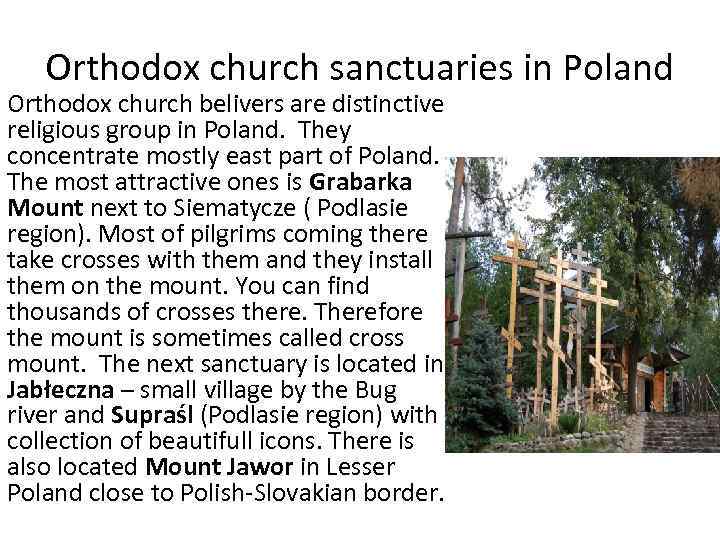
Orthodox church sanctuaries in Poland Orthodox church belivers are distinctive religious group in Poland. They concentrate mostly east part of Poland. The most attractive ones is Grabarka Mount next to Siematycze ( Podlasie region). Most of pilgrims coming there take crosses with them and they install them on the mount. You can find thousands of crosses there. Therefore the mount is sometimes called cross mount. The next sanctuary is located in Jabłeczna – small village by the Bug river and Supraśl (Podlasie region) with collection of beautifull icons. There is also located Mount Jawor in Lesser Poland close to Polish-Slovakian border.
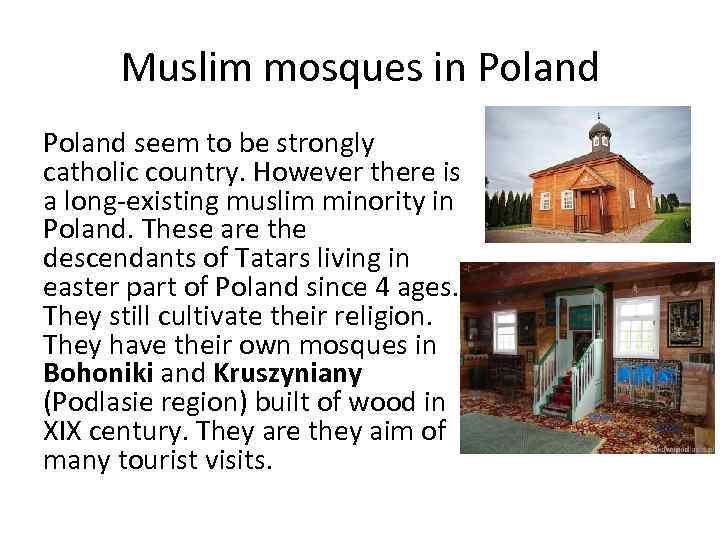
Muslim mosques in Poland seem to be strongly catholic country. However there is a long-existing muslim minority in Poland. These are the descendants of Tatars living in easter part of Poland since 4 ages. They still cultivate their religion. They have their own mosques in Bohoniki and Kruszyniany (Podlasie region) built of wood in XIX century. They are they aim of many tourist visits.
Jewish shrines However there are not that many Jewish living in Poland recently there used to be the traces of vurnelable past of that minority all over Poland. Jewish from abroad come and visit shrines of famous cadics in Kraków, Leżajsk, Bobowa, Nowy Sącz, Kock, Koniecpol and Kielce.
Classification of sightseeings of Poland The practical function of classification of Polish sightseeings is encompasses their usage in maps, guidebooks etc. B. Mikułowski and J. Wyrzykowski while preparing their Atlas Turystyczny Polski prepared a scale of measuring their value based on the ones used in Michelin guidebooks and Poliglot: ***- highly interesting attractions, often main destination **- important attractions, worth to curve on the way to the destination *- other attractions
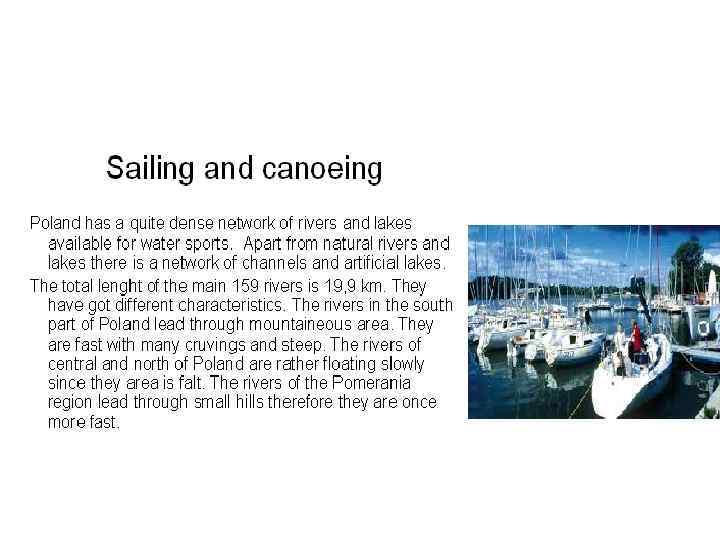

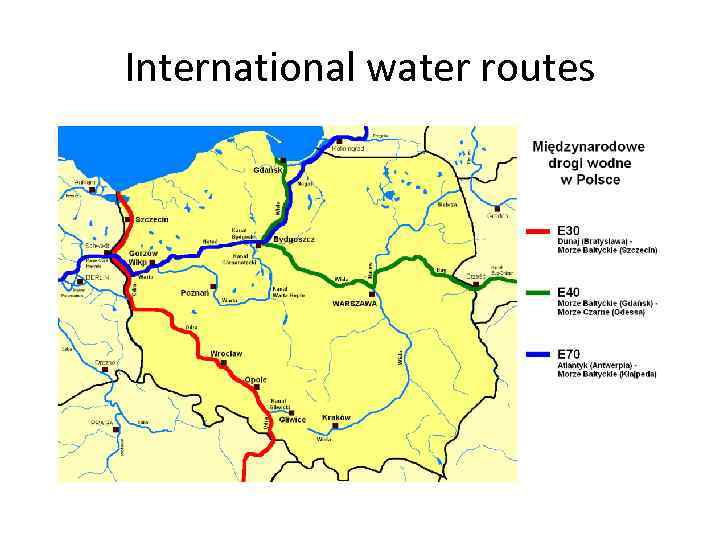
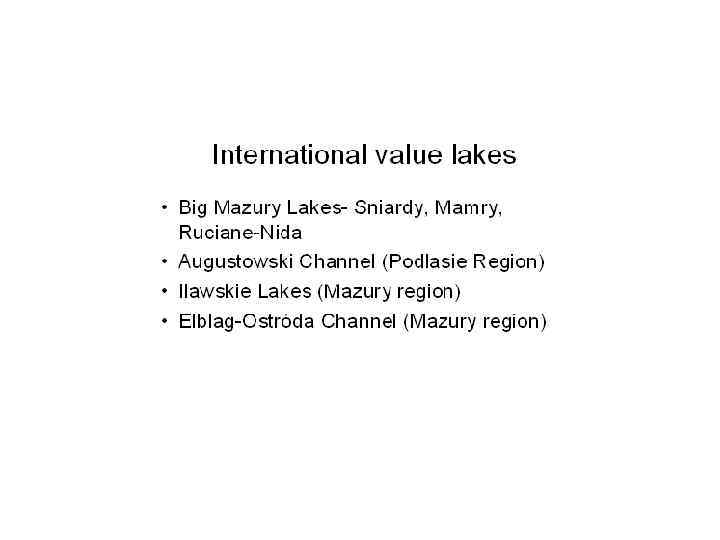
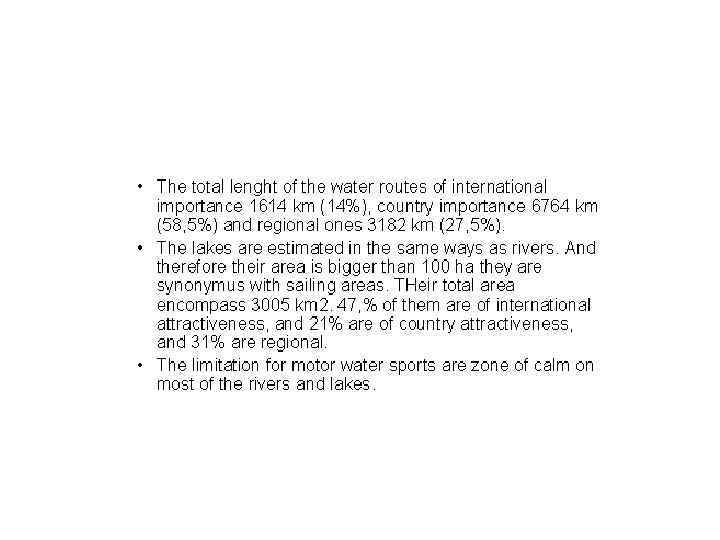
International water routes
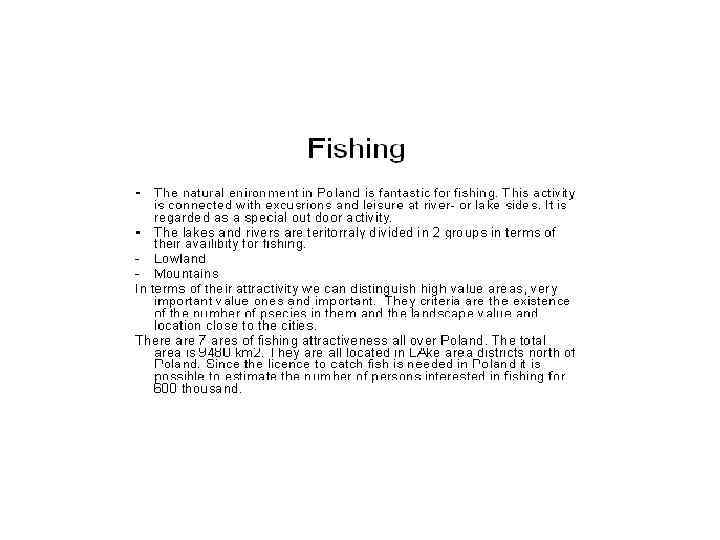
Fishing The record pike caught with a fishing rod in Poland weighed over 24 kg, and the biggest carp was 3 kg heavier. The anglers who caught them said that the fight took over five hours! In Poland, even the calm waters on the shores of a Mazurian lake can turn into an adventure. There are many very good areas in Poland for fishing with more than 20 fish species which can be caught – others are protected: • in the mountains – trout, salmon, • in the lakes and rivers, - pike, pikeperch, catfish and eels. • The rivers and lakes which are the richest in fish are found in the northern part of Poland. Around the Baltic coast most of the fish can be found in small river deltas. You can also fish in some of the man-made lakes in Poland, for example, Zalew Zegrzyński, not far from Warsaw, Sulejowski, close to Łódź and Soliński in the Bieszczady, and many others. During the winter ice fishing is very popular especially on the lakes in the Mazury.
Hunting • Hunters in Poland form a brotherhood with their own traditions, language and customs. As they say, they are not bloodthirsty killers, but ‘selectioners’, assisting in the natural balance of nature. It is worth becoming acquainted with their traditions, language and customs, even if you don’t want to have anything to do with shooting the animals. Poland is also a country of forests and meadows. Poland’s natural environment is excellent for organizing hunts and big-game hunting has rich, deeply rooted traditions. Game is found in great abundance across the country, among these are the habitual, hares, boars, roe-deer, foxes, ducks, partridges and pheasants. Much less common animals which you can encounter are: moose, fallow deer and moufflon. The areas richest in wild animals that can be hunted are in the north east of Poland (Mazury, Suwalszczyzna, and Podlasie). Here you have a great abundance of mostly deer. The Bieszczady region is another typical hunting region.
Horseback riding • Horseback riding is one of the oldest, carefully cultivated traditions in Poland. It is worth looking at this phenomenon. • This process of erudition can begin during the most important and most prestigious European auction of Arab blood stock horses in Janow Podlaski, where among the bidders amongst many other wealthy celebrities, Charlie Watts, the Rolling Stones drummer, is regularly present. It is in Janów, where the famous bay El Paso stallion, one of the most expensive horses in history was sold for around one million dollars. • Poland is famous not only for its pure blood Arabs horses. Hucul horses from Gladyszow, though inconspicuous, are very patient, gentle and brave. They are the cousins of the Polish ponies which can be seen in the Roztocze National Park and in the research station in Popielno in Mazury.
. Huculs are great therapists and they don’t have any problems climbing the gentle hills of Lower Beskid. Several day long meetings in a saddle are organised by many stud farms in Poland where there is an opportunity not only to commune with nature and the landscape but to approach wild animals. Horse scent does not frighten off the deer or roe-deer. Dozens of horse breeding farms in Poland teach the western type of horse riding which is much better and more comfortable for long distances. Advanced riders can conquer Poland on their own, using the growing network of horseback trails on the Baltic coast (Białogora), the forests of Wielkopolska (Wilczy Szlak) and in the Warmian hills (the region of Kierzbun). The 400 km long horse trail in Sudety zigzags between Lądek Zdrój and Karpacz and the summit of Snieznik can almost be reached by horse! A trip like this to the countryside is an opportunity to experience one more pleasure connected with horses – a night sledging cavalcade lit by torches, with blankets on your laps and a thermos full of tea with alcohol. During the Highland carnival in Bukowina Tatrzanska, kumoterki races (small sledges once used to carry children to baptism) are a great attraction. Horse-back riding has long traditions in Poland. There a large number of clubs and horse-riding centers, of which about 400 are members of the Polish Riding Association (Warsaw, 29 Lektykarska St. , tel. +48 22 639 32 40). Also many agro-tourist farms offer horse-back riding. Here they organize recreational horse-back riding tours and horse-riding holidays and camps. In summer you can take a carriage and in winter – a sleigh. Amateurs of sightseeing from the saddle will also find something to their likening. Many centers organize one- and several days’ horse rallies on especially marked trails. The longest and most beautiful are those in mountainous regions: the Trans-Beskid Horse Trail and the Trans-Jurassic Horse Trail (600 and 250 km). Practicing horse riding in Poland can be combined easily with sightseeing architectural historic sites. Many horse riding centers and studs are located in the vicinity or directly on the properties of beautiful historical manors and palaces, for example, Chlewiska (the 400 -year old Palace of the Odrowąż family), Walewice (the 18 th century Palace of Maria Walewska) and Kurozwęki. The studs known worldwide for their purebreds are especially note-worthy: Janów Podlaski (Arab thoroughbreds), Kętrzyn (heavy horses), Gładyszów (hucul), Książ near Wałbrzych, Bogusławice, Czerniejew, Kozienice, Racot, Łąck and Sieraków
Скачать презентацию Pilgrim shrines Pilgrim places belong to the
Pilgrim places and specialst values.pptx