Pig-breeding
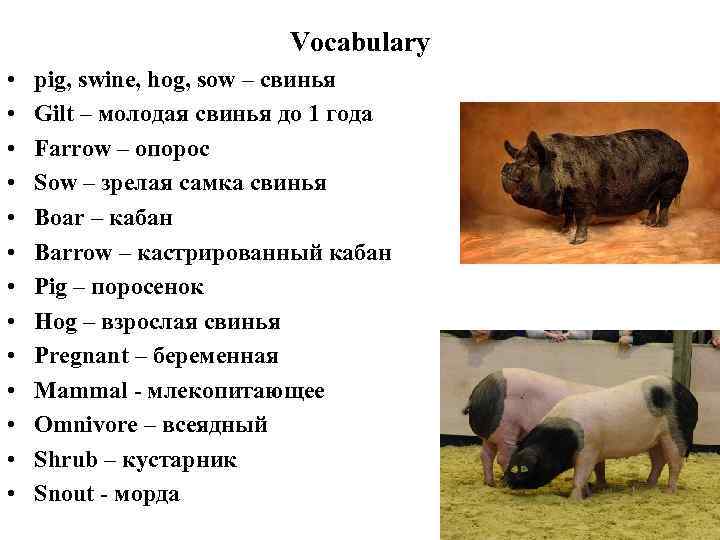
Vocabulary • • • • pig, swine, hog, sow – свинья Gilt – молодая свинья до 1 года Farrow – опорос Sow – зрелая самка свинья Boar – кабан Barrow – кастрированный кабан Pig – поросенок Hog – взрослая свинья Pregnant – беременная Mammal - млекопитающее Omnivore – всеядный Shrub – кустарник Snout - морда
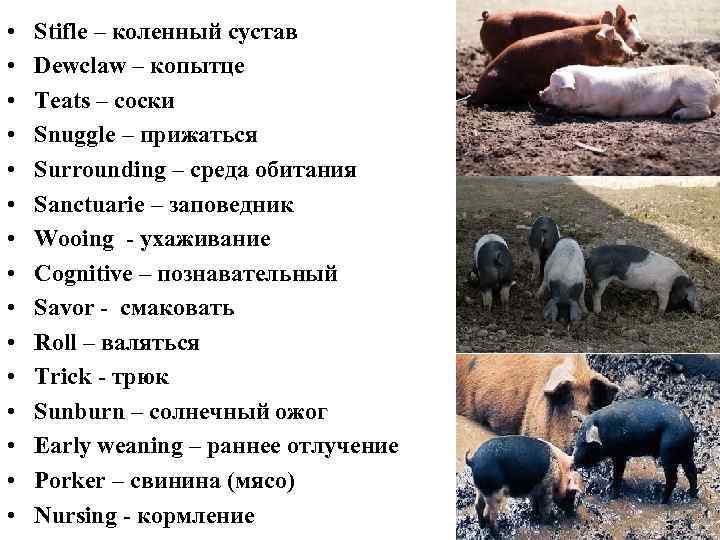
• • • • Stifle – коленный сустав Dewclaw – копытце Teats – соски Snuggle – прижаться Surrounding – среда обитания Sanctuarie – заповедник Wooing - ухаживание Cognitive – познавательный Savor - смаковать Roll – валяться Trick - трюк Sunburn – солнечный ожог Early weaning – раннее отлучение Porker – свинина (мясо) Nursing - кормление
Glossary • Swine – A generic term for all pigs, hogs, etc. • Gilt – A young female swine, generally under 12 months of age, who has not yet farrowed. • Sow – A mature female swine, generally 10+ months of age, who has farrowed at least one litter. • Boar – An intact male swine. • Barrow – A castrated male swine. • Pig – A very young swine. • Hog – An older swine, usually over about 120 pounds live weight. • Shoat – A young swine, usually between weaning and about 120 pounds live weight. • Weaner – A young swine at and during the point of weaning. • Feeder – A young swine usually between 40 and 70 pounds live weight that is being sold, bought, or held to be fed out to market weight. •
• Finisher – An older swine, usually over about 150 pounds live weight; one that is in the finishing stage of its growth, nearing market weight. • Market Hog – A hog that’s ready to be processed into pork or sent “to market”. The ideal market weight for hogs changes with pork demand industry technology (among other things. ) Usually market hogs weigh between 230 and 270 pounds live. • Bred – Pregnant. Usually used to preface the appropriate word for a particular female swine. “Bred Gilt” or “Bred Sow”, depending on her age and stage of life. • Open – Used to preface the appropriate term to refer to a female swine that is not currently bred. “Open Gilt” or “Open Sow”, for example. • Farrow – As a noun it refers to a litter of newborn pigs, as a verb it is used to describe the act of giving birth. • Litter - all the piglets produced at one birth. • Porker - pig slaughtered at about 50 kg (40 kg carcass) for fresh meat.
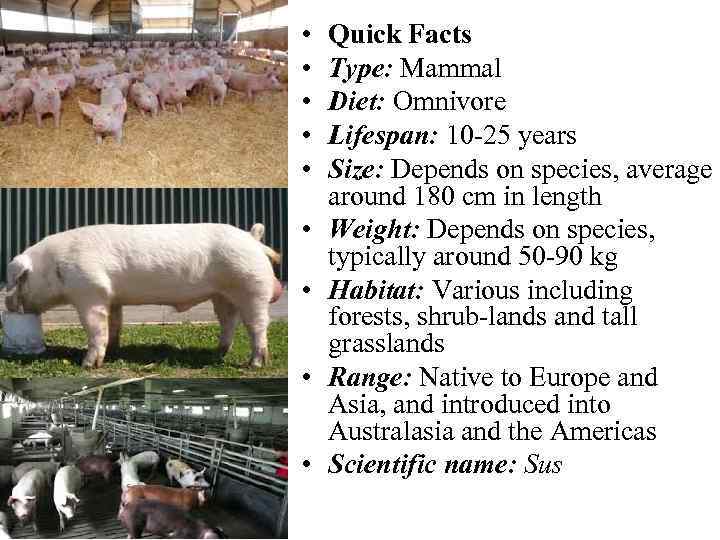
• • • Quick Facts Type: Mammal Diet: Omnivore Lifespan: 10 -25 years Size: Depends on species, average around 180 cm in length Weight: Depends on species, typically around 50 -90 kg Habitat: Various including forests, shrub-lands and tall grasslands Range: Native to Europe and Asia, and introduced into Australasia and the Americas Scientific name: Sus
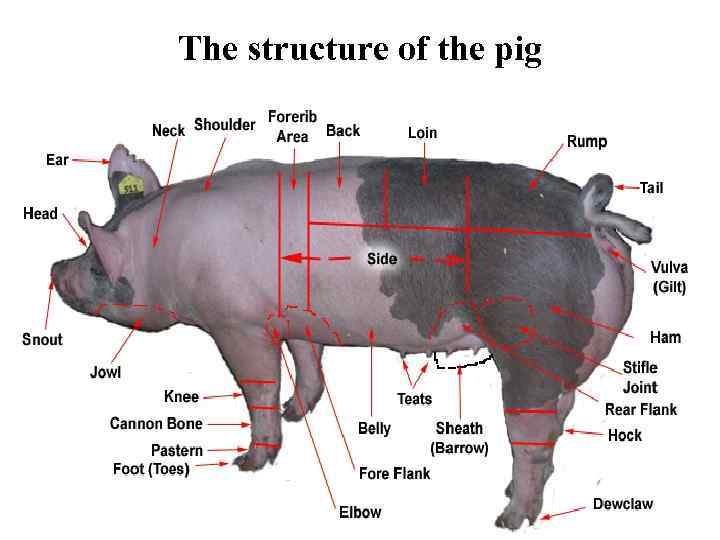
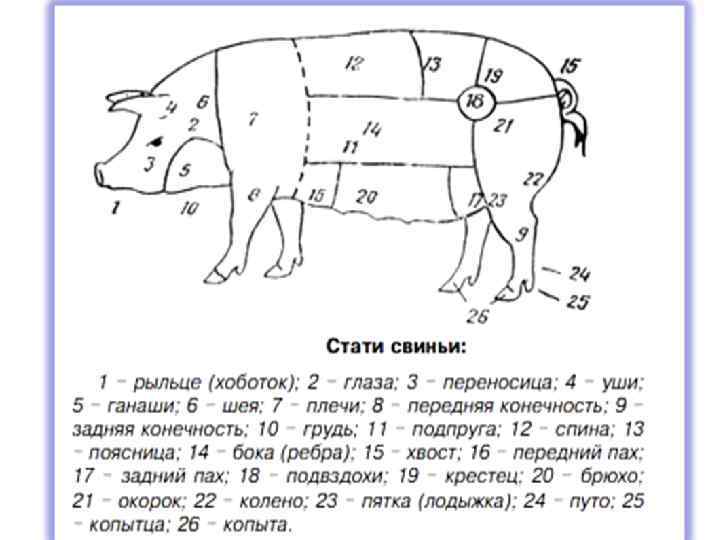
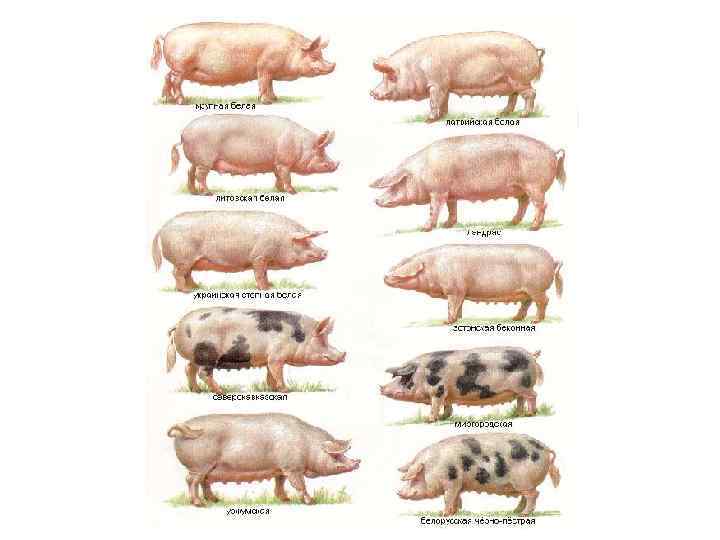
The structure of the pig
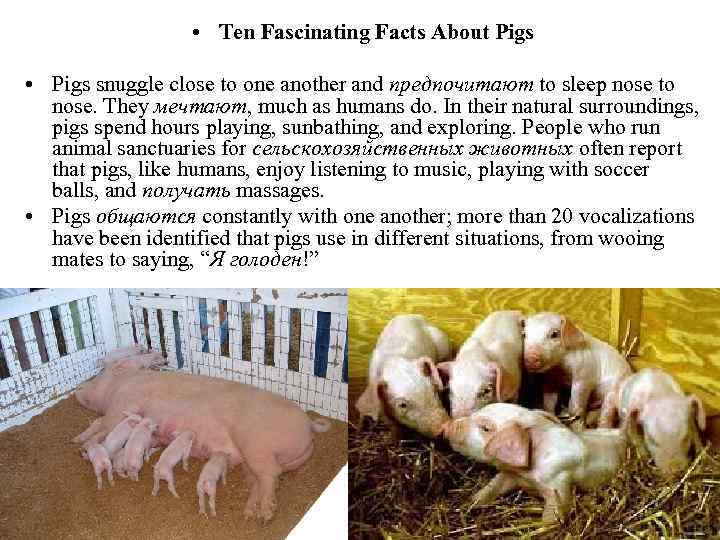
• Ten Fascinating Facts About Pigs • Pigs snuggle close to one another and предпочитают to sleep nose to nose. They мечтают, much as humans do. In their natural surroundings, pigs spend hours playing, sunbathing, and exploring. People who run animal sanctuaries for сельскохозяйственных животных often report that pigs, like humans, enjoy listening to music, playing with soccer balls, and получать massages. • Pigs общаются constantly with one another; more than 20 vocalizations have been identified that pigs use in different situations, from wooing mates to saying, “Я голоден!”
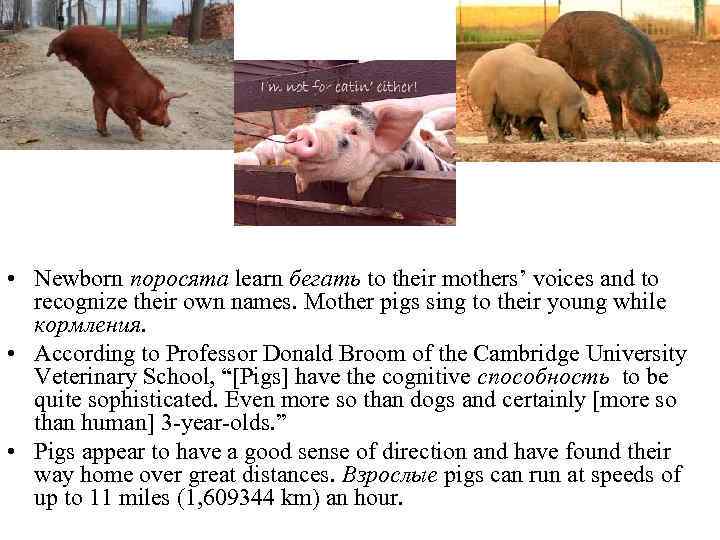
• Newborn поросята learn бегать to their mothers’ voices and to recognize their own names. Mother pigs sing to their young while кормления. • According to Professor Donald Broom of the Cambridge University Veterinary School, “[Pigs] have the cognitive способность to be quite sophisticated. Even more so than dogs and certainly [more so than human] 3 -year-olds. ” • Pigs appear to have a good sense of direction and have found their way home over great distances. Взрослые pigs can run at speeds of up to 11 miles (1, 609344 km) an hour.
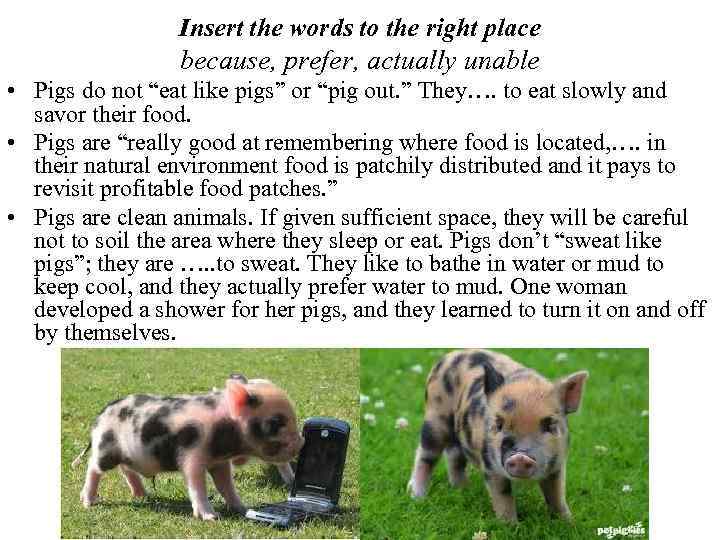
Insert the words to the right place because, prefer, actually unable • Pigs do not “eat like pigs” or “pig out. ” They…. to eat slowly and savor their food. • Pigs are “really good at remembering where food is located, …. in their natural environment food is patchily distributed and it pays to revisit profitable food patches. ” • Pigs are clean animals. If given sufficient space, they will be careful not to soil the area where they sleep or eat. Pigs don’t “sweat like pigs”; they are …. . to sweat. They like to bathe in water or mud to keep cool, and they actually prefer water to mud. One woman developed a shower for her pigs, and they learned to turn it on and off by themselves.
Insert the words to the right place play, biologist, animals, observing • In his book , ……and Johannesburg Zoo director Lyall Watson writes, “I know of no other…… [who] are more consistently curious, more willing to explore new experiences, more ready to meet the world with open mouthed enthusiasm. Pigs, I have discovered, are incurable optimists and get a big kick out of just being. ” • Professor Stanley Curtis of Penn State University has found that pigs can…. joystick-controlled video games and are “capable of abstract representation. ” Dr. Curtis believes that “there is much more going on in terms of thinking and…. . by these pigs than we would ever have guessed. ”
Answer the pig questions • 1. Where do pigs live and what do they eat? • 2. Why do pigs roll in the mud? • 3. Are pigs smart? • 4. What are the mother, father and baby pigs called? • 5. Are pigs clean or dirty animals? • 6. Do pigs make good pets? • 7. On what continent are pigs not found? • 8. How big was the biggest pig that ever lived? • 9. Can pigs do tricks? • 10. How many piglets are usually born at one time? • 11. How many toes does a pig have?
• • • 12. What parts of the pig do people use? 13. When was the first book about pig-raising written? 14. Do pigs like to eat plants or animals? 15. Do pigs have a good sense of smell? 16. How loud can a pig scream? 17. How thick is a pig's skin? 18. Are pigs mammals? 19. Do pigs shed their hair like cats and dogs? 20. How long can a pig live? 21. Can a pig get a sunburn?