 Скачать презентацию Pidgin and Creole languages Author Derek Bickerton By
Turashova Moldir PPT.pptx
- Количество слайдов: 13




Pidgin and Creole languages Author: Derek Bickerton By Turashova Moldir
Plan: 1. What studies pidgin and creoles? Definition of pidgin and creole. Key words. 2. Terms from article. 3. Torres-Strait Creole alphabet. 4. Discusses theories of pidginization, creolization and language contact. 5. Pidgins and Creoles and problems of language acquisition and language universals.
Derek Bickerton (born March 25, 1926) is a linguist and Professor Emeritus at the University of Hawaii, Manoa. Based on his work in creole languages in Guyana and Hawaii, he has proposed that the features of creole languages provide powerful insights into the development of language both by individuals and as a feature of the human species. In his book Roots of Language (1981), Bickerton speculates on a theory to answer three questions: Ø How did creole languages originate? Ø How do children acquire language? Ø How did the language faculty originate as a feature of the human species?
Pidgin and Creole studies have emerged as important challenges to linguistic theory and method. By definition Pidgins and Creoles (following Bickerton, item 11. 1) involve language mix, and currently spoken Creole languages arose as a direct result of European Colonial expansion.
Pidgin v Developed for some practical purpose, trading v No native speakers v Absence of grammatical morphemes v Limited vocabulary
Creole v If a pidgin becomes a first language of a social community v Native speakers v French creoles in Haiti v English creoles in Jamaica
Key words: Sociolinguistics perspective of Language Contact, English-based pidgins and creoles were formed, different hypotheses for the pidgins/creoles formation, Bickerton’s theory for a Language Bioprogram Hypothesis related to language acquisition.
There are evidences that creole languages were invented in isolated places; however, there are similarities between them. It shows that there are some elements of human capability responsible for linguistic similarities. In this way, the linguist Derek Bickerton proposed the Language Bioprogramm Hipothesis(LBH) (1974), which, according to him, is common to all members of our species (see section 5. 2). Based on his hypothesis, we intend to demonstrate how studies of pidgins and creoles influenced in language acquisition studies, offering arguments for certain theories.
Contact is an important concept in sociolinguistics. Actually, languages do not get in contact; it is always the speakers of different languages who get in contact. And it is their attitude toward each other that will affect the way they speak. However, to be considered pidginit must be stable and have norms of meaning, grammar and pronunciation. Some of its characteristics are: limited vocabulary; elimination of many grammatical devices - such as number and gender; lack of inflectional and derivational morphemes;
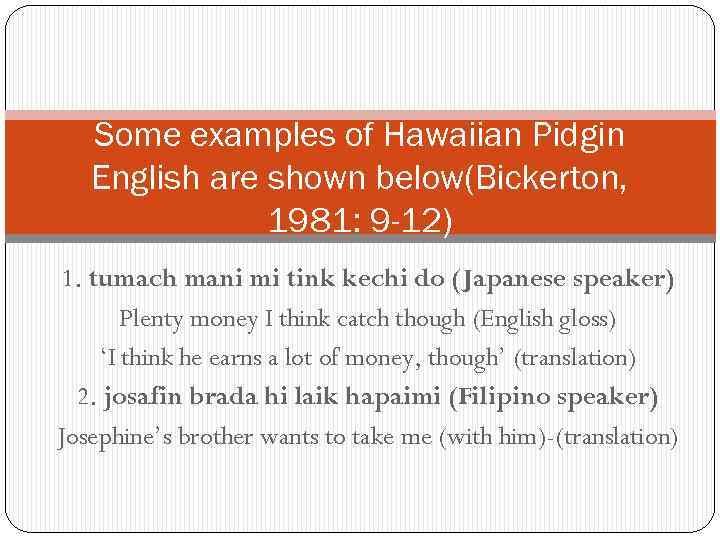
Some examples of Hawaiian Pidgin English are shown below(Bickerton, 1981: 9 -12) 1. tumach mani mi tink kechi do (Japanese speaker) Plenty money I think catch though (English gloss) ‘I think he earns a lot of money, though’ (translation) 2. josafin brada hi laik hapaimi (Filipino speaker) Josephine’s brother wants to take me (with him)-(translation)
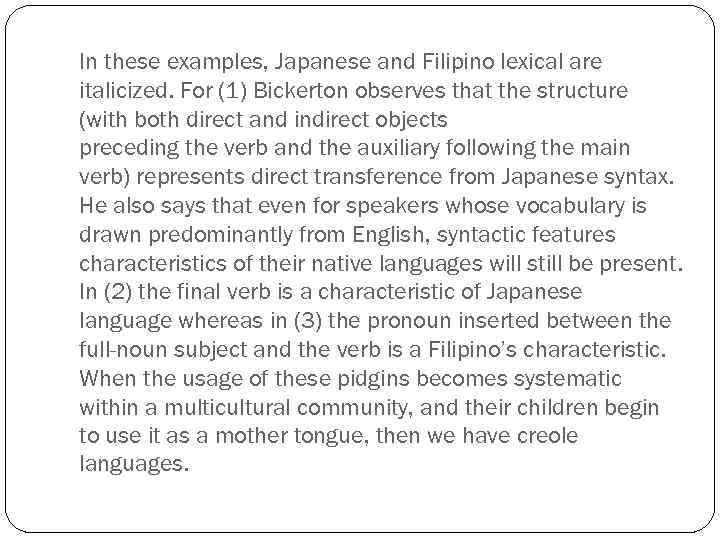
In these examples, Japanese and Filipino lexical are italicized. For (1) Bickerton observes that the structure (with both direct and indirect objects preceding the verb and the auxiliary following the main verb) represents direct transference from Japanese syntax. He also says that even for speakers whose vocabulary is drawn predominantly from English, syntactic features characteristics of their native languages will still be present. In (2) the final verb is a characteristic of Japanese language whereas in (3) the pronoun inserted between the full-noun subject and the verb is a Filipino’s characteristic. When the usage of these pidgins becomes systematic within a multicultural community, and their children begin to use it as a mother tongue, then we have creole languages.
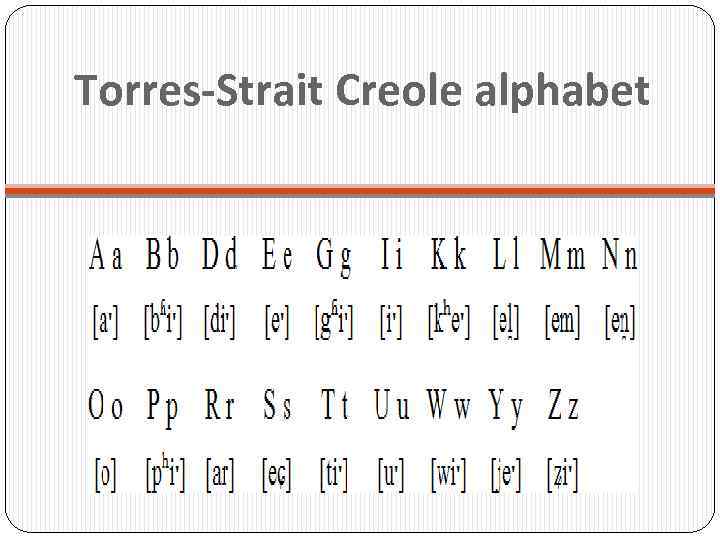
Torres-Strait Creole alphabet
References http: //www. revel. inf. br/files/artigos/revel_9_english_based_pidgins_and_creoles_from_social_to_cogniti ve_hypotheses_of_acquisition. pdf http: //www. omniglot. com/writing/tsc. htm http: //www. dailywritingtips. com/pidgin-and-creole-languages/ http: //lib. stanford. edu/social-sciences-resource-center/pidgin-and-creole-languages-0 Hall, Robert, 1964, "Creolized Langauges, " in Hall, Introductory Linguistics, p. 382 -386. (P 121. H 29 STK). . Valdman, Albert, 1981, "Indications, " in Perrot (ed. ), Les Langues dans le monde anciens et moderne, part II: Pidgins et Creoles, p. 621 -630. (P 121. L 285 v. 1 STK). Hancock, Ian (ed. ), 1979, Readings in Creole Studies. (PM 7831. R 4 STK). Bickerton, Derek, 1981, Roots of Language. (PM 7831. B 52). Important, controversial and difficult work, summarized in Bickerton's article "Creole Languages" in Scientific American, July, 1983. There have been numerous reviews and extensive debate, which are reported in the Carrier Pidgin (20); also see Appendix A. www. thefreedictionary. com/expansion https: //benjamins. com/#catalog/journals/jpcl/main http: //www. ingentaconnect. com/content/jbp/jpcl http: //www. oxforddictionaries. com/definition/english/expansion
Скачать презентацию Pidgin and Creole languages Author Derek Bickerton By
Turashova Moldir PPT.pptx