


 Скачать презентацию PID Controller Design and Tuning Chapter 12 Performance
509e52e9589a78e274ef69a18dc55c70.ppt
- Количество слайдов: 27
 PID Controller Design and Tuning Chapter 12 Performance Criteria For Closed-Loop Systems • The function of a feedback control system is to ensure that the closed loop system has desirable dynamic and steady-state response characteristics. 1
 • The desired performance of closed-loop system: Chapter 12 1. The closed-loop system must be stable. 2. The effects of disturbances are minimized, providing good disturbance rejection. 3. Rapid, smooth responses to set-point changes are obtained, that is, good set-point tracking. 2
 Chapter 12 4. Steady-state error (offset) is eliminated. 5. Excessive control action is avoided. 6. The control system is robust, that is, insensitive to changes in process conditions and to inaccuracies in the process model. 3
 Chapter 12 PID controller settings can be determined by a number of alternative techniques: 1. Direct Synthesis (DS) method 2. Internal Model Control (IMC) method 3. Controller tuning relations 4. Frequency response techniques 5. Computer simulation 6. On-line tuning after the control system is installed. 4
 Chapter 12 • Method 1 -5 based on process models (DS & IMC) • Can be used to specify the controller settings before the control system is installed. • Provide good initial controller settings that can subsequently be fine tuned on-line, if necessary • Method 6 – online tuning – time consuming, very useful to have a good initial controller setting 5
 Chapter 12 • Method 1 -2 based on simple transfer function models---Section 12. 2 • Method 5 – Computer simulation of controlled process – MATLAB & Simulink • Method 6 – Online tuning --- Section 12. 5 6
 Chapter 12 Direct Synthesis Method • In the Direct Synthesis (DS) method, the controller design is based on a process model and a desired closed-loop transfer function. 7
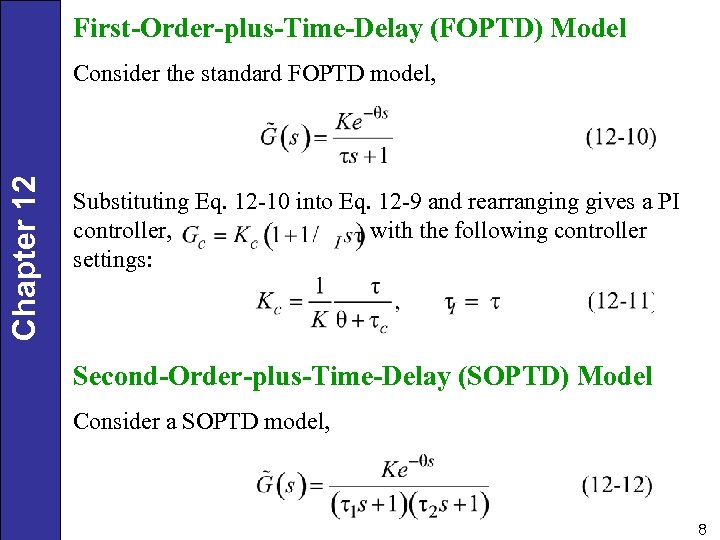 First-Order-plus-Time-Delay (FOPTD) Model Chapter 12 Consider the standard FOPTD model, Substituting Eq. 12 -10 into Eq. 12 -9 and rearranging gives a PI controller, with the following controller settings: Second-Order-plus-Time-Delay (SOPTD) Model Consider a SOPTD model, 8
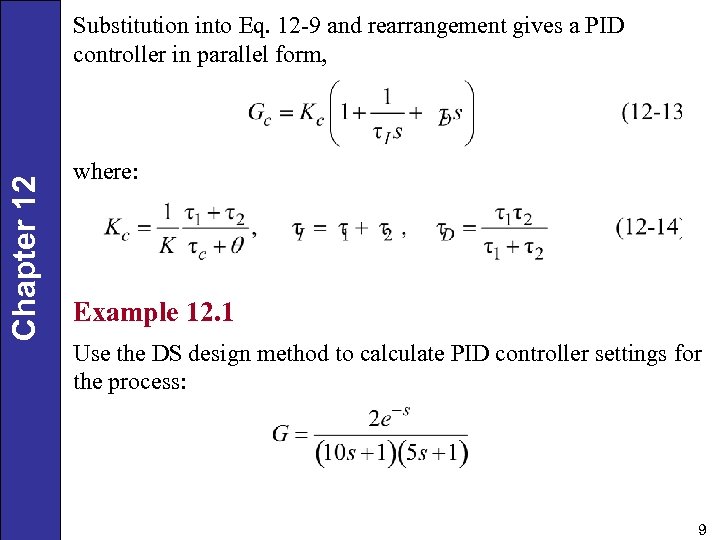 Chapter 12 Substitution into Eq. 12 -9 and rearrangement gives a PID controller in parallel form, where: Example 12. 1 Use the DS design method to calculate PID controller settings for the process: 9
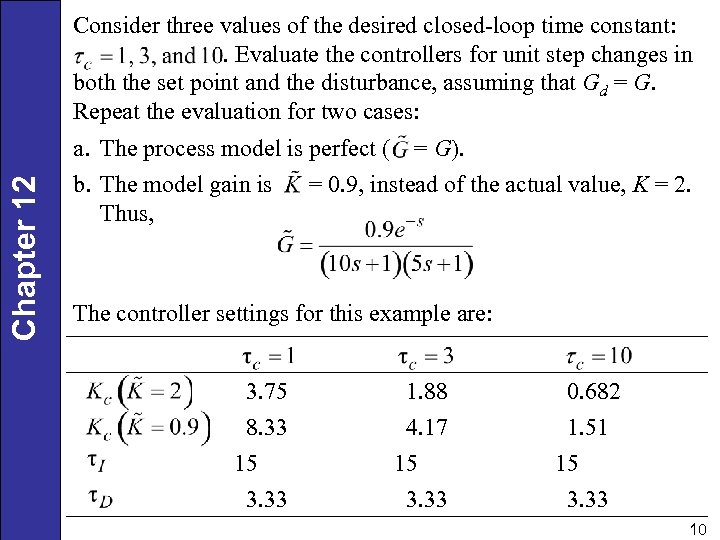 Chapter 12 Consider three values of the desired closed-loop time constant: . Evaluate the controllers for unit step changes in both the set point and the disturbance, assuming that Gd = G. Repeat the evaluation for two cases: a. The process model is perfect ( = G). b. The model gain is = 0. 9, instead of the actual value, K = 2. Thus, The controller settings for this example are: 3. 75 8. 33 15 1. 88 4. 17 15 0. 682 1. 51 15 3. 33 10
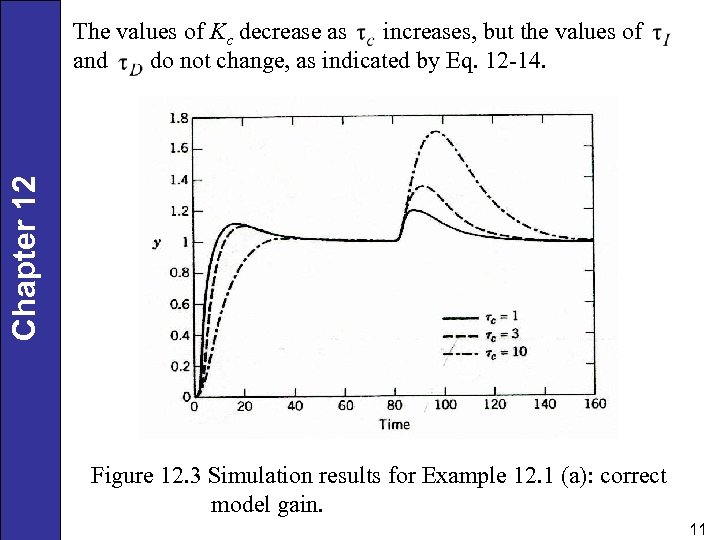 Chapter 12 The values of Kc decrease as increases, but the values of and do not change, as indicated by Eq. 12 -14. Figure 12. 3 Simulation results for Example 12. 1 (a): correct model gain. 11
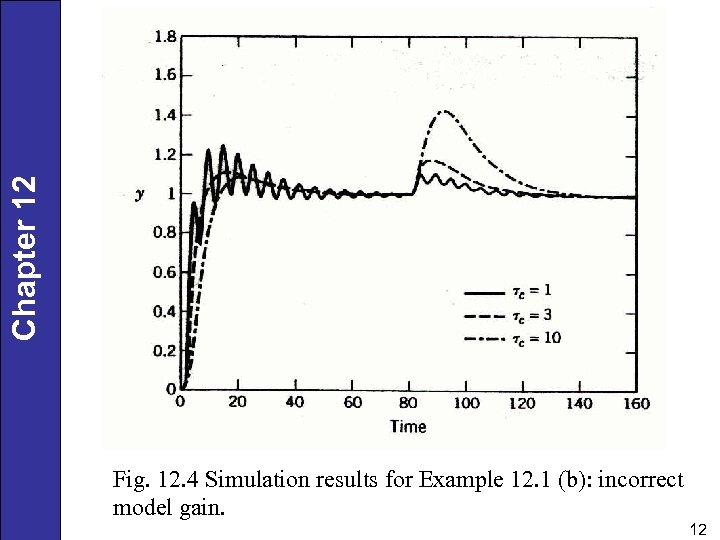 Chapter 12 Fig. 12. 4 Simulation results for Example 12. 1 (b): incorrect model gain. 12
 Internal Model Control (IMC) Chapter 12 • A more comprehensive model-based design method, Internal Model Control (IMC), was developed by Morari and coworkers (Garcia and Morari, 1982; Rivera et al. , 1986). • The IMC method, like the DS method, is based on an assumed process model and leads to analytical expressions for the controller settings. 13
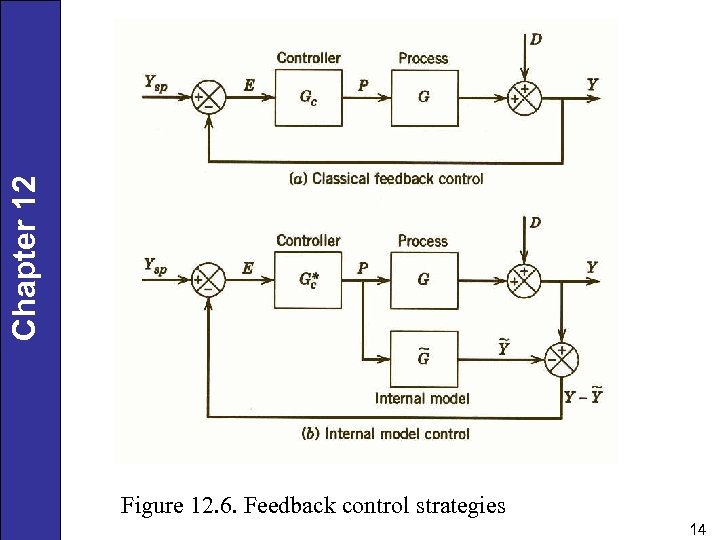 Chapter 12 Figure 12. 6. Feedback control strategies 14
 Chapter 12 On-Line Controller Tuning 1. Continuous Cycling Method 2. Relay Auto-Tuning 3. Step Test Method 15
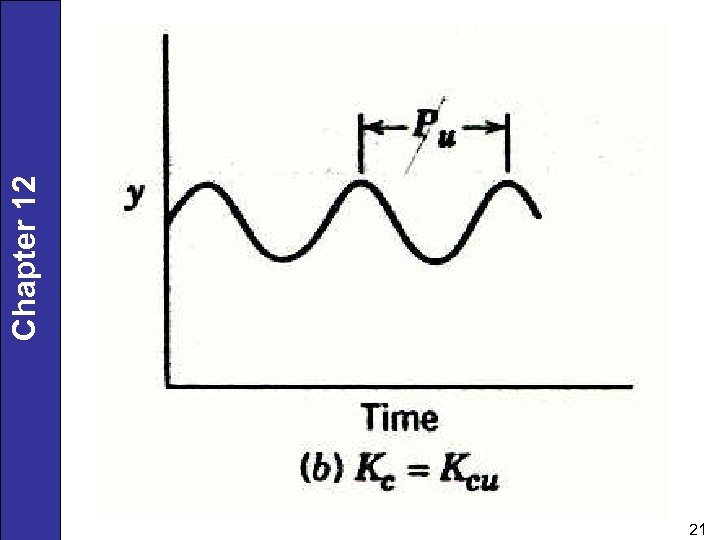
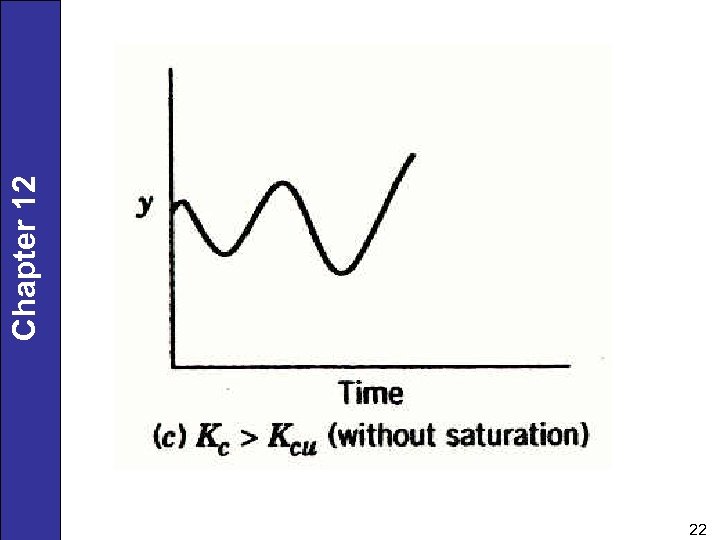
 Continuous Cycling Method Chapter 12 • Ziegler and Nichols (1942) introduced the continuous cycling method for controller tuning. • based on the following trial-and-error procedure: Step 1. After the process has reached steady state (at least approximately), eliminate the integral and derivative control action by setting: = zero = the largest possible value. 16
 Chapter 12 Step 2. Set Kc equal to a small value (e. g. , 0. 5) and place the controller in the automatic mode. Step 3. Gradually increase Kc in small increments until continuous cycling occurs. The term continuous cycling refers to a sustained oscillation with a constant amplitude. Ultimate gain, Kcu - The numerical value of Kc that produces continuous cycling (for proportional-only control) Ultimate period, Pu - The period of the corresponding sustained oscillation 17
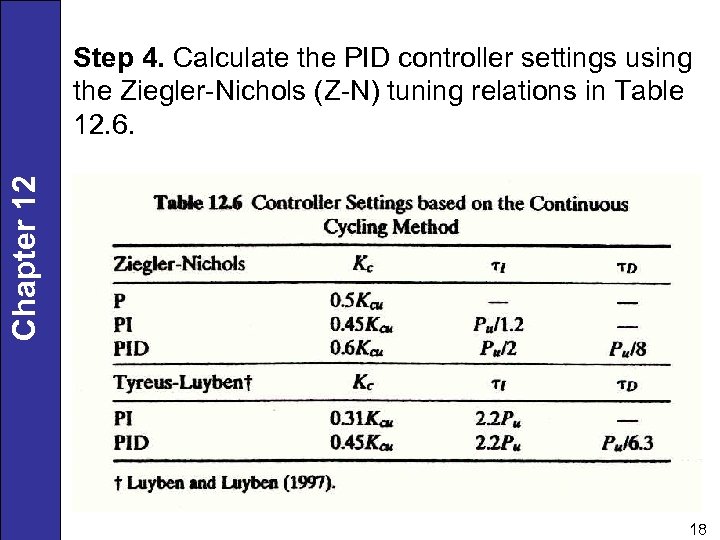 Chapter 12 Step 4. Calculate the PID controller settings using the Ziegler-Nichols (Z-N) tuning relations in Table 12. 6. 18
 Chapter 12 Step 5. Evaluate the Z-N controller settings by introducing a small set-point change and observing the closed-loop response. Fine-tune the settings, if necessary. 19
 20 Chapter 12
 21 Chapter 12
 22 Chapter 12
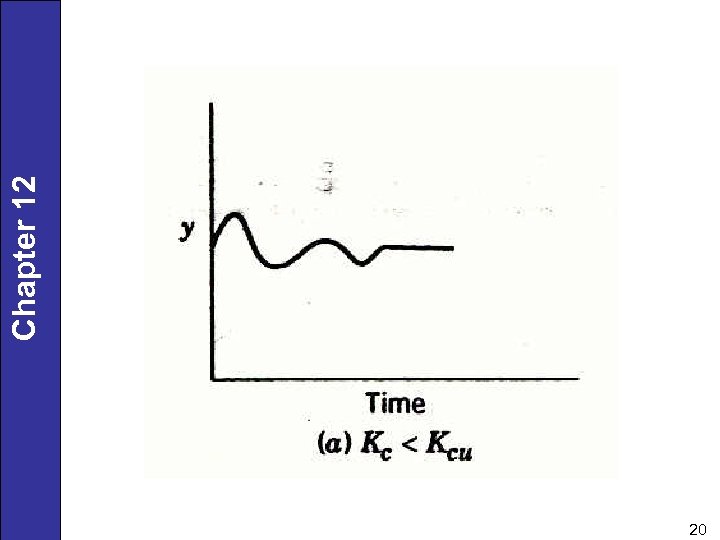
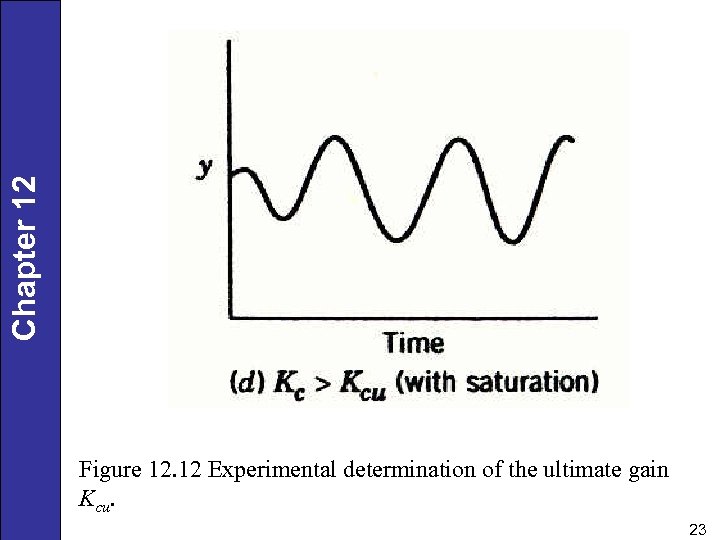 Chapter 12 Figure 12. 12 Experimental determination of the ultimate gain Kcu. 23
 Relay Auto-Tuning Chapter 12 • Åström and Hägglund (1984) have developed an attractive alternative to the continuous cycling method. • In the relay auto-tuning method, a simple experimental test is used to determine Kcu and Pu. • For this test, the feedback controller is temporarily replaced by an on-off controller (or relay). • After the control loop is closed, the controlled variable exhibits a sustained oscillation that is characteristic of on-off control (cf. Section 8. 4). The operation of the relay auto-tuner includes a dead band as shown in Fig. 12. 14. • The dead band is used to avoid frequent switching caused by measurement noise. 24
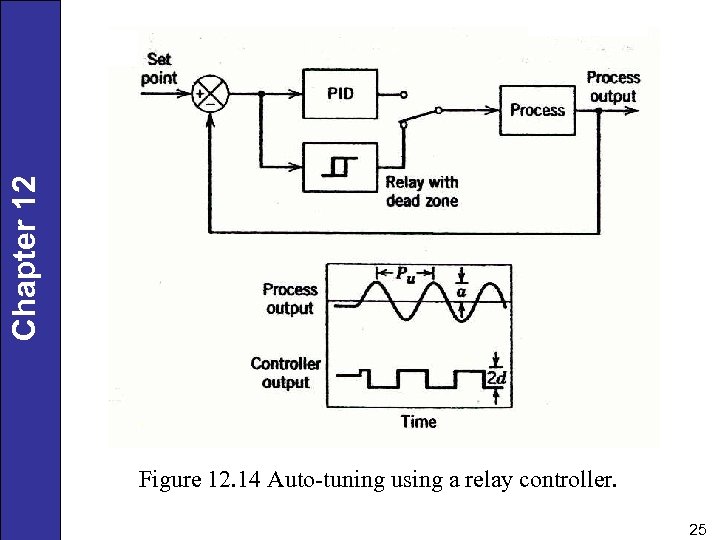 Chapter 12 Figure 12. 14 Auto-tuning using a relay controller. 25
 • The relay auto-tuning method has several important advantages compared to the continuous cycling method: Chapter 12 1. Only a single experiment test is required instead of a trial-and-error procedure. 2. The amplitude of the process output a can be restricted by adjusting relay amplitude d. 3. The process is not forced to a stability limit. 4. The experimental test is easily automated using commercial products. 26
 Step Test Method Chapter 12 • In their classic paper, Ziegler and Nichols (1942) proposed a second on-line tuning technique based on a single step test. The experimental procedure is quite simple. • After the process has reached steady state (at least approximately), the controller is placed in the manual mode. • Then a small step change in the controller output (e. g. , 3 to 5%) is introduced. • The controller settings are based on the process reaction curve (Section 7. 2), the open-loop step response. • Consequently, this on-line tuning technique is referred to as the step test method or the process reaction curve method. 27