 Скачать презентацию Picture from http web ukonline co uk members j ill
08576eae8514ad3ad8cb6e02e86a0348.ppt
- Количество слайдов: 27



Picture from: http: //web. ukonline. co. uk/members/j ill. lawson/
What exactly is Fractals and Chaos and why is it so important in Biology? Chaos is traditionally thought of as being confusion, hysteria, and turmoil. Chaos, however, in the sense of chaos theory is the idea that the final outcome of something can be extremely sensitive upon initial conditions. Amazingly, you can actually find brief organized patterns within chaotic systems. Chaotic systems have three main properties of sensitivity, mixing, and periodicity. As chaos theory is still a fairly new field of research, the properties may be apt to change in the near future. Fractals are the models generated by math equations resulting in chaotic systems. Fractals are very artistic, complex, and intricate. They also have properties which include having a fine structure, being defined by a recursive process, being too irregular to be described by traditional geometry, having self-similarity, and having fractal dimension. In Biology, Chaotic systems can be used to show the rhythms of heartbeats, walking strides, and even the biological changes of aging. Fractals can be used to model the structures of nerve networks, circulatory systems, lungs, and even DNA. (Click to see full view of background)
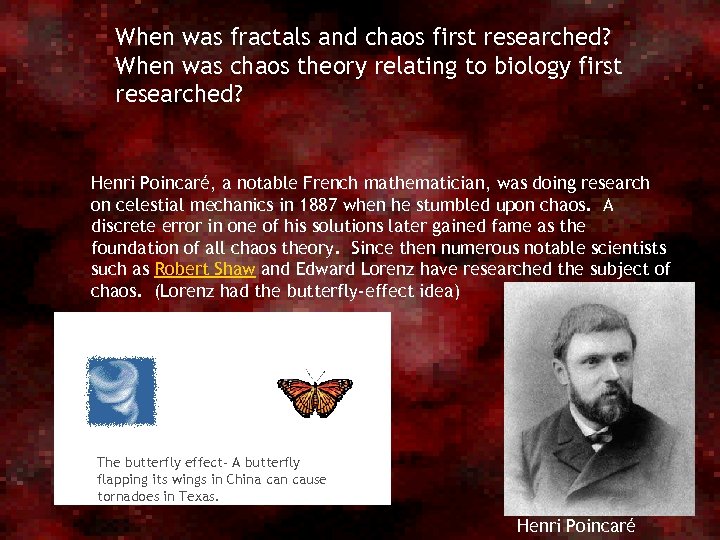
When was fractals and chaos first researched? When was chaos theory relating to biology first researched? Henri Poincaré, a notable French mathematician, was doing research on celestial mechanics in 1887 when he stumbled upon chaos. A discrete error in one of his solutions later gained fame as the foundation of all chaos theory. Since then numerous notable scientists such as Robert Shaw and Edward Lorenz have researched the subject of chaos. (Lorenz had the butterfly-effect idea) The butterfly effect- A butterfly flapping its wings in China can cause tornadoes in Texas. Henri Poincaré
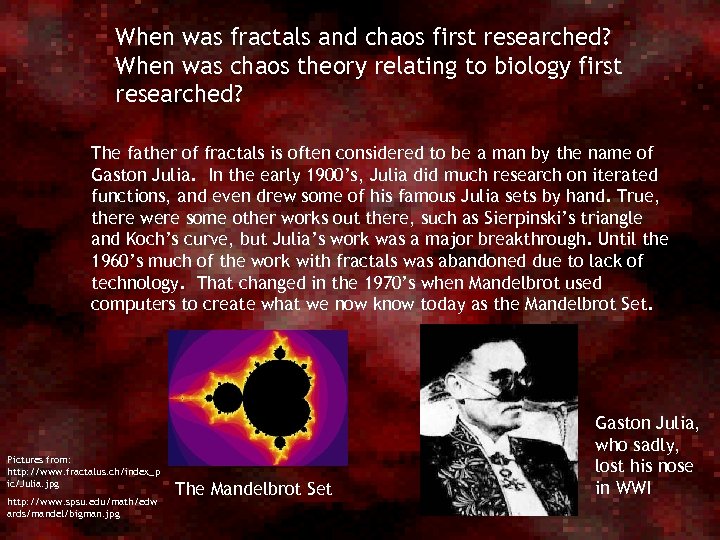
When was fractals and chaos first researched? When was chaos theory relating to biology first researched? The father of fractals is often considered to be a man by the name of Gaston Julia. In the early 1900’s, Julia did much research on iterated functions, and even drew some of his famous Julia sets by hand. True, there were some other works out there, such as Sierpinski’s triangle and Koch’s curve, but Julia’s work was a major breakthrough. Until the 1960’s much of the work with fractals was abandoned due to lack of technology. That changed in the 1970’s when Mandelbrot used computers to create what we now know today as the Mandelbrot Set. Pictures from: http: //www. fractalus. ch/index_p ic/Julia. jpg http: //www. spsu. edu/math/edw ards/mandel/bigman. jpg The Mandelbrot Set Gaston Julia, who sadly, lost his nose in WWI
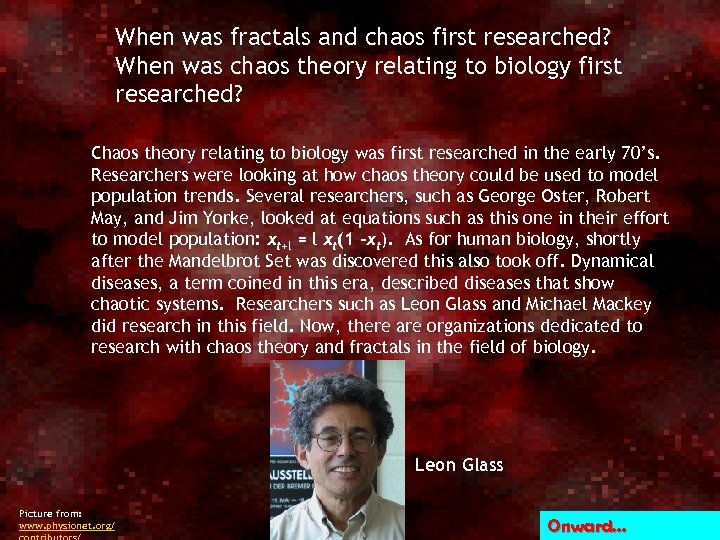
When was fractals and chaos first researched? When was chaos theory relating to biology first researched? Chaos theory relating to biology was first researched in the early 70’s. Researchers were looking at how chaos theory could be used to model population trends. Several researchers, such as George Oster, Robert May, and Jim Yorke, looked at equations such as this one in their effort to model population: xt+l = l xt(1 –xt). As for human biology, shortly after the Mandelbrot Set was discovered this also took off. Dynamical diseases, a term coined in this era, described diseases that show chaotic systems. Researchers such as Leon Glass and Michael Mackey did research in this field. Now, there are organizations dedicated to research with chaos theory and fractals in the field of biology. Leon Glass Picture from: www. physionet. org/ Onward…
Select a topic The human heart Brain, DNA Lungs Click when finished…
The Human Heart
Evidence for this…
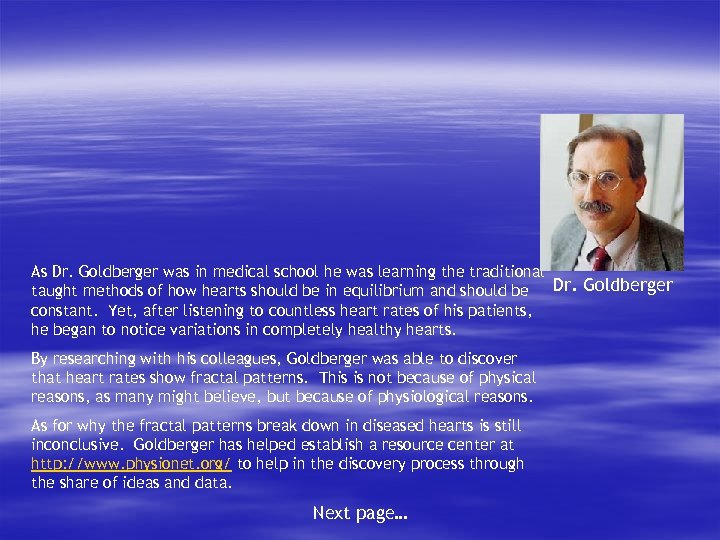
As Dr. Goldberger was in medical school he was learning the traditional Dr. Goldberger taught methods of how hearts should be in equilibrium and should be constant. Yet, after listening to countless heart rates of his patients, he began to notice variations in completely healthy hearts. By researching with his colleagues, Goldberger was able to discover that heart rates show fractal patterns. This is not because of physical reasons, as many might believe, but because of physiological reasons. As for why the fractal patterns break down in diseased hearts is still inconclusive. Goldberger has helped establish a resource center at http: //www. physionet. org/ to help in the discovery process through the share of ideas and data. Next page…
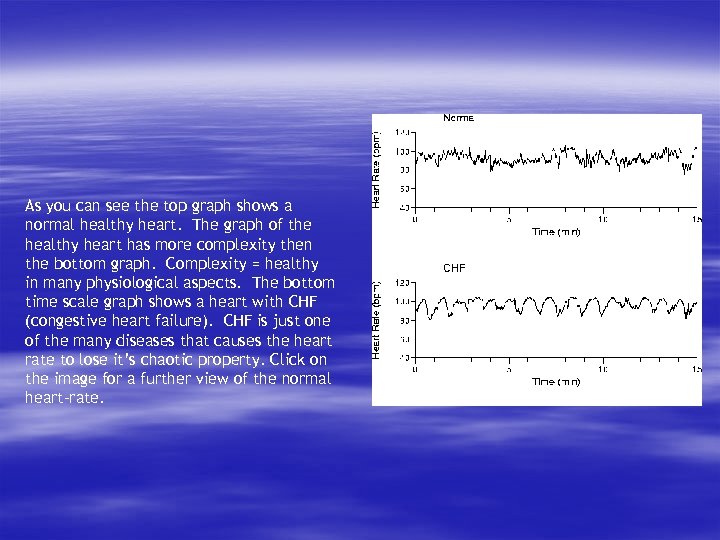
As you can see the top graph shows a normal healthy heart. The graph of the healthy heart has more complexity then the bottom graph. Complexity = healthy in many physiological aspects. The bottom time scale graph shows a heart with CHF (congestive heart failure). CHF is just one of the many diseases that causes the heart rate to lose it’s chaotic property. Click on the image for a further view of the normal heart-rate.
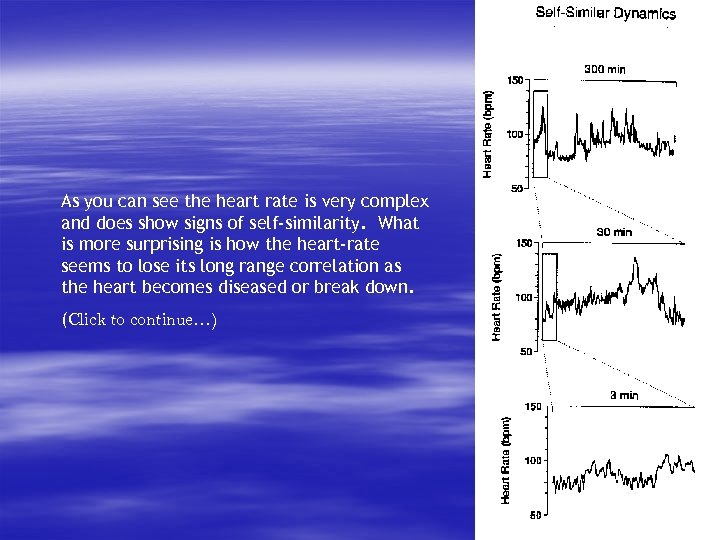
As you can see the heart rate is very complex and does show signs of self-similarity. What is more surprising is how the heart-rate seems to lose its long range correlation as the heart becomes diseased or break down. (Click to continue…)
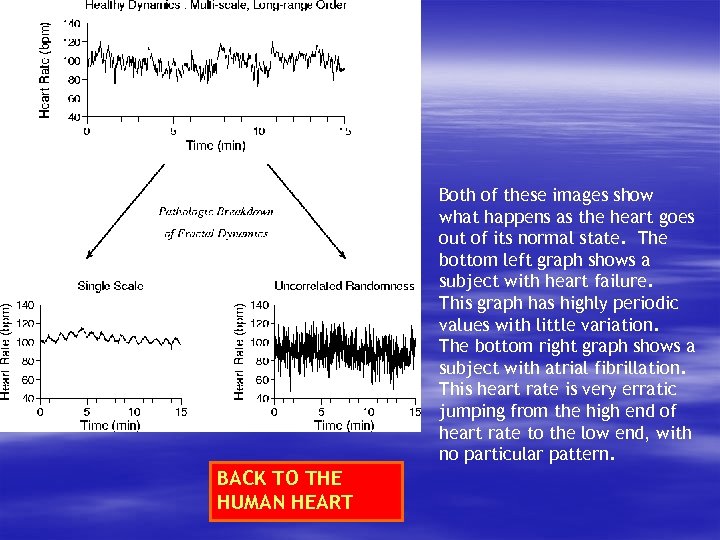
Both of these images show what happens as the heart goes out of its normal state. The bottom left graph shows a subject with heart failure. This graph has highly periodic values with little variation. The bottom right graph shows a subject with atrial fibrillation. This heart rate is very erratic jumping from the high end of heart rate to the low end, with no particular pattern. BACK TO THE HUMAN HEART
This may take a moment to load. It should open up a web page and load. (must have realplayer to view) BACK TO THE HUMAN HEART
How does the fractal structure help? -The fractal structure of the veins, arteries, and heart muscles help protect the circulatory system from the strong, violent pumping of the human heart. -The fractal structure, which is usually unnecessary, can come into play when the His-Purkinje network is damaged. This helps the heart be resilient and resistant to damage. - The fractal geometry of the heart could possibly save us everyday.
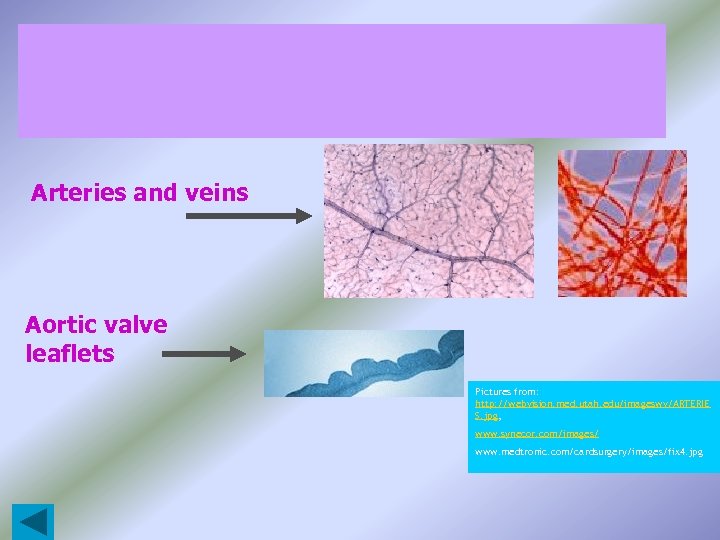
Arteries and veins Aortic valve leaflets Pictures from: http: //webvision. med. utah. edu/imageswv/ARTERIE S. jpg, www. synecor. com/images/ www. medtronic. com/cardsurgery/images/fix 4. jpg
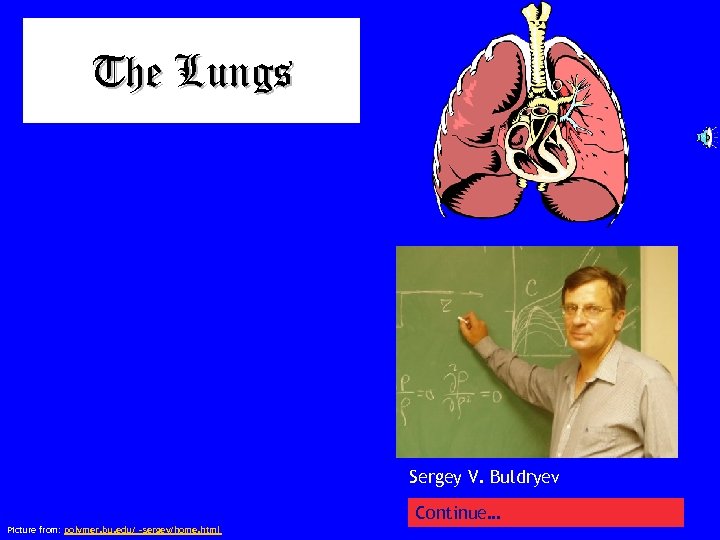
The Lungs Sergey V. Buldryev Continue… Picture from: polymer. bu. edu/ ~sergey/home. html
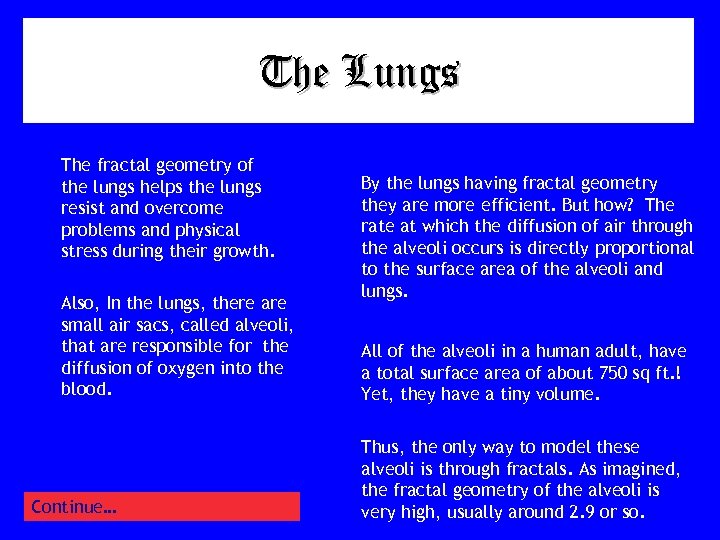
The Lungs The fractal geometry of the lungs helps the lungs resist and overcome problems and physical stress during their growth. Also, In the lungs, there are small air sacs, called alveoli, that are responsible for the diffusion of oxygen into the blood. Continue… By the lungs having fractal geometry they are more efficient. But how? The rate at which the diffusion of air through the alveoli occurs is directly proportional to the surface area of the alveoli and lungs. All of the alveoli in a human adult, have a total surface area of about 750 sq ft. ! Yet, they have a tiny volume. Thus, the only way to model these alveoli is through fractals. As imagined, the fractal geometry of the alveoli is very high, usually around 2. 9 or so.
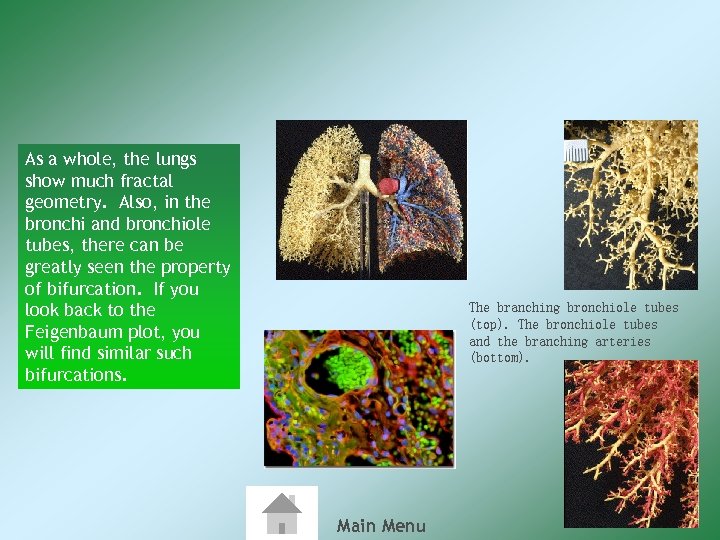
As a whole, the lungs show much fractal geometry. Also, in the bronchi and bronchiole tubes, there can be greatly seen the property of bifurcation. If you look back to the Feigenbaum plot, you will find similar such bifurcations. The branching bronchiole tubes (top). The bronchiole tubes and the branching arteries (bottom). Main Menu
*Image from: http: //www. geocities. com/Omegaman_UK/ fractal. html *Alpha rhythm- frequency of brainwaves between 8 -12 Hz.
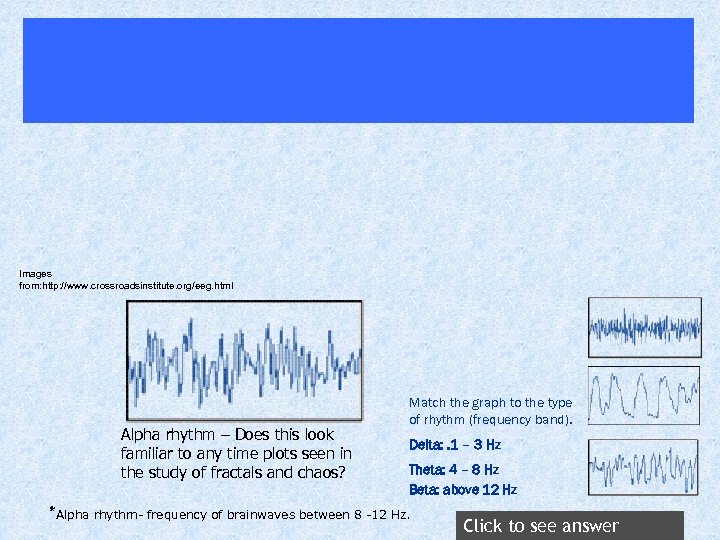
Images from: http: //www. crossroadsinstitute. org/eeg. html Alpha rhythm – Does this look familiar to any time plots seen in the study of fractals and chaos? Match the graph to the type of rhythm (frequency band). Delta: . 1 – 3 Hz Theta: 4 – 8 Hz Beta: above 12 Hz *Alpha rhythm- frequency of brainwaves between 8 -12 Hz. Click to see answer
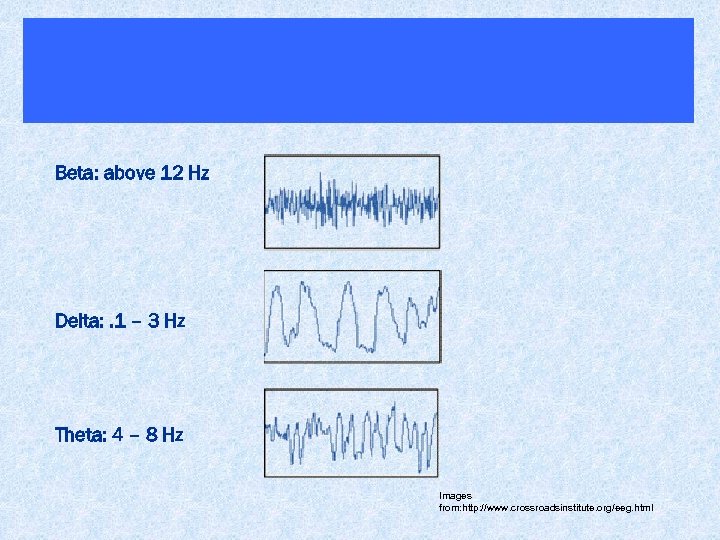
Beta: above 12 Hz Delta: . 1 – 3 Hz Theta: 4 – 8 Hz Images from: http: //www. crossroadsinstitute. org/eeg. html
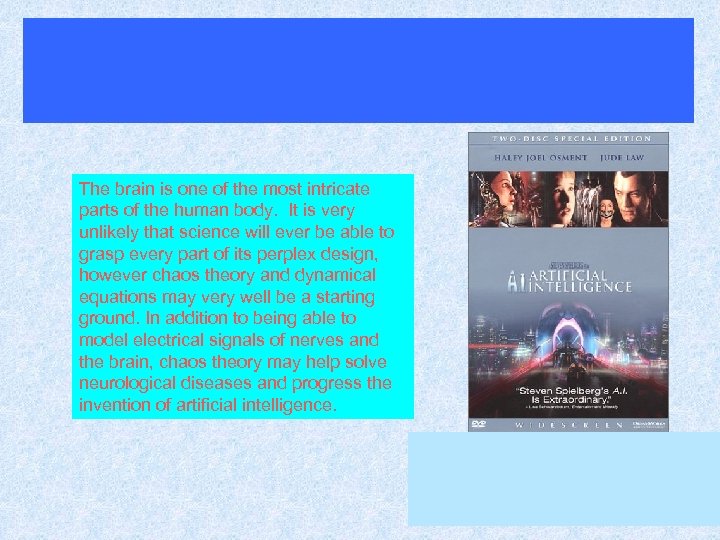
The brain is one of the most intricate parts of the human body. It is very unlikely that science will ever be able to grasp every part of its perplex design, however chaos theory and dynamical equations may very well be a starting ground. In addition to being able to model electrical signals of nerves and the brain, chaos theory may help solve neurological diseases and progress the invention of artificial intelligence.
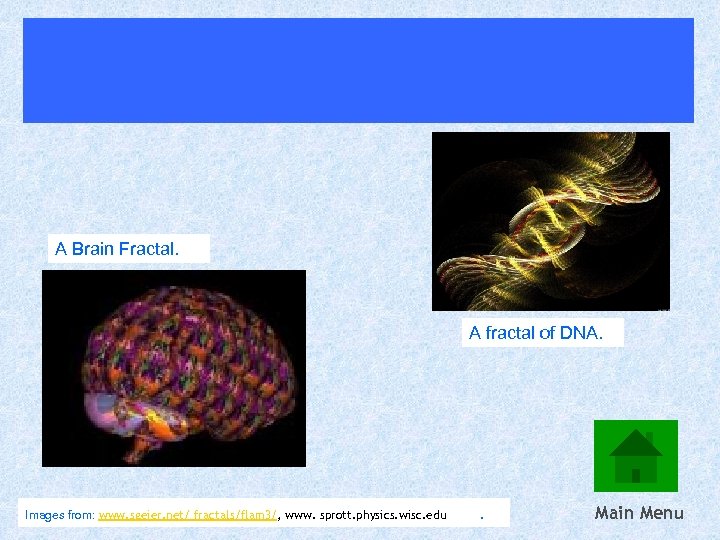
A Brain Fractal. A fractal of DNA. Images from: www. sgeier. net/ fractals/flam 3/, www. sprott. physics. wisc. edu , . Main Menu
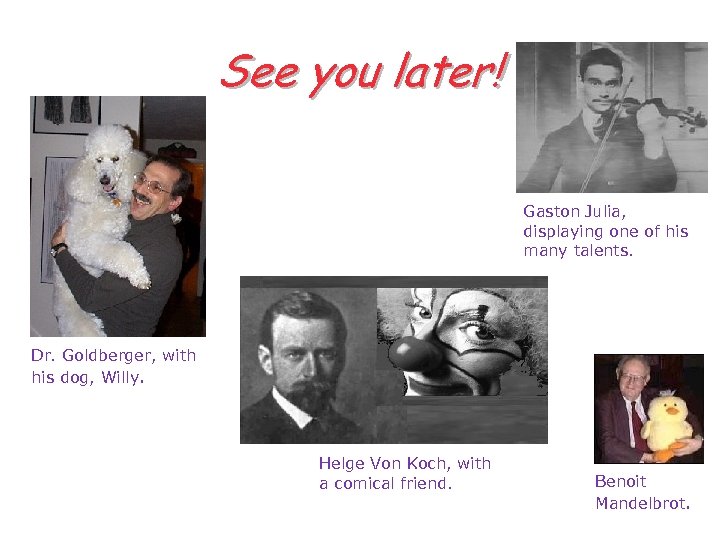
See you later! Gaston Julia, displaying one of his many talents. Dr. Goldberger, with his dog, Willy. Helge Von Koch, with a comical friend. Benoit Mandelbrot.
 Скачать презентацию Picture from http web ukonline co uk members j ill
08576eae8514ad3ad8cb6e02e86a0348.ppt