


 Скачать презентацию Picosatellite Programming within the Constraints of the 1
e9c9bafce2e471b2e1e076aac0f7693a.ppt
- Количество слайдов: 31
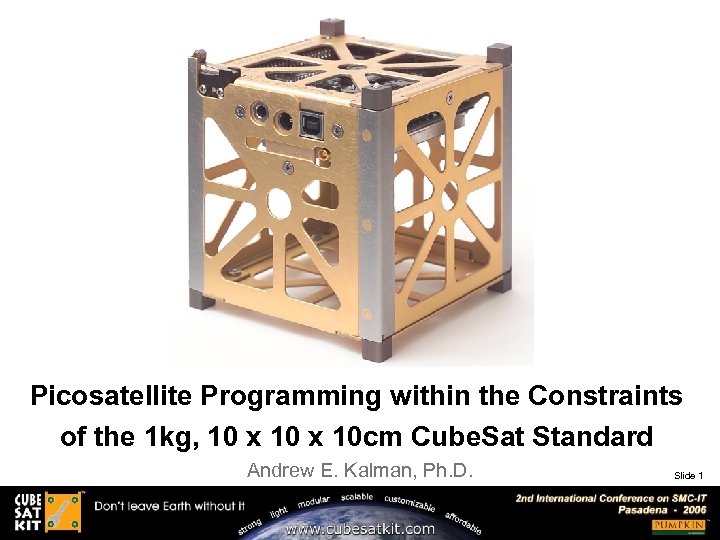 Picosatellite Programming within the Constraints of the 1 kg, 10 x 10 cm Cube. Sat Standard Andrew E. Kalman, Ph. D. Slide 1
 Introduction • Andrew E. Kalman § President and CTO, Pumpkin, Inc. § Author of § Creator of the § 20+ years of embedded systems design and programming experience. § Contact: aek@pumpkininc. com Slide 2
 Outline • Overview: Presentation Goals • Part I: Picosatellites & Cube. Sats • Part II: The Cube. Sat Standard • Part III: Architectural Constraints • Part IV: Cube. Sat Kit Architecture • Part V: Cube. Sat Kit Programming • Part VI: Architectural Extensions Slide 3
 Overview • This presentation is targeted at programmers who are interested in getting their work into space via new, lowcost and rapid-response opportunities. • After introducing the Cube. Sat picosatellite standard, we present an overview of the physical, electrical, mission and cost constraints of a picosatellite conforming to the standard from a programmer’s viewpoint. • The embedded architecture of Pumpkin’s Cube. Sat Kit – a popular implementation of the standard – is one reaction to these constraints. • We examine the effects of these constraints on the Cube. Sat Kit’s operational software. • We present extensions to the architecture to bring more “desktop-like functionality” to a Cube. Sat-class picosatellite. Slide 4
 Part I: Picosatellites & Cube. Sats • The Cube. Sat is a 10 x 10 cm, 1 kg public picosatellite design specification proposed by Stanford and Cal Poly San Luis Obispo universities. • Low-earth orbit (LEO) Cube. Sat missions have typical lifespans of 3 -9 months. • Cost to complete a Cube. Sat mission (inception to launch to operation to end-of-life) ranges from <$100, 000 to $1, 500, 000. • Working from a standard promotes rapid development and idea sharing • Picosatellites are already a hot topic in aerospace. Worldwide interest is focused on Cube. Sats in particular, partly because they are becoming a de facto standard. Slide 5
 Picosatellites & Cube. Sats (cont’d) • Development, debugging & functional testing: typical lab environment. • Pre-delivery and pre-launch: § Temperature, vacuum and shake tests. § Integration into launch vehicle. § Picosatellite may remain in storage for months on end waiting for launch. • Launch & deployment: high g-forces (10 g or more). • Operation in space: vacuum, wide temperature range -20º to +60º C), solar radiation, and remoteness. ( • End of mission: deorbit and burn up in earth's atmosphere. Slide 6
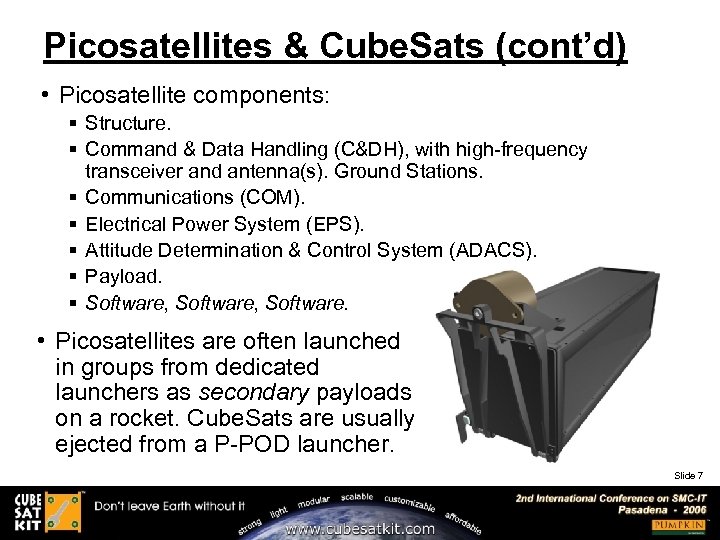 Picosatellites & Cube. Sats (cont’d) • Picosatellite components: § Structure. § Command & Data Handling (C&DH), with high-frequency transceiver and antenna(s). Ground Stations. § Communications (COM). § Electrical Power System (EPS). § Attitude Determination & Control System (ADACS). § Payload. § Software, Software. • Picosatellites are often launched in groups from dedicated launchers as secondary payloads on a rocket. Cube. Sats are usually ejected from a P-POD launcher. Slide 7
 Part II: The Cube. Sat Standard • Available as an 8 -page document from www. cubesat. org. • Requirements summary: • Designed to be launched from a P-POD (10 x 10 cm internal crosssection) • 1 kg mass • Nominal 10 x 10 cm size to fit inside P-POD launcher • +6. 5 mm allowed above each of the Cube. Sat’s six faces • 2 separation springs • Launch switch • Remove-before-flight switch • Location of access port area clearly defined • Material & finish requirements on rail contact surfaces • Safety – various electrical, testing and operational requirements Slide 8
 The Cube. Sat Standard (cont’d) • Things that the standard does not spell out: • • Payloads Antennas Electronics Programming Power sources Structural materials Operating frequencies & ground stations If your Cube. Sat satisfies the external (i. e. shape), mass, safety and regulatory requirements, then you can “board the bus” for the next available Cube. Sat launch for $40, 000. How you get there, and what you do with your Cube. Sat, is pretty much up to your imagination. • Cube. Sat missions have included technology demonstrators, Slide 9 proof-of-concepts and scientific experiments.
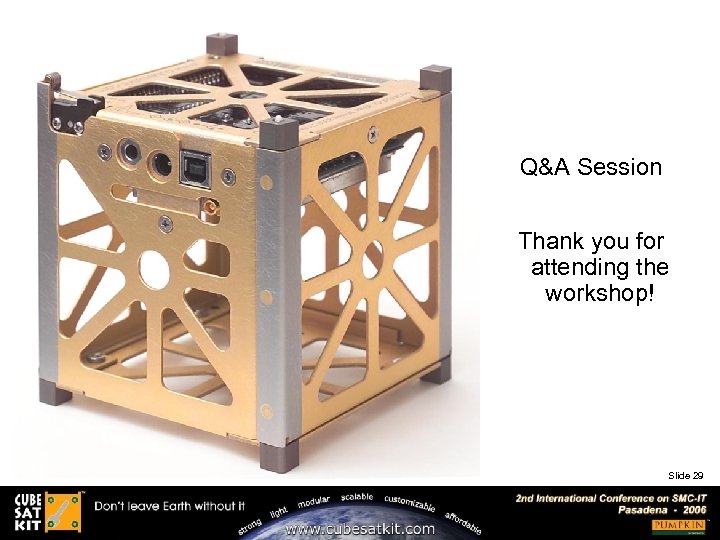
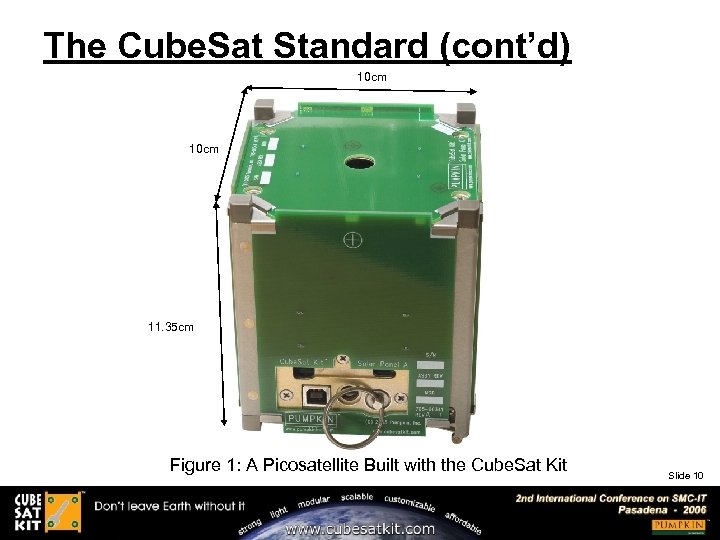 The Cube. Sat Standard (cont’d) 10 cm 11. 35 cm Figure 1: A Picosatellite Built with the Cube. Sat Kit Slide 10
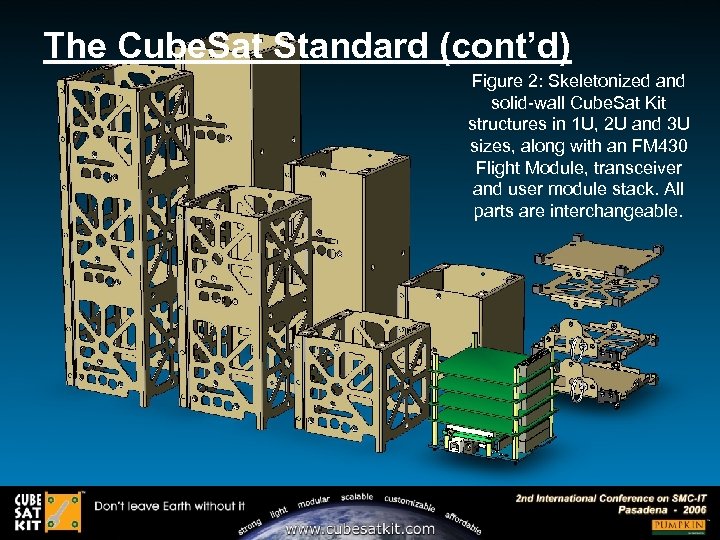 The Cube. Sat Standard (cont’d) Figure 2: Skeletonized and solid-wall Cube. Sat Kit structures in 1 U, 2 U and 3 U sizes, along with an FM 430 Flight Module, transceiver and user module stack. All parts are interchangeable. Slide 11
 Part III: Architectural Constraints • The Cube. Sat standard – essentially a mechanical & safety specification – along with a typical picosat mission profile impose certain real physical & electrical constraints on the electronics contained therein: • Maximum planar dimensions of a PCB: 100 x 100 mm, less wall thicknesses. PC/104’s 90 x 96 mm is practically speaking the largest common OTS form factor compatible with the Cube. Sat Kit. • Maximum mass: From the 1 kg mass budget we must deduct the structure (150 - 300 g), EPS (200 – 400 g), transceiver(s) and antenna(s) (100 – 200 g), and payload. That doesn’t leave much of a home for our IT. • Maximum power consumption: A Cube. Sat-sized object in LEO can expect 1 - 2 W on average of radiated power from the Sun. This caps our average power consumption. • Maximum cost: Many Cube. Sat missions are done on small budgets with considerable free / donated materials and labor. COTS components are used whenever possible. Slide 12
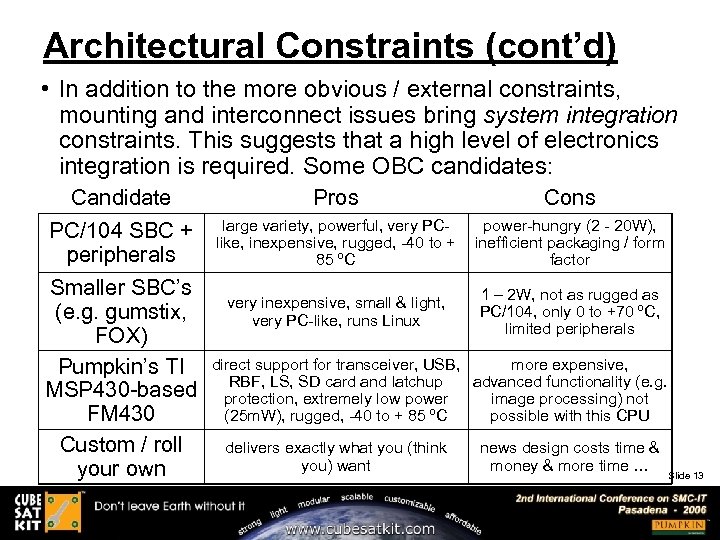 Architectural Constraints (cont’d) • In addition to the more obvious / external constraints, mounting and interconnect issues bring system integration constraints. This suggests that a high level of electronics integration is required. Some OBC candidates: Candidate Pros Cons PC/104 SBC + peripherals large variety, powerful, very PClike, inexpensive, rugged, -40 to + 85 ºC power-hungry (2 - 20 W), inefficient packaging / form factor very inexpensive, small & light, very PC-like, runs Linux 1 – 2 W, not as rugged as PC/104, only 0 to +70 ºC, limited peripherals Smaller SBC’s (e. g. gumstix, FOX) Pumpkin’s TI MSP 430 -based FM 430 Custom / roll your own direct support for transceiver, USB, more expensive, RBF, LS, SD card and latchup advanced functionality (e. g. protection, extremely low power image processing) not (25 m. W), rugged, -40 to + 85 ºC possible with this CPU delivers exactly what you (think you) want news design costs time & money & more time … Slide 13
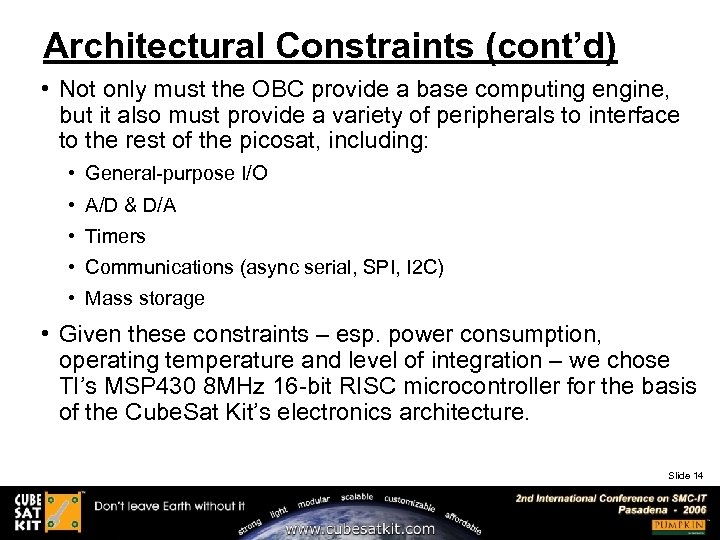 Architectural Constraints (cont’d) • Not only must the OBC provide a base computing engine, but it also must provide a variety of peripherals to interface to the rest of the picosat, including: • General-purpose I/O • A/D & D/A • Timers • Communications (async serial, SPI, I 2 C) • Mass storage • Given these constraints – esp. power consumption, operating temperature and level of integration – we chose TI’s MSP 430 8 MHz 16 -bit RISC microcontroller for the basis of the Cube. Sat Kit’s electronics architecture. Slide 14
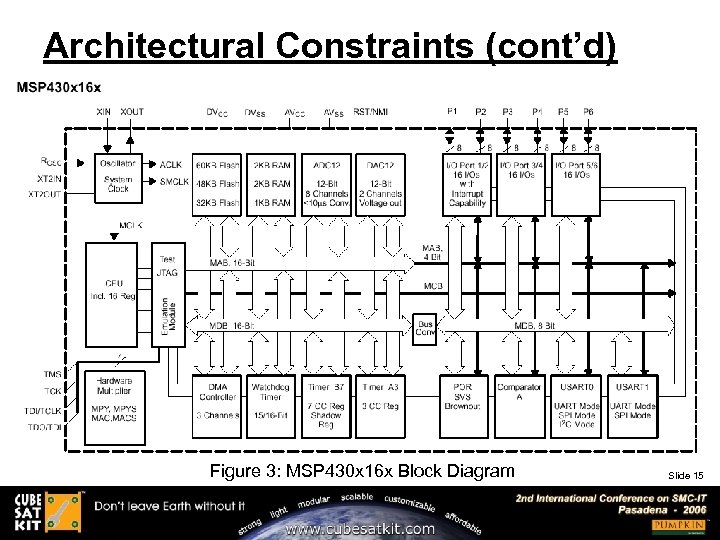 Architectural Constraints (cont’d) Figure 3: MSP 430 x 16 x Block Diagram Slide 15
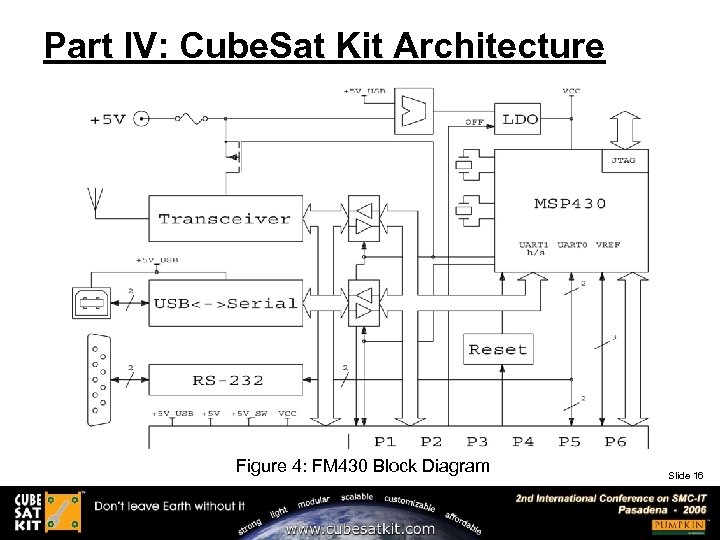 Part IV: Cube. Sat Kit Architecture Figure 4: FM 430 Block Diagram Slide 16
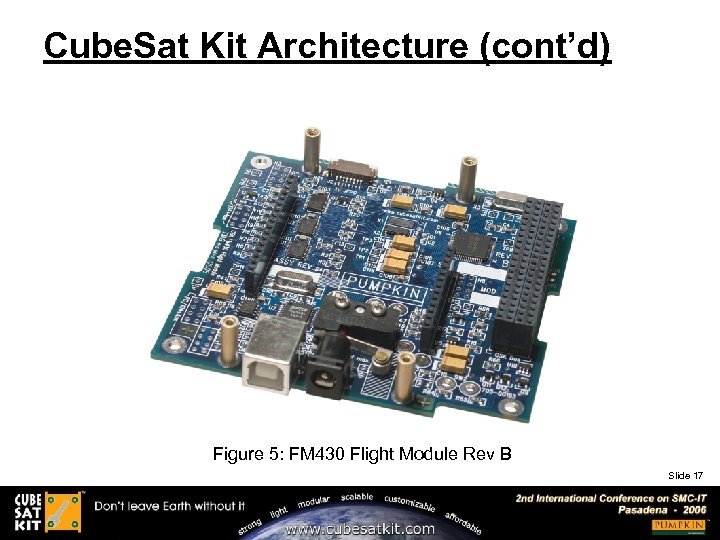 Cube. Sat Kit Architecture (cont’d) Figure 5: FM 430 Flight Module Rev B Slide 17
 Part V: Cube. Sat Kit Programming • How does the choice of 16 -bit MSP 430 affect the programming environment of the Cube. Sat Kit? • 64 KB memory space – MSP 430 F 1612 has 5 KB RAM and 55 KB Flash. RAM is especially limited, as is typical of microcontrollers. • C rules here. C++ is generally ill-suited to this small embedded programming space. Assembly language is not required. HLL’s are not an option due to memory & speed limitations. • Tools (compiler, linker, debugger, IDE, both commercial and free) are very good, standard C libraries are all present, multitasking RTOSes (e. g. Salvo) are available. • As a Cube. Sat programmer, you’re never too far from the on-board hardware, at least at the early stages of development. Since much of the hardware in each Cube. Sat’s payload is unique and requires drivers & support, there are many opportunities for real-world learning when programming a Cube. Sat. Slide 18
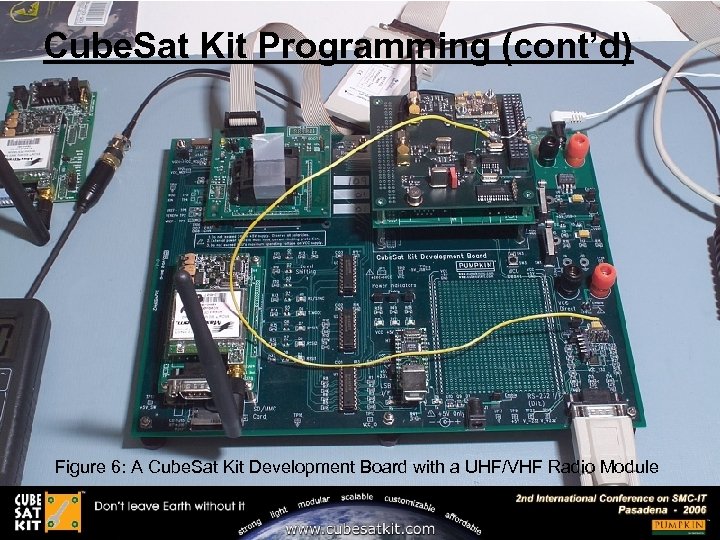 Cube. Sat Kit Programming (cont’d) Figure 6: A Cube. Sat Kit Development Board with a UHF/VHF Radio Module Slide 19
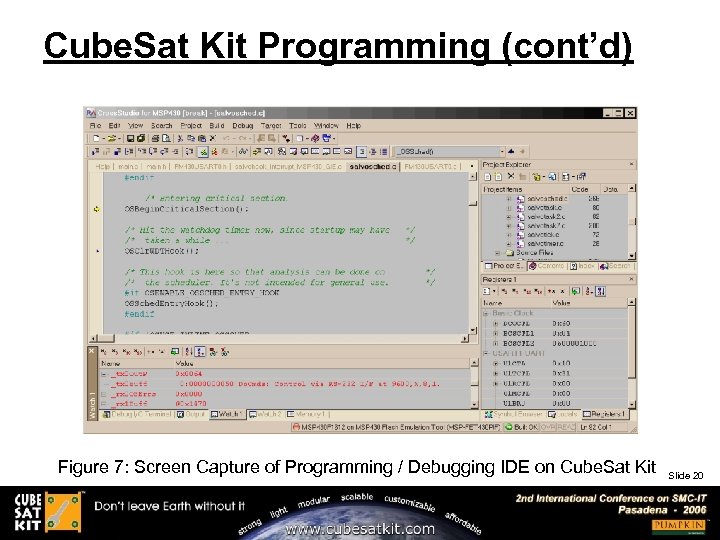 Cube. Sat Kit Programming (cont’d) Figure 7: Screen Capture of Programming / Debugging IDE on Cube. Sat Kit Slide 20
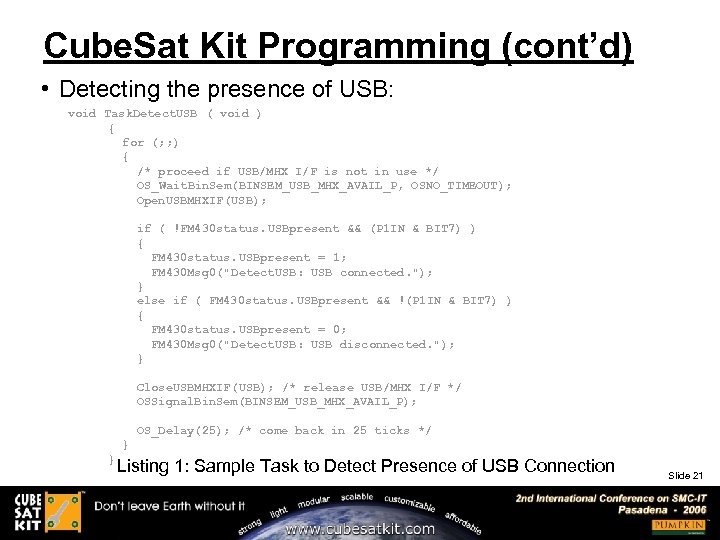 Cube. Sat Kit Programming (cont’d) • Detecting the presence of USB: void Task. Detect. USB ( void ) { for (; ; ) { /* proceed if USB/MHX I/F is not in use */ OS_Wait. Bin. Sem(BINSEM_USB_MHX_AVAIL_P, OSNO_TIMEOUT); Open. USBMHXIF(USB); if ( !FM 430 status. USBpresent && (P 1 IN & BIT 7) ) { FM 430 status. USBpresent = 1; FM 430 Msg 0("Detect. USB: USB connected. "); } else if ( FM 430 status. USBpresent && !(P 1 IN & BIT 7) ) { FM 430 status. USBpresent = 0; FM 430 Msg 0("Detect. USB: USB disconnected. "); } Close. USBMHXIF(USB); /* release USB/MHX I/F */ OSSignal. Bin. Sem(BINSEM_USB_MHX_AVAIL_P); OS_Delay(25); /* come back in 25 ticks */ } } Listing 1: Sample Task to Detect Presence of USB Connection Slide 21
 Cube. Sat Kit Programming (cont’d) • Code modules developed for Cube. Sats include: • Interfaces to various I 2 C devices to measure currents, voltages, etc. I 2 C is very popular because it’s a two-wire bus with a wide choice of supported devices. • Interfaces to various SPI devices (e. g. magnetometers, MMC cards, other / slave processors). • Interfaces to various asynchronous serial devices (e. g. transceivers and cameras). • Watchdog / reset code (both internal and external). • On-board fault detection, collection and correction. • Multi-processor intercommunications. • Sun- and attitude-sensing algorithms. • Deployment & release mechanisms. • End-of-life / deorbit mechanisms. • In-flight reprogramming. • Active attitude control. Slide 22
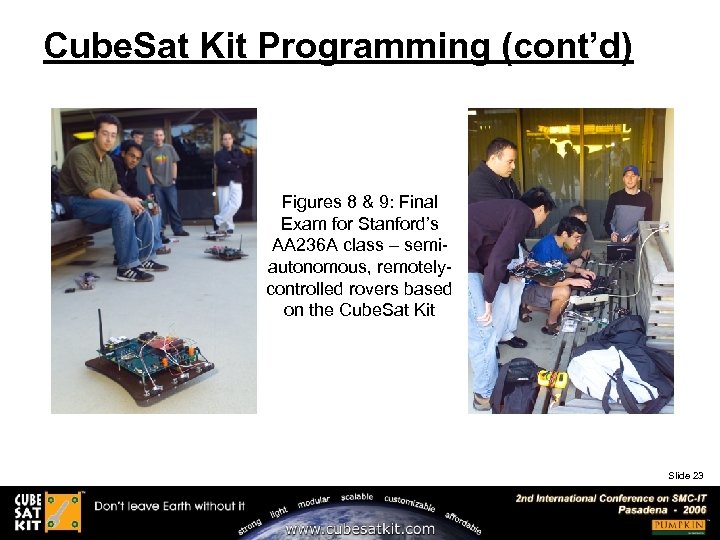 Cube. Sat Kit Programming (cont’d) Figures 8 & 9: Final Exam for Stanford’s AA 236 A class – semiautonomous, remotelycontrolled rovers based on the Cube. Sat Kit Slide 23
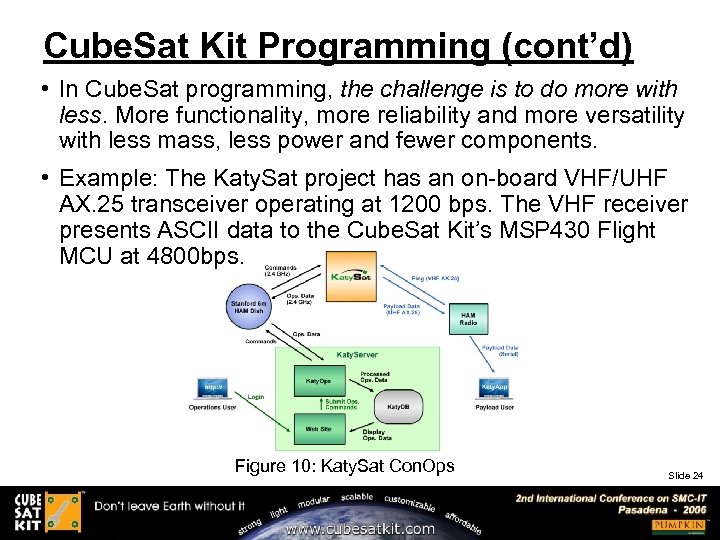 Cube. Sat Kit Programming (cont’d) • In Cube. Sat programming, the challenge is to do more with less. More functionality, more reliability and more versatility with less mass, less power and fewer components. • Example: The Katy. Sat project has an on-board VHF/UHF AX. 25 transceiver operating at 1200 bps. The VHF receiver presents ASCII data to the Cube. Sat Kit’s MSP 430 Flight MCU at 4800 bps. Figure 10: Katy. Sat Con. Ops Slide 24
 Cube. Sat Kit Programming (cont’d) • The challenge with the Katy. Sat VHF/UHF module lies in the fact that we would like to be able to listen on the VHF uplink 100% of the time. This requires a dedicated serial UART. But the FM 430’s UART 1 is dedicated to the 2. 4 GHz TT&C, and UART 0 is shared among UART, I 2 C and SPI devices in the Cube. Sat. So the hardware UARTs are spoken for. • The solution was to bit-bang the UART in software, using a TI example as the base code. During testing, it was found that a CPU clock of ~ 800 k. Hz (the nominal DCO frequency) was insufficiently fast to guarantee reliable operation. Therefore the MSP 430’s CPU clock was sourced from the HF crystal (7. 3728 MHz). Careful choices of timer modules, interrupt vectors and interface to the overlying RTOS ensure reliable operation within the larger multitasking framework of the SC software. ΔPD was deemed acceptable. Slide 25
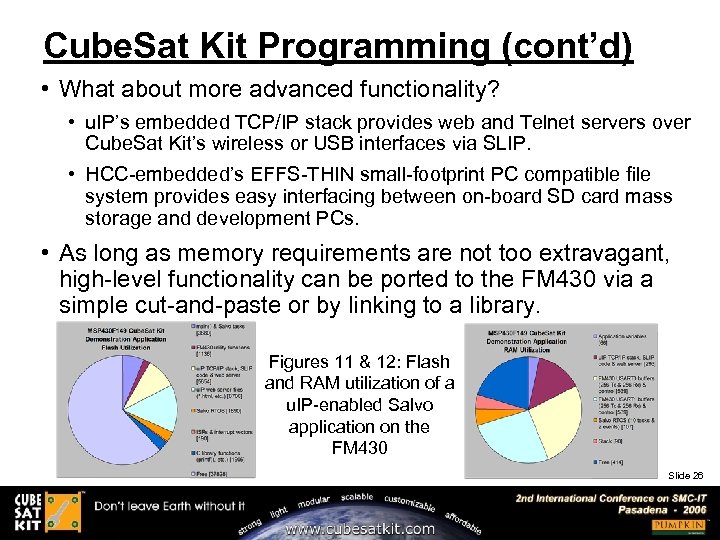 Cube. Sat Kit Programming (cont’d) • What about more advanced functionality? • u. IP’s embedded TCP/IP stack provides web and Telnet servers over Cube. Sat Kit’s wireless or USB interfaces via SLIP. • HCC-embedded’s EFFS-THIN small-footprint PC compatible file system provides easy interfacing between on-board SD card mass storage and development PCs. • As long as memory requirements are not too extravagant, high-level functionality can be ported to the FM 430 via a simple cut-and-paste or by linking to a library. Figures 11 & 12: Flash and RAM utilization of a u. IP-enabled Salvo application on the FM 430 Slide 26
 Part VI: Architectural Extensions • All of the MSP 430’s I/O is on the CSK bus connector. • The FM 430’s ultralow power requirements mean that it can run 24 x 7 during the entire mission. Additional processors (e. g. Linux SBC’s) can be added due to a variety of architectural features: • Multiple pins on CSK bus connector reserved for user. • MSP 430’s NMI input enables simple handshake with other processors. • SPI, I 2 C and UART all available for inter-processor communications. • Up/downlink transceiver can be accessed directly via CSK bus connector. • Due to the SBC’s higher power consumption, its on-time duty cycle will necessarily be << 100%. The FM 430 can manage it as an “on-demand coprocessor. ” Slide 27
 Notice This presentation is available online in Microsoft Power. Point and Adobe Acrobat formats at: ® ® www. pumpkininc. com/content/doc/press/Pumpkin_SMC-IT-2006. ppt and: www. pumpkininc. com/content/doc/press/Pumpkin_ SMC-IT-2006. pdf Slide 28
 Q&A Session Thank you for attending the workshop! Slide 29
 Notes & References 1. Cube. Sat Design Specification, www. cubesat. org. 2. MSP 430 x 16 x block diagram from TI’s MSP 430 F 1612 datasheets, www. ti. com. 3. Cube. Sat Kit User Manual, Pumpkin, Inc. 2005, www. pumpkininc. com. 4. Connex-xm platform spex, www. gumstix. com. 5. FOX Board Documentation page, Acme Systems, www. acmesystems. it. 6. AXIS ETRAX 100 LX MCM 4+16 product brochure, Axis Communications AB, 2004, www. axis. com. 7. The u. IP Embedded TCP/IP Stack, Adam Dunkels, http: //www. sics. se/~adam/uip/. 8. EFFS-THIN product specification, HCC-embedded, www. hcc-embedded. com. Slide 30
 Appendix • Speaker information § Dr. Kalman is Pumpkin's president and chief technology architect. He entered the embedded programming world in the mid-1980's. After co-founding Euphonix, Inc – the pioneering Silicon Valley high-tech pro-audio company – he founded Pumpkin to explore the feasibility of applying high-level programming paradigms to severely memory-constrained embedded architectures. He holds two United States patents and is a consulting professor at Stanford University. • Acknowledgements § Stanford Professor Bob Twiggs' continued support for the Cube. Sat Kit, and his input on enhancements and suggestions for future Cube. Sat Kit products, are greatly appreciated. § Pumpkin’s Salvo and Cube. Sat Kit customers, whose real-world experience with our products helps us improve and innovate. • Salvo, Cube. Sat Kit and Cube. Sat information § More information on the Pumpkin’s Salvo RTOS and Pumpkin’s Cube. Sat Kit can be found at http: //www. pumpkininc. com/ and http: //www. cubesatkit. com/, respectively. § More information on the open Cube. Sat standard and the Cube. Sat community can be found at http: //www. cubesat. info/. • Copyright notice © 2006 Pumpkin, Inc. All rights reserved. Pumpkin and the Pumpkin logo, Salvo and the Salvo logo, The RTOS that runs in tiny places, Cube. Sat Kit Bus and the Cube. Sat Kit logo are all trademarks of Pumpkin, Inc. All other trademarks and logos are the property of their respective owners. No endorsements of or by third parties listed are implied. All specifications subject to change without notice. First presented at the 2 nd IEEE International Conference on Space Mission Challenges for Information Technology in Pasadena, California on July 17, 2006. Slide 31