 Скачать презентацию Piconet Embedded Mobile Networking F Bennett D Clarke
deed478473726479933c8b2ebbb72a90.ppt
- Количество слайдов: 17



Piconet: Embedded Mobile Networking F. Bennett, D. Clarke, and J. B. Evans in IEEE Personal Communications, Vol. 4, No. 5, Oct. 1997, pp. 8 -15 -- presented by Yu-Chee Tseng -- Pico. Net: 1
Embedded Mobile Networking q There already exist many simple communication devices around our everyday life: l phone, fax, copy machine l printer, portable computer, PDA l electronic access control to buildings and roads l banking machine l public information terminal, etc. q Imagine how much we may benefit if these devices can TALK with each other. 2
Benefit of Embedded Networks q Embedded Network: l a small, wireless, portable communication device l can be embedded in many communication devices Ø and thus connect them together q Enhanced personal connectivity l we have a multitude of connections to many devices q Context awareness l the connectivity differs as we move around 3
Piconet of ORL q Developed by ORL (Olivetti and Oracle Research): l general purpose l low powered l ad-hoc radio q Can talk to a multitude of computing and communication devices: l static, mobile, or embedded l used for sensing, communication, and control l to support only a “base level” of connectivity between things. 4
Technological Choices of Piconet q ubiquitous l periodically convey its state to others l indoor or outdoor, exposed or embedded, line-of-sight or diffused q low-power, low-rate, low-range l sleep (switched off) most of the time q radio-based l Ir. DA (infrared) was not chosen as its inappropriateness in outdoor use 5
Prototype Piconet Hardware q q q size: 12 cm x 7 cm implemented in FPGA major components: l radio l protocol l runtime environment l attribute store 6
Radio q q 418 MHz FM transceiver around 5 meters of transmission range l low-powered and cheap l greater re-use of radio channel l close to human’s definition of “proximity” 7
Protocol q q ad-hoc, without base station for short-lived transaction, not long-lived stream of data 4 b 6 b DC balanced encoding support 2 kinds of multicast: l well-known (pre-assigned) l transient (dynamically created) 8
Runtime Environment q on-board kernel l a message queue l a scheduler q on-board loader 9
Attribute Store q In Piconet, each node is responsible for describing itself to the rest of the world. l any other node is thus able to determine what kind of services is provided by the device. q A mapping between a device’s name and service type should be supported. l called “attribute store” in Piconet 10
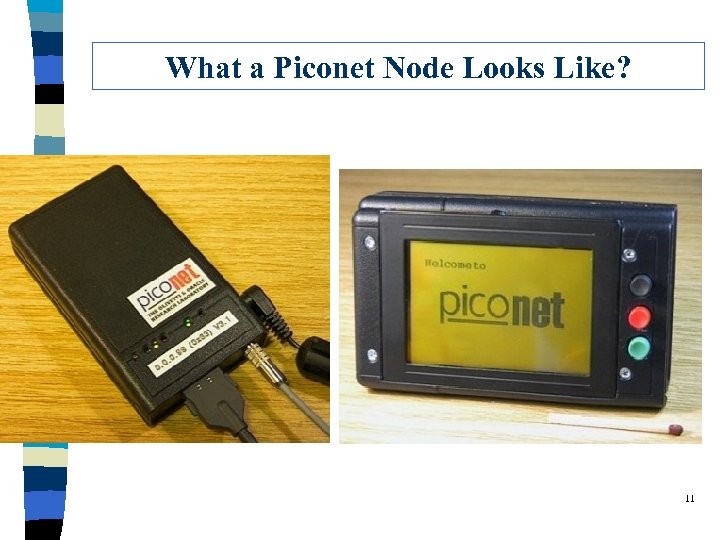
What a Piconet Node Looks Like? 11
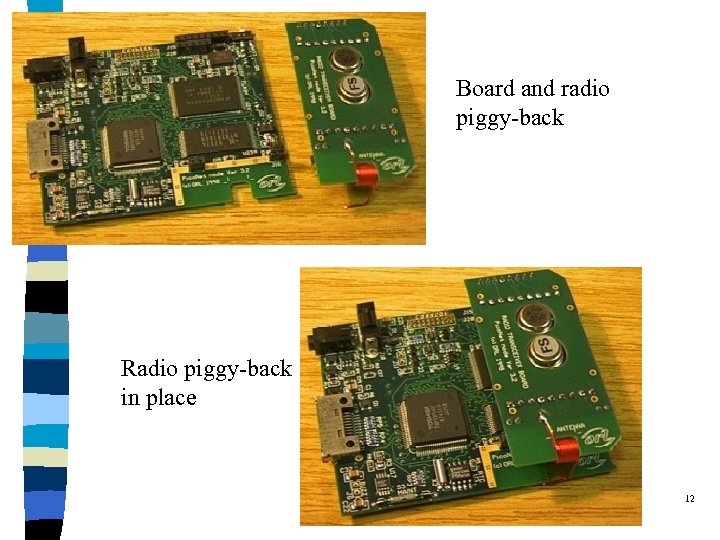
Board and radio piggy-back Radio piggy-back in place 12
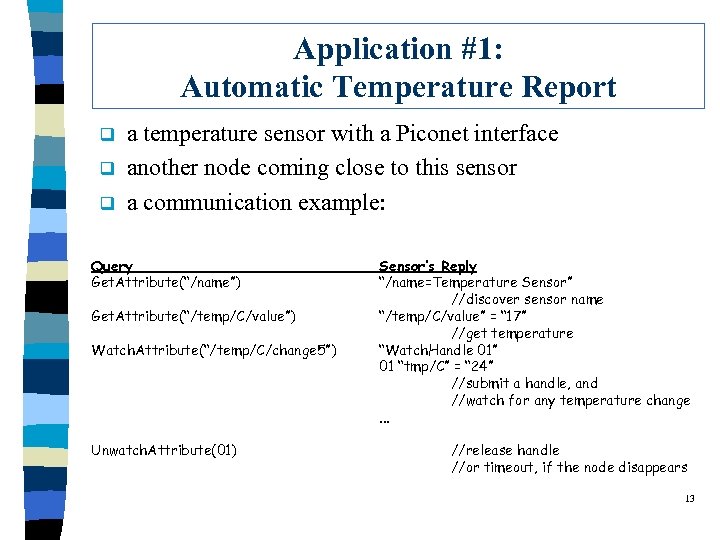
Application #1: Automatic Temperature Report q q q a temperature sensor with a Piconet interface another node coming close to this sensor a communication example: Query Get. Attribute(“/name”) Get. Attribute(“/temp/C/value”) Watch. Attribute(“/temp/C/change 5”) Unwatch. Attribute(01) Sensor’s Reply “/name=Temperature Sensor” //discover sensor name “/temp/C/value” = “ 17” //get temperature “Watch. Handle 01” 01 “tmp/C” = “ 24” //submit a handle, and //watch for any temperature change. . . //release handle //or timeout, if the node disappears 13
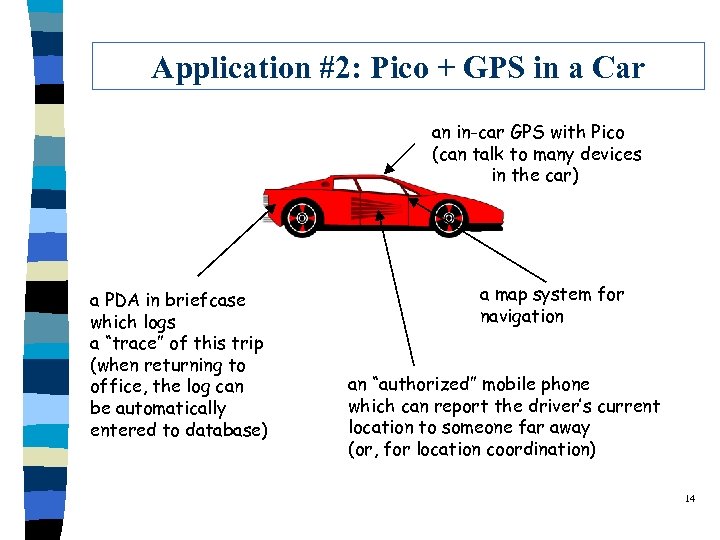
Application #2: Pico + GPS in a Car an in-car GPS with Pico (can talk to many devices in the car) a PDA in briefcase which logs a “trace” of this trip (when returning to office, the log can be automatically entered to database) a map system for navigation an “authorized” mobile phone which can report the driver’s current location to someone far away (or, for location coordination) 14
Application #3: Integration with Existing Services q q “authorized” phone, printer, etc control of home appliances: l VCR, microwave, clock, radio, PDA l house heating system, control house lighting l connecting to networks for email, WWW, etc. q Only your imagination can limit!! 15
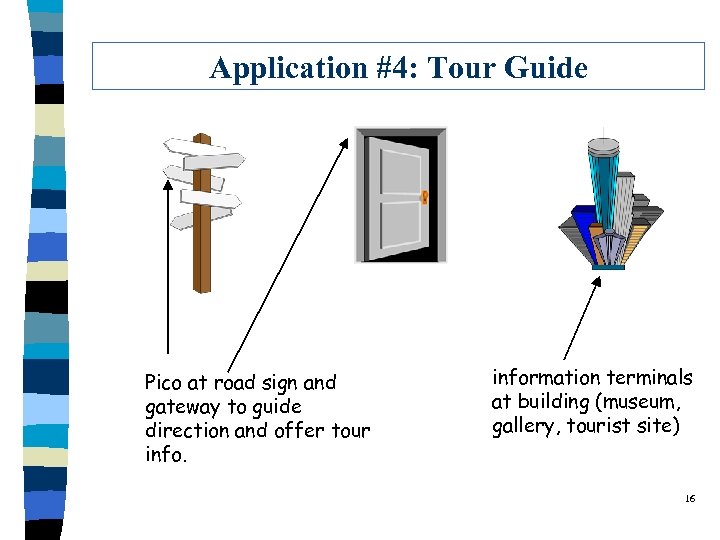
Application #4: Tour Guide Pico at road sign and gateway to guide direction and offer tour information terminals at building (museum, gallery, tourist site) 16
Demo q A music CD with a piconet!! 17
Скачать презентацию Piconet Embedded Mobile Networking F Bennett D Clarke
deed478473726479933c8b2ebbb72a90.ppt