 Скачать презентацию Piano Thieving for Experts That Bathroom Window IS
c53a1f65e9000d248c76b0a7e2b77c78.ppt
- Количество слайдов: 76




Piano Thieving for Experts That Bathroom Window *IS* Big Enough In fond memory of Irish comedy legend Spike Milligan
How are you off-shoring today? • Enterprise Context Inputs – Government (Regulator) • Regulatory framework with responsibility for data privacy (PI/PII @ Privacy/PCI, PHI @ HIPAA, etc). – Corporate (Board/Executive) • Data sovereignty mandate – data doesn’t leave its jurisdiction of origin (Board-level risk appetite). • Semi-trusted or untrusted users offshore working with sensitive information assets on-shore (Rightsourcing/Best-shoring as cost strategy; Use-v-Dsc) September 2014 Piano Thieving for Experts // Ian Latter 2
Are you meeting that challenge? • Enterprise Context Result – Security/Technology Architecture • You’ve invested in industry (or NIST or ISO 27002, etc) endorsed security controls/compliance. • You’ve stacked them vertically, and layered them deeply – Multiple domains of authentication, many factors – EPS -> FW/IPS -> Un. Auth. Chg -> SIEM -> Reputation – Controlled Workstations -> VPN -> Citrix -> VDI -> Jump – Blah etc blah (it really doesn’t matter) – Users can’t print or download = Safe!! September 2014 Piano Thieving for Experts // Ian Latter 3
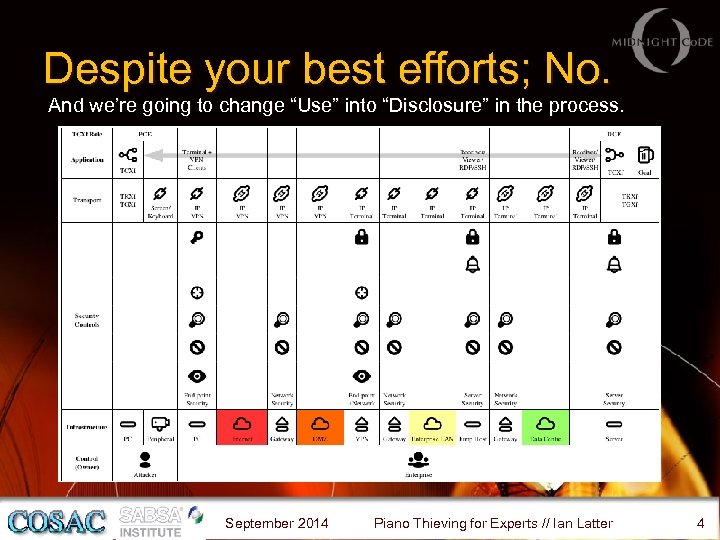
Despite your best efforts; No. And we’re going to change “Use” into “Disclosure” in the process. September 2014 Piano Thieving for Experts // Ian Latter 4
Key messages for this session • Current security architecture, flawed (now) – Will give you everything you need to know • from first principles, to demonstrations and full code release (Po. C) with test framework. – The impact will probably be significant • SABSA and others warned us all – There are no easy answers – But this is an architecture forum, and there is a bar. . September 2014 Piano Thieving for Experts // Ian Latter 5
Who is this guy, at work? • Career – Blue, create & fix • Governance (Technical, Security) – Multiple iconic international enterprise organisations • Architect / Designer – Enterprise perimeters, Data Centre consolidation • Sys. Admin, Tech Support – Red, break & destroy • Ethical Hacker / Penetration Tester – Pwn’d asia pacific in a business day September 2014 Piano Thieving for Experts // Ian Latter 6
Who is this guy, at home? • My time – Threat Intelligence • “Practical Threat Intelligence” course, BH’ 14 • “Threat Analytics” cloud service – OSSTMM • “Active Filter Detection” tool – Linux distributions • “CHAOS” – the super computer for your wallet • “Saturn” – scalable distributed storage – Barbie car? September 2014 Piano Thieving for Experts // Ian Latter 7

PROBLEM SPACE Framing the Architectural Problem September 2014 Piano Thieving for Experts // Ian Latter 8
First principles • Assertion: – Any user controlled bit is a communications channel • Validation: – The screen transmits large volumes of user controlled bits (imagine the screen as cut fiber optic bundle) – Can the screen be transformed into an uncontrolled binary transfer interface? September 2014 Piano Thieving for Experts // Ian Latter 9

TECHNOLOGY SOLUTION Engineering a Proof of Concept September 2014 Piano Thieving for Experts // Ian Latter 10
Screen data extraction • Terminal Printing (1984) – Virtual screen as a multi-use data device • DEC VT 220 Programmer Reference Manual – Ditto for [XYZ]modem protocols • VHS Tape Backup (1992 -1996) – Video record/play of compressed binary data • Grey-scaled picture of two rows of eight blocks, comprised of more nested blocks – Ar. Vid ISA board with AV-in/out (composite) September 2014 Piano Thieving for Experts // Ian Latter 11
Real screen data extraction • Timex Data. Link Watch (1994) – Address book data transmitted from the screen to a wrist watch • Eeprom programmed with light – Windows 95 and 98, required CRT • Open source (dfries) done with USB TTL LED – Transfer rate: • 20 seconds to transfer 70 phone numbers September 2014 Piano Thieving for Experts // Ian Latter 12
Timex / Microsoft advert Playing video 1. . September 2014 Piano Thieving for Experts // Ian Latter 13
Machine recognition • Quick Response Codes (1994) – 1960 s: Denso Wave responded to cashiers’ need for machine readable Kanji encoded data with 2 D barcodes – 1990 s: Denso Wave wanted to improve performance and did an exhaustive study of printed business materials – QR Code is: • Highly distinguished • Highly machine recognisable • 360 degree scanning September 2014 Piano Thieving for Experts // Ian Latter 14
Performance & error correction • Quick Response Codes (2000 -2006) – Adopted by the auto industry – Formalised as ISO/IEC 18004: 2000 • • Rapid scanning capability Automatic re-orientation of the image Inherent error correction Native binary support – Revised as ISO/IEC 18004: 2006 for model 2 • Support deformed/distorted codes • Capacity up to about 3 KB September 2014 Piano Thieving for Experts // Ian Latter 15
Optical packet network (L 3) • Zen moment – Consider the QR Code as an optical packet captured within the ether of the display device. – Datagram network protocol, OSI Layer 3 • Beyond the packet boundary, create a flow – Transmitter replaces one code for another – Receiver uses video instead of a photo – Receiver doesn’t exit, just keeps going. September 2014 Piano Thieving for Experts // Ian Latter 16
Layer 4 problems • All new problems: – Unidirectional interface • No synchronisation, no signalling, no flow control • Requires over-sampling (2 -3 x) – Oversampling creates duplicates • Requires de-duplication • Duplicates may be intentional (repeating sequences in the application layer) • Need for a transport protocol! September 2014 Piano Thieving for Experts // Ian Latter 17
Creating transport data flow • QR code v 1 = 14 octets at 15% ECC – Take the 1 st octet and create “control byte” – Create two frames, “Control” and “Data” • Data Frame – Control Byte • Bit 0: is always 0 (Data Frame) • Bits 1 -4: Counter (cycles from 0 -15) • Bits 5 -7: Reserved (unused) – Payload of source bytes mod capacity bytes September 2014 Piano Thieving for Experts // Ian Latter 18
Creating transport control flow • Control Frame – Control Byte • • • Bit 0: is always 1 (Control Frame) Bits 1 -3: Control Type Bits 4 -7: Control Sub-Type – Payload is control data, as needed • • File name File size CRC etc September 2014 Piano Thieving for Experts // Ian Latter 19
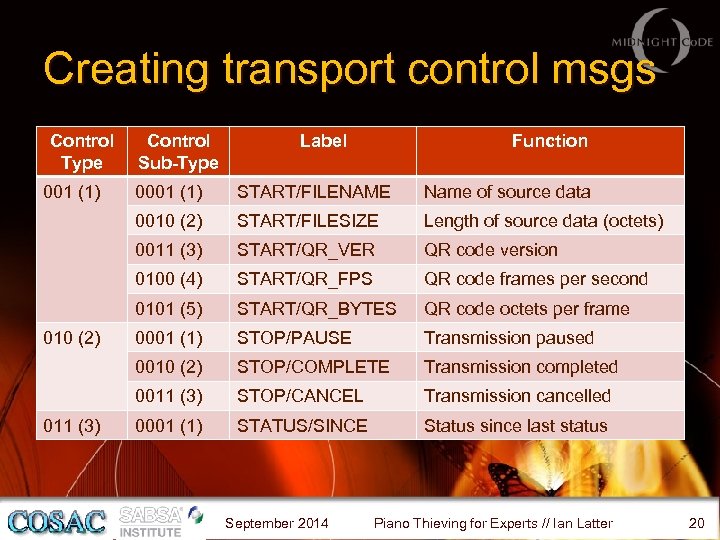
Creating transport control msgs Control Type 001 (1) Control Sub-Type Label Function Name of source data START/FILESIZE Length of source data (octets) 0011 (3) START/QR_VER QR code version 0100 (4) START/QR_FPS QR code frames per second 0101 (5) START/QR_BYTES QR code octets per frame 0001 (1) STOP/PAUSE Transmission paused 0010 (2) STOP/COMPLETE Transmission completed 0011 (3) START/FILENAME 0010 (2) 0001 (1) STOP/CANCEL Transmission cancelled 0001 (1) STATUS/SINCE Status since last status September 2014 Piano Thieving for Experts // Ian Latter 20
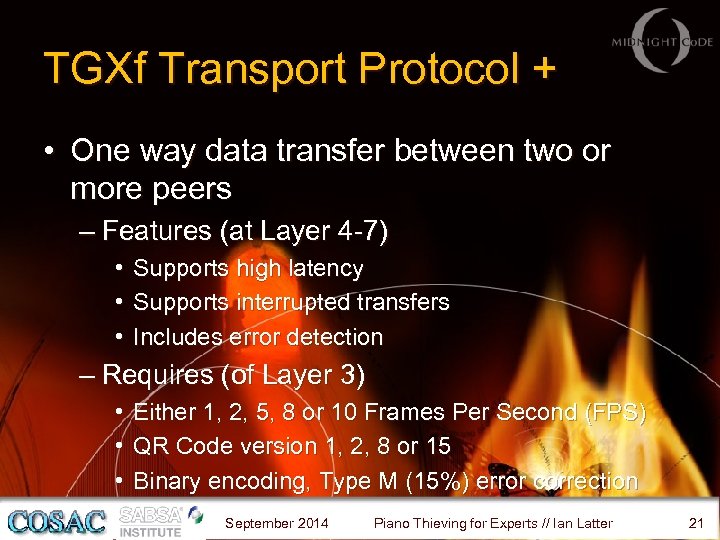
TGXf Transport Protocol + • One way data transfer between two or more peers – Features (at Layer 4 -7) • • • Supports high latency Supports interrupted transfers Includes error detection – Requires (of Layer 3) • • • Either 1, 2, 5, 8 or 10 Frames Per Second (FPS) QR Code version 1, 2, 8 or 15 Binary encoding, Type M (15%) error correction September 2014 Piano Thieving for Experts // Ian Latter 21
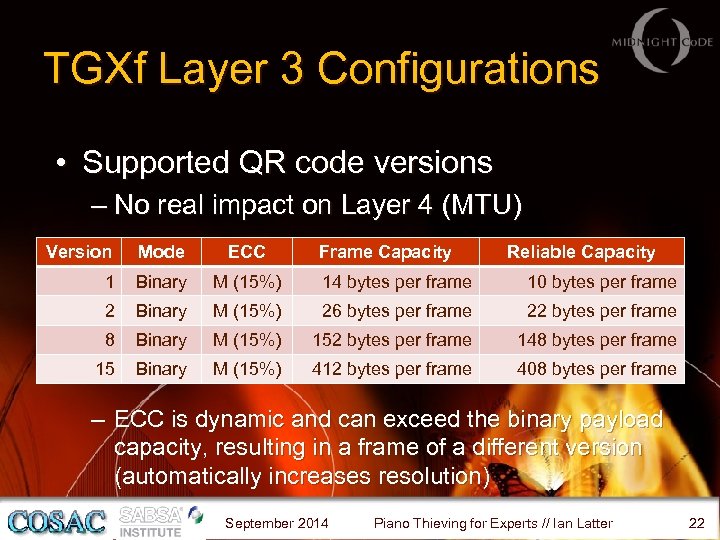
TGXf Layer 3 Configurations • Supported QR code versions – No real impact on Layer 4 (MTU) Version Mode ECC Frame Capacity Reliable Capacity 1 Binary M (15%) 14 bytes per frame 10 bytes per frame 2 Binary M (15%) 26 bytes per frame 22 bytes per frame 8 Binary M (15%) 152 bytes per frame 148 bytes per frame 15 Binary M (15%) 412 bytes per frame 408 bytes per frame – ECC is dynamic and can exceed the binary payload capacity, resulting in a frame of a different version (automatically increases resolution) September 2014 Piano Thieving for Experts // Ian Latter 22
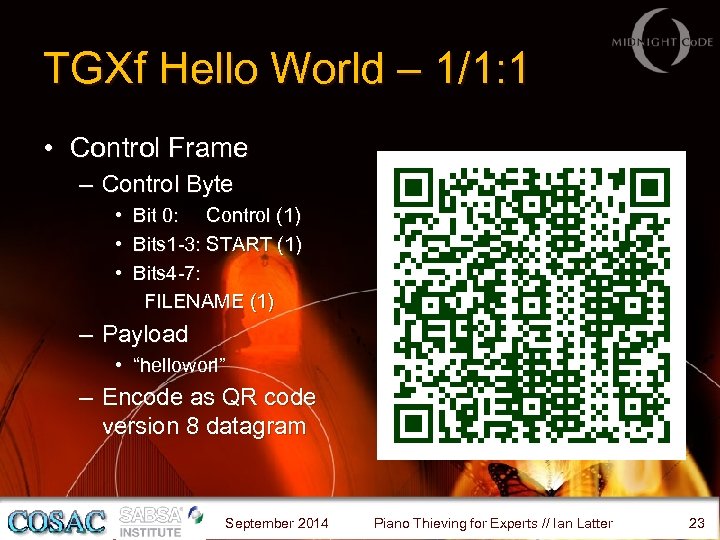
TGXf Hello World – 1/1: 1 • Control Frame – Control Byte • • • Bit 0: Control (1) Bits 1 -3: START (1) Bits 4 -7: FILENAME (1) – Payload • “helloworl” – Encode as QR code version 8 datagram September 2014 Piano Thieving for Experts // Ian Latter 23
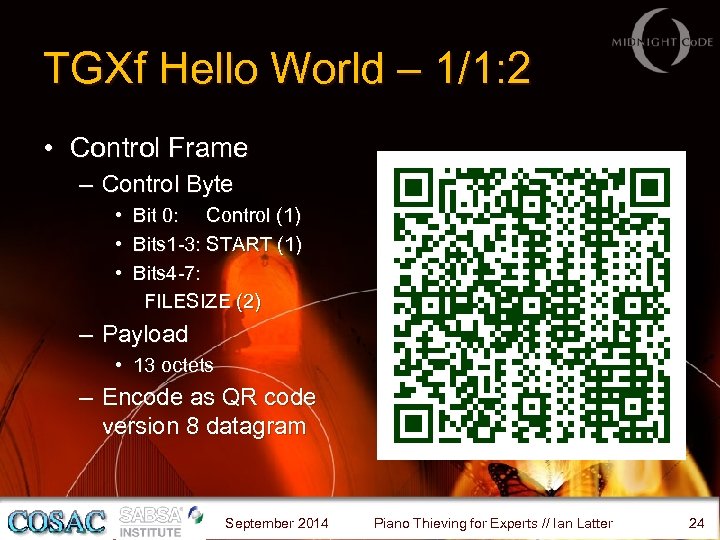
TGXf Hello World – 1/1: 2 • Control Frame – Control Byte • • • Bit 0: Control (1) Bits 1 -3: START (1) Bits 4 -7: FILESIZE (2) – Payload • 13 octets – Encode as QR code version 8 datagram September 2014 Piano Thieving for Experts // Ian Latter 24
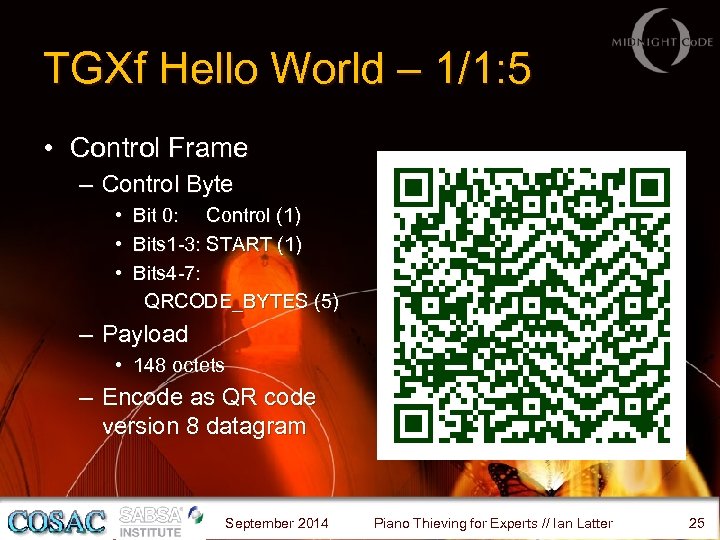
TGXf Hello World – 1/1: 5 • Control Frame – Control Byte • • • Bit 0: Control (1) Bits 1 -3: START (1) Bits 4 -7: QRCODE_BYTES (5) – Payload • 148 octets – Encode as QR code version 8 datagram September 2014 Piano Thieving for Experts // Ian Latter 25
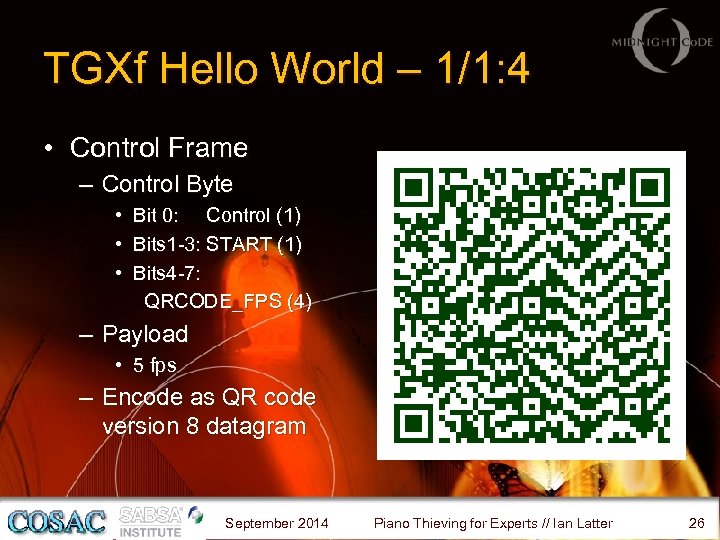
TGXf Hello World – 1/1: 4 • Control Frame – Control Byte • • • Bit 0: Control (1) Bits 1 -3: START (1) Bits 4 -7: QRCODE_FPS (4) – Payload • 5 fps – Encode as QR code version 8 datagram September 2014 Piano Thieving for Experts // Ian Latter 26
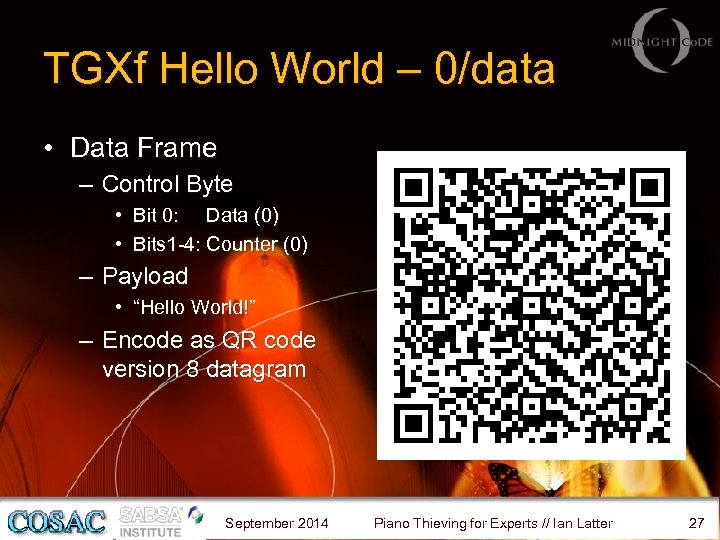
TGXf Hello World – 0/data • Data Frame – Control Byte • Bit 0: Data (0) • Bits 1 -4: Counter (0) – Payload • “Hello World!” – Encode as QR code version 8 datagram September 2014 Piano Thieving for Experts // Ian Latter 27
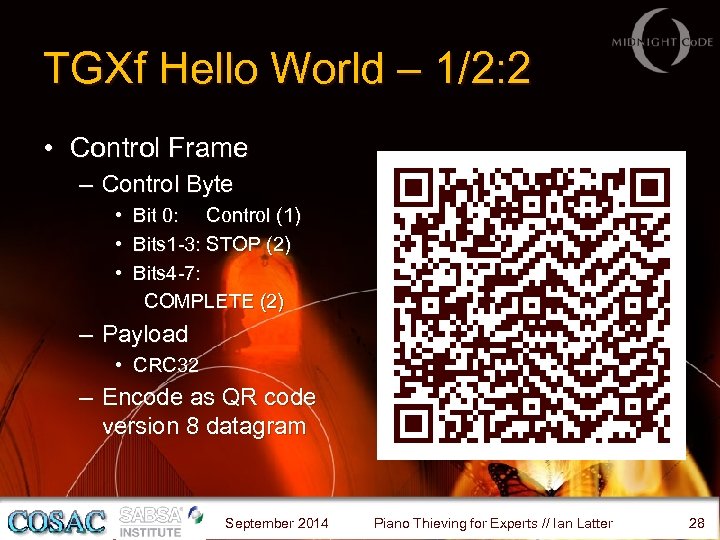
TGXf Hello World – 1/2: 2 • Control Frame – Control Byte • • • Bit 0: Control (1) Bits 1 -3: STOP (2) Bits 4 -7: COMPLETE (2) – Payload • CRC 32 – Encode as QR code version 8 datagram September 2014 Piano Thieving for Experts // Ian Latter 28
TGXf Result – visual modem Playing video 2. . September 2014 Piano Thieving for Experts // Ian Latter 29
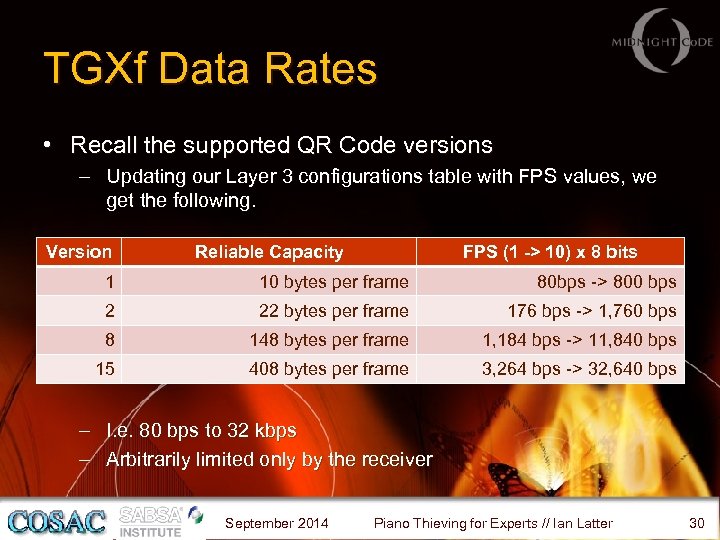
TGXf Data Rates • Recall the supported QR Code versions – Updating our Layer 3 configurations table with FPS values, we get the following. Version Reliable Capacity FPS (1 -> 10) x 8 bits 1 10 bytes per frame 80 bps -> 800 bps 2 22 bytes per frame 176 bps -> 1, 760 bps 8 148 bytes per frame 1, 184 bps -> 11, 840 bps 15 408 bytes per frame 3, 264 bps -> 32, 640 bps – I. e. 80 bps to 32 kbps – Arbitrarily limited only by the receiver September 2014 Piano Thieving for Experts // Ian Latter 30
TGXf a PDF from Youtube Playing video 3. . September 2014 Piano Thieving for Experts // Ian Latter 31
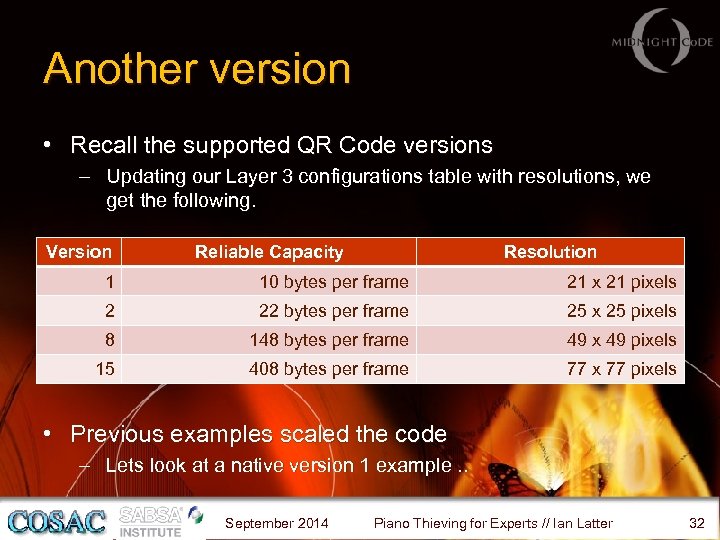
Another version • Recall the supported QR Code versions – Updating our Layer 3 configurations table with resolutions, we get the following. Version Reliable Capacity Resolution 1 10 bytes per frame 21 x 21 pixels 2 22 bytes per frame 25 x 25 pixels 8 148 bytes per frame 49 x 49 pixels 15 408 bytes per frame 77 x 77 pixels • Previous examples scaled the code – Lets look at a native version 1 example. . September 2014 Piano Thieving for Experts // Ian Latter 32
TGXf a PDF from BASH Playing video 4. . September 2014 Piano Thieving for Experts // Ian Latter 33
Technology check-point (1/3) • So! – If the TGXf transmit software was on a laptop we could now exfiltrate data, file by file, through its screen (binaries already public) • How do we get TGXf onto the laptop in the first place? – Recall that: any user controlled bit is a communications channel. . – And. . we have a keyboard! September 2014 Piano Thieving for Experts // Ian Latter 34
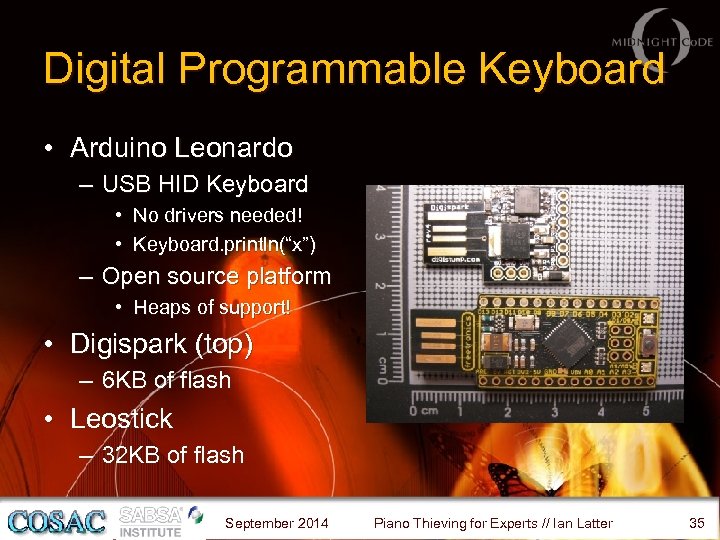
Digital Programmable Keyboard • Arduino Leonardo – USB HID Keyboard • No drivers needed! • Keyboard. println(“x”) – Open source platform • Heaps of support! • Digispark (top) – 6 KB of flash • Leostick – 32 KB of flash September 2014 Piano Thieving for Experts // Ian Latter 35
What to type? • Source code (text) would be easy to send but then needs to be compiled. . meh • Send statically compiled binary – Gzip TGXf transmit binary (~80 ->25 KB) – Hexdump the. gz (byte = 2 chars; 0 -9, a-f) • Receive via text editor – “Type” it in, structured • Bash (printf) or Perl (print) – Save, chmod and run script, gunzip result! September 2014 Piano Thieving for Experts // Ian Latter 36
Typing a BASH 2 BIN script Playing video 5. . September 2014 Piano Thieving for Experts // Ian Latter 37
Technology check-point (2/3) • Wait, what!? – First, there’s now no barrier to getting TGXf into a computer (this is bad in enterprise). – But second, we just sent data into the computer. . so: • No longer unidirectional – ZOMG Full Duplex! w 00 t • Could now replace TGXf file transfers with full-blown through screen and keyboard networking! September 2014 Piano Thieving for Experts // Ian Latter 38
Keyboard Interface • USB HID Keyboard interface – Polled interface, each 1 ms • Typical implementations send one “key” packet followed by one “null” packet (key clear) • Not necessary, but still implemented – Contains up to 6 keyboard keys (by code) • Note – no native binary mode – Automatically de-duped (no one key twice) • Note – data removed irretrievably September 2014 Piano Thieving for Experts // Ian Latter 39
TKXf – Keyboard Transport • Same as TGXf – USB HID packet is L 3 – Still unidirectional • Though status LEDs could be used – Create binary payload by encoding data in hexadecimal • Halves throughput: 3 octets/pkt/ms • Retained “key clear” packet: 3 octets/pkt/2 ms – Correct for de-duplication by creating a dedupe layer that re-dupes at the receiving end • Simple positional reference based encoding September 2014 Piano Thieving for Experts // Ian Latter 40
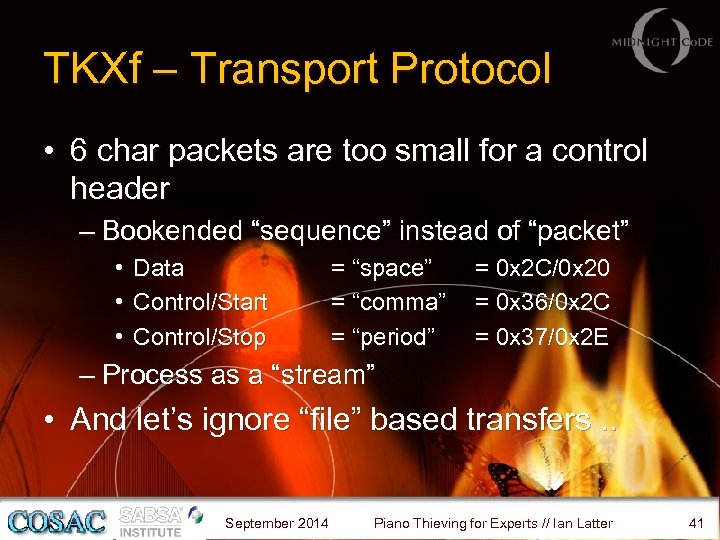
TKXf – Transport Protocol • 6 char packets are too small for a control header – Bookended “sequence” instead of “packet” • • • Data Control/Start Control/Stop = “space” = “comma” = “period” = 0 x 2 C/0 x 20 = 0 x 36/0 x 2 C = 0 x 37/0 x 2 E – Process as a “stream” • And let’s ignore “file” based transfers. . September 2014 Piano Thieving for Experts // Ian Latter 41
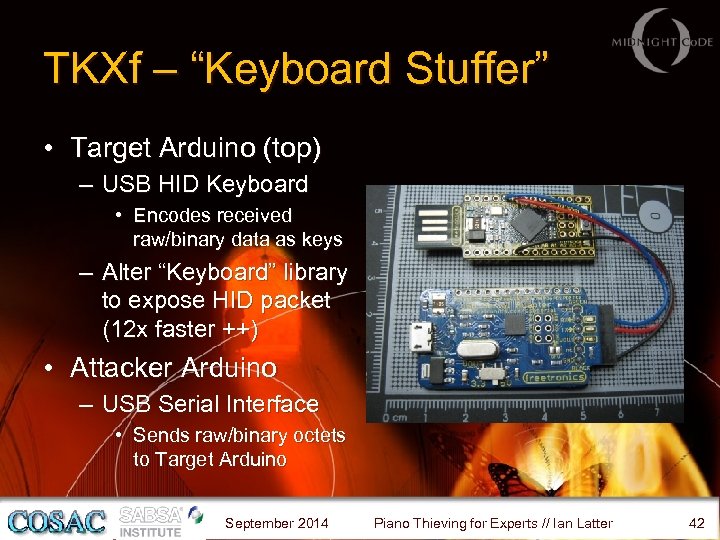
TKXf – “Keyboard Stuffer” • Target Arduino (top) – USB HID Keyboard • Encodes received raw/binary data as keys – Alter “Keyboard” library to expose HID packet (12 x faster ++) • Attacker Arduino – USB Serial Interface • Sends raw/binary octets to Target Arduino September 2014 Piano Thieving for Experts // Ian Latter 42
TGXf note • One note on TGXf before we integrate TGXf and TKXf – If we remove the control frames (layer) from TGXf it is capable of “streams” rather than “files” • Now we can assemble the Through Console Transfer application! September 2014 Piano Thieving for Experts // Ian Latter 43
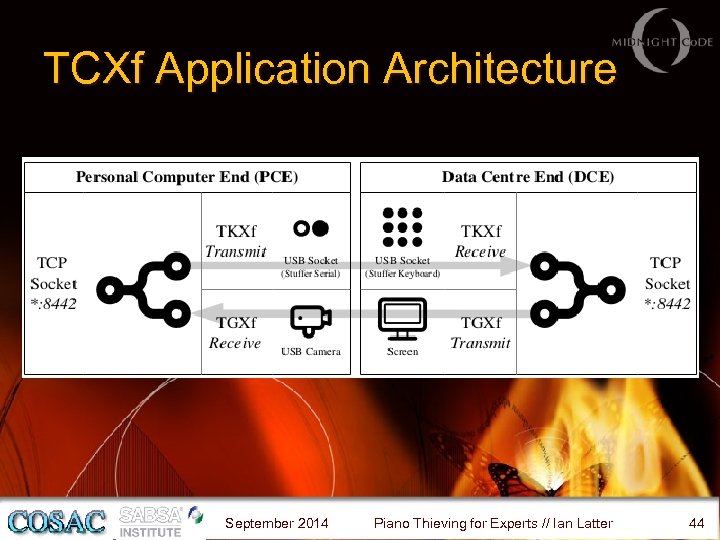
TCXf Application Architecture September 2014 Piano Thieving for Experts // Ian Latter 44
Technology check-point (3/3) • TCXf (code released today) – TKXf reference impl. has 12 kbps max, up • Could probably get this up to 32 kbps – Use Key clear packet with second character set (x 2) – Use base 64 for 4 bytes per 3 hex values (+1/3) – TGXf reference impl. has 32 kbps max, down – Features • • • Bi-directional, binary clear, serial connection Native network socket interface Insane portability / Massive vulnerability September 2014 Piano Thieving for Experts // Ian Latter 45
TCXf IP Network Evolution • PPP over the Screen and Keyboard – On the target device; • sudo pppd 10. 1. 1. 1: 10. 1. 1. 2 debug noccp nodetatch pty “netcat localhost 8442” – Note the privilege required to create a NIC (We already had a full-duplex socket without it) – On the attackers device; • sleep 2; sudo pppd noipdefault debug noccp nodetatch pty “netcat localhost 8442” September 2014 Piano Thieving for Experts // Ian Latter 46

ARCHITECTURE POC Impact on the Enterprise Architecture September 2014 Piano Thieving for Experts // Ian Latter 47
ESA Context? • Time to be Enterprise Security Architects again – Firstly, what are TGXf, TKXf and TCXf? • In the vulnerability taxonomy we are dealing with as “storage based” covert channel attacks – Secondly, where’s the enterprise? • So far we’ve been working from a local computer context • But in enterprise we abstract the screen and keyboard (on the organisation’s side). . September 2014 Piano Thieving for Experts // Ian Latter 48
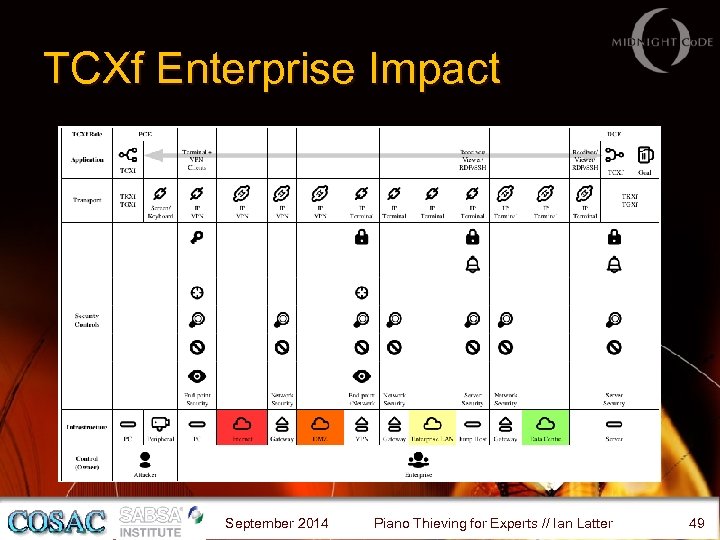
TCXf Enterprise Impact September 2014 Piano Thieving for Experts // Ian Latter 49
You made this September 2014 Piano Thieving for Experts // Ian Latter 50
TCXf pipe via XPe Thin Client Playing video 6. . September 2014 Piano Thieving for Experts // Ian Latter 51
TCXf PPP via XPe Thin Client Playing video 7. . September 2014 Piano Thieving for Experts // Ian Latter 52
Quick Fix? • You wish! – You could • Make all of your displays sub- 21 x 21 pixels & 2 fps – Make your DLP pick up QR codes? • I will change Layer 3 to a different bar-code – Block “evil barcodes”? • Add Open. CV and let people train TGXf – Cat pictures? Cars? Fortune 500 Logos? • I can also unplug the HDMI cable. . (later) September 2014 Piano Thieving for Experts // Ian Latter 53
Architectural Analysis • Human versus Machine? – Leaving out the PPP example, no variation in access was granted to the user. • TCXf can only type and read what the user can. – The distinct properties of delta seem to be; • Volume: transfer rate in bits per second or number of bits at rest, and; • Accuracy: of data transferred or stored, and; • Structure: of the data transferred, and; • Utility: of the over-arching capability. September 2014 Piano Thieving for Experts // Ian Latter 54
AA – Volume and Accuracy • Human performance: – Downloading • Humans can read from a screen at ~133 bps (~200 wpm x 5 bytes x 8 bits / 60 sec) – Uploading • Steven Hawking was uploading at 10 bps (15 wpm), prior to going infrared. • Stenotype world record set in 2004 is 240 bps (360 wpm) at 97. 23% accuracy. • Average of ~125 bps September 2014 Piano Thieving for Experts // Ian Latter 55
AA – Volume/Accuracy threat? • Is the primary threat being super-human? – After all: • How long can you read and write at your peak rate? • What percentage of that data will be errors, or throughput impacts as you resend (re-read & retype) corrections? • How much of what you have read can you repeat letter for letter? September 2014 Piano Thieving for Experts // Ian Latter 56
AA – Codify/Encipher/Structure • There was no intent to create a clandestine or encrypted channel here – Architecturally, the only distinction is whether we (or others) can parse the structure. • Humans can parse substantially less structured data than the machine – threat? – This gap is diminishing – So perhaps the machine communication channel requires only “additional structure”. . September 2014 Piano Thieving for Experts // Ian Latter 57
AA – Utility • Human up side – Humans would seem to have greater utility than machines (you can pass a metal detector with bits, swim with them, etc) • Human down side – Data outside of the machine is not as valuable in utility terms – Human declarative memory is pretty feeble (i. e. 25%+ of data lost in 30 minutes) September 2014 Piano Thieving for Experts // Ian Latter 58
AA – Utility threat? • Most substantial impacts from: – One end of the attack being outside of the controlled environment entirely – Communications channel leveraged being effectively unchecked (outside of random assignments) – Digital preservation of the source data, in a mobile/portable format (unconstrained by time, physical or logical environment, or person) – immediately reusable September 2014 Piano Thieving for Experts // Ian Latter 59
Mitigation Strategies (1/2) • Aligned to architectural analysis – Volume • • • Reduce display resolution Decrease the # of HID packets/s Increase latency into either data stream – Accuracy • Add visual distortions to display data • Introduce errors into key strokes and add noise to mouse pointer data September 2014 Piano Thieving for Experts // Ian Latter 60
Mitigation Strategies (2/2) – Structure • Analyse display data for excessive structure – Consider “Deep Packet Inspection” equivalent for displays – looking inside video/image data for structure. • Perform frequency analysis on key strokes or bayesian analysis on typed words – Utility • Seal (glue/weld, not fish eater) electronic interfaces • Apply secondary controls to exposed user interfaces. September 2014 Piano Thieving for Experts // Ian Latter 61
Counter Culture (1/2) • Compare the mitigation proposals to your remote access strategies; – Reducing latency / improving responsiveness • Increased network infrastructure capacities • Ever increasing CPU core-count per user – Increasing throughput (particularly display) • • • Increased display resolution and refresh rates Video acceleration Stream compression / Link compression September 2014 Piano Thieving for Experts // Ian Latter 62
Counter Culture (2/2) – Increased utility • Less structured graphical interfaces • Allowing users to bring uncontrolled devices into controlled environments (& even directly connect) – Apathy toward physical controls • Physical security is lax, weak or absent at end points • Publishing controlled interfaces into uncontrolled environments • Photographic equipment in controlled environments September 2014 Piano Thieving for Experts // Ian Latter 63
Forever War (1/4) • Human consumers will be the losers in the coming and inevitable war (Mr Anderson). • Anticipated evolutionary strategies: – Volume • Using multiple interfaces to increase through-put – Caps/Num/Scroll Lock lights on the keyboard, user ctrl – Sound has not been explored here • Using software interfaces to increase through-put – The ATAPI interface in VMWare for example – Printer drivers for example September 2014 Piano Thieving for Experts // Ian Latter 64
Forever War (2/4) – Accuracy • Making noise – Random errors in displays exist (ever tuned a TV), but so does error correction (and there’s Shannon’s Law) – How long will your users accept errors being injected into their chat sessions, email and office suite apps? September 2014 Piano Thieving for Experts // Ian Latter 65
Forever War (3/4) – Structure • Analyse I/O data for excessive structure – Observing highly structured data (like only 20 keys being used, excluding vowels) through bayes analysis is an obvious detection method » Using a dictionary and bayes generation approach is the obvious response – Deep packet inspection for visual data can be defeated through meta views (logo example) – Also, be prepared for » OCR and encoded blocks of text (english stories) » Non-contextual use of “foreign” language » Data in “random” pixels (yellow printer serial dots) September 2014 Piano Thieving for Experts // Ian Latter 66
Forever War (4/4) – Utility • Cutting / melting equipment – Glue the USB socket and I’ll cut the cord – Bury the cord or encrypt keyboard-to-PC comms and I’ll pull the keys off (high school – good times) • Disconnecting accessories – Virtual keyboards (under glass) in how many budgets? – Meet my electrostatic overlay for capacitive/resistive displays, or reflective surface for optical displays • Morphing infrastructure – Strobe lights for displays? Randomly moving virtual keyboards to necessitate visual tracking? Really? September 2014 Piano Thieving for Experts // Ian Latter 67
History – Lampson, 1973 • “A note on the Confinement Problem” • Enforcement: The supervisor must ensure that a confined program's input to covert channels conforms to the caller's specifications. This may require slowing the program down, generating spurious disk references, or whatever, but it is conceptually straightforward. The cost of enforcement may be high. A cheaper alternative (if the customer is willing to accept some amount of leakage) is to bound the capacity of the covert channels. September 2014 Piano Thieving for Experts // Ian Latter 68
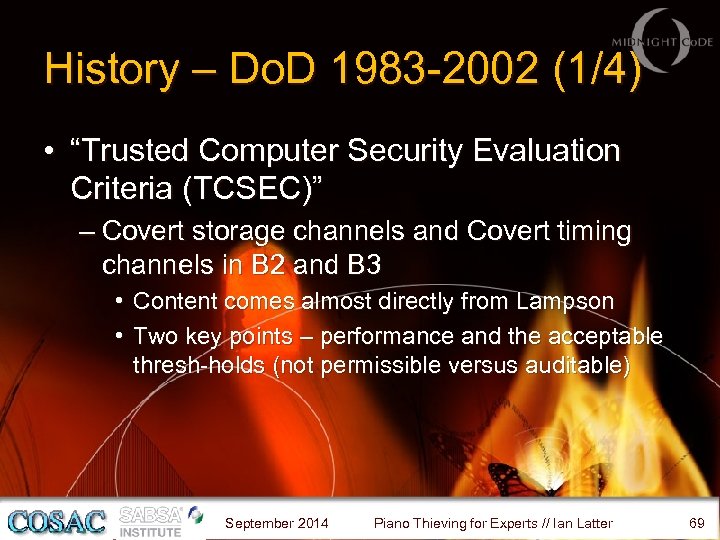
History – Do. D 1983 -2002 (1/4) • “Trusted Computer Security Evaluation Criteria (TCSEC)” – Covert storage channels and Covert timing channels in B 2 and B 3 • Content comes almost directly from Lampson • Two key points – performance and the acceptable thresh-holds (not permissible versus auditable) September 2014 Piano Thieving for Experts // Ian Latter 69
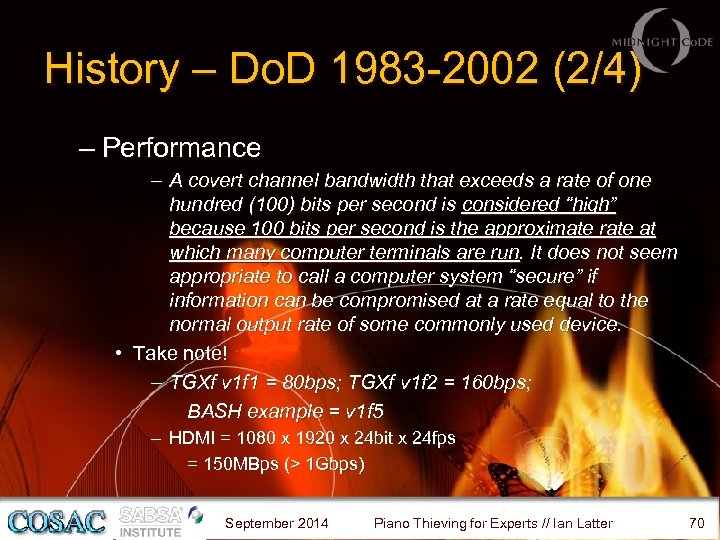
History – Do. D 1983 -2002 (2/4) – Performance – A covert channel bandwidth that exceeds a rate of one hundred (100) bits per second is considered “high” because 100 bits per second is the approximate rate at which many computer terminals are run. It does not seem appropriate to call a computer system “secure” if information can be compromised at a rate equal to the normal output rate of some commonly used device. • Take note! – TGXf v 1 f 1 = 80 bps; TGXf v 1 f 2 = 160 bps; BASH example = v 1 f 5 – HDMI = 1080 x 1920 x 24 bit x 24 fps = 150 MBps (> 1 Gbps) September 2014 Piano Thieving for Experts // Ian Latter 70
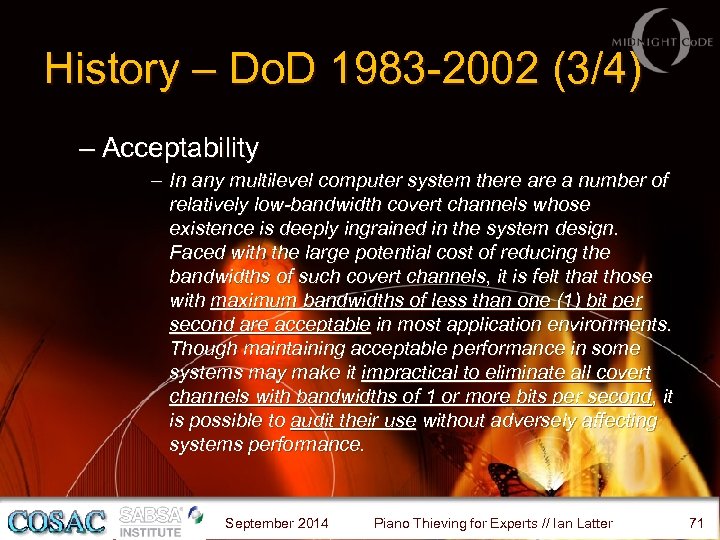
History – Do. D 1983 -2002 (3/4) – Acceptability – In any multilevel computer system there a number of relatively low-bandwidth covert channels whose existence is deeply ingrained in the system design. Faced with the large potential cost of reducing the bandwidths of such covert channels, it is felt that those with maximum bandwidths of less than one (1) bit per second are acceptable in most application environments. Though maintaining acceptable performance in some systems may make it impractical to eliminate all covert channels with bandwidths of 1 or more bits per second, it is possible to audit their use without adversely affecting systems performance. September 2014 Piano Thieving for Experts // Ian Latter 71
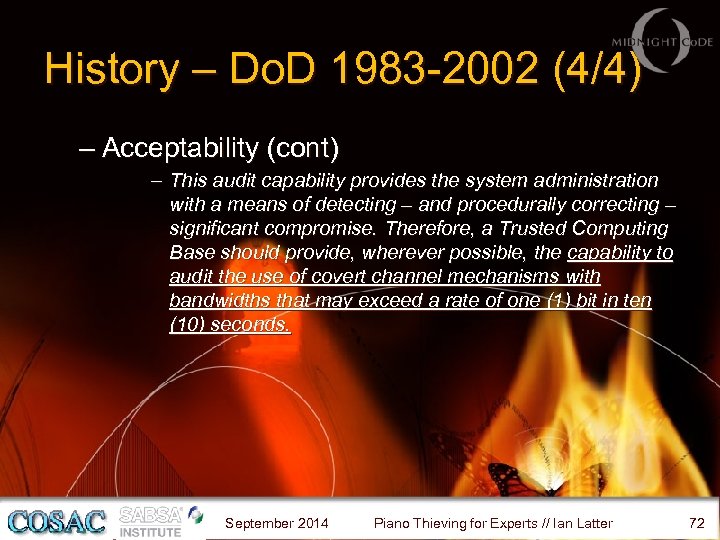
History – Do. D 1983 -2002 (4/4) – Acceptability (cont) – This audit capability provides the system administration with a means of detecting – and procedurally correcting – significant compromise. Therefore, a Trusted Computing Base should provide, wherever possible, the capability to audit the use of covert channel mechanisms with bandwidths that may exceed a rate of one (1) bit in ten (10) seconds. September 2014 Piano Thieving for Experts // Ian Latter 72
History – SABSA, 2010 • Foundation 1, Slide 30, Page 16 – 3 pages into F 1: Component Solutions Fail – Each of these devices (and those to come in future) bypass the technology-specific gateway content filter – So the gateway filtering solution no longer solves the problem and we must find (and pay for) a new one each time technology changes – An architected future-proof solution would have utilised the presentation layer – the issue is ‘display of inappropriate images’ and the proper solution could detect them whatever the source of the images (today or in the future) September 2014 Piano Thieving for Experts // Ian Latter 73
Punch-line – Use and Off-shore • The new equilibrium. . – Use –v– Disclosure • Are functionally identical (Display = Upload) • There is no pragmatic difference – Off-shoring / Right-Sourcing / Best-shoring • . . as the short-form for “remote access for un/semitrusted users to access sensitive data on shore”. . • . . if you like your data to be yours alone. . • Is not currently, and is unlikely to ever be, “safe” – This may also affect other user populations September 2014 Piano Thieving for Experts // Ian Latter 74
Punch-line – Controls – Technical Security Capability • “like human” – Data statistically and structurally human language – Likely? Peer review paper accepted in 2008 • Lack the appropriate controls framework – Controls on the axis of: Volume, Accuracy, Structure, and Utility • Such a controls framework is likely to be broadly useful to society for – Robotics (human machine, flexible interfaces) – Offensive and Defensive AI strategies » Advanced Persistent Threats, anyone? September 2014 Piano Thieving for Experts // Ian Latter 75
Thank-you! – Thanks to COSAC and SABSA • Thanks to my wife and daughter • Thru. Glass. Xfer – Information site: http: //thruglassxfer. com/ – Project site: http: //midnightcode. org/projects/TGXf/ – Contact me: Ian. Latter@midnightcode. org (If you’re talking to me on social media, it’s not me) – And to Spike Milligan: • Headstone: Duirt mé leat go raibh mé breoite – Gaelic for “I told you I was ill. ” – lol, legend September 2014 Piano Thieving for Experts // Ian Latter 76
Скачать презентацию Piano Thieving for Experts That Bathroom Window IS
c53a1f65e9000d248c76b0a7e2b77c78.ppt