


 Скачать презентацию PI Prof P Sellin University of Surrey Dr
ad9bdb990c2a4fb85542bc0f304f3883.ppt
- Количество слайдов: 8
 PI: Prof P. Sellin University of Surrey Dr Neil Gaspar Nuclear Threat Reduction, AWE www. nusec. uk STFC Nuclear Science Community Meeting January 2018
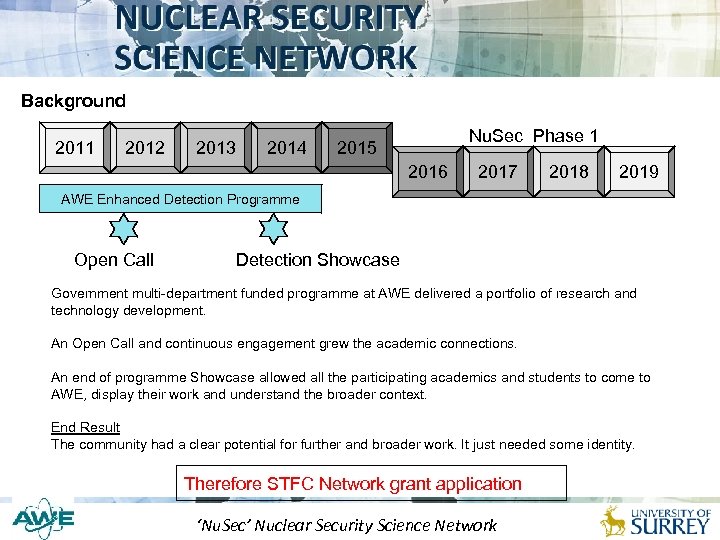 Background 2011 2012 2013 2014 Nu. Sec Phase 1 2015 2016 2017 2018 2019 AWE Enhanced Detection Programme Open Call Detection Showcase Government multi-department funded programme at AWE delivered a portfolio of research and technology development. An Open Call and continuous engagement grew the academic connections. An end of programme Showcase allowed all the participating academics and students to come to AWE, display their work and understand the broader context. End Result The community had a clear potential for further and broader work. It just needed some identity. Therefore STFC Network grant application ‘Nu. Sec’ Nuclear Security Science Network
 PI Prof Paul Sellin March 2016 for three years Value £ 220 k at 80% FEC Introducing the Nuclear Security Sciences Network, ‘Nu. Sec’ The aims of the Network: to develop collaboration between the academic, industrial and defence sectors in the area of nuclear security 1. To encourage translational research and technology development, through annual Technology workshops that focus on technical themes. 2. Cross disciplinary collaboration to address end-user challenges, through annual Challenge Meetings 3. Pilot studies supported by £ 60 k of Home Office network funding. 4. Coordinate applications to third party funding (H 2020, CDE, Innovate UK, AWE/ED programme, US DNDO/DTRA). 5. Provide a mechanism for collaboration with other networks and communities, eg Env. Rad. Net and KTN Defence and Security. ‘Nu. Sec’ Nuclear Security Science Network
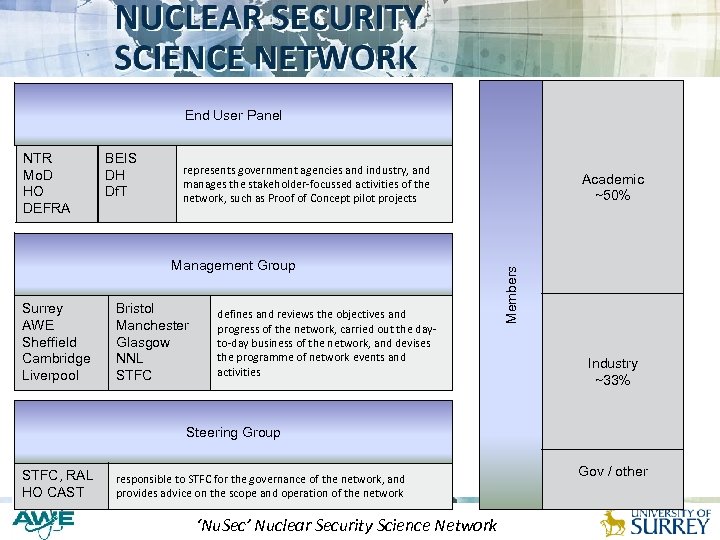 End User Panel BEIS DH Df. T represents government agencies and industry, and manages the stakeholder-focussed activities of the network, such as Proof of Concept pilot projects Management Group Surrey AWE Sheffield Cambridge Liverpool Bristol Manchester Glasgow NNL STFC defines and reviews the objectives and progress of the network, carried out the dayto-day business of the network, and devises the programme of network events and activities Academic ~50% Members NTR Mo. D HO DEFRA Industry ~33% Steering Group STFC, RAL HO CAST responsible to STFC for the governance of the network, and provides advice on the scope and operation of the network ‘Nu. Sec’ Nuclear Security Science Network Gov / other
 Network Meetings are our main route to deliver the network objectives Technology Workshops –focus on specific technical themes, bringing together new research collaborations Kick off Event – March 2016 Imaging and Localisation – Sep 2016 Data and Algorithms – Sep 2017 Challenge Workshops –to develop cross-disciplinary solutions to address enduser challenges Alternative Technologies to Well Loggers – Jan 2018 A cross disciplinary technology roadmapping event to drive the replacement of industrial sources in the energy industry. Driven by the HO with notable US involvement and buy-in from the energy industry. Conferences/Showcases – to enable broad community discussions and sharing of results Broad community conference – March 2019 ‘Nu. Sec’ Nuclear Security Science Network
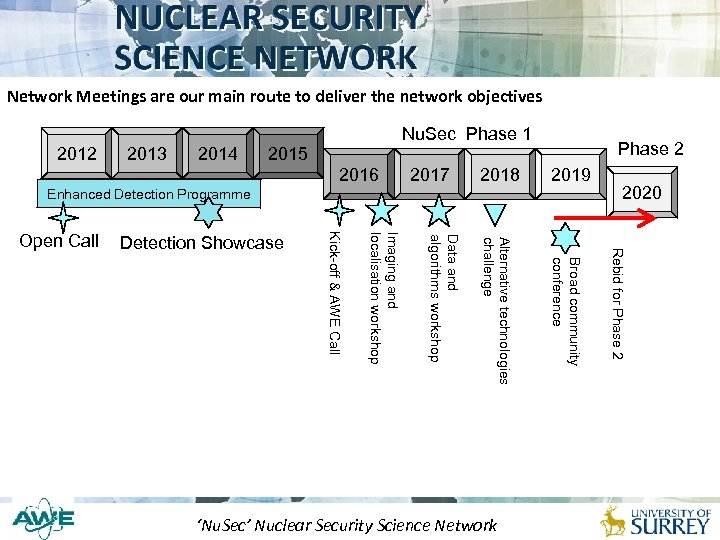 Network Meetings are our main route to deliver the network objectives Nu. Sec Phase 1 2012 2013 2014 Phase 2 2015 2019 Enhanced Detection Programme Data and algorithms workshop Imaging and localisation workshop Detection Showcase Kick-off & AWE Call Open Call ‘Nu. Sec’ Nuclear Security Science Network 2020 Rebid for Phase 2 2018 Broad community conference 2017 Alternative technologies challenge 2016
 Pilot Studies The network has funding from Home Office through AWE to support small proof of concept studies. These are typically be summer student projects up to £ 4 k. Selection is via the End User Panel with Management group providing technical scrutiny. • Colloid interaction with Muons • Passive radiation imaging • Pulse-shape analysis • Evidential Reasoning for Radiological Detection • Thallium Bromide sensors • Fluorescence spectra of alpha emitting isotopes for stand-off detector development • PSA for temperature dependent scintillators • A Study of Van Allen Belt Signatures of Nuclear Weapon Tests for Future CTBT Technologies • Compact X-Ray Sources • Neural Network Techniques for Neutron Source Localisation using a Segmented Scintillator Detector Personal Development Grants General criteria for developing people or inter-disciplinary collaboration. 12 awards in two years valuing ~£ 13 k ‘Nu. Sec’ Nuclear Security Science Network
 Everyone can keep in touch with the network via: The Nu. Sec website –at www. nusec. uk By email –the general network email address is: info@nusec. uk Contact our Network Administrator – we have a part-time network administrator based at the University of Surrey for two days a week. ‘Nu. Sec’ Nuclear Security Science Network