 Скачать презентацию Physiological Roots of Psychology Contributions to Founding
1f041d19a29e9cfb895b434c5cb4ab75.ppt
- Количество слайдов: 34




Physiological Roots of Psychology
Contributions to Founding of Psychology • Philosophers – Deductive and inductive reasoning – Raised many of the basic questions psychological research addresses today • Physiologists – The methodological systems for testing proposed answers to these questions
Goals of early physiological research • Neuroanatomy – attempted to determine if function could be localized in the nervous system and how it was localized • Neurophysiology – attempted to identify how nerves worked
Major contributors • Neuroanatomy – Gall, Flouren, Broca, and Wernicke • Neurophysiology – Bell, Magendie, Muller, and Helmholtz (Mentor to Wilhelm Wundt)
Function of the spinal nerves • Difference in function between dorsal nerves, entering the back of the spinal cord , and the ventral nerves leaving the front. • Magendie – French physician – 1822 – described the function correctly dorsal nerves carry snsory information; ventral related to movement – Experimental methods systematic and of a high quality – Identified the reflex arc that became the framework for psychology’s stimulus->response
Controversy • Bell – an English neuroanatomist – Claimed he had discovered this first and published it in a private publication – Demanded credit for the discovery or he claimed “priority” – His description of the functions was wrong • Ventral nerves voluntary movement • Dorsal nerves involuntary movement – Magendie read Bell’s paper said it was similar but not enough to quit his claim of priority
Controversy (cont. ) • Final outcome was the Bell-Magendie Law • In reality, Bell had no claim to the finding – – Magendie used better experimental methods Magendie findings more complete and definitive His conclusions were clear and correct Much of Bell’s criticisms were inaccurate and unrelated to the issue – There was extensive evidence that Bell alstered his early work to support his claim
Bell’s contribution • After Magendie published his paper, Bell made his most significant contributiions – Since nerves intervene between the world and our perceptions, nerve activity can influence the quality of our perceptions – The sensation a person experiences depends upon not only the stimulus but upon which nerve was active
Muller and the doctrine of Nerve Specificity • 5 kinds of nerves one for each sensory ability. Each carried only one type of sensory information • Failure of Muller – – Attempted to measure the speed of nerve conduction and was unable to do so because inadequate measuring devices – Concluded that nerve impulses were instantaneous and therefore could not be measured
Muller and “vitalism” • Vitalism –Life processes could not be explained by the interaction of physical and chemical processes alone. Life was more than a physical process and could not be reduced to physical processes. Therefore there is a life force that was beyond scientific study
Herman von Helmholtz • Rejected vitalism – nothing mysterious about life; it could be studied using physical and chemical methods of inquiry – the same laws that apply to nonliving things apply to living things – Example Principle of Conservation of Energy
Contributions of von Helmholtz • He developed equipment that could measure nerve impulses – they were not instantaneous – activity of nervous system could be studied. Motor neuron in frog had impulses of 43 meters/second • Speed of nerve conduction in humans much slower than previously thought and could be measured • Importance to development of psychology – mental actions could be measured and studied
Important example • F. C. Donders – Dutch physiologist described 3 types of reaction times – A-reaction time – simple s->r – B-reaction time – see many stimuli (one at a time) make a discrimination - choose the correct response to make – C-reaction time – see many stimuli respond only to 1 of the stimuli • Each of these reaction times could be measured and used to calculate the speed of mental processing
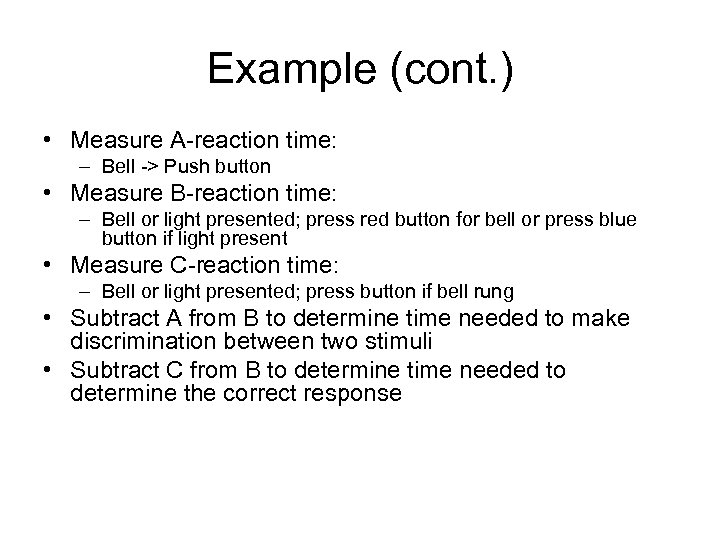
Example (cont. ) • Measure A-reaction time: – Bell -> Push button • Measure B-reaction time: – Bell or light presented; press red button for bell or press blue button if light present • Measure C-reaction time: – Bell or light presented; press button if bell rung • Subtract A from B to determine time needed to make discrimination between two stimuli • Subtract C from B to determine time needed to determine the correct response
Von Helmholtz – Theory of Perception • Sensations are the raw elements of conscious experience; they result from physical activity of different sensory organs • Perceptions are sensations converted by past experience – past experiences give meaning to sensations by turning them into perceptions • Theory of color vision – Young-Helmholtz Trichromatic Theory
Helmholtz’s major influence • Psychological events could be studied using scientific methods • Studying and measuring the relationship between physical events and mental experiences naturally led to experimental psychology • Helmholtz was never a psychologist
Localization of Function
Franz Gall – Phrenology 1810 -1819 • A person’s personality characteristics could be determined by the size of different bumps on the head • Concept that physical features could indicate psychological characteristics very popular at the time – Darwin almost excluded from trip on HMS Beagle because the Captain didn’t think his nose shape was that of a sailor
Gall’s error with Phrenology • His assumption that the shape of the skull was related to the size of the underlying areas of brain • His “faculties” of personality were arbitrary and undefendable • Confirmation bias – only presented cases that were consistent with his theory and discounted evidence that contradicted it
Phrenology • Quickly rejected and ridiculed by scientific community – extreme reaction fueled by Gall not one of the inner circle • Rejected by Catholic Church and books banned • Gall’s response was to go on speaking tour making money using an invalid theory
Ignored contributions of Gall • Higher cognitive processes related to the cortex, the more cortex an animal had the higher its mental functions • 1 st to describe 2 forms of matter in CNS and what they consisted of • 1 st to identify the interconnections between the hemispheres as made up of nerve bundles • 1 st to describe the crossing over of nerve fibers in the spinal cord
Pierre Flouren’s Experiments 18201830’s • Most serious challenge to Gall and phrenology • Criticized Gall for improper methology • Experiments removed slices of brain from live animals, then measured behavioral changes • Gall centered sex drive in an area now know as the cerebellum in the back of the brain • Flouren showed that removal of this area affected motor activity and coordination • Removed other areas and found different results than predicted by phrenology
Debate • Gall criticized Flourens studies by saying Flouren had removed extremely large amounts of tissue and had removed multiple areas resulting in extensive damage • Finding Gall couldn’t respond to – recovery of function; sometimes animals regained a lost function
Flouren’s error • The very large size of his lesions and his adamant rejection of phrenology led him to reject localization of functioning in the cortex • The only localization of function was the cortex was the “seat of will” and the cerebellum was involved in muscle coordination • Adopted unity of function
Phrenology, Mesmerism, Perkinism, and Acupuncture • Popularity of phrenology continued in the general public despite scientific rejection • Mesmerism, Perkinism, and acupuncture were summarily ejected, and disappeared • Phrenology consistent with popular beliefs – physical characteristics could indicate personality traits; others were not • Issue not addressed – if these were useless cures, why did they sometimes work?
Unrecognized contributions of Phrenology • 1 st systematic scientific attempt at behavior research • 1 st attempt at applied psychology • 1 st attempt at physiological psychology
The end of unity of function • Famous case of Phineas Gage • Studies of Pierre-Paul Broca – French physician and strong supporter of Flouren’s unity of function
Broca’s change of mind • 1861 Ernest Aubertin presented a single case study of a person who had lost his speech and had increasing right side paralysis. He predicted that damage in the frontal lobes would be found. • April 4, 1861 - Broca argued against this idea of localization o speech • A few days later Broca given a similar case
Case history • Patient normal until loss of speech • 10 years later – weakness in right arm developed into paralysis • 4 years later – paralysis spread down right side until he could no longer stand • 7 years later bed ridden with loss of sensation on right side – intellect intact • Patient died April 17, 1861 • Autopsy showed large lesion centered in lower area of left frontal lobe
Broca’s Area? • Broca admitted he was wrong and continued to study the rain and case history • He determined that the center of the lesion must be where speech was located – That was where the most damage was so it was where the lesion began – The patient’s 1 st deficit was a lack of speech • Auberton not interested in studying the brain after he was shown to be correct • Broca found the precise area involved in speech production
Localization of function (cont. ) • 1874 – Wernicke reported that an area of the temporal lobe was responsible for language comprehension • 1860 -1870’s – great use of lesion work with nonhumans to further localize function in the cortex • 1870’s – began electrical stimulation of nonhuman animal brains
Electrical stimulation • Most important was the work of David Ferrier • 1876 – reported localization of different sensory and motor functions in many nonhuman animals • Later, he so precisely mapped functions in the monkey that his maps were used to remove a tumor in a human for the 1 st time in history • Bartholomew – 1874 – reported results of electrical stimulation of a human brain – Raised ethical questions and he was run out of town
Electrical stimulation • Electrical stimulation continues today in both nonhumans and humans • In humans, it is done during neurosurgery to locate functional areas because there tends to be large individual differences
Important point in history for psychology • 1870’s • Philosophers have developed the general questions psychologists will address • Studies of the nervous system, psychophysics, physiology, etc. have applied the scientific method to the study of mental function • They have also shown that we can measure mental processes. • Finding that different mental processes involve different parts of the brain indicates they function differently
Скачать презентацию Physiological Roots of Psychology Contributions to Founding
1f041d19a29e9cfb895b434c5cb4ab75.ppt