 Скачать презентацию Physics for Health CERN February 2010 Technical evaluation
41dfc9556c1d0f344f9987485e0c8838.ppt
- Количество слайдов: 35



Physics for Health, CERN, February 2010 Technical evaluation of an acceleratordriven production of Mo-99 for Tc-99 m generators at CERN (Moly. PAN project) S. Buono, N. Burgio, L. Maciocco
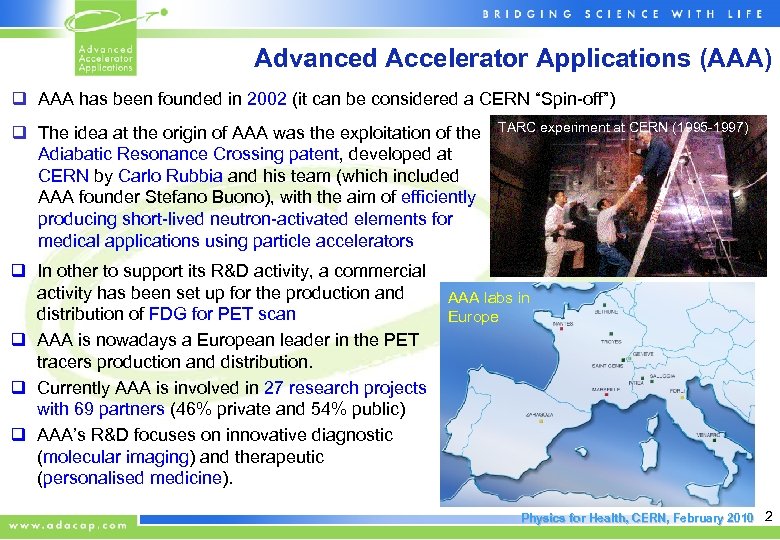
Advanced Accelerator Applications (AAA) q AAA has been founded in 2002 (it can be considered a CERN “Spin-off”) q The idea at the origin of AAA was the exploitation of the Adiabatic Resonance Crossing patent, developed at CERN by Carlo Rubbia and his team (which included AAA founder Stefano Buono), with the aim of efficiently producing short-lived neutron-activated elements for medical applications using particle accelerators q In other to support its R&D activity, a commercial activity has been set up for the production and distribution of FDG for PET scan q AAA is nowadays a European leader in the PET tracers production and distribution. q Currently AAA is involved in 27 research projects with 69 partners (46% private and 54% public) q AAA’s R&D focuses on innovative diagnostic (molecular imaging) and therapeutic (personalised medicine). TARC experiment at CERN (1995 -1997) AAA labs in Europe Physics for Health, CERN, February 2010 2
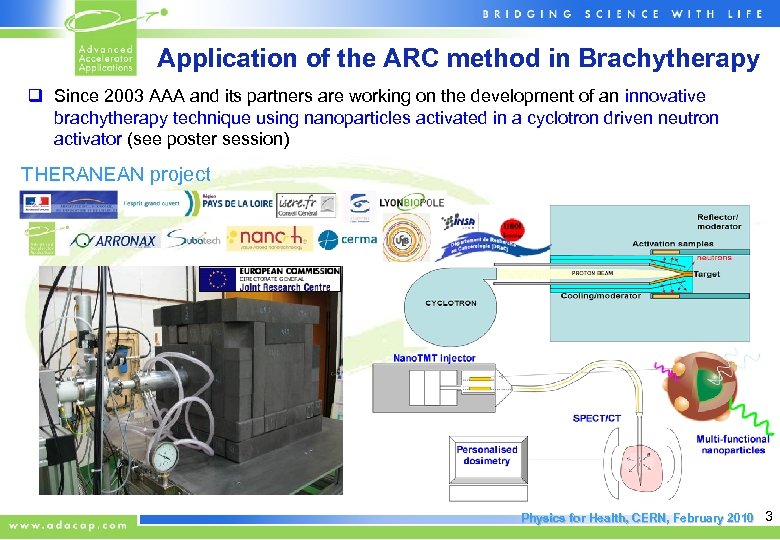
Application of the ARC method in Brachytherapy q Since 2003 AAA and its partners are working on the development of an innovative brachytherapy technique using nanoparticles activated in a cyclotron driven neutron activator (see poster session) THERANEAN project Physics for Health, CERN, February 2010 3
Mo-99 production from a particle accelerator • The worldwide supply chain of Mo-99 is essentially based on the production from 5 nuclear research reactors that are approaching the end of their operational lifetime • The ageing of the installations are inducing unscheduled shutdowns that provoke severe shortage of Mo-99, hitting the nuclear medicine community • As a consequence, the feasibility of a Mo-99 production cycle based on particle accelerators is being assessed, as it may presents many advantages in terms of safety, cost, time to market as well as environmental and proliferation issues 4
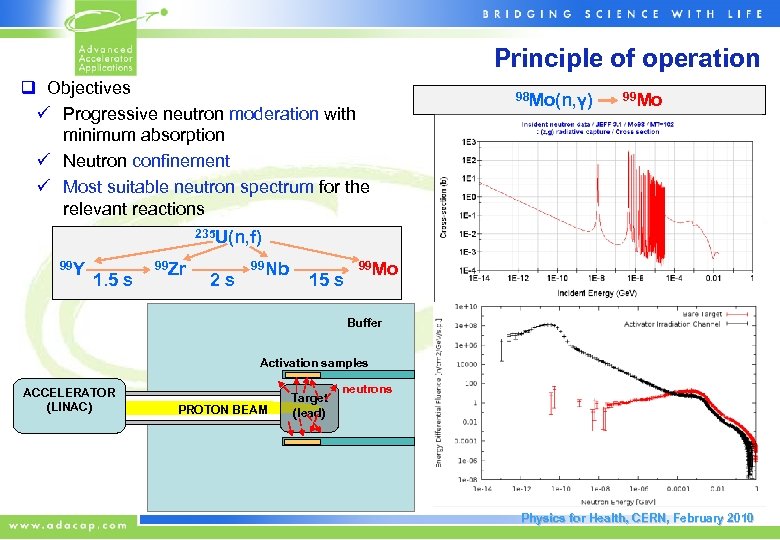
Principle of operation q Objectives ü Progressive neutron moderation with minimum absorption ü Neutron confinement ü Most suitable neutron spectrum for the relevant reactions 98 Mo(n, γ) 99 Mo 235 U(n, f) 99 Y 99 Zr 99 Nb 99 Mo 1. 5 s 2 s 15 s Buffer Activation samples ACCELERATOR (LINAC) PROTON BEAM Target (lead) neutrons Physics for Health, CERN, February 2010
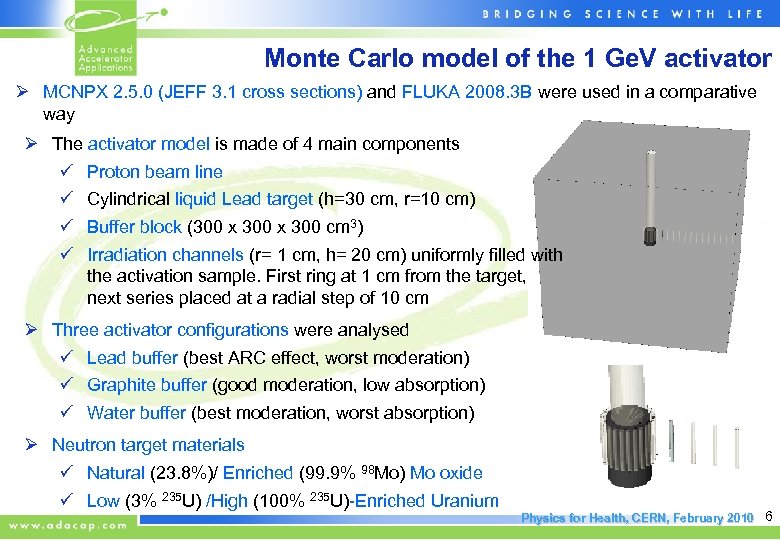
Monte Carlo model of the 1 Ge. V activator Ø MCNPX 2. 5. 0 (JEFF 3. 1 cross sections) and FLUKA 2008. 3 B were used in a comparative way Ø The activator model is made of 4 main components ü Proton beam line ü Cylindrical liquid Lead target (h=30 cm, r=10 cm) ü Buffer block (300 x 300 cm 3) ü Irradiation channels (r= 1 cm, h= 20 cm) uniformly filled with the activation sample. First ring at 1 cm from the target, next series placed at a radial step of 10 cm Ø Three activator configurations were analysed ü Lead buffer (best ARC effect, worst moderation) ü Graphite buffer (good moderation, low absorption) ü Water buffer (best moderation, worst absorption) Ø Neutron target materials ü Natural (23. 8%)/ Enriched (99. 9% 98 Mo) Mo oxide ü Low (3% 235 U) /High (100% 235 U)-Enriched Uranium Physics for Health, CERN, February 2010 6
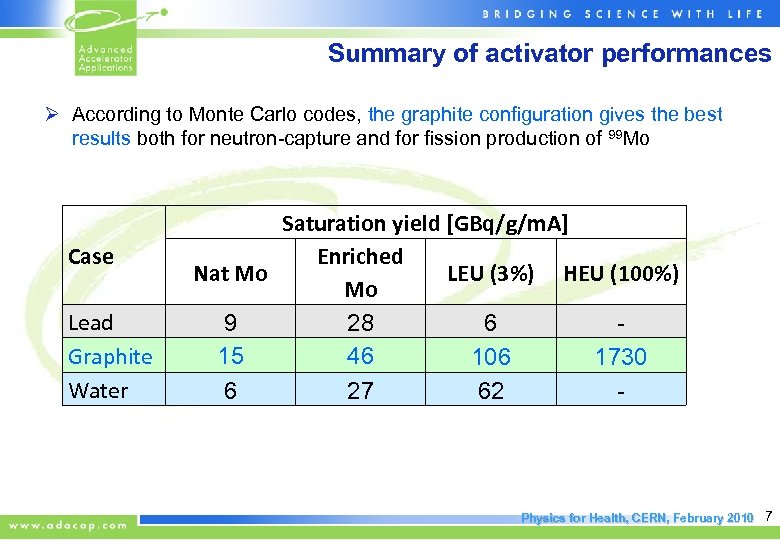
Summary of activator performances Ø According to Monte Carlo codes, the graphite configuration gives the best results both for neutron-capture and for fission production of 99 Mo Case Lead Graphite Water Saturation yield [GBq/g/m. A] Enriched Nat Mo LEU (3%) HEU (100%) Mo 9 28 6 15 46 106 1730 6 27 62 - Physics for Health, CERN, February 2010 7
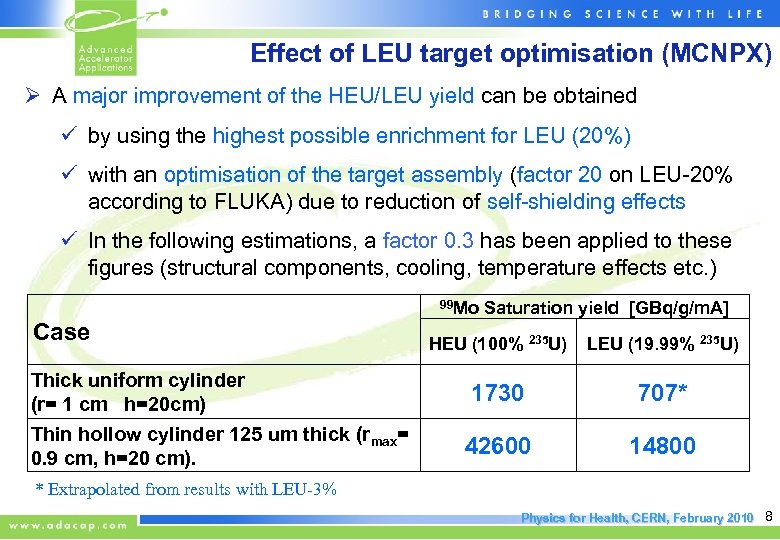
Effect of LEU target optimisation (MCNPX) Ø A major improvement of the HEU/LEU yield can be obtained ü by using the highest possible enrichment for LEU (20%) ü with an optimisation of the target assembly (factor 20 on LEU-20% according to FLUKA) due to reduction of self-shielding effects ü In the following estimations, a factor 0. 3 has been applied to these figures (structural components, cooling, temperature effects etc. ) 99 Mo Saturation yield [GBq/g/m. A] Case Thick uniform cylinder (r= 1 cm h=20 cm) Thin hollow cylinder 125 um thick (rmax= 0. 9 cm, h=20 cm). HEU (100% 235 U) LEU (19. 99% 235 U) 1730 707* 42600 14800 * Extrapolated from results with LEU-3% Physics for Health, CERN, February 2010 8
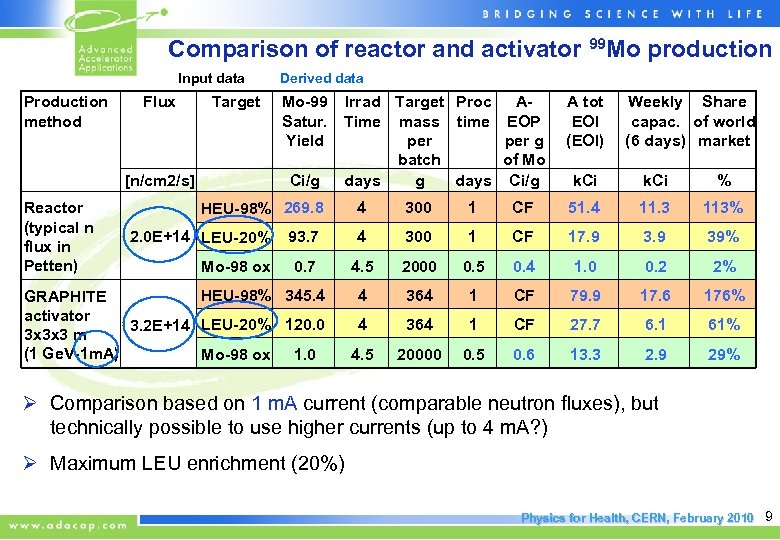
Comparison of reactor and activator 99 Mo production Input data Derived data Production method Flux Target [n/cm 2/s] Reactor (typical n flux in Petten) Mo-99 Irrad Target Proc ASatur. Time mass time EOP Yield per g batch of Mo Ci/g days Ci/g HEU-98% 269. 8 A tot EOI (EOI) Weekly Share capac. of world (6 days) market k. Ci % 4 300 1 CF 51. 4 11. 3 113% 2. 0 E+14 LEU-20% 93. 7 4 300 1 CF 17. 9 39% Mo-98 ox 0. 7 4. 5 2000 0. 5 0. 4 1. 0 0. 2 2% 4 364 1 CF 79. 9 17. 6 176% 4 364 1 CF 27. 7 6. 1 61% 4. 5 20000 0. 5 0. 6 13. 3 2. 9 29% HEU-98% 345. 4 GRAPHITE activator 3. 2 E+14 LEU-20% 120. 0 3 x 3 x 3 m (1 Ge. V-1 m. A) Mo-98 ox 1. 0 Ø Comparison based on 1 m. A current (comparable neutron fluxes), but technically possible to use higher currents (up to 4 m. A? ) Ø Maximum LEU enrichment (20%) Physics for Health, CERN, February 2010 9
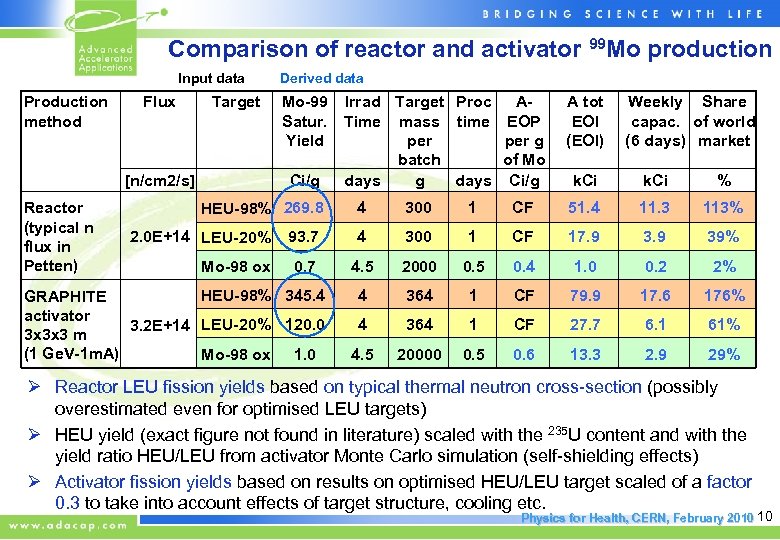
Comparison of reactor and activator 99 Mo production Input data Derived data Production method Flux Target [n/cm 2/s] Reactor (typical n flux in Petten) Mo-99 Irrad Target Proc ASatur. Time mass time EOP Yield per g batch of Mo Ci/g days Ci/g HEU-98% 269. 8 A tot EOI (EOI) Weekly Share capac. of world (6 days) market k. Ci % 4 300 1 CF 51. 4 11. 3 113% 2. 0 E+14 LEU-20% 93. 7 4 300 1 CF 17. 9 39% Mo-98 ox 0. 7 4. 5 2000 0. 5 0. 4 1. 0 0. 2 2% 4 364 1 CF 79. 9 17. 6 176% 4 364 1 CF 27. 7 6. 1 61% 4. 5 20000 0. 5 0. 6 13. 3 2. 9 29% HEU-98% 345. 4 GRAPHITE activator 3. 2 E+14 LEU-20% 120. 0 3 x 3 x 3 m (1 Ge. V-1 m. A) Mo-98 ox 1. 0 Ø Reactor LEU fission yields based on typical thermal neutron cross-section (possibly overestimated even for optimised LEU targets) Ø HEU yield (exact figure not found in literature) scaled with the 235 U content and with the yield ratio HEU/LEU from activator Monte Carlo simulation (self-shielding effects) Ø Activator fission yields based on results on optimised HEU/LEU target scaled of a factor 0. 3 to take into account effects of target structure, cooling etc. Physics for Health, CERN, February 2010 10
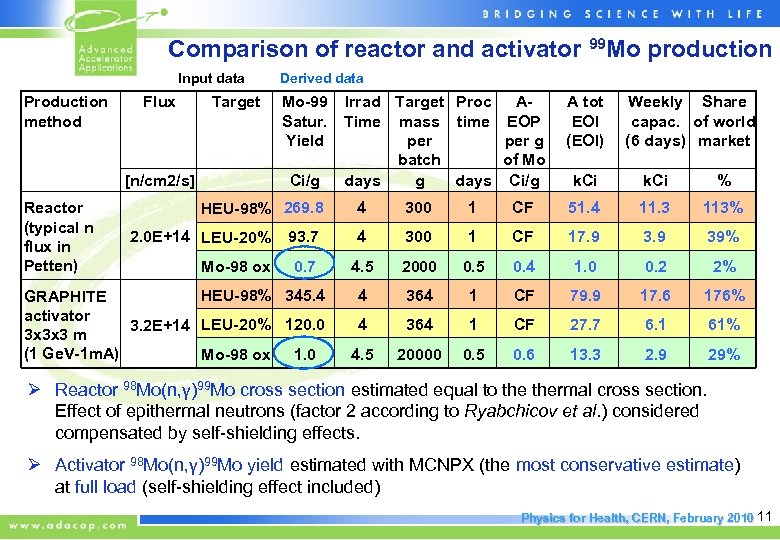
Comparison of reactor and activator 99 Mo production Input data Derived data Production method Flux Target [n/cm 2/s] Reactor (typical n flux in Petten) Mo-99 Irrad Target Proc ASatur. Time mass time EOP Yield per g batch of Mo Ci/g days Ci/g HEU-98% 269. 8 A tot EOI (EOI) Weekly Share capac. of world (6 days) market k. Ci % 4 300 1 CF 51. 4 11. 3 113% 2. 0 E+14 LEU-20% 93. 7 4 300 1 CF 17. 9 39% Mo-98 ox 0. 7 4. 5 2000 0. 5 0. 4 1. 0 0. 2 2% 4 364 1 CF 79. 9 17. 6 176% 4 364 1 CF 27. 7 6. 1 61% 4. 5 20000 0. 5 0. 6 13. 3 2. 9 29% HEU-98% 345. 4 GRAPHITE activator 3. 2 E+14 LEU-20% 120. 0 3 x 3 x 3 m (1 Ge. V-1 m. A) Mo-98 ox 1. 0 Ø Reactor 98 Mo(n, γ)99 Mo cross section estimated equal to thermal cross section. Effect of epithermal neutrons (factor 2 according to Ryabchicov et al. ) considered compensated by self-shielding effects. Ø Activator 98 Mo(n, γ)99 Mo yield estimated with MCNPX (the most conservative estimate) at full load (self-shielding effect included) Physics for Health, CERN, February 2010 11
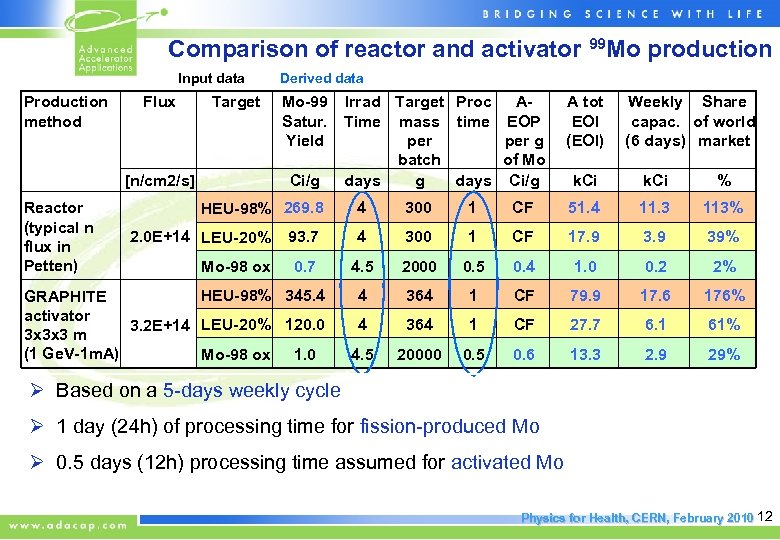
Comparison of reactor and activator 99 Mo production Input data Derived data Production method Flux Target [n/cm 2/s] Reactor (typical n flux in Petten) Mo-99 Irrad Target Proc ASatur. Time mass time EOP Yield per g batch of Mo Ci/g days Ci/g HEU-98% 269. 8 A tot EOI (EOI) Weekly Share capac. of world (6 days) market k. Ci % 4 300 1 CF 51. 4 11. 3 113% 2. 0 E+14 LEU-20% 93. 7 4 300 1 CF 17. 9 39% Mo-98 ox 0. 7 4. 5 2000 0. 5 0. 4 1. 0 0. 2 2% 4 364 1 CF 79. 9 17. 6 176% 4 364 1 CF 27. 7 6. 1 61% 4. 5 20000 0. 5 0. 6 13. 3 2. 9 29% HEU-98% 345. 4 GRAPHITE activator 3. 2 E+14 LEU-20% 120. 0 3 x 3 x 3 m (1 Ge. V-1 m. A) Mo-98 ox 1. 0 Ø Based on a 5 -days weekly cycle Ø 1 day (24 h) of processing time for fission-produced Mo Ø 0. 5 days (12 h) processing time assumed for activated Mo Physics for Health, CERN, February 2010 12
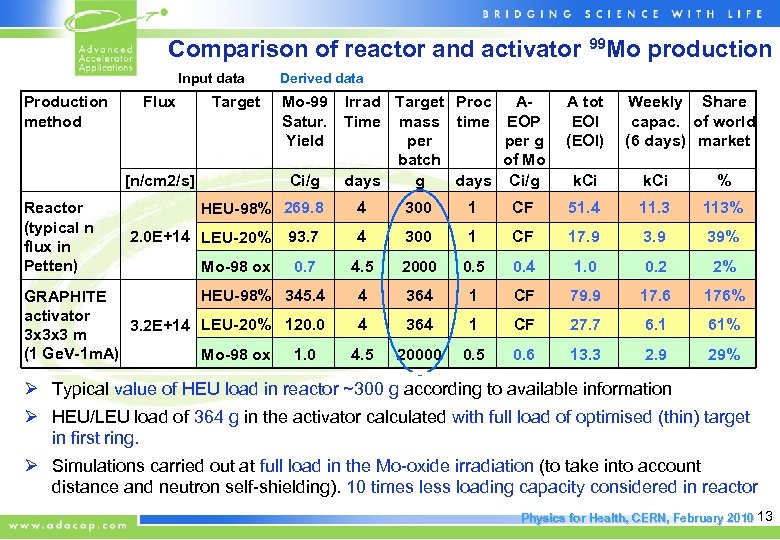
Comparison of reactor and activator 99 Mo production Input data Derived data Production method Flux Target [n/cm 2/s] Reactor (typical n flux in Petten) Mo-99 Irrad Target Proc ASatur. Time mass time EOP Yield per g batch of Mo Ci/g days Ci/g HEU-98% 269. 8 A tot EOI (EOI) Weekly Share capac. of world (6 days) market k. Ci % 4 300 1 CF 51. 4 11. 3 113% 2. 0 E+14 LEU-20% 93. 7 4 300 1 CF 17. 9 39% Mo-98 ox 0. 7 4. 5 2000 0. 5 0. 4 1. 0 0. 2 2% 4 364 1 CF 79. 9 17. 6 176% 4 364 1 CF 27. 7 6. 1 61% 4. 5 20000 0. 5 0. 6 13. 3 2. 9 29% HEU-98% 345. 4 GRAPHITE activator 3. 2 E+14 LEU-20% 120. 0 3 x 3 x 3 m (1 Ge. V-1 m. A) Mo-98 ox 1. 0 Ø Typical value of HEU load in reactor ~300 g according to available information Ø HEU/LEU load of 364 g in the activator calculated with full load of optimised (thin) target in first ring. Ø Simulations carried out at full load in the Mo-oxide irradiation (to take into account distance and neutron self-shielding). 10 times less loading capacity considered in reactor Physics for Health, CERN, February 2010 13
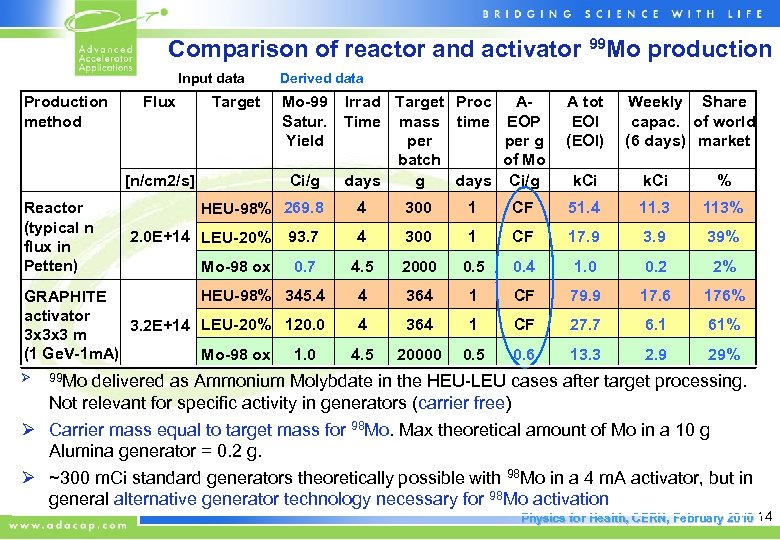
Comparison of reactor and activator 99 Mo production Input data Derived data Production method Flux Target [n/cm 2/s] Reactor (typical n flux in Petten) Mo-99 Irrad Target Proc ASatur. Time mass time EOP Yield per g batch of Mo Ci/g days Ci/g HEU-98% 269. 8 Weekly Share capac. of world (6 days) market k. Ci % 4 300 1 CF 51. 4 11. 3 113% 2. 0 E+14 LEU-20% 93. 7 4 300 1 CF 17. 9 39% Mo-98 ox 0. 7 4. 5 2000 0. 5 0. 4 1. 0 0. 2 2% 4 364 1 CF 79. 9 17. 6 176% 4 364 1 CF 27. 7 6. 1 61% 4. 5 20000 0. 5 0. 6 13. 3 2. 9 29% HEU-98% 345. 4 GRAPHITE activator 3. 2 E+14 LEU-20% 120. 0 3 x 3 x 3 m (1 Ge. V-1 m. A) Mo-98 ox 1. 0 Ø A tot EOI (EOI) 99 Mo delivered as Ammonium Molybdate in the HEU-LEU cases after target processing. Not relevant for specific activity in generators (carrier free) Ø Carrier mass equal to target mass for 98 Mo. Max theoretical amount of Mo in a 10 g Alumina generator = 0. 2 g. Ø ~300 m. Ci standard generators theoretically possible with 98 Mo in a 4 m. A activator, but in general alternative generator technology necessary for 98 Mo activation Physics for Health, CERN, February 2010 14
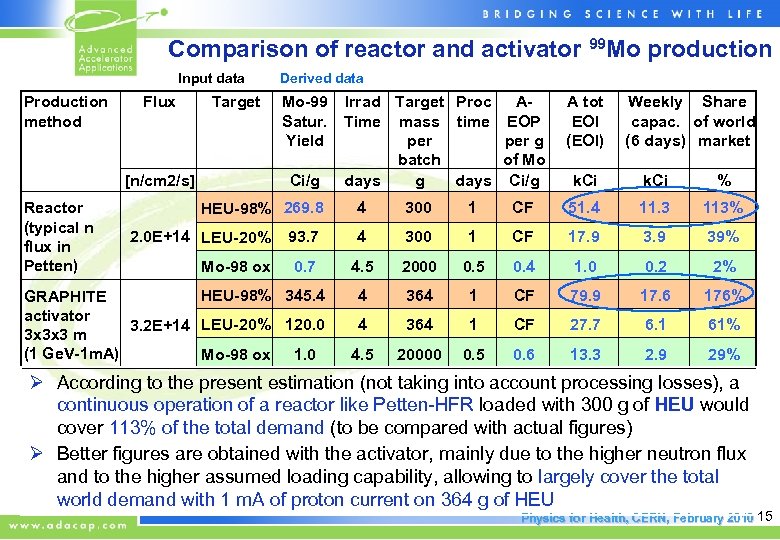
Comparison of reactor and activator 99 Mo production Input data Derived data Production method Flux Target [n/cm 2/s] Reactor (typical n flux in Petten) Mo-99 Irrad Target Proc ASatur. Time mass time EOP Yield per g batch of Mo Ci/g days Ci/g HEU-98% 269. 8 A tot EOI (EOI) Weekly Share capac. of world (6 days) market k. Ci % 4 300 1 CF 51. 4 11. 3 113% 2. 0 E+14 LEU-20% 93. 7 4 300 1 CF 17. 9 39% Mo-98 ox 0. 7 4. 5 2000 0. 5 0. 4 1. 0 0. 2 2% 4 364 1 CF 79. 9 17. 6 176% 4 364 1 CF 27. 7 6. 1 61% 4. 5 20000 0. 5 0. 6 13. 3 2. 9 29% HEU-98% 345. 4 GRAPHITE activator 3. 2 E+14 LEU-20% 120. 0 3 x 3 x 3 m (1 Ge. V-1 m. A) Mo-98 ox 1. 0 Ø According to the present estimation (not taking into account processing losses), a continuous operation of a reactor like Petten-HFR loaded with 300 g of HEU would cover 113% of the total demand (to be compared with actual figures) Ø Better figures are obtained with the activator, mainly due to the higher neutron flux and to the higher assumed loading capability, allowing to largely cover the total world demand with 1 m. A of proton current on 364 g of HEU Physics for Health, CERN, February 2010 15
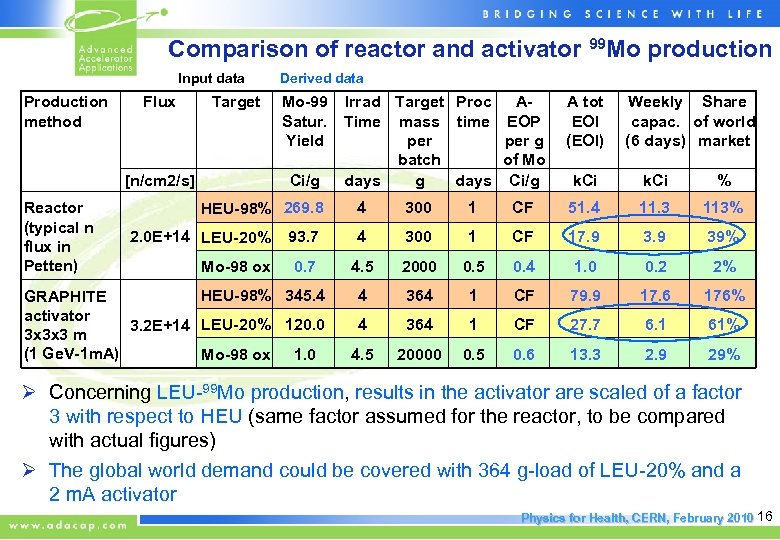
Comparison of reactor and activator 99 Mo production Input data Derived data Production method Flux Target [n/cm 2/s] Reactor (typical n flux in Petten) Mo-99 Irrad Target Proc ASatur. Time mass time EOP Yield per g batch of Mo Ci/g days Ci/g HEU-98% 269. 8 A tot EOI (EOI) Weekly Share capac. of world (6 days) market k. Ci % 4 300 1 CF 51. 4 11. 3 113% 2. 0 E+14 LEU-20% 93. 7 4 300 1 CF 17. 9 39% Mo-98 ox 0. 7 4. 5 2000 0. 5 0. 4 1. 0 0. 2 2% 4 364 1 CF 79. 9 17. 6 176% 4 364 1 CF 27. 7 6. 1 61% 4. 5 20000 0. 5 0. 6 13. 3 2. 9 29% HEU-98% 345. 4 GRAPHITE activator 3. 2 E+14 LEU-20% 120. 0 3 x 3 x 3 m (1 Ge. V-1 m. A) Mo-98 ox 1. 0 Ø Concerning LEU-99 Mo production, results in the activator are scaled of a factor 3 with respect to HEU (same factor assumed for the reactor, to be compared with actual figures) Ø The global world demand could be covered with 364 g-load of LEU-20% and a 2 m. A activator Physics for Health, CERN, February 2010 16
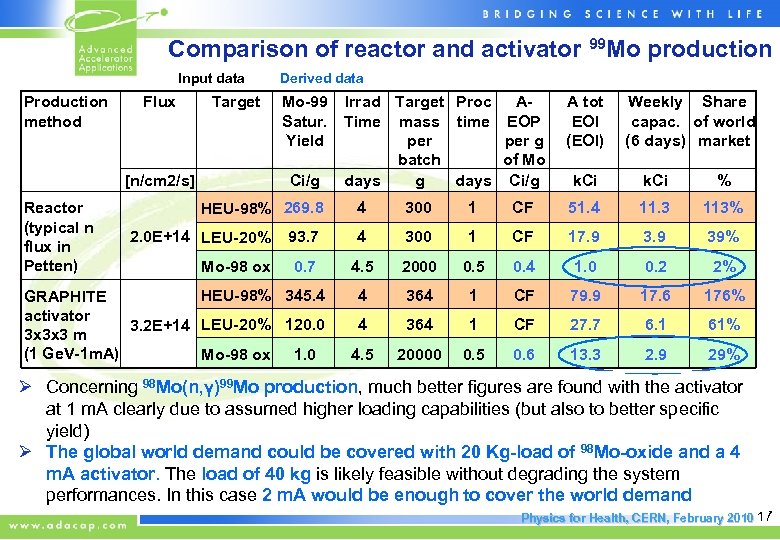
Comparison of reactor and activator 99 Mo production Input data Derived data Production method Flux Target [n/cm 2/s] Reactor (typical n flux in Petten) Mo-99 Irrad Target Proc ASatur. Time mass time EOP Yield per g batch of Mo Ci/g days Ci/g HEU-98% 269. 8 A tot EOI (EOI) Weekly Share capac. of world (6 days) market k. Ci % 4 300 1 CF 51. 4 11. 3 113% 2. 0 E+14 LEU-20% 93. 7 4 300 1 CF 17. 9 39% Mo-98 ox 0. 7 4. 5 2000 0. 5 0. 4 1. 0 0. 2 2% 4 364 1 CF 79. 9 17. 6 176% 4 364 1 CF 27. 7 6. 1 61% 4. 5 20000 0. 5 0. 6 13. 3 2. 9 29% HEU-98% 345. 4 GRAPHITE activator 3. 2 E+14 LEU-20% 120. 0 3 x 3 x 3 m (1 Ge. V-1 m. A) Mo-98 ox 1. 0 Ø Concerning 98 Mo(n, γ)99 Mo production, much better figures are found with the activator at 1 m. A clearly due to assumed higher loading capabilities (but also to better specific yield) Ø The global world demand could be covered with 20 Kg-load of 98 Mo-oxide and a 4 m. A activator. The load of 40 kg is likely feasible without degrading the system performances. In this case 2 m. A would be enough to cover the world demand Physics for Health, CERN, February 2010 17
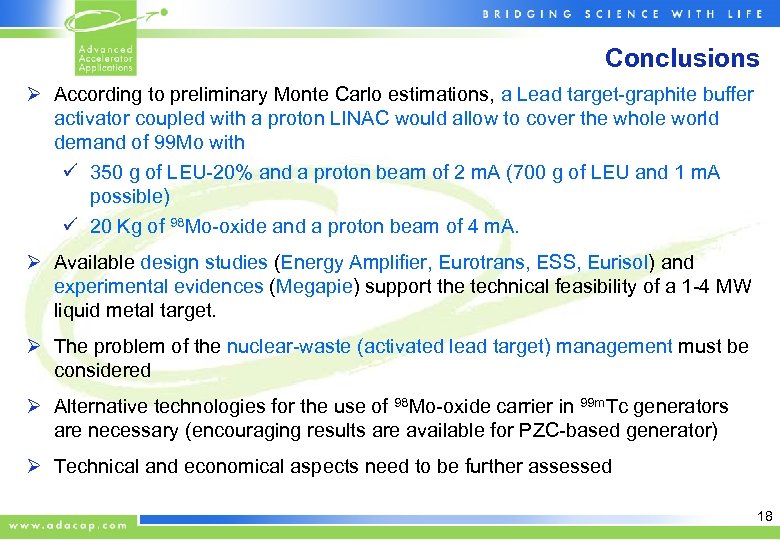
Conclusions Ø According to preliminary Monte Carlo estimations, a Lead target-graphite buffer activator coupled with a proton LINAC would allow to cover the whole world demand of 99 Mo with ü 350 g of LEU-20% and a proton beam of 2 m. A (700 g of LEU and 1 m. A possible) ü 20 Kg of 98 Mo-oxide and a proton beam of 4 m. A. Ø Available design studies (Energy Amplifier, Eurotrans, ESS, Eurisol) and experimental evidences (Megapie) support the technical feasibility of a 1 -4 MW liquid metal target. Ø The problem of the nuclear-waste (activated lead target) management must be considered Ø Alternative technologies for the use of 98 Mo-oxide carrier in 99 m. Tc generators are necessary (encouraging results are available for PZC-based generator) Ø Technical and economical aspects need to be further assessed 18
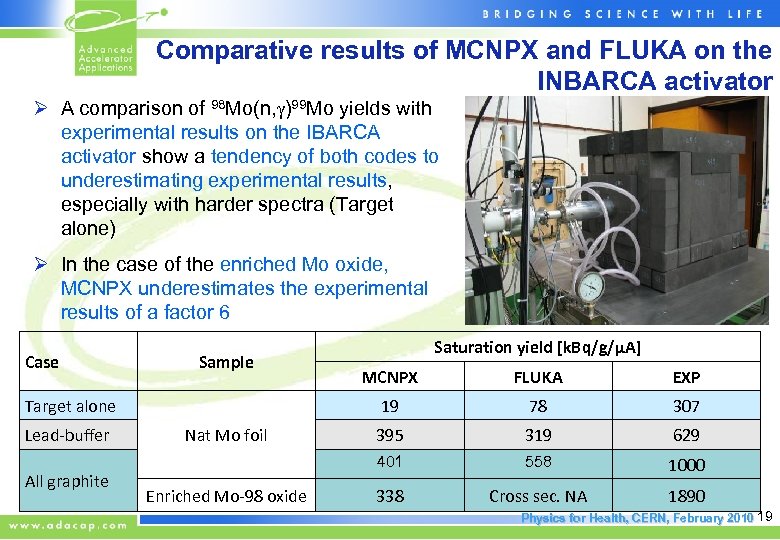
Comparative results of MCNPX and FLUKA on the INBARCA activator Ø A comparison of 98 Mo(n, )99 Mo yields with experimental results on the IBARCA activator show a tendency of both codes to underestimating experimental results, especially with harder spectra (Target alone) Ø In the case of the enriched Mo oxide, MCNPX underestimates the experimental results of a factor 6 Case Sample All graphite Enriched Mo-98 oxide FLUKA EXP 78 307 395 319 629 401 Nat Mo foil MCNPX 19 Target alone Lead-buffer Saturation yield [k. Bq/g/µA] 558 1000 338 Cross sec. NA 1890 Physics for Health, CERN, February 2010 19
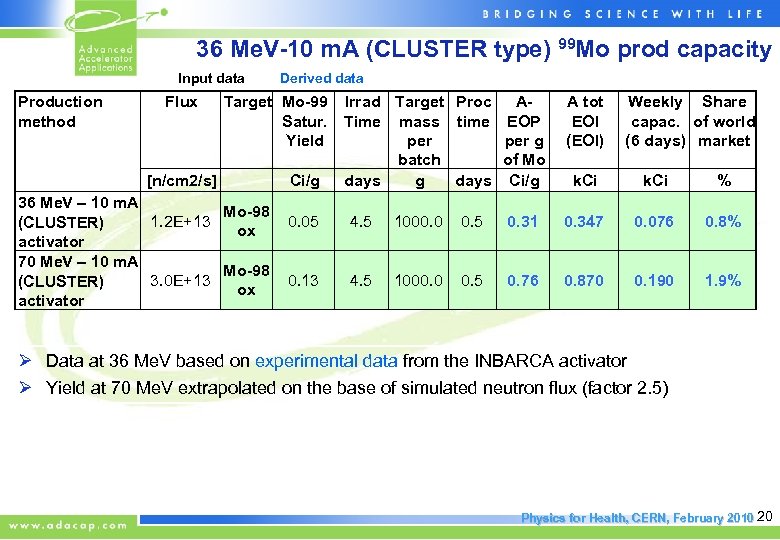
36 Me. V-10 m. A (CLUSTER type) 99 Mo prod capacity Input data Derived data Production method Flux Target Mo-99 Irrad Target Proc ASatur. Time mass time EOP Yield per g batch of Mo [n/cm 2/s] Ci/g days Ci/g 36 Me. V – 10 m. A Mo-98 1. 2 E+13 0. 05 (CLUSTER) ox activator 70 Me. V – 10 m. A Mo-98 3. 0 E+13 0. 13 (CLUSTER) ox activator A tot EOI (EOI) Weekly Share capac. of world (6 days) market k. Ci % 4. 5 1000. 0 0. 5 0. 31 0. 347 0. 076 0. 8% 4. 5 1000. 0 0. 5 0. 76 0. 870 0. 190 1. 9% Ø Data at 36 Me. V based on experimental data from the INBARCA activator Ø Yield at 70 Me. V extrapolated on the base of simulated neutron flux (factor 2. 5) Physics for Health, CERN, February 2010 20
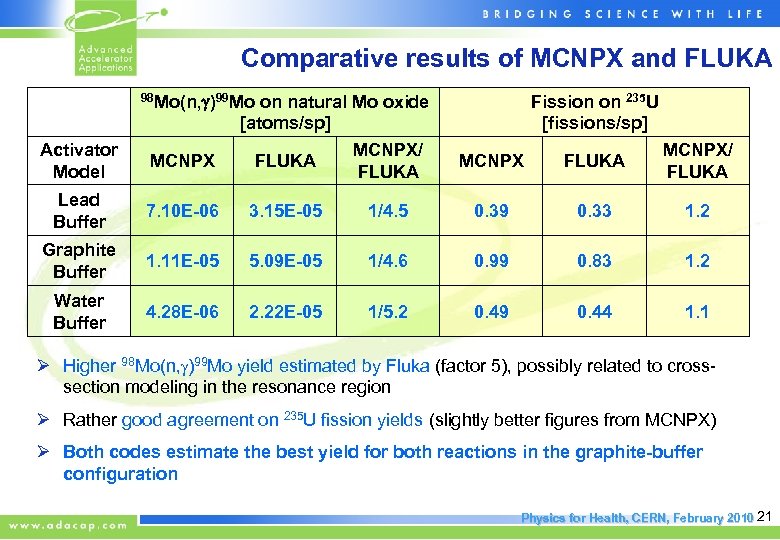
Comparative results of MCNPX and FLUKA 98 Mo(n, )99 Mo on natural Mo oxide Fission on 235 U [fissions/sp] [atoms/sp] Activator Model MCNPX FLUKA MCNPX/ FLUKA Lead Buffer 7. 10 E-06 3. 15 E-05 1/4. 5 0. 39 0. 33 1. 2 Graphite Buffer 1. 11 E-05 5. 09 E-05 1/4. 6 0. 99 0. 83 1. 2 Water Buffer 4. 28 E-06 2. 22 E-05 1/5. 2 0. 49 0. 44 1. 1 Ø Higher 98 Mo(n, )99 Mo yield estimated by Fluka (factor 5), possibly related to crosssection modeling in the resonance region Ø Rather good agreement on 235 U fission yields (slightly better figures from MCNPX) Ø Both codes estimate the best yield for both reactions in the graphite-buffer configuration Physics for Health, CERN, February 2010 21
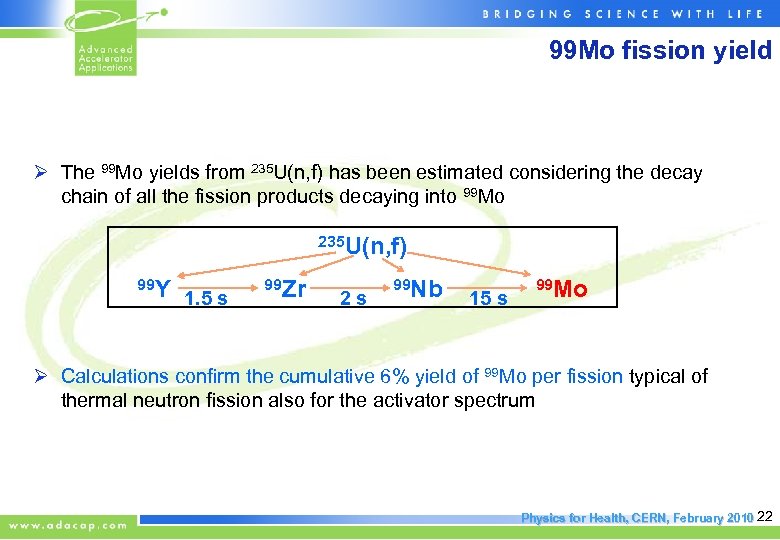
99 Mo fission yield Ø The 99 Mo yields from 235 U(n, f) has been estimated considering the decay chain of all the fission products decaying into 99 Mo 235 U(n, f) 99 Y 99 Zr 99 Nb 99 Mo 1. 5 s 2 s 15 s Ø Calculations confirm the cumulative 6% yield of 99 Mo per fission typical of thermal neutron fission also for the activator spectrum Physics for Health, CERN, February 2010 22
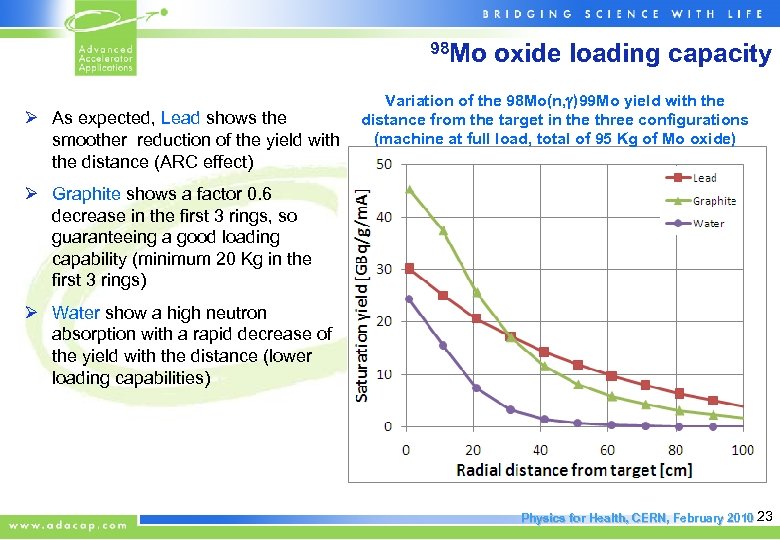
98 Mo oxide loading capacity Ø As expected, Lead shows the smoother reduction of the yield with the distance (ARC effect) Variation of the 98 Mo(n, )99 Mo yield with the distance from the target in the three configurations (machine at full load, total of 95 Kg of Mo oxide) Ø Graphite shows a factor 0. 6 decrease in the first 3 rings, so guaranteeing a good loading capability (minimum 20 Kg in the first 3 rings) Ø Water show a high neutron absorption with a rapid decrease of the yield with the distance (lower loading capabilities) Physics for Health, CERN, February 2010 23
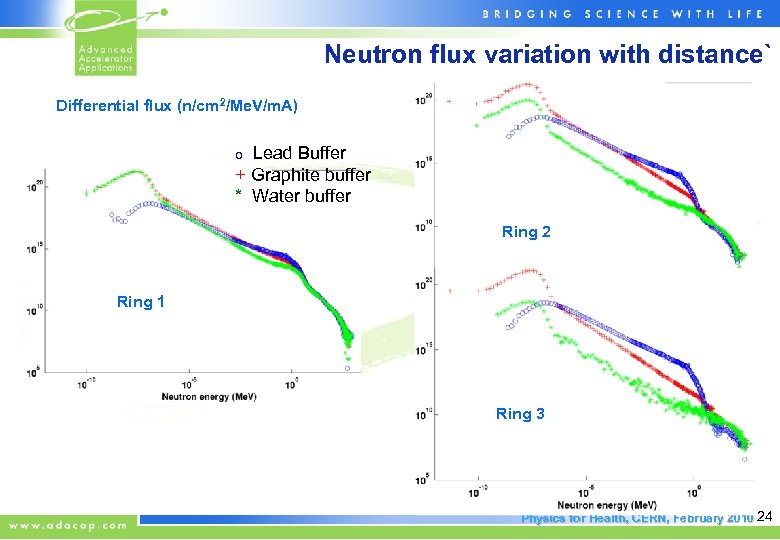
Neutron flux variation with distance` Differential flux (n/cm 2/Me. V/m. A) Lead Buffer + Graphite buffer * Water buffer o Ring 2 Ring 1 Ring 3 Physics for Health, CERN, February 2010 24
Provision of 98 Mo oxide / LEU Ø The possibility to produce large amounts of 98 Mo oxide should be assessed Ø The cost of a small quantity (~1 g) is at present around 2. 5 $/mg. This would imply a cost of 50 M$ per 1 activator load of 20 Kg. A large scale production of 98 Mo oxide is expected to significantly reduce the price (at least a factor 10 giving a cost in the order of 5 M€ per load) Ø The technical/economical feasibility of recuperating the 98 Mo-oxide from the used generators should be assessed Ø A cost analysis for the supply of LEU at different enrichment should be done Physics for Health, CERN, February 2010 25
Alternative methods for 98 Mo-produced generators Ø Post-elution concentration techniques ü Elution with Acetone instead of saline solution ü Tandem-type generator Ø Zirconium-based adsorbent instead of alumina column ü Zr gel-based generators ü Poly Zirconium Compound (PZC)-based generators Physics for Health, CERN, February 2010 26
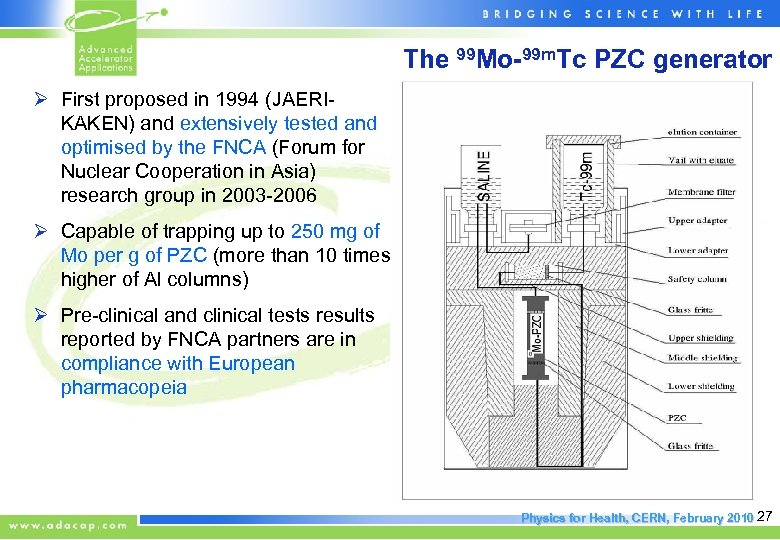
The 99 Mo-99 m. Tc PZC generator Ø First proposed in 1994 (JAERIKAKEN) and extensively tested and optimised by the FNCA (Forum for Nuclear Cooperation in Asia) research group in 2003 -2006 Ø Capable of trapping up to 250 mg of Mo per g of PZC (more than 10 times higher of Al columns) Ø Pre-clinical and clinical tests results reported by FNCA partners are in compliance with European pharmacopeia Physics for Health, CERN, February 2010 27
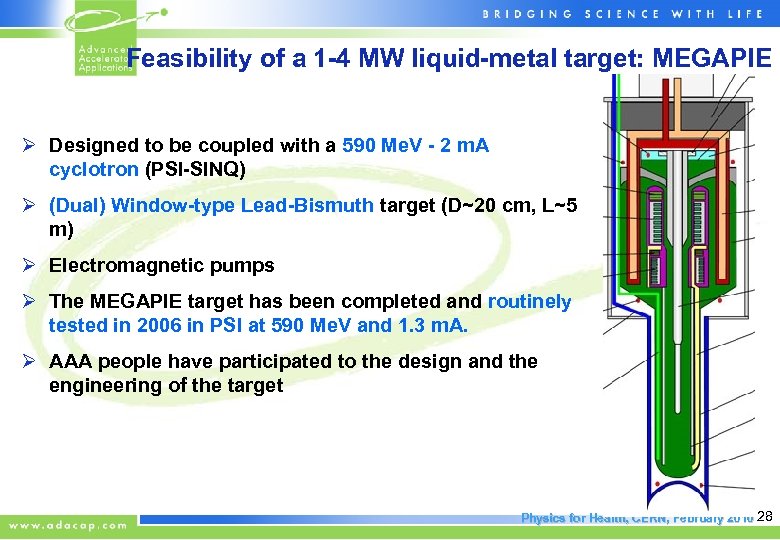
Feasibility of a 1 -4 MW liquid-metal target: MEGAPIE Ø Designed to be coupled with a 590 Me. V - 2 m. A cyclotron (PSI-SINQ) Ø (Dual) Window-type Lead-Bismuth target (D~20 cm, L~5 m) Ø Electromagnetic pumps Ø The MEGAPIE target has been completed and routinely tested in 2006 in PSI at 590 Me. V and 1. 3 m. A. Ø AAA people have participated to the design and the engineering of the target Physics for Health, CERN, February 2010 28
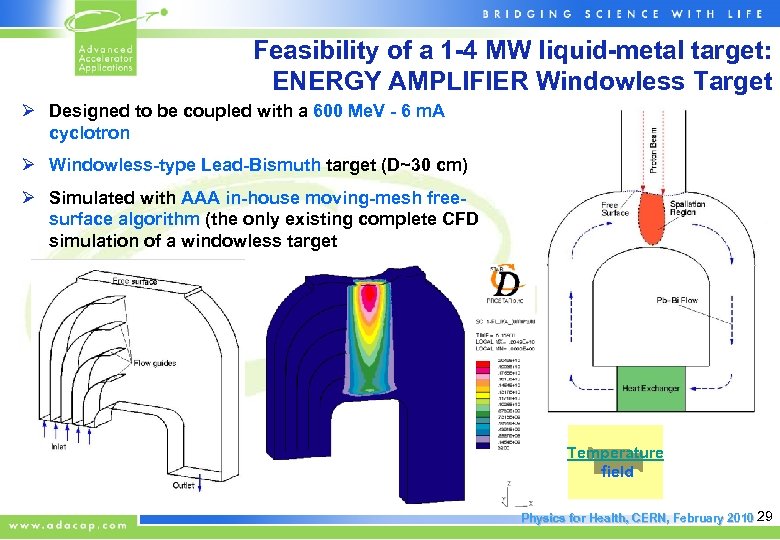
Feasibility of a 1 -4 MW liquid-metal target: ENERGY AMPLIFIER Windowless Target Ø Designed to be coupled with a 600 Me. V - 6 m. A cyclotron Ø Windowless-type Lead-Bismuth target (D~30 cm) Ø Simulated with AAA in-house moving-mesh freesurface algorithm (the only existing complete CFD simulation of a windowless target Temperature field Physics for Health, CERN, February 2010 29
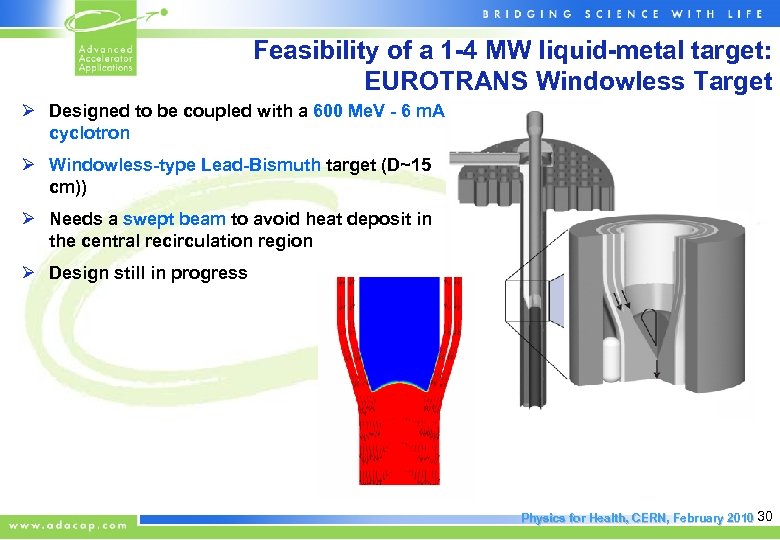
Feasibility of a 1 -4 MW liquid-metal target: EUROTRANS Windowless Target Ø Designed to be coupled with a 600 Me. V - 6 m. A cyclotron Ø Windowless-type Lead-Bismuth target (D~15 cm)) Ø Needs a swept beam to avoid heat deposit in the central recirculation region Ø Design still in progress Physics for Health, CERN, February 2010 30
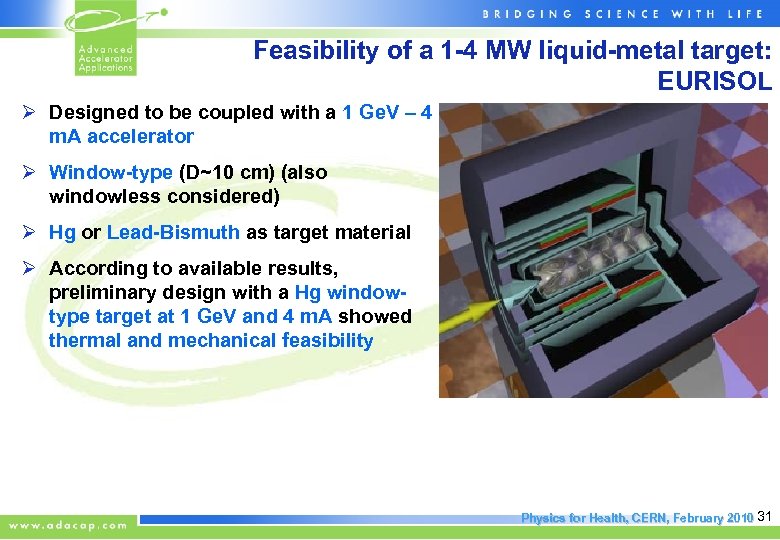
Feasibility of a 1 -4 MW liquid-metal target: EURISOL Ø Designed to be coupled with a 1 Ge. V – 4 m. A accelerator Ø Window-type (D~10 cm) (also windowless considered) Ø Hg or Lead-Bismuth as target material Ø According to available results, preliminary design with a Hg windowtype target at 1 Ge. V and 4 m. A showed thermal and mechanical feasibility Physics for Health, CERN, February 2010 31
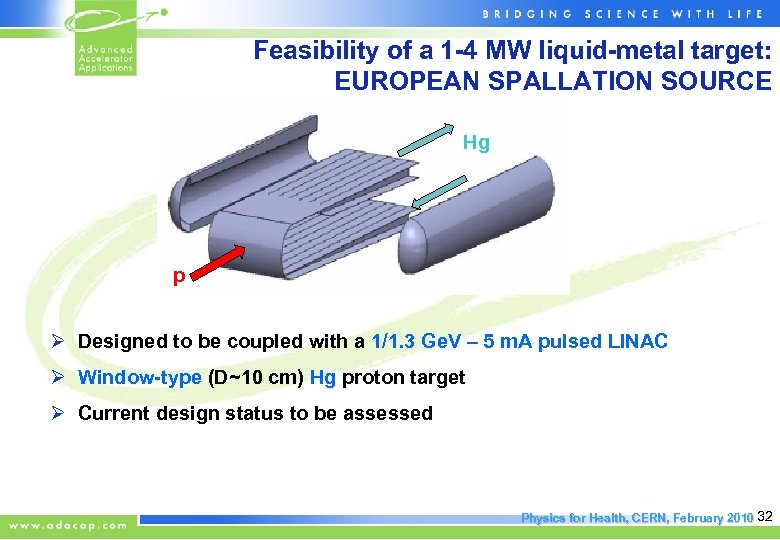
Feasibility of a 1 -4 MW liquid-metal target: EUROPEAN SPALLATION SOURCE Hg p Ø Designed to be coupled with a 1/1. 3 Ge. V – 5 m. A pulsed LINAC Ø Window-type (D~10 cm) Hg proton target Ø Current design status to be assessed Physics for Health, CERN, February 2010 32
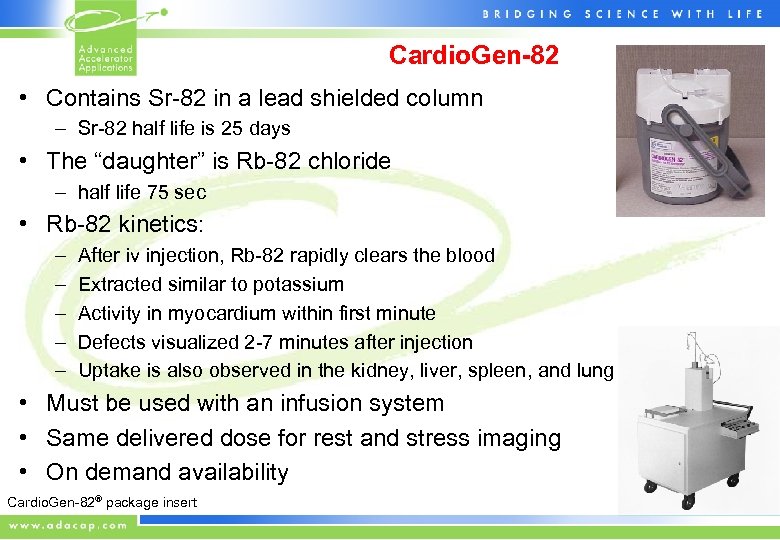
Cardio. Gen-82 • Contains Sr-82 in a lead shielded column – Sr-82 half life is 25 days • The “daughter” is Rb-82 chloride – half life 75 sec • Rb-82 kinetics: – – – After iv injection, Rb-82 rapidly clears the blood Extracted similar to potassium Activity in myocardium within first minute Defects visualized 2 -7 minutes after injection Uptake is also observed in the kidney, liver, spleen, and lung • Must be used with an infusion system • Same delivered dose for rest and stress imaging • On demand availability Cardio. Gen-82® package insert
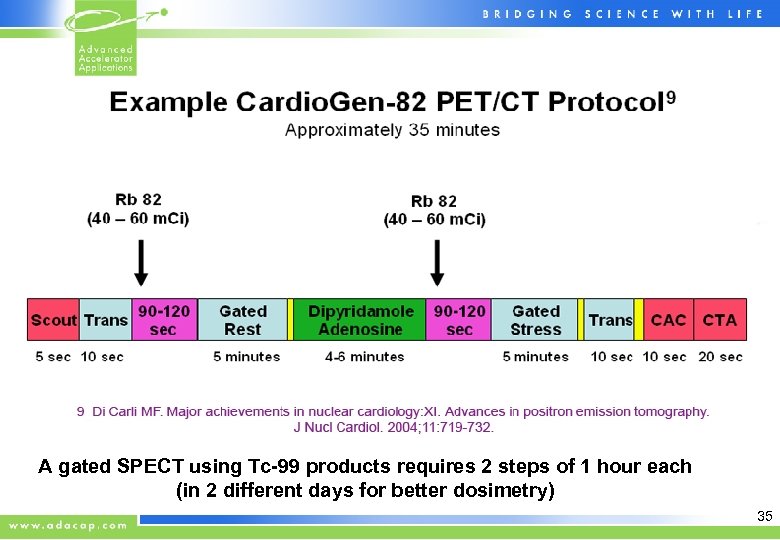
A gated SPECT using Tc-99 products requires 2 steps of 1 hour each (in 2 different days for better dosimetry) 35
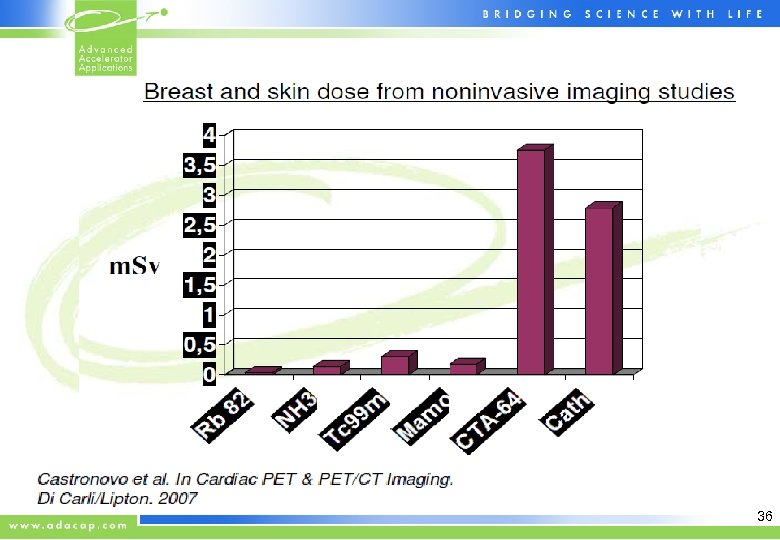
36
Скачать презентацию Physics for Health CERN February 2010 Technical evaluation
41dfc9556c1d0f344f9987485e0c8838.ppt