


 Скачать презентацию Physics design of front ends for superconducting ion
2247c6448bbd35a9eebcde0ea701385e.ppt
- Количество слайдов: 33
 Physics design of front ends for superconducting ion linacs Peter N. Ostroumov Physics Division, ANL Jean-Paul Carneiro FNAL
 Content n RF ion linear accelerators (Normal Conducting and Superconducting) – CW (100% duty factor) – Pulsed n Available SC accelerating structures for low energy hadron beams n Focusing Lattice n HINS PD - Example of axial-symmetric focusing SC Front End n RFQ design to form axial-symmetric beams n Properties of focusing lattice for HINS PD – 40 m. A peak current n Front End for a SC Linac with 100 m. A beam current n Conclusion P. N. Ostroumov Physics design of front ends for superconducting ion linacs August 25 -29, 2008 2
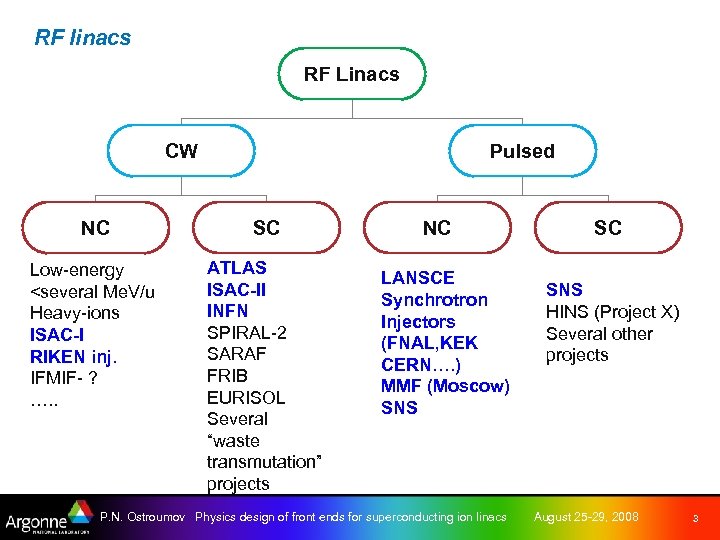 RF linacs RF Linacs CW Pulsed NC SC Low-energy
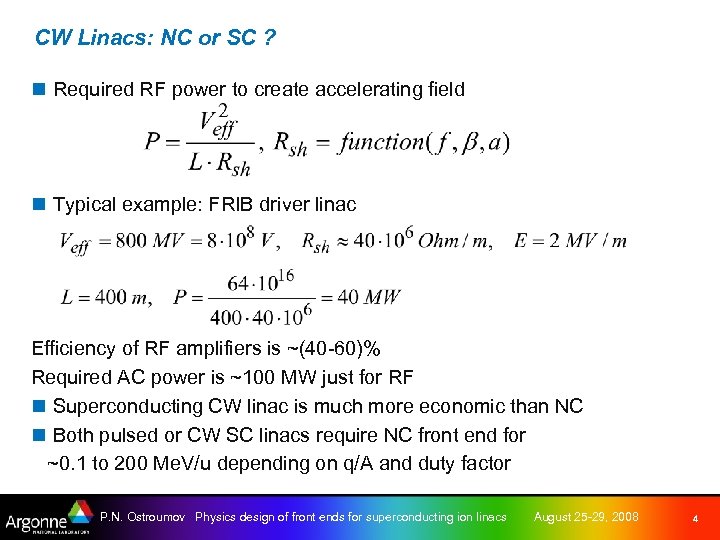 CW Linacs: NC or SC ? n Required RF power to create accelerating field n Typical example: FRIB driver linac Efficiency of RF amplifiers is ~(40 -60)% Required AC power is ~100 MW just for RF n Superconducting CW linac is much more economic than NC n Both pulsed or CW SC linacs require NC front end for ~0. 1 to 200 Me. V/u depending on q/A and duty factor P. N. Ostroumov Physics design of front ends for superconducting ion linacs August 25 -29, 2008 4
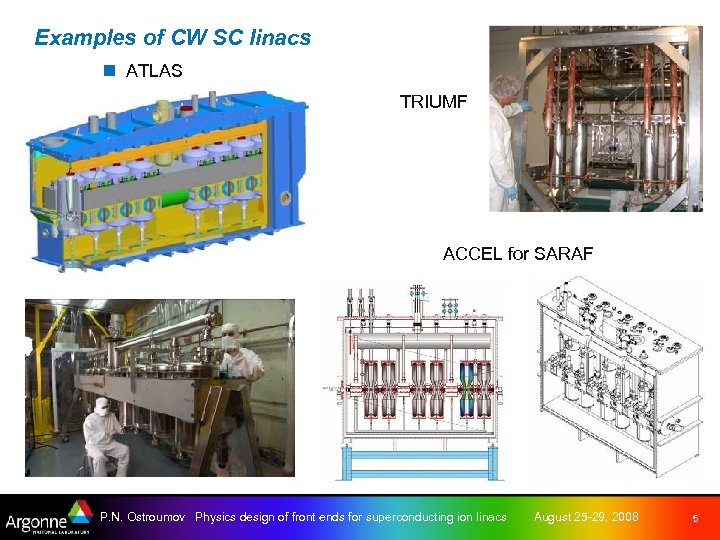 Examples of CW SC linacs n ATLAS TRIUMF ACCEL for SARAF P. N. Ostroumov Physics design of front ends for superconducting ion linacs August 25 -29, 2008 5
 Pulsed Superconducting Linacs n SC structures offer higher accelerating gradients then NC structures – SNS NC Front End – 128. 5 m, 185. 6 Me. V – HINS (Project X) SC Front End– 137 m, 420 Me. V n Comparable cost for the duty factor ~7% - SNS high-energy section n 8 Ge. V p & H-minus Linac with low duty factor <1% (FNAL: HINS or Project X) – Cost-effective above ~0. 4 Ge. V thanks to the ILC developments – Innovative technology: one klystron feeds multiple cavities • One J-PARC klystron is required to obtain 100 Me. V • 5 klystrons for Front End 420 Me. V – Below 400 Me. V the costs of NC and SC linacs are comparable. In the presence of cryoplant, a SC front end is favorable P. N. Ostroumov Physics design of front ends for superconducting ion linacs August 25 -29, 2008 6
 HINS SC Linac design n 8 -Ge. V based on ILC 1300 MHz 9 -cell cavities – H-minus linac – 45 m. A peak current from the Ion Source n Requires Front End above ~420 Me. V. n Superconducting linac 325 MHz, – 2 types of Single Spoke Resonators and Triple SR from 10 Me. V to ~420 Me. V n NC front end: RFQ, MEBT and 16 short CH-type cavities n Apply SC solenoid focusing to obtain compact lattice in the front end including MEBT n RFQ delivers axial-symmetric 2. 5 Me. V H-minus beam n MEBT consists of 2 re-bunchers and a chopper. Smooth axialsymmetric focusing mitigates beam halo formation n ILC section: 1 klystron feeds ~20 -26 cavities n Apply similar approach for the Front End n Five klystrons are sufficient to accelerate up to ~420 Me. V P. N. Ostroumov Physics design of front ends for superconducting ion linacs August 25 -29, 2008 7
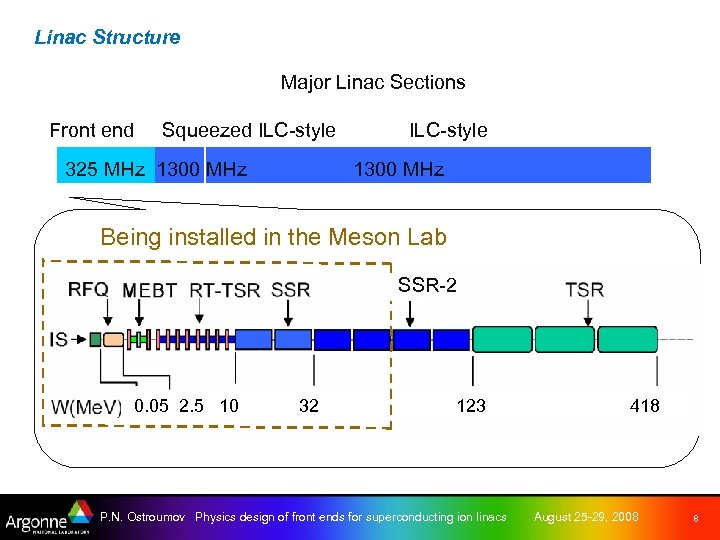 Linac Structure Major Linac Sections Front end Squeezed ILC-style 325 MHz 1300 MHz ILC-style 1300 MHz Being installed in the Meson Lab SSR-2 0. 05 2. 5 10 0. 065 2. 5 10 32 33 123 110 P. N. Ostroumov Physics design of front ends for superconducting ion linacs 418 410 August 25 -29, 2008 8
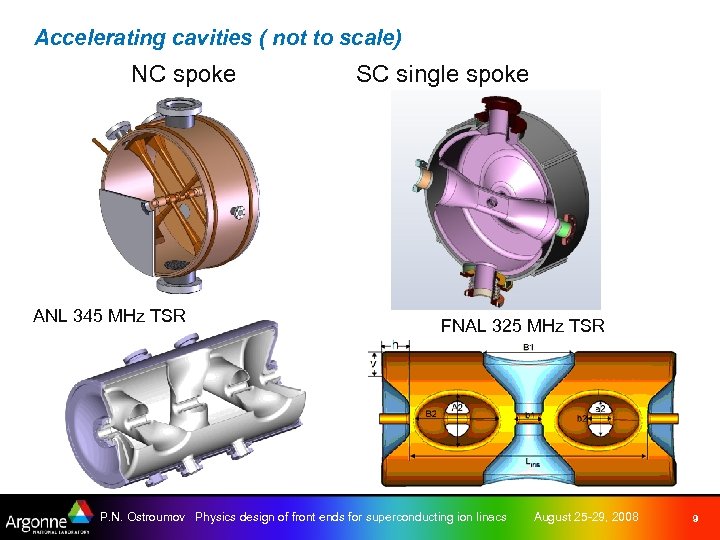 Accelerating cavities ( not to scale) NC spoke ANL 345 MHz TSR SC single spoke FNAL 325 MHz TSR P. N. Ostroumov Physics design of front ends for superconducting ion linacs August 25 -29, 2008 9
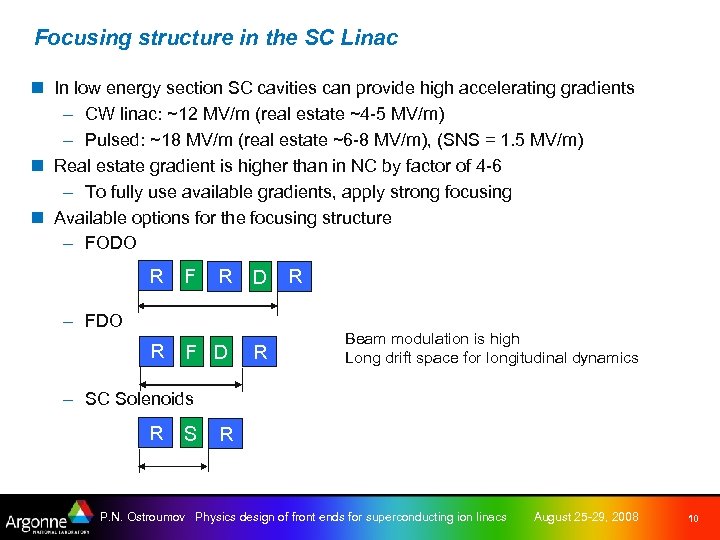 Focusing structure in the SC Linac n In low energy section SC cavities can provide high accelerating gradients – CW linac: ~12 MV/m (real estate ~4 -5 MV/m) – Pulsed: ~18 MV/m (real estate ~6 -8 MV/m), (SNS = 1. 5 MV/m) n Real estate gradient is higher than in NC by factor of 4 -6 – To fully use available gradients, apply strong focusing n Available options for the focusing structure – FODO R F R D R F D R – FDO R Beam modulation is high Long drift space for longitudinal dynamics – SC Solenoids R S R P. N. Ostroumov Physics design of front ends for superconducting ion linacs August 25 -29, 2008 10
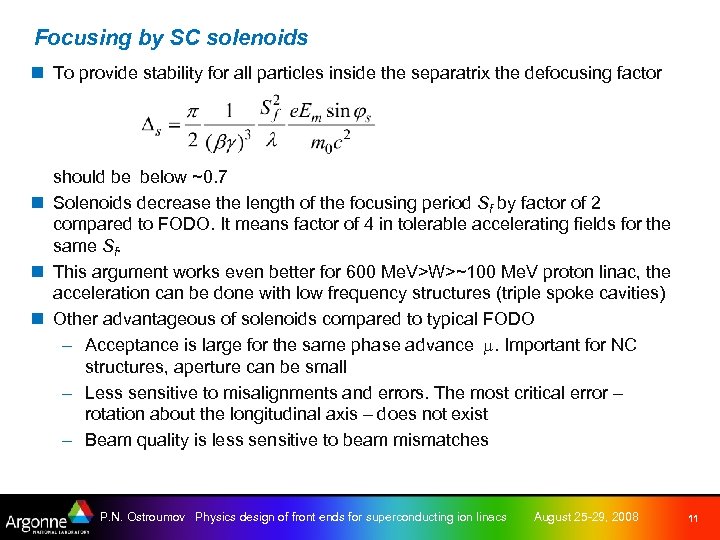 Focusing by SC solenoids n To provide stability for all particles inside the separatrix the defocusing factor should be below ~0. 7 n Solenoids decrease the length of the focusing period Sf by factor of 2 compared to FODO. It means factor of 4 in tolerable accelerating fields for the same Sf. n This argument works even better for 600 Me. V>W>~100 Me. V proton linac, the acceleration can be done with low frequency structures (triple spoke cavities) n Other advantageous of solenoids compared to typical FODO – Acceptance is large for the same phase advance . Important for NC structures, aperture can be small – Less sensitive to misalignments and errors. The most critical error – rotation about the longitudinal axis – does not exist – Beam quality is less sensitive to beam mismatches P. N. Ostroumov Physics design of front ends for superconducting ion linacs August 25 -29, 2008 11
 Focusing by SC solenoids (cont’d) n n Long term experience at ATLAS (ANL) Now operational at TRIUMF New projects: SARAF Perfectly suitable for SC environment together with SRF – Beam quality is less sensitive to inter-cryostat transitions – Easily re-tunable to adjust to the accelerating gradient variation from cavity to cavity. This is critical in low energy SC linac due to the beam space charge. – Can be supplemented with dipole coils for corrective steering n MEBT: long drift space for chopper does not cause dramatic emittance growth for high current beams n Not suitable for H-minus above ~100 Me. V due to stripping at solenoid edge field P. N. Ostroumov Physics design of front ends for superconducting ion linacs August 25 -29, 2008 12
 Why SC solenoids in the HINS proton driver (or Project X) ? n Cryogenics facility is available, major part of the linac is SC n The Front End (up to 420 Me. V) is based on SC cavities: 325 MHz SSR, TSR – Long cryostats house up to ~10 SC cavities and solenoids n Short focusing periods in the low energy region, 75 cm n Axially-symmetric beam is less sensitive to space charge effects in the MEBT where the long drift space is necessary to accommodate the chopper and following beam dump n Using SC solenoids in the NC section from 2. 5 Me. V to 10 Me. V – Small beam size, aperture of the cavities is 18 mm in diameter – Short focusing periods from 50 cm to 75 cm n RFQ can provide axial-symmetric beam P. N. Ostroumov Physics design of front ends for superconducting ion linacs August 25 -29, 2008 13
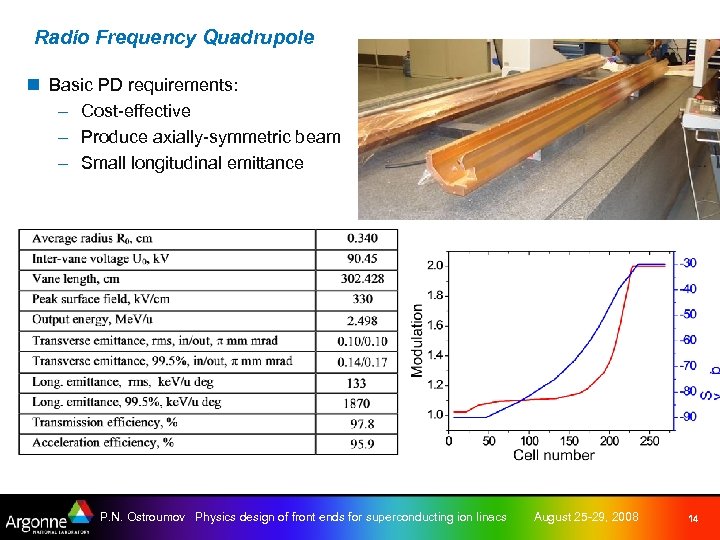 Radio Frequency Quadrupole n Basic PD requirements: – Cost-effective – Produce axially-symmetric beam – Small longitudinal emittance P. N. Ostroumov Physics design of front ends for superconducting ion linacs August 25 -29, 2008 14
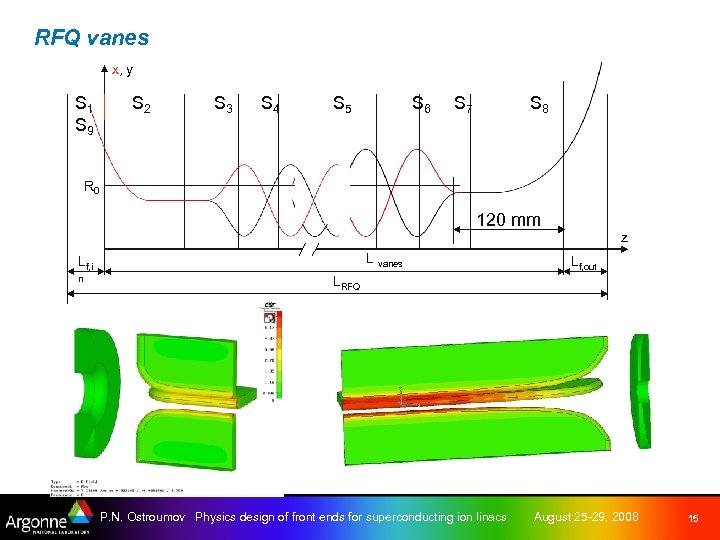 RFQ vanes x, y S 1 S 9 S 2 S 3 S 4 S 5 S 6 S 7 S 8 R 0 120 mm L vanes Lf, i n z Lf, out LRFQ P. N. Ostroumov Physics design of front ends for superconducting ion linacs August 25 -29, 2008 15
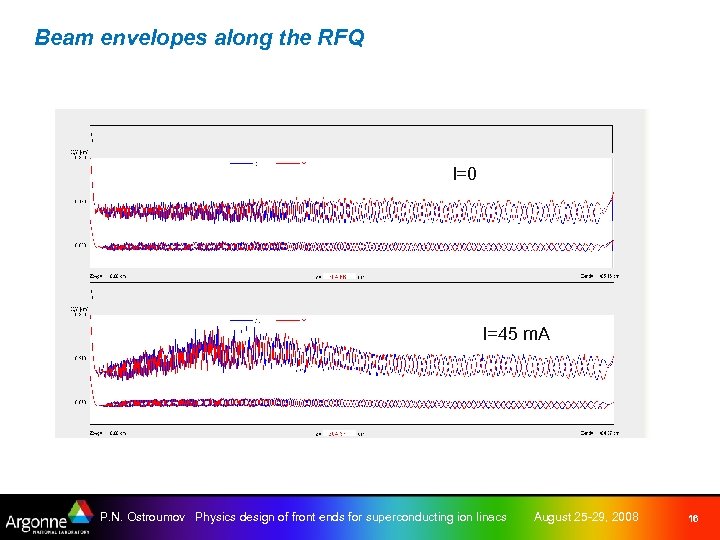 Beam envelopes along the RFQ I=0 I=45 m. A P. N. Ostroumov Physics design of front ends for superconducting ion linacs August 25 -29, 2008 16
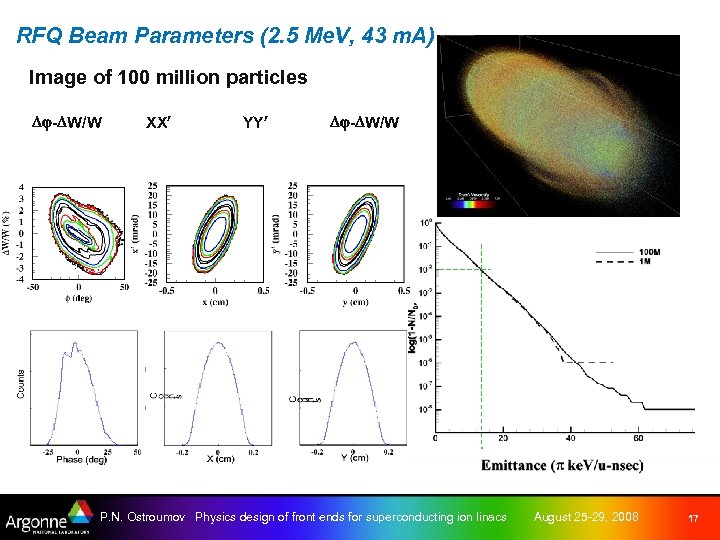 RFQ Beam Parameters (2. 5 Me. V, 43 m. A) Image of 100 million particles - W/W XX YY - W/W P. N. Ostroumov Physics design of front ends for superconducting ion linacs August 25 -29, 2008 17
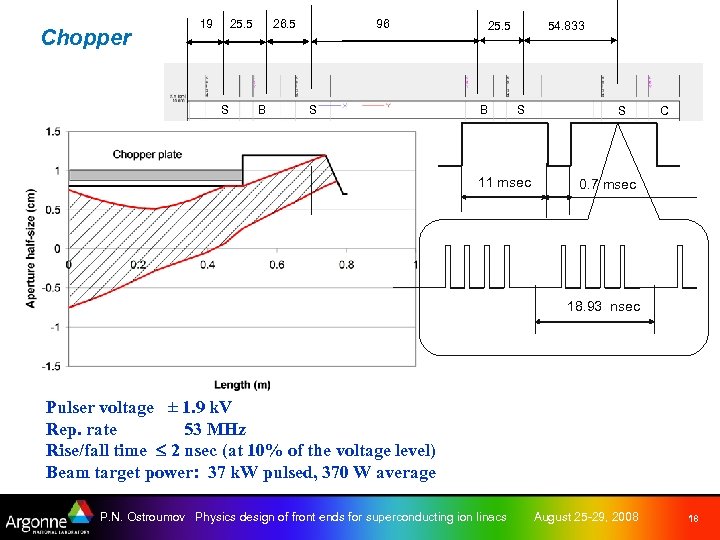 Chopper 19 25. 5 S 26. 5 B 96 S 25. 5 B 54. 833 S 11 msec S C 0. 7 msec 18. 93 nsec Pulser voltage ± 1. 9 k. V Rep. rate 53 MHz Rise/fall time 2 nsec (at 10% of the voltage level) Beam target power: 37 k. W pulsed, 370 W average P. N. Ostroumov Physics design of front ends for superconducting ion linacs August 25 -29, 2008 18
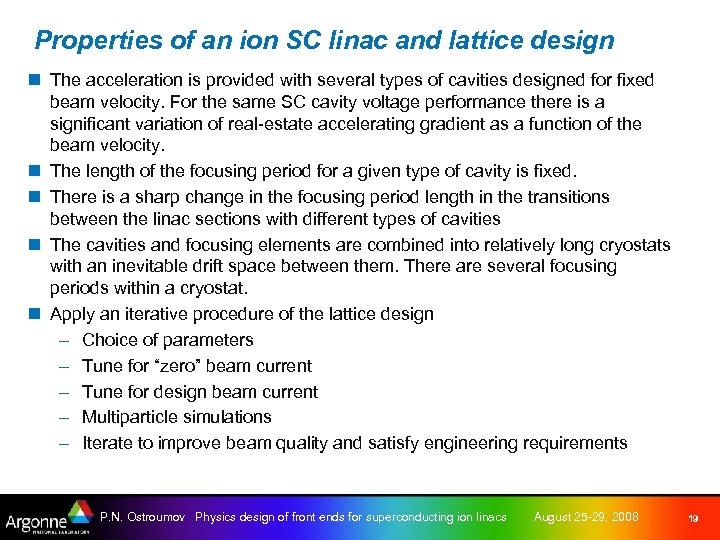 Properties of an ion SC linac and lattice design n The acceleration is provided with several types of cavities designed for fixed beam velocity. For the same SC cavity voltage performance there is a significant variation of real-estate accelerating gradient as a function of the beam velocity. n The length of the focusing period for a given type of cavity is fixed. n There is a sharp change in the focusing period length in the transitions between the linac sections with different types of cavities n The cavities and focusing elements are combined into relatively long cryostats with an inevitable drift space between them. There are several focusing periods within a cryostat. n Apply an iterative procedure of the lattice design – Choice of parameters – Tune for “zero” beam current – Tune for design beam current – Multiparticle simulations – Iterate to improve beam quality and satisfy engineering requirements P. N. Ostroumov Physics design of front ends for superconducting ion linacs August 25 -29, 2008 19
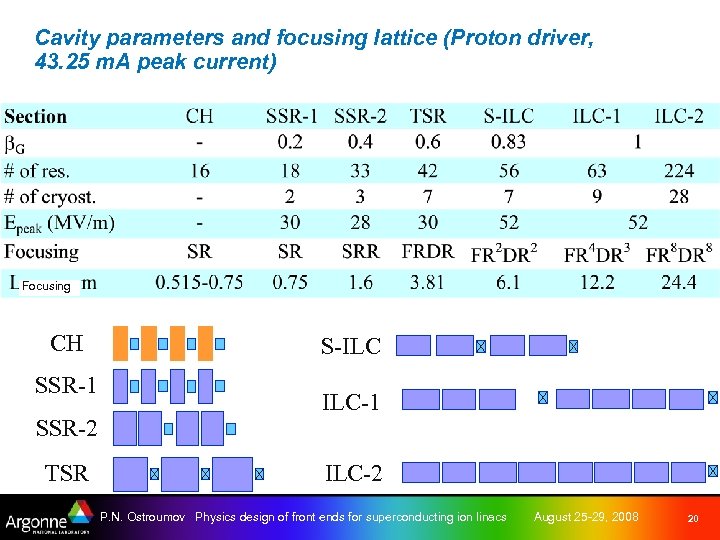 Cavity parameters and focusing lattice (Proton driver, 43. 25 m. A peak current) Focusing CH SSR-1 SSR-2 TSR S-ILC ILC-1 ILC-2 P. N. Ostroumov Physics design of front ends for superconducting ion linacs August 25 -29, 2008 20
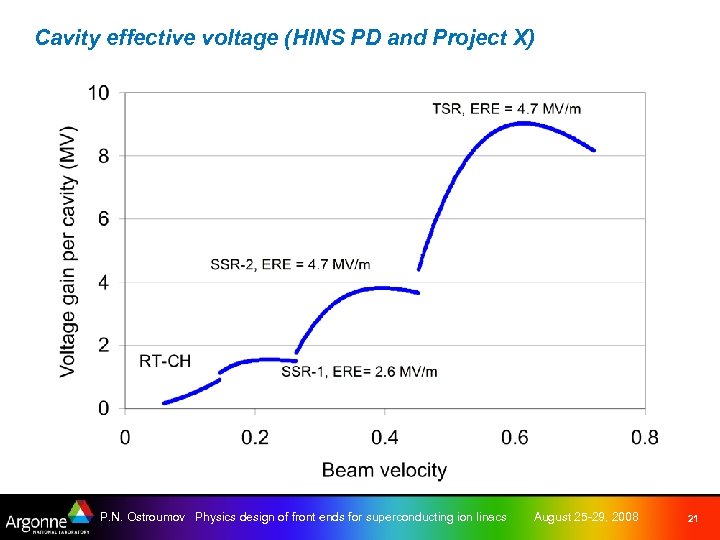 Cavity effective voltage (HINS PD and Project X) P. N. Ostroumov Physics design of front ends for superconducting ion linacs August 25 -29, 2008 21
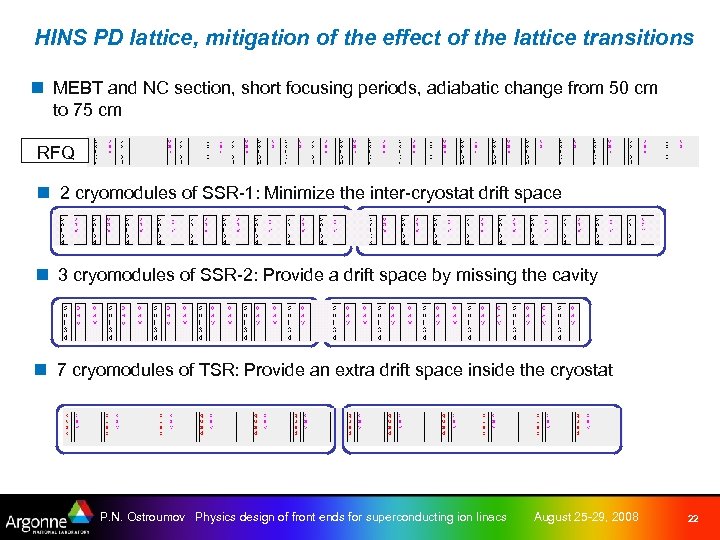 HINS PD lattice, mitigation of the effect of the lattice transitions n MEBT and NC section, short focusing periods, adiabatic change from 50 cm to 75 cm RFQ n 2 cryomodules of SSR-1: Minimize the inter-cryostat drift space n 3 cryomodules of SSR-2: Provide a drift space by missing the cavity n 7 cryomodules of TSR: Provide an extra drift space inside the cryostat P. N. Ostroumov Physics design of front ends for superconducting ion linacs August 25 -29, 2008 22
 Beam Dynamics Simulations n n The major workhorse is TRACK, recently P-TRACK “Zero-current” tune were created using TRACK routines in 3 D-fields The tuned lattice was simulated with ASTRA for detailed comparison Tune depression with space charge: – rms beam dimensions are from TRACK or ASTRA – Use formula from T. Wangler’s book P. N. Ostroumov Physics design of front ends for superconducting ion linacs August 25 -29, 2008 23
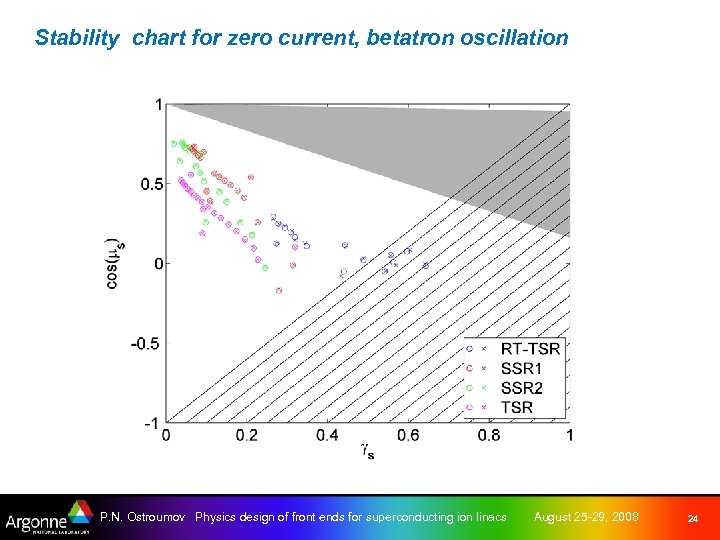 Stability chart for zero current, betatron oscillation P. N. Ostroumov Physics design of front ends for superconducting ion linacs August 25 -29, 2008 24
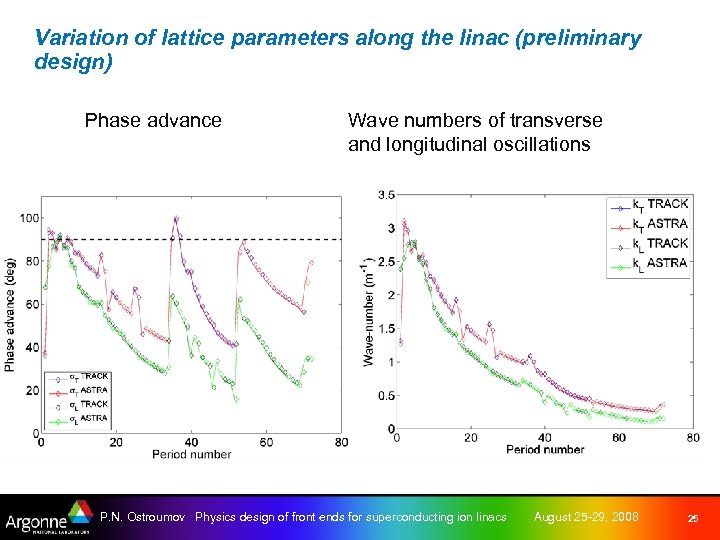 Variation of lattice parameters along the linac (preliminary design) Phase advance Wave numbers of transverse and longitudinal oscillations P. N. Ostroumov Physics design of front ends for superconducting ion linacs August 25 -29, 2008 25
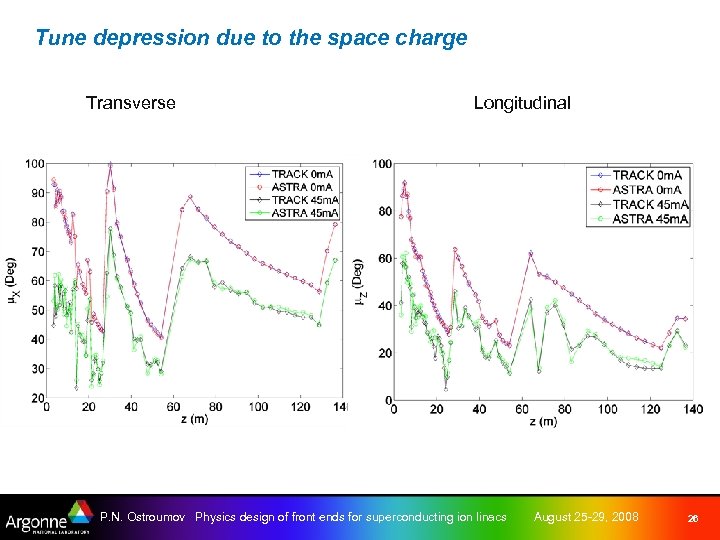 Tune depression due to the space charge Transverse Longitudinal P. N. Ostroumov Physics design of front ends for superconducting ion linacs August 25 -29, 2008 26
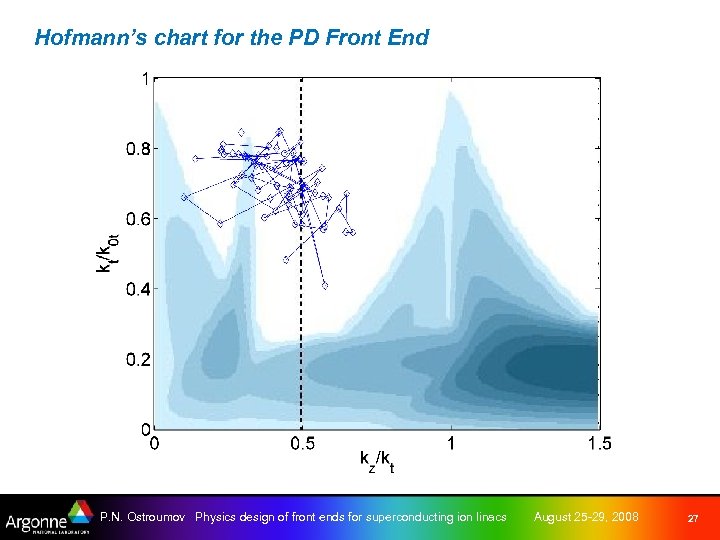 Hofmann’s chart for the PD Front End P. N. Ostroumov Physics design of front ends for superconducting ion linacs August 25 -29, 2008 27
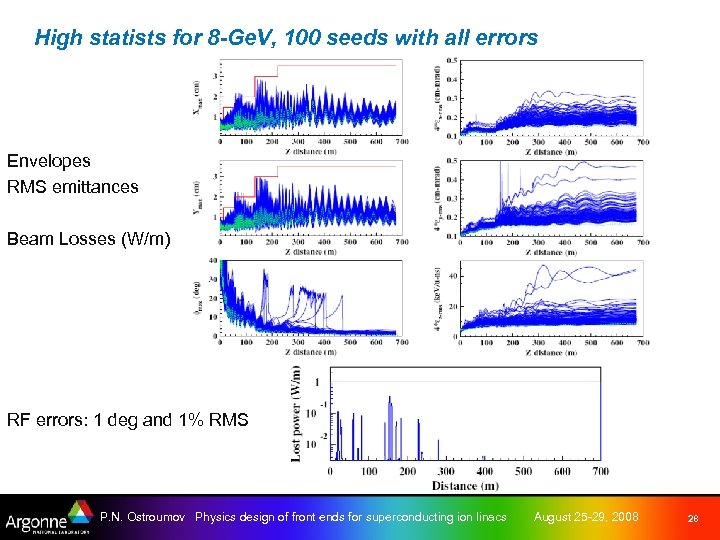 High statists for 8 -Ge. V, 100 seeds with all errors Envelopes RMS emittances Beam Losses (W/m) RF errors: 1 deg and 1% RMS P. N. Ostroumov Physics design of front ends for superconducting ion linacs August 25 -29, 2008 28
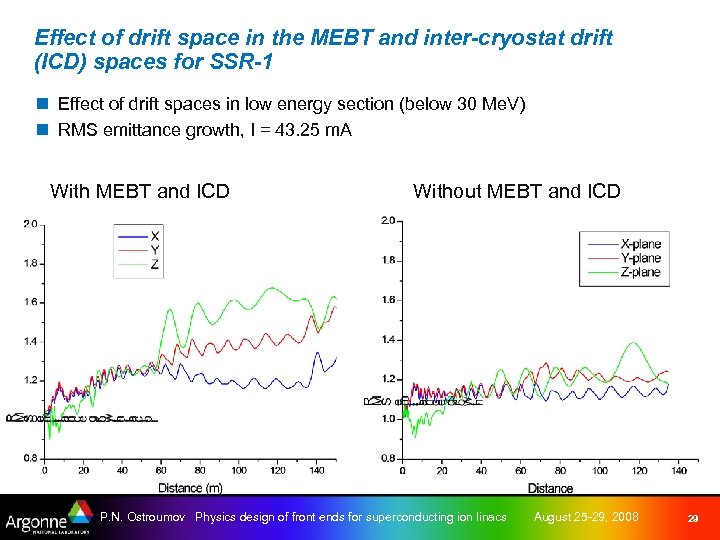 Effect of drift space in the MEBT and inter-cryostat drift (ICD) spaces for SSR-1 n Effect of drift spaces in low energy section (below 30 Me. V) n RMS emittance growth, I = 43. 25 m. A With MEBT and ICD Without MEBT and ICD P. N. Ostroumov Physics design of front ends for superconducting ion linacs August 25 -29, 2008 29
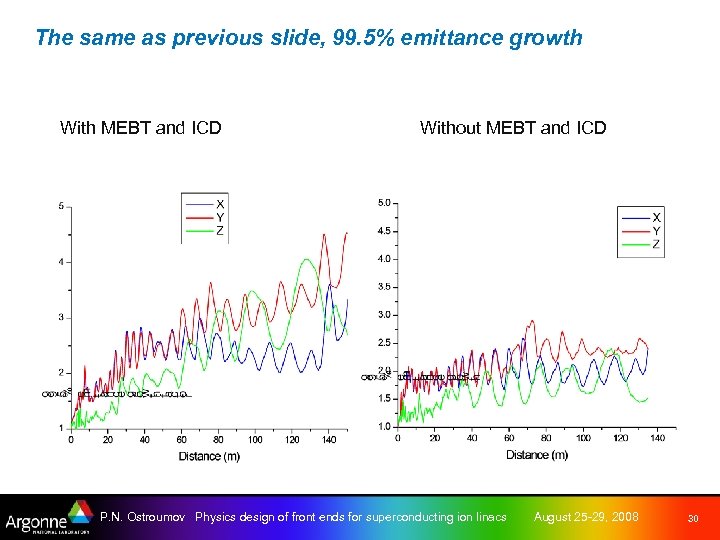 The same as previous slide, 99. 5% emittance growth With MEBT and ICD Without MEBT and ICD P. N. Ostroumov Physics design of front ends for superconducting ion linacs August 25 -29, 2008 30
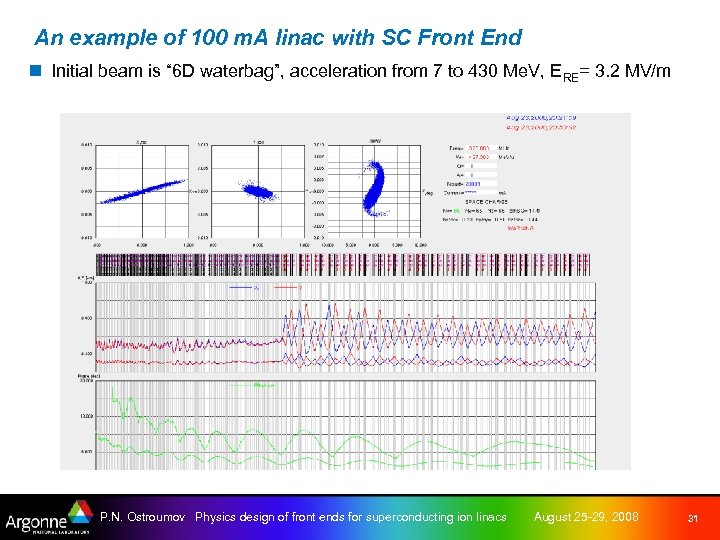 An example of 100 m. A linac with SC Front End n Initial beam is “ 6 D waterbag”, acceleration from 7 to 430 Me. V, ERE= 3. 2 MV/m P. N. Ostroumov Physics design of front ends for superconducting ion linacs August 25 -29, 2008 31
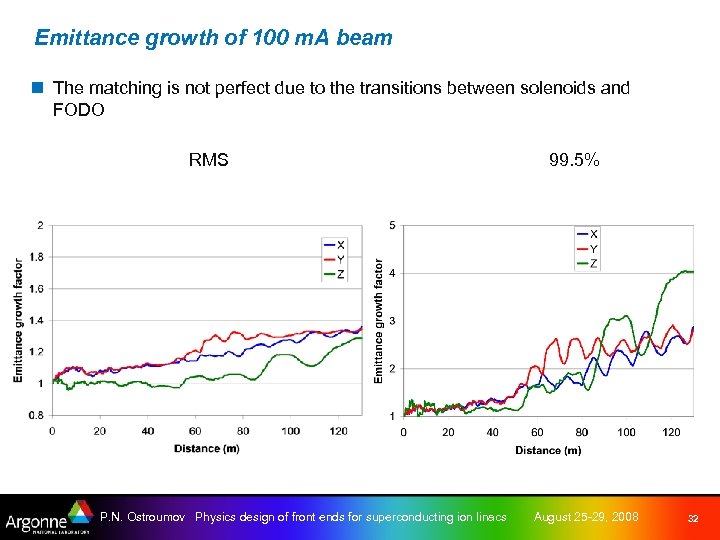 Emittance growth of 100 m. A beam n The matching is not perfect due to the transitions between solenoids and FODO RMS P. N. Ostroumov Physics design of front ends for superconducting ion linacs 99. 5% August 25 -29, 2008 32
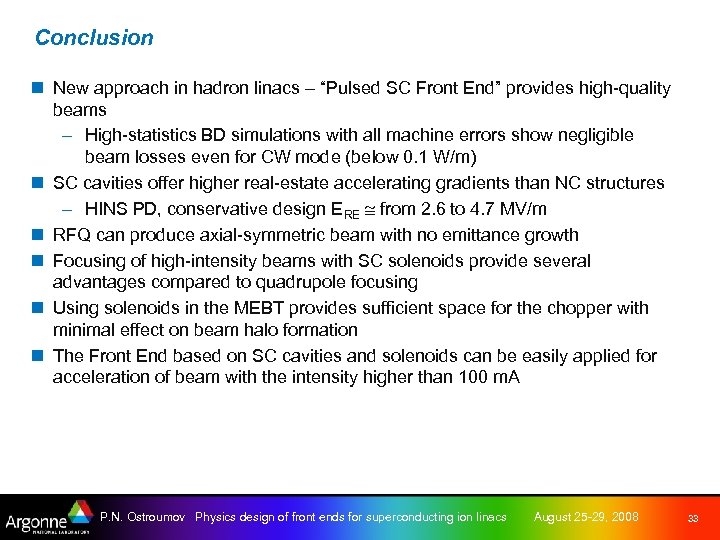 Conclusion n New approach in hadron linacs – “Pulsed SC Front End” provides high-quality beams – High-statistics BD simulations with all machine errors show negligible beam losses even for CW mode (below 0. 1 W/m) n SC cavities offer higher real-estate accelerating gradients than NC structures – HINS PD, conservative design ERE from 2. 6 to 4. 7 MV/m n RFQ can produce axial-symmetric beam with no emittance growth n Focusing of high-intensity beams with SC solenoids provide several advantages compared to quadrupole focusing n Using solenoids in the MEBT provides sufficient space for the chopper with minimal effect on beam halo formation n The Front End based on SC cavities and solenoids can be easily applied for acceleration of beam with the intensity higher than 100 m. A P. N. Ostroumov Physics design of front ends for superconducting ion linacs August 25 -29, 2008 33