


 Скачать презентацию Physics 1501 Lecture 12 l Announcements ç HW
2324143d495eacc1e8831f6c5098351f.ppt
- Количество слайдов: 23
 Physics 1501: Lecture 12 l Announcements ç HW 04 due this Friday. ç Midterm 1: Monday Oct. 3 ç Practice test on web ç HW solutions all this Friday. ç Office hours Friday instead of Wednesday l Topics ç Work & Energy ç Power Physics 1501: Lecture 12, Pg 1
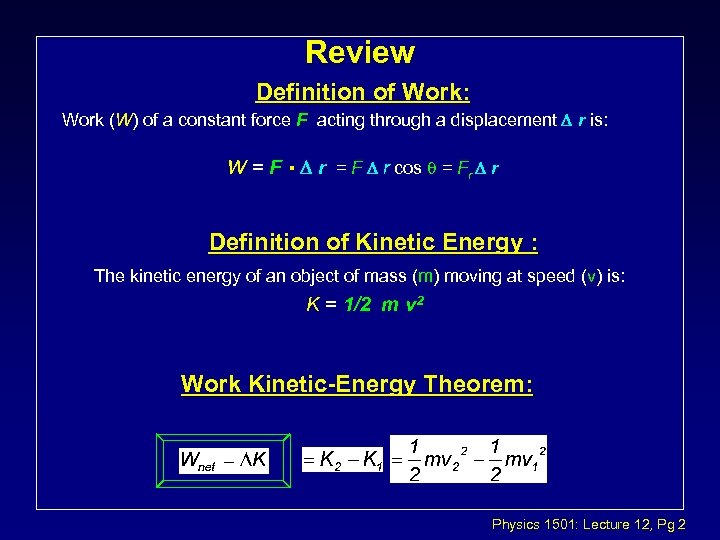 Review Definition of Work: Work (W) of a constant force F acting through a displacement r is: . W = F r cos = Fr r Definition of Kinetic Energy : The kinetic energy of an object of mass (m) moving at speed (v) is: K = 1/2 m v 2 Work Kinetic-Energy Theorem: Physics 1501: Lecture 12, Pg 2
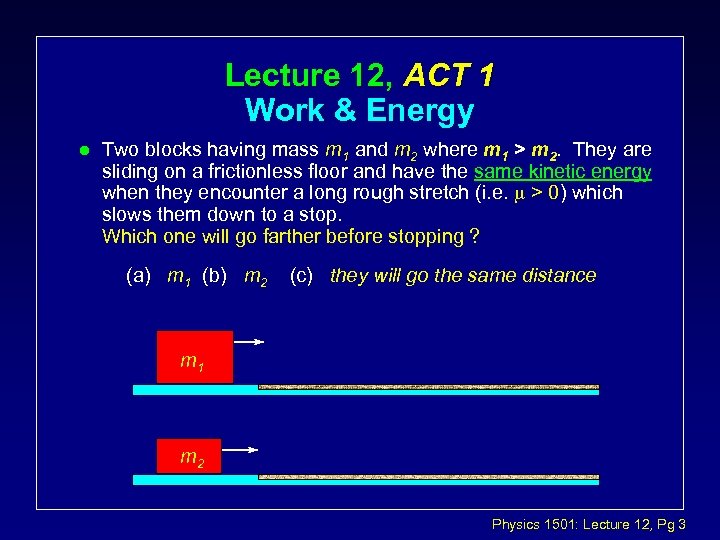 Lecture 12, ACT 1 Work & Energy l Two blocks having mass m 1 and m 2 where m 1 > m 2. They are sliding on a frictionless floor and have the same kinetic energy when they encounter a long rough stretch (i. e. m > 0) which slows them down to a stop. Which one will go farther before stopping ? (a) m 1 (b) m 2 (c) they will go the same distance m 1 m 2 Physics 1501: Lecture 12, Pg 3
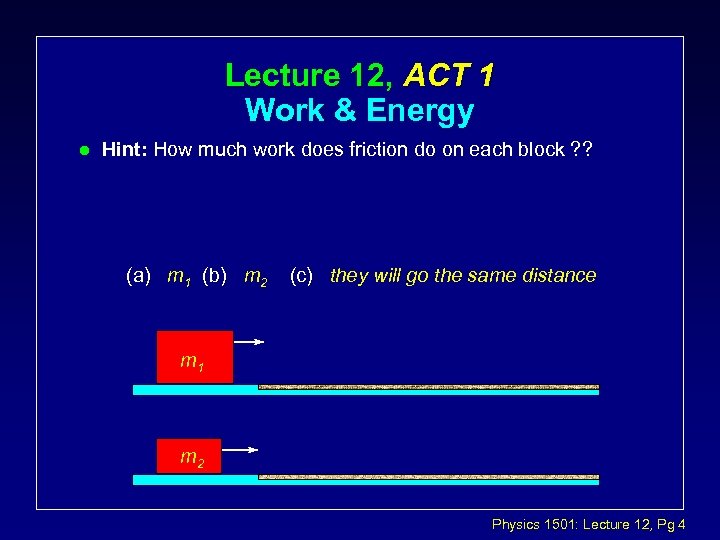 Lecture 12, ACT 1 Work & Energy l Hint: How much work does friction do on each block ? ? (a) m 1 (b) m 2 (c) they will go the same distance m 1 m 2 Physics 1501: Lecture 12, Pg 4
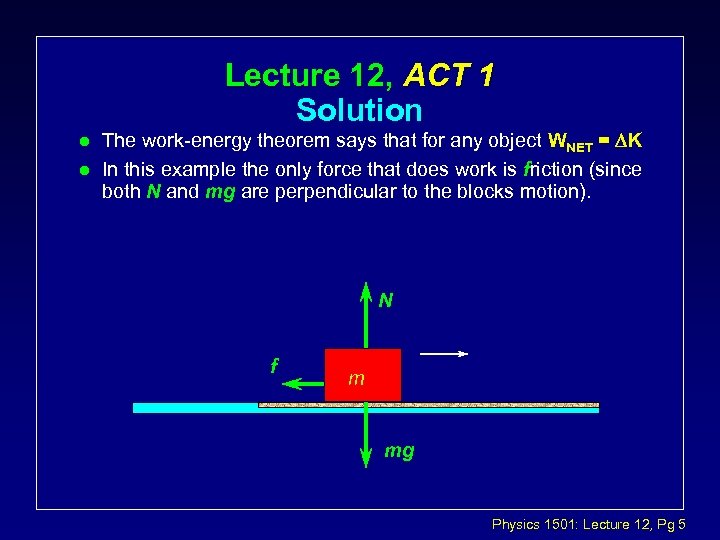 Lecture 12, ACT 1 Solution l l The work-energy theorem says that for any object WNET = K In this example the only force that does work is friction (since both N and mg are perpendicular to the blocks motion). N f m mg Physics 1501: Lecture 12, Pg 5
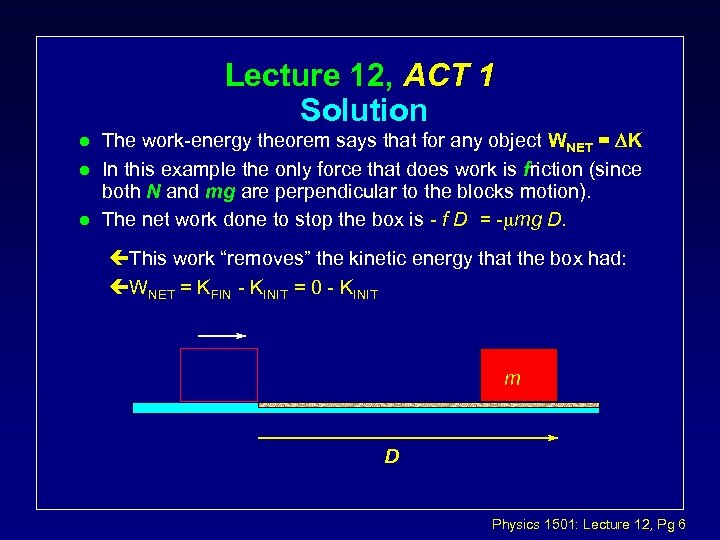 Lecture 12, ACT 1 Solution l l l The work-energy theorem says that for any object WNET = K In this example the only force that does work is friction (since both N and mg are perpendicular to the blocks motion). The net work done to stop the box is - f D = -mmg D. çThis work “removes” the kinetic energy that the box had: çWNET = KFIN - KINIT = 0 - KINIT m D Physics 1501: Lecture 12, Pg 6
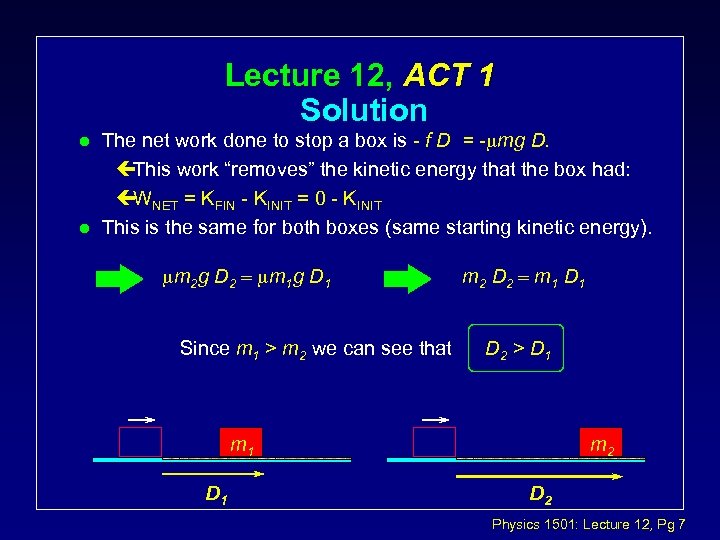 Lecture 12, ACT 1 Solution l l The net work done to stop a box is - f D = -mmg D. çThis work “removes” the kinetic energy that the box had: çWNET = KFIN - KINIT = 0 - KINIT This is the same for both boxes (same starting kinetic energy). mm 2 g D 2 = mm 1 g D 1 Since m 1 > m 2 we can see that m 2 D 2 = m 1 D 2 > D 1 m 1 D 1 m 2 D 2 Physics 1501: Lecture 12, Pg 7
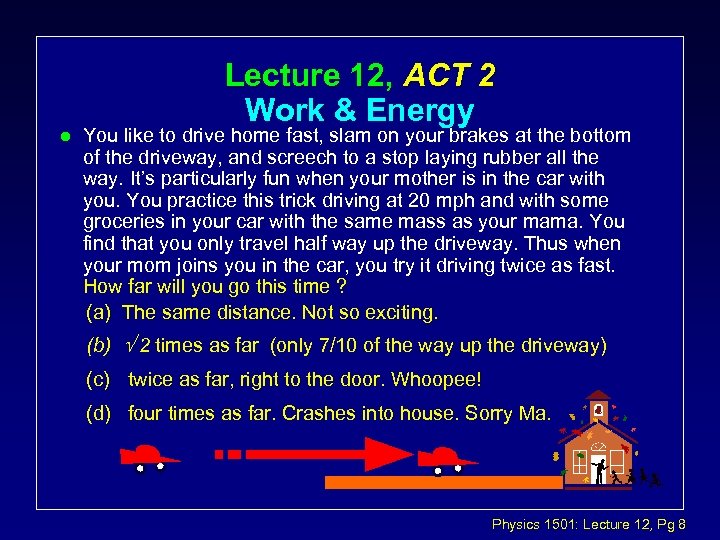 l Lecture 12, ACT 2 Work & Energy You like to drive home fast, slam on your brakes at the bottom of the driveway, and screech to a stop laying rubber all the way. It’s particularly fun when your mother is in the car with you. You practice this trick driving at 20 mph and with some groceries in your car with the same mass as your mama. You find that you only travel half way up the driveway. Thus when your mom joins you in the car, you try it driving twice as fast. How far will you go this time ? (a) The same distance. Not so exciting. (b) 2 times as far (only 7/10 of the way up the driveway) (c) twice as far, right to the door. Whoopee! (d) four times as far. Crashes into house. Sorry Ma. Physics 1501: Lecture 12, Pg 8
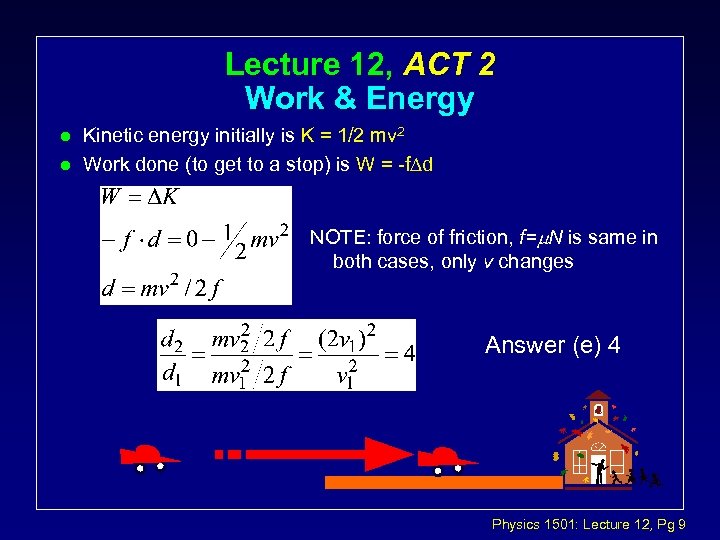 Lecture 12, ACT 2 Work & Energy l l Kinetic energy initially is K = 1/2 mv 2 Work done (to get to a stop) is W = -f. Dd NOTE: force of friction, f=m. N is same in both cases, only v changes Answer (e) 4 Physics 1501: Lecture 12, Pg 9
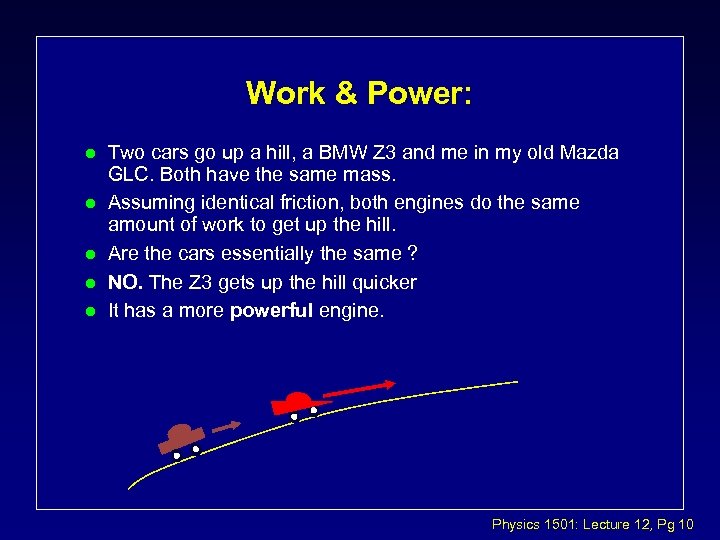 Work & Power: l l l Two cars go up a hill, a BMW Z 3 and me in my old Mazda GLC. Both have the same mass. Assuming identical friction, both engines do the same amount of work to get up the hill. Are the cars essentially the same ? NO. The Z 3 gets up the hill quicker It has a more powerful engine. Physics 1501: Lecture 12, Pg 10
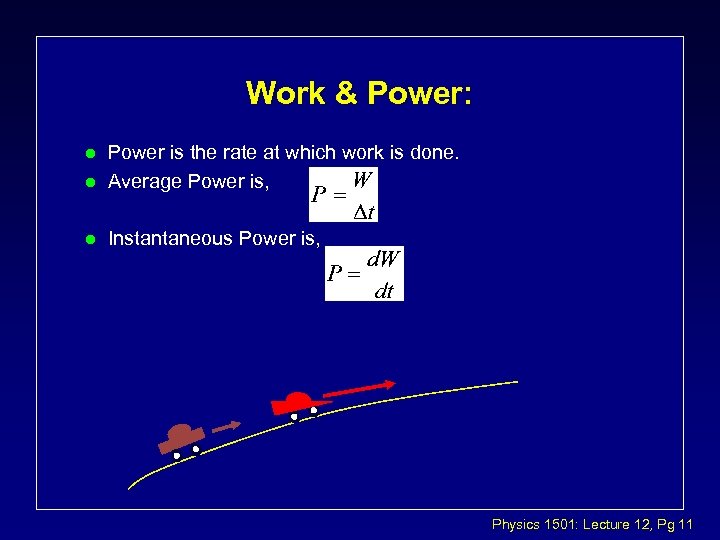 Work & Power: l Power is the rate at which work is done. Average Power is, l Instantaneous Power is, l Physics 1501: Lecture 12, Pg 11
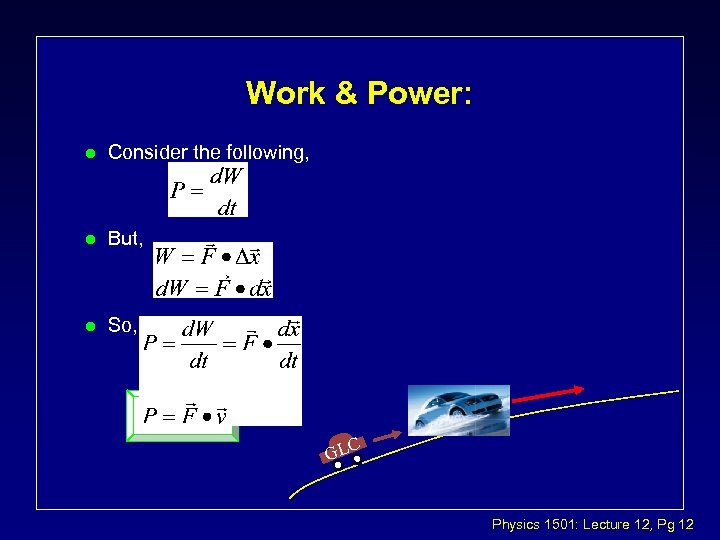 Work & Power: l Consider the following, l But, l So, Z 3 GLC Physics 1501: Lecture 12, Pg 12
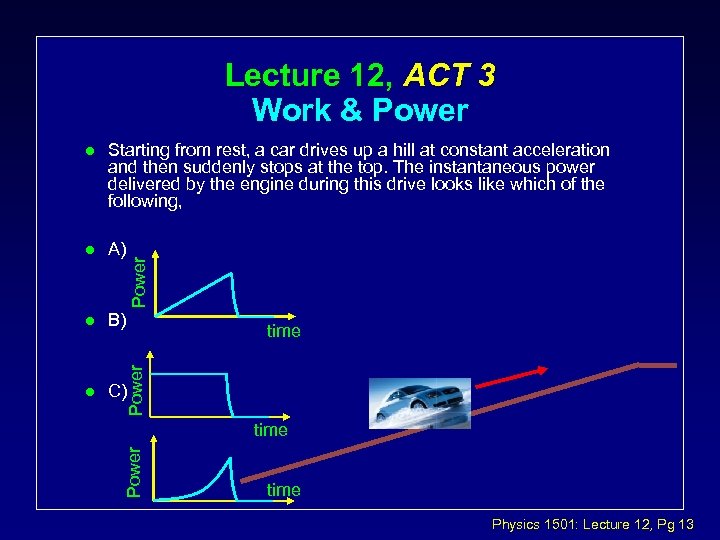 Lecture 12, ACT 3 Work & Power Starting from rest, a car drives up a hill at constant acceleration and then suddenly stops at the top. The instantaneous power delivered by the engine during this drive looks like which of the following, l A) l B) l C) Power l Power time Z 3 Power time Physics 1501: Lecture 12, Pg 13
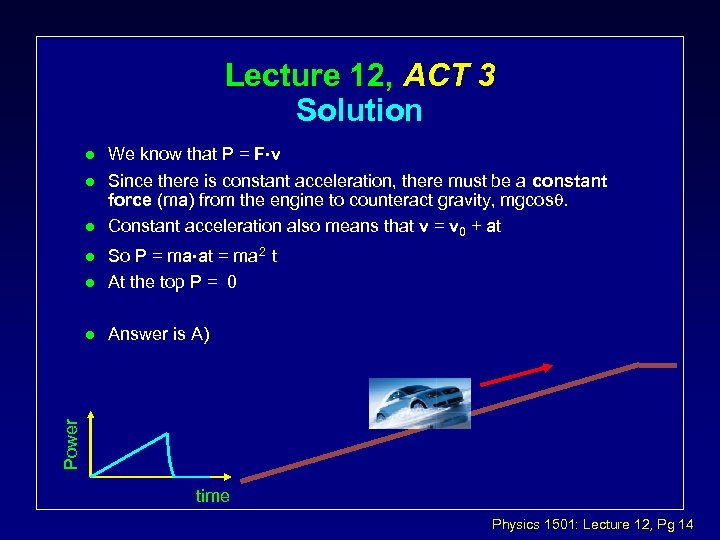 Lecture 12, ACT 3 Solution l l l We know that P = F. v Since there is constant acceleration, there must be a constant force (ma) from the engine to counteract gravity, mgcos. Constant acceleration also means that v = v 0 + at l So P = ma. at = ma 2 t At the top P = 0 l Answer is A) l Power Z 3 time Physics 1501: Lecture 12, Pg 14
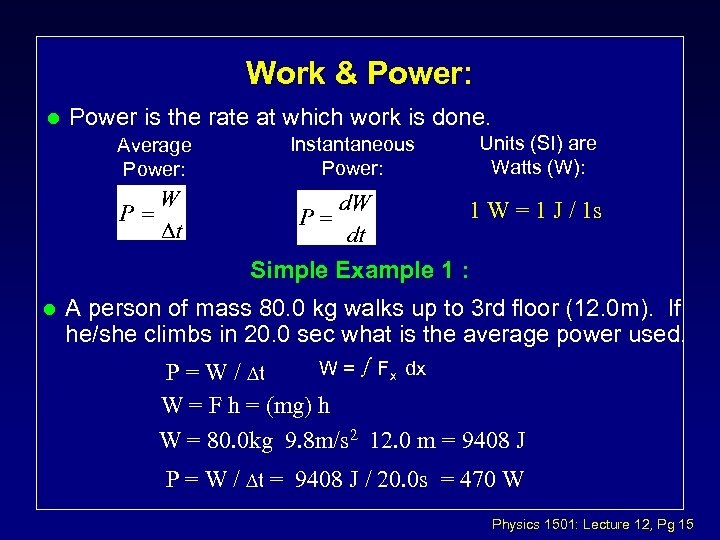 Work & Power: l Power is the rate at which work is done. Average Power: Units (SI) are Watts (W): Instantaneous Power: 1 W = 1 J / 1 s Simple Example 1 : l A person of mass 80. 0 kg walks up to 3 rd floor (12. 0 m). If he/she climbs in 20. 0 sec what is the average power used. W = Fx dx P = W / Dt W = F h = (mg) h W = 80. 0 kg 9. 8 m/s 2 12. 0 m = 9408 J P = W / Dt = 9408 J / 20. 0 s = 470 W Physics 1501: Lecture 12, Pg 15
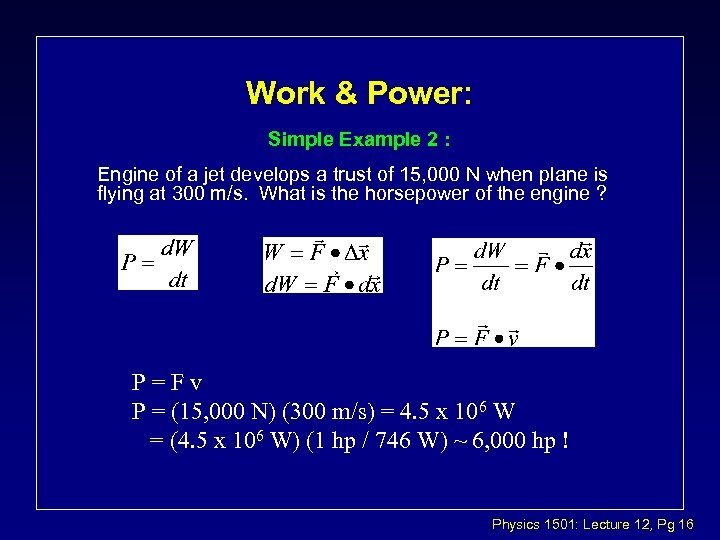 Work & Power: Simple Example 2 : Engine of a jet develops a trust of 15, 000 N when plane is flying at 300 m/s. What is the horsepower of the engine ? P=Fv P = (15, 000 N) (300 m/s) = 4. 5 x 10⁶ W = (4. 5 x 10⁶ W) (1 hp / 746 W) ~ 6, 000 hp ! Physics 1501: Lecture 12, Pg 16
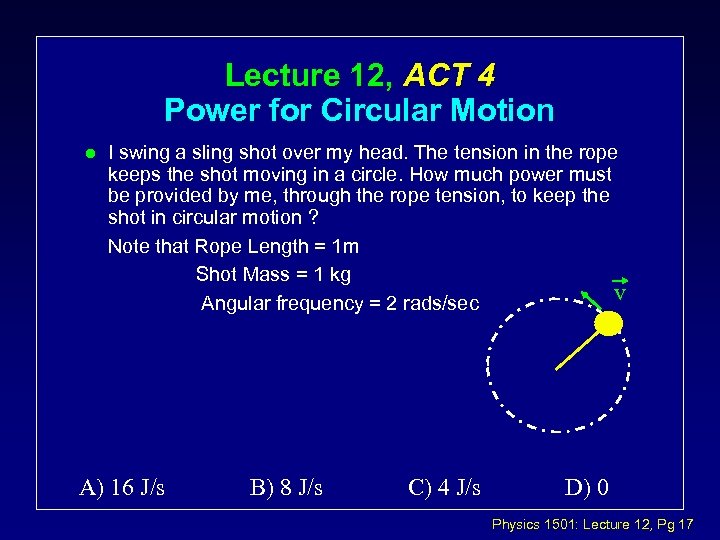 Lecture 12, ACT 4 Power for Circular Motion l I swing a sling shot over my head. The tension in the rope keeps the shot moving in a circle. How much power must be provided by me, through the rope tension, to keep the shot in circular motion ? Note that Rope Length = 1 m Shot Mass = 1 kg v Angular frequency = 2 rads/sec A) 16 J/s B) 8 J/s C) 4 J/s D) 0 Physics 1501: Lecture 12, Pg 17
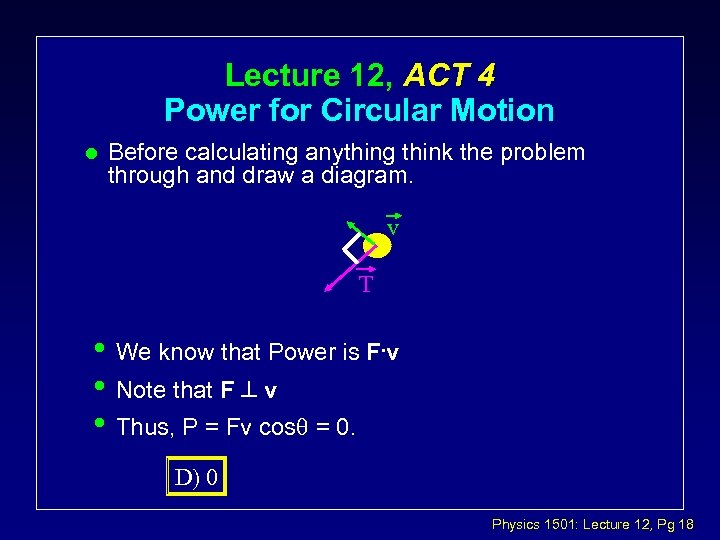 Lecture 12, ACT 4 Power for Circular Motion l Before calculating anything think the problem through and draw a diagram. v T • We know that Power is F. v • Note that F v • Thus, P = Fv cos = 0. D) 0 Physics 1501: Lecture 12, Pg 18
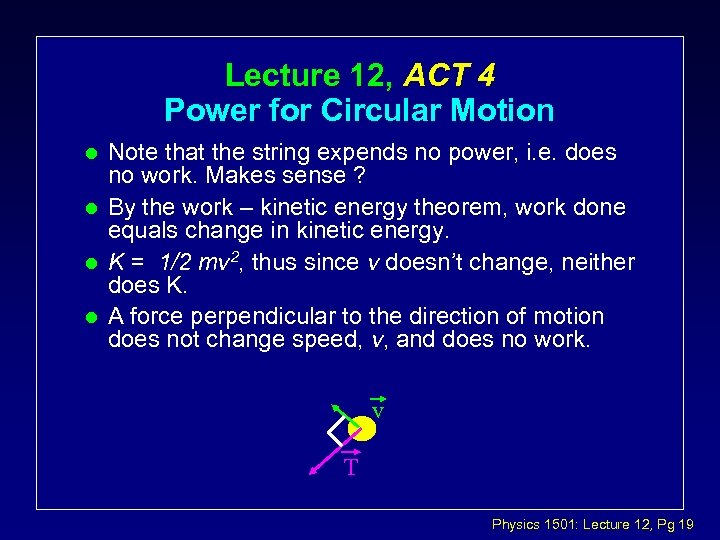 Lecture 12, ACT 4 Power for Circular Motion l l Note that the string expends no power, i. e. does no work. Makes sense ? By the work – kinetic energy theorem, work done equals change in kinetic energy. K = 1/2 mv 2, thus since v doesn’t change, neither does K. A force perpendicular to the direction of motion does not change speed, v, and does no work. v T Physics 1501: Lecture 12, Pg 19
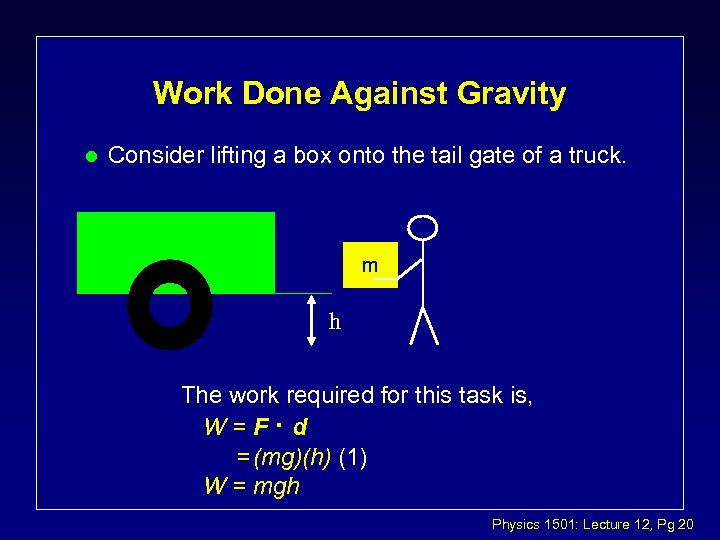 Work Done Against Gravity l Consider lifting a box onto the tail gate of a truck. m h The work required for this task is, W=F·d =(mg)(h) (1) W = mgh Physics 1501: Lecture 12, Pg 20
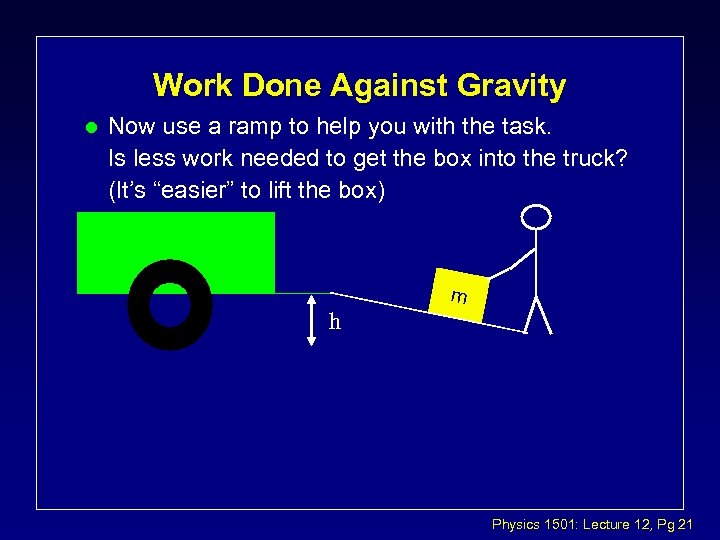 Work Done Against Gravity l Now use a ramp to help you with the task. Is less work needed to get the box into the truck? (It’s “easier” to lift the box) m h Physics 1501: Lecture 12, Pg 21
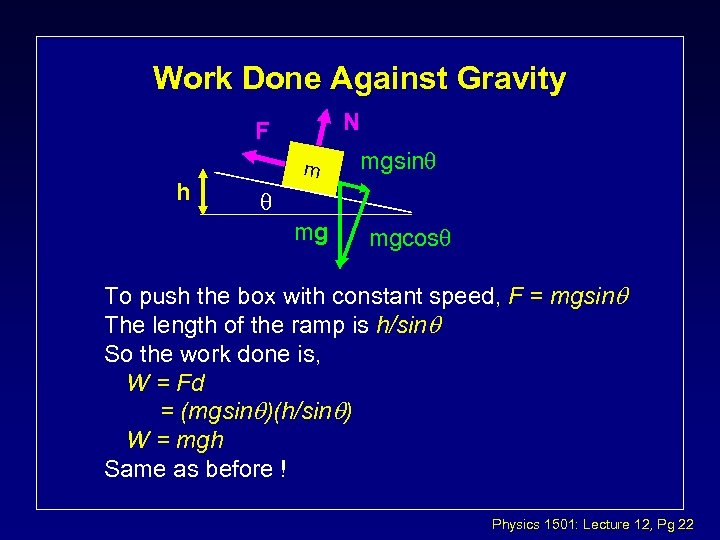 Work Done Against Gravity N F h m mgsin mg mgcos To push the box with constant speed, F = mgsinq The length of the ramp is h/sinq So the work done is, W = Fd = (mgsinq)(h/sinq) W = mgh Same as before ! Physics 1501: Lecture 12, Pg 22
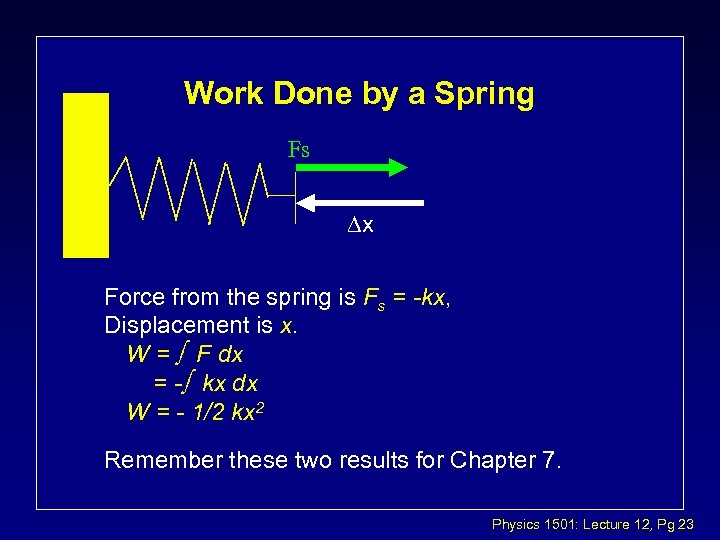 Work Done by a Spring Fs Dx Force from the spring is Fs = -kx, Displacement is x. W = F dx = - kx dx W = - 1/2 kx 2 Remember these two results for Chapter 7. Physics 1501: Lecture 12, Pg 23