


 Скачать презентацию Physics 12 UCSD Solar Technologies Ways to extract
94aa8ef1b1a6150e046bd01a6f20b4ec.ppt
- Количество слайдов: 32
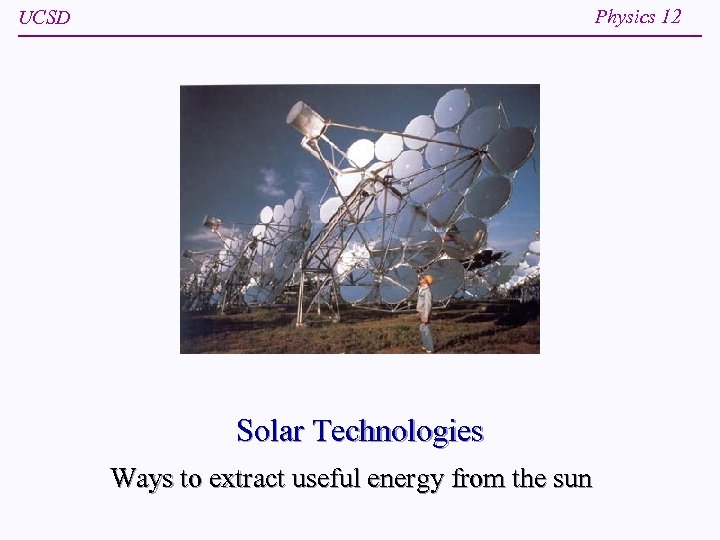 Physics 12 UCSD Solar Technologies Ways to extract useful energy from the sun
 Physics 12 UCSD Notable quotes • I’d put my money on the sun and solar energy. What a source of power! I hope we don’t have to wait until oil and coal run out before we tackle that. – Thomas Edison, 1910 • My father rode a camel. I drive a car. My son flies a jet airplane. His son will ride a camel. – Saudi proverb Spring 2013 2
 Physics 12 UCSD Four Basic Schemes 1. 2. 3. 4. Photovoltaics (Lecture 12) Thermal electric power generation Flat-Plate direct heating (hot water, usually) Passive solar heating Spring 2013 3
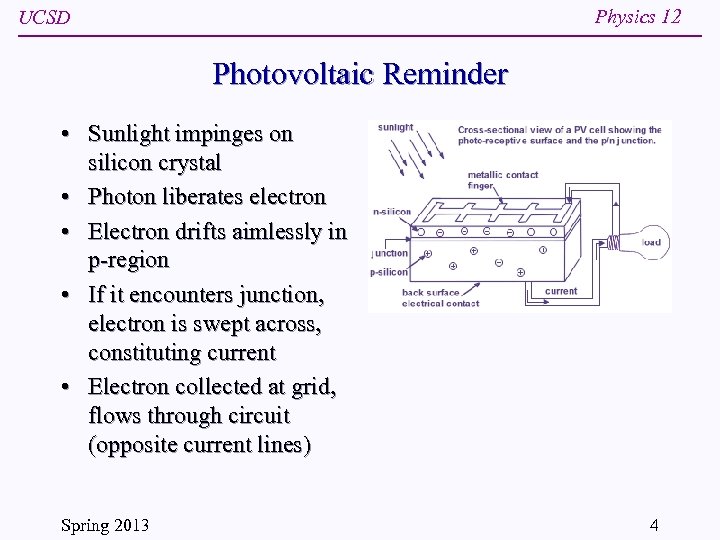 Physics 12 UCSD Photovoltaic Reminder • Sunlight impinges on silicon crystal • Photon liberates electron • Electron drifts aimlessly in p-region • If it encounters junction, electron is swept across, constituting current • Electron collected at grid, flows through circuit (opposite current lines) Spring 2013 4
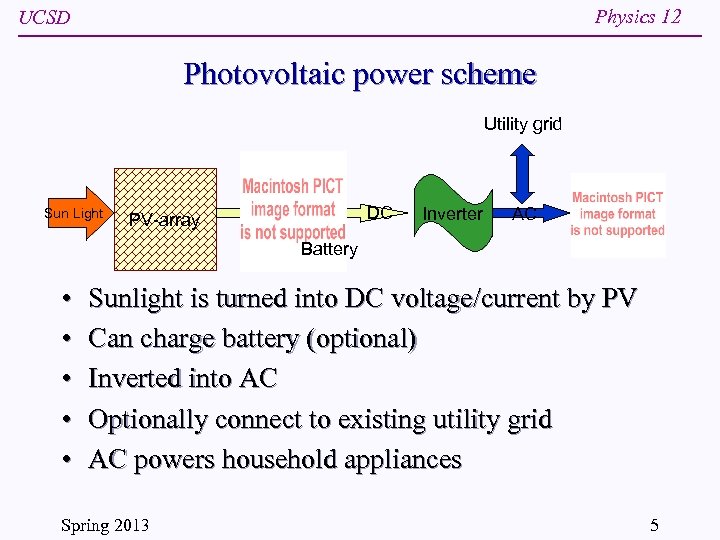 Physics 12 UCSD Photovoltaic power scheme Utility grid Sun Light DC PV-array Inverter AC Battery • • • Sunlight is turned into DC voltage/current by PV Can charge battery (optional) Inverted into AC Optionally connect to existing utility grid AC powers household appliances Spring 2013 5
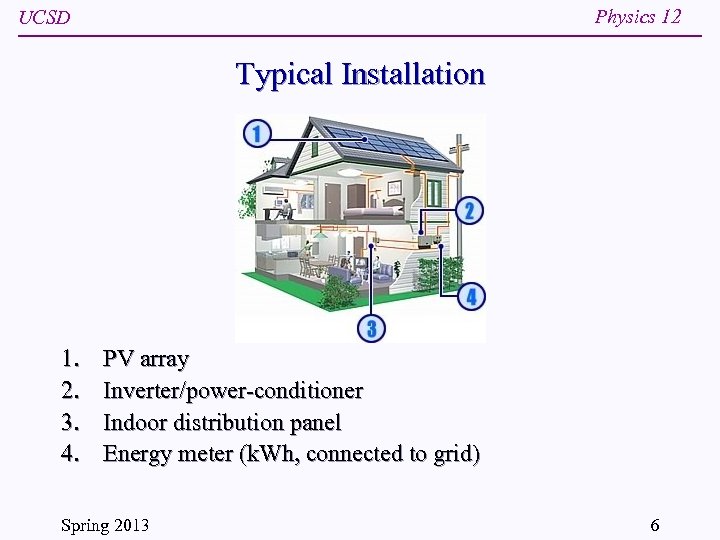 Physics 12 UCSD Typical Installation 1. 2. 3. 4. PV array Inverter/power-conditioner Indoor distribution panel Energy meter (k. Wh, connected to grid) Spring 2013 6
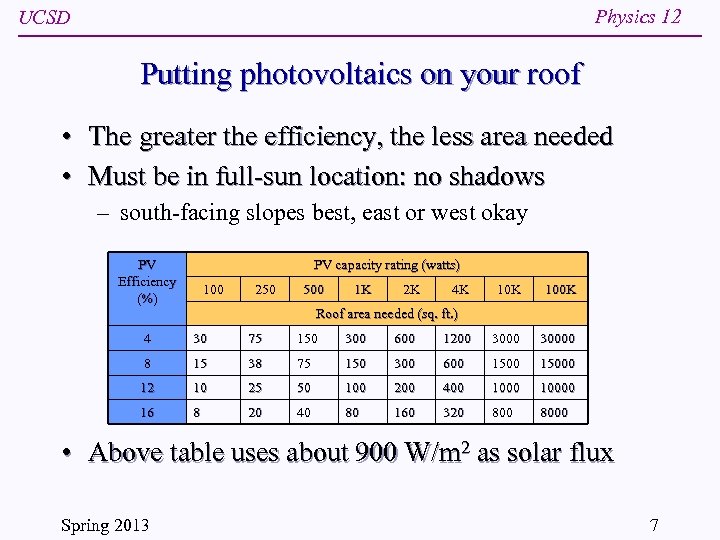 Physics 12 UCSD Putting photovoltaics on your roof • The greater the efficiency, the less area needed • Must be in full-sun location: no shadows – south-facing slopes best, east or west okay PV Efficiency (%) PV capacity rating (watts) 100 250 500 1 K 2 K 4 K 100 K Roof area needed (sq. ft. ) 4 30 75 150 300 600 1200 30000 8 15 38 75 150 300 600 15000 12 10 25 50 100 200 400 10000 16 8 20 40 80 160 320 8000 • Above table uses about 900 W/m 2 as solar flux Spring 2013 7
 Physics 12 UCSD When the sun doesn’t shine… • Can either run from batteries (bank of 12 gives roughly one day’s worth) or stay on grid – usually design off-grid system for ~3 days no-sun • In CA (and 37 other states), they do “net metering, ” which lets you run your meter backwards when you are producing more than you are consuming – this means that the utility effectively buys power from you at the same rate they sell it to you: a sweet deal – but very few U. S. utilities cut a check for excess production • Backup generator also possible Spring 2013 2 Q 8
 Physics 12 UCSD Photovoltaic Transportation • A 10 m 2 car using 15% efficiency photovoltaics under 850 W/m 2 solar flux would generate at most 1250 W – 1. 7 horsepower max – in full sun when sun is high in the sky • Could only take a 5% grade at 20 mph – this neglects any and all other inefficiencies • Would do better if panels charged batteries – no more shady parking spots! Spring 2013 9
 Physics 12 UCSD Photovoltaic transportation • Quote about solar car pictured above: – “With sunlight as its only fuel, the U of Toronto solar car, named Faust, consumes no more energy than a hairdryer but can reach speeds of up to 120 kilometers per hour. ” • is this downhill? ? Note the mistake in the above quote… • The real point is that it can be done – but most of the engineering effort is in reducing drag, weight, friction, etc. – even without air resistance, it would take two minutes to get up to freeway speed if the car and driver together had a mass of 250 kg (very light) • just ½mv 2 divided by 1000 W of power Spring 2013 Q 10
 Physics 12 UCSD Future Projections • As fossil fuels run out, the price of FF energy will climb relative to PV prices • Break-even time will drop from 15 to 10 to 5 years – now at 8 years for California home (considering rebates) • Meanwhile PV is sure to become a more visible/prevalent part of our lives! – In Japan, it is so in to have photovoltaics, they make fake PV panels for rooftops so it’ll look like you’ve gone solar! Spring 2013 11
 Physics 12 UCSD But not all is rosy in PV-land… • Photovoltaics don’t last forever – useful life is about 30 years (though maybe more? ) – manufacturers often guarantee < 20% degradation in 25 years – damage from radiation, cosmic rays create crystal imperfections • Some toxic chemicals used during production – therefore not entirely environmentally friendly • Much land area would have to be covered, with corresponding loss of habitat – not clear that this is worse than mining/processing and power plant land use (plus thermal pollution of rivers) Spring 2013 12
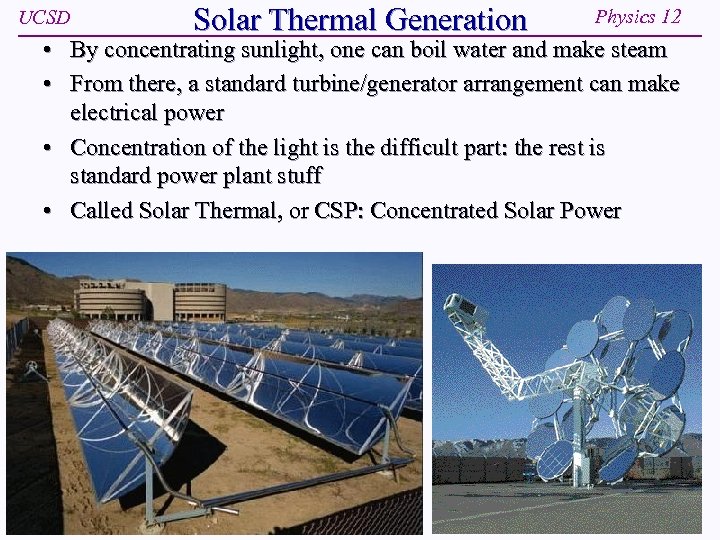 UCSD Solar Thermal Generation Physics 12 • By concentrating sunlight, one can boil water and make steam • From there, a standard turbine/generator arrangement can make electrical power • Concentration of the light is the difficult part: the rest is standard power plant stuff • Called Solar Thermal, or CSP: Concentrated Solar Power Spring 2013 13
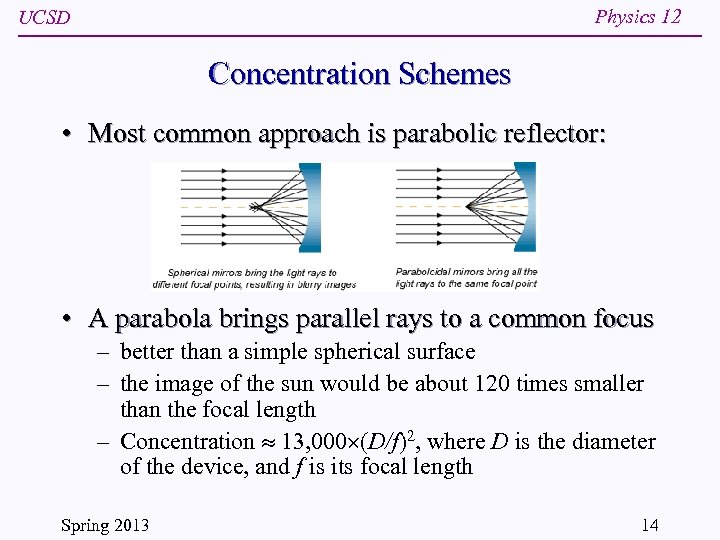 Physics 12 UCSD Concentration Schemes • Most common approach is parabolic reflector: • A parabola brings parallel rays to a common focus – better than a simple spherical surface – the image of the sun would be about 120 times smaller than the focal length – Concentration 13, 000 (D/f)2, where D is the diameter of the device, and f is its focal length Spring 2013 14
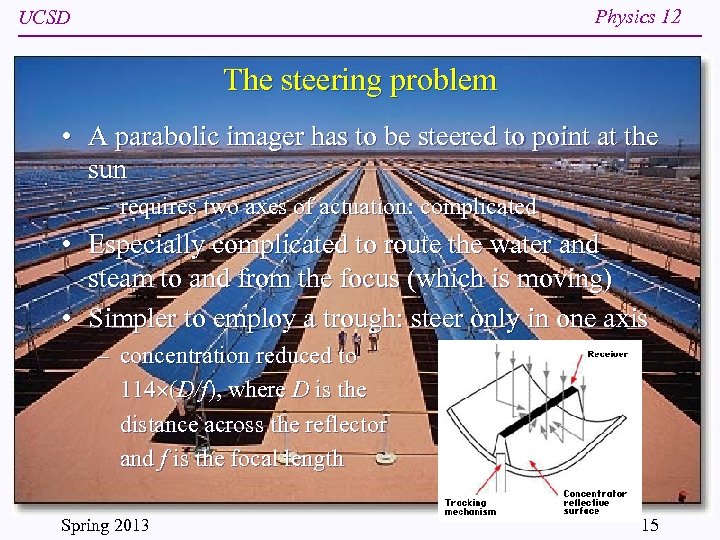 Physics 12 UCSD The steering problem • A parabolic imager has to be steered to point at the sun – requires two axes of actuation: complicated • Especially complicated to route the water and steam to and from the focus (which is moving) • Simpler to employ a trough: steer only in one axis – concentration reduced to 114 (D/f), where D is the distance across the reflector and f is the focal length Spring 2013 15
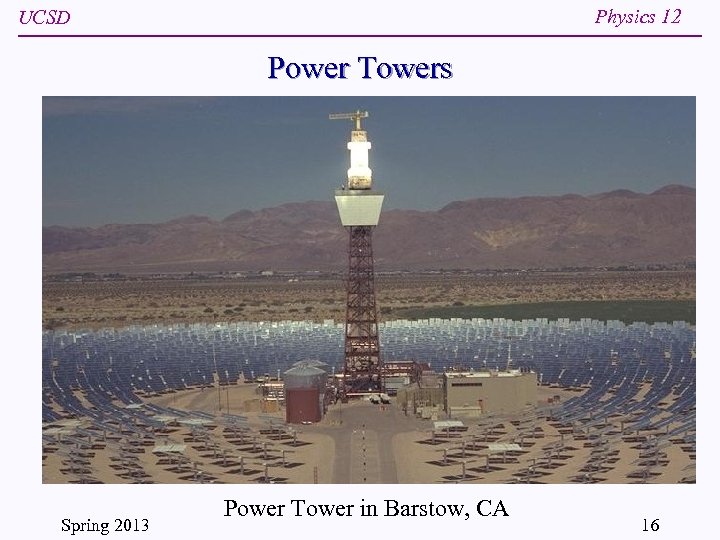 Physics 12 UCSD Power Towers Spring 2013 Power Tower in Barstow, CA 16
 Physics 12 UCSD Who needs a parabola! • You can cheat on the parabola somewhat by adopting a steerable-segment approach – each flat segment reflects (but does not itself focus) sunlight onto some target – makes mirrors cheap (flat, low-quality) • Many coordinated reflectors putting light on the same target can yield very high concentrations – concentration ratios in the thousands – Barstow installation has 1900 20 20 -ft 2 reflectors, and generates 10 MW of electrical power • calculate an efficiency of 17%, though this assumes each panel is perpendicular to sun Spring 2013 17
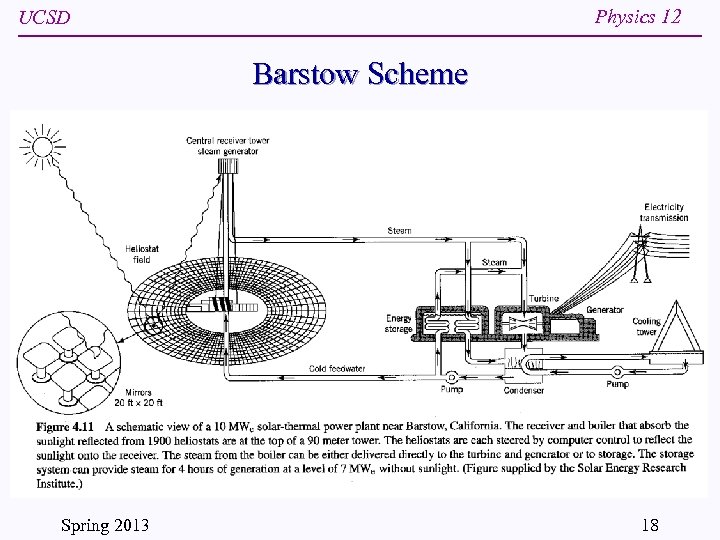 Physics 12 UCSD Barstow Scheme Spring 2013 18
 Physics 12 UCSD Solar thermal economics • Becoming cost-competitive with fossil fuel alternatives • Cost Evolution: solar thermal plants – 1983 13. 8 MW plant cost $6 per peak Watt • 25% efficient • about 25 cents per k. Wh – 1991 plant cost $3 per peak Watt • 8 cents per k. Wh – Solar One in Nevada cost $266 million, produces 75 MW in full sun, and produces 134 million k. Wh/year • so about $3. 50 per peak Watt, 10 cents/k. Wh over 20 years • California dominated world for CSP (354 MW) – now U. S. has 1000 MW capacity; 500 MW in Spain Spring 2013 Q 19
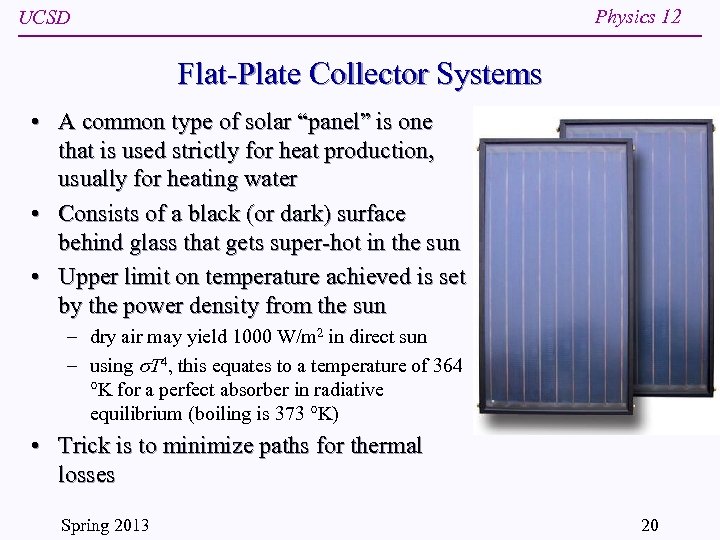 Physics 12 UCSD Flat-Plate Collector Systems • A common type of solar “panel” is one that is used strictly for heat production, usually for heating water • Consists of a black (or dark) surface behind glass that gets super-hot in the sun • Upper limit on temperature achieved is set by the power density from the sun – dry air may yield 1000 W/m 2 in direct sun – using T 4, this equates to a temperature of 364 K for a perfect absorber in radiative equilibrium (boiling is 373 K) • Trick is to minimize paths for thermal losses Spring 2013 20
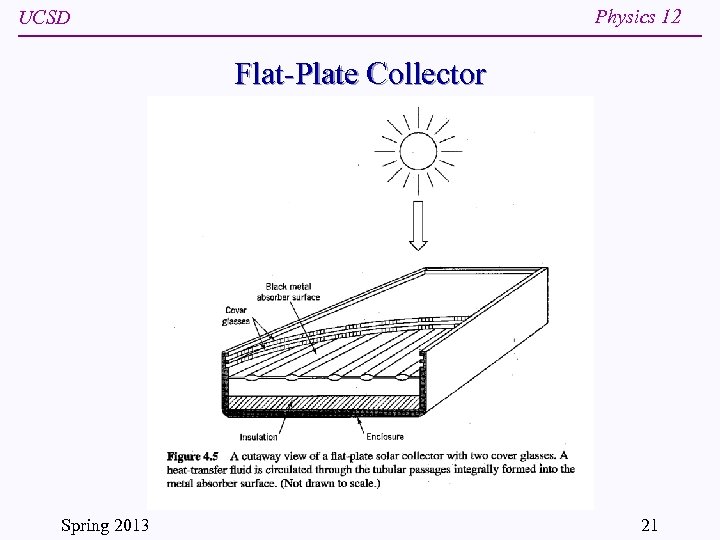 Physics 12 UCSD Flat-Plate Collector Spring 2013 21
 Physics 12 UCSD Controlling the heat flow • You want to channel as much of the solar energy into the water as you can – this means suppressing other channels of heat flow • Double-pane glass – cuts conduction of heat (from hot air behind) in half – provides a buffer against radiative losses (the pane heats up by absorbing IR radiation from the collector) – If space between is thin, inhibits convection of air between the panes (making air a good insulator) • Insulate behind absorber so heat doesn’t escape • Heat has few options but to go into circulating fluid Spring 2013 22
 Physics 12 UCSD What does the glass do, exactly? • Glass is transparent to visible radiation (aside from 8% reflection loss), but opaque to infrared radiation from 8– 24 microns in wavelength – collector at 350 K has peak emission at about 8. 3 microns – inner glass absorbs collector emission, and heats up – glass re-radiates thermal radiation: half inward and half outward: cuts thermal radiation in half – actually does more than this, because outer pane also sends back some radiation: so 2/3 ends up being returned to collector Spring 2013 23
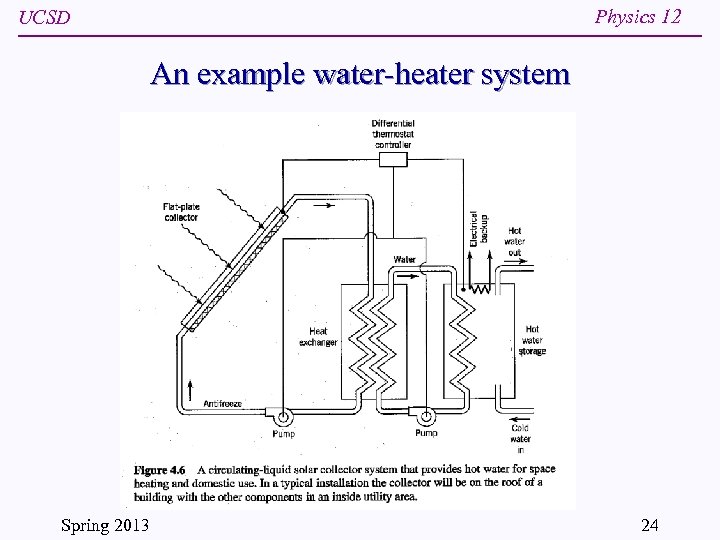 Physics 12 UCSD An example water-heater system Spring 2013 24
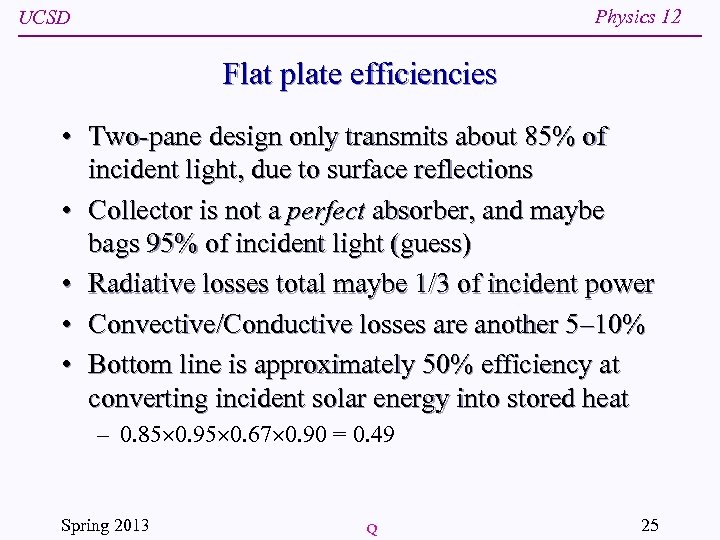 Physics 12 UCSD Flat plate efficiencies • Two-pane design only transmits about 85% of incident light, due to surface reflections • Collector is not a perfect absorber, and maybe bags 95% of incident light (guess) • Radiative losses total maybe 1/3 of incident power • Convective/Conductive losses are another 5– 10% • Bottom line is approximately 50% efficiency at converting incident solar energy into stored heat – 0. 85 0. 95 0. 67 0. 90 = 0. 49 Spring 2013 Q 25
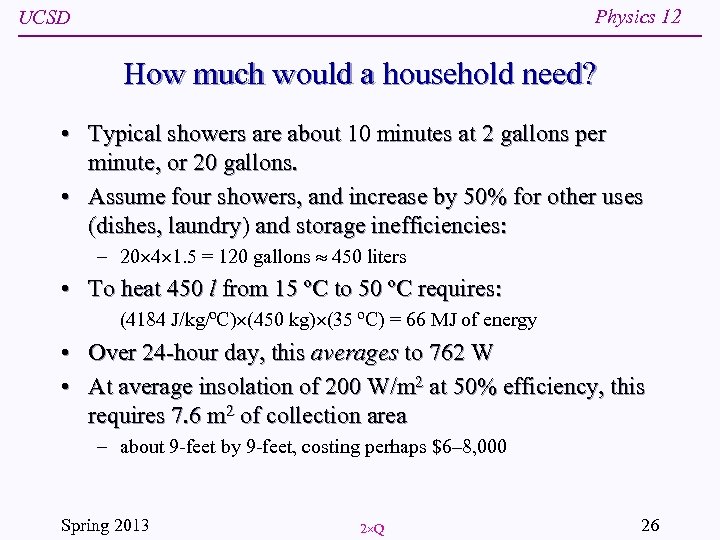 Physics 12 UCSD How much would a household need? • Typical showers are about 10 minutes at 2 gallons per minute, or 20 gallons. • Assume four showers, and increase by 50% for other uses (dishes, laundry) and storage inefficiencies: – 20 4 1. 5 = 120 gallons 450 liters • To heat 450 l from 15 ºC to 50 ºC requires: (4184 J/kg/ºC) (450 kg) (35 ºC) = 66 MJ of energy • Over 24 -hour day, this averages to 762 W • At average insolation of 200 W/m 2 at 50% efficiency, this requires 7. 6 m 2 of collection area – about 9 -feet by 9 -feet, costing perhaps $6– 8, 000 Spring 2013 2 Q 26
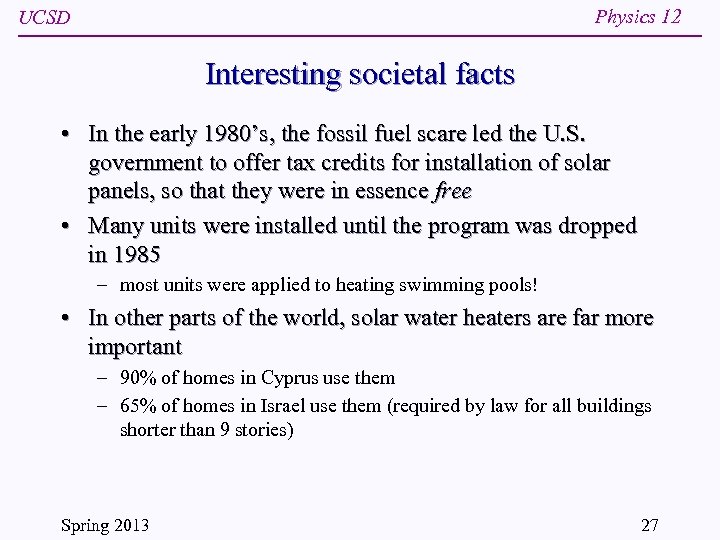 Physics 12 UCSD Interesting societal facts • In the early 1980’s, the fossil fuel scare led the U. S. government to offer tax credits for installation of solar panels, so that they were in essence free • Many units were installed until the program was dropped in 1985 – most units were applied to heating swimming pools! • In other parts of the world, solar water heaters are far more important – 90% of homes in Cyprus use them – 65% of homes in Israel use them (required by law for all buildings shorter than 9 stories) Spring 2013 27
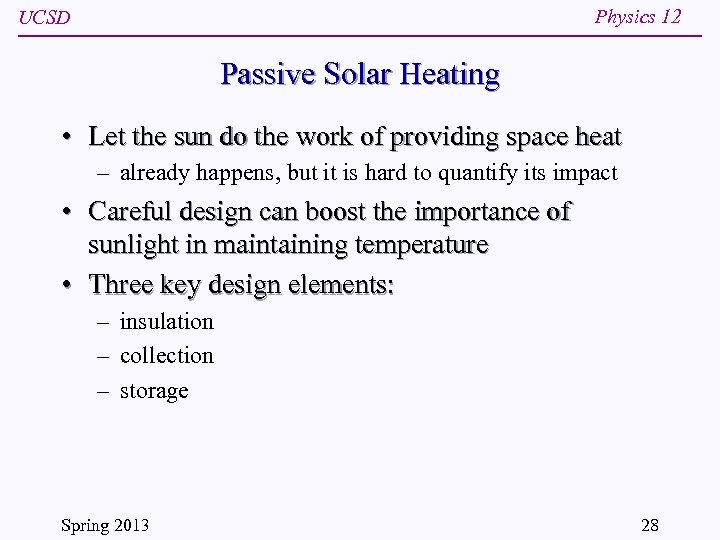 Physics 12 UCSD Passive Solar Heating • Let the sun do the work of providing space heat – already happens, but it is hard to quantify its impact • Careful design can boost the importance of sunlight in maintaining temperature • Three key design elements: – insulation – collection – storage Spring 2013 28
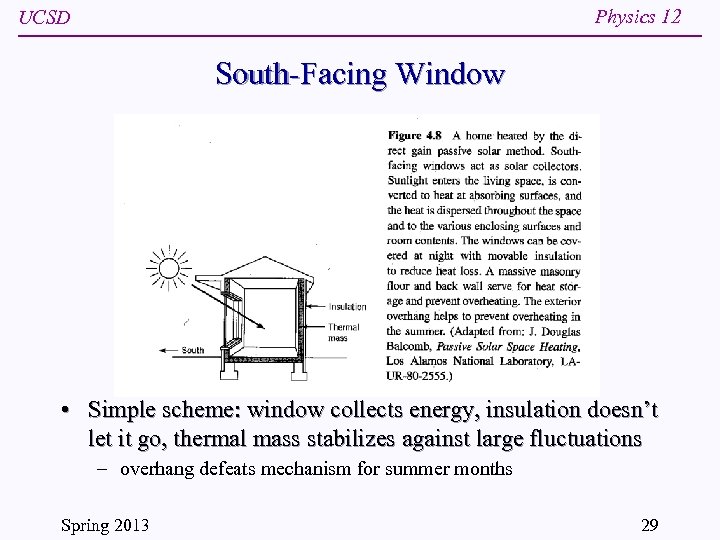 Physics 12 UCSD South-Facing Window • Simple scheme: window collects energy, insulation doesn’t let it go, thermal mass stabilizes against large fluctuations – overhang defeats mechanism for summer months Spring 2013 29
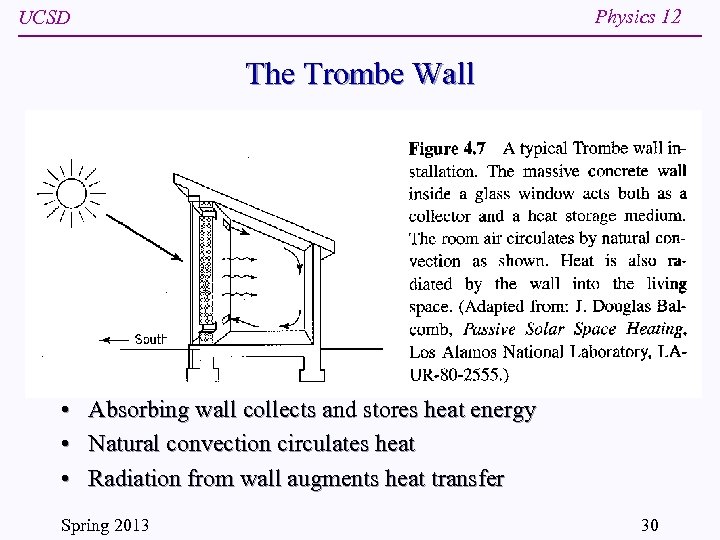 Physics 12 UCSD The Trombe Wall • • • Absorbing wall collects and stores heat energy Natural convection circulates heat Radiation from wall augments heat transfer Spring 2013 30
 Physics 12 UCSD How much heat is available? • Take a 1600 ft 2 house (40 40 footprint), with a 40 10 foot = 400 ft 2 south-facing wall • Using numbers from Table 4. 2 in book, a south-facing wall at 40º latitude receives about 1700 Btu per square foot per clear day – comes out to about 700, 000 Btu for our sample house • Account for losses: – 70% efficiency at trapping available heat (guess) – 50% of days have sun (highly location-dependent) • Net result: 250, 000 Btu per day available for heat – typical home (shoddy insulation) requires 1, 000 Btu/day – can bring into range with proper insulation techniques Spring 2013 31
 Physics 12 UCSD Announcements and Assignments • Stay in School • No HW this week, but Quiz Friday, by midnight • Read Chapter 5 (5. 1, 5. 2, 5. 3, 5. 5, 5. 7) for next lecture • Optional Reading from Do the Math – 23. A Solar-Powered Car – 25. Wind Fights Solar; Triangle Wins – 31. Basking in the Sun Spring 2013 32