 Скачать презентацию PHYSICS 1 B 03 — MECHANICS Dr Waldemar
17a0dc20b3c8f68bdd65660e4ab0c219.ppt
- Количество слайдов: 42



PHYSICS 1 B 03 - MECHANICS Dr. Waldemar Okoń Office: ABB-150 e-mail: okon@physics. mcmaster. ca Office Hours: T, R 1: 00 -2: 00 pm Course web page: http: //physwww. mcmaster. ca/~okon/1 b 03 s. html Physics 1 B 3 -summer Lecture 1 1
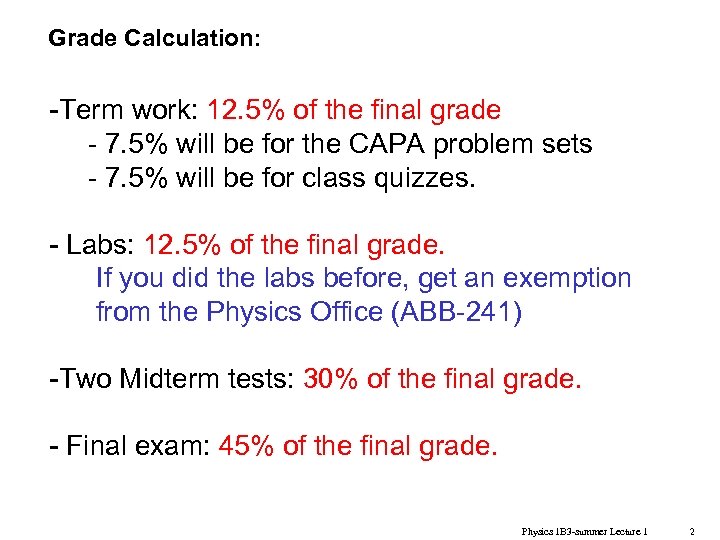
Grade Calculation: -Term work: 12. 5% of the final grade - 7. 5% will be for the CAPA problem sets - 7. 5% will be for class quizzes. - Labs: 12. 5% of the final grade. If you did the labs before, get an exemption from the Physics Office (ABB-241) -Two Midterm tests: 30% of the final grade. - Final exam: 45% of the final grade. Physics 1 B 3 -summer Lecture 1 2
Web. CT Login page: http: //webct. mcmaster. ca/ We are using the Web. CT system as the main source of information related to the course. Your term marks will be posted regularly. A “discussion area” allows you to seek help with assignment or other questions from other students in the course. Web. CT will be used for access to the CAPA assignment problems, so all students will need to use it. The Web. CT login page explains how to get your login account working. Start trying now! If you have a problem, it may require a few days to get it fixed by CIS. Physics 1 B 3 -summer Lecture 1 3
Homework Using CAPA Web page: http: //capa. physics. mcmaster. ca/ • There will be an assignment each week. Answers are entered into the computer. The CAPA system tells you immediately whether the answer is correct, and allows you to try again. You can log in and out many times without having to complete the entire assignment in one session. You’ll have 10 tires for each question. • You can access the CAPA assignments directly from Web. CT. • You should try to complete the CAPA assignments a day before the final deadline. You may use the student computer labs on campus. If you work from home, finish the assignments well in advance, to avoid being caught by internet malfunctions. • Read the CAPA help page before you start! (help on units etc…) Physics 1 B 3 -summer Lecture 1 4
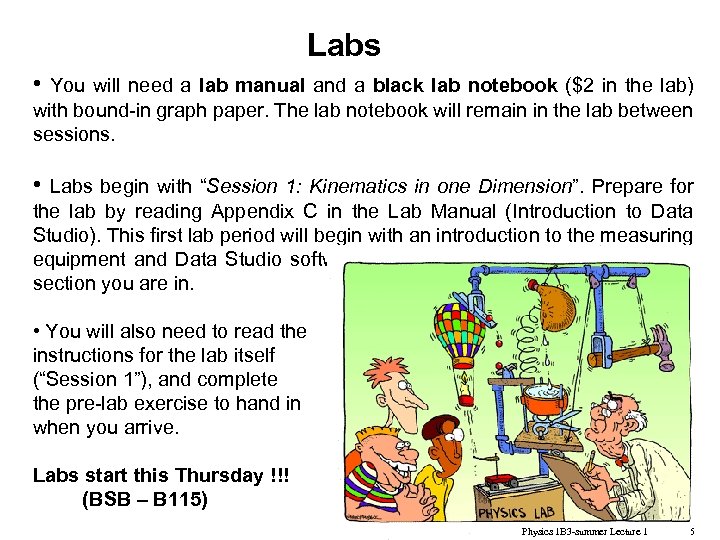
Labs • You will need a lab manual and a black lab notebook ($2 in the lab) with bound-in graph paper. The lab notebook will remain in the lab between sessions. • Labs begin with “Session 1: Kinematics in one Dimension”. Prepare for the lab by reading Appendix C in the Lab Manual (Introduction to Data Studio). This first lab period will begin with an introduction to the measuring equipment and Data Studio software. Check in Web. CT to see which lab section you are in. • You will also need to read the instructions for the lab itself (“Session 1”), and complete the pre-lab exercise to hand in when you arrive. Labs start this Thursday !!! (BSB – B 115) Physics 1 B 3 -summer Lecture 1 5
Lectures • Introduce the important concepts and principles, with the aid of demonstrations. Examples with solutions. • Partial lecture slides will be posted on the web page or Web. CT before the lecture. The slides are not the whole lecture! Take notes as we work things out on the blackboard – print the slides out! • Lectures will include short “concept quizzes” after each main idea. • You should read the relevant sections of the text before the lecture, ask questions in class and discuss topics among yourselves from time to time. Physics 1 B 3 -summer Lecture 1 6
i-clicker quizzes • During the lectures we will have multiple choice quizzes • For these quizzes we will use the i-clickers • 7. 5% of the course mark will be based on these. If you are not in class, you will not get these marks! • Quizzes for marks will start on Thursday • You must register your i-clicker (see link on the course site) at some time before the final exam (late registration will result in a mark of zero for the quizzes). Physics 1 B 3 -summer Lecture 1 7
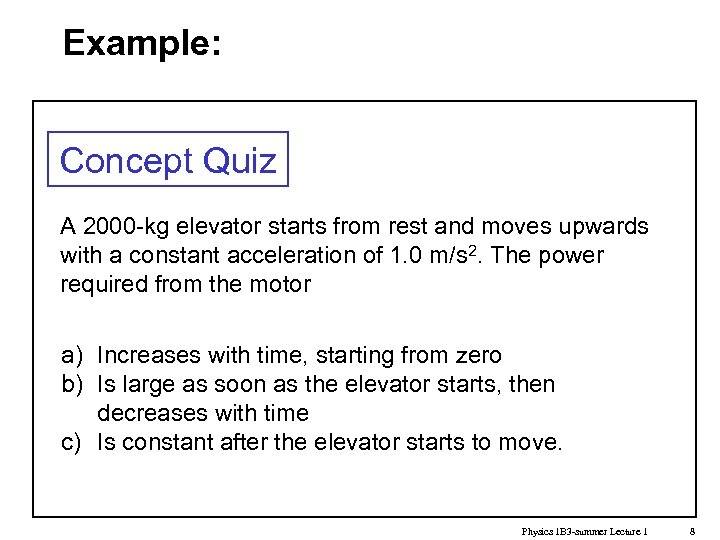
Example: Concept Quiz A 2000 -kg elevator starts from rest and moves upwards with a constant acceleration of 1. 0 m/s 2. The power required from the motor a) Increases with time, starting from zero b) Is large as soon as the elevator starts, then decreases with time c) Is constant after the elevator starts to move. Physics 1 B 3 -summer Lecture 1 8
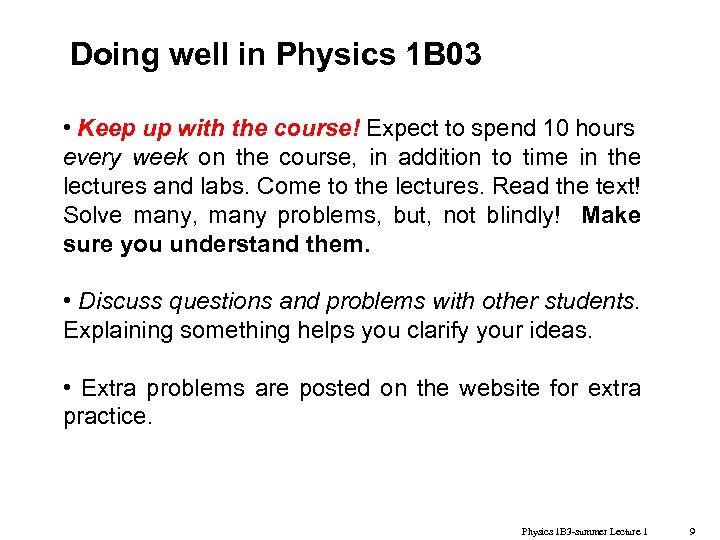
Doing well in Physics 1 B 03 • Keep up with the course! Expect to spend 10 hours every week on the course, in addition to time in the lectures and labs. Come to the lectures. Read the text! Solve many, many problems, but, not blindly! Make sure you understand them. • Discuss questions and problems with other students. Explaining something helps you clarify your ideas. • Extra problems are posted on the website for extra practice. Physics 1 B 3 -summer Lecture 1 9
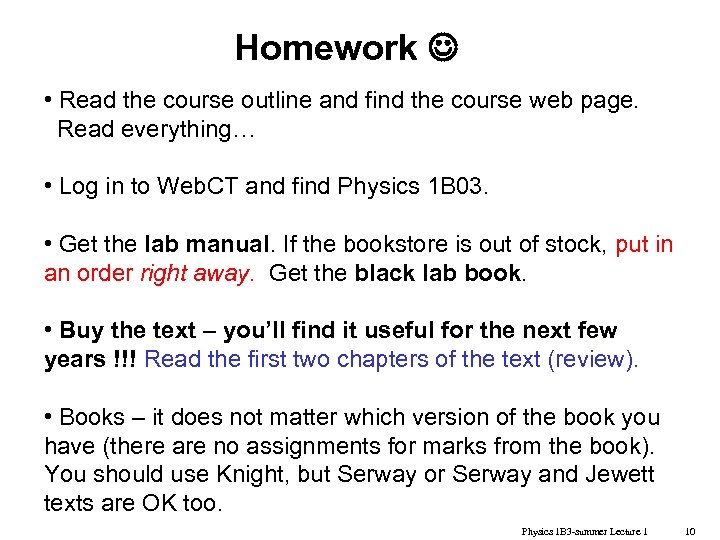
Homework • Read the course outline and find the course web page. Read everything… • Log in to Web. CT and find Physics 1 B 03. • Get the lab manual. If the bookstore is out of stock, put in an order right away. Get the black lab book. • Buy the text – you’ll find it useful for the next few years !!! Read the first two chapters of the text (review). • Books – it does not matter which version of the book you have (there are no assignments for marks from the book). You should use Knight, but Serway or Serway and Jewett texts are OK too. Physics 1 B 3 -summer Lecture 1 10
10 min break Physics 1 B 3 -summer Lecture 1 11
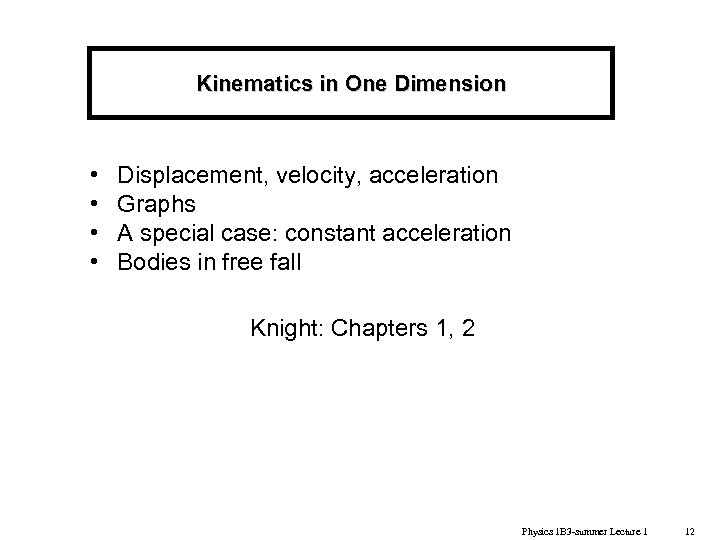
Kinematics in One Dimension • • Displacement, velocity, acceleration Graphs A special case: constant acceleration Bodies in free fall Knight: Chapters 1, 2 Physics 1 B 3 -summer Lecture 1 12
• Kinematics : the description of motion in terms of space and time – ignores the agents that cause the motion (dynamics) • One dimension : motion along a straight line (e. g. , the x-axis) Examples - sprinter running 100 meters in a straight line - ball falling straight down, and bouncing back up Physics 1 B 3 -summer Lecture 1 13
Motion: the change of object position with time Position: measure of where an object is, relative to some pre-defined point, often the origin, x=0. Displacement: change in position Distance: the distance between two positions Physics 1 B 3 -summer Lecture 1 14
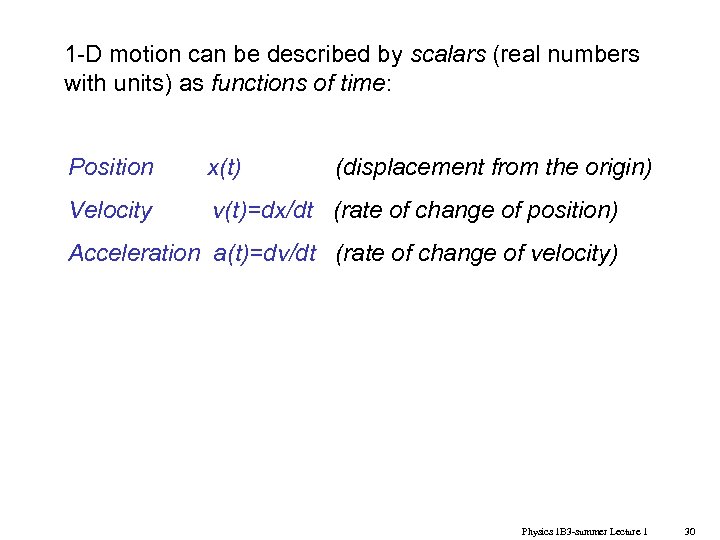
1 -D motion can be described by scalars (real numbers with units) as functions of time: Position x(t) (displacement from the origin) Velocity v(t) (rate of change of position) Acceleration a(t) (rate of change of velocity) • The sign (positive or negative) keeps track of direction. • Algebraic relations involving position, velocity, and acceleration come from calculus. • The same relations can be seen from graphs of position, velocity, and acceleration as functions of time. Physics 1 B 3 -summer Lecture 1 15
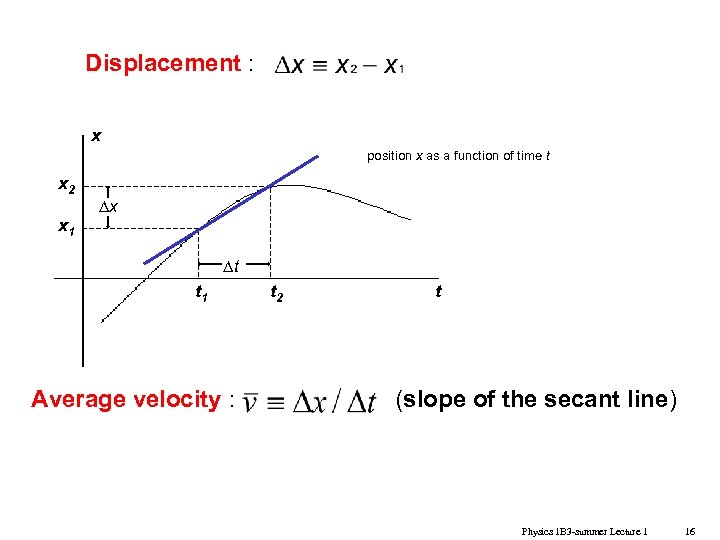
Displacement : x position x as a function of time t x 2 x 1 x t t 1 Average velocity : t 2 t (slope of the secant line) Physics 1 B 3 -summer Lecture 1 16
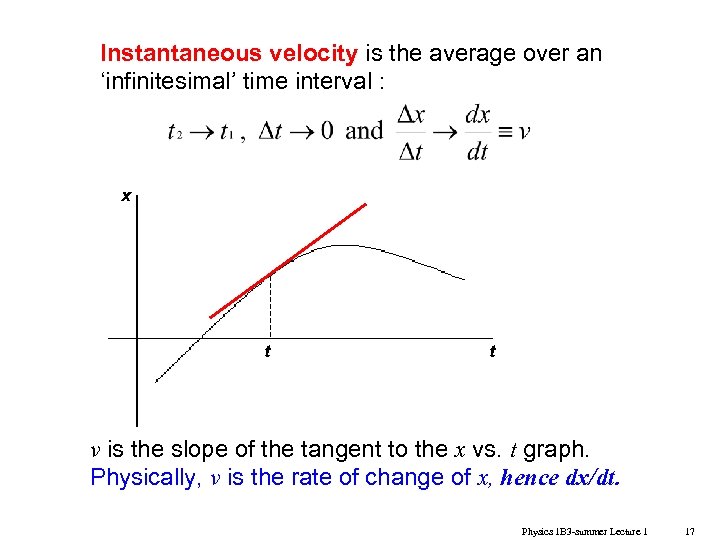
Instantaneous velocity is the average over an ‘infinitesimal’ time interval : x t t v is the slope of the tangent to the x vs. t graph. Physically, v is the rate of change of x, hence dx/dt. Physics 1 B 3 -summer Lecture 1 17
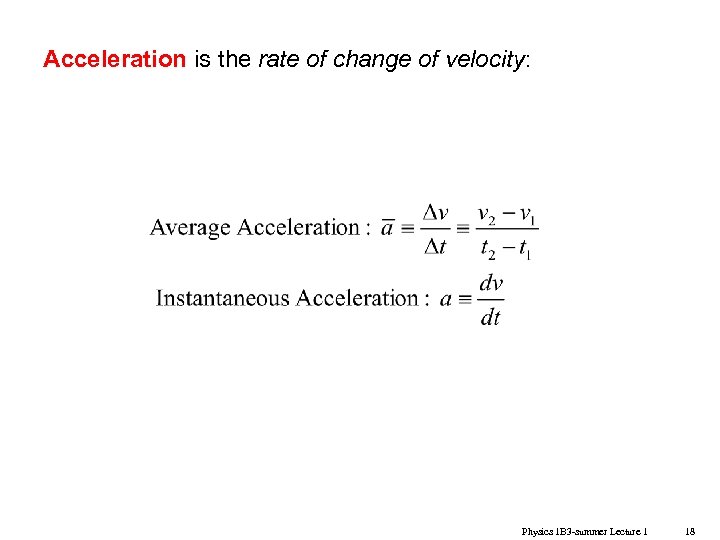
Acceleration is the rate of change of velocity: Physics 1 B 3 -summer Lecture 1 18
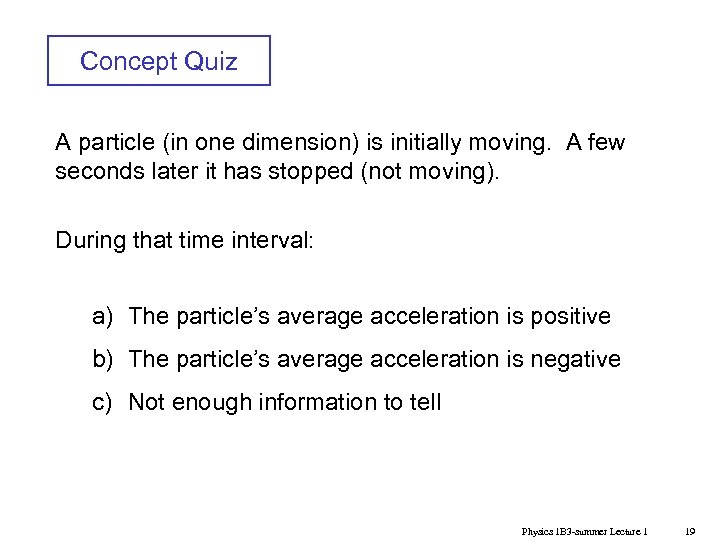
Concept Quiz A particle (in one dimension) is initially moving. A few seconds later it has stopped (not moving). During that time interval: a) The particle’s average acceleration is positive b) The particle’s average acceleration is negative c) Not enough information to tell Physics 1 B 3 -summer Lecture 1 19
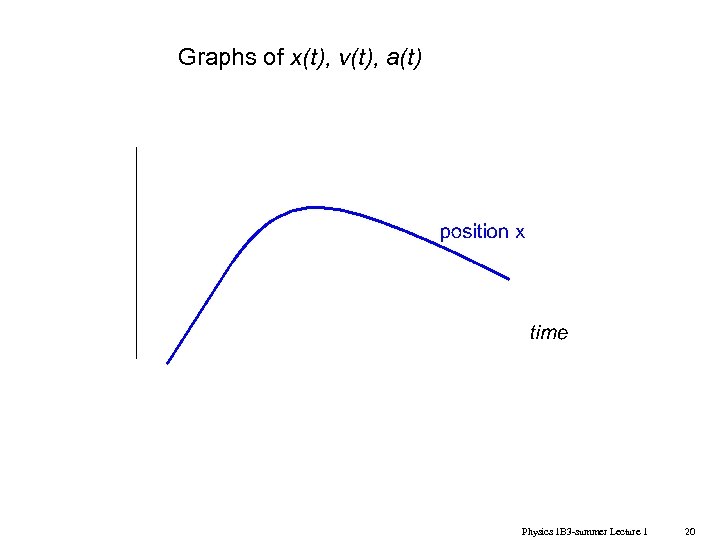
Graphs of x(t), v(t), a(t) Physics 1 B 3 -summer Lecture 1 20
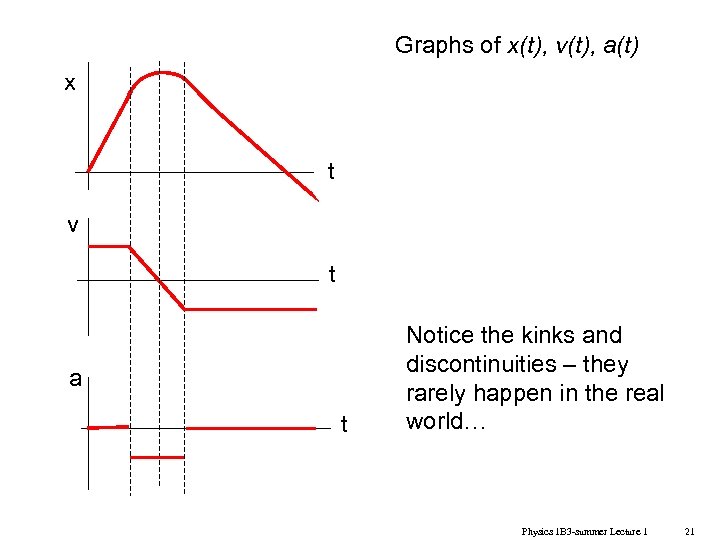
Graphs of x(t), v(t), a(t) x t v t a t Notice the kinks and discontinuities – they rarely happen in the real world… Physics 1 B 3 -summer Lecture 1 21
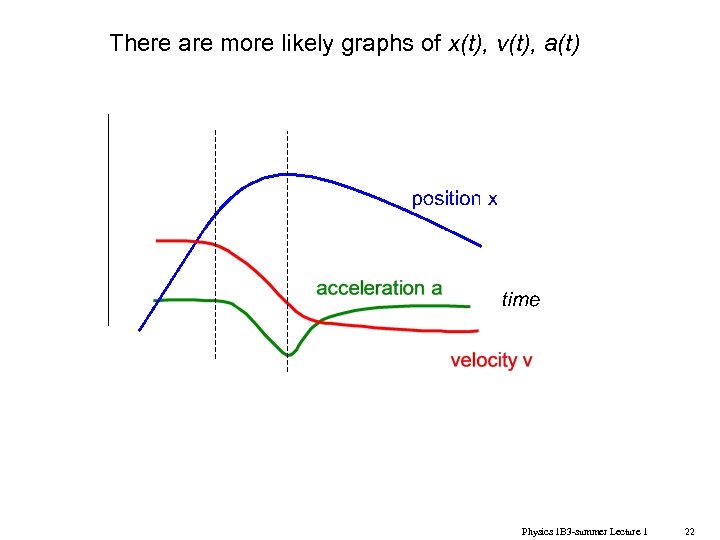
There are more likely graphs of x(t), v(t), a(t) Physics 1 B 3 -summer Lecture 1 22
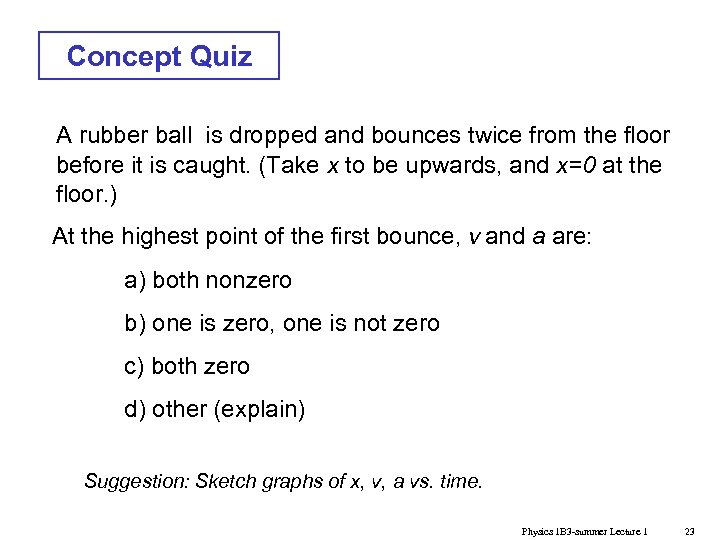
Concept Quiz A rubber ball is dropped and bounces twice from the floor before it is caught. (Take x to be upwards, and x=0 at the floor. ) At the highest point of the first bounce, v and a are: a) both nonzero b) one is zero, one is not zero c) both zero d) other (explain) Suggestion: Sketch graphs of x, v, a vs. time. Physics 1 B 3 -summer Lecture 1 23
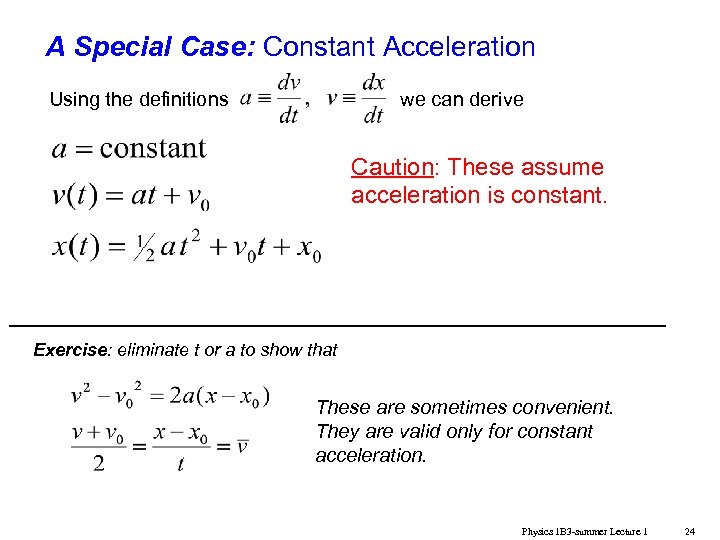
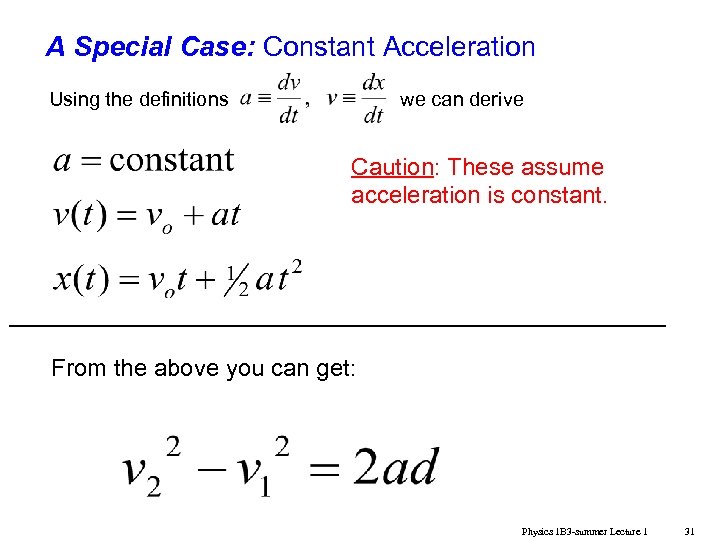
A Special Case: Constant Acceleration Using the definitions we can derive Caution: These assume acceleration is constant. Exercise: eliminate t or a to show that These are sometimes convenient. They are valid only for constant acceleration. Physics 1 B 3 -summer Lecture 1 24
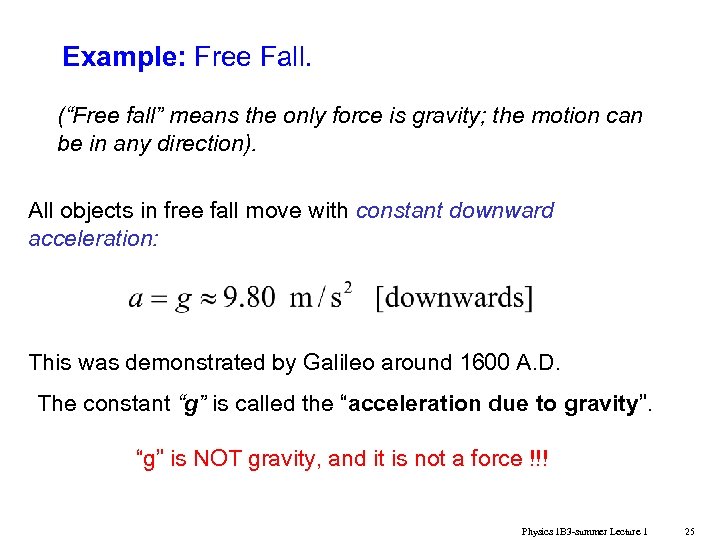
Example: Free Fall. (“Free fall” means the only force is gravity; the motion can be in any direction). All objects in free fall move with constant downward acceleration: This was demonstrated by Galileo around 1600 A. D. The constant “g” is called the “acceleration due to gravity”. “g” is NOT gravity, and it is not a force !!! Physics 1 B 3 -summer Lecture 1 25
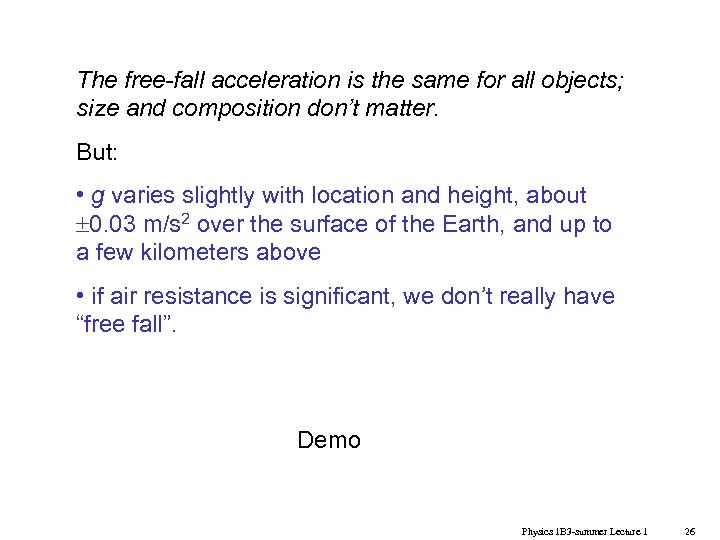
The free-fall acceleration is the same for all objects; size and composition don’t matter. But: • g varies slightly with location and height, about 0. 03 m/s 2 over the surface of the Earth, and up to a few kilometers above • if air resistance is significant, we don’t really have “free fall”. Demo Physics 1 B 3 -summer Lecture 1 26
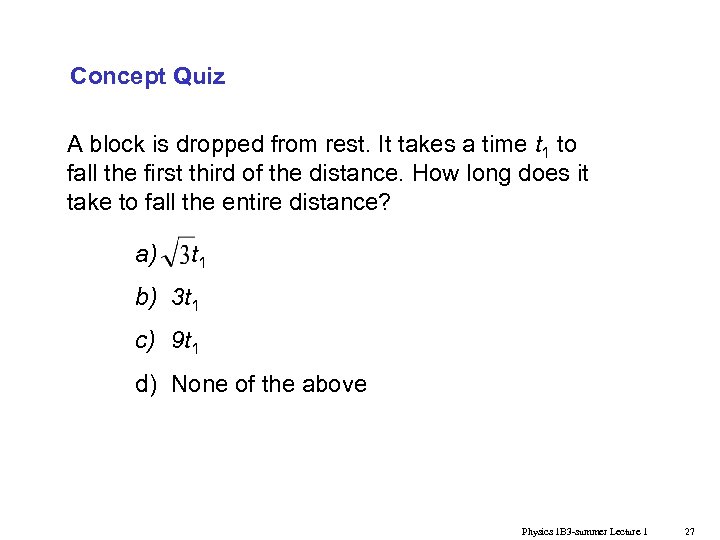
Concept Quiz A block is dropped from rest. It takes a time t 1 to fall the first third of the distance. How long does it take to fall the entire distance? a) t 1 b) 3 t 1 c) 9 t 1 d) None of the above Physics 1 B 3 -summer Lecture 1 27
10 min break Physics 1 B 3 -summer Lecture 1 28
Kinematics in One Dimension • Displacement, velocity, acceleration, free fall • Examples Knight: Chapters 1, 2 Physics 1 B 3 -summer Lecture 1 29
1 -D motion can be described by scalars (real numbers with units) as functions of time: Position x(t) (displacement from the origin) Velocity v(t)=dx/dt (rate of change of position) Acceleration a(t)=dv/dt (rate of change of velocity) Physics 1 B 3 -summer Lecture 1 30
A Special Case: Constant Acceleration Using the definitions we can derive Caution: These assume acceleration is constant. From the above you can get: Physics 1 B 3 -summer Lecture 1 31
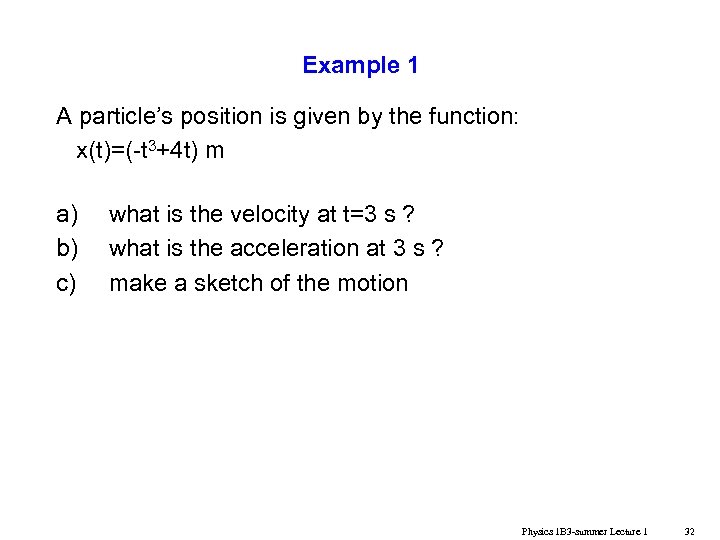
Example 1 A particle’s position is given by the function: x(t)=(-t 3+4 t) m a) b) c) what is the velocity at t=3 s ? what is the acceleration at 3 s ? make a sketch of the motion Physics 1 B 3 -summer Lecture 1 32
Example 2 An object if thrown straight up with a velocity of 5 m/s. What will the velocity be when it comes back to its original position ? Physics 1 B 3 -summer Lecture 1 33
Example 3 A skier is moving at 40 m/s at the top of a hill. His velocity changes to 10 m/s after covering a distance of 600 m. What is his acceleration ? Physics 1 B 3 -summer Lecture 1 34
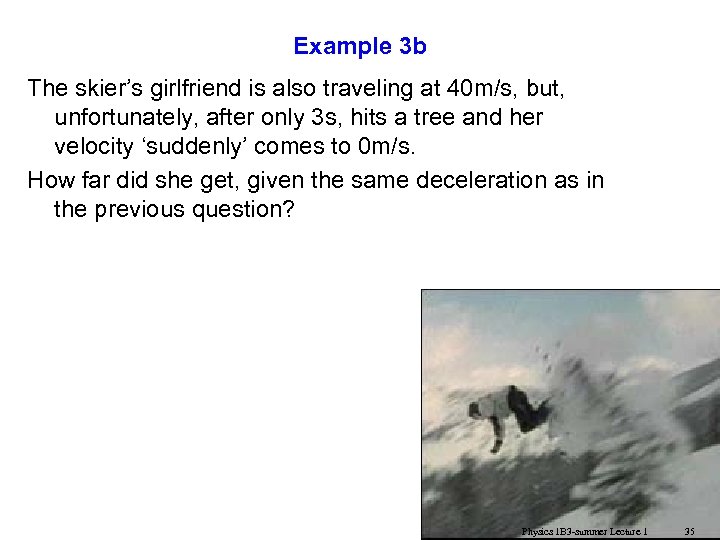
Example 3 b The skier’s girlfriend is also traveling at 40 m/s, but, unfortunately, after only 3 s, hits a tree and her velocity ‘suddenly’ comes to 0 m/s. How far did she get, given the same deceleration as in the previous question? Physics 1 B 3 -summer Lecture 1 35
Vector Review • Scalars and Vectors • Vector Components and Arithmetic Physics 1 B 3 -summer Lecture 1 36
Physical quantities are classified as scalars, vectors, etc. Scalar : described by a real number with units examples: mass, charge, energy. . . Vector : described by a scalar (its magnitude) and a direction in space examples: displacement, velocity, force. . . Vectors have direction, and obey different rules of arithmetic. Physics 1 B 3 -summer Lecture 1 37
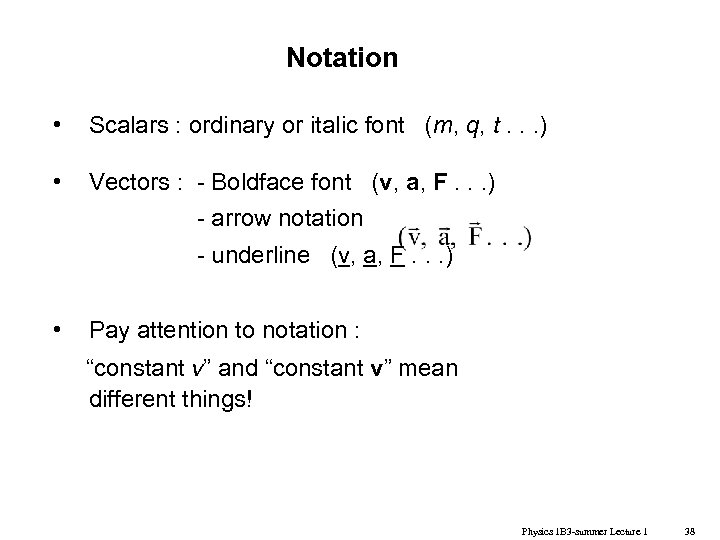
Notation • Scalars : ordinary or italic font (m, q, t. . . ) • Vectors : - Boldface font (v, a, F. . . ) - arrow notation - underline (v, a, F. . . ) • Pay attention to notation : “constant v” and “constant v” mean different things! Physics 1 B 3 -summer Lecture 1 38
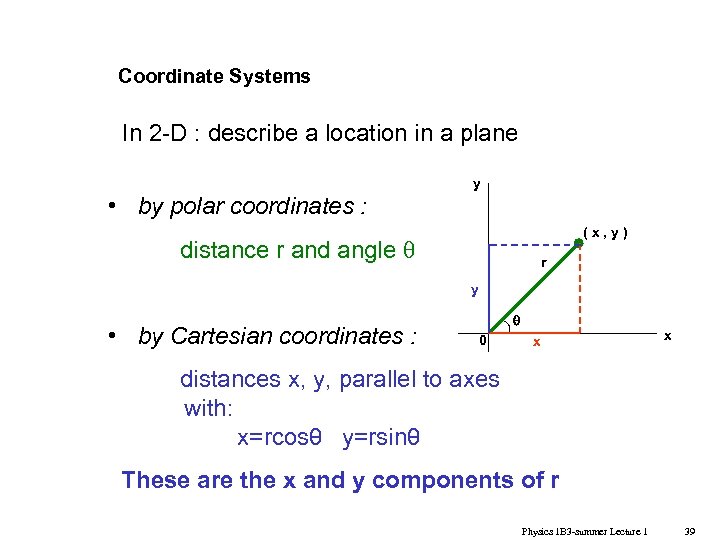
Coordinate Systems In 2 -D : describe a location in a plane y • by polar coordinates : (x, y) distance r and angle r y • by Cartesian coordinates : 0 x x distances x, y, parallel to axes with: x=rcosθ y=rsinθ These are the x and y components of r Physics 1 B 3 -summer Lecture 1 39
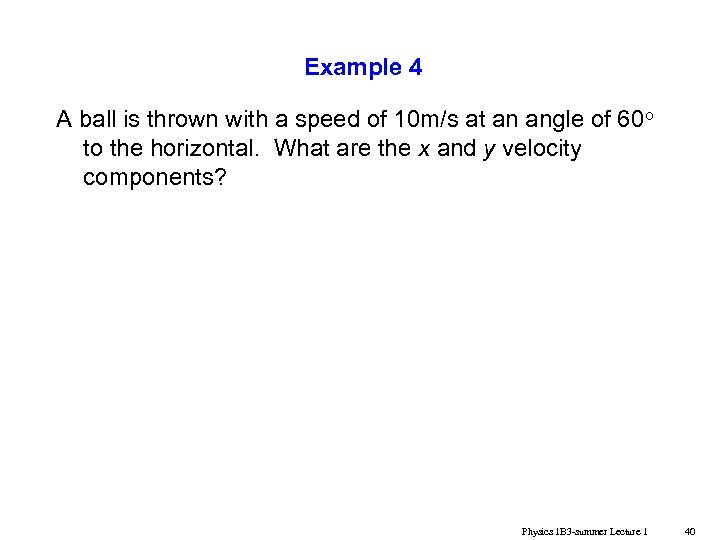
Example 4 A ball is thrown with a speed of 10 m/s at an angle of 60 o to the horizontal. What are the x and y velocity components? Physics 1 B 3 -summer Lecture 1 40
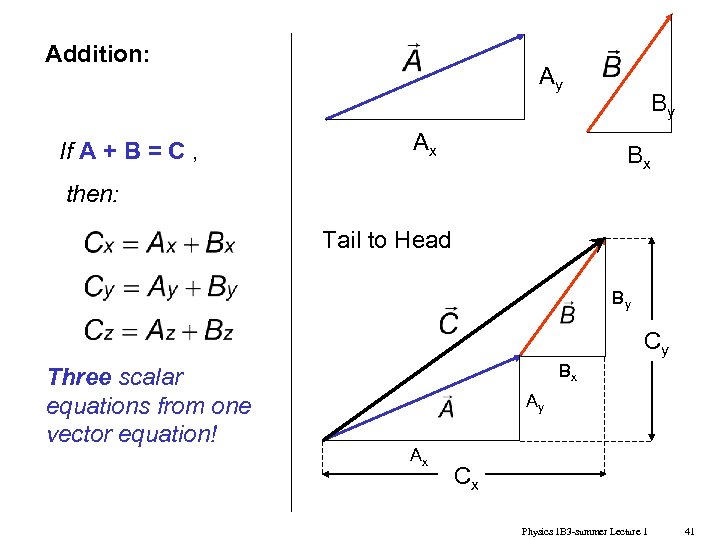
Addition: If A + B = C , Ay Ax By Bx then: Tail to Head By Cy Three scalar equations from one vector equation! Bx Ay Ax Cx Physics 1 B 3 -summer Lecture 1 41
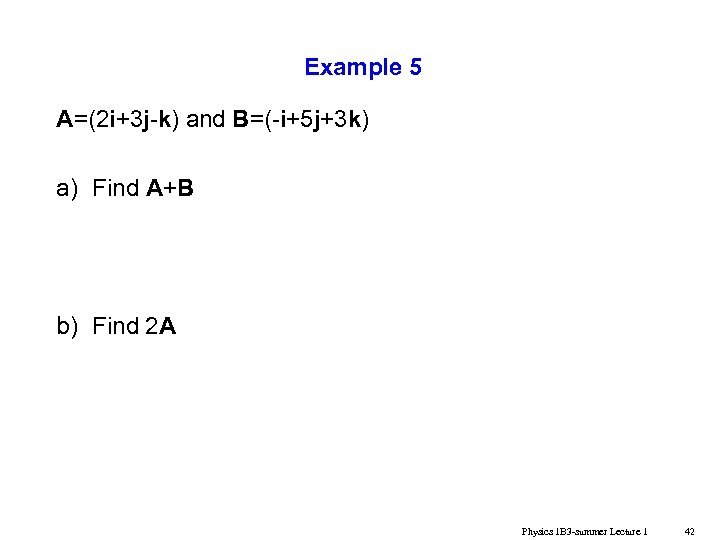
Example 5 A=(2 i+3 j-k) and B=(-i+5 j+3 k) a) Find A+B b) Find 2 A Physics 1 B 3 -summer Lecture 1 42
Скачать презентацию PHYSICS 1 B 03 — MECHANICS Dr Waldemar
17a0dc20b3c8f68bdd65660e4ab0c219.ppt