


 Скачать презентацию Physical activity a national perspective PAN-WM 27
b1881df30c72407c55a462c6f6ec3d81.ppt
- Количество слайдов: 19
 Physical activity – a national perspective PAN-WM, 27 March 2007 Alison Giles, Physical Activity programme manager, DH
 In April 2006, the Prime Minister asked Caroline Flint to develop a cross-government strategy to transform the population into a fitter and more active nation in the run up to the 2012 Olympic and Paralympic Games. This builds on the commitments set out in the Choosing Health White paper.
 § What are government departments currently doing? § What should they be doing? § What should cross-government working look like?
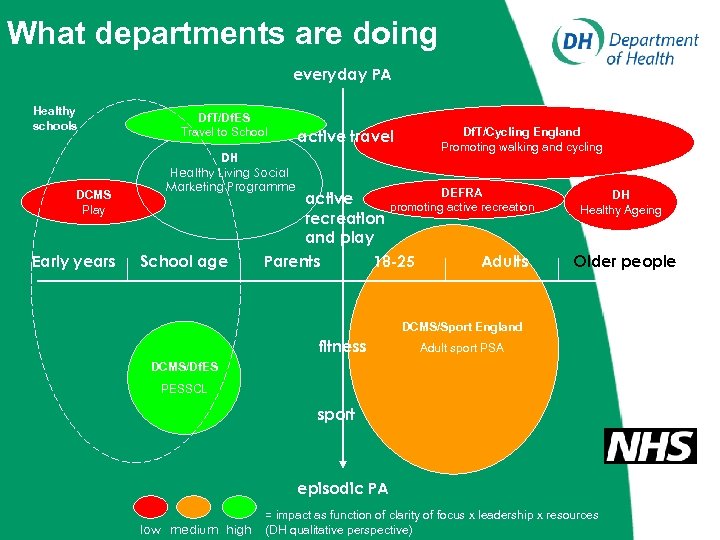 What departments are doing everyday PA Healthy schools DCMS Play Early years Df. T/Df. ES Travel to School active travel DH Healthy Living Social Marketing Programme School age Df. T/Cycling England Promoting walking and cycling DEFRA active promoting active recreation and play Parents 18 -25 Adults DH Healthy Ageing Older people DCMS/Sport England fitness Adult sport PSA DCMS/Df. ES PESSCL sport episodic PA low medium high = impact as function of clarity of focus x leadership x resources (DH qualitative perspective)
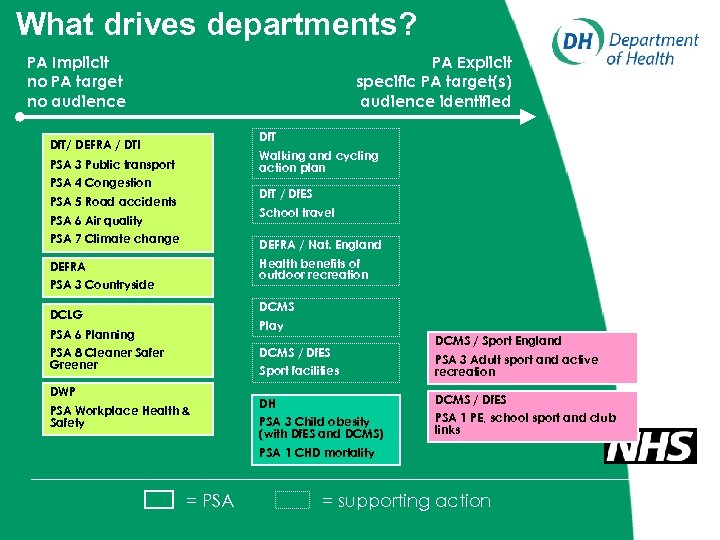 What drives departments? PA Implicit no PA target no audience PA Explicit specific PA target(s) audience identified Df. T/ DEFRA / DTI Walking and cycling action plan PSA 3 Public transport PSA 4 Congestion Df. T / Df. ES PSA 5 Road accidents School travel PSA 6 Air quality PSA 7 Climate change DEFRA / Nat. England DEFRA Health benefits of outdoor recreation PSA 3 Countryside DCMS DCLG Play PSA 6 Planning DCMS / Df. ES PSA 8 Cleaner Safer Greener DCMS / Sport England Sport facilities DWP PSA Workplace Health & Safety PSA 3 Adult sport and active recreation DH DCMS / Df. ES PSA 3 Child obesity (with Df. ES and DCMS) PSA 1 PE, school sport and club links PSA 1 CHD mortality = PSA = supporting action
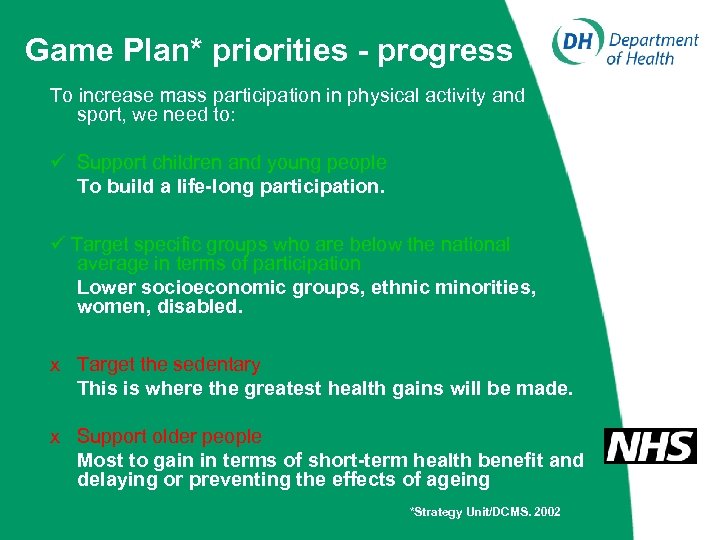 Game Plan* priorities - progress To increase mass participation in physical activity and sport, we need to: Support children and young people To build a life-long participation. Target specific groups who are below the national average in terms of participation Lower socioeconomic groups, ethnic minorities, women, disabled. x Target the sedentary This is where the greatest health gains will be made. x Support older people Most to gain in terms of short-term health benefit and delaying or preventing the effects of ageing *Strategy Unit/DCMS. 2002
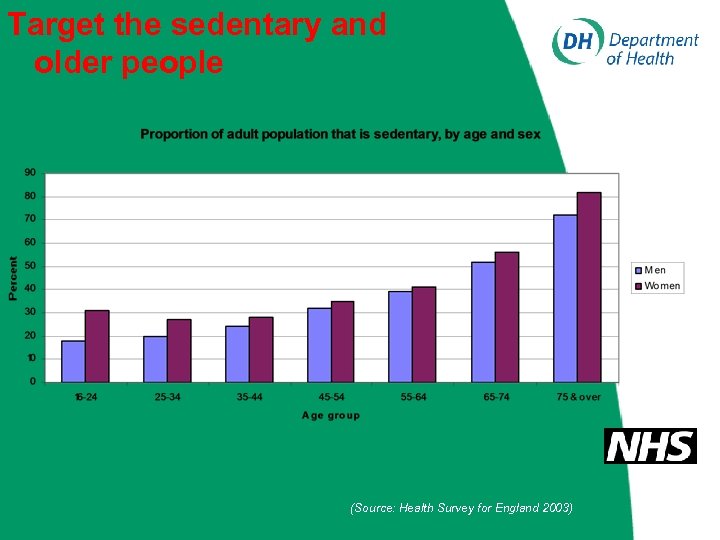 Target the sedentary and older people (Source: Health Survey for England 2003)
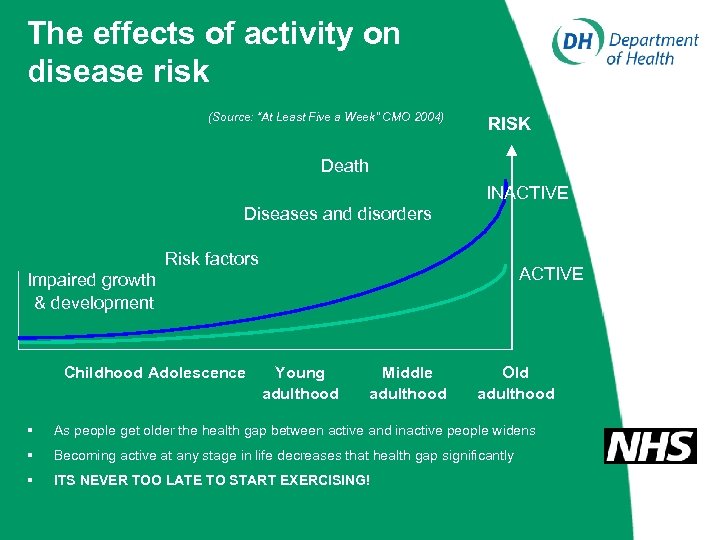 The effects of activity on disease risk (Source: “At Least Five a Week” CMO 2004) RISK Death INACTIVE Diseases and disorders Risk factors ACTIVE Impaired growth & development Childhood Adolescence Young adulthood Middle adulthood Old adulthood § As people get older the health gap between active and inactive people widens § Becoming active at any stage in life decreases that health gap significantly § ITS NEVER TOO LATE TO START EXERCISING!
 Role of DH 1. Develop the evidence base 2. Promote health benefits of all types of activity 3. Focus on sedentary and older adults 4. Develop a social marketing strategy 5. Identify mechanisms to engage NHS in physical activity promotion 6. Increase regional capacity 7. Deliver a health legacy from 2012 Games 8. Advocate action across government
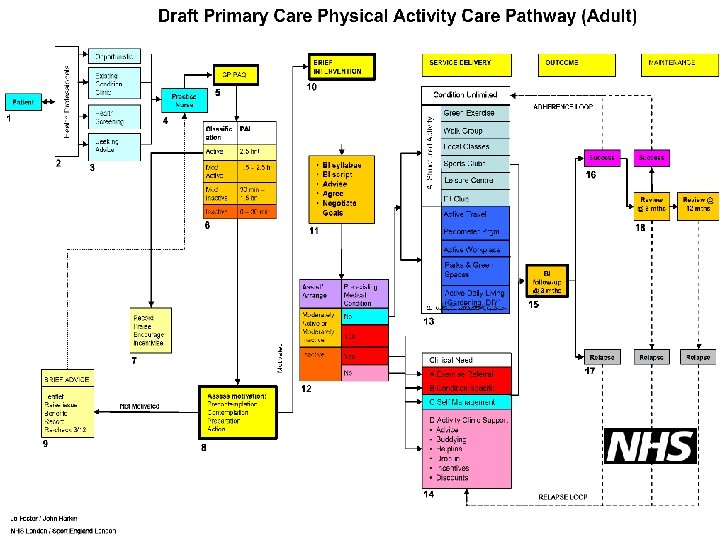
 Engaging the NHS § Patient activity questionnaire § NHS physical activity care pathway § National Step-O-Meter programme § Health trainers § Practice-based commissioning?
 GP PA questionnaire § General Practice Physical Activity Questionnaire § Patients 16 -74 § Self-completion (30 seconds) § Identification of patients who would benefit from increased physical activity § Available from www. dh. gov. uk
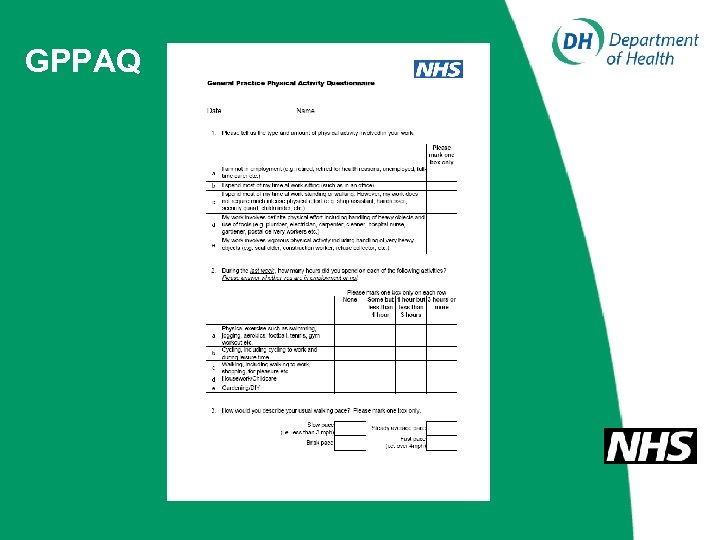 GPPAQ
GPPAQ
 Increasing regional capacity § To work across the GO to influence regional and local plans; § To develop a social marketing approach to delivering regional physical activity and sport strategies, and attract match funding where appropriate; § To ensure senior engagement with the regional sports board, and maximise opportunities for joined up action on physical activity and sport. To engage with the delivery system at the regional, sub-regional and local level;
 Increasing regional capacity § To develop a regional Health & 2012 delivery plan that complements the national plan; § To develop plans to maximise the engagement of the NHS in promoting physical activity and sport; § To work in partnership with obesity, food and health, and healthy schools leads to ensure a joined-up approach to tackling obesity.
 Role of government departments 1. 2. 3. 4. 5. 6. Focus on their own contribution Get their own house in order Set national policy framework Identify levers to local action Remove barriers to local action Develop regional and local capacity
 Walking and cycling Department for Transport has concluded that: 1. One in 5 of all car journeys are less than 1 mile. By shifting these to bicycle or foot, traffic congestion would become a thing of the past. Game Plan and Choosing Activity identify that: 2. Walking and cycling provide important opportunities for activity for both young people and adults 3. Walking and cycling are two of the four main activities that continue from childhood to adulthood The Health Development Agency has concluded that: 4. Activities that do not require specific equipment or facilities are more likely to be maintained long-term
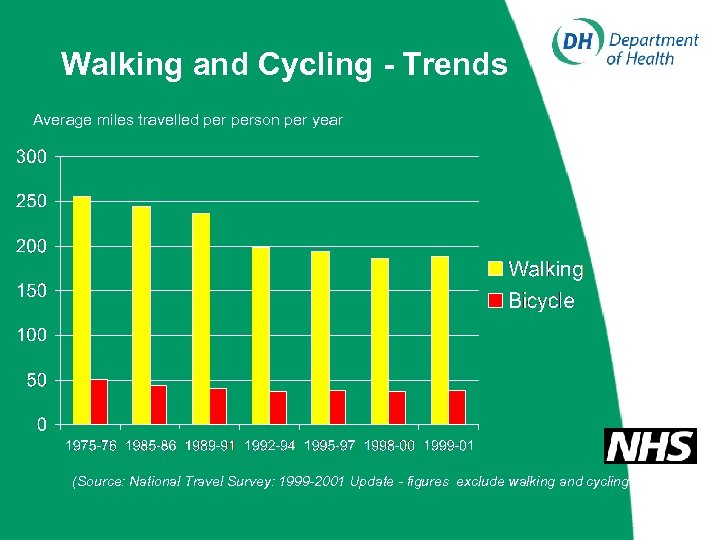 Walking and Cycling - Trends Average miles travelled person per year (Source: National Travel Survey: 1999 -2001 Update - figures exclude walking and cycling for leisure)
 The future…. . …is uncertain § § PSA targets are changing and reducing More local ownership Change of leadership? Change of approach to tackling obesity?