


 Скачать презентацию Phys 201 Spring 2010 Chapt 1 Lect 2
03777ba0a7d9d1d2910e8d5e21b76edf.ppt
- Количество слайдов: 26
 Phys 201, Spring 2010 Chapt. 1, Lect. 2 Chapter 1: Measurement and vectors Reminders: 1. The grace period of Web. Assign access is to Jan. 22. 2. The lab manual can be viewed online, but you are recommended to buy a hard copy from the bookstore. 3. For honors credit, attend Friday’s 207 lecture (or else).
 Review from last time: Units: Stick with SI, do proper conversion. (in every equation have to match!) Dimensionality: any quantity in terms of L, T, M Significant figures (digits) and errors Estimate (rounding off to integer) and order of magnitude (to 10’s power)
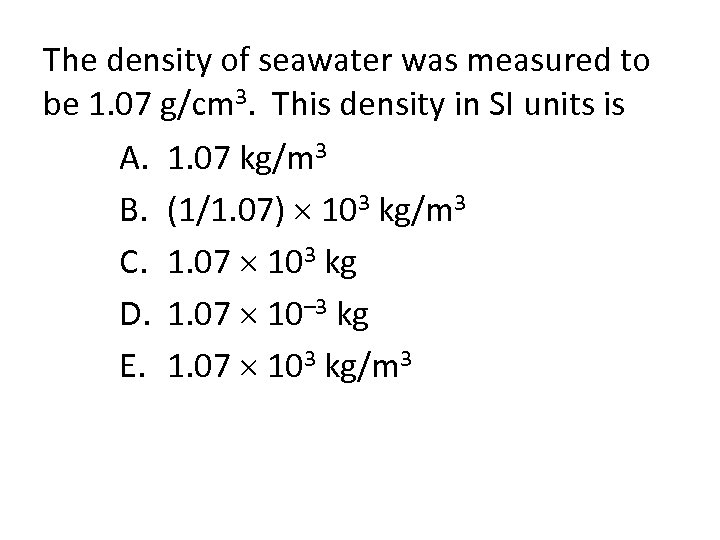 The density of seawater was measured to be 1. 07 g/cm 3. This density in SI units is A. B. C. D. E. 1. 07 kg/m 3 (1/1. 07) 103 kg/m 3 1. 07 103 kg 1. 07 10– 3 kg 1. 07 103 kg/m 3
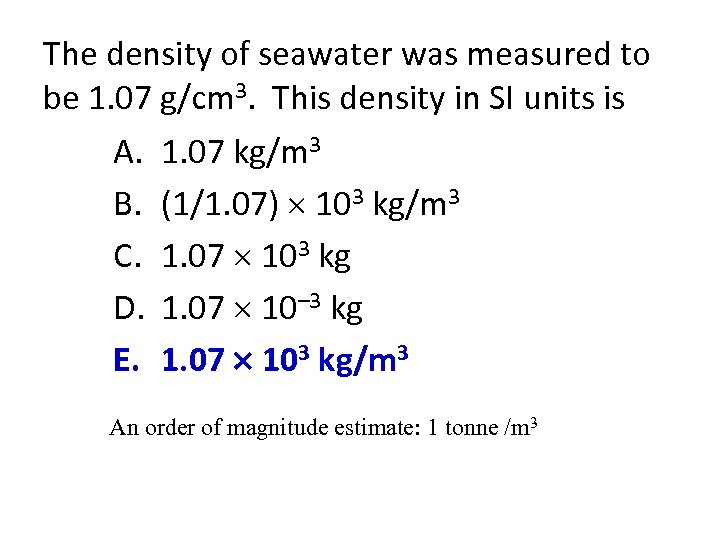 The density of seawater was measured to be 1. 07 g/cm 3. This density in SI units is A. B. C. D. E. 1. 07 kg/m 3 (1/1. 07) 103 kg/m 3 1. 07 103 kg 1. 07 10– 3 kg 1. 07 103 kg/m 3 An order of magnitude estimate: 1 tonne /m 3
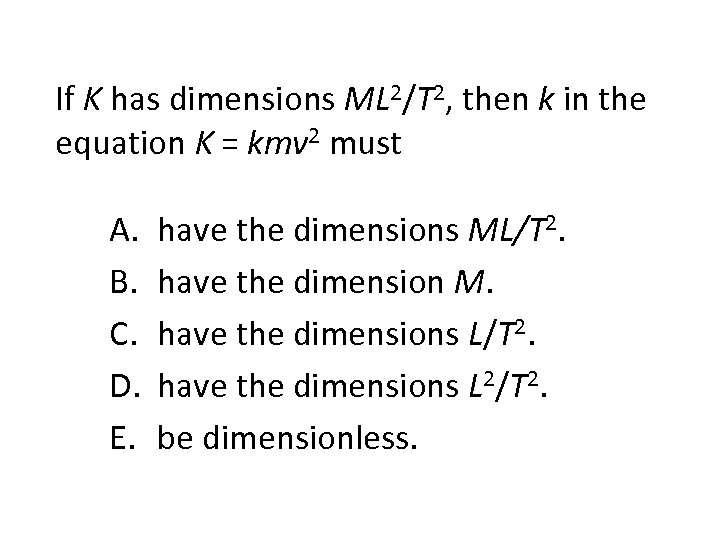 If K has dimensions ML 2/T 2, then k in the equation K = kmv 2 must A. B. C. D. E. have the dimensions ML/T 2. have the dimension M. have the dimensions L/T 2. have the dimensions L 2/T 2. be dimensionless.
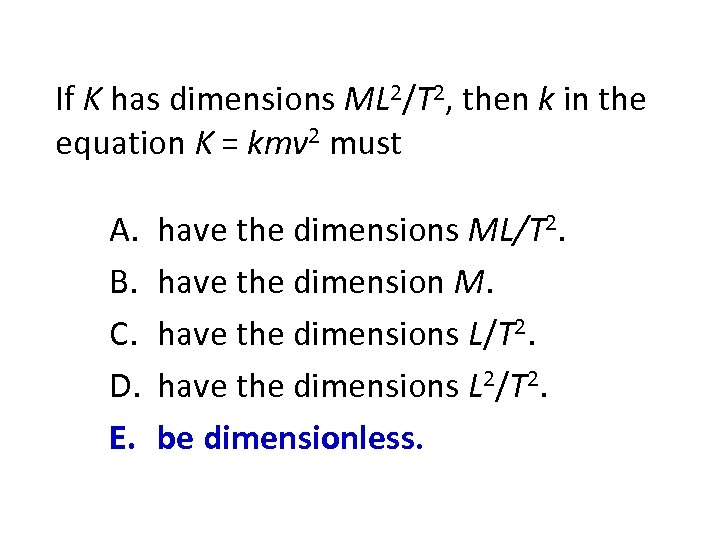 If K has dimensions ML 2/T 2, then k in the equation K = kmv 2 must A. B. C. D. E. have the dimensions ML/T 2. have the dimension M. have the dimensions L/T 2. have the dimensions L 2/T 2. be dimensionless.
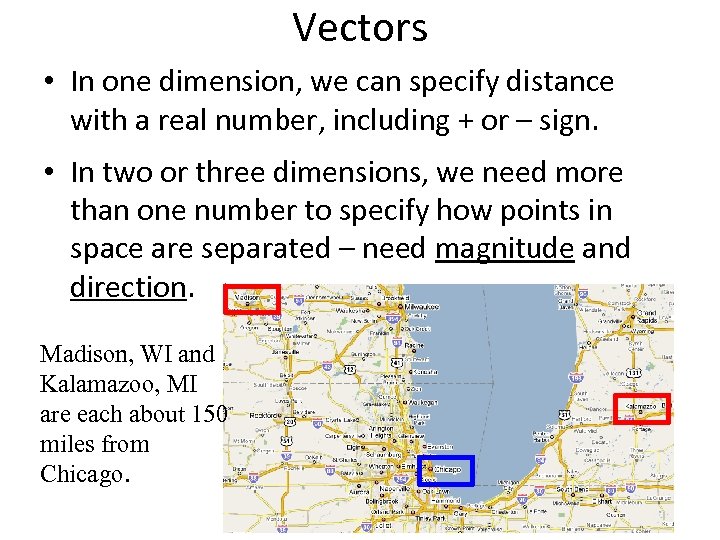 Vectors • In one dimension, we can specify distance with a real number, including + or – sign. • In two or three dimensions, we need more than one number to specify how points in space are separated – need magnitude and direction. Madison, WI and Kalamazoo, MI are each about 150 miles from Chicago.
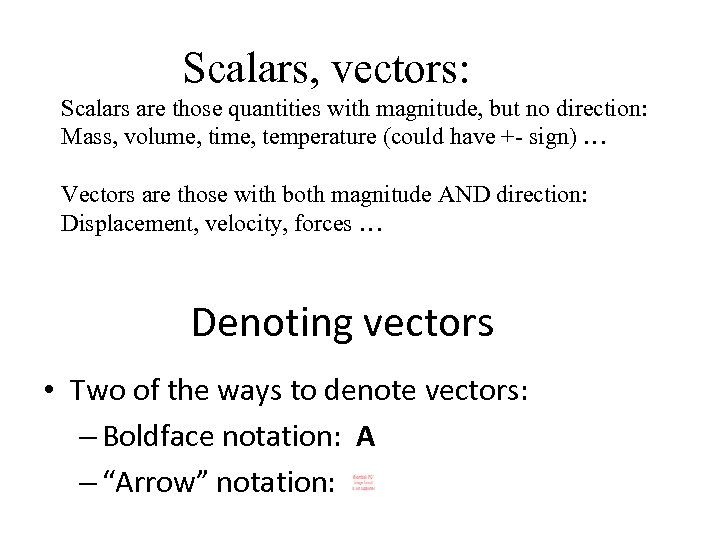 Scalars, vectors: Scalars are those quantities with magnitude, but no direction: Mass, volume, time, temperature (could have +- sign) … Vectors are those with both magnitude AND direction: Displacement, velocity, forces … Denoting vectors • Two of the ways to denote vectors: – Boldface notation: A – “Arrow” notation:
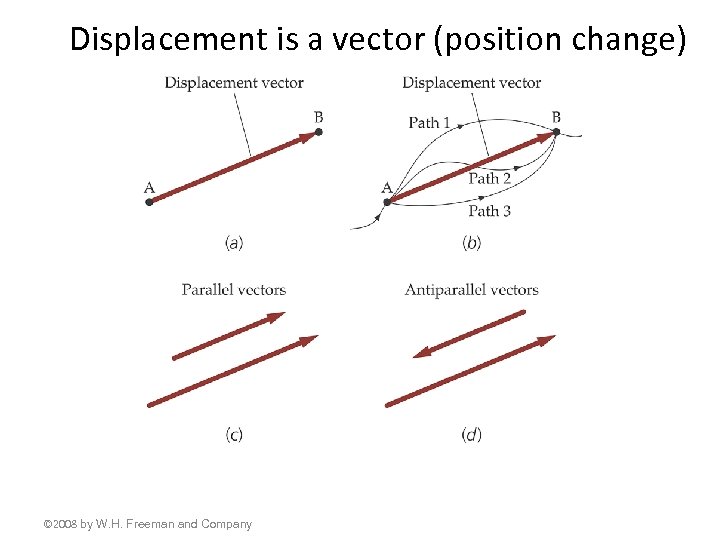 Displacement is a vector (position change) © 2008 by W. H. Freeman and Company
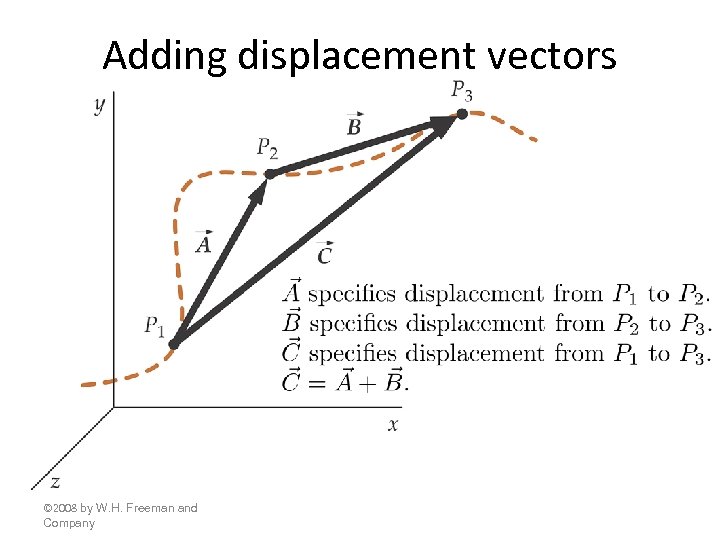 Adding displacement vectors © 2008 by W. H. Freeman and Company
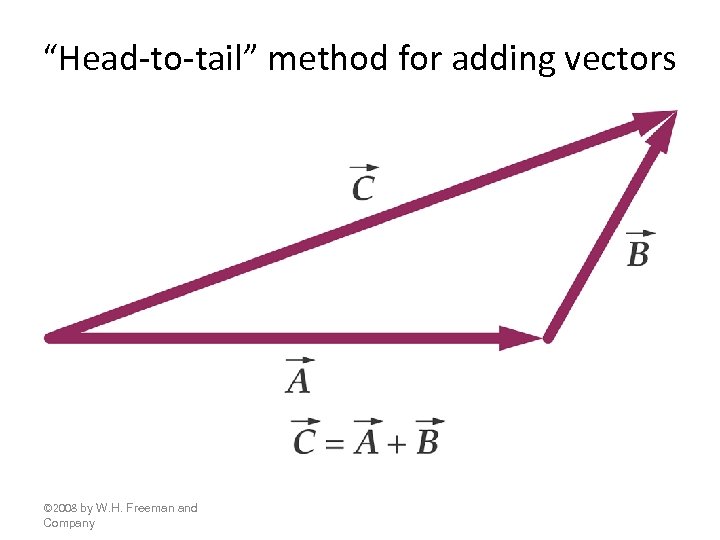 “Head-to-tail” method for adding vectors © 2008 by W. H. Freeman and Company
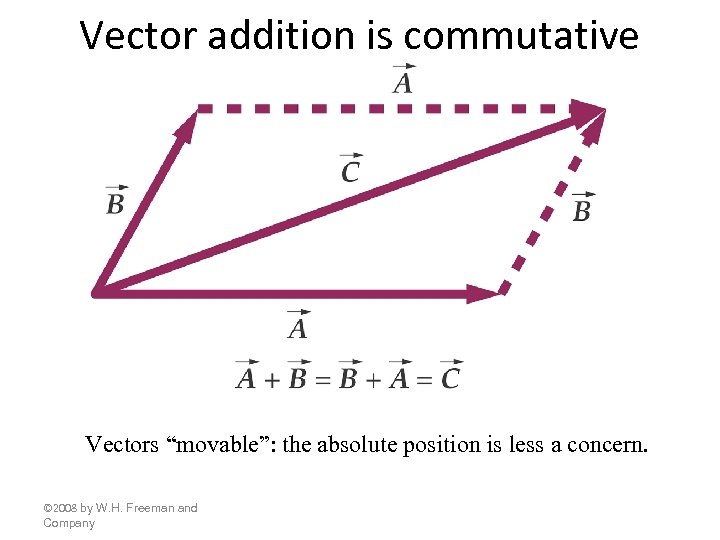 Vector addition is commutative Vectors “movable”: the absolute position is less a concern. © 2008 by W. H. Freeman and Company
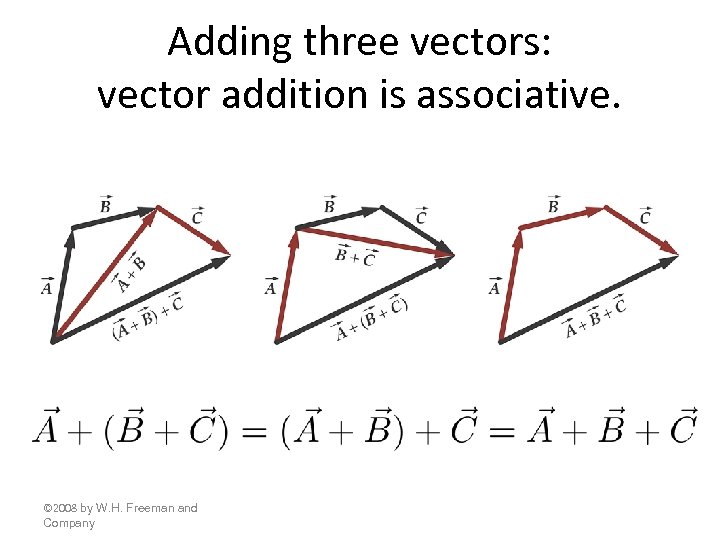 Adding three vectors: vector addition is associative. © 2008 by W. H. Freeman and Company
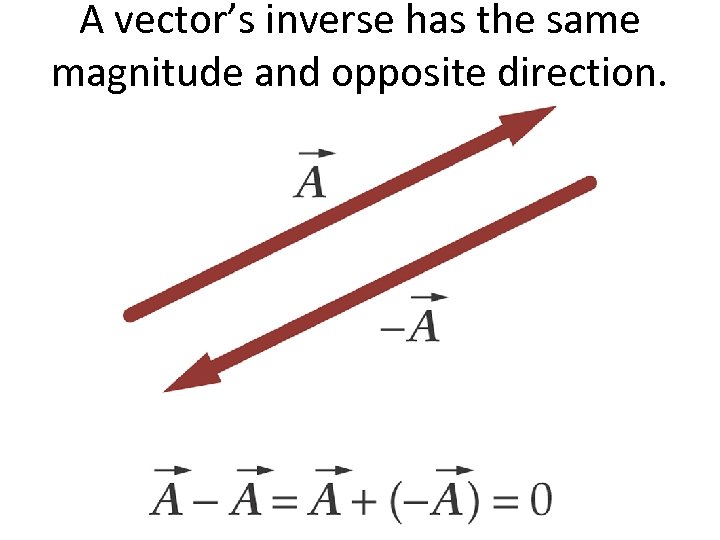 A vector’s inverse has the same magnitude and opposite direction. © 2008 by W. H. Freeman and Company
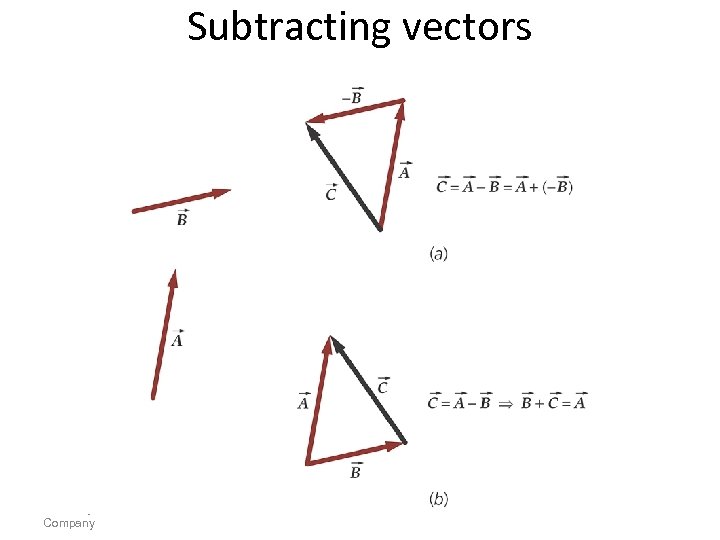 Subtracting vectors © 2008 by W. H. Freeman and Company
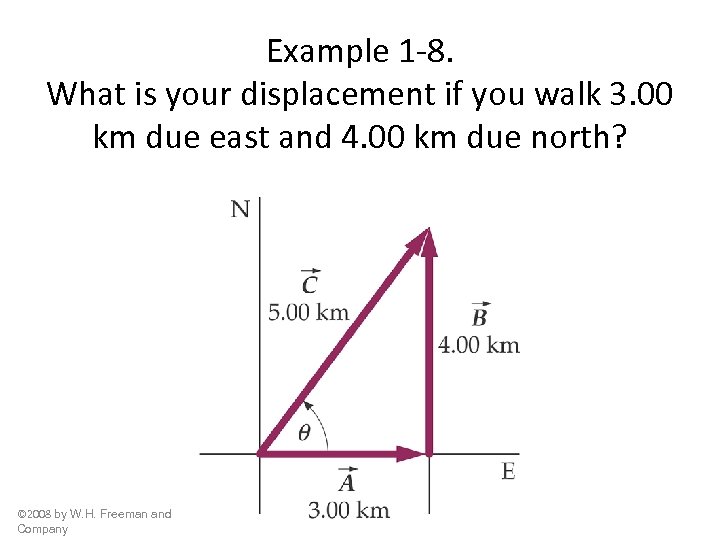 Example 1 -8. What is your displacement if you walk 3. 00 km due east and 4. 00 km due north? © 2008 by W. H. Freeman and Company
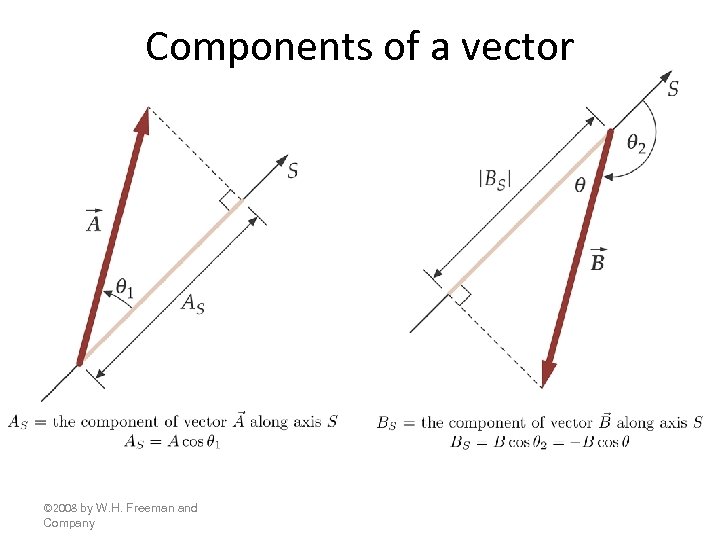 Components of a vector © 2008 by W. H. Freeman and Company
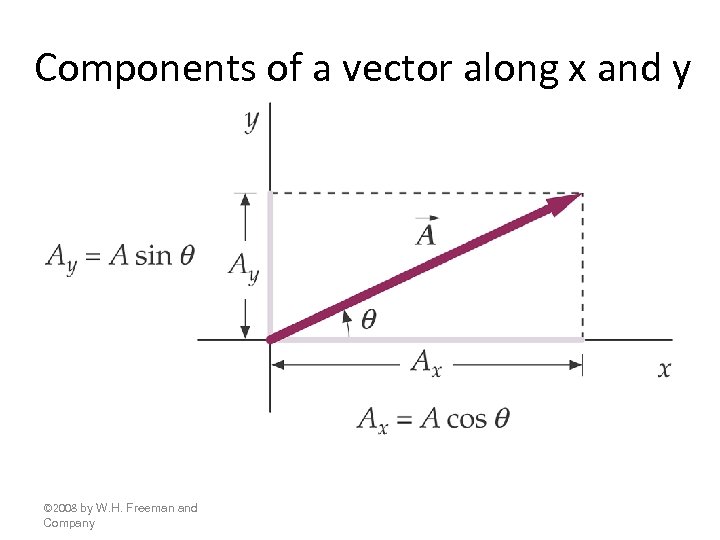 Components of a vector along x and y © 2008 by W. H. Freeman and Company
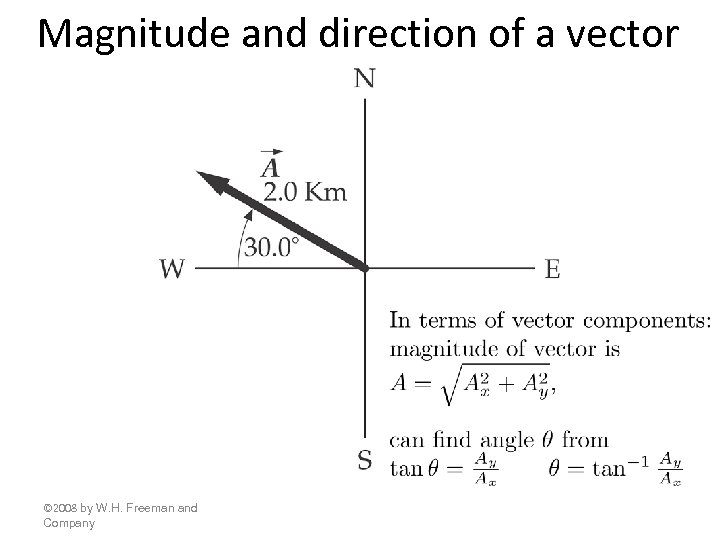 Magnitude and direction of a vector © 2008 by W. H. Freeman and Company
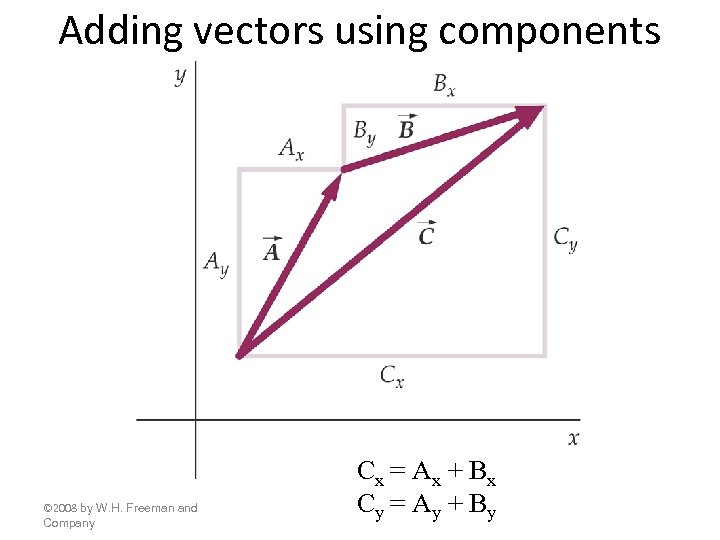 Adding vectors using components © 2008 by W. H. Freeman and Company Cx = Ax + B x Cy = Ay + B y
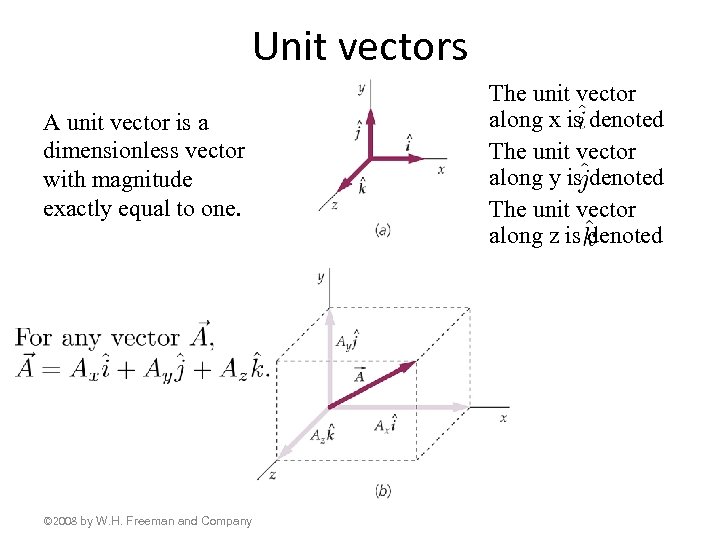 Unit vectors The unit vector along x is denoted The unit vector along y is denoted The unit vector along z is denoted A unit vector is a dimensionless vector with magnitude exactly equal to one. © 2008 by W. H. Freeman and Company aa a
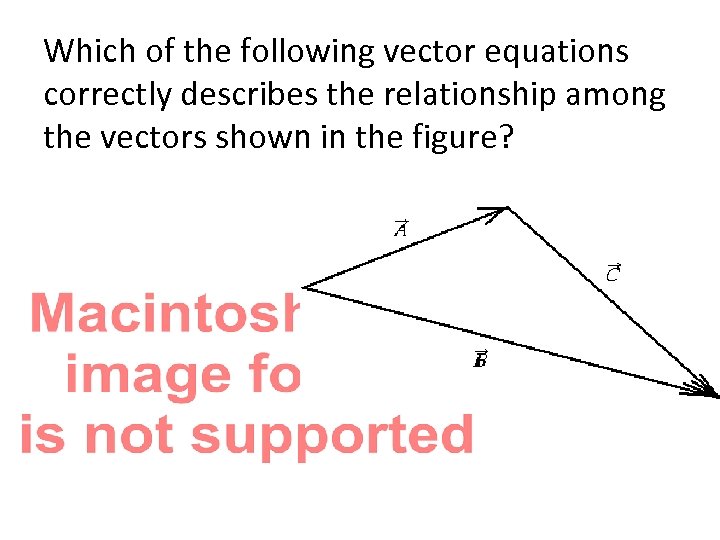 Which of the following vector equations correctly describes the relationship among the vectors shown in the figure?
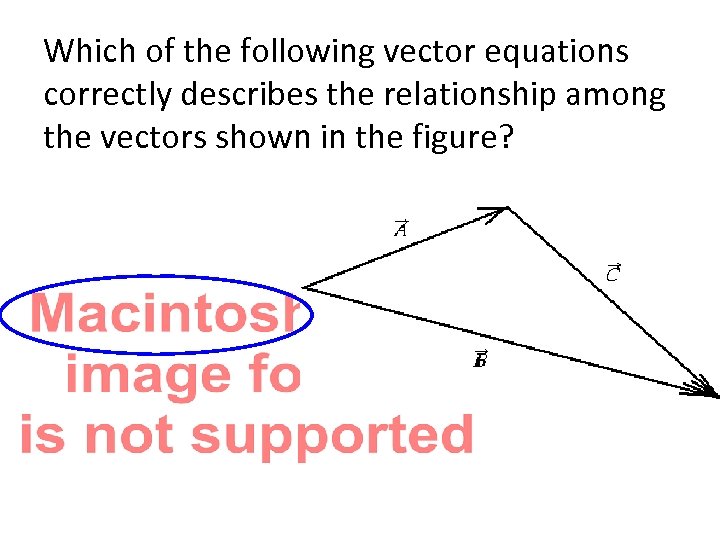 Which of the following vector equations correctly describes the relationship among the vectors shown in the figure?
 Can a vector have a component bigger than its magnitude? Yes No
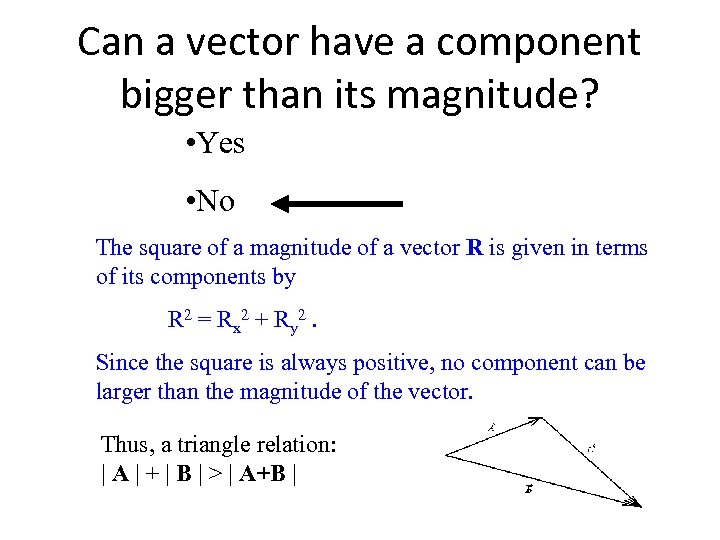 Can a vector have a component bigger than its magnitude? • Yes • No The square of a magnitude of a vector R is given in terms of its components by R 2 = Rx 2 + Ry 2. Since the square is always positive, no component can be larger than the magnitude of the vector. Thus, a triangle relation: | A | + | B | > | A+B |
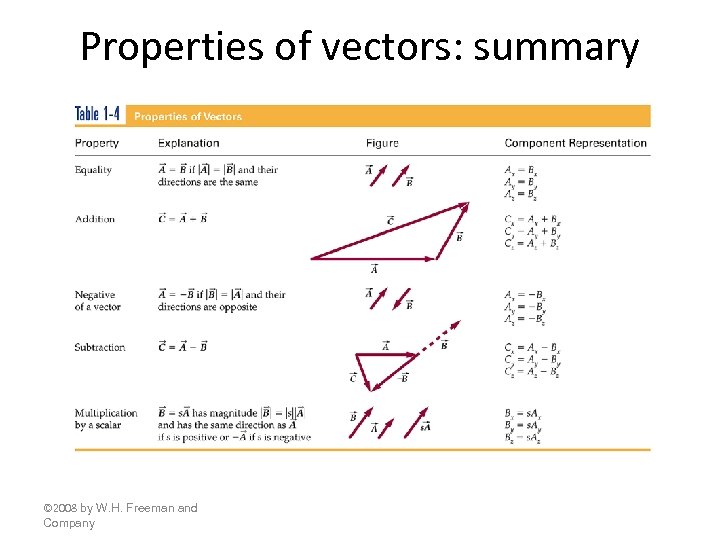 Properties of vectors: summary © 2008 by W. H. Freeman and Company