


 Скачать презентацию PHYS 1444 Section 501 Lecture 12 Monday
954fc43eda9174c71c02fd20991cdb82.ppt
- Количество слайдов: 19
 PHYS 1444 – Section 501 Lecture #12 Monday, Mar. 6, 2006 Dr. Jaehoon Yu EMF and Terminal Voltage Resistors in Series and Parallel Energy losses in Resistors Kirchhoff’s Rules RC Circuits Monday, Mar. 6, 2006 PHYS 1444 -501, Spring 2006 Dr. Jaehoon Yu 1
 Announcements • Please bring back your exams to me by Wednesday, Mar. 8 • Quiz on Monday, Mar. 20 – Covers CH 25, 26 and some of 27 • Reading assignments – CH 26 – 5 and 26 – 6 Monday, Mar. 6, 2006 PHYS 1444 -501, Spring 2006 Dr. Jaehoon Yu 2
 EMF and Terminal Voltage • What do we need to have current in an electric circuit? – A device that provides a potential difference, such as battery or generator • They normally convert some types of energy into electric energy • These devices are called source of electromotive force (emf) – This is does NOT refer to a real “force”. • Potential difference between terminals of emf source, when no current flows to an external circuit, is called the emf ( ) of the source. • Battery itself has some internal resistance (r) due to the flow of charges in the electrolyte – Why does the headlight dim when you start the car? • The starter needs a large amount of current but the battery cannot provide charge fast enough to supply current to both the Monday, Mar. 6, 2006 PHYS 1444 -501, Spring 3 starter and the headlight Jaehoon Yu 2006 Dr.
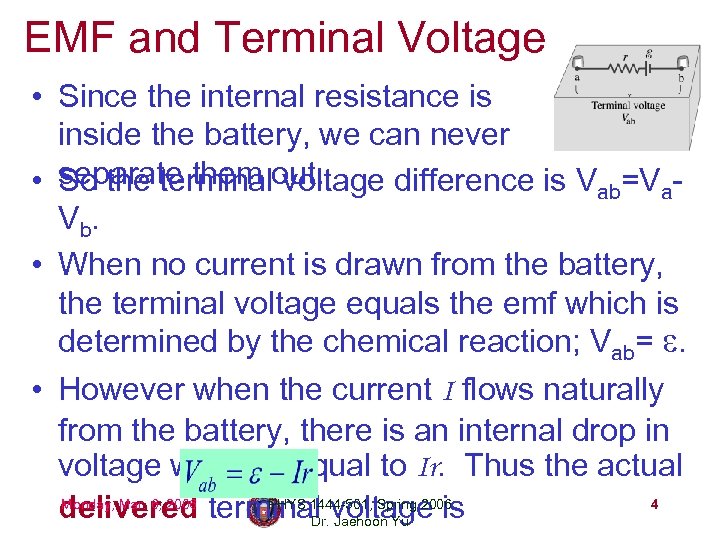 EMF and Terminal Voltage • Since the internal resistance is inside the battery, we can never • separate them out. So the terminal voltage difference is Vab=Va. V b. • When no current is drawn from the battery, the terminal voltage equals the emf which is determined by the chemical reaction; Vab= . • However when the current I flows naturally from the battery, there is an internal drop in voltage which is equal to Ir. Thus the actual Monday, Mar. 6, 2006 PHYS 1444 -501, Spring 2006 4 delivered terminal voltage is Dr. Jaehoon Yu
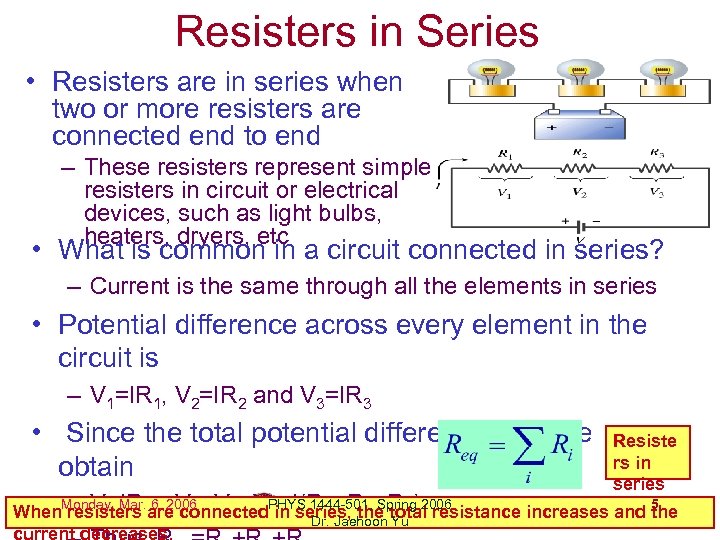 Resisters in Series • Resisters are in series when two or more resisters are connected end to end – These resisters represent simple resisters in circuit or electrical devices, such as light bulbs, heaters, dryers, etc • What is common in a circuit connected in series? – Current is the same through all the elements in series • Potential difference across every element in the circuit is – V 1=IR 1, V 2=IR 2 and V 3=IR 3 • Since the total potential difference is V, we obtain Resiste rs in series 5 – V=IR 6, 2006 When. Monday, Mar. eq=V 1+V 2+VPHYS 1444 -501, +R 3)2006 resisters are connected 3=I(R 1+R 2 Spring resistance increases and the in series, the total Dr. Jaehoon Yu current decreases.
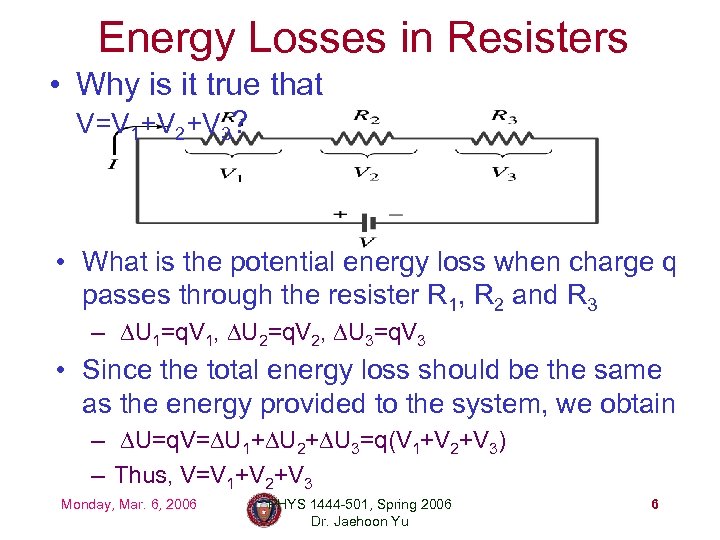 Energy Losses in Resisters • Why is it true that V=V 1+V 2+V 3? • What is the potential energy loss when charge q passes through the resister R 1, R 2 and R 3 – DU 1=q. V 1, DU 2=q. V 2, DU 3=q. V 3 • Since the total energy loss should be the same as the energy provided to the system, we obtain – DU=q. V=DU 1+DU 2+DU 3=q(V 1+V 2+V 3) – Thus, V=V 1+V 2+V 3 Monday, Mar. 6, 2006 PHYS 1444 -501, Spring 2006 Dr. Jaehoon Yu 6
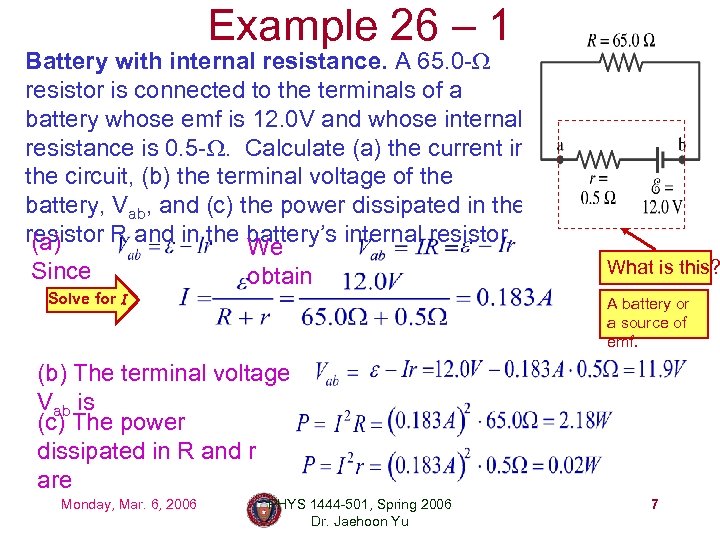 Example 26 – 1 Battery with internal resistance. A 65. 0 -W resistor is connected to the terminals of a battery whose emf is 12. 0 V and whose internal resistance is 0. 5 -W. Calculate (a) the current in the circuit, (b) the terminal voltage of the battery, Vab, and (c) the power dissipated in the resistor R and in the battery’s internal resistor. (a) We Since obtain Solve for I What is this? A battery or a source of emf. (b) The terminal voltage Vab is (c) The power dissipated in R and r are Monday, Mar. 6, 2006 PHYS 1444 -501, Spring 2006 Dr. Jaehoon Yu 7
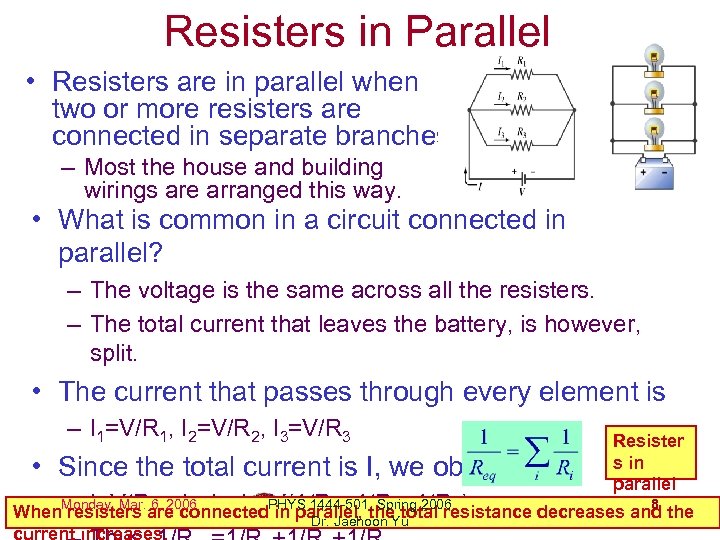 Resisters in Parallel • Resisters are in parallel when two or more resisters are connected in separate branches – Most the house and building wirings are arranged this way. • What is common in a circuit connected in parallel? – The voltage is the same across all the resisters. – The total current that leaves the battery, is however, split. • The current that passes through every element is – I 1=V/R 1, I 2=V/R 2, I 3=V/R 3 • Since the total current is I, we obtain Resister s in parallel 8 – I=V/R 6, =I 1 +1/R When. Monday, Mar. are connected. PHYS 1444 -501, Spring 20063) resisters eq 2006+I 2+I 3=V(1/R 1+1/RYu in parallel, the 2 total resistance decreases and the Dr. Jaehoon current increases.
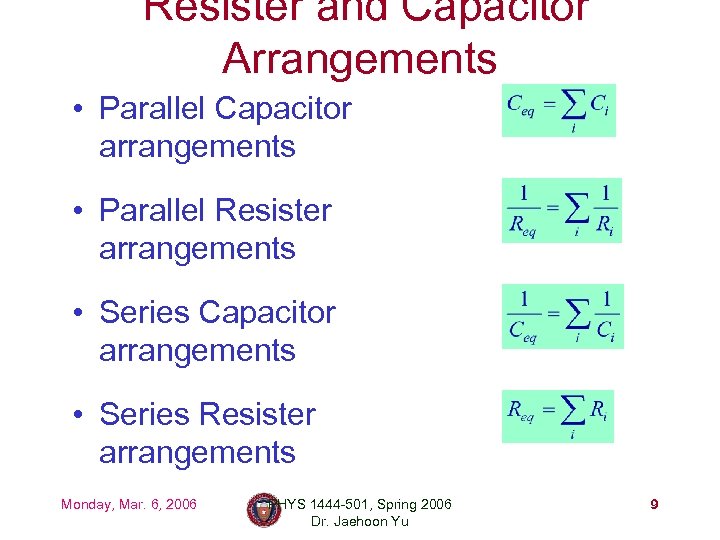 Resister and Capacitor Arrangements • Parallel Capacitor arrangements • Parallel Resister arrangements • Series Capacitor arrangements • Series Resister arrangements Monday, Mar. 6, 2006 PHYS 1444 -501, Spring 2006 Dr. Jaehoon Yu 9
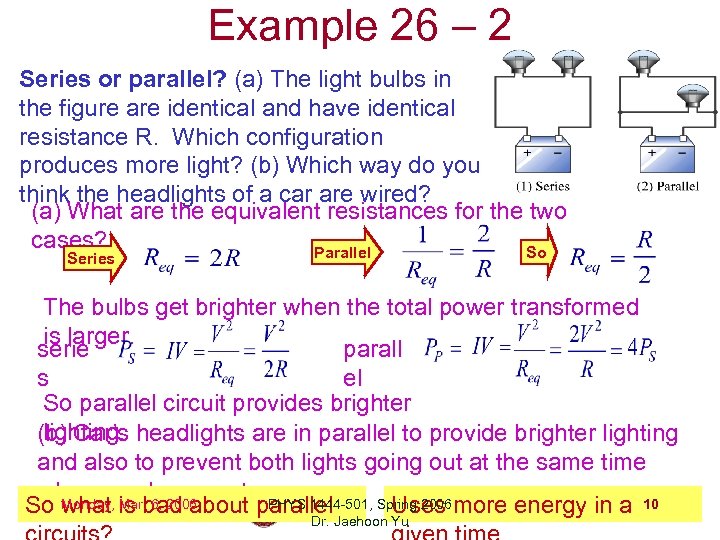 Example 26 – 2 Series or parallel? (a) The light bulbs in the figure are identical and have identical resistance R. Which configuration produces more light? (b) Which way do you think the headlights of a car are wired? (a) What are the equivalent resistances for the two cases? Parallel So Series The bulbs get brighter when the total power transformed is larger. serie parall s el So parallel circuit provides brighter lighting. (b) Car’s headlights are in parallel to provide brighter lighting and also to prevent both lights going out at the same time when one burns out. PHYS 1444 -501, Spring 2006 Monday, Mar. 6, 2006 So what is bad about parallel Uses more energy in a 10 Dr. Jaehoon Yu
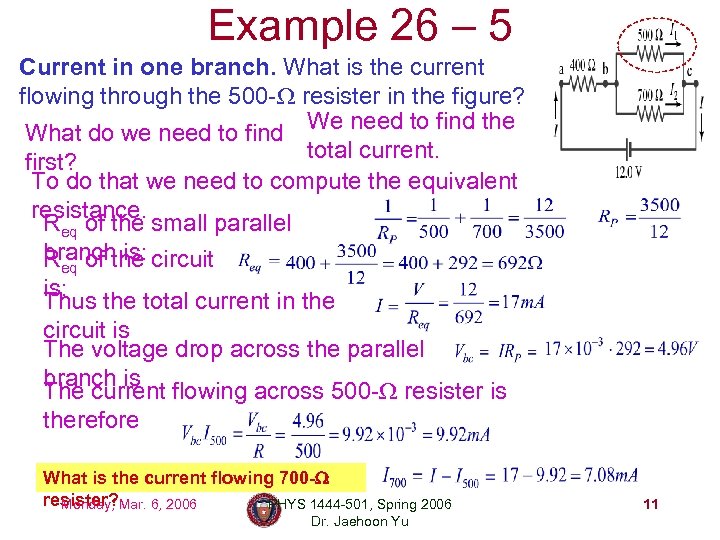 Example 26 – 5 Current in one branch. What is the current flowing through the 500 -W resister in the figure? What do we need to find We need to find the total current. first? To do that we need to compute the equivalent resistance. Req of the small parallel branch is: circuit Req of the is: Thus the total current in the circuit is The voltage drop across the parallel branch is The current flowing across 500 -W resister is therefore What is the current flowing 700 -W resister? Mar. 6, 2006 Monday, PHYS 1444 -501, Spring 2006 Dr. Jaehoon Yu 11
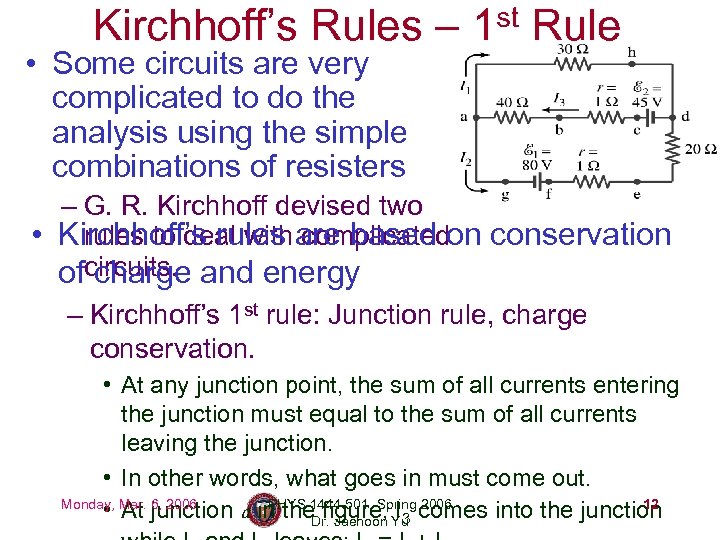 Kirchhoff’s Rules – • Some circuits are very complicated to do the analysis using the simple combinations of resisters st 1 Rule – G. R. Kirchhoff devised two • Kirchhoff’s rules are based on conservation rules to deal with complicated ofcircuits. and energy charge – Kirchhoff’s 1 st rule: Junction rule, charge conservation. • At any junction point, the sum of all currents entering the junction must equal to the sum of all currents leaving the junction. • In other words, what goes in must come out. Monday, Mar. 6, 2006 PHYS 1444 -501, Spring 2006 12 • At junction a in the. Dr. Jaehoon Yu comes into the junction figure, I 3
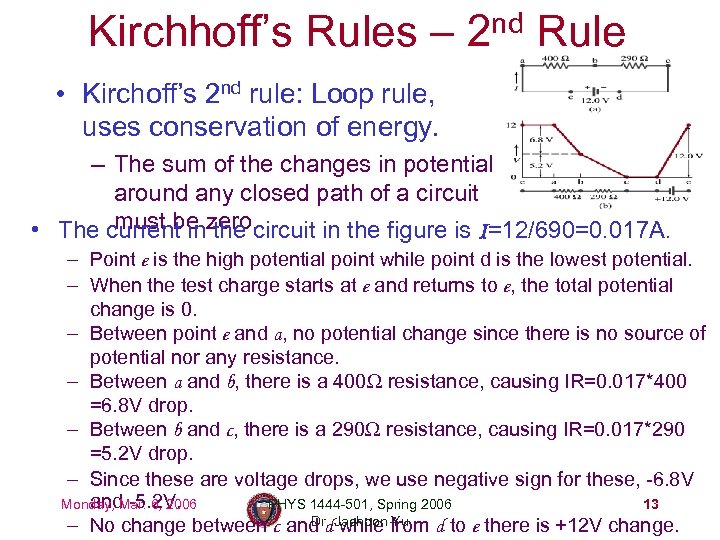 Kirchhoff’s Rules – 2 nd Rule • Kirchoff’s 2 nd rule: Loop rule, uses conservation of energy. – The sum of the changes in potential around any closed path of a circuit must be the circuit in the figure is I=12/690=0. 017 A. • The current inzero. – Point e is the high potential point while point d is the lowest potential. – When the test charge starts at e and returns to e, the total potential change is 0. – Between point e and a, no potential change since there is no source of potential nor any resistance. – Between a and b, there is a 400 W resistance, causing IR=0. 017*400 =6. 8 V drop. – Between b and c, there is a 290 W resistance, causing IR=0. 017*290 =5. 2 V drop. – Since these are voltage drops, we use negative sign for these, -6. 8 V and -5. 2 V. Monday, Mar. 6, 2006 PHYS 1444 -501, Spring 2006 13 Dr. while Yu – No change between c and d Jaehoon from d to e there is +12 V change.
 Using Kirchhoff’s Rules 1. Determine the flow of currents at the junctions. • • It does not matter which direction you decide. If the value of the current after completing the calculations are negative, you just flip the direction of the current flow. 2. Write down the current equation based on Kirchhoff’s 1 st rule at various junctions. • Be sure to see if any of them are the same. 3. Choose closed loops in the circuit 4. Write down the potential in each interval of the junctions, keeping the sign properly. 5. Write down the potential equations for each loop. 6. Monday, Mar. 6, 2006 equations for unknowns. Solve the PHYS 1444 -501, Spring 2006 14 Dr. Jaehoon Yu
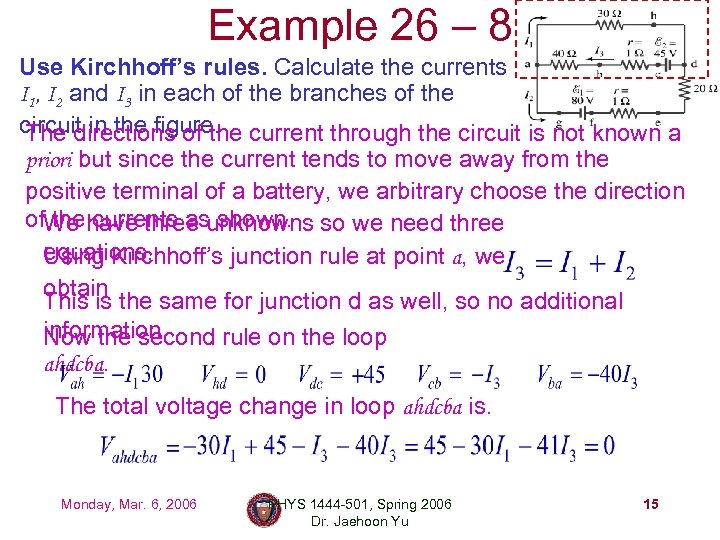 Example 26 – 8 Use Kirchhoff’s rules. Calculate the currents I 1, I 2 and I 3 in each of the branches of the circuit in the figure. current through the circuit is not known a The directions of the priori but since the current tends to move away from the positive terminal of a battery, we arbitrary choose the direction of. We have three unknowns so we need three the currents as shown. equations. Using Kirchhoff’s junction rule at point a, we obtain This is the same for junction d as well, so no additional information. Now the second rule on the loop ahdcba. The total voltage change in loop ahdcba is. Monday, Mar. 6, 2006 PHYS 1444 -501, Spring 2006 Dr. Jaehoon Yu 15
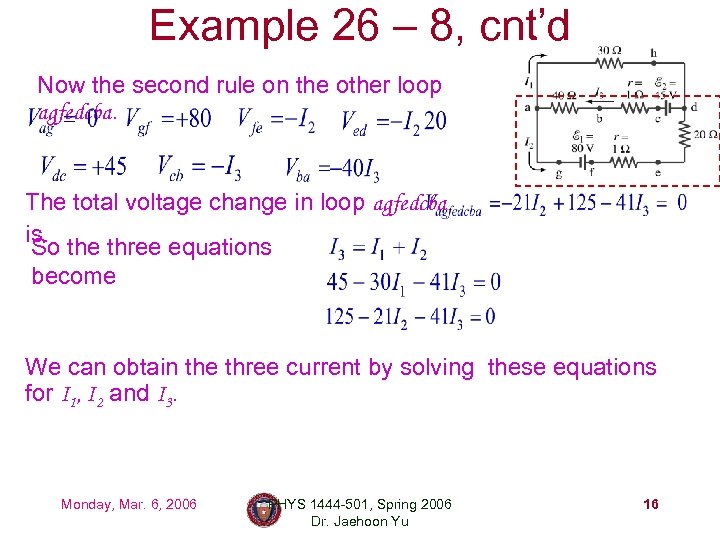 Example 26 – 8, cnt’d Now the second rule on the other loop agfedcba. The total voltage change in loop agfedcba is. So the three equations become We can obtain the three current by solving these equations for I 1, I 2 and I 3. Monday, Mar. 6, 2006 PHYS 1444 -501, Spring 2006 Dr. Jaehoon Yu 16
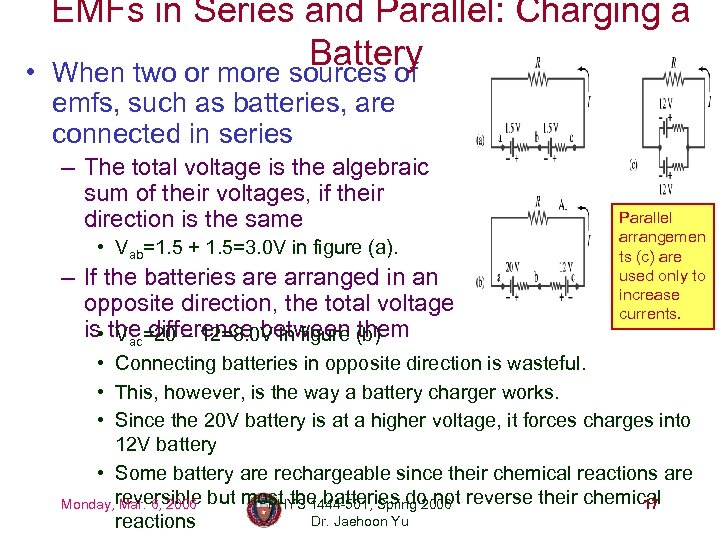 • EMFs in Series and Parallel: Charging a Battery When two or more sources of emfs, such as batteries, are connected in series – The total voltage is the algebraic sum of their voltages, if their direction is the same • Vab=1. 5 + 1. 5=3. 0 V in figure (a). – If the batteries are arranged in an opposite direction, the total voltage is • the =20 – 12=8. 0 V in figure (b) Vac difference between them Parallel arrangemen ts (c) are used only to increase currents. • Connecting batteries in opposite direction is wasteful. • This, however, is the way a battery charger works. • Since the 20 V battery is at a higher voltage, it forces charges into 12 V battery • Some battery are rechargeable since their chemical reactions are Monday, reversible but most the batteries do not reverse their chemical Mar. 6, 2006 PHYS 1444 -501, Spring 2006 17 Dr. Jaehoon Yu reactions
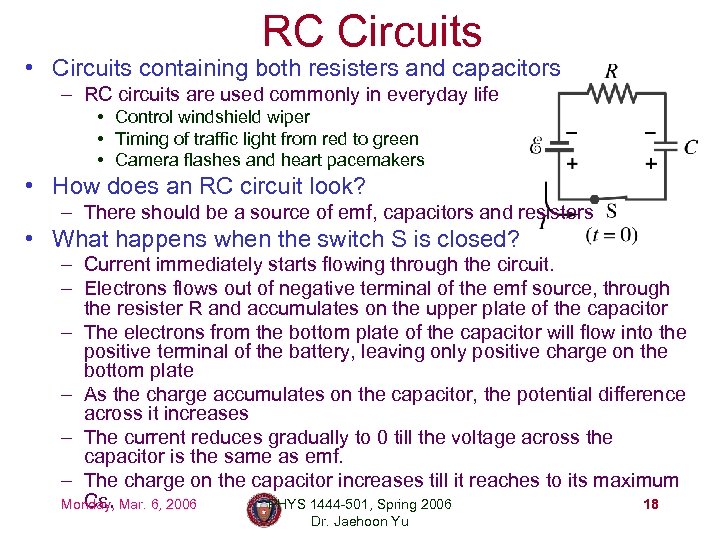 RC Circuits • Circuits containing both resisters and capacitors – RC circuits are used commonly in everyday life • Control windshield wiper • Timing of traffic light from red to green • Camera flashes and heart pacemakers • How does an RC circuit look? – There should be a source of emf, capacitors and resisters • What happens when the switch S is closed? – Current immediately starts flowing through the circuit. – Electrons flows out of negative terminal of the emf source, through the resister R and accumulates on the upper plate of the capacitor – The electrons from the bottom plate of the capacitor will flow into the positive terminal of the battery, leaving only positive charge on the bottom plate – As the charge accumulates on the capacitor, the potential difference across it increases – The current reduces gradually to 0 till the voltage across the capacitor is the same as emf. – The charge on the capacitor increases till it reaches to its maximum C. Monday, Mar. 6, 2006 PHYS 1444 -501, Spring 2006 18 Dr. Jaehoon Yu
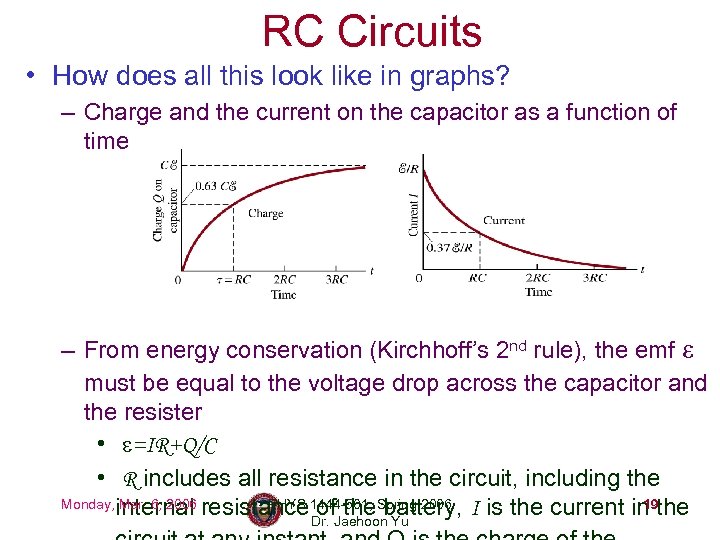 RC Circuits • How does all this look like in graphs? – Charge and the current on the capacitor as a function of time – From energy conservation (Kirchhoff’s 2 nd rule), the emf must be equal to the voltage drop across the capacitor and the resister • =IR+Q/C • R includes all resistance in the circuit, including the Monday, internal resistance 1444 -501, Spring 2006 I is the current in the Mar. 6, 2006 PHYS of the battery, 19 Dr. Jaehoon Yu