


 Скачать презентацию PHYS 1444 Section 02 Lecture 11 Tuesday
c788fc8a11bc30c9919a1d1bc4c9baa0.ppt
- Количество слайдов: 19
 PHYS 1444 – Section 02 Lecture #11 Tuesday Mar 1, 2011 Dr. Andrew Brandt • Chapter 25 • Alternating Current • Microscopic Current Mar 3 Review HW 5 Ch 25 isdue Fri. Mar. 4 • Chapter 26 March 4: deadline to receive • EMF and Terminal Voltage credit for late HW probs • Resistors in Series and Parallelso solutions can be • Energy loss in Resistors posted ***Test 1 will be Tues. Mar. 8 on Tuesday, Mar. 1, 2011 PHYS 1444 -02 Dr. Andrew ch 21 -25*** Test 2 will 1 Brandt be Thurs April 14 on Ch
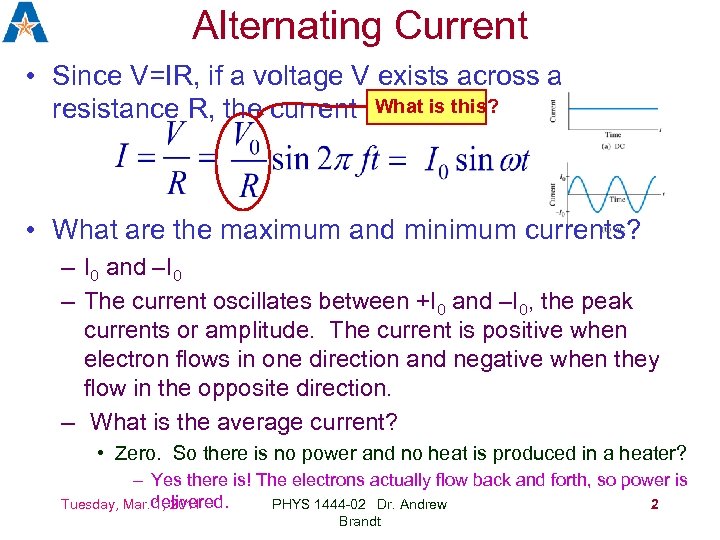 Alternating Current • Since V=IR, if a voltage V exists across a resistance R, the current I What is this? is • What are the maximum and minimum currents? – I 0 and –I 0 – The current oscillates between +I 0 and –I 0, the peak currents or amplitude. The current is positive when electron flows in one direction and negative when they flow in the opposite direction. – What is the average current? • Zero. So there is no power and no heat is produced in a heater? – Yes there is! The electrons actually flow back and forth, so power is Tuesday, Mar. delivered. 1, 2011 PHYS 1444 -02 Dr. Andrew 2 Brandt
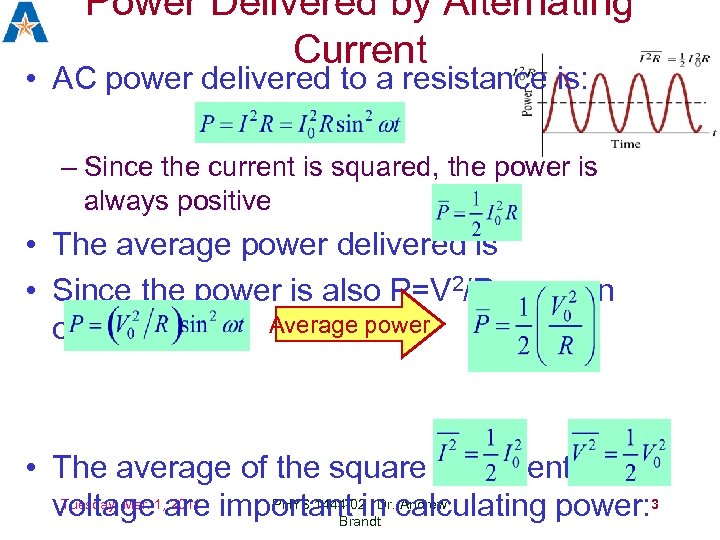 Power Delivered by Alternating Current • AC power delivered to a resistance is: – Since the current is squared, the power is always positive • The average power delivered is • Since the power is also P=V 2/R, we can Average power obtain • The average of the square of current and Tuesday, Mar. 2011 PHYS 1444 -02 Dr. Andrew voltage 1, are important in calculating power: 3 Brandt
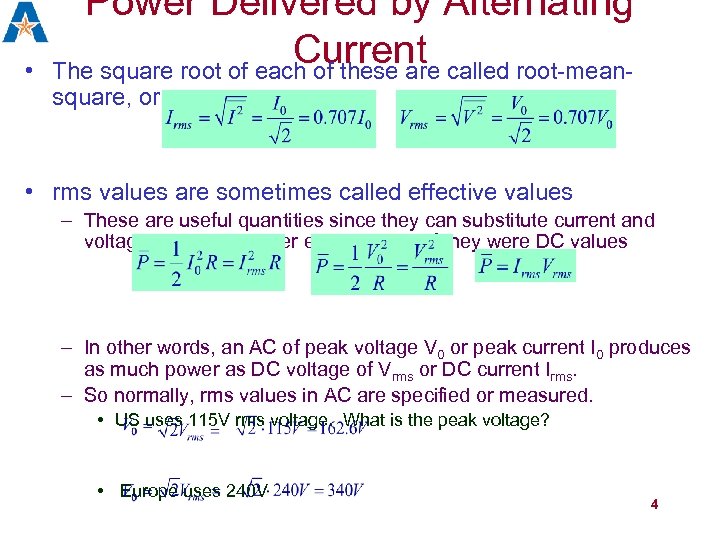 • Power Delivered by Alternating Current called root-mean. The square root of each of these are square, or rms: • rms values are sometimes called effective values – These are useful quantities since they can substitute current and voltage directly in power equations, as if they were DC values – In other words, an AC of peak voltage V 0 or peak current I 0 produces as much power as DC voltage of Vrms or DC current Irms. – So normally, rms values in AC are specified or measured. • US uses 115 V rms voltage. What is the peak voltage? • Europe uses 240 V Tuesday, Mar. 1, 2011 PHYS 1444 -02 Dr. Andrew Brandt 4
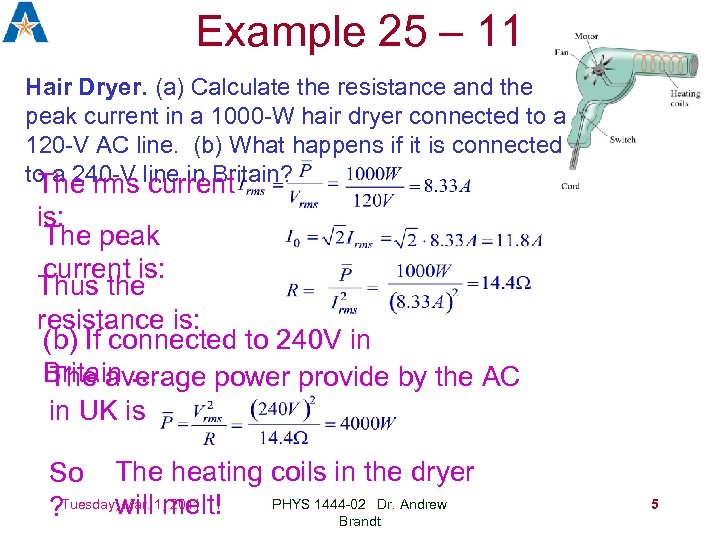 Example 25 – 11 Hair Dryer. (a) Calculate the resistance and the peak current in a 1000 -W hair dryer connected to a 120 -V AC line. (b) What happens if it is connected to a 240 -V line in Britain? The rms current is: The peak current is: Thus the resistance is: (b) If connected to 240 V in Britain … The average power provide by the AC in UK is So The heating coils in the dryer Mar. 2011 PHYS 1444 -02 Dr. Andrew ? Tuesday, will 1, melt! Brandt 5
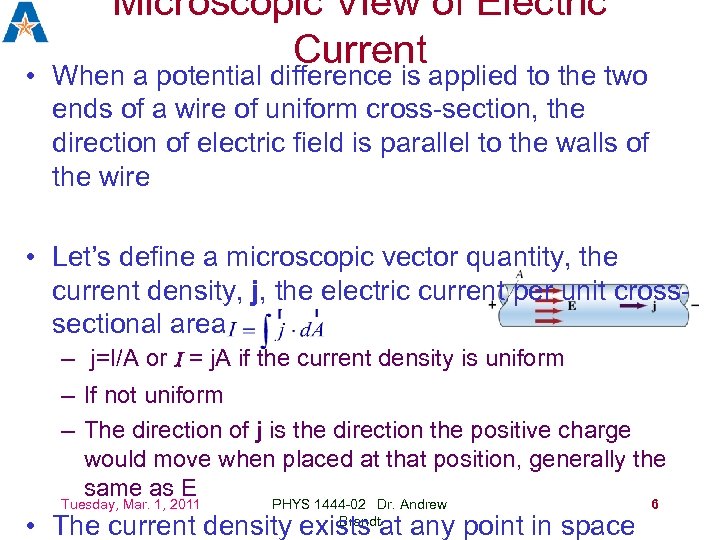 Microscopic View of Electric Current • When a potential difference is applied to the two ends of a wire of uniform cross-section, the direction of electric field is parallel to the walls of the wire • Let’s define a microscopic vector quantity, the current density, j, the electric current per unit crosssectional area – j=I/A or I = j. A if the current density is uniform – If not uniform – The direction of j is the direction the positive charge would move when placed at that position, generally the same as E Tuesday, Mar. 1, 2011 PHYS 1444 -02 Dr. Andrew Brandt • The current density exists at any point in space 6
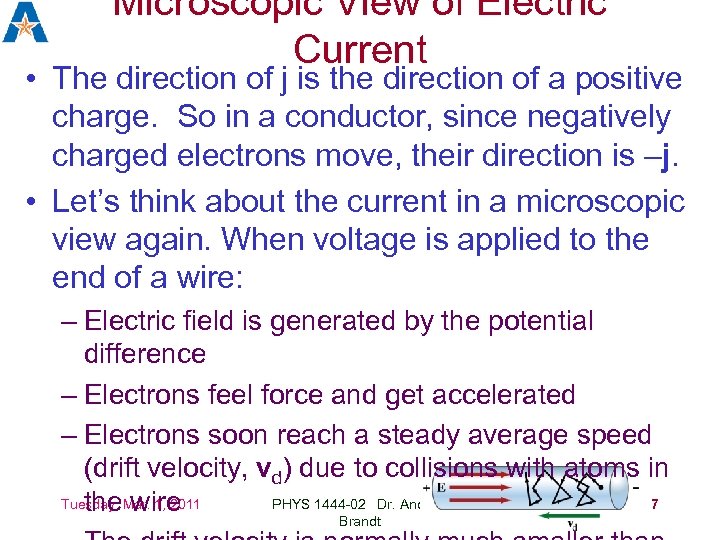 Microscopic View of Electric Current • The direction of j is the direction of a positive charge. So in a conductor, since negatively charged electrons move, their direction is –j. • Let’s think about the current in a microscopic view again. When voltage is applied to the end of a wire: – Electric field is generated by the potential difference – Electrons feel force and get accelerated – Electrons soon reach a steady average speed (drift velocity, vd) due to collisions with atoms in Tuesday, Mar. 1, 2011 PHYS 1444 -02 Dr. Andrew 7 the wire Brandt
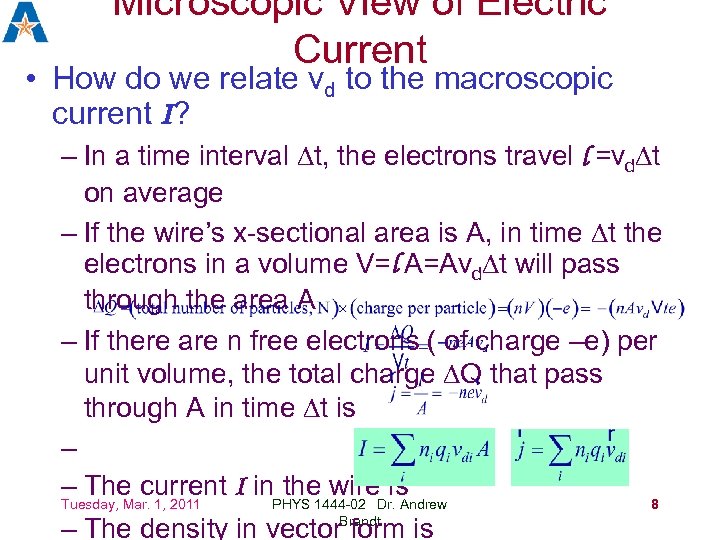 Microscopic View of Electric Current • How do we relate vd to the macroscopic current I? – In a time interval Dt, the electrons travel l =vd. Dt on average – If the wire’s x-sectional area is A, in time Dt the electrons in a volume V=l A=Avd. Dt will pass through the area A – If there are n free electrons ( of charge –e) per unit volume, the total charge DQ that pass through A in time Dt is – – The current I in the wire is Tuesday, Mar. 1, 2011 PHYS 1444 -02 Dr. Andrew Brandt – The density in vector form is 8
 Microscopic View of Electric Current • The drift velocity of electrons in a wire is only about 0. 05 mm/s. How does a light turned on immediately then? – While the electrons in a wire travel slowly, the electric field travels essentially at the speed of light. Then what is all the talk about electrons flowing through? • It is just like water. When you turn on a faucet, water flows right out of the faucet despite the fact that the water travels slowly. • Electricity is the same. Electrons fill the wire and when the switch is flipped on or a potential difference is applied, the electrons close to the positive terminal Tuesday, Mar. 1, 2011 PHYS 1444 -02 Dr. Andrew 9 flow into the bulb. Brandt
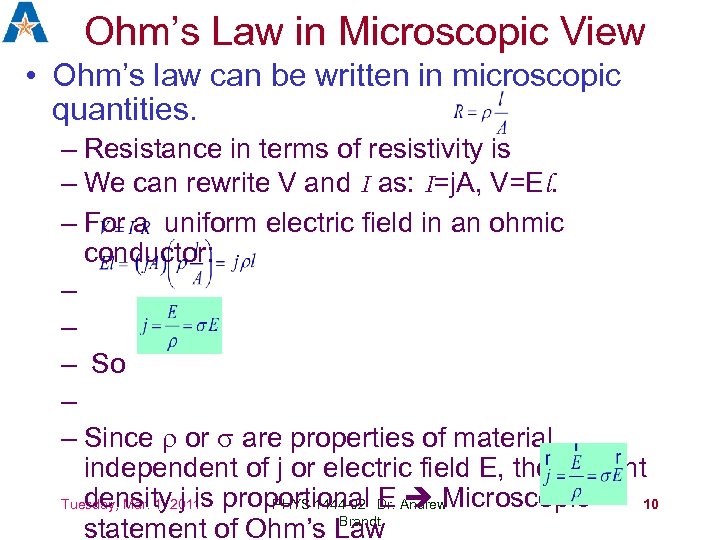 Ohm’s Law in Microscopic View • Ohm’s law can be written in microscopic quantities. – Resistance in terms of resistivity is – We can rewrite V and I as: I=j. A, V=El. – For a uniform electric field in an ohmic conductor: – – – So – – Since r or s are properties of material independent of j or electric field E, the current density j is Tuesday, Mar. 1, 2011 proportional Dr. Andrew PHYS 1444 -02 E Microscopic 10 Brandt statement of Ohm’s Law
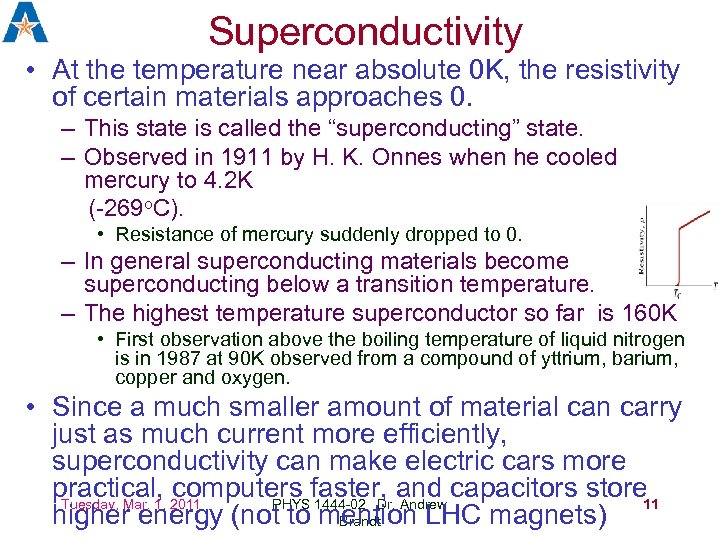 Superconductivity • At the temperature near absolute 0 K, the resistivity of certain materials approaches 0. – This state is called the “superconducting” state. – Observed in 1911 by H. K. Onnes when he cooled mercury to 4. 2 K (-269 o. C). • Resistance of mercury suddenly dropped to 0. – In general superconducting materials become superconducting below a transition temperature. – The highest temperature superconductor so far is 160 K • First observation above the boiling temperature of liquid nitrogen is in 1987 at 90 K observed from a compound of yttrium, barium, copper and oxygen. • Since a much smaller amount of material can carry just as much current more efficiently, superconductivity can make electric cars more practical, 2011 computers faster, and capacitors store 11 Tuesday, Mar. 1, PHYS 1444 -02 Dr. Andrew higher energy (not to mention LHC magnets) Brandt
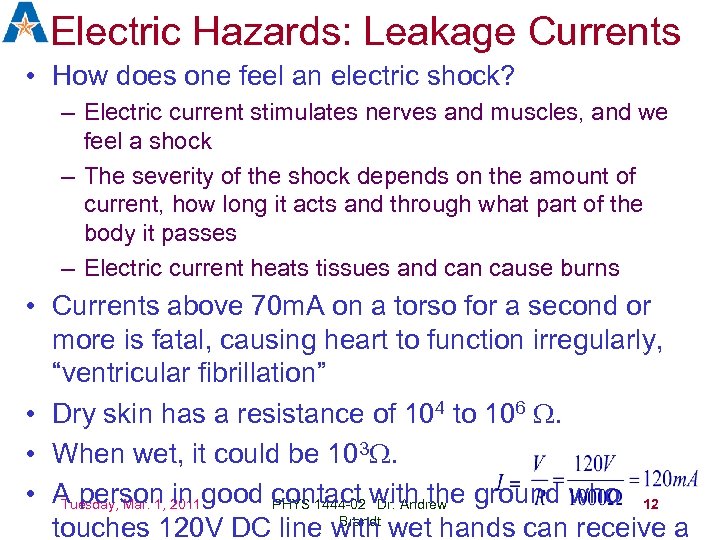 Electric Hazards: Leakage Currents • How does one feel an electric shock? – Electric current stimulates nerves and muscles, and we feel a shock – The severity of the shock depends on the amount of current, how long it acts and through what part of the body it passes – Electric current heats tissues and can cause burns • Currents above 70 m. A on a torso for a second or more is fatal, causing heart to function irregularly, “ventricular fibrillation” • Dry skin has a resistance of 104 to 106 W. • When wet, it could be 103 W. • A person 2011 good contact with the ground who 12 Tuesday, Mar. 1, in PHYS 1444 -02 Dr. Andrew Brandt touches 120 V DC line with wet hands can receive a
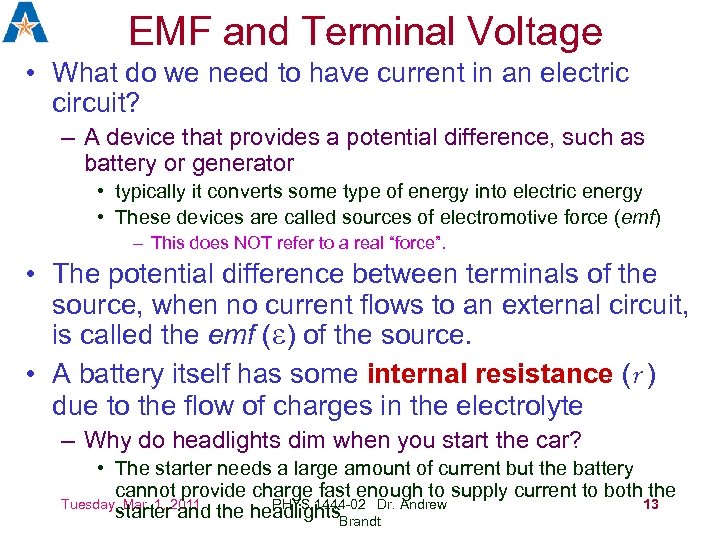 EMF and Terminal Voltage • What do we need to have current in an electric circuit? – A device that provides a potential difference, such as battery or generator • typically it converts some type of energy into electric energy • These devices are called sources of electromotive force (emf) – This does NOT refer to a real “force”. • The potential difference between terminals of the source, when no current flows to an external circuit, is called the emf ( ) of the source. • A battery itself has some internal resistance (r ) due to the flow of charges in the electrolyte – Why do headlights dim when you start the car? • The starter needs a large amount of current but the battery cannot provide charge fast enough to supply current to both the Tuesday, Mar. 1, 2011 PHYS 1444 -02 13 starter and the headlights. Brandt. Dr. Andrew
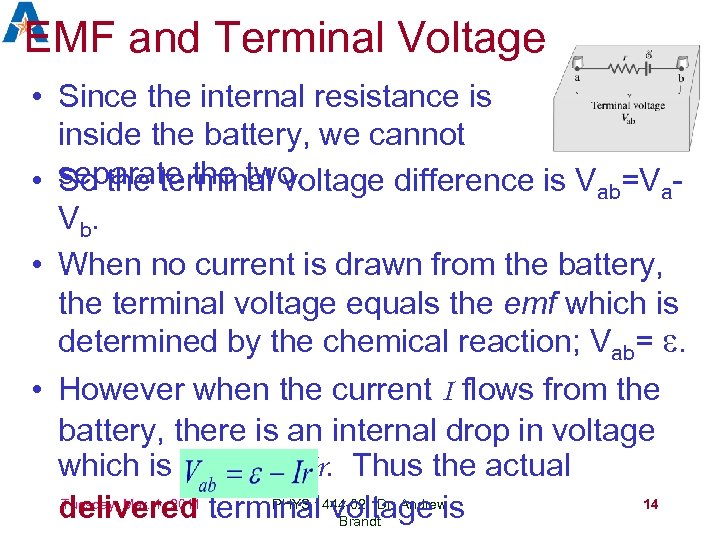 EMF and Terminal Voltage • Since the internal resistance is inside the battery, we cannot • separate the two. So the terminal voltage difference is Vab=Va. V b. • When no current is drawn from the battery, the terminal voltage equals the emf which is determined by the chemical reaction; Vab= . • However when the current I flows from the battery, there is an internal drop in voltage which is equal to Ir. Thus the actual Tuesday, Mar. 1, 2011 PHYS 1444 -02 Dr. Andrew 14 delivered terminal voltage is Brandt
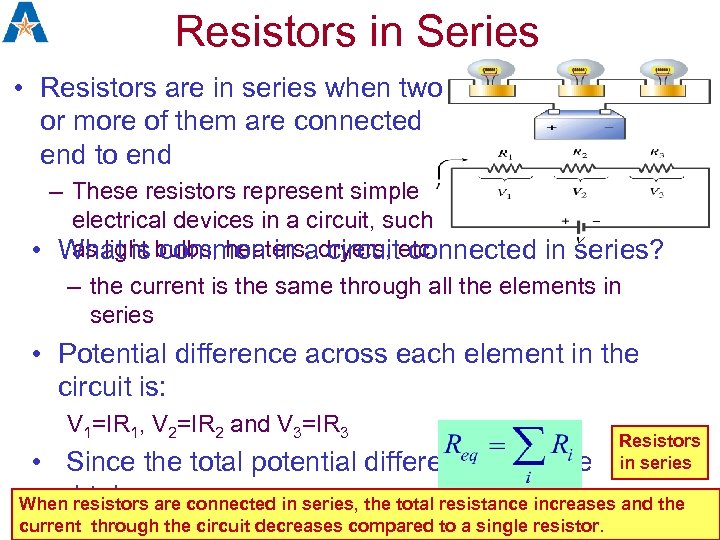 Resistors in Series • Resistors are in series when two or more of them are connected end to end – These resistors represent simple electrical devices in a circuit, such as light common in a circuit connected in series? • What is bulbs, heaters, dryers, etc. – the current is the same through all the elements in series • Potential difference across each element in the circuit is: V 1=IR 1, V 2=IR 2 and V 3=IR 3 Resistors in series • Since the total potential difference is V, we obtain 1, 2011 Tuesday, Mar. PHYS 1444 -02 Dr. Andrew 15 When resistors are connected in series, the total resistance increases and the Brandt current through the circuit decreases compared to a single resistor.
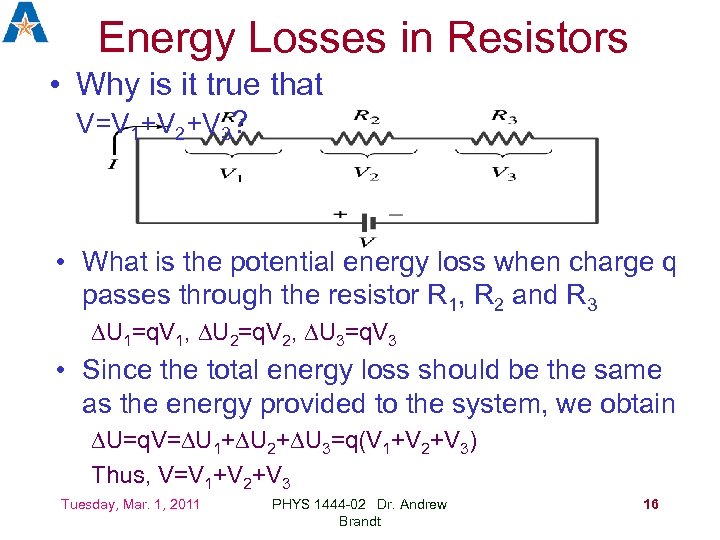 Energy Losses in Resistors • Why is it true that V=V 1+V 2+V 3? • What is the potential energy loss when charge q passes through the resistor R 1, R 2 and R 3 DU 1=q. V 1, DU 2=q. V 2, DU 3=q. V 3 • Since the total energy loss should be the same as the energy provided to the system, we obtain DU=q. V=DU 1+DU 2+DU 3=q(V 1+V 2+V 3) Thus, V=V 1+V 2+V 3 Tuesday, Mar. 1, 2011 PHYS 1444 -02 Dr. Andrew Brandt 16
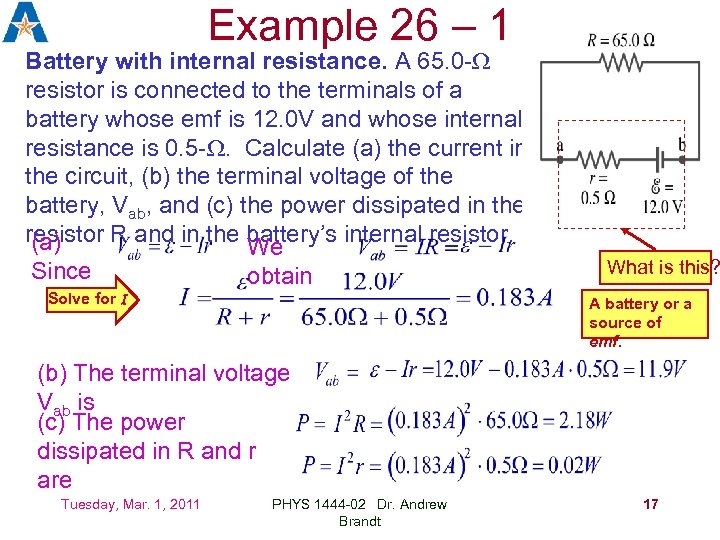 Example 26 – 1 Battery with internal resistance. A 65. 0 -W resistor is connected to the terminals of a battery whose emf is 12. 0 V and whose internal resistance is 0. 5 -W. Calculate (a) the current in the circuit, (b) the terminal voltage of the battery, Vab, and (c) the power dissipated in the resistor R and in the battery’s internal resistor. (a) We Since obtain Solve for I What is this? A battery or a source of emf. (b) The terminal voltage Vab is (c) The power dissipated in R and r are Tuesday, Mar. 1, 2011 PHYS 1444 -02 Dr. Andrew Brandt 17
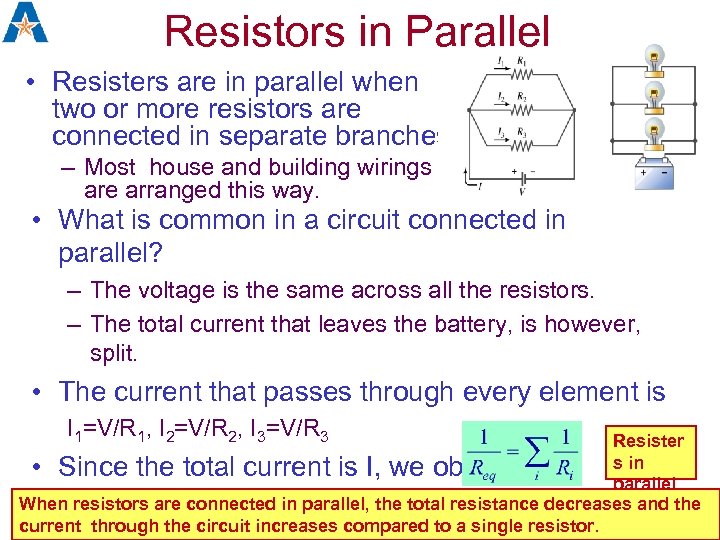 Resistors in Parallel • Resisters are in parallel when two or more resistors are connected in separate branches – Most house and building wirings are arranged this way. • What is common in a circuit connected in parallel? – The voltage is the same across all the resistors. – The total current that leaves the battery, is however, split. • The current that passes through every element is I 1=V/R 1, I 2=V/R 2, I 3=V/R 3 Resister s in • Since the total current is I, we obtain parallel Tuesday, Mar. are connected in parallel, Dr. total PHYS 1444 -02 +1/R ) 18 When. I=V/Req=I 1+I 2+I 3=V(1/R 1+1/R 2 the. Andrew resistance decreases and the resistors 1, 2011 3 current through the circuit increases Brandt compared to a single resistor.
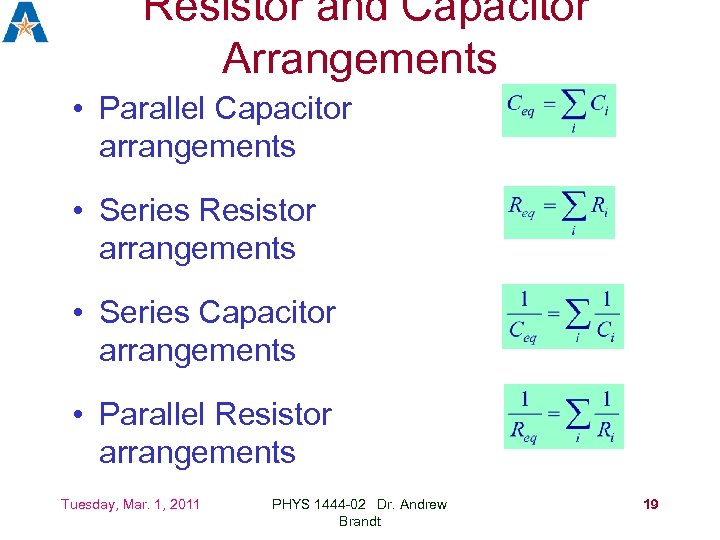 Resistor and Capacitor Arrangements • Parallel Capacitor arrangements • Series Resistor arrangements • Series Capacitor arrangements • Parallel Resistor arrangements Tuesday, Mar. 1, 2011 PHYS 1444 -02 Dr. Andrew Brandt 19